URINARY DIVERSION
Dr. Rojan Adhikari
FCPS II resident
Urology
INTRODUCTION
• URINARY DIVERSION
Diversion of urinary pathway from its natural
path
Types:
• Temporary/Permanent
• External /Internal
• Continent / Incontinent
• Definitive/Palliative
• Orthotopic / Heterotopic
HISTORY
• First attempted urinary diversion by Simon in
1852
• Ureterosigmoidostomy is the oldest
• Zaayer in 1911 started ileal conduit and it was
gold standard through 1990’s
• 1950 (Bricker): eastablish ileal conduit as first
choice
• In 1979, Camey and Le Duc reported their
pioneer othrotopic neobladder
• Kock and associates reintroduced continent
cutaneous diversion in 1982
IDEAL URINARY DIVERSION
1. Undisturbed Body Image
2. Natural Micturation
3. Continence
4. Safe Upper Urinary Tract
5. Non Refluxing
6. Low Pressure
GOAL OF URINARY DIVERSION
• To provide the best local cancer control.
• To reduce potential range of complications.
• To guarantee the best quality of life for the
patient.
PREFERABLE DIVERSION
• Continent reservior connected to urethra
• Ileal segments (lower pressure peaks and ease
of surgical handling)
PRINCIPLE OF URINARY DIVERSION
• A reservoir in which to store urine in low
pressure
• A conduit through which the urine is conducted
to the surface
• A continence mechanism
BLADDER RESERVOIR
• Able to retent 500-1000ml of fluid
• Maintenance of low pressure after filling
• Elimination of intermittant pressure spikes
• True continence
• Ease of catheterization and emptying
• Prevention of reflux
CLASSIFICATION OF DIVERSION
• ORTHOTOPIC:
Orthotopic bladder substitution
• HETEROTOPIC
1. Continent : Cutaneous
2. Non-continent: Ileal conduit / colonic conduit
Cutaneous ureterostomy
3.Diversion to GIT: Uretero-sigmoidostomy/
rectal bladder
NON CONTINENT DIVESION
• NON CONTINENT DIVERSION involve a wide
stoma and an external appliance to collect the
urine.
TYPE
1.Ileal Conduit
2.Colonic Conduit
3.Jejunal Conduit
CONTINENT URINARY DIVERSION
• Heterotopic Continent Diversion
It’s a catheterizable stoma on the abdominal wall to
empty an intra abdominal neobladder
TYPE
1. Right Colonic Pouches
The Indiana Pouch , The Florida Pouch
The Miami Pouch ,The Penn Pouch
2. Ileal Pouches
The Kock Pouch
The Mainz Pouch
CONTINENT URINARY DIVERSION
• Orthotopic Continent Diversion
It creates a pelvic neobladder that is anastomosed
to urethra
TYPE
1.Studder neobladder
2.Hautmann neobladder
3. Mainz neobladder
PRINCIPLE OF ANASTOMOSIS
• Adequate exposure
• Ensure good blood supply
• Control spillage
• Accurate apposition of serosa to serosa
• Ensure tight
• Realignment of the mesentery
TEMPORARY DIVERSION
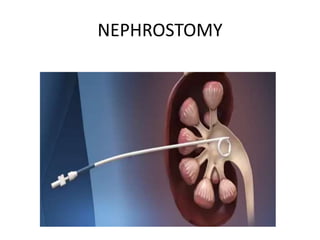
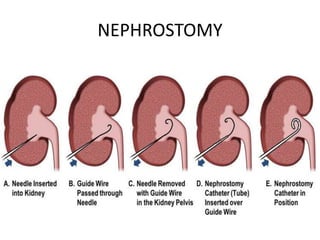
• Nephrostomy
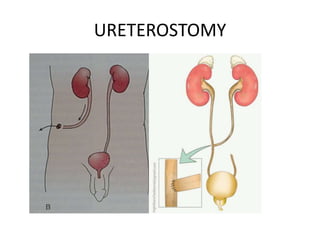
• Pyelostomy or ureterostomy
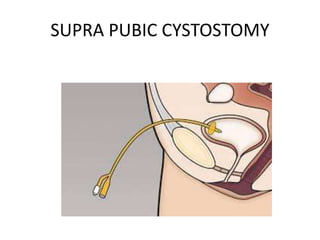
• Suprapubic cystostomy
NEPHROSTOMY
NEPHROSTOMY
URETEROSTOMY
SUPRA PUBIC CYSTOSTOMY
Indications For Permanent Diversion
• After radical cystectomy in a case of muscle invasive
bladder tumor, along with radical prostatectomy
• Neurogenic bladder dysfunction due to congenital or
acquired disorders in case of neural tube defect and
spinal cord injury.
• Severe idiopathic detrusor overactivity
• Chronic inflammatory conditions like interstitial cystitis,
Tuberculosis, schistosomiasis and post radiation bladder
contraction
• As a palliative diversion in case of irremovable
obstruction in the bladder & distal to bladder
• Severe hemorrhagic cystitis
• Ectopic vesicle
• Incurable vesico- vagina fistula
SELECTION OF TYPE OF DIVERSION
• Age/ Survival rate
• Co morbidities
• Oncological Extent of disease
• Renal and Hepatic functional status
• Bowel condition
• Patient’s preferences
• Available expertise
• Mental status
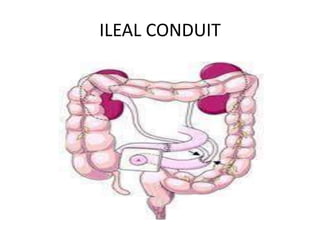
ILEAL CONDUIT
PRE OPERATIVE PREPARATION
• Mechanical bowel preparation
Whole gut irrigation with poly ehylene glycol and
enema
• Pre-op antibiotic: cephalosporin + metronidazole
• Stoma site assessment
• Well informed consent
INDICATION
• After a cystectomy
• dysfunctional bladders
 persistent bleeding,
 obstructed ureter,
 poor compliance with upper tract deterioration,
 inadequate storage with total urinary
incontinence
CONTRAINDICATION
• Short bowel syndrome
• Inflammatory small bowel disease
• Pelvic irradiation
ILEAL CONDUIT
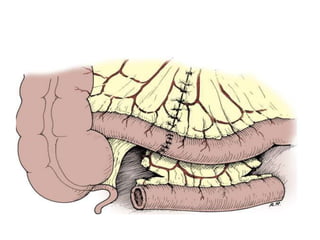
• 10-12cm ileal segment isolated 20cm proximal to
IC valve
• Short straight conduit without kinking
• Continuity of small bowel re-established
• Mesenteric window closed
• Ileum in isoperistaltic fashion
• Isolated segment flushed with warm saline till
return of clear fluid
• Left ureter brought beneath the sigmoid
mesocolon (inferior to IMA)
• Ureteroenteric anastomosis
ILEAL CONDUIT
• After single J ureteral stent is placed in both ureter
• Distal end of ileal segment fashioned as end
ileostomy in RLQ
• A Rutzen bag/ stoma bag can be applied to the
stoma on the fifth or sixth postoperative day with
complete comfort for the patient
ILEAL CONDUIT
• ADVANTAGES
Technically simple surgery
Few complication
No bladder retaining
No nocturnal incontinence
Dwayne Tun Soong Chang Published in Urology annals 2015, DOI:10.4103/0974-7796.148553
ILEAL CONDUIT
• DISADVANTAGES
Risk of stomal complication eg: parastomal
hernia or stenosis
Urinary incontinance
Increased long term expenses of stoma care
Dwayne Tun Soong Chang Published in Urology annals 2015, DOI:10.4103/0974-7796.148553
COLONIC CONDUIT
• Indication
1. Extensive pelvic irradiation
2. When the middle and distal ureter are
absent.
• Containdication
1. Inflammatory large bowel disease
2. Severe chronic diarrhoea
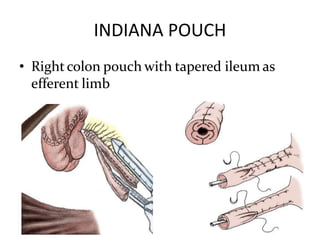
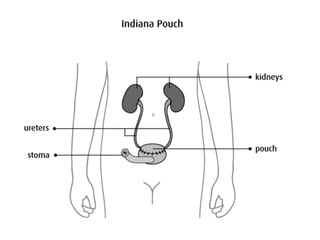
INDIANA POUCH
• Rightcolon pouch with tapered ileum as
efferent limb
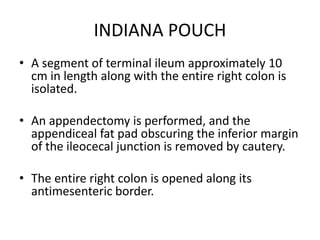
INDIANA POUCH
• A segment of terminal ileum approximately 10
cm in length along with the entire right colon is
isolated.
• An appendectomy is performed, and the
appendiceal fat pad obscuring the inferior margin
of the ileocecal junction is removed by cautery.
• The entire right colon is opened along its
antimesenteric border.
INDIANA POUCH
• Interrupted Lembert sutures are taken over a
short distance (3 to 4 cm) in two rows for the
double imbrication of the ileocecal valve.
• Application of opposing Lembert sutures on
each side of the terminal ileum
• Excess ileum can be tapered by stapling
technique.
INDIANA POUCH
• ADVANTAGES
Potential for normal or near normal urinary
continence
No nocturnal incontinence
No need for a stoma bag
The small stoma can be easily covered with
bandage that is less effect on physical image vs
ileal conduit
Dwayne Tun Soong Chang Published in Urology annals 2015, DOI:10.4103/0974-7796.148553
INDIANA POUCH
• DISADVANTAGES
Technically more difficult procedure
Complication associated with intermittent
catherization
Potential complications from urinary waste
product reabsorption
Risk of stomal complication eg: parastomal hernia
or stenosis
Neobladder
• The clinical goal of most neobladders is to
– allow volitional voiding 4 - 6 times per day
– capacity range of 400 to 500 mL of urine at low
pressures (>15 cm H2O)
• Two important criteria
– No compromise of oncological outcomes by
reconstruction at the urethroenteric anastomosis
– Rhabdosphincter mechanism must remain intact
to provide continent
Types of Neobladder
• Camey I & II
• Hautman
• Kock
• Mainz
• T-Pouch, Florida, UCLA, S pouch, Le bag
• Studer (most common)
STUDER NEOBLADDER
• Designated segments of terminal ileum for
construction of neobladder.
• Note that the distal mesenteric division is made
between the ileocolic and terminal branches of
the superior mesenteric artery, which extends
into the avascular plane of the mesentery.
• In addition, a small window of mesentery and a
5-cm segment of proximal small bowel are
discarded to allow mobility to the pouch and
small bowel anastomosis.
Contra-indication of Orthotopic
Neobladder
• Compromised renal function
• Severe hepatic dysfunction
• Compromised intestinal function
• Positive urethral margin
• Mental impairment
• Pre-existing incontinence
• Pelvic radiation (increased complications)
• Recurrent urethral stricture disease
• AGE NOT CONTRAINDICTION!!
COMPLICATION RELATED WITH
URINARY DIVERSION
Metabolic Problems
• Electrolyte Abnormalities
• Abnormal drug metabolism
• Osteomalacia and growth retardation
• Infections
• Formation of renal and reservoir calculi
• Renal deterioration
• Development of urothelial or intestinal cancer
Metabolic Problems
• Due to continued solute transport by interposed
segment
• The factors that influence
– Segment of bowel used
– Surface area of the bowel
– The amount of time the urine is exposed
– The concentration of solutes in the urine
– Renal function
– The pH of the fluid
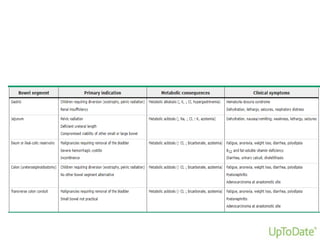
• stomach: a hypochloremic hypokalemic metabolic
alkalosis may occur
• jejunum – hyponatremia, hyperkalemia, and
metabolic acidosis occur.
• ileum or colon – hyperchloremic metabolic acidosis
ensues.
• Other electrolyte abnormalities – hypokalemia,
hypomagnesemia, hypocalcemia, hyperammonemia,
and elevated blood urea nitrogen and creatinine.
Infection
• An increased incidence of bacteriuria, bacteremia,
and septic episodes occurs in patients with bowel
interposition
• Incidence : 10% to 17% with colon and ileal
conduits
• Patients with continent diversions also have a
significant incidence of bacteriuria and septic
episodes
Stones
• Most are infection stone
• Structural or metabolic cause
• Major risk: hyperchloremic metabolic acidosis
• Colon conduits : 3% to 4%
• Ileal conduits : 10% to 12%
• Continent cecal reservoirs : 20%
Short bowel and nutritional problem
• Significant loss of ileum
Vit B12 malabsorption : megaloblastic
anemia
Malabsorption of bile salts: diarrhea
Malabsorption of fat: fatty diarrhea
References
• Campbell and Walsh Urology 10th edition
•
• Bailey and love 27th edition
THANK YOU

Urinary diversion

  • 1.
    URINARY DIVERSION Dr. RojanAdhikari FCPS II resident Urology
  • 2.
    INTRODUCTION • URINARY DIVERSION Diversionof urinary pathway from its natural path Types: • Temporary/Permanent • External /Internal • Continent / Incontinent • Definitive/Palliative • Orthotopic / Heterotopic
  • 3.
    HISTORY • First attemptedurinary diversion by Simon in 1852 • Ureterosigmoidostomy is the oldest • Zaayer in 1911 started ileal conduit and it was gold standard through 1990’s • 1950 (Bricker): eastablish ileal conduit as first choice
  • 4.
    • In 1979,Camey and Le Duc reported their pioneer othrotopic neobladder • Kock and associates reintroduced continent cutaneous diversion in 1982
  • 5.
    IDEAL URINARY DIVERSION 1.Undisturbed Body Image 2. Natural Micturation 3. Continence 4. Safe Upper Urinary Tract 5. Non Refluxing 6. Low Pressure
  • 6.
    GOAL OF URINARYDIVERSION • To provide the best local cancer control. • To reduce potential range of complications. • To guarantee the best quality of life for the patient.
  • 7.
    PREFERABLE DIVERSION • Continentreservior connected to urethra • Ileal segments (lower pressure peaks and ease of surgical handling)
  • 8.
    PRINCIPLE OF URINARYDIVERSION • A reservoir in which to store urine in low pressure • A conduit through which the urine is conducted to the surface • A continence mechanism
  • 9.
    BLADDER RESERVOIR • Ableto retent 500-1000ml of fluid • Maintenance of low pressure after filling • Elimination of intermittant pressure spikes • True continence • Ease of catheterization and emptying • Prevention of reflux
  • 10.
    CLASSIFICATION OF DIVERSION •ORTHOTOPIC: Orthotopic bladder substitution • HETEROTOPIC 1. Continent : Cutaneous 2. Non-continent: Ileal conduit / colonic conduit Cutaneous ureterostomy 3.Diversion to GIT: Uretero-sigmoidostomy/ rectal bladder
  • 11.
    NON CONTINENT DIVESION •NON CONTINENT DIVERSION involve a wide stoma and an external appliance to collect the urine. TYPE 1.Ileal Conduit 2.Colonic Conduit 3.Jejunal Conduit
  • 12.
    CONTINENT URINARY DIVERSION •Heterotopic Continent Diversion It’s a catheterizable stoma on the abdominal wall to empty an intra abdominal neobladder TYPE 1. Right Colonic Pouches The Indiana Pouch , The Florida Pouch The Miami Pouch ,The Penn Pouch 2. Ileal Pouches The Kock Pouch The Mainz Pouch
  • 13.
    CONTINENT URINARY DIVERSION •Orthotopic Continent Diversion It creates a pelvic neobladder that is anastomosed to urethra TYPE 1.Studder neobladder 2.Hautmann neobladder 3. Mainz neobladder
  • 14.
    PRINCIPLE OF ANASTOMOSIS •Adequate exposure • Ensure good blood supply • Control spillage • Accurate apposition of serosa to serosa • Ensure tight • Realignment of the mesentery
  • 15.
    TEMPORARY DIVERSION • Nephrostomy •Pyelostomy or ureterostomy • Suprapubic cystostomy
  • 16.
  • 17.
  • 18.
  • 19.
  • 20.
    Indications For PermanentDiversion • After radical cystectomy in a case of muscle invasive bladder tumor, along with radical prostatectomy • Neurogenic bladder dysfunction due to congenital or acquired disorders in case of neural tube defect and spinal cord injury. • Severe idiopathic detrusor overactivity • Chronic inflammatory conditions like interstitial cystitis, Tuberculosis, schistosomiasis and post radiation bladder contraction
  • 21.
    • As apalliative diversion in case of irremovable obstruction in the bladder & distal to bladder • Severe hemorrhagic cystitis • Ectopic vesicle • Incurable vesico- vagina fistula
  • 22.
    SELECTION OF TYPEOF DIVERSION • Age/ Survival rate • Co morbidities • Oncological Extent of disease • Renal and Hepatic functional status • Bowel condition • Patient’s preferences • Available expertise • Mental status
  • 23.
  • 24.
    PRE OPERATIVE PREPARATION •Mechanical bowel preparation Whole gut irrigation with poly ehylene glycol and enema • Pre-op antibiotic: cephalosporin + metronidazole • Stoma site assessment • Well informed consent
  • 25.
    INDICATION • After acystectomy • dysfunctional bladders  persistent bleeding,  obstructed ureter,  poor compliance with upper tract deterioration,  inadequate storage with total urinary incontinence
  • 26.
    CONTRAINDICATION • Short bowelsyndrome • Inflammatory small bowel disease • Pelvic irradiation
  • 27.
    ILEAL CONDUIT • 10-12cmileal segment isolated 20cm proximal to IC valve • Short straight conduit without kinking • Continuity of small bowel re-established • Mesenteric window closed • Ileum in isoperistaltic fashion
  • 28.
    • Isolated segmentflushed with warm saline till return of clear fluid • Left ureter brought beneath the sigmoid mesocolon (inferior to IMA) • Ureteroenteric anastomosis
  • 30.
    ILEAL CONDUIT • Aftersingle J ureteral stent is placed in both ureter • Distal end of ileal segment fashioned as end ileostomy in RLQ • A Rutzen bag/ stoma bag can be applied to the stoma on the fifth or sixth postoperative day with complete comfort for the patient
  • 31.
    ILEAL CONDUIT • ADVANTAGES Technicallysimple surgery Few complication No bladder retaining No nocturnal incontinence Dwayne Tun Soong Chang Published in Urology annals 2015, DOI:10.4103/0974-7796.148553
  • 32.
    ILEAL CONDUIT • DISADVANTAGES Riskof stomal complication eg: parastomal hernia or stenosis Urinary incontinance Increased long term expenses of stoma care Dwayne Tun Soong Chang Published in Urology annals 2015, DOI:10.4103/0974-7796.148553
  • 33.
    COLONIC CONDUIT • Indication 1.Extensive pelvic irradiation 2. When the middle and distal ureter are absent. • Containdication 1. Inflammatory large bowel disease 2. Severe chronic diarrhoea
  • 34.
    INDIANA POUCH • Rightcolonpouch with tapered ileum as efferent limb
  • 35.
    INDIANA POUCH • Asegment of terminal ileum approximately 10 cm in length along with the entire right colon is isolated. • An appendectomy is performed, and the appendiceal fat pad obscuring the inferior margin of the ileocecal junction is removed by cautery. • The entire right colon is opened along its antimesenteric border.
  • 36.
    INDIANA POUCH • InterruptedLembert sutures are taken over a short distance (3 to 4 cm) in two rows for the double imbrication of the ileocecal valve. • Application of opposing Lembert sutures on each side of the terminal ileum • Excess ileum can be tapered by stapling technique.
  • 38.
    INDIANA POUCH • ADVANTAGES Potentialfor normal or near normal urinary continence No nocturnal incontinence No need for a stoma bag The small stoma can be easily covered with bandage that is less effect on physical image vs ileal conduit Dwayne Tun Soong Chang Published in Urology annals 2015, DOI:10.4103/0974-7796.148553
  • 39.
    INDIANA POUCH • DISADVANTAGES Technicallymore difficult procedure Complication associated with intermittent catherization Potential complications from urinary waste product reabsorption Risk of stomal complication eg: parastomal hernia or stenosis
  • 40.
    Neobladder • The clinicalgoal of most neobladders is to – allow volitional voiding 4 - 6 times per day – capacity range of 400 to 500 mL of urine at low pressures (>15 cm H2O) • Two important criteria – No compromise of oncological outcomes by reconstruction at the urethroenteric anastomosis – Rhabdosphincter mechanism must remain intact to provide continent
  • 41.
    Types of Neobladder •Camey I & II • Hautman • Kock • Mainz • T-Pouch, Florida, UCLA, S pouch, Le bag • Studer (most common)
  • 42.
    STUDER NEOBLADDER • Designatedsegments of terminal ileum for construction of neobladder. • Note that the distal mesenteric division is made between the ileocolic and terminal branches of the superior mesenteric artery, which extends into the avascular plane of the mesentery. • In addition, a small window of mesentery and a 5-cm segment of proximal small bowel are discarded to allow mobility to the pouch and small bowel anastomosis.
  • 44.
    Contra-indication of Orthotopic Neobladder •Compromised renal function • Severe hepatic dysfunction • Compromised intestinal function • Positive urethral margin
  • 45.
    • Mental impairment •Pre-existing incontinence • Pelvic radiation (increased complications) • Recurrent urethral stricture disease • AGE NOT CONTRAINDICTION!!
  • 46.
  • 47.
    Metabolic Problems • ElectrolyteAbnormalities • Abnormal drug metabolism • Osteomalacia and growth retardation • Infections • Formation of renal and reservoir calculi • Renal deterioration • Development of urothelial or intestinal cancer
  • 48.
    Metabolic Problems • Dueto continued solute transport by interposed segment • The factors that influence – Segment of bowel used – Surface area of the bowel – The amount of time the urine is exposed – The concentration of solutes in the urine – Renal function – The pH of the fluid
  • 50.
    • stomach: ahypochloremic hypokalemic metabolic alkalosis may occur • jejunum – hyponatremia, hyperkalemia, and metabolic acidosis occur. • ileum or colon – hyperchloremic metabolic acidosis ensues. • Other electrolyte abnormalities – hypokalemia, hypomagnesemia, hypocalcemia, hyperammonemia, and elevated blood urea nitrogen and creatinine.
  • 51.
    Infection • An increasedincidence of bacteriuria, bacteremia, and septic episodes occurs in patients with bowel interposition • Incidence : 10% to 17% with colon and ileal conduits • Patients with continent diversions also have a significant incidence of bacteriuria and septic episodes
  • 52.
    Stones • Most areinfection stone • Structural or metabolic cause • Major risk: hyperchloremic metabolic acidosis • Colon conduits : 3% to 4% • Ileal conduits : 10% to 12% • Continent cecal reservoirs : 20%
  • 53.
    Short bowel andnutritional problem • Significant loss of ileum Vit B12 malabsorption : megaloblastic anemia Malabsorption of bile salts: diarrhea Malabsorption of fat: fatty diarrhea
  • 54.
    References • Campbell andWalsh Urology 10th edition • • Bailey and love 27th edition
  • 55.