Urinary Catheter Care 
Skills & Asepsis 
17-09-2014 1
Urinary Catheter 
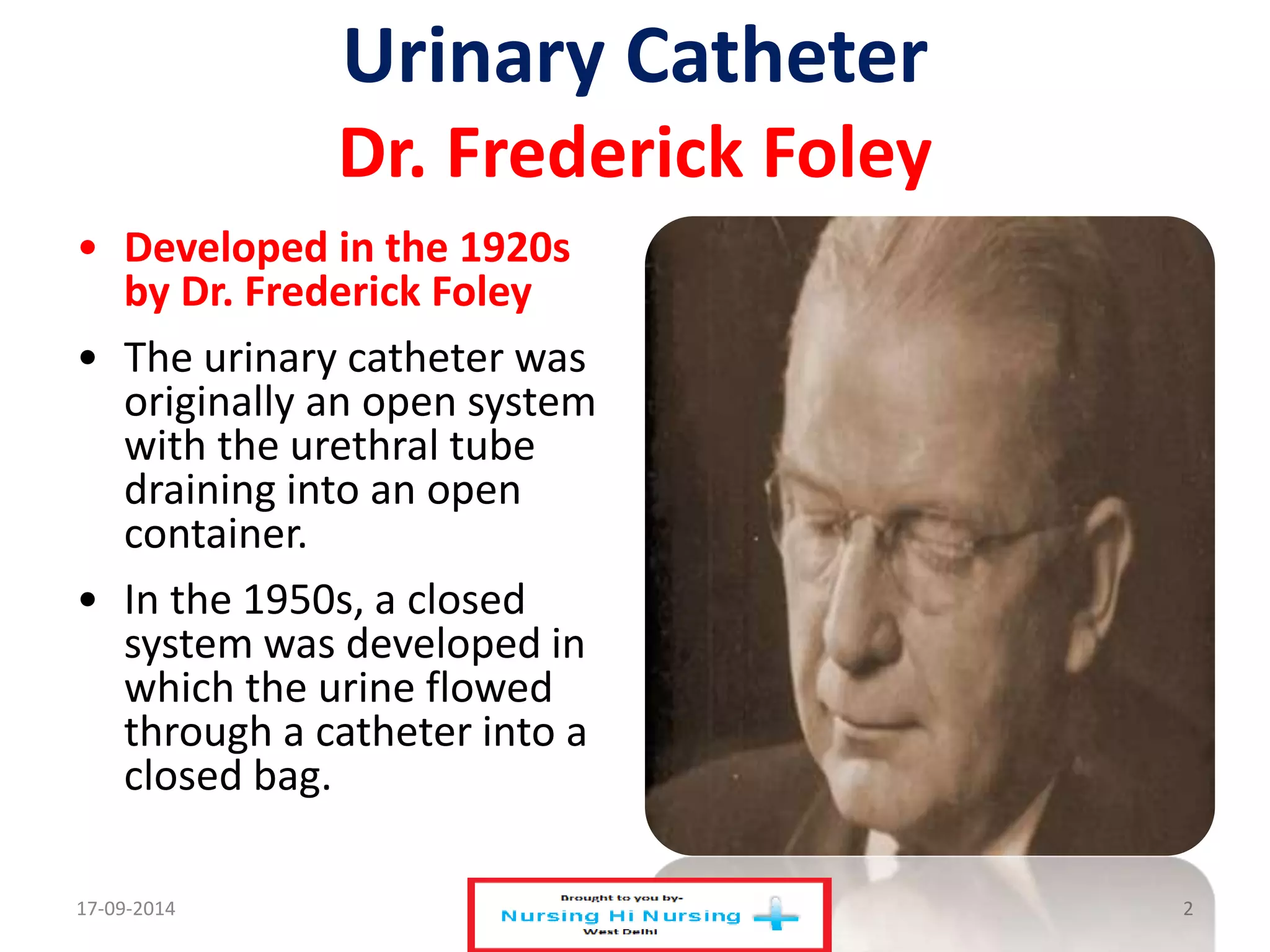
Dr. Frederick Foley 
• Developed in the 1920s 
by Dr. Frederick Foley 
• The urinary catheter was 
originally an open system 
with the urethral tube 
draining into an open 
container. 
• In the 1950s, a closed 
system was developed in 
which the urine flowed 
through a catheter into a 
closed bag. 
17-09-2014 2
What is a Foley's catheter 
17-09-2014 3
What is a urinary catheter 
• Urinary catheter 
is any tube 
placed in the 
body to drain 
and collect 
urine from the 
bladder 
17-09-2014 4
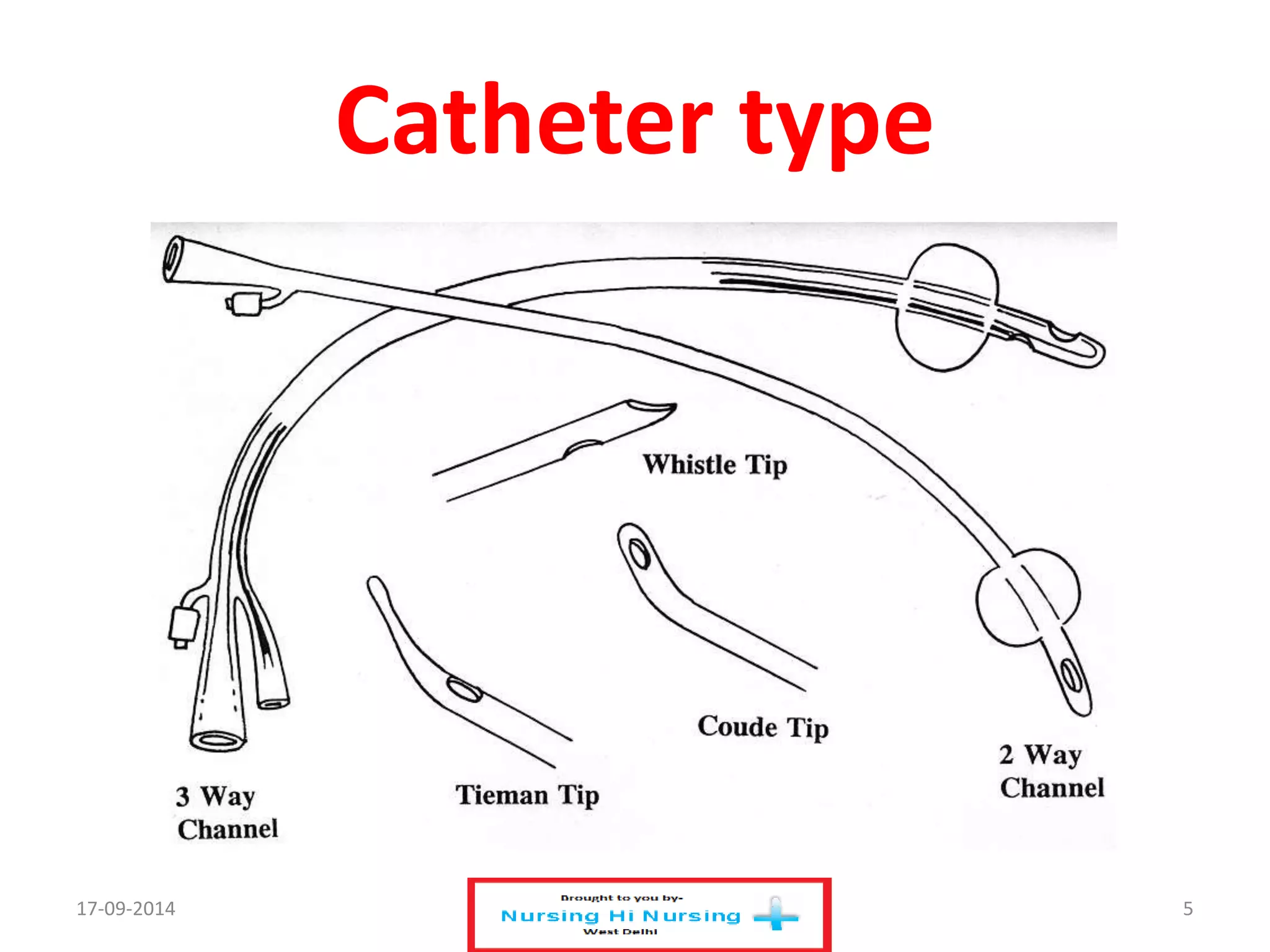
Catheter type 
17-09-2014 5
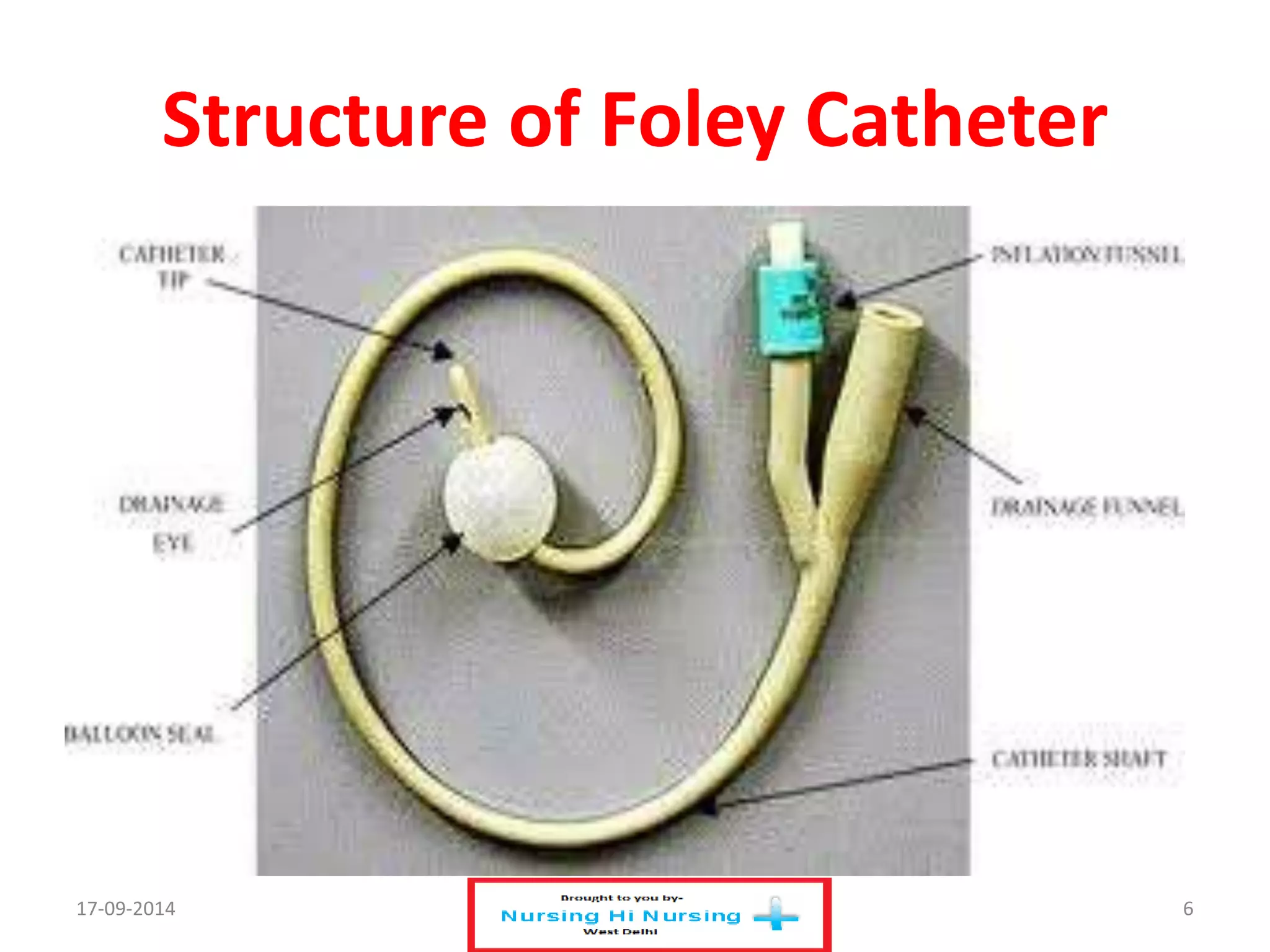
Structure of Foley Catheter 
17-09-2014 6
Urinary Catheter Utilization 
• About 15-25% of patients 
during their hospitalization 
will have an urinary 
catheter placed 
• Many are placed either in 
the intensive care or 
Emergency Department 
• 40% - 50% of these patients 
do not have a valid 
indication for urinary 
catheter placement 
17-09-2014 7
Purpose of Catheterization 
Catheterization is carried out for a number of 
reasons and can either be a temporary or 
permanent solution to a number of problems. 
Problems include physical disease and damage, 
psychological issues and a way to help to improve 
the quality of life to someone who is bed ridden. 
Good regular catheter care involves good hygiene, 
observation, monitoring well-being and 
prevention of problems associated with 
catheterization. 
17-09-2014 8
Foley Catheter 
17-09-2014 9
Documentation 
• Details regarding the 
catheterisation 
should be recorded 
in the patient’s 
notes. For further 
information please 
refer to your 
hospitals policy and 
procedure manual. 
17-09-2014 10
Matters to consider for 
Catheterization 
• Indication for catheterisation 
• • Time and date of catheterisation 
• • Type of catheter 
• • Amount of water in balloon 
• • Size of catheter 
• • Expiry date of product 
• • Any problems on insertion 
• • Description of urine, colour and volume drained 
• • Specimen collected 
• • Review date 
• (Marsden Manual 2001) 
17-09-2014 11
What you Need for Catheterization 
• 1 Dressing trolley 
• 2. Catheterisation pack 
• 3. Sterile gloves 
• 4. Appropriate size catheter 
• 5. Xylocaine jelly syringe 
• 6. Sterile water for the balloon 
• 7. Syringe 
• 8. Specimen jar 
• 9. Antiseptic solution 
• 10. Waterproof Sheet 
• 11. Extra Jug 
• 12. Light source 
• 13. Tape to secure the catheter to the leg 
• 14. Drainage bag 
• 15 Urine bag holder 
17-09-2014 12
Choose the Right Catheter 
• Choose the smallest 
catheter size that 
will drain adequately 
for its intended use 
• Catheters range in 
size from 5 – 24 Fg. 
• (Joanna Briggs 
Institute 2003) 
17-09-2014 13
Guidelines on Size 
• Women 12 – 14 Fg 
• Men 16 – 18Fg 
• Suprapubic 16 –20Fg 
• Haematuria 20 -24 Fg 
• If a haematuria catheter is required a 3 –way 
should be used to allow for the option of 
continuous bladder irrigation without requiring a 
further catheter change. When not in use, the 
irrigating port should be spigotted. 
17-09-2014 14
Length of Catheters 
• Catheters are available in 3 lengths: Paediatric, 
Regular length and Female length. 
• Female length is a shorter length catheter (20- 
25cm). A shorter length catheter may be more 
convenient for ambulant women with a long 
term catheter. A shorter length catheter is not 
appropriate for all women particularly those 
who are bedridden or obese. 
17-09-2014 15
Catheters in Obese Women 
• In obese women, the 
inflation valve of the 
shorter catheter may 
cause soreness by 
rubbing against the 
inside of the thighs, and 
the catheter is more 
likely to pull on the 
bladder neck (Britton & 
Wright 1990; Pomfret 1996) 
17-09-2014 16
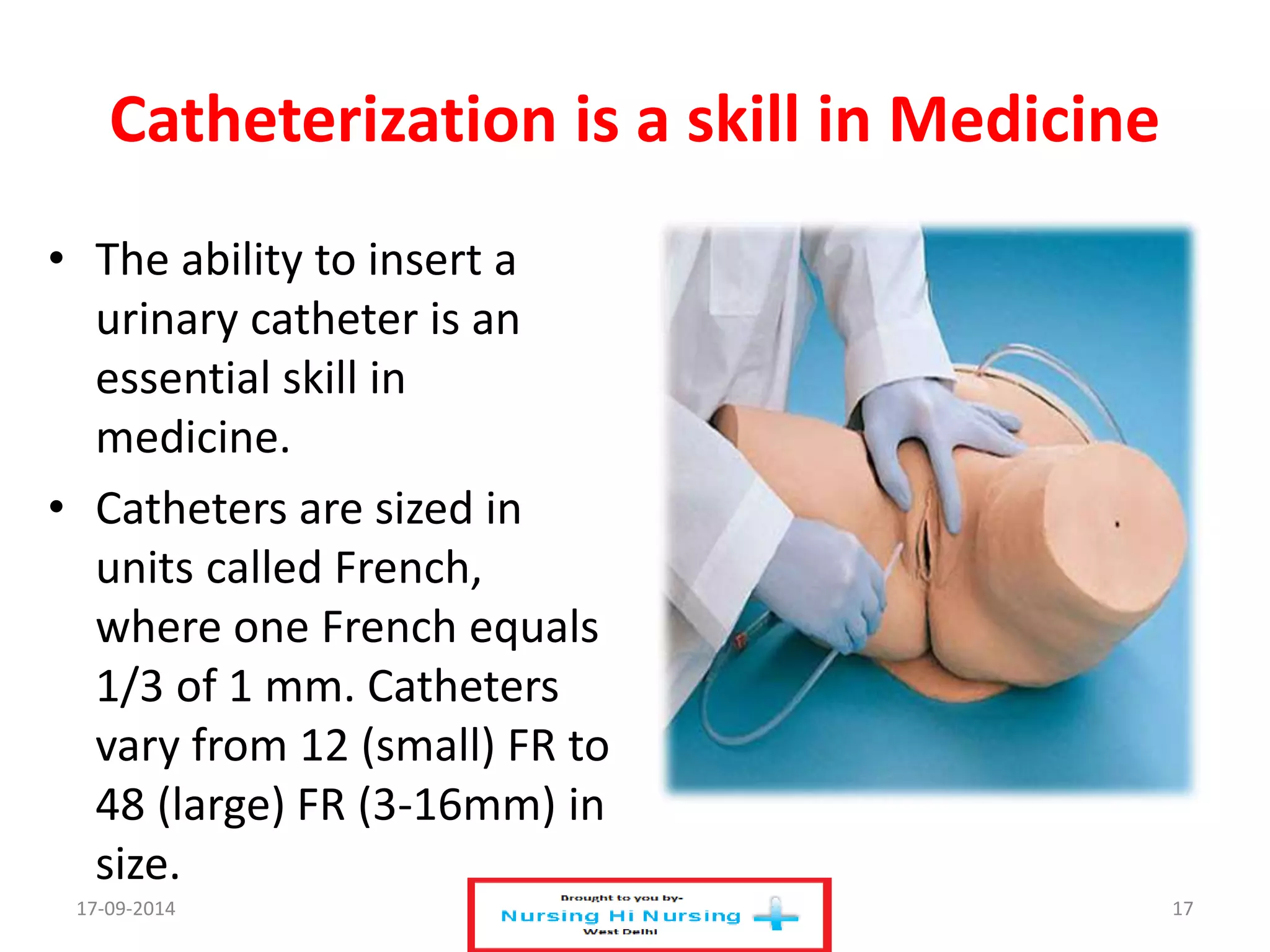
Catheterization is a skill in Medicine 
• The ability to insert a 
urinary catheter is an 
essential skill in 
medicine. 
• Catheters are sized in 
units called French, 
where one French equals 
1/3 of 1 mm. Catheters 
vary from 12 (small) FR to 
48 (large) FR (3-16mm) in 
size. 
17-09-2014 17
Catheters are available in different 
varieties 
• They also come in 
different varieties 
including ones without 
a bladder balloon, and 
ones with different 
sized balloons - you 
should check how much 
the balloon is made to 
hold when inflating the 
balloon with water! 
17-09-2014 18
What is indwelling Catheter 
• In indwelling urinary catheter is one that is left in place 
in the bladder. Indwelling catheters may be needed for 
only a short time, or for a long time. These catheters 
attach to a drainage bag to collect urine. A newer type 
of catheter has a valve that can be opened to allow 
urine to flow out, when needed. An indwelling catheter 
may be inserted into the bladder in two ways: 
• Sometimes, one may insert a tube, called a suprapubic 
catheter, into your bladder from a small hole in your 
belly. This is done as an outpatient surgery or office 
procedure. 
17-09-2014 19
Caution on catheterization 
• The potential for contact with a 
patient's blood/body fluids while 
starting a catheter is present and 
increases with the inexperience 
of the operator. Gloves must be 
worn while starting the Foley, 
not only to protect the user, but 
also to prevent infection in the 
patient. Trauma protocol calls for 
all team members to wear 
gloves, face and eye protection 
and gowns. 
17-09-2014 20
Explain the patient before doing the 
catheritization 
• Before you start tell the person what you are going 
to do and why. This is important for everyone, but 
especially if the person is confused, has memory 
problems as in Alzheimer's disease or dementia. If 
you can, assist the catheterized person with their 
hygiene, rather than doing it yourself. It is 
important to try to help the person / patient keep 
their skills rather than just take over for them. 
There are so many advantages but it can just take 
that bit longer. 
17-09-2014 21
Which Disinfectant Should be Used for 
Catheter Site Care? 
• Povidone-iodine (PI) is 
currently the most widely 
used agent for site 
disinfection 
• Chlorhexidine gluconate 
(CHG) has been compared 
to PI with mixed results 
• We performed a formal 
meta-analysis of published 
and unpublished studies to 
clarify relative efficacy 
17-09-2014 22
Skills in catheterization to be 
Perfected 
17-09-2014 23
CONDOM CATHETERS 
• Condom catheters are most 
frequently used in elderly 
men with dementia. There 
is no tube placed inside the 
penis. Instead, a condom-like 
device is placed over 
the penis. A tube leads from 
this device to a drainage 
bag. The condom catheter 
must be changed every day. 
17-09-2014 24
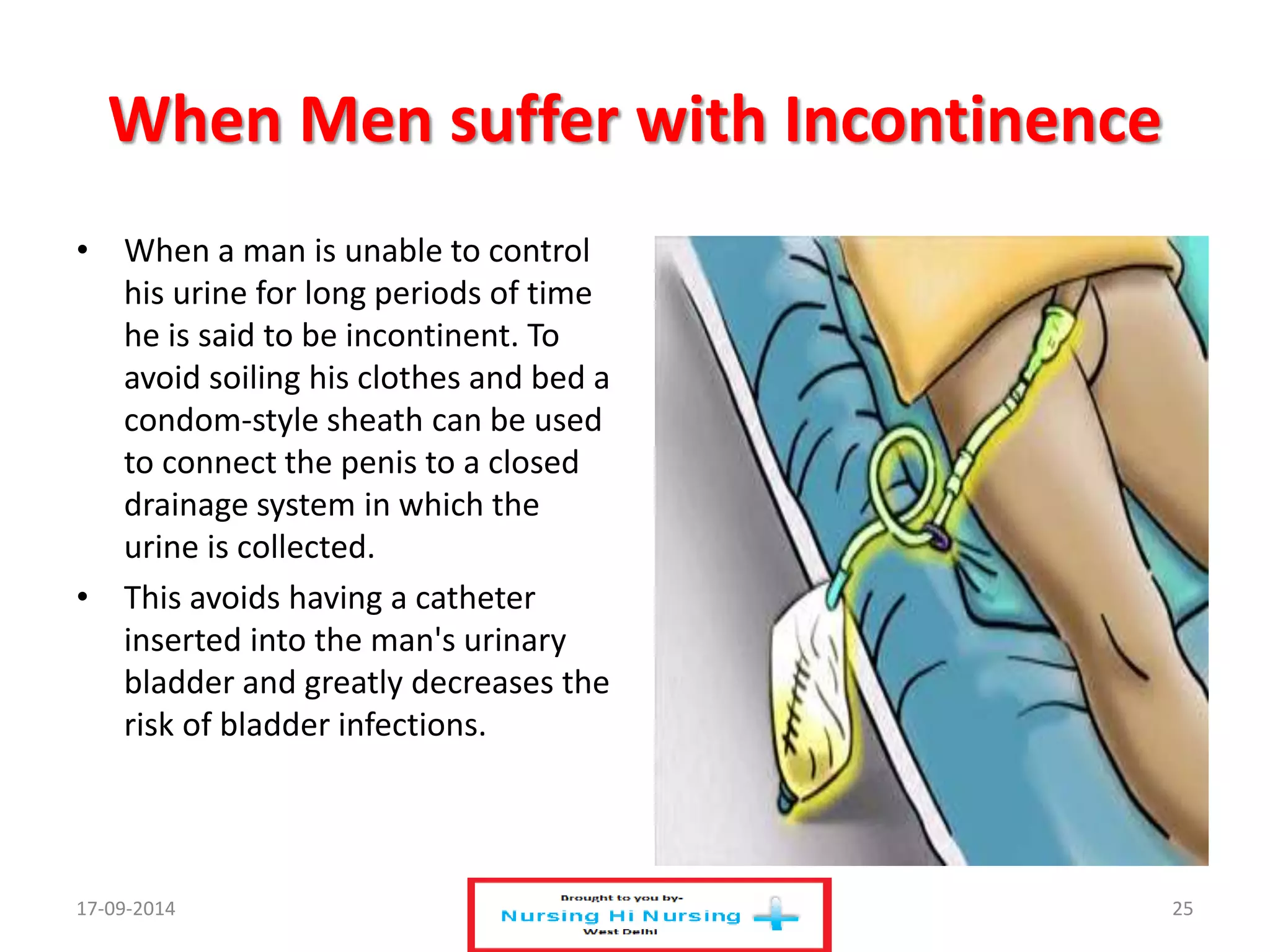
When Men suffer with Incontinence 
• When a man is unable to control 
his urine for long periods of time 
he is said to be incontinent. To 
avoid soiling his clothes and bed a 
condom-style sheath can be used 
to connect the penis to a closed 
drainage system in which the 
urine is collected. 
• This avoids having a catheter 
inserted into the man's urinary 
bladder and greatly decreases the 
risk of bladder infections. 
17-09-2014 25
INTERMITTENT (SHORT-TERM) CATHETERS 
• Some people only need 
to use a catheter on 
occasion. Short-term, or 
intermittent, catheters 
are removed after the 
flow of urine has 
stopped. For more 
information on this type 
of catheter, see: Clean 
intermittent self-catheterization. 
17-09-2014 26
Hand washing the most important 
preparation before catheterization 
• Wash your hands 
before and after 
handling the drainage 
device. Do not allow the 
outlet valve to touch 
anything. If the outlet 
becomes obviously 
dirty, clean it with soap 
and water. 
17-09-2014 27
Antiseptic Hand Rinses many 
using alcohols 
• 60-70% alcohol 
solutions 
• Effective against most 
bacteria, viruses, fungi 
• Protective against 
hand drying 
• Faster, increased 
compliance 
17-09-2014 28
Caring before the insertion of Catheter 
• Wash around the 
catheter entry site with 
soap and water twice 
each day. Clean the top 
several inches of the 
catheter too. 
Always wash the site 
after a bowel 
movement. 
17-09-2014 29
Health care workers should develop skills 
in introduction of Catheter 
• Introduction Female 
urethral catheterization, the 
insertion of a catheter 
through the urethra into the 
urinary bladder to permit 
drainage of urine, is a 
fundamental skill Insert the 
catheter completely into 
the urethra, and do not 
inflate the balloon until 
there is return of urine, to 
avoid trauma … 
17-09-2014 30
Principles of placement of catheter and 
collecting bag 
17-09-2014 31
The Urine collecting bag should be at a 
lower level to the patient 
to prevent retrograde flow 
17-09-2014 32
• Criteria for insertion and 
continuation of a F/C includes: 
a. Retention 
b. Critical I&O 
c. Comatose 
d. Paralyzed 
e. Neurogenic Bladder 
f. Pre-op placement 
g. Wound with incontinence 
h. Bladder Irrigation 
i. Physical trauma/pain with bedpan/incontinence brief 
j. Terminal illness/comfort measures 
17-09-2014 33
Care of Inserted Catheters 
• Every day , wash around the catheter and 
perineum with soap and water; rinse and dry 
these areas well. you may shower while 
wearing the catheter 
• Sitting in the tub, however , is not 
recommended. Good personal hygiene pre 
vents the accumulation of bacteria, reduces 
the risk of infection, and prevents odor 
17-09-2014 34
POSSIBLE COMPLICATIONS 
• Inability to catheterise 
• • Urethral Injury – by inflating balloon before insuring correct 
catheter placement in the 
• bladder 
• • Infection 
• • Psychological Trauma 
• • Haemorrhage – trauma sustained during insertion or balloon 
inflation 
• • False Passage – by injury to the urethral wall during insertion 
• • Urethral Strictures – following damage to the urethra – long term 
problem 
• • Paraphimosis due to failure to return foreskin to normal position 
following catheter insertion. 
17-09-2014 35
Complications of catheterization 
• The main complications are tissue trauma and infection. After 
48 hours of catheterization, most catheters are colonized with 
bacteria, thus leading to possible Bacteriuria and its 
complications. Catheters can also cause renal inflammation, 
nephro-cysto-lithiasis, and pyelonephritis if left in for 
prolonged periods. 
• The most common short term complications are inability to 
insert catheter, and causation of tissue trauma during the 
insertion. 
• The alternatives to urethral catheterization include 
suprapubic catheterization and external condom catheters for 
longer durations. 
17-09-2014 36
Urinary Catheter-related Infection: 
Background 
• Urinary tract infection (UTI) causes over 40% 
of hospital-acquired infections 
• Most infections due to urinary catheters 
• 25% of inpatients are catheterized 
• Leads to increased morbidity and costs 
17-09-2014 37
Risks / Consequences of 
Catheterization 
• UTI 
• PYELONEPHRITIS 
• DEATH R/T BACTEREMIA 
• DAMAGE TO URETHRA (SCARRING AND 
STRICTURES) 
• Prostatitis and epididymitis 
17-09-2014 38
• Indwelling Foley catheters are a major 
source of UTI’S. 
• Direct relationship between duration a f/c is in the 
patient and incidence of infection. 
• Risk factors: 
 Female 
 Advanced age 
 Duration 
 Diabetes 
 Renal insufficiency 
17-09-2014 39
Biofilm: Extracellular Polymers 
(Donlan, CID 2001; 33:1387–92, Liedl, Curr Opinion Urol 2001;11: 75-9) 
• Organisms attach to and 
grow on a surface and 
produce extracellular 
polymers 
• Intraluminal ascent 
(48hours) of bacteria 
faster than extraluminal 
(72-168 hours) 
• Most catheters used >1 
week have biofilms 
• Extraluminal more 
important in women 
Staphylococcus aureus biofilm on 
40 
an indwelling catheter. 
CDC Public Health Image Library 
17-09-2014
What we are doing now, is it right things to do. 
Foley Catheter Bundle 
What is the Foley Catheter Bundle? 
 Insert using sterile technique 
 Hand hygiene before and after any contact with the F/C 
system 
 Secure catheter to thigh at ALL times 
 Keep catheter bag below the level of the bladder at 
ALL times 
 Maintain a sterile, continuously closed system 
 Specified criteria for insertion and continuation of a Foley 
catheter 
 Peri care daily and after all incontinent stool 
What is “Peri Care” for a patient with a f/c? Daily wash with 
17-09w-201a4rm soap & water then dry. 41
Gravity will help the Draining of 
Bladder 
• Gravity is important for drainage and the 
prevention of urine backflow. Ensure that 
catheter bags are always draining 
downwards, do not become kinked and 
are secured and below thigh level. Metal 
or plastic hangers should be attached to 
the side of the bed. Cloth bags tied to the 
bed to support the bags are also 
17-09a-20v14ailable 42
Collection of urine from catheterised 
patients 
• The process of obtaining a sample of urine from a 
patient with an indwelling urinary catheter must 
be obtained from a sampling port. The sample 
must be obtained using an aseptic technique. 
• This port is usually situated in the drainage tubing, 
proximal to the collection bag which ensures the 
freshest sample possible. The use of drainage 
systems without a sampling port should be 
avoided (Gilbert, 2006). 
17-09-2014 43
COLLECTION OF CATHETER SPECIMENS 
In Urinary Tract Infections 
• Clean entry port with alcohol swab using firm 
friction and allow to air dry 
• • Insert syringe into direct entry point of bag 
and aspirate urine. The port will self-seal 
when the syringe is withdrawn. 
• • If direct syringe entry port is not available, 
insert needle into entry port and aspirate 
urine. The port will self-seal when the needle 
is withdrawn 
17-09-2014 44
Specimens for Culturing Should not 
be Cultured from Urine bags 
• Specimens should not 
be collected from the 
tap from the main 
collecting chamber of 
the catheter bag as 
colonisation and 
multiplication of 
bacteria within the 
stagnant urine or 
around the drainage tap 
may have occurred. 
17-09-2014 45
Aspirating the urine with syringe and 
Needle 
• Aspirating urine from a 
sampling port has 
traditionally been 
performed using a 
syringe and needle. 
However, needle-free 
systems are 
commercially available, 
which may reduce the 
risk of inoculation 
injury. 
17-09-2014 46
Contraindications for catheterization 
• Foley catheters are contraindicated in the 
presence of urethral trauma. Urethral injuries 
may occur in patients with multisystem 
injuries and pelvic factures, as well as straddle 
impacts. If this is suspected, one must 
perform a genital and rectal exam first. If one 
finds blood at the meatus of the urethra, a 
scrotal hematoma, a pelvic fracture, or a high 
riding prostate then a high suspicion of 
urethral tear is present. 
17-09-2014 47
Epidemiology of urinary 
catheterization 
• Up to 25% of hospitalized patients 
– urinary catheterization 
• Catheter associated nosocomial UTI 
– 5% per day ! 
• Nosocomial UTI 
– 40% of nosocomial infection 
• Bacteria ascend intraluminally into the bladder 
– within 24 to 72 hours (from Harrison’s 16th) 
• > 1 month of catheterization 
– Nearly all will be bacteriuic 
• Long-term (>30 days) and short-term (<30 days) 
catheterization 
• 80% of patients with nosocomial UTI 
– have an indwelling urinary catheter 
17-09-2014 48
Women in labour Need 
Catheterization 
17-09-2014 49
Reminder for Appropriate Urinary 
Catheter Use 
• Avoid urinary catheter use if 
not indicated 
• Try to discontinue the 
catheter promptly when not 
needed 
• The longer the catheter is 
present, the higher the risk 
of infection! 
• The urinary drainage system 
should always remain a 
closed system 
17-09-2014 50
Rapid draining leads to Complications 
• Rapid drainage of large 
volumes of urine from 
the bladder may result 
in hypotension and/or 
haemorrhage.(Upson 
1995) Clamp catheter if 
the volume drained is 
1000mls or greater. 
After 20minutes release 
the clamp and allow 
urine to drain 
17-09-2014 51
Repeat the Clamping when 
volume is higher 
• If the amount of 
urine is 1000mls 
or greater 
repeat the 
clamping 
procedure. 
17-09-2014 52
PROCEDURE FOR EMPTYING CATHETER 
BAGS 
• Use a clean jug large enough to avoid spillage 
eg 2-3 litres. 
• • After emptying the bag, wipe the end of the 
catheter outlet with an alcohol swab. 
• • Note the amount and colour of drainage – 
record . 
• • Empty jug carefully down the sluice to avoid 
splashing 
• • Place jug straight into sanitizer and store dry 
17-09-2014 53
Constant evaluation to continue to use catheter 
……. 
• Both nurses and physicians 
should evaluate the 
indications for urinary 
catheter utilization. 
• Physicians should promptly 
discontinue catheters that 
are no longer needed. 
• Nurses evaluating catheters 
and finding no indication 
should contact physician to 
promptly discontinue 
catheter. 
17-09-2014 54
Important question when to remove 
• Should we need to remove the urinary 
catheter in 48~72 hours of smoothly post op 
patients to reduce the rate of catheter 
associated UTI? What’s the rate of catheter 
associated UTI in 48~ 72 hours? 
– Remove urinary catheter as soon as 
possible! 
– Rate of Bacteriuria in indwelling catheter 
patient in 48 hours post-OP: average 24% 
17-09-2014 55
Mannequins Recruited To Teach 
Medicine 
17-09-2014 56
Clean and Washed Hands Saves many Lives 
from Complications of Catheterization 
17-09-2014 57
For More Articles of Interest on 
Infectious Diseases Visit Me … 
17-09-2014 58
This platform has been started by 
Parveen Kumar Chadha with the vision that 
nobody should suffer the way he has suffered 
because of lack and improper healthcare 
facilities in India. We need lots of funds 
manpower etc. to make this vision a reality 
please contact us. Join us as a member for a 
noble cause. 
17-09-2014 59
Our views have increased the 
mark of the 35,000 
 Thank you viewers 
 Looking forward for franchise, 
collaboration, partners. 
17-09-2014 60
Contact us:- 011-25464531, 9818569476 
E-mail:- nursingnursing@yahoo.in 
Saxbee Consultants Details :-www.parveenchadha.com 
17-09-2014 61
Thank you for your attention 
17-09-2014 62

Urinary catheter care skills & asepsis

  • 1.
    Urinary Catheter Care Skills & Asepsis 17-09-2014 1
  • 2.
    Urinary Catheter Dr.Frederick Foley • Developed in the 1920s by Dr. Frederick Foley • The urinary catheter was originally an open system with the urethral tube draining into an open container. • In the 1950s, a closed system was developed in which the urine flowed through a catheter into a closed bag. 17-09-2014 2
  • 3.
    What is aFoley's catheter 17-09-2014 3
  • 4.
    What is aurinary catheter • Urinary catheter is any tube placed in the body to drain and collect urine from the bladder 17-09-2014 4
  • 5.
  • 6.
    Structure of FoleyCatheter 17-09-2014 6
  • 7.
    Urinary Catheter Utilization • About 15-25% of patients during their hospitalization will have an urinary catheter placed • Many are placed either in the intensive care or Emergency Department • 40% - 50% of these patients do not have a valid indication for urinary catheter placement 17-09-2014 7
  • 8.
    Purpose of Catheterization Catheterization is carried out for a number of reasons and can either be a temporary or permanent solution to a number of problems. Problems include physical disease and damage, psychological issues and a way to help to improve the quality of life to someone who is bed ridden. Good regular catheter care involves good hygiene, observation, monitoring well-being and prevention of problems associated with catheterization. 17-09-2014 8
  • 9.
  • 10.
    Documentation • Detailsregarding the catheterisation should be recorded in the patient’s notes. For further information please refer to your hospitals policy and procedure manual. 17-09-2014 10
  • 11.
    Matters to considerfor Catheterization • Indication for catheterisation • • Time and date of catheterisation • • Type of catheter • • Amount of water in balloon • • Size of catheter • • Expiry date of product • • Any problems on insertion • • Description of urine, colour and volume drained • • Specimen collected • • Review date • (Marsden Manual 2001) 17-09-2014 11
  • 12.
    What you Needfor Catheterization • 1 Dressing trolley • 2. Catheterisation pack • 3. Sterile gloves • 4. Appropriate size catheter • 5. Xylocaine jelly syringe • 6. Sterile water for the balloon • 7. Syringe • 8. Specimen jar • 9. Antiseptic solution • 10. Waterproof Sheet • 11. Extra Jug • 12. Light source • 13. Tape to secure the catheter to the leg • 14. Drainage bag • 15 Urine bag holder 17-09-2014 12
  • 13.
    Choose the RightCatheter • Choose the smallest catheter size that will drain adequately for its intended use • Catheters range in size from 5 – 24 Fg. • (Joanna Briggs Institute 2003) 17-09-2014 13
  • 14.
    Guidelines on Size • Women 12 – 14 Fg • Men 16 – 18Fg • Suprapubic 16 –20Fg • Haematuria 20 -24 Fg • If a haematuria catheter is required a 3 –way should be used to allow for the option of continuous bladder irrigation without requiring a further catheter change. When not in use, the irrigating port should be spigotted. 17-09-2014 14
  • 15.
    Length of Catheters • Catheters are available in 3 lengths: Paediatric, Regular length and Female length. • Female length is a shorter length catheter (20- 25cm). A shorter length catheter may be more convenient for ambulant women with a long term catheter. A shorter length catheter is not appropriate for all women particularly those who are bedridden or obese. 17-09-2014 15
  • 16.
    Catheters in ObeseWomen • In obese women, the inflation valve of the shorter catheter may cause soreness by rubbing against the inside of the thighs, and the catheter is more likely to pull on the bladder neck (Britton & Wright 1990; Pomfret 1996) 17-09-2014 16
  • 17.
    Catheterization is askill in Medicine • The ability to insert a urinary catheter is an essential skill in medicine. • Catheters are sized in units called French, where one French equals 1/3 of 1 mm. Catheters vary from 12 (small) FR to 48 (large) FR (3-16mm) in size. 17-09-2014 17
  • 18.
    Catheters are availablein different varieties • They also come in different varieties including ones without a bladder balloon, and ones with different sized balloons - you should check how much the balloon is made to hold when inflating the balloon with water! 17-09-2014 18
  • 19.
    What is indwellingCatheter • In indwelling urinary catheter is one that is left in place in the bladder. Indwelling catheters may be needed for only a short time, or for a long time. These catheters attach to a drainage bag to collect urine. A newer type of catheter has a valve that can be opened to allow urine to flow out, when needed. An indwelling catheter may be inserted into the bladder in two ways: • Sometimes, one may insert a tube, called a suprapubic catheter, into your bladder from a small hole in your belly. This is done as an outpatient surgery or office procedure. 17-09-2014 19
  • 20.
    Caution on catheterization • The potential for contact with a patient's blood/body fluids while starting a catheter is present and increases with the inexperience of the operator. Gloves must be worn while starting the Foley, not only to protect the user, but also to prevent infection in the patient. Trauma protocol calls for all team members to wear gloves, face and eye protection and gowns. 17-09-2014 20
  • 21.
    Explain the patientbefore doing the catheritization • Before you start tell the person what you are going to do and why. This is important for everyone, but especially if the person is confused, has memory problems as in Alzheimer's disease or dementia. If you can, assist the catheterized person with their hygiene, rather than doing it yourself. It is important to try to help the person / patient keep their skills rather than just take over for them. There are so many advantages but it can just take that bit longer. 17-09-2014 21
  • 22.
    Which Disinfectant Shouldbe Used for Catheter Site Care? • Povidone-iodine (PI) is currently the most widely used agent for site disinfection • Chlorhexidine gluconate (CHG) has been compared to PI with mixed results • We performed a formal meta-analysis of published and unpublished studies to clarify relative efficacy 17-09-2014 22
  • 23.
    Skills in catheterizationto be Perfected 17-09-2014 23
  • 24.
    CONDOM CATHETERS •Condom catheters are most frequently used in elderly men with dementia. There is no tube placed inside the penis. Instead, a condom-like device is placed over the penis. A tube leads from this device to a drainage bag. The condom catheter must be changed every day. 17-09-2014 24
  • 25.
    When Men sufferwith Incontinence • When a man is unable to control his urine for long periods of time he is said to be incontinent. To avoid soiling his clothes and bed a condom-style sheath can be used to connect the penis to a closed drainage system in which the urine is collected. • This avoids having a catheter inserted into the man's urinary bladder and greatly decreases the risk of bladder infections. 17-09-2014 25
  • 26.
    INTERMITTENT (SHORT-TERM) CATHETERS • Some people only need to use a catheter on occasion. Short-term, or intermittent, catheters are removed after the flow of urine has stopped. For more information on this type of catheter, see: Clean intermittent self-catheterization. 17-09-2014 26
  • 27.
    Hand washing themost important preparation before catheterization • Wash your hands before and after handling the drainage device. Do not allow the outlet valve to touch anything. If the outlet becomes obviously dirty, clean it with soap and water. 17-09-2014 27
  • 28.
    Antiseptic Hand Rinsesmany using alcohols • 60-70% alcohol solutions • Effective against most bacteria, viruses, fungi • Protective against hand drying • Faster, increased compliance 17-09-2014 28
  • 29.
    Caring before theinsertion of Catheter • Wash around the catheter entry site with soap and water twice each day. Clean the top several inches of the catheter too. Always wash the site after a bowel movement. 17-09-2014 29
  • 30.
    Health care workersshould develop skills in introduction of Catheter • Introduction Female urethral catheterization, the insertion of a catheter through the urethra into the urinary bladder to permit drainage of urine, is a fundamental skill Insert the catheter completely into the urethra, and do not inflate the balloon until there is return of urine, to avoid trauma … 17-09-2014 30
  • 31.
    Principles of placementof catheter and collecting bag 17-09-2014 31
  • 32.
    The Urine collectingbag should be at a lower level to the patient to prevent retrograde flow 17-09-2014 32
  • 33.
    • Criteria forinsertion and continuation of a F/C includes: a. Retention b. Critical I&O c. Comatose d. Paralyzed e. Neurogenic Bladder f. Pre-op placement g. Wound with incontinence h. Bladder Irrigation i. Physical trauma/pain with bedpan/incontinence brief j. Terminal illness/comfort measures 17-09-2014 33
  • 34.
    Care of InsertedCatheters • Every day , wash around the catheter and perineum with soap and water; rinse and dry these areas well. you may shower while wearing the catheter • Sitting in the tub, however , is not recommended. Good personal hygiene pre vents the accumulation of bacteria, reduces the risk of infection, and prevents odor 17-09-2014 34
  • 35.
    POSSIBLE COMPLICATIONS •Inability to catheterise • • Urethral Injury – by inflating balloon before insuring correct catheter placement in the • bladder • • Infection • • Psychological Trauma • • Haemorrhage – trauma sustained during insertion or balloon inflation • • False Passage – by injury to the urethral wall during insertion • • Urethral Strictures – following damage to the urethra – long term problem • • Paraphimosis due to failure to return foreskin to normal position following catheter insertion. 17-09-2014 35
  • 36.
    Complications of catheterization • The main complications are tissue trauma and infection. After 48 hours of catheterization, most catheters are colonized with bacteria, thus leading to possible Bacteriuria and its complications. Catheters can also cause renal inflammation, nephro-cysto-lithiasis, and pyelonephritis if left in for prolonged periods. • The most common short term complications are inability to insert catheter, and causation of tissue trauma during the insertion. • The alternatives to urethral catheterization include suprapubic catheterization and external condom catheters for longer durations. 17-09-2014 36
  • 37.
    Urinary Catheter-related Infection: Background • Urinary tract infection (UTI) causes over 40% of hospital-acquired infections • Most infections due to urinary catheters • 25% of inpatients are catheterized • Leads to increased morbidity and costs 17-09-2014 37
  • 38.
    Risks / Consequencesof Catheterization • UTI • PYELONEPHRITIS • DEATH R/T BACTEREMIA • DAMAGE TO URETHRA (SCARRING AND STRICTURES) • Prostatitis and epididymitis 17-09-2014 38
  • 39.
    • Indwelling Foleycatheters are a major source of UTI’S. • Direct relationship between duration a f/c is in the patient and incidence of infection. • Risk factors:  Female  Advanced age  Duration  Diabetes  Renal insufficiency 17-09-2014 39
  • 40.
    Biofilm: Extracellular Polymers (Donlan, CID 2001; 33:1387–92, Liedl, Curr Opinion Urol 2001;11: 75-9) • Organisms attach to and grow on a surface and produce extracellular polymers • Intraluminal ascent (48hours) of bacteria faster than extraluminal (72-168 hours) • Most catheters used >1 week have biofilms • Extraluminal more important in women Staphylococcus aureus biofilm on 40 an indwelling catheter. CDC Public Health Image Library 17-09-2014
  • 41.
    What we aredoing now, is it right things to do. Foley Catheter Bundle What is the Foley Catheter Bundle?  Insert using sterile technique  Hand hygiene before and after any contact with the F/C system  Secure catheter to thigh at ALL times  Keep catheter bag below the level of the bladder at ALL times  Maintain a sterile, continuously closed system  Specified criteria for insertion and continuation of a Foley catheter  Peri care daily and after all incontinent stool What is “Peri Care” for a patient with a f/c? Daily wash with 17-09w-201a4rm soap & water then dry. 41
  • 42.
    Gravity will helpthe Draining of Bladder • Gravity is important for drainage and the prevention of urine backflow. Ensure that catheter bags are always draining downwards, do not become kinked and are secured and below thigh level. Metal or plastic hangers should be attached to the side of the bed. Cloth bags tied to the bed to support the bags are also 17-09a-20v14ailable 42
  • 43.
    Collection of urinefrom catheterised patients • The process of obtaining a sample of urine from a patient with an indwelling urinary catheter must be obtained from a sampling port. The sample must be obtained using an aseptic technique. • This port is usually situated in the drainage tubing, proximal to the collection bag which ensures the freshest sample possible. The use of drainage systems without a sampling port should be avoided (Gilbert, 2006). 17-09-2014 43
  • 44.
    COLLECTION OF CATHETERSPECIMENS In Urinary Tract Infections • Clean entry port with alcohol swab using firm friction and allow to air dry • • Insert syringe into direct entry point of bag and aspirate urine. The port will self-seal when the syringe is withdrawn. • • If direct syringe entry port is not available, insert needle into entry port and aspirate urine. The port will self-seal when the needle is withdrawn 17-09-2014 44
  • 45.
    Specimens for CulturingShould not be Cultured from Urine bags • Specimens should not be collected from the tap from the main collecting chamber of the catheter bag as colonisation and multiplication of bacteria within the stagnant urine or around the drainage tap may have occurred. 17-09-2014 45
  • 46.
    Aspirating the urinewith syringe and Needle • Aspirating urine from a sampling port has traditionally been performed using a syringe and needle. However, needle-free systems are commercially available, which may reduce the risk of inoculation injury. 17-09-2014 46
  • 47.
    Contraindications for catheterization • Foley catheters are contraindicated in the presence of urethral trauma. Urethral injuries may occur in patients with multisystem injuries and pelvic factures, as well as straddle impacts. If this is suspected, one must perform a genital and rectal exam first. If one finds blood at the meatus of the urethra, a scrotal hematoma, a pelvic fracture, or a high riding prostate then a high suspicion of urethral tear is present. 17-09-2014 47
  • 48.
    Epidemiology of urinary catheterization • Up to 25% of hospitalized patients – urinary catheterization • Catheter associated nosocomial UTI – 5% per day ! • Nosocomial UTI – 40% of nosocomial infection • Bacteria ascend intraluminally into the bladder – within 24 to 72 hours (from Harrison’s 16th) • > 1 month of catheterization – Nearly all will be bacteriuic • Long-term (>30 days) and short-term (<30 days) catheterization • 80% of patients with nosocomial UTI – have an indwelling urinary catheter 17-09-2014 48
  • 49.
    Women in labourNeed Catheterization 17-09-2014 49
  • 50.
    Reminder for AppropriateUrinary Catheter Use • Avoid urinary catheter use if not indicated • Try to discontinue the catheter promptly when not needed • The longer the catheter is present, the higher the risk of infection! • The urinary drainage system should always remain a closed system 17-09-2014 50
  • 51.
    Rapid draining leadsto Complications • Rapid drainage of large volumes of urine from the bladder may result in hypotension and/or haemorrhage.(Upson 1995) Clamp catheter if the volume drained is 1000mls or greater. After 20minutes release the clamp and allow urine to drain 17-09-2014 51
  • 52.
    Repeat the Clampingwhen volume is higher • If the amount of urine is 1000mls or greater repeat the clamping procedure. 17-09-2014 52
  • 53.
    PROCEDURE FOR EMPTYINGCATHETER BAGS • Use a clean jug large enough to avoid spillage eg 2-3 litres. • • After emptying the bag, wipe the end of the catheter outlet with an alcohol swab. • • Note the amount and colour of drainage – record . • • Empty jug carefully down the sluice to avoid splashing • • Place jug straight into sanitizer and store dry 17-09-2014 53
  • 54.
    Constant evaluation tocontinue to use catheter ……. • Both nurses and physicians should evaluate the indications for urinary catheter utilization. • Physicians should promptly discontinue catheters that are no longer needed. • Nurses evaluating catheters and finding no indication should contact physician to promptly discontinue catheter. 17-09-2014 54
  • 55.
    Important question whento remove • Should we need to remove the urinary catheter in 48~72 hours of smoothly post op patients to reduce the rate of catheter associated UTI? What’s the rate of catheter associated UTI in 48~ 72 hours? – Remove urinary catheter as soon as possible! – Rate of Bacteriuria in indwelling catheter patient in 48 hours post-OP: average 24% 17-09-2014 55
  • 56.
    Mannequins Recruited ToTeach Medicine 17-09-2014 56
  • 57.
    Clean and WashedHands Saves many Lives from Complications of Catheterization 17-09-2014 57
  • 58.
    For More Articlesof Interest on Infectious Diseases Visit Me … 17-09-2014 58
  • 59.
    This platform hasbeen started by Parveen Kumar Chadha with the vision that nobody should suffer the way he has suffered because of lack and improper healthcare facilities in India. We need lots of funds manpower etc. to make this vision a reality please contact us. Join us as a member for a noble cause. 17-09-2014 59
  • 60.
    Our views haveincreased the mark of the 35,000  Thank you viewers  Looking forward for franchise, collaboration, partners. 17-09-2014 60
  • 61.
    Contact us:- 011-25464531,9818569476 E-mail:- nursingnursing@yahoo.in Saxbee Consultants Details :-www.parveenchadha.com 17-09-2014 61
  • 62.
    Thank you foryour attention 17-09-2014 62