Intravenous
cannulation
Ahmad alshareef
BSN.ANP.RN
By the end of this lecture you should be able to:
• Define and types of intravenous cannulation
• Explain the indication and contraindication of intravenous cannulation
• List equipment needed for an intravenous cannulation
• Identify and explain the IV cannulation procedure
• Describe complications that may arise
• Nursing care for patient with IV cannulation
INTRAVENOUS CANNULATION OBJECTIVES
• 90-95% of patients in the hospital receive
some type of intravenous therapy.
Introduction
• Veins are unlike arteries in that they are :
1)superficial.
2) display dark red blood at skin surface
3) have no pulsation
WHAT IS AN INTRAVENOUS CANNULATION ?
A technique in which a cannula is placed
inside a vein to provide venous access.
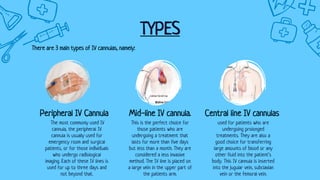
TYPES
The most commonly used IV
cannula, the peripheral IV
cannula is usually used for
emergency room and surgical
patients, or for those individuals
who undergo radiological
imaging. Each of these IV lines is
used for up to three days and
not beyond that.
Peripheral IV Cannula
used for patients who are
undergoing prolonged
treatments. They are also a
good choice for transferring
large amounts of blood or any
other fluid into the patient’s
body. This IV cannula is inserted
into the jugular vein, subclavian
vein or the femoral vein.
Central line IV cannulas
This is the perfect choice for
those patients who are
undergoing a treatment that
lasts for more than five days
but less than a month. They are
considered a less invasive
method. The IV line is placed on
a large vein in the upper part of
the patients arm.
Mid-line IV cannula.
There are 3 main types of IV cannulas, namely:
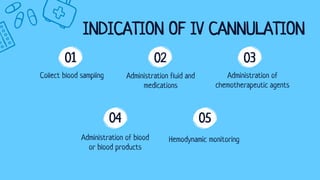
INDICATION OF IV CANNULATION
Collect blood sampling
01
Administration fluid and
medications
02
Administration of
chemotherapeutic agents
03
Administration of blood
or blood products
04 05
Hemodynamic monitoring
CONTRAINDICATION OF IV CANNULATION
• Sites close to infection
• Veins of fractured limbs
• Where there is an AV fistula present
• Oedema
• Extra care to be taken on patients with bleeding, clotting disorders & on warfarin.
attention
please
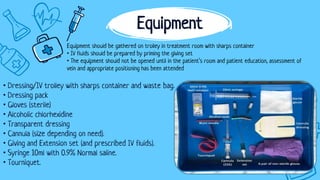
• Dressing/IV trolley with sharps container and waste bag.
• Dressing pack
• Gloves (sterile)
• Alcoholic chlorhexidine
• Transparent dressing
• Cannula (size depending on need).
• Giving and Extension set (and prescribed IV fluids).
• Syringe 10ml with 0.9% Normal saline.
• Tourniquet.
Equipment
Equipment should be gathered on trolley in treatment room with sharps container
• IV fluids should be prepared by priming the giving set
• The equipment should not be opened until in the patient’s room and patient education, assessment of
vein and appropriate positioning has been attended
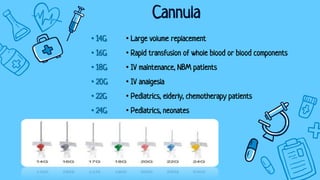
Cannula
• 14G
• 16G
• 18G
• 20G
• 22G
• 24G
• Large volume replacement
• Rapid transfusion of whole blood or blood components
• IV maintenance, NBM patients
• IV analgesia
• Pediatrics, elderly, chemotherapy patients
• Pediatrics, neonates
• Check patient for baseline vital signs, diagnosis and
allergies to medications, cleansing fluids & dressings
• Provide a clear explanation of the procedure including
potential adverse and side effects
• A relaxed patient is generally easier to cannulate
• Assess the dominant/non-dominant side and check the
veins for status and suitability
Assessing & preparing the patient
Positioning the patient
• If possible use the non dominant arm
• Raise bed prior to procedure
• Place the arm in a supported comfortable position
• Use a tourniquet to find vein
• Position patient with pillows or towels
• Have IV trolley close by
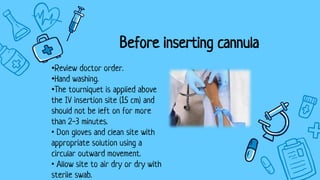
Before inserting cannula
•Review doctor order.
•Hand washing.
•The tourniquet is applied above
the IV insertion site (15 cm) and
should not be left on for more
than 2-3 minutes.
• Don gloves and clean site with
appropriate solution using a
circular outward movement.
• Allow site to air dry or dry with
sterile swab.
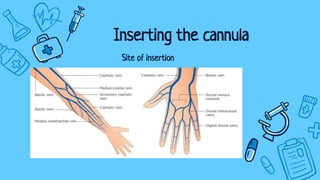
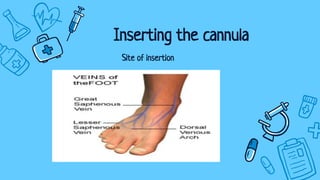
Site of insertion
Inserting the cannula
Site of insertion
Inserting the cannula
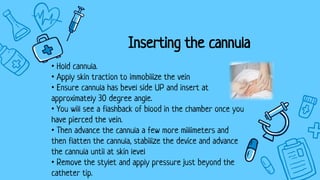
• Hold cannula.
• Apply skin traction to immobilize the vein
• Ensure cannula has bevel side UP and insert at
approximately 30 degree angle.
• You will see a flashback of blood in the chamber once you
have pierced the vein.
• Then advance the cannula a few more millimeters and
then flatten the cannula, stabilize the device and advance
the cannula until at skin level
• Remove the stylet and apply pressure just beyond the
catheter tip.
Inserting the cannula
• Gently stabilize the cannula hub
• Release the tourniquet
• Attach the extension line
• Apply dressing and secure cannula
• Flush cannula with 5-10ml 0.9% sodium chloride to ensure
patency
• Connect to IV fluid
• Dispose of sharps and waste
• Document in patient notes
Dressing
• A transparent sterile occlusive dressing is the optimal
dressing to use
• Before applying dressing, ensure site is clean of blood
and moisture
• Check with patient allergies to dressings
Documentation
• Site of insertion-vein and arm/hand
• Type and gauge of cannula
• Date and time of insertion
• Type and amount of IV solution
• Reason for IV therapy
Potential complications
The infiltration of a drug
from an I.V. line into
surrounding tissue.
Extravasation
Pathogen in the surrounding
tissue of the I.V. site.
Infection
Formation of a thrombus
and inflammation in the
vein, usually occurs after
phlebitis.
Thrombophlebitis
Inflammation of the vein
Phlebitis
Preventing complications
• Know your organization's policy on IV therapy
• Check and inspect the IV site regularly as per your
facility policy
• Ask the patient how the IV site feels
• Troubleshoot at first sign
• Report any problems
Hints
The use of proper equipment with proper technique
Familiarity with anatomy
Knowledge of the latest evidence in the area
Successful peripheral intravenous cannulation increases with
01
02
03
Post-Catheterization
Labeling
Equipment Disposal
Patient Education
Documentation
● Monitor the signs and symptoms
of infection :
1-redness 2-swelling 3-pain
● Monitor the signs and symptoms
of infiltration :
1-swelling 2-pain 3-coolness skin
● Maintain aseptic technique when
change iv botlle or administr
medication.
Nursing care
● Change iv site every 72 hours or
when needed
● Check that the dressing is clean,
dry and intact.
● Check that the patient is not able to
remove or dislodge the cannula.
● Check the cannula site every shift
● Follow the police and procedure
CREDITS: This presentation template was
created by Slidesgo, including icons by Flaticon
and infographics & images by Freepik
Do you have any questions?
Thanks
ahhalsharif@moh.gov.sa
+966590590700
Nursing Quality Services
Please keep this slide for attribution

Intravenous Cannulation

  • 1.
  • 2.
    By the endof this lecture you should be able to: • Define and types of intravenous cannulation • Explain the indication and contraindication of intravenous cannulation • List equipment needed for an intravenous cannulation • Identify and explain the IV cannulation procedure • Describe complications that may arise • Nursing care for patient with IV cannulation INTRAVENOUS CANNULATION OBJECTIVES
  • 3.
    • 90-95% ofpatients in the hospital receive some type of intravenous therapy. Introduction • Veins are unlike arteries in that they are : 1)superficial. 2) display dark red blood at skin surface 3) have no pulsation
  • 4.
    WHAT IS ANINTRAVENOUS CANNULATION ? A technique in which a cannula is placed inside a vein to provide venous access.
  • 5.
    TYPES The most commonlyused IV cannula, the peripheral IV cannula is usually used for emergency room and surgical patients, or for those individuals who undergo radiological imaging. Each of these IV lines is used for up to three days and not beyond that. Peripheral IV Cannula used for patients who are undergoing prolonged treatments. They are also a good choice for transferring large amounts of blood or any other fluid into the patient’s body. This IV cannula is inserted into the jugular vein, subclavian vein or the femoral vein. Central line IV cannulas This is the perfect choice for those patients who are undergoing a treatment that lasts for more than five days but less than a month. They are considered a less invasive method. The IV line is placed on a large vein in the upper part of the patients arm. Mid-line IV cannula. There are 3 main types of IV cannulas, namely:
  • 6.
    INDICATION OF IVCANNULATION Collect blood sampling 01 Administration fluid and medications 02 Administration of chemotherapeutic agents 03 Administration of blood or blood products 04 05 Hemodynamic monitoring
  • 7.
    CONTRAINDICATION OF IVCANNULATION • Sites close to infection • Veins of fractured limbs • Where there is an AV fistula present • Oedema • Extra care to be taken on patients with bleeding, clotting disorders & on warfarin.
  • 8.
  • 9.
    • Dressing/IV trolleywith sharps container and waste bag. • Dressing pack • Gloves (sterile) • Alcoholic chlorhexidine • Transparent dressing • Cannula (size depending on need). • Giving and Extension set (and prescribed IV fluids). • Syringe 10ml with 0.9% Normal saline. • Tourniquet. Equipment Equipment should be gathered on trolley in treatment room with sharps container • IV fluids should be prepared by priming the giving set • The equipment should not be opened until in the patient’s room and patient education, assessment of vein and appropriate positioning has been attended
  • 10.
    Cannula • 14G • 16G •18G • 20G • 22G • 24G • Large volume replacement • Rapid transfusion of whole blood or blood components • IV maintenance, NBM patients • IV analgesia • Pediatrics, elderly, chemotherapy patients • Pediatrics, neonates
  • 11.
    • Check patientfor baseline vital signs, diagnosis and allergies to medications, cleansing fluids & dressings • Provide a clear explanation of the procedure including potential adverse and side effects • A relaxed patient is generally easier to cannulate • Assess the dominant/non-dominant side and check the veins for status and suitability Assessing & preparing the patient
  • 12.
    Positioning the patient •If possible use the non dominant arm • Raise bed prior to procedure • Place the arm in a supported comfortable position • Use a tourniquet to find vein • Position patient with pillows or towels • Have IV trolley close by
  • 13.
    Before inserting cannula •Reviewdoctor order. •Hand washing. •The tourniquet is applied above the IV insertion site (15 cm) and should not be left on for more than 2-3 minutes. • Don gloves and clean site with appropriate solution using a circular outward movement. • Allow site to air dry or dry with sterile swab.
  • 14.
  • 15.
  • 16.
    Inserting the cannula •Hold cannula. • Apply skin traction to immobilize the vein • Ensure cannula has bevel side UP and insert at approximately 30 degree angle. • You will see a flashback of blood in the chamber once you have pierced the vein. • Then advance the cannula a few more millimeters and then flatten the cannula, stabilize the device and advance the cannula until at skin level • Remove the stylet and apply pressure just beyond the catheter tip.
  • 17.
    Inserting the cannula •Gently stabilize the cannula hub • Release the tourniquet • Attach the extension line • Apply dressing and secure cannula • Flush cannula with 5-10ml 0.9% sodium chloride to ensure patency • Connect to IV fluid • Dispose of sharps and waste • Document in patient notes
  • 18.
    Dressing • A transparentsterile occlusive dressing is the optimal dressing to use • Before applying dressing, ensure site is clean of blood and moisture • Check with patient allergies to dressings
  • 19.
    Documentation • Site ofinsertion-vein and arm/hand • Type and gauge of cannula • Date and time of insertion • Type and amount of IV solution • Reason for IV therapy
  • 20.
    Potential complications The infiltrationof a drug from an I.V. line into surrounding tissue. Extravasation Pathogen in the surrounding tissue of the I.V. site. Infection Formation of a thrombus and inflammation in the vein, usually occurs after phlebitis. Thrombophlebitis Inflammation of the vein Phlebitis
  • 21.
    Preventing complications • Knowyour organization's policy on IV therapy • Check and inspect the IV site regularly as per your facility policy • Ask the patient how the IV site feels • Troubleshoot at first sign • Report any problems
  • 22.
    Hints The use ofproper equipment with proper technique Familiarity with anatomy Knowledge of the latest evidence in the area Successful peripheral intravenous cannulation increases with 01 02 03
  • 23.
  • 24.
    ● Monitor thesigns and symptoms of infection : 1-redness 2-swelling 3-pain ● Monitor the signs and symptoms of infiltration : 1-swelling 2-pain 3-coolness skin ● Maintain aseptic technique when change iv botlle or administr medication. Nursing care ● Change iv site every 72 hours or when needed ● Check that the dressing is clean, dry and intact. ● Check that the patient is not able to remove or dislodge the cannula. ● Check the cannula site every shift ● Follow the police and procedure
  • 25.
    CREDITS: This presentationtemplate was created by Slidesgo, including icons by Flaticon and infographics & images by Freepik Do you have any questions? Thanks ahhalsharif@moh.gov.sa +966590590700 Nursing Quality Services Please keep this slide for attribution