PURPOSES
 To promote normal bladder function.
 To prevent trauma to the urethra.
 To prevent infection.
4/28/2013 2www.drjayeshpatidar.blogspot.in
ARTICLES
 Syringe without needle (10 ml)
 Clean gloves
 Protective pad
 Soap, towel & washcloth
 Container for waste disposal
 Urinal or bedpan
 Kidney tray.
4/28/2013 3www.drjayeshpatidar.blogspot.in
PROCEDURE
 Wash hands & don gloves
 If bladder conditioning is to be
performed:
a. 10 hours before removal, clamp
indwelling catheter for 3 hrs.
b. Unclamp & drain urine for 5 minutes
c. Repeat clamping for 3 hours &
draining for 5 minute two more times.
4/28/2013 4www.drjayeshpatidar.blogspot.in
Count…
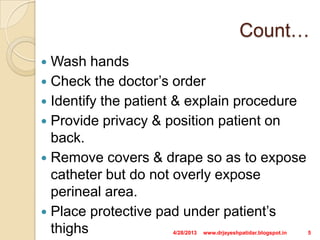
 Wash hands
 Check the doctor’s order
 Identify the patient & explain procedure
 Provide privacy & position patient on
back.
 Remove covers & drape so as to expose
catheter but do not overly expose
perineal area.
 Place protective pad under patient’s
thighs 4/28/2013 5www.drjayeshpatidar.blogspot.in
Count…
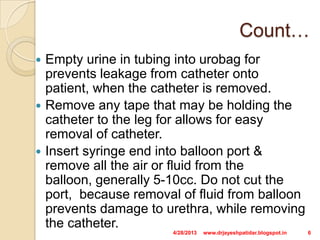
 Empty urine in tubing into urobag for
prevents leakage from catheter onto
patient, when the catheter is removed.
 Remove any tape that may be holding the
catheter to the leg for allows for easy
removal of catheter.
 Insert syringe end into balloon port &
remove all the air or fluid from the
balloon, generally 5-10cc. Do not cut the
port, because removal of fluid from balloon
prevents damage to urethra, while removing
the catheter.
4/28/2013 6www.drjayeshpatidar.blogspot.in
Count…
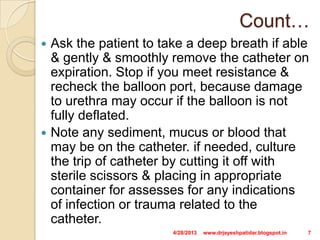
 Ask the patient to take a deep breath if able
& gently & smoothly remove the catheter on
expiration. Stop if you meet resistance &
recheck the balloon port, because damage
to urethra may occur if the balloon is not
fully deflated.
 Note any sediment, mucus or blood that
may be on the catheter. if needed, culture
the trip of catheter by cutting it off with
sterile scissors & placing in appropriate
container for assesses for any indications
of infection or trauma related to the
catheter.
4/28/2013 7www.drjayeshpatidar.blogspot.in
Count…
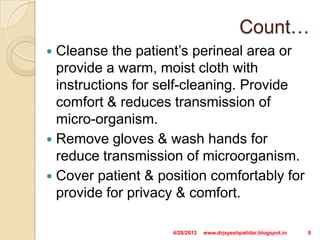
 Cleanse the patient’s perineal area or
provide a warm, moist cloth with
instructions for self-cleaning. Provide
comfort & reduces transmission of
micro-organism.
 Remove gloves & wash hands for
reduce transmission of microorganism.
 Cover patient & position comfortably for
provide for privacy & comfort.
4/28/2013 8www.drjayeshpatidar.blogspot.in
Count…
 Instruct the patient to drink oral fluids as
tolerated & to call when he/she needs to
void. Because determines that patient
has returned to usual voiding pattern.
 Record time & amount of first voiding.
Offer bedpan/ urinal every 2-4 hours.
 If the patient is unable to void within 8
hours, report to the physician.
4/28/2013 9www.drjayeshpatidar.blogspot.in
SPECIAL CONSIDERATION
 Instruct patient to inform the nurse, if
experiencing any pain, or symptoms of
bladder infection, after the catheter is
removed.
 Check if physician has ordered bladder
conditioning before removal of catheter.
 Keep track of intake & output for at least
24 hours after removal of catheter.
 If patient has not voided within 8 hours
after catheter removal, the catheter may
have to be reinserted.
4/28/2013 10www.drjayeshpatidar.blogspot.in
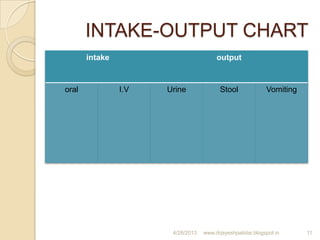
INTAKE-OUTPUT CHART
intake output
oral I.V Urine Stool Vomiting
4/28/2013 www.drjayeshpatidar.blogspot.in 11
4/28/2013 12www.drjayeshpatidar.blogspot.in

Ppt.removing an indwelling ursinary catheter

  • 2.
    PURPOSES  To promotenormal bladder function.  To prevent trauma to the urethra.  To prevent infection. 4/28/2013 2www.drjayeshpatidar.blogspot.in
  • 3.
    ARTICLES  Syringe withoutneedle (10 ml)  Clean gloves  Protective pad  Soap, towel & washcloth  Container for waste disposal  Urinal or bedpan  Kidney tray. 4/28/2013 3www.drjayeshpatidar.blogspot.in
  • 4.
    PROCEDURE  Wash hands& don gloves  If bladder conditioning is to be performed: a. 10 hours before removal, clamp indwelling catheter for 3 hrs. b. Unclamp & drain urine for 5 minutes c. Repeat clamping for 3 hours & draining for 5 minute two more times. 4/28/2013 4www.drjayeshpatidar.blogspot.in
  • 5.
    Count…  Wash hands Check the doctor’s order  Identify the patient & explain procedure  Provide privacy & position patient on back.  Remove covers & drape so as to expose catheter but do not overly expose perineal area.  Place protective pad under patient’s thighs 4/28/2013 5www.drjayeshpatidar.blogspot.in
  • 6.
    Count…  Empty urinein tubing into urobag for prevents leakage from catheter onto patient, when the catheter is removed.  Remove any tape that may be holding the catheter to the leg for allows for easy removal of catheter.  Insert syringe end into balloon port & remove all the air or fluid from the balloon, generally 5-10cc. Do not cut the port, because removal of fluid from balloon prevents damage to urethra, while removing the catheter. 4/28/2013 6www.drjayeshpatidar.blogspot.in
  • 7.
    Count…  Ask thepatient to take a deep breath if able & gently & smoothly remove the catheter on expiration. Stop if you meet resistance & recheck the balloon port, because damage to urethra may occur if the balloon is not fully deflated.  Note any sediment, mucus or blood that may be on the catheter. if needed, culture the trip of catheter by cutting it off with sterile scissors & placing in appropriate container for assesses for any indications of infection or trauma related to the catheter. 4/28/2013 7www.drjayeshpatidar.blogspot.in
  • 8.
    Count…  Cleanse thepatient’s perineal area or provide a warm, moist cloth with instructions for self-cleaning. Provide comfort & reduces transmission of micro-organism.  Remove gloves & wash hands for reduce transmission of microorganism.  Cover patient & position comfortably for provide for privacy & comfort. 4/28/2013 8www.drjayeshpatidar.blogspot.in
  • 9.
    Count…  Instruct thepatient to drink oral fluids as tolerated & to call when he/she needs to void. Because determines that patient has returned to usual voiding pattern.  Record time & amount of first voiding. Offer bedpan/ urinal every 2-4 hours.  If the patient is unable to void within 8 hours, report to the physician. 4/28/2013 9www.drjayeshpatidar.blogspot.in
  • 10.
    SPECIAL CONSIDERATION  Instructpatient to inform the nurse, if experiencing any pain, or symptoms of bladder infection, after the catheter is removed.  Check if physician has ordered bladder conditioning before removal of catheter.  Keep track of intake & output for at least 24 hours after removal of catheter.  If patient has not voided within 8 hours after catheter removal, the catheter may have to be reinserted. 4/28/2013 10www.drjayeshpatidar.blogspot.in
  • 11.
    INTAKE-OUTPUT CHART intake output oralI.V Urine Stool Vomiting 4/28/2013 www.drjayeshpatidar.blogspot.in 11
  • 12.