OVERVIEW:
• SOURCES
• METHODSOF BLOOD COLLECTION
• VENOUS BLOODVSARTERIAL BLOODVS CAPILLARY BLOOD
• TYPES OF ANTICOAGULANTS USED (COLOURCODING)
• BLOOD BANK
Patient’s specimen:
• A properly labelled sample is essential so that the results of the test should
match the patient.
• Label with patient’s ID or the sample number provided for the patient.
oBlood can be collected from 3 different sources:
 Capillary blood.
 Venous blood.
 Arterial blood.
CAPILLARY BLOOD - METHOD OF COLLECTION :
•Select the least used finger.
•Cleanse the site with alcohol swab.
•Puncture across the grain of the skin
•And transfer blood to a strip or small container.
• INDICATIONS:
To draw a small amount of blood
 in a microtube or
 strip for blood sugar and
 bleeding time tests.
 For infants and young children.
Automatic lancet device
HEEL PULP:
FINGER PULP
EAR LOBULE
Blood collection for
arterial blood:
Equipment required:
•Tourniquet.
•Vacutainer and syringe.
•Alcohol swab.
•Bandage
• Specially required for estimation of blood gases ABG,
PH,
CO2 and
O2.
• Collect quickly, fill completely and seal both ends immediately
RADIAL ARTERY AND
BRACHIAL ARTERY
FEMORAL
ARTERY
TEMPORAL ARTERY
Blood collection for
venous blood:
Equipment required:
•Tourniquet.
•Vacutainer and syringe.
•Alcohol swab.
•Bandage
• Most common
Majority of routine tests are performed on venous blood.
Blood can be taken directly from the vein.
The best site - deep veins of the ante-cubital fossa.
FORE ARMVEIN:
Other sites are:
DORSUM OF HAND:
FEMORALVEIN:
JUGULARVEIN
SCALPVEIN
PHLEBOTOMY:
•Surgical opening or puncture of a vein to withdraw
blood or to introduce fluid.
Tourniquet should be applied on the upper arm.
Sterilise the puncture area with a spirit/alcohol swab and allow it
to dry.
Visualize and palpate the vein.
Don’t enter the vein directly and vertically.
Draw blood according to required tests.
Loosen the tourniquet.
Withdraw the needle.
Press down on the gauze, applying adequate pressure.
Apply a piece of band.
Put blood into a suitable container.
•Precaution:
Venipuncture area must be cleaned/sterilized properly.
Tourniquet should not be applied for a long time and not more
than 1 min.
Blind attempts should not made.
Subcutaneous manipulation of the needle to enter a vein
should not be done.
Once the needle is withdrawn, pressure should be applied and
maintained for 1-2 minutes.
If you can’t control the pressure this will cause Ecchymoses i.e.
extravasation of blood.
•Order of Draw:
1st. (Yellow-black stopper)
2nd Plain tube (Red stopper or SST)
3rd Coagulation tube (light blue stopper).
& for the last draw :
1. Heparin
2. EDTA
3. Oxalate/ fluoride
Tubes with anticoagulants/additives must be mixed thoroughly with collected
blood.
•SERUM:
• Liquid remaining after blood has clotted naturally in a plain tube.
• It’s the most common specimen required for chemical and
serological test.
PLASMA:
 A fluid obtained from anticoagulated and centrifuged blood
 Plasma is required for Coagulation Profile and FibrinogenAssay.
Blood Collection tubes
Plastic tube with a rubber stopper include color coded.
Contain anticoagulants and/or other chemical additives.
Plain tubes contain no anticoagulants.
All tubes must be mixed thoroughly.
ANTICOAGULANT TUBE/
VACUTAINER
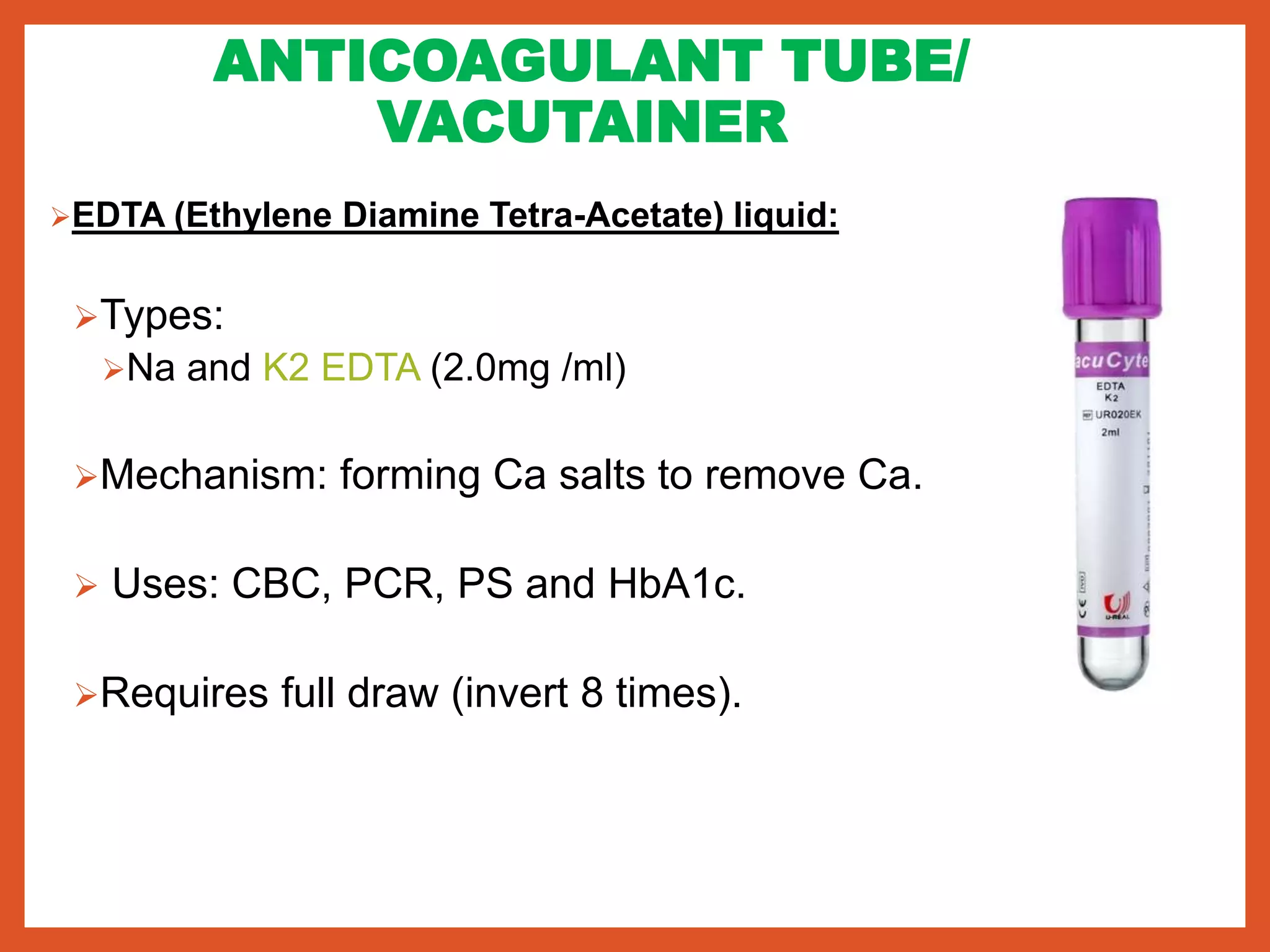
EDTA (Ethylene Diamine Tetra-Acetate) liquid:
Types:
Na and K2 EDTA (2.0mg /ml)
Mechanism: forming Ca salts to remove Ca.
 Uses: CBC, PCR, PS and HbA1c.
Requires full draw (invert 8 times).
EDTA• Available as:
• Disodium EDTA
• Dipotassium EDTA
• Uses:
1. cell counts
2. smears &
3. platelet counts
 Sodium citrate :
 (1:9 ratio).
 Anticoagulant: 3.2%
 Mechanism: Calcium chelation.
 Use: Coagulation studies and
 platelet function.
 BLACK:
 Na citrate 1:4.
 3.8% of sodium citrate
 Action: Remove calcium.
 Uses: Westergren –
Erythrocyte Sedimentation Rate (ESR).
 ESR tube
 Additive: 3.8% sodium citrate
Citrate
•Action:
- Binds Ca in a non-ionsed but soluble complex.
•Disadvantage:
- It is a liquid -
not acceptable for blood cell counts &
Hb estimation.
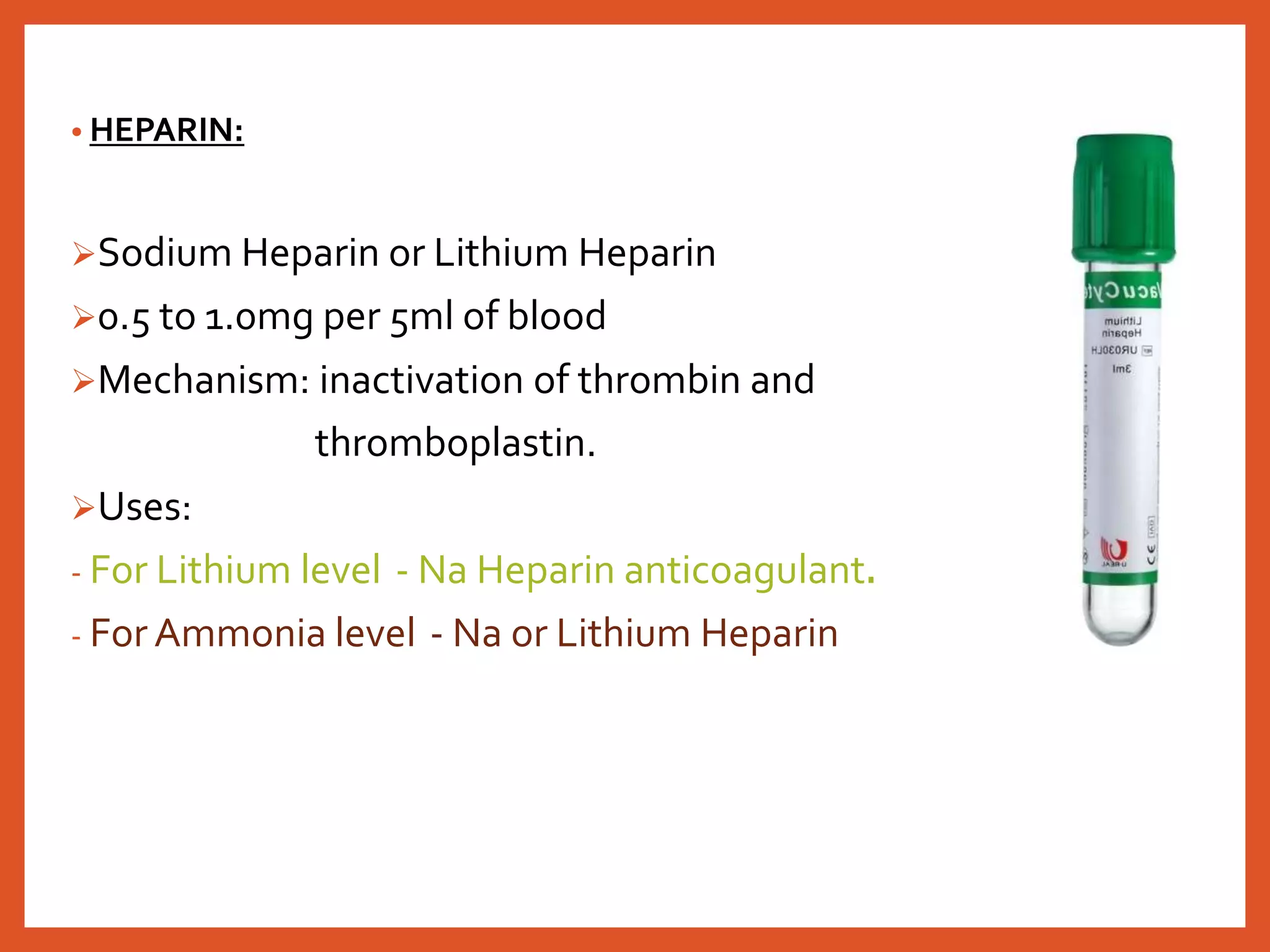
• HEPARIN:
Sodium Heparin or Lithium Heparin
0.5 to 1.0mg per 5ml of blood
Mechanism: inactivation of thrombin and
thromboplastin.
Uses:
- For Lithium level - Na Heparin anticoagulant.
- For Ammonia level - Na or Lithium Heparin
Heparin
• Uses:
-naturally occuring biological anti-coagulant
-Used in hematological special tests,
biochemistry for electrolytes
-For blood gases
-Transfusions
• Action:
-Inhibition of enzymes involved in coagulation
eg: Anti thrombin III
-Inhibits action of thrombin on fibrinogen and formation of
thromboplastin
• Disadvantages:
-expensive
-highly acidic-blue colouration in smear
•GREY:
•Sodium fluoride +
Potassium oxalate
•MOA:
inhibits red cell glycolytic pathway
•Used: blood glucose
Oxalate
•Potasium oxalate:
- concentration is 2mg/ml blood
- shrinkage of RBC’s,
so 8% shrinkage in PCV
- used for chemical analysis
-Not used for PCV, ESR, cell morphology
•Ammonium oxalate:
- concentration 2mg/ml blood
- Adr: swelling of RBC
- Not used for PCV, ESR
RED (PLAINTUBE):
 No preservative/anticoagulant.
 Uses: usually for toxicology and serology
SST (SERUM SEPARATOR TUBE)
 No additives.
 Clotting accelerator and separation gel.
 Uses: Chemistry, Immunology, and Serology.
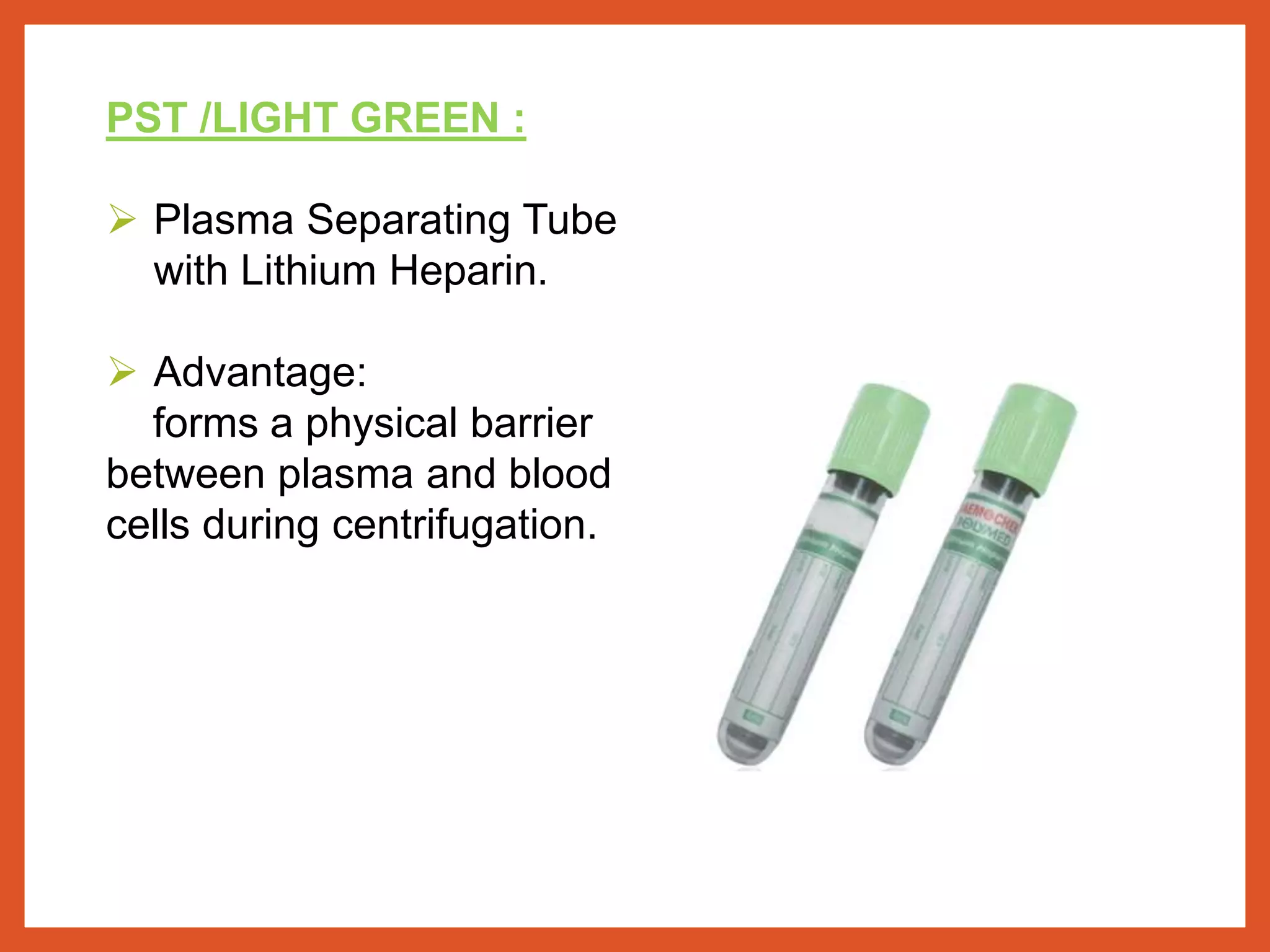
PST /LIGHT GREEN :
 Plasma Separating Tube
with Lithium Heparin.
 Advantage:
forms a physical barrier
between plasma and blood
cells during centrifugation.
• PHOTO :
ANTI-COAGULANT IN
BLOODBAG:
•CPD - CITRATE PHOSPHATE DEXTROSE
•At 2-4 degree C – 21days
•CPDA-1 - CITRATE PHOSPHATE DEXTROSE ADENINE
•At 2-4 degree C – 35 days
•SAGM - SALINE ADENINE GLUCOSE MANNITOL
Apheresis
• Process of removal of whole blood from the donor /patient
• separating it into various components followed by
• retention of desired or unwanted components while the
• remaining consitituents are reinfused back into the
• donor/patient.
• The following terms are used according to the material
• retained :-
• Plateletpheresis – where platelets are retained.
• Plasmapheresis – when plasma is retained.
• Leukopheresis – when white cells are retained.
Apheresis
Techniques used in Apheresis
• Techniques used in Apheresis
• Manual Method
• • Performed using refrigerated centrifuges and specialized plastic bags.
• • Blood collected in the primary bag is centrifuged to separate the desired
• component which is retained in the satellite bag and the remainder is
• reinfused through the same vein back to the donor.
• Advantages:
• • Simple and less expensive method.
• Disadvantages:
• •The amount of component prepared per procedure is less than that collected
• from cell separators.
• •The risk of returning red cells to the wrong patient if stringent donor
• identification is not done.
SUMMARY:
oMETHODSOF SAMPLING
oTYPES OF BLOOD SAMPLED
oTYPES OF ANTICOAGULANTSAND USES FOR EACH
oORDER OF DRAWING BLOOD
oBLOOD BANK.

Blood collection and anticoagulants

  • 2.
    OVERVIEW: • SOURCES • METHODSOFBLOOD COLLECTION • VENOUS BLOODVSARTERIAL BLOODVS CAPILLARY BLOOD • TYPES OF ANTICOAGULANTS USED (COLOURCODING) • BLOOD BANK
  • 3.
    Patient’s specimen: • Aproperly labelled sample is essential so that the results of the test should match the patient. • Label with patient’s ID or the sample number provided for the patient.
  • 4.
    oBlood can becollected from 3 different sources:  Capillary blood.  Venous blood.  Arterial blood.
  • 6.
    CAPILLARY BLOOD -METHOD OF COLLECTION : •Select the least used finger. •Cleanse the site with alcohol swab. •Puncture across the grain of the skin •And transfer blood to a strip or small container.
  • 8.
    • INDICATIONS: To drawa small amount of blood  in a microtube or  strip for blood sugar and  bleeding time tests.  For infants and young children.
  • 9.
  • 10.
  • 11.
  • 13.
    Blood collection for arterialblood: Equipment required: •Tourniquet. •Vacutainer and syringe. •Alcohol swab. •Bandage
  • 14.
    • Specially requiredfor estimation of blood gases ABG, PH, CO2 and O2. • Collect quickly, fill completely and seal both ends immediately
  • 15.
  • 16.
  • 17.
  • 19.
    Blood collection for venousblood: Equipment required: •Tourniquet. •Vacutainer and syringe. •Alcohol swab. •Bandage
  • 20.
    • Most common Majorityof routine tests are performed on venous blood. Blood can be taken directly from the vein. The best site - deep veins of the ante-cubital fossa.
  • 21.
  • 22.
  • 23.
  • 24.
  • 25.
  • 26.
    PHLEBOTOMY: •Surgical opening orpuncture of a vein to withdraw blood or to introduce fluid.
  • 27.
    Tourniquet should beapplied on the upper arm. Sterilise the puncture area with a spirit/alcohol swab and allow it to dry. Visualize and palpate the vein. Don’t enter the vein directly and vertically.
  • 29.
    Draw blood accordingto required tests. Loosen the tourniquet. Withdraw the needle. Press down on the gauze, applying adequate pressure. Apply a piece of band. Put blood into a suitable container.
  • 30.
    •Precaution: Venipuncture area mustbe cleaned/sterilized properly. Tourniquet should not be applied for a long time and not more than 1 min.
  • 31.
    Blind attempts shouldnot made. Subcutaneous manipulation of the needle to enter a vein should not be done. Once the needle is withdrawn, pressure should be applied and maintained for 1-2 minutes. If you can’t control the pressure this will cause Ecchymoses i.e. extravasation of blood.
  • 32.
    •Order of Draw: 1st.(Yellow-black stopper) 2nd Plain tube (Red stopper or SST) 3rd Coagulation tube (light blue stopper). & for the last draw : 1. Heparin 2. EDTA 3. Oxalate/ fluoride Tubes with anticoagulants/additives must be mixed thoroughly with collected blood.
  • 33.
    •SERUM: • Liquid remainingafter blood has clotted naturally in a plain tube. • It’s the most common specimen required for chemical and serological test.
  • 34.
    PLASMA:  A fluidobtained from anticoagulated and centrifuged blood  Plasma is required for Coagulation Profile and FibrinogenAssay.
  • 35.
    Blood Collection tubes Plastictube with a rubber stopper include color coded. Contain anticoagulants and/or other chemical additives. Plain tubes contain no anticoagulants. All tubes must be mixed thoroughly.
  • 36.
    ANTICOAGULANT TUBE/ VACUTAINER EDTA (EthyleneDiamine Tetra-Acetate) liquid: Types: Na and K2 EDTA (2.0mg /ml) Mechanism: forming Ca salts to remove Ca.  Uses: CBC, PCR, PS and HbA1c. Requires full draw (invert 8 times).
  • 37.
    EDTA• Available as: •Disodium EDTA • Dipotassium EDTA • Uses: 1. cell counts 2. smears & 3. platelet counts
  • 38.
     Sodium citrate:  (1:9 ratio).  Anticoagulant: 3.2%  Mechanism: Calcium chelation.  Use: Coagulation studies and  platelet function.
  • 39.
     BLACK:  Nacitrate 1:4.  3.8% of sodium citrate  Action: Remove calcium.  Uses: Westergren – Erythrocyte Sedimentation Rate (ESR).
  • 40.
     ESR tube Additive: 3.8% sodium citrate
  • 41.
    Citrate •Action: - Binds Cain a non-ionsed but soluble complex. •Disadvantage: - It is a liquid - not acceptable for blood cell counts & Hb estimation.
  • 42.
    • HEPARIN: Sodium Heparinor Lithium Heparin 0.5 to 1.0mg per 5ml of blood Mechanism: inactivation of thrombin and thromboplastin. Uses: - For Lithium level - Na Heparin anticoagulant. - For Ammonia level - Na or Lithium Heparin
  • 43.
    Heparin • Uses: -naturally occuringbiological anti-coagulant -Used in hematological special tests, biochemistry for electrolytes -For blood gases -Transfusions • Action: -Inhibition of enzymes involved in coagulation eg: Anti thrombin III -Inhibits action of thrombin on fibrinogen and formation of thromboplastin • Disadvantages: -expensive -highly acidic-blue colouration in smear
  • 44.
    •GREY: •Sodium fluoride + Potassiumoxalate •MOA: inhibits red cell glycolytic pathway •Used: blood glucose
  • 45.
    Oxalate •Potasium oxalate: - concentrationis 2mg/ml blood - shrinkage of RBC’s, so 8% shrinkage in PCV - used for chemical analysis -Not used for PCV, ESR, cell morphology •Ammonium oxalate: - concentration 2mg/ml blood - Adr: swelling of RBC - Not used for PCV, ESR
  • 46.
    RED (PLAINTUBE):  Nopreservative/anticoagulant.  Uses: usually for toxicology and serology
  • 47.
    SST (SERUM SEPARATORTUBE)  No additives.  Clotting accelerator and separation gel.  Uses: Chemistry, Immunology, and Serology.
  • 48.
    PST /LIGHT GREEN:  Plasma Separating Tube with Lithium Heparin.  Advantage: forms a physical barrier between plasma and blood cells during centrifugation.
  • 51.
  • 53.
    ANTI-COAGULANT IN BLOODBAG: •CPD -CITRATE PHOSPHATE DEXTROSE •At 2-4 degree C – 21days •CPDA-1 - CITRATE PHOSPHATE DEXTROSE ADENINE •At 2-4 degree C – 35 days •SAGM - SALINE ADENINE GLUCOSE MANNITOL
  • 54.
    Apheresis • Process ofremoval of whole blood from the donor /patient • separating it into various components followed by • retention of desired or unwanted components while the • remaining consitituents are reinfused back into the • donor/patient. • The following terms are used according to the material • retained :- • Plateletpheresis – where platelets are retained. • Plasmapheresis – when plasma is retained. • Leukopheresis – when white cells are retained.
  • 55.
  • 56.
    Techniques used inApheresis • Techniques used in Apheresis • Manual Method • • Performed using refrigerated centrifuges and specialized plastic bags. • • Blood collected in the primary bag is centrifuged to separate the desired • component which is retained in the satellite bag and the remainder is • reinfused through the same vein back to the donor. • Advantages: • • Simple and less expensive method. • Disadvantages: • •The amount of component prepared per procedure is less than that collected • from cell separators. • •The risk of returning red cells to the wrong patient if stringent donor • identification is not done.
  • 57.
    SUMMARY: oMETHODSOF SAMPLING oTYPES OFBLOOD SAMPLED oTYPES OF ANTICOAGULANTSAND USES FOR EACH oORDER OF DRAWING BLOOD oBLOOD BANK.