Urea cycle
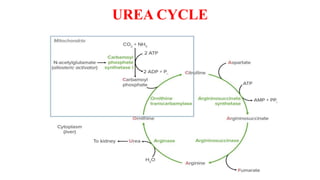
The urea cycle (also known as the ornithine cycle) is a cycle
of biochemical reactions that produces urea (NH2)2CO
from ammonia (NH3). This cycle occurs in ureotelic organisms. The
urea cycle converts highly toxic ammonia to urea for
excretion. This cycle was the first metabolic cycle to be discovered
(Hans Krebs and Kurt Henseleit, 1932), The urea cycle takes place
primarily in the liver and, to a lesser extent, in the kidneys.
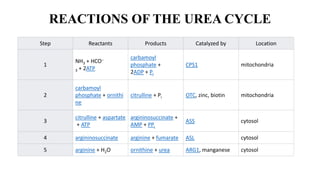
REACTIONS OF THE UREA CYCLE
Step Reactants Products Catalyzed by Location
1
NH3 + HCO−
3 + 2ATP
carbamoyl
phosphate +
2ADP + Pi
CPS1 mitochondria
2
carbamoyl
phosphate + ornithi
ne
citrulline + Pi OTC, zinc, biotin mitochondria
3
citrulline + aspartate
+ ATP
argininosuccinate +
AMP + PPi
ASS cytosol
4 argininosuccinate arginine + fumarate ASL cytosol
5 arginine + H2O ornithine + urea ARG1, manganese cytosol
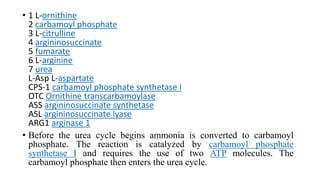
• 1 L-ornithine
2 carbamoyl phosphate
3 L-citrulline
4 argininosuccinate
5 fumarate
6 L-arginine
7 urea
L-Asp L-aspartate
CPS-1 carbamoyl phosphate synthetase I
OTC Ornithine transcarbamoylase
ASS argininosuccinate synthetase
ASL argininosuccinate lyase
ARG1 arginase 1
• Before the urea cycle begins ammonia is converted to carbamoyl
phosphate. The reaction is catalyzed by carbamoyl phosphate
synthetase I and requires the use of two ATP molecules. The
carbamoyl phosphate then enters the urea cycle.
UREA CYCLE
STEPS OF THE UREA CYCLE
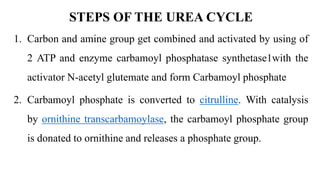
1. Carbon and amine group get combined and activated by using of
2 ATP and enzyme carbamoyl phosphatase synthetase1with the
activator N-acetyl glutemate and form Carbamoyl phosphate
2. Carbamoyl phosphate is converted to citrulline. With catalysis
by ornithine transcarbamoylase, the carbamoyl phosphate group
is donated to ornithine and releases a phosphate group.
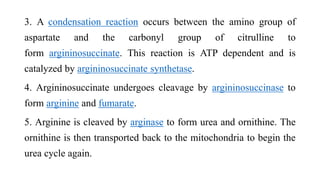
3. A condensation reaction occurs between the amino group of
aspartate and the carbonyl group of citrulline to
form argininosuccinate. This reaction is ATP dependent and is
catalyzed by argininosuccinate synthetase.
4. Argininosuccinate undergoes cleavage by argininosuccinase to
form arginine and fumarate.
5. Arginine is cleaved by arginase to form urea and ornithine. The
ornithine is then transported back to the mitochondria to begin the
urea cycle again.
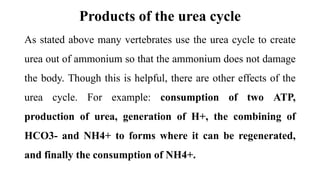
Products of the urea cycle
As stated above many vertebrates use the urea cycle to create
urea out of ammonium so that the ammonium does not damage
the body. Though this is helpful, there are other effects of the
urea cycle. For example: consumption of two ATP,
production of urea, generation of H+, the combining of
HCO3- and NH4+ to forms where it can be regenerated,
and finally the consumption of NH4+.
SIGNIFICANCE OF THE UREA CYCLE
The main purpose of the urea cycle is to eliminate toxic
ammonia from the body. About 10 to 20 g of ammonia is
removed from the body of a healthy adult every day. A
dysfunctional urea cycle would mean excess amount of
ammonia in the body, which can lead to hyperammonemia
and related diseases.
Defects in the urea cycle can cause vomiting, coma and convulsions
in new born babies. This is often misdiagnosed as septicemia and
treated with antibiotics in vain. Even 1mm of excess ammonia can
cause severe and irreversible damages.
DIAGNOSIS OF UREA CYCLE DEFECTS
•A blood aminogram is routinely used in the diagnosis of
urea cycle disorders. The concentration of the nitrogen-
carrying amino acids, glutamine and alanine, in plasma is
elevated in the case of OTC (Ornithine transcarbamylase
deficiency).
Cont….
In babies, elevated levels of orotic acid in the urine may be an
indicator of OTC deficiency. Increased levels of blood citrulline
and argininosuccinate are also seen in cases of citrullinemia.
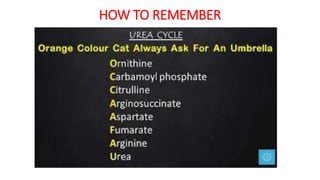
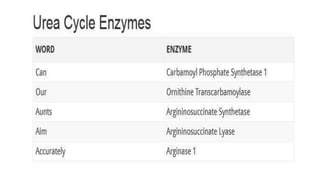
HOW TO REMEMBER
Urea cycle.pptx

Urea cycle.pptx

  • 1.
    Urea cycle The ureacycle (also known as the ornithine cycle) is a cycle of biochemical reactions that produces urea (NH2)2CO from ammonia (NH3). This cycle occurs in ureotelic organisms. The urea cycle converts highly toxic ammonia to urea for excretion. This cycle was the first metabolic cycle to be discovered (Hans Krebs and Kurt Henseleit, 1932), The urea cycle takes place primarily in the liver and, to a lesser extent, in the kidneys.
  • 2.
    REACTIONS OF THEUREA CYCLE Step Reactants Products Catalyzed by Location 1 NH3 + HCO− 3 + 2ATP carbamoyl phosphate + 2ADP + Pi CPS1 mitochondria 2 carbamoyl phosphate + ornithi ne citrulline + Pi OTC, zinc, biotin mitochondria 3 citrulline + aspartate + ATP argininosuccinate + AMP + PPi ASS cytosol 4 argininosuccinate arginine + fumarate ASL cytosol 5 arginine + H2O ornithine + urea ARG1, manganese cytosol
  • 3.
    • 1 L-ornithine 2carbamoyl phosphate 3 L-citrulline 4 argininosuccinate 5 fumarate 6 L-arginine 7 urea L-Asp L-aspartate CPS-1 carbamoyl phosphate synthetase I OTC Ornithine transcarbamoylase ASS argininosuccinate synthetase ASL argininosuccinate lyase ARG1 arginase 1 • Before the urea cycle begins ammonia is converted to carbamoyl phosphate. The reaction is catalyzed by carbamoyl phosphate synthetase I and requires the use of two ATP molecules. The carbamoyl phosphate then enters the urea cycle.
  • 4.
  • 5.
    STEPS OF THEUREA CYCLE 1. Carbon and amine group get combined and activated by using of 2 ATP and enzyme carbamoyl phosphatase synthetase1with the activator N-acetyl glutemate and form Carbamoyl phosphate 2. Carbamoyl phosphate is converted to citrulline. With catalysis by ornithine transcarbamoylase, the carbamoyl phosphate group is donated to ornithine and releases a phosphate group.
  • 6.
    3. A condensationreaction occurs between the amino group of aspartate and the carbonyl group of citrulline to form argininosuccinate. This reaction is ATP dependent and is catalyzed by argininosuccinate synthetase. 4. Argininosuccinate undergoes cleavage by argininosuccinase to form arginine and fumarate. 5. Arginine is cleaved by arginase to form urea and ornithine. The ornithine is then transported back to the mitochondria to begin the urea cycle again.
  • 7.
    Products of theurea cycle As stated above many vertebrates use the urea cycle to create urea out of ammonium so that the ammonium does not damage the body. Though this is helpful, there are other effects of the urea cycle. For example: consumption of two ATP, production of urea, generation of H+, the combining of HCO3- and NH4+ to forms where it can be regenerated, and finally the consumption of NH4+.
  • 8.
    SIGNIFICANCE OF THEUREA CYCLE The main purpose of the urea cycle is to eliminate toxic ammonia from the body. About 10 to 20 g of ammonia is removed from the body of a healthy adult every day. A dysfunctional urea cycle would mean excess amount of ammonia in the body, which can lead to hyperammonemia and related diseases.
  • 9.
    Defects in theurea cycle can cause vomiting, coma and convulsions in new born babies. This is often misdiagnosed as septicemia and treated with antibiotics in vain. Even 1mm of excess ammonia can cause severe and irreversible damages.
  • 10.
    DIAGNOSIS OF UREACYCLE DEFECTS •A blood aminogram is routinely used in the diagnosis of urea cycle disorders. The concentration of the nitrogen- carrying amino acids, glutamine and alanine, in plasma is elevated in the case of OTC (Ornithine transcarbamylase deficiency).
  • 11.
    Cont…. In babies, elevatedlevels of orotic acid in the urine may be an indicator of OTC deficiency. Increased levels of blood citrulline and argininosuccinate are also seen in cases of citrullinemia.
  • 12.