SPECIAL ANTI- POVERTY
PROGRAMMES ADOPTED BY THE
GOVERNMENT
1
MadanKumar
M.A.,M.A.,B.Ed.,M.Phil.,M.B.A.,
MAHATMA GANDHI NATIONAL RURAL EMPLOYMENT
GUARANTEE ACT (MGNREGA)
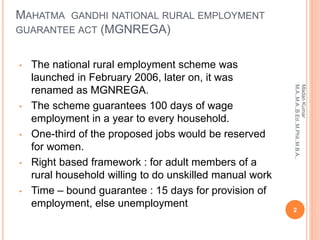
• The national rural employment scheme was
launched in February 2006, later on, it was
renamed as MGNREGA.
• The scheme guarantees 100 days of wage
employment in a year to every household.
• One-third of the proposed jobs would be reserved
for women.
• Right based framework : for adult members of a
rural household willing to do unskilled manual work
• Time – bound guarantee : 15 days for provision of
employment, else unemployment
2
MadanKumar
M.A.,M.A.,B.Ed.,M.Phil.,M.B.A.,
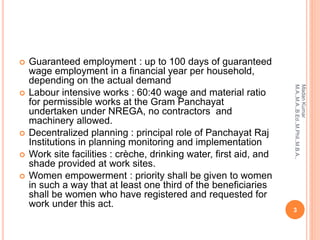
 Guaranteed employment : up to 100 days of guaranteed
wage employment in a financial year per household,
depending on the actual demand
 Labour intensive works : 60:40 wage and material ratio
for permissible works at the Gram Panchayat
undertaken under NREGA, no contractors and
machinery allowed.
 Decentralized planning : principal role of Panchayat Raj
Institutions in planning monitoring and implementation
 Work site facilities : crèche, drinking water, first aid, and
shade provided at work sites.
 Women empowerment : priority shall be given to women
in such a way that at least one third of the beneficiaries
shall be women who have registered and requested for
work under this act.
3
MadanKumar
M.A.,M.A.,B.Ed.,M.Phil.,M.B.A.,
SWARNAJAYANTI GRAM SWAROZGAR YOJANA
(SGSY)
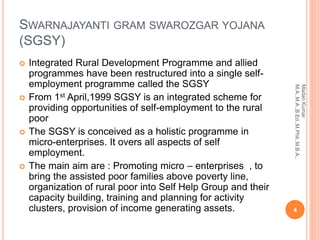
 Integrated Rural Development Programme and allied
programmes have been restructured into a single self-
employment programme called the SGSY
 From 1st April,1999 SGSY is an integrated scheme for
providing opportunities of self-employment to the rural
poor
 The SGSY is conceived as a holistic programme in
micro-enterprises. It overs all aspects of self
employment.
 The main aim are : Promoting micro – enterprises , to
bring the assisted poor families above poverty line,
organization of rural poor into Self Help Group and their
capacity building, training and planning for activity
clusters, provision of income generating assets. 4
MadanKumar
M.A.,M.A.,B.Ed.,M.Phil.,M.B.A.,
 The shame is being implemented on a cost sharing ratio
of 75:25 between the Centre and States.
 It insists that 50 per cent of the self help group must be
formed exclusively by women and that 50 per cent of the
benefits should flow to SCs and STs.
 The SGSY has now been restricted as the National
Rural Livelihoods mission (NRLM) – Aajeevika
 Features of NRLM
a) At least one member from each rural BPL family,
preferably a women, is to be brought under the SHG
net
b) It will focus on setting up of federations of SHGs from
village panchayat to district levels .
5
MadanKumar
M.A.,M.A.,B.Ed.,M.Phil.,M.B.A.,
c) It proposes to ensure universal financial inclusion
by facilitating opening of savings bank accounts of
all beneficiaries
d) It will also focus on supporting rural poor youth for
accessing skilled wage employment through
placement linked skill development projects.
e) The distinctive focus of the NRLM is on
federations of SHGs that become powerful unit of
economic empowerment
6
MadanKumar
M.A.,M.A.,B.Ed.,M.Phil.,M.B.A.,
PRADHAN MANTRI GRAM SADAK YOJANA
(PMGSY)
 The PMGSY was launched on 25th December, 2000
as 100 per cent centrally sponsored scheme.
 The primary objective of the PMGSY is to provide
all weather connectivity to the eligible unconnected
habitations in the rural areas.
 The systematic upgradation of the existing rural
road network
 The programme is funded mainly from the accruals
of diesel cess in the Cantal Road Fund.
 The implementation strategy focuses on quality,
cost management and on time delivery
7
MadanKumar
M.A.,M.A.,B.Ed.,M.Phil.,M.B.A.,
INDIRA AWAS YOJANA (IAY)
 It was launched in May 1985 as a sub-scheme of
Jawahar Rozgar Yojana. Now it is being
implemented as an independent scheme since
January 1996.
 This scheme aims at providing dwelling units, free
of cost, to the poor families of the SC ,ST, freed
bonded labourers
 The scheme is funded on a cost sharing basis of
75:25 between Centre and the States
8
MadanKumar
M.A.,M.A.,B.Ed.,M.Phil.,M.B.A.,
BHARAT NIRMAN
 PMGSY and IAY have now been made components
of Bharat Nirman.
 This programme was launched in 2005-06 for
building infrastructure and basic amenities in rural
areas.
 It has six components
1. Rural housing
2. Irrigation potential
3. Drinking water
4. Rural roads
5. Electrification
6. Rural telecommunication connectivity. 9
MadanKumar
M.A.,M.A.,B.Ed.,M.Phil.,M.B.A.,
SWARNA JAYANTI SHAHARI ROZGAR
YOJANA(SJSRY)
 It was launched on 1st December, 1997,
 This yojana subsumed the earlier three urban
poverty programmes i.e. nehru rozgar yojana,
urban basic services for the poor and prime
minister’s integrated urban poverty alleviation
programme
 The funding pattern for the scheme between centre
and the states is 75:25
 43 new trades have been identified in which it is
proposed to build capacity by skill development,
self-help group and self employment skills plus
facilitation of credit for setting up self employment
10
MadanKumar
M.A.,M.A.,B.Ed.,M.Phil.,M.B.A.,
NATIONAL SOCIAL ASSISTANCE PROGRAMME
 It was introduced on 15 August 1995 as centrally
sponsored scheme.
 The baisc aim of this programme was to provide
social assistance benefit to the rural people in case
of old age, death of primary bread-earner and for
poor women during maternity.
 It provides an opportunity for linking the social
assistance package to schemes for poverty
alleviation and provision of basic needs
11
MadanKumar
M.A.,M.A.,B.Ed.,M.Phil.,M.B.A.,
NATIONAL FOOD FOR WORK PROGRAMME
 This programme was launched on November 14,
2004.
 It aims at augmenting food security through
creation of need based economic, social and
community assets in the backward districts of the
country
12
MadanKumar
M.A.,M.A.,B.Ed.,M.Phil.,M.B.A.,
ANNAPURNA YOJNA
 This scheme came into effect from April 1, 2001
 It aims at providing food security to meet the
requirements of the senior citizens,
13
MadanKumar
M.A.,M.A.,B.Ed.,M.Phil.,M.B.A.,
KRISHI SHRMIK SAMAJIK SURAKSHA YOJANA
 This schema was launched in July,2001 for giving
social security benefits to agricultural laborers
14
MadanKumar
M.A.,M.A.,B.Ed.,M.Phil.,M.B.A.,
SHIKSHA SAHAYOG YOJANA
 The scheme has been finalized for providing
educational allowance of ₹100 per month to the
children of parents living below the poverty line
15
MadanKumar
M.A.,M.A.,B.Ed.,M.Phil.,M.B.A.,
ANTYODAYA ANNA YOJANA
 The scheme was launched by the prime minster in
December, 2000.
 Under the scheme one crore poorest families out
of the BPL families covered under the Targeted
Public Distribution System are identified .
 35kg of food grain are made available to each
eligible family at highly subsidized rate of ₹2 per kg
for wheat and ₹3 per kg rice.
16
MadanKumar
M.A.,M.A.,B.Ed.,M.Phil.,M.B.A.,
PRADHAN MANTRI JAN-DHAN YOJNA
 In the year 2014, the government launched this
scheme to promote saving habit among people by
encouraging them to open a bank account.
 Besides promoting savings, it intends to transfer the
benefits of government schemes as subsidies
directly to the account holders.
 Each account holder is also entitled to ₹1 lakh
accident insurance and ₹30,000 life insurance cover .
17
MadanKumar
M.A.,M.A.,B.Ed.,M.Phil.,M.B.A.,
18
MadanKumar
M.A.,M.A.,B.Ed.,M.Phil.,M.B.A.,

Poverty allivation programme by government

  • 1.
    SPECIAL ANTI- POVERTY PROGRAMMESADOPTED BY THE GOVERNMENT 1 MadanKumar M.A.,M.A.,B.Ed.,M.Phil.,M.B.A.,
  • 2.
    MAHATMA GANDHI NATIONALRURAL EMPLOYMENT GUARANTEE ACT (MGNREGA) • The national rural employment scheme was launched in February 2006, later on, it was renamed as MGNREGA. • The scheme guarantees 100 days of wage employment in a year to every household. • One-third of the proposed jobs would be reserved for women. • Right based framework : for adult members of a rural household willing to do unskilled manual work • Time – bound guarantee : 15 days for provision of employment, else unemployment 2 MadanKumar M.A.,M.A.,B.Ed.,M.Phil.,M.B.A.,
  • 3.
     Guaranteed employment: up to 100 days of guaranteed wage employment in a financial year per household, depending on the actual demand  Labour intensive works : 60:40 wage and material ratio for permissible works at the Gram Panchayat undertaken under NREGA, no contractors and machinery allowed.  Decentralized planning : principal role of Panchayat Raj Institutions in planning monitoring and implementation  Work site facilities : crèche, drinking water, first aid, and shade provided at work sites.  Women empowerment : priority shall be given to women in such a way that at least one third of the beneficiaries shall be women who have registered and requested for work under this act. 3 MadanKumar M.A.,M.A.,B.Ed.,M.Phil.,M.B.A.,
  • 4.
    SWARNAJAYANTI GRAM SWAROZGARYOJANA (SGSY)  Integrated Rural Development Programme and allied programmes have been restructured into a single self- employment programme called the SGSY  From 1st April,1999 SGSY is an integrated scheme for providing opportunities of self-employment to the rural poor  The SGSY is conceived as a holistic programme in micro-enterprises. It overs all aspects of self employment.  The main aim are : Promoting micro – enterprises , to bring the assisted poor families above poverty line, organization of rural poor into Self Help Group and their capacity building, training and planning for activity clusters, provision of income generating assets. 4 MadanKumar M.A.,M.A.,B.Ed.,M.Phil.,M.B.A.,
  • 5.
     The shameis being implemented on a cost sharing ratio of 75:25 between the Centre and States.  It insists that 50 per cent of the self help group must be formed exclusively by women and that 50 per cent of the benefits should flow to SCs and STs.  The SGSY has now been restricted as the National Rural Livelihoods mission (NRLM) – Aajeevika  Features of NRLM a) At least one member from each rural BPL family, preferably a women, is to be brought under the SHG net b) It will focus on setting up of federations of SHGs from village panchayat to district levels . 5 MadanKumar M.A.,M.A.,B.Ed.,M.Phil.,M.B.A.,
  • 6.
    c) It proposesto ensure universal financial inclusion by facilitating opening of savings bank accounts of all beneficiaries d) It will also focus on supporting rural poor youth for accessing skilled wage employment through placement linked skill development projects. e) The distinctive focus of the NRLM is on federations of SHGs that become powerful unit of economic empowerment 6 MadanKumar M.A.,M.A.,B.Ed.,M.Phil.,M.B.A.,
  • 7.
    PRADHAN MANTRI GRAMSADAK YOJANA (PMGSY)  The PMGSY was launched on 25th December, 2000 as 100 per cent centrally sponsored scheme.  The primary objective of the PMGSY is to provide all weather connectivity to the eligible unconnected habitations in the rural areas.  The systematic upgradation of the existing rural road network  The programme is funded mainly from the accruals of diesel cess in the Cantal Road Fund.  The implementation strategy focuses on quality, cost management and on time delivery 7 MadanKumar M.A.,M.A.,B.Ed.,M.Phil.,M.B.A.,
  • 8.
    INDIRA AWAS YOJANA(IAY)  It was launched in May 1985 as a sub-scheme of Jawahar Rozgar Yojana. Now it is being implemented as an independent scheme since January 1996.  This scheme aims at providing dwelling units, free of cost, to the poor families of the SC ,ST, freed bonded labourers  The scheme is funded on a cost sharing basis of 75:25 between Centre and the States 8 MadanKumar M.A.,M.A.,B.Ed.,M.Phil.,M.B.A.,
  • 9.
    BHARAT NIRMAN  PMGSYand IAY have now been made components of Bharat Nirman.  This programme was launched in 2005-06 for building infrastructure and basic amenities in rural areas.  It has six components 1. Rural housing 2. Irrigation potential 3. Drinking water 4. Rural roads 5. Electrification 6. Rural telecommunication connectivity. 9 MadanKumar M.A.,M.A.,B.Ed.,M.Phil.,M.B.A.,
  • 10.
    SWARNA JAYANTI SHAHARIROZGAR YOJANA(SJSRY)  It was launched on 1st December, 1997,  This yojana subsumed the earlier three urban poverty programmes i.e. nehru rozgar yojana, urban basic services for the poor and prime minister’s integrated urban poverty alleviation programme  The funding pattern for the scheme between centre and the states is 75:25  43 new trades have been identified in which it is proposed to build capacity by skill development, self-help group and self employment skills plus facilitation of credit for setting up self employment 10 MadanKumar M.A.,M.A.,B.Ed.,M.Phil.,M.B.A.,
  • 11.
    NATIONAL SOCIAL ASSISTANCEPROGRAMME  It was introduced on 15 August 1995 as centrally sponsored scheme.  The baisc aim of this programme was to provide social assistance benefit to the rural people in case of old age, death of primary bread-earner and for poor women during maternity.  It provides an opportunity for linking the social assistance package to schemes for poverty alleviation and provision of basic needs 11 MadanKumar M.A.,M.A.,B.Ed.,M.Phil.,M.B.A.,
  • 12.
    NATIONAL FOOD FORWORK PROGRAMME  This programme was launched on November 14, 2004.  It aims at augmenting food security through creation of need based economic, social and community assets in the backward districts of the country 12 MadanKumar M.A.,M.A.,B.Ed.,M.Phil.,M.B.A.,
  • 13.
    ANNAPURNA YOJNA  Thisscheme came into effect from April 1, 2001  It aims at providing food security to meet the requirements of the senior citizens, 13 MadanKumar M.A.,M.A.,B.Ed.,M.Phil.,M.B.A.,
  • 14.
    KRISHI SHRMIK SAMAJIKSURAKSHA YOJANA  This schema was launched in July,2001 for giving social security benefits to agricultural laborers 14 MadanKumar M.A.,M.A.,B.Ed.,M.Phil.,M.B.A.,
  • 15.
    SHIKSHA SAHAYOG YOJANA The scheme has been finalized for providing educational allowance of ₹100 per month to the children of parents living below the poverty line 15 MadanKumar M.A.,M.A.,B.Ed.,M.Phil.,M.B.A.,
  • 16.
    ANTYODAYA ANNA YOJANA The scheme was launched by the prime minster in December, 2000.  Under the scheme one crore poorest families out of the BPL families covered under the Targeted Public Distribution System are identified .  35kg of food grain are made available to each eligible family at highly subsidized rate of ₹2 per kg for wheat and ₹3 per kg rice. 16 MadanKumar M.A.,M.A.,B.Ed.,M.Phil.,M.B.A.,
  • 17.
    PRADHAN MANTRI JAN-DHANYOJNA  In the year 2014, the government launched this scheme to promote saving habit among people by encouraging them to open a bank account.  Besides promoting savings, it intends to transfer the benefits of government schemes as subsidies directly to the account holders.  Each account holder is also entitled to ₹1 lakh accident insurance and ₹30,000 life insurance cover . 17 MadanKumar M.A.,M.A.,B.Ed.,M.Phil.,M.B.A.,
  • 18.