Upward Communication and
Downward Communication
Ms. Nupoor Awsarmol
Department of Computer Science
Contents
Definition of Upward Communication
Objectives of Upward Communication
Advantages of Upward Communication
Definition of Downward Communication
Objectives of Downward Communication
Advantages of Downward Communication
Upward Communication
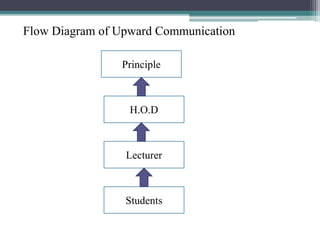
Upward communication is the flow of message or information
from lower level to higher level in any organization.
According to Dr. Urmila Rai “Messages Which Go From
Subordinates To Supervisors And To Higher Levels Are
Upward Communication.”
In The Opinion Of L.C Bovee & Others, “Upward
Communication Is The Flow Of Information From Lower
Level To Higher Level In The Organization.”
Flow Diagram of Upward Communication
Principle
H.O.D
Lecturer
Students
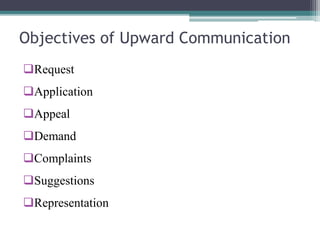
Objectives of Upward Communication
Request
Application
Appeal
Demand
Complaints
Suggestions
Representation
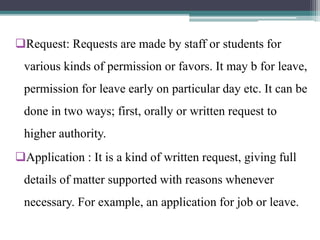
Request: Requests are made by staff or students for
various kinds of permission or favors. It may b for leave,
permission for leave early on particular day etc. It can be
done in two ways; first, orally or written request to
higher authority.
Application : It is a kind of written request, giving full
details of matter supported with reasons whenever
necessary. For example, an application for job or leave.
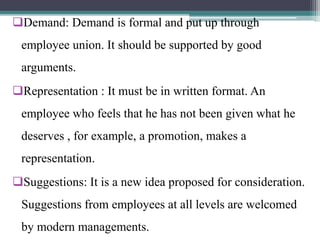
Demand: Demand is formal and put up through
employee union. It should be supported by good
arguments.
Representation : It must be in written format. An
employee who feels that he has not been given what he
deserves , for example, a promotion, makes a
representation.
Suggestions: It is a new idea proposed for consideration.
Suggestions from employees at all levels are welcomed
by modern managements.
Advantages of Upward Communication
Feedback : Upward communication provides
feedback to higher authority. The management is
able to know what the employees think of the
organization and their decisions.
Management will also understand whether the
directives issued to the lower level employees have
been properly understood and followed.
Effective Decision making : Employees supply the
information and their opinions through upward
communication that helps the management to make
decision easier and quick.
Constructive Suggestion: Everyone develops ideas
about better ways in which to do their work or to
improve their conditions. In an organization, suggestions
from employees at all levels are greatly welcomed for
improvement of work.
Motivating: Upward communication system encourages
the lower-level employees to express their opinions and
suggestions to the superiors that, in fact, act as a
motivational tool.
Easier Introduction of New Schemes: In upward
communication system, the subordinates feel themselves
as a part of decision making process. Hence,
management can introduce new schemes without the
resistance of the employees.
Downward communication
Message moving from seniors to subordinates in an
organization or from person with expert knowledge
to lay persons is called downward communication.
According to Dr. Urmila Rai, “Message which in
turn should go in the increased authority levels to the
cheaper levels is actually downward
communication.”
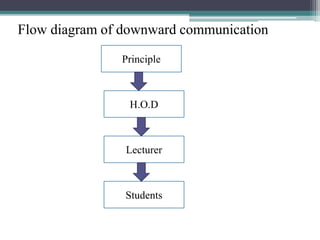
Flow diagram of downward communication
Principle
H.O.D
Lecturer
Students
Objective of downward
communication
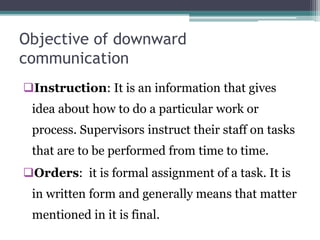
Instruction: It is an information that gives
idea about how to do a particular work or
process. Supervisors instruct their staff on tasks
that are to be performed from time to time.
Orders: it is formal assignment of a task. It is
in written form and generally means that matter
mentioned in it is final.
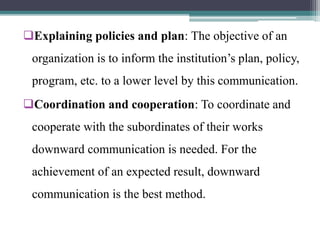
Explaining policies and plan: The objective of an
organization is to inform the institution’s plan, policy,
program, etc. to a lower level by this communication.
Coordination and cooperation: To coordinate and
cooperate with the subordinates of their works
downward communication is needed. For the
achievement of an expected result, downward
communication is the best method.
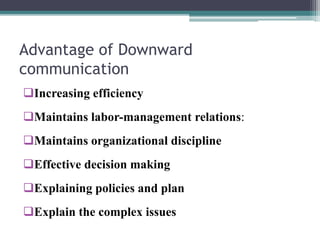
Advantage of Downward
communication
Increasing efficiency
Maintains labor-management relations:
Maintains organizational discipline
Effective decision making
Explaining policies and plan
Explain the complex issues
Thank you!!

Upward communication and downward communication

  • 1.
    Upward Communication and DownwardCommunication Ms. Nupoor Awsarmol Department of Computer Science
  • 2.
    Contents Definition of UpwardCommunication Objectives of Upward Communication Advantages of Upward Communication Definition of Downward Communication Objectives of Downward Communication Advantages of Downward Communication
  • 3.
    Upward Communication Upward communicationis the flow of message or information from lower level to higher level in any organization. According to Dr. Urmila Rai “Messages Which Go From Subordinates To Supervisors And To Higher Levels Are Upward Communication.” In The Opinion Of L.C Bovee & Others, “Upward Communication Is The Flow Of Information From Lower Level To Higher Level In The Organization.”
  • 4.
    Flow Diagram ofUpward Communication Principle H.O.D Lecturer Students
  • 5.
    Objectives of UpwardCommunication Request Application Appeal Demand Complaints Suggestions Representation
  • 6.
    Request: Requests aremade by staff or students for various kinds of permission or favors. It may b for leave, permission for leave early on particular day etc. It can be done in two ways; first, orally or written request to higher authority. Application : It is a kind of written request, giving full details of matter supported with reasons whenever necessary. For example, an application for job or leave.
  • 7.
    Demand: Demand isformal and put up through employee union. It should be supported by good arguments. Representation : It must be in written format. An employee who feels that he has not been given what he deserves , for example, a promotion, makes a representation. Suggestions: It is a new idea proposed for consideration. Suggestions from employees at all levels are welcomed by modern managements.
  • 8.
    Advantages of UpwardCommunication Feedback : Upward communication provides feedback to higher authority. The management is able to know what the employees think of the organization and their decisions. Management will also understand whether the directives issued to the lower level employees have been properly understood and followed.
  • 9.
    Effective Decision making: Employees supply the information and their opinions through upward communication that helps the management to make decision easier and quick. Constructive Suggestion: Everyone develops ideas about better ways in which to do their work or to improve their conditions. In an organization, suggestions from employees at all levels are greatly welcomed for improvement of work.
  • 10.
    Motivating: Upward communicationsystem encourages the lower-level employees to express their opinions and suggestions to the superiors that, in fact, act as a motivational tool. Easier Introduction of New Schemes: In upward communication system, the subordinates feel themselves as a part of decision making process. Hence, management can introduce new schemes without the resistance of the employees.
  • 11.
    Downward communication Message movingfrom seniors to subordinates in an organization or from person with expert knowledge to lay persons is called downward communication. According to Dr. Urmila Rai, “Message which in turn should go in the increased authority levels to the cheaper levels is actually downward communication.”
  • 12.
    Flow diagram ofdownward communication Principle H.O.D Lecturer Students
  • 13.
    Objective of downward communication Instruction:It is an information that gives idea about how to do a particular work or process. Supervisors instruct their staff on tasks that are to be performed from time to time. Orders: it is formal assignment of a task. It is in written form and generally means that matter mentioned in it is final.
  • 14.
    Explaining policies andplan: The objective of an organization is to inform the institution’s plan, policy, program, etc. to a lower level by this communication. Coordination and cooperation: To coordinate and cooperate with the subordinates of their works downward communication is needed. For the achievement of an expected result, downward communication is the best method.
  • 15.
    Advantage of Downward communication Increasingefficiency Maintains labor-management relations: Maintains organizational discipline Effective decision making Explaining policies and plan Explain the complex issues
  • 16.