UNITED PARCEL SERVICE
 HARVARD BUSINESS SCHOOL


Masca Indra
Renni Rengganis
Yessie Fransiska
OUTLINE

Case Background

Case Problem Definition

Company Profile

Problem solving and analysis

Conclusion
Case Background
On an annual basis, UPS delivers 4 billion packages and documents
through a fleet of approximately 100,000 package cars, vans, tractors,
motorcycles and 233 UPS-owned aircraft


         Having an enormous package delivery network, offers UPS an opportunity to
         create even greater value for their customers by using the network to manage
         the                               integration                             of
         information,    transportation,     inventory,    warehousing,     material
         handling, packaging and even the security of packages.
Case Problem Definition
1. New plan for hiring outside talent Information Services
2. Different opinions about hiring new talent for Information Services
3. Facing the competitors and new technology challenges
4. Face the competitors
   USPS : they compete in the delivery of low weight packages in short distance
   and expedited service.
   FedEx : the using of hi tech
5. Face the new generation of workers
6. Information service department’s problems :
                   - poor skill
                   - haven’t specialist the “new” outsiders can not match with
                   UPS culture
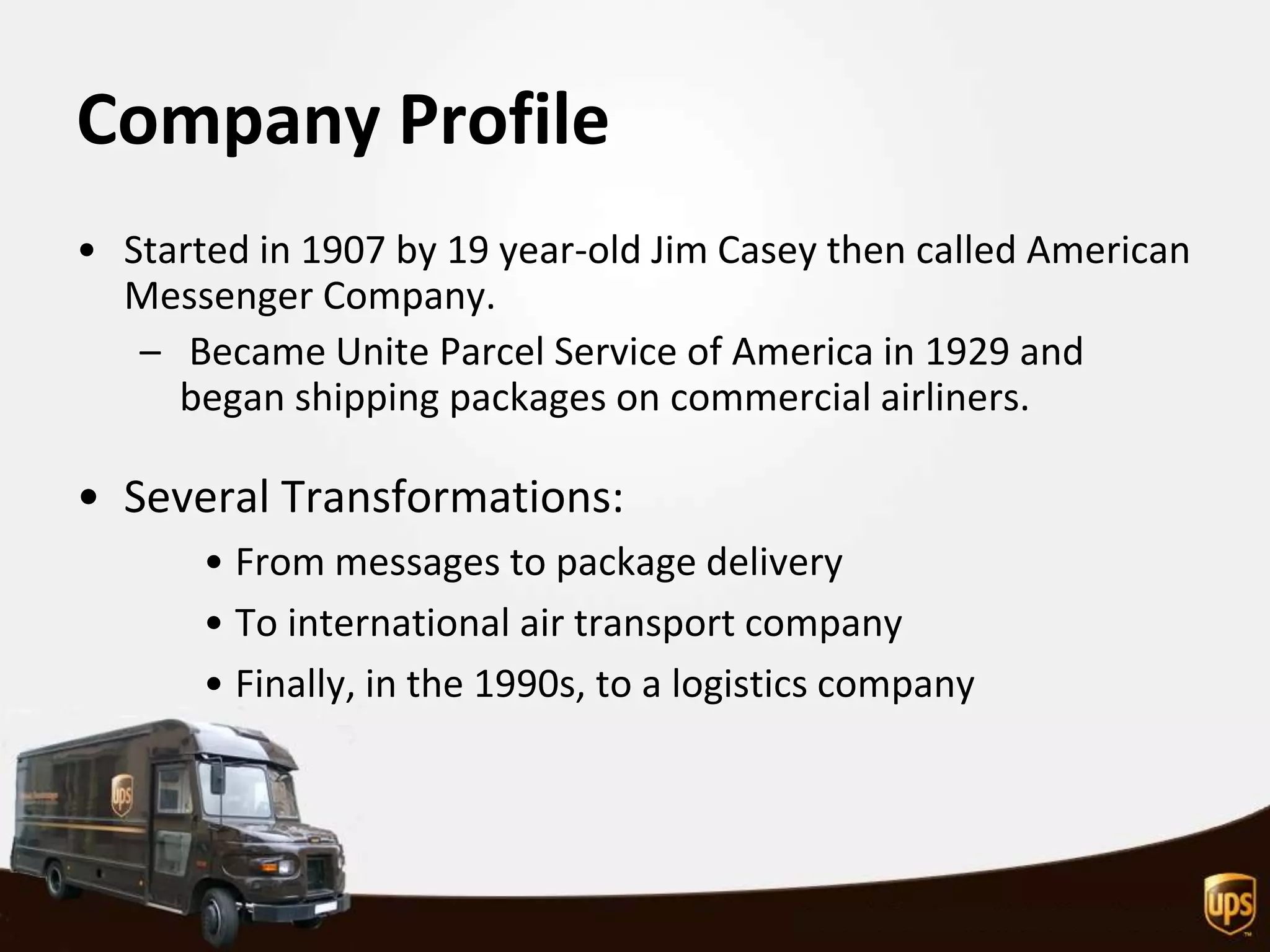
Company Profile
• Started in 1907 by 19 year-old Jim Casey then called American
  Messenger Company.
   – Became Unite Parcel Service of America in 1929 and
     began shipping packages on commercial airliners.

• Several Transformations:
       • From messages to package delivery
       • To international air transport company
       • Finally, in the 1990s, to a logistics company
The UPS Road Map

 Year                                         Description
 1907   Jim Casey founds a six-bicycle messenger service called American Messenger Company in
        Seattle, Washington
 1913   American Messenger merges with Motorcycle Delivery Company, creating Merchants
        Parcel Delivery, which has a "fleet" of a few motorcycles and one
        Model T Ford.
 1915   The company begins painting its delivery vehicles brown.
 1916   The company drivers join the International Brotherhood of Teamsters.
 1918   Three Seattle department stores hire the firm to deliver merchandise to their customers.
 1919   After buying a delivery firm in Oakland, California, the company changes its name to
        United Parcel Service (UPS).
 1930   Operations are expanded to New York City, which also becomes the location of the
        company's new headquarters.
 1953   UPS begins a steady expansion of its common-carrier parcel business, through which it
        picks up parcels from anyone and takes them to anyone else; UPS Air is launched as a
        two-day air express service connecting major cities on the East and West Coasts.
The UPS Road Map


 Year                                          Description
 1962   Casey ends his long reign as CEO.
 1975   UPS becomes the first package delivery firm to serve every address in the continental
        United States; the first international expansion begins with the launch of delivery service
        in Ontario, Canada; the company moves its headquarters to Connecticut.
 1976   UPS enters the European market through the start-up of a delivery service in West
        Germany.
 1982   UPS Next Day Air, an overnight air delivery service, debuts.
 1985   The company begins offering international air service between the United States and
        Europe.
 1991   Headquarters are relocated to Atlanta.
Company Profile
Known in the industry as "Big Brown,“ UPS is one of the biggest
Shipping Company In US

UPS relocated its corporate headquarters from Greenwich, Connecticut,
to Atlanta, Georgia


By 1992, the corporation was     investing more money in
computers        than in ubiquitous brown vehicles. These internal
changes reflected the company's traditional focus on super-efficiency
as well as its newfound emphasis on customer satisfaction.
UPS VALUE


We serve the evolving distribution, logistics, and
commerce needs of our customer worldwide, offering
excellence and value in all we do. We sustain a
financially strong company, with broad employee
ownership, that provides a long-term competitive return
to our shareowners.

 – UPS Mission Statement
CULTURE


• “Consensus building”
• Focused on efficiency and execution
• Continuous improvement
• Strong values: service excellence, employee
  ownership, commitment to stability
• Low turnover, loyal workforce
 Private postal companies
COMPETITION                        – Federal Express
                                 Large government-supported agencies
                                   – USPS
                                   – Deutsche Post


  HEAD-TO-HEAD COMPETITION
                                 FedEx                   UPS
Ground Vehicles              50,000              88,000
Aircraft                     625                 583
Employees                    216,500             360,000
Packages Shipped Daily       5.4 million         13 million
Assets                       $15.4 billion       $28.9 billion
Revenues                     $22.5 billion       $33.4 billion
Net Income                   $830 million        $2.9 billion
Problem solving and conclusion
Problem solving


                               To be the first company in
 For the problem are faced
                              Logistic Industry, UPS have
  by UPS, they are late to
                                  to concern about this
   follow the technology                                    The choice for hiring can be
                              problem, they should place
   because lack of skill in                                    internal or external.
                                  the person with high
    Information Service
                                capability in Information
        Department.
                                  Service Department.
INTERNAL RECRUITMENT                         EXTERNAL RECRUITMENT

              ADVANTAGES                                    ADVANTAGES
1. The cost is relatively cheap, because it   1. Have ideas and new approaches
   does not need the selection
   process as external recruitment.
2. Organization knows that workers have       2. Work started with a
   the ability to chair empty.                   clean sheet and pay attention to the
                                                 specification of experience

3. Workers have a                             3. The level of
   high motivation because knowing the           knowledge and expertise not
   possibility of increasing                     available within the
                                                 company that now.
4. Clear career development

5. Workers have a good understanding
  of policies, procedures, rules and habit
  of the organization.
INTERNAL RECRUITMENT                          EXTERNAL RECRUITMENT

             DISADVANTAGES                                  DISADVANTAGES
1. Not always provide a new perspective        1. Low employee morale and commitment


2. Promoted workers are                        2. A relatively long period of adjustment
   familiar with subordinates making it
   difficult to run the authority and power.
UPS VALUES :
• Function as partner
• Consolidated parcel delivery is main business
• Promote from within
• Considerate and understanding of our people
• Uniform service
• Maintain dependable delivery service
• Insist upon integrity in our people
• Economic stability


                               UPS Core Competencies
                               Achievement orientation
                             Organizational commitment
                             Teamwork and cooperation
                                  Developing others
                          Relationship building (networking)
CONCLUSION

 • Based on the value that company
   have, especially about employee which is said
   that “Promote from within”, we decided to make
   Internal Recruitment for IT Service.
 • IT Service need company generic
   competency, the skill can be trained to the
   internal sources.
 • The UPS has already run well because the
   employee, supervisor, manager, and director
   have a solid teamwork, the newcomers have to
   work hard to adjust the culture. It’s better to
   choose Internal Recruitment as a choice.
thaNK yOu…

United parcel service

  • 1.
    UNITED PARCEL SERVICE HARVARD BUSINESS SCHOOL Masca Indra Renni Rengganis Yessie Fransiska
  • 2.
    OUTLINE Case Background Case ProblemDefinition Company Profile Problem solving and analysis Conclusion
  • 3.
    Case Background On anannual basis, UPS delivers 4 billion packages and documents through a fleet of approximately 100,000 package cars, vans, tractors, motorcycles and 233 UPS-owned aircraft Having an enormous package delivery network, offers UPS an opportunity to create even greater value for their customers by using the network to manage the integration of information, transportation, inventory, warehousing, material handling, packaging and even the security of packages.
  • 4.
    Case Problem Definition 1.New plan for hiring outside talent Information Services 2. Different opinions about hiring new talent for Information Services 3. Facing the competitors and new technology challenges 4. Face the competitors USPS : they compete in the delivery of low weight packages in short distance and expedited service. FedEx : the using of hi tech 5. Face the new generation of workers 6. Information service department’s problems : - poor skill - haven’t specialist the “new” outsiders can not match with UPS culture
  • 5.
    Company Profile • Startedin 1907 by 19 year-old Jim Casey then called American Messenger Company. – Became Unite Parcel Service of America in 1929 and began shipping packages on commercial airliners. • Several Transformations: • From messages to package delivery • To international air transport company • Finally, in the 1990s, to a logistics company
  • 6.
    The UPS RoadMap Year Description 1907 Jim Casey founds a six-bicycle messenger service called American Messenger Company in Seattle, Washington 1913 American Messenger merges with Motorcycle Delivery Company, creating Merchants Parcel Delivery, which has a "fleet" of a few motorcycles and one Model T Ford. 1915 The company begins painting its delivery vehicles brown. 1916 The company drivers join the International Brotherhood of Teamsters. 1918 Three Seattle department stores hire the firm to deliver merchandise to their customers. 1919 After buying a delivery firm in Oakland, California, the company changes its name to United Parcel Service (UPS). 1930 Operations are expanded to New York City, which also becomes the location of the company's new headquarters. 1953 UPS begins a steady expansion of its common-carrier parcel business, through which it picks up parcels from anyone and takes them to anyone else; UPS Air is launched as a two-day air express service connecting major cities on the East and West Coasts.
  • 7.
    The UPS RoadMap Year Description 1962 Casey ends his long reign as CEO. 1975 UPS becomes the first package delivery firm to serve every address in the continental United States; the first international expansion begins with the launch of delivery service in Ontario, Canada; the company moves its headquarters to Connecticut. 1976 UPS enters the European market through the start-up of a delivery service in West Germany. 1982 UPS Next Day Air, an overnight air delivery service, debuts. 1985 The company begins offering international air service between the United States and Europe. 1991 Headquarters are relocated to Atlanta.
  • 8.
    Company Profile Known inthe industry as "Big Brown,“ UPS is one of the biggest Shipping Company In US UPS relocated its corporate headquarters from Greenwich, Connecticut, to Atlanta, Georgia By 1992, the corporation was investing more money in computers than in ubiquitous brown vehicles. These internal changes reflected the company's traditional focus on super-efficiency as well as its newfound emphasis on customer satisfaction.
  • 9.
    UPS VALUE We servethe evolving distribution, logistics, and commerce needs of our customer worldwide, offering excellence and value in all we do. We sustain a financially strong company, with broad employee ownership, that provides a long-term competitive return to our shareowners. – UPS Mission Statement
  • 10.
    CULTURE • “Consensus building” •Focused on efficiency and execution • Continuous improvement • Strong values: service excellence, employee ownership, commitment to stability • Low turnover, loyal workforce
  • 11.
     Private postalcompanies COMPETITION – Federal Express  Large government-supported agencies – USPS – Deutsche Post HEAD-TO-HEAD COMPETITION FedEx UPS Ground Vehicles 50,000 88,000 Aircraft 625 583 Employees 216,500 360,000 Packages Shipped Daily 5.4 million 13 million Assets $15.4 billion $28.9 billion Revenues $22.5 billion $33.4 billion Net Income $830 million $2.9 billion
  • 12.
  • 13.
    Problem solving To be the first company in For the problem are faced Logistic Industry, UPS have by UPS, they are late to to concern about this follow the technology The choice for hiring can be problem, they should place because lack of skill in internal or external. the person with high Information Service capability in Information Department. Service Department.
  • 15.
    INTERNAL RECRUITMENT EXTERNAL RECRUITMENT ADVANTAGES ADVANTAGES 1. The cost is relatively cheap, because it 1. Have ideas and new approaches does not need the selection process as external recruitment. 2. Organization knows that workers have 2. Work started with a the ability to chair empty. clean sheet and pay attention to the specification of experience 3. Workers have a 3. The level of high motivation because knowing the knowledge and expertise not possibility of increasing available within the company that now. 4. Clear career development 5. Workers have a good understanding of policies, procedures, rules and habit of the organization.
  • 16.
    INTERNAL RECRUITMENT EXTERNAL RECRUITMENT DISADVANTAGES DISADVANTAGES 1. Not always provide a new perspective 1. Low employee morale and commitment 2. Promoted workers are 2. A relatively long period of adjustment familiar with subordinates making it difficult to run the authority and power.
  • 17.
    UPS VALUES : •Function as partner • Consolidated parcel delivery is main business • Promote from within • Considerate and understanding of our people • Uniform service • Maintain dependable delivery service • Insist upon integrity in our people • Economic stability UPS Core Competencies Achievement orientation Organizational commitment Teamwork and cooperation Developing others Relationship building (networking)
  • 18.
    CONCLUSION • Basedon the value that company have, especially about employee which is said that “Promote from within”, we decided to make Internal Recruitment for IT Service. • IT Service need company generic competency, the skill can be trained to the internal sources. • The UPS has already run well because the employee, supervisor, manager, and director have a solid teamwork, the newcomers have to work hard to adjust the culture. It’s better to choose Internal Recruitment as a choice.
  • 19.