UNITED
PARCEL SERVICE
PRESENTED BY :
Md. Feroz Mahmud
ID: 130103023
ABOUT THE COMPANY
• The United Parcel Service (UPS) delivers more than 15 million
packages a day to about 6.1 million customers in 200 countries
around the world, making it the world’s largest package delivery
company.
• UPS is headquartered in Atlanta, Georgia and operates primarily
in the United States with about 428,000 employees.
• Top competitors of UPS include Federal Express (FedEx), DHL
International and the United States Postal Service.
INDUSTRY PROSPECTS AND OVERALL
ATTRACTIVENESS
• This industry should remain attractive, with concentration
on competition for market share, service differentiation,
and brand image.
• Current Advertising has been aimed at being better than
the competitor for different reasons.
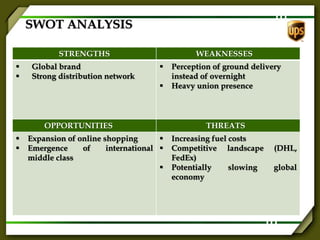
SWOT ANALYSIS
STRENGTHS WEAKNESSES
 Global brand
 Strong distribution network
 Perception of ground delivery
instead of overnight
 Heavy union presence
OPPORTUNITIES THREATS
 Expansion of online shopping
 Emergence of international
middle class
 Increasing fuel costs
 Competitive landscape (DHL,
FedEx)
 Potentially slowing global
economy
FUNCTIONAL ANALYSIS (Marketing)
OBJECTIVE: Provide a complete logistics infrastructure to businesses of
any size.
• UPS is targeting a global market of producers and consumers, while
making a move to become the supply chain integrator of choice in e-
commerce.
• They offer products and services that are state of the art in logistics,
which include the use of bar codes, high speed package routing systems,
and consulting services.
.
FUNCTIONAL ANALYSIS (Marketing)
.
• There are 150,000 different places to access UPS, worldwide.
Customers can reach them by phone, web, retail outlets,
customer service centers, distribution centers and any of the
drivers will pick up packages. This level of reach to customers is
necessary if UPS expects to gain market share from FedEx.
FUNCTIONAL ANALYSIS (Operations Tech)
OBJECTIVE: Highly integrated operations support product offerings to
offer low cost delivery operations.
• UPS is the 11th largest airline world, with nearly 600 planes, 15
airport hubs worldwide and 900 airports served. Connecting these
airports hubs to customers are 1,750 distribution facilities that sort
packages into 90,000 trucks for deliveries to the home, office, and
72,000 retail outlets. All this requires the integration of air,
ground, logistics and trade financing that UPS maintains is a key
competitive strength.
FUNCTIONAL ANALYSIS (Finance)
OBJECTIVE: Highly liquid company has been investing at a faster rate
than returning cash to investors, which are for most employees.
• The company is highly liquid with 1 ½ times the cash necessary
to cover current liabilities. UPS increased its dividends at 20% per
year for the past five years with an even higher growth in the rate
it has been buying back stock, at 47% over the same period.
• Over the past five years, Working capital has increased 24% per
year.
CHALLENGES
• To make strategic technology group from a small strategic planning
process. This was basically required for finding major gap in
technologies.
• Competition from both private companies and large government
supported agencies.
• Execution of Scenario-planning session.
• To tackle the impact of axis of uncertainty.
• Formation of scenarios for future strategic planning.
STEPS TAKEN BY UPS TO FACE THE
CHALLENGES
• As opportunities arose, UPS had shifted from message delivery to
package delivery.
• “Strategy road map”, which was the two step in the strategic
process was developed to take the centennial plan to an executable
level of detail
• UPS moved from “leadership in package distribution” to “enabler
of global commerce” due to the new mission and purpose.
STRATEGIES ADOPTED BY UPS
• Building competencies in the integration of goods, funds, and
information.
• Using technology to create new services.
• Attracting talented people.
• Studying customer behavior and anticipating their needs.
• Practicing innovation that leads to growth.
THANK YOU !!
“What can
brown do fo
r you”

Ups 090419105235-phpapp01

  • 1.
    UNITED PARCEL SERVICE PRESENTED BY: Md. Feroz Mahmud ID: 130103023
  • 2.
    ABOUT THE COMPANY •The United Parcel Service (UPS) delivers more than 15 million packages a day to about 6.1 million customers in 200 countries around the world, making it the world’s largest package delivery company. • UPS is headquartered in Atlanta, Georgia and operates primarily in the United States with about 428,000 employees. • Top competitors of UPS include Federal Express (FedEx), DHL International and the United States Postal Service.
  • 3.
    INDUSTRY PROSPECTS ANDOVERALL ATTRACTIVENESS • This industry should remain attractive, with concentration on competition for market share, service differentiation, and brand image. • Current Advertising has been aimed at being better than the competitor for different reasons.
  • 4.
    SWOT ANALYSIS STRENGTHS WEAKNESSES Global brand  Strong distribution network  Perception of ground delivery instead of overnight  Heavy union presence OPPORTUNITIES THREATS  Expansion of online shopping  Emergence of international middle class  Increasing fuel costs  Competitive landscape (DHL, FedEx)  Potentially slowing global economy
  • 5.
    FUNCTIONAL ANALYSIS (Marketing) OBJECTIVE:Provide a complete logistics infrastructure to businesses of any size. • UPS is targeting a global market of producers and consumers, while making a move to become the supply chain integrator of choice in e- commerce. • They offer products and services that are state of the art in logistics, which include the use of bar codes, high speed package routing systems, and consulting services. .
  • 6.
    FUNCTIONAL ANALYSIS (Marketing) . •There are 150,000 different places to access UPS, worldwide. Customers can reach them by phone, web, retail outlets, customer service centers, distribution centers and any of the drivers will pick up packages. This level of reach to customers is necessary if UPS expects to gain market share from FedEx.
  • 7.
    FUNCTIONAL ANALYSIS (OperationsTech) OBJECTIVE: Highly integrated operations support product offerings to offer low cost delivery operations. • UPS is the 11th largest airline world, with nearly 600 planes, 15 airport hubs worldwide and 900 airports served. Connecting these airports hubs to customers are 1,750 distribution facilities that sort packages into 90,000 trucks for deliveries to the home, office, and 72,000 retail outlets. All this requires the integration of air, ground, logistics and trade financing that UPS maintains is a key competitive strength.
  • 8.
    FUNCTIONAL ANALYSIS (Finance) OBJECTIVE:Highly liquid company has been investing at a faster rate than returning cash to investors, which are for most employees. • The company is highly liquid with 1 ½ times the cash necessary to cover current liabilities. UPS increased its dividends at 20% per year for the past five years with an even higher growth in the rate it has been buying back stock, at 47% over the same period. • Over the past five years, Working capital has increased 24% per year.
  • 9.
    CHALLENGES • To makestrategic technology group from a small strategic planning process. This was basically required for finding major gap in technologies. • Competition from both private companies and large government supported agencies. • Execution of Scenario-planning session. • To tackle the impact of axis of uncertainty. • Formation of scenarios for future strategic planning.
  • 10.
    STEPS TAKEN BYUPS TO FACE THE CHALLENGES • As opportunities arose, UPS had shifted from message delivery to package delivery. • “Strategy road map”, which was the two step in the strategic process was developed to take the centennial plan to an executable level of detail • UPS moved from “leadership in package distribution” to “enabler of global commerce” due to the new mission and purpose.
  • 11.
    STRATEGIES ADOPTED BYUPS • Building competencies in the integration of goods, funds, and information. • Using technology to create new services. • Attracting talented people. • Studying customer behavior and anticipating their needs. • Practicing innovation that leads to growth.
  • 12.
    THANK YOU !! “Whatcan brown do fo r you”