Full Business Case
United Parcel Service, Inc.
Ops Team 8
Cameron Straton
Chris Rivera-Ramirez
Sarah Rucci
Matt Merchant
1
Table of Contents
Executive Summary
Background Information 3
Issue Statement 3
Recommendations 4
Summary and Conclusion 4
Alternative A 5
Scope 5
Resources 5
Organizational Factors 6
External Environment 6
Cost Effectiveness 6
Contingencies 6
Alternative B 7
Scope 7
Resources 7
Organizational Factors 8
External Environment 8
Cost Effectiveness 8
Contingencies 8
Alternative C 9
Scope 9
Resources 9
Organizational Factors 9
External Environment 10
Cost Effectiveness 10
Contingencies 10
Action Plan 10
Statement of Recommendations 10
Strategies and Policies 11
Standards and Activities 11
Schedules 12
Contingencies 12
Appendix 13
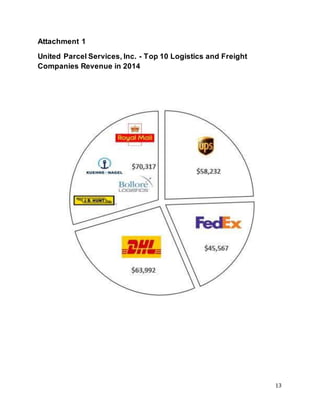
Attachment 1: Top 10 Logistic and Freight Companies Revenue in 2014 13
Attachment 2: UPS’s Market Share 2010-2014 14
Attachment 3: Selected Financial Figures 15
Attachment 4: Domestic VS International Revenue 17
Attachment 5: Global Coverage Map 18
Attachment 6: SWOT Analysis 19
Attachment 7: Relationship Diagram, UPS Market Share Drivers/Competencies 20
Attachment 8: Cause and Effect Diagram 21
Attachment 9: Alternative Selection Criteria 22
Attachment 10: Deployment Framework for the Recommended Alternative 24
Attachment 11: Value Analysis 28
Attachment 12: Deployment Timeline (Gantt Chart) 30
Attachment 13: United Parcel Service - Ratio Analysis 31
Attachment 14: Current and Projected Financial Statements for Years 2014 through 2019 34
2
Background
The American Messenger Company, later known as United Parcel Service, Inc. (UPS), was
founded in 1907 by James Casey as a private messenger and delivery service in Seattle,
Washington. Since then UPS has expanded to specialize in ground delivery services, but also
participates in air and ocean-freight shipping. Headquartered in Atlanta, UPS is today the
world’s largest package delivery company, a leader in the U.S. less-than-truckload industry
and the premier provider of global supply chain management solutions. The company's ground
segment dominates the US market, and it continues to expand through acquisitions in Asia-
Pacific, Latin America and Europe. The company also has regional air delivery hubs in
Canada, Germany and Taiwan. Each business day packages are delivered for 1.6 million
shipping customers to 8.2 million receivers (consignees) in over 220 countries and territories.
In 2014, an average of 18.0 million pieces per day worldwide, or a total of 4.6 billion packages
were delivered. Total revenue in 2014 was $58.2 billion.
As a global leader in logistics, UPS creates value for customers through solutions that lower costs,
improves service, and provides highly customizable supply chain control and visibility. Customers
are attracted to UPS’s set of services through its integrated ground, air, and ocean global network
that provides tracking and on-time delivery. UPS services and integrated network allow shippers to
simplify their supply chains by using fewer carriers, and to adapt their transportation requirements
and expenditures as their businesses evolve. At the same time, UPS also provides control and
visibility of customers’ inventories and supply chains via UPS technology platform. Particularly over
the last decade, UPS has significantly expanded the scope of its capabilities to include more than
package delivery; its logistics and distribution capabilities give companies the power to easily
expand their businesses to new markets around the world.
By leveraging its international infrastructure, UPS enables customers to bridge time
zones, cultures, distances and languages to keep the entire supply chain moving
smoothly. UPS serves the global market for logistics services, which include
transportation, distribution, forwarding; ground freight, ocean freight, air freight;
brokerage, and financing, which make UPS the top logistic company in the world.
Issue Statement
Within the next five years, increase United Parcel Service’s profitable global market share
from 19.6 percent to 23 percent and increase customer satisfaction by focusing on UPS’s core
competencies of reliable and timely delivery, affordable shipping costs, and customer service.
3
Recommendations
UPS should focus on their core competencies of reliable and timely delivery, affordable
shipping costs, and customer service, emphasizing internal operations processes to
become more efficient and fulfill customer needs.
 Strategically locate UPS distribution centers in major cities throughout the globe.
Adding additional distribution hubs in highly populated regions will result in reduced
transit time and reduced transportation costs. The decrease in transit time and
transportation costs will lead to higher profit margins and customer satisfaction. 

 Improve forecasting time-in-transit to prevent delays in aircraft departure. Implement GPS
system in all UPS vehicles to record transit time data. Analyze data to find most efficient and
consistent routes in order to ensure accurate measurement of time-in-transit and thus
prevent delays in aircraft departure. Improved time-in-transit measurements will result in
quicker delivery and more affordable shipping costs for consumers. 

 Automate the sorting processes. Implement automated sorting process to reduce manual
labor and in turn prevent broken or damaged packages and reduce delivery time. This will
eliminate human error in the sorting process and ensure that all packages are sorted into
the proper warehouses or shipping vehicles and are shipped as quickly as possible. 

 Develop new labeling system for all packages carried by UPS. Reduce amount of
missing or lost packages by implementing a standardized labeling system for all
packages. Implement laser printing to ensure all labels are legible and clearly visible.
Use RFID technology to accurately track packages from their point of origin to their
final destination. Provide customers with up-to-date information about their items. 
Summary and Conclusions
United Parcel Service’s success can be attributed to their mission to maintain and
continue to strengthen their core competencies. They strive to have reliable and timely
delivery, affordable shipping costs, and excellent customer service. Through continually
analyzing these core competencies, they have seen tremendous growth throughout their
history, establishing themselves as industry leaders on a global level. They manage to
provide high quality services while at the same time eliminate waste in their operations,
and thus their customer satisfaction rates are consistently impressive. This can be
attributed to their highly skilled labor force and strategic training programs.
UPS delivers packages faster and at more affordable prices than their competitors. They ensure
all packages are only handled by qualified employees and shipped in the quickest and safest
manner, whether it is via ground freight, ocean freight, or airfreight. UPS has proven that
effective operations can allow a company to reach 8.2 million customers per day in 220
countries and territories across the globe. Furthermore, UPS showed that establishing strong
relationships with customers leads to major increases in revenues, and in turn a larger market
share. Our recommendations are in line with the UPS mission of delivering goods as quickly as
possible while still maintaining the affordable prices that incentivize customers to come back
and use UPS as their package delivery company of choice.
4
Alternative A
UPS should focus on their core competencies of reliable and timely delivery, affordable
shipping costs, and customer service, emphasizing internal operations processes to
become more efficient and fulfill customer needs.
 Strategically locate UPS distribution centers in major cities throughout the globe.
Adding additional distribution hubs in highly-populated regions will result in reduced
transit time and reduced transportation costs. The decrease in transit time and
transportation costs will lead to higher profit margins and customer satisfaction. 

 Improve forecasting time-in-transit to prevent delays in aircraft departure. Implement GPS
system in all UPS vehicles to record transit time data. Analyze data to find most efficient and
consistent routes in order to ensure accurate measurement of time-in-transit and thus
prevent delays in aircraft departure. Improved time-in-transit measurements will result in
quicker delivery and more affordable shipping costs for consumers. 

 Automate the sorting processes. Implement automated sorting process to reduce manual
labor and in turn prevent broken or damaged packages and reduce delivery time. This will
eliminate human error in the sorting process and ensure that all packages are sorted into
the proper warehouses or shipping vehicles and are shipped as quickly as possible. 

 Develop new labeling system for all packages carried by UPS. Reduce amount of
missing or lost packages by implementing a standardized labeling system for all
packages. Implement laser printing to ensure all labels are legible and clearly visible.
Use RFID technology to accurately track packages from their point of origin to their
final destination. Provide customers with up-to-date information about their items. 
Scope
This recommendation focuses on improving the overall experience of the customer.
UPS will improve their reliability and delivery time, ensure that shipping costs are
affordable, and provide industry-leading customer service. The company will allocate
funds to accelerate the research and strategic placement of distribution centers. In
addition, UPS will invest in technological research regarding GPS, automated sorting,
and labeling systems. The resultant findings will then need to be analyzed in order to
determine the most cost efficient way to purchase and implement new systems.
Resources
This recommendation requires UPS to increase spending on research and analysis in the field of
new technologies. At the completion of said research and analysis, UPS will need to allocate funds
for the purchase of technologies as well as land and building expenses for new locations. In addition
to these expenditures, employees will need to be trained to work the new technologies that UPS
implements. Because of the large investment, Research and Development, Engineering, and
Finance teams will be heavily involved in the decision making process.
5
Organizational Factors
This recommendation involves UPS developing and implementing advanced technologies
into their operations. Their innovative strategies will help them to continue to meet the
needs and preferences of their customers. Due to the innovative nature of this
recommendation, the Research and Development department will be heavily involved
developing and testing new technologies. In addition, the finance department must approve
purchases and meet their budget. The Operations department will need to invest a lot of
time into learning how to operate new technologies through strategic training. The new
distribution centers will require staff, so the Human Resources department should facilitate
interviews and hiring. Also regarding Human Resources, there will likely be employees who
need to be reassigned due to the increased efficiencies in sorting and labeling.
External Factors
This recommendation takes into account the competitive nature of the shipping industry. UPS
must maintain their competitive advantage by continually increasing efficiency and reliability
while cutting costs. FedEx and other competitors are seeking to gain more of the market share
that UPS dominates through innovative ideas, but UPS will leverage its strong innovative
capabilities and highly skilled labor force to to continue to be the leader in the industry.
Cost Effectiveness
This recommendation aims to increase UPS’s revenue and profitable market share. By
further establishing themselves as the top courier in the industry, UPS can grow their
customer base. In addition, the increase in efficiency will lead to lower costs and more
satisfied customers. The Research and Development will account for the largest
expenditures. However, the new technologies will greatly improve the efficiency of
operations and in turn generate higher revenues.
Contingencies
This recommendation addresses the potential to improve efficiency in operations and
build a stronger reputation with customers. However, if the Research and Development
team is unable to design, test, and implement innovative technologies, UPS will not see
improvement in efficiency. A lack of innovative and new technologies will lead to no
additional improvement in customer satisfaction, and their market share will suffer due
to losing the competitive edge to their competitors.
6
Alternative B
Due to the continual growth of e-commerce and online purchasing habits of customers,
UPS should focus on implementing strategic measures to account for future demand and a
rise in online shopping over the past five years. This approach will aid them in keeping up
with the growing e-commerce industry, in which shipping companies will need to account for
a greater number of deliveries between retailers, manufacturers, and consumers occurring
online. Since web-based, business-to-home deliveries are UPS’s specialty in the current
market, they must respond to rising costs by starting to price deliveries based on the size of
ground shipments rather than solely on weight alone, resulting in a higher profit margin for
themselves. As more and more customers adapt to the online world of e-commerce, UPS’s
primary goal should be to bypass the low costs of their competitors and implement next day
delivery into their business model for this growing industry.
 Design a new, automated system to fulfill next-day delivery requests from customers 

 Implement an updated package tracking application to give customers the ability
to see when their items will be delivered 

 Research competitor e-commerce strategies to stay ahead of the market and
compete with rising costs for delivery service companies 

 Build a number of new shipping centers near the areas of greatest
demand for e-commerce deliveries 

 Develop drone technology to minimize costs of manual delivery labor and of
shipping inexpensive products 
Scope
This recommendation focuses on developing new ways to address the rising business of e-
commerce by keeping production costs down and formulating strategies to offer next-day
delivery to UPS customers. The ultimate benefit of this recommendation is the expansion
and preparation into a rising marketplace which will only continue to grow in the upcoming
decade. Updating e-commerce delivery technology will provide online shoppers with a fast,
reliable system that gets them their packages faster than UPS’s competitors. These
initiatives should also improve both operations efficiency and customer satisfaction.
Resources
These strategic recommendations require UPS to undergo intensive research in the e-commerce
marketplace as well as the development of new technologies to improve the current delivery
system. Customer feedback will also play a large role in this strategy as more and more deliveries
are made using the improved system. Strong marketing and advertising will ensure that customers
are aware of this new technology and market analysis will assist UPS in
7
pinpointing the highest geographical areas of demand. Each department needs to collaborate
together in order for UPS to stay a step ahead of their competitors with this strategy.
Organizational Factors
All departments at UPS must collaborate together in order for this recommendation to be effectively
utilized. Research and development must be especially emphasized as the new system is
developed and the e-commerce market is analyzed to determine the highest areas of demand.
Customer relations need to conduct customer surveys of both current and potential customers of the
e-commerce market. After these surveys are analyzed and evaluated, engineering will be able to
improve upon these new technologies to continually satisfy customers.
External Factors
Although UPS only has one true competitor in the global delivery service industry, FedEx,
there are a number of rising organizations in the e-commerce market that pose a threat to
their success in this recommendation. Amazon and Target have offered free shipping and
next -day delivery services to attract online shoppers, and UPS must constantly be
innovative in the e-commerce industry to maintain their position as the number one delivery
service company in the world. Through staying a step ahead of their competitors, UPS
ensures recurrent increases to revenue in the e-commerce marketplace.
Cost Effectiveness
This recommendation is concerned with increasing UPS’s efficiency in e-commerce
deliveries by offering strategic advancements over their competitors. In the short run,
there will be a decrease in revenues due to an increase in spending to research and
development. However, by minimizing the operational gap between themselves and
their competitors within the industry, UPS should expect to see large gains in revenue
in the long run due to their higher resulting market share in e-commerce.
Contingencies
The focus of this recommendation is to improve its e-commerce system through making
numerous improvements to their operations system as well as analyzing the current market
to address the greatest areas of customer demand. However, if there are delays in these
technological advancements due to conflict across departments, UPS will suffer gradual
setbacks in the e-commerce industry as their competitors gain a larger share of the market.
If research results are unable to be accurately analyzed by research and development,
UPS must quickly look to their engineering, design, and marketing teams to create and
promote the new operational systems in order to stay ahead of their immediate competitors.
8
Alternative C
Due to the emerging popularity of “green” initiatives, United Parcel Service should focus on
increasing the sustainability of their business model through new packaging options and
ground transportation methods. This approach will greatly improve the company’s image
and reputation while decreasing long-run operating costs. UPS has already made indirect
efforts towards sustainability via their Forestry Initiative, but a more direct approach with
greater visibility will likely prove much more effective. The environmentally concerned
consumer will be more prone to choosing UPS for their shipping needs. And as this
population grows, so will United Parcel Service’s customer base.
 Research low-cost, recycled packaging options 

 Partner with a small company producing boxes and packages out of recycled material 

 Initially offer new sustainable options at UPS stores in urban areas like Seattle,
where environmental concern is greater. 

 Research fuel-efficient transportation options 

 Introduce alternatively fueled trucks for ground-shipping 
Scope
The focus of this recommendation involves two main parts: the offering of sustainable
recycled packaging options, and the introduction of environmentally friendly,
alternatively-fueled trucks for ground transportation. These suggestions will attract a
wider customer base and improve customer satisfaction. In addition, these initiatives
should increase both profitability and market appeal.
Resources
This recommendation requires a great deal of research into sustainable packaging and
fuel sources, as well as the analysis of that research. The marketing department is also
going to be a very important part of the implementation of this plan. In order for the
initiatives to be truly effective, they must be heavily advertised to promote awareness.
Organizational Factors
Primarily, the finance, marketing, and research departments must collaborate in order to
effectively implement this initiative. The research department will need to determine the
most viable options for UPS’s investment. The finance department must develop a budget
and approve purchases. And finally the marketing department will need to create a
campaign to introduce these green initiatives to the public in the most effective manner.
9
External Factors
This recommendation must take into account UPS’s competition, primarily FedEx. UPS
will need to leverage their leading reputation while introducing their new sustainable
business model. It is imperative that they do not allow the implementation of the new
systems to detract from their current levels of revenue and customer satisfaction.
Cost Effectiveness
This recommendation aims to increase market share and profitability by minimizing transportation
and packaging costs and attracting a wider customer base. Initial expenses for research and new
products and vehicles will be substantial, but over time the increased revenue and decreased
costs resulting from these changes will offset these expenditures. In addition, the improved
reputation and public image will be a significant and priceless asset for UPS.
Contingencies
The focus of this recommendation is to decrease costs while widening UPS’s customer
base. If the preliminary research finds that sustainable materials and alternatively fueled
vehicles will not be cost effective, management must review the research and find
alternative avenues along which to pursue a more effective sustainable business model.
Action Plan
Statement of Recommendations
UPS should focus on their core competencies of reliable and timely delivery, affordable
shipping costs, and customer service, emphasizing internal operations processes to
become more efficient and fulfill customer needs.
 Strategically locate UPS distribution centers in major cities throughout the globe.
Adding additional distribution hubs in highly populated regions will result in reduced
transit time and reduced transportation costs. The decrease in transit time and
transportation costs will lead to higher profit margins and customer satisfaction. 

 Improve forecasting time-in-transit to prevent delays in aircraft departure. Implement GPS
system in all UPS vehicles to record transit time data. Analyze data to find most efficient and
consistent routes in order to ensure accurate measurement of time-in-transit and thus
prevent delays in aircraft departure. Improved time-in-transit measurements will result in
quicker delivery and more affordable shipping costs for consumers. 

 Automate the sorting processes. Implement automated sorting process to reduce manual
labor and in turn prevent broken or damaged packages and reduce delivery time. This will
eliminate human error in the sorting process and ensure that all packages are sorted into
the proper warehouses or shipping vehicles and are shipped as quickly as possible. 
10
 Develop new labeling system for all packages carried by UPS. Reduce amount of
missing or lost packages by implementing a standardized labeling system for all
packages. Implement laser printing to ensure all labels are legible and clearly visible.
Use RFID technology to accurately track packages from their point of origin to their
final destination. Provide customers with up-to-date information about their items. 
Strategies and Policies
UPS is currently one of the most widely recognized delivery service companies in the
marketplace, and claims a market share larger than any of their competitors. The
proposed recommendations will allow them to capitalize on their strengths of reliable
and timely delivery, affordable shipping costs, and customer service.
First, UPS will strategically locate distribution centers throughout the United States. These
distribution centers will allow for products to reach their end destination faster and at
cheaper costs. With companies like Amazon and Target offering next day shipping, it is
crucial that UPS can provide customers with their packages as fast as possible.
Second, UPS will focus its effort on improving the forecasting of time -in-transit. Delays in aircraft
departure can result in major losses for the company. Through analyzing data from GPS tracking
systems, the research team can find the most efficient and consistent routes. This will help UPS
satisfy their customers and continue to build the positive brand image that they have. Research
and innovative technologies are the keys for UPS to gain a larger market share.
Third, UPS will automate the sorting process to reduce manual labor, prevent broken or damaged
packages, and reduce delivery time. In order to ensure the highest level of reliability and quality,
UPS must eliminate the potential for errors occurring when packages are being sorted into the
proper warehouses or shipping vehicles. The automation of the sorting process will lead to
increased customer satisfaction, which is one of the highest priorities for the company.
Fourth, UPS will develop and implement a new labeling system for all packages. The
innovative new labeling system will reduce missing or lost packages, and in turn save costs
and build more customer loyalty. Allowing customers to get up-to-date information about their
products highlights the industry-leading logistics services UPS provides for all customers.
Standards and Activities
United Parcel Service’s reputation for delivering packages quickly, safely, and at an affordable
price is encompassed in these recommendations. Throughout the history of the company, they
have leveraged their strengths in order to build and grow the already industry-leading business.
UPS will continue to increase expenditures, particularly in research and development, in order
to satisfy their customers by offering the best and most innovative customer experience. The
research and development teams will focus on developing and implementing advanced
technologies to increase reliability and efficiency within operations. The human resources team
will work to train employees and ensure that all work is being done in a professional manner.
The development of new technologies will benefit all customers. Packages will arrive quicker,
11
safer, and at a cheaper price than competitors offer. The potential benefits of these
recommendations will enhance the customer experience for all users of UPS, from
individual people to large businesses.
Although expenditures to develop and implement new technologies will be large, the
benefits of increasing global market share to 23% puts the monetary costs and
implementation time into perspective. These recommendations depend heavily on
employees knowing how to properly use the systems, and UPS will greatly benefit through
their training programs. UPS commits themselves to hiring highly skilled workers and
actively trains them to work as efficiently as possible. The combination of new technologies
and proficiently trained employees will take some time, but when the two become cohesive
UPS will surely see a positive impact on their overall operations and financial success.
Schedules
See Attachments 10 Deployment Framework, 11 Value Analysis, 12 Deployment
Timeline, 13 Ratio Analysis, and 14 Current and Projected Financial Statements.
Contingencies
There are alternatives in place of the event that UPS will be unable to implement strategic
distribution centers across the United States and improve operations procedures in
forecasting, sorting process automation, and labeling system efficiency and in turn
increase their global market share and customer satisfaction. Alternative B will focus on
expanding into the e-commerce industry through technological innovations and improved
operations management for online shopping distribution. Alternative C will focus on
developing UPS’s sustainability policies by introducing environmentally friendly options for
packing and ground transportation delivery to customers.
12
Attachment 1
United Parcel Services, Inc. - Top 10 Logistics and Freight
Companies Revenue in 2014
13
Attachment 2
United Parcel Service - Market share 2010-2014
14
Attachment 3
United Parcel Service - Selected Financial Figures
*in millions
15
Attachment 3 - Continued
16
Attachment 4
United Parcel Service
Domestic VS International Revenue
*in millions
17
Attachment 5
United Parcel Service
Global Coverage Map
18
Attachment 6
United Parcel Service
SWOT ANALYSIS
19
Attachment 7
United Parcel Service
Relationship diagram
UPS Market Share Drivers/Competencies
20
Attachment 8
United Parcel Service
Cause and Effect Diagram
21
Attachment 9
United Parcel Service - Alternative Selection Criteria
Decision Criteria Alternative Alternative Alternative
A B C
SCOPE Positive: 1 Positive: 1 Positive: 1
Improving Expand into Environment
efficiency the e- al innovation
and commerce and
technological industry and sustainable
innovation to increase products to
minimize market share enhance
delays and as well as UPS’s
unnecessary widening the image and
costs customer decrease
base costs
RESOURCES Negative: -1 Negative: -1 Negative: -1
Huge extensive Large R&D
investment R&D costs spending as
into as well as well as
technological marketing purchases
research and and and
spending advertising marketing
ORGANIZATIONA Positive: 1 Negative: -1 Positive: 1
L FACTORS Improvement The Focusing on
in introduction sustainability
collaboration of a new e- will increase
between commerce employee
departments division may job
due to cause satisfaction
decrease in traditional and create a
delays and employees to positive
operational feel company
issues threatened culture
EXTERNAL Positive: 1 Positive: 1 Negative: -1
ENVIRONMENT UPS will be Adding an e- Placing
more commerce importance
competitive division will on
due to keep UPS up sustainability
22
greater to date with rather than
efficiency trends in the innovation
economy puts UPS at
risk of falling
behind
COST Positive: 1 Positive: 1 Positive: 1
EFFECTIVENESS increased growth in sustainable
efficiency will market share practices will
lead to lower and decrease
costs and expanded overall costs
more customer after
satisfied base will successful
customers result in implementati
greater profit on
CONTINGENCIES Positive: 1 Neutral: 0 Negative: -1
focus on while achieving
improving expanding sustainability
current into the may require
operations. virtual more
Success will marketplace resources
benefit UPS may be than
very lucrative, it is anticipated,
positively also very and costs
risky may rise
TOTAL 4 1 0
23
Attachment 10
United Parcel Service
Deployment Framework for the Recommended Alternative
Action
Time Frame
Person Cost
Beg End Responsible
(Q/Yr) (Q/Yr)
Strategically Locate Distribution Centers
1 Research distribution Q1/2016 Q2/2016 Research $50,000
of demand in U.S. Department
2 Determine top 3 Q2/2016 Q2/2016 Research $50,000
optimal locations and Department
operational needs for
each
3 Research real estate Q3/2016 Q4/2016 Research $100,000
in those 3 locations Department
4 Purchase buildings Q4/2016 Q4/2016 Purchases $1,750,000
that fulfill operational Department
needs
5 Hire contractor to Q1/2017 Q4/2017 Human $100,000
make additional Resources
changes to structure Department
6 Interviews and hiring Q4/2017 Q4/2017 HR $175,000
of managers (one for Department
each location)
7 Interviews, hiring, and Q4/2017 Q1/2018 HR $1,000,000
training of new Department
employees
8 Interior design and Q1/2018 Q2/2018 Marketing $75,000
decoration Department
24
9 Update transportation Q2/2018 Q3/2018 Operations $80,000
routes to include new Department
locations
10 Analyze and monitor Q2/2018 Ongoing Operations ----
changes in transit Department
time and delays
Improve forecasting of time-in-transit
1 Research GPS Q1/2016 Q2/2016 Research $90,000
technologies and Department
determine the optimal
device for UPS
vehicles
2 Purchase devices for Q2/2016 Q3/2016 Purchases $250,000
one distribution center Department
3 Install devices in Q3/2016 Q3/2016 Operations $100,000
vehicles Department
4 Train employees to use Q3/2016 Q4/2016 Operations $150,000
the devices accurately Department
5 Appoint a team to Q4/2016 Q2/2017 Human $300,000
monitor the route data Resources
collected and instruct Department
drivers based on the
most efficient routes
6 Analyze and monitor Q2/2017 Q3/2017 Analysis $300,000
the effect of the GPS Team
devices and resultant
route data on delays
and time-in-transit
7 If results are positive, Q4/2017 Q1/2018 Operations $4,000,000
implement the devices Department
at all other locations
25
Automate Sorting Processes
1 Research automated Q1/2016 Q2/2016 Research $100,000
sorting technologies Department
to determine the
most suited system
2 Purchase automation Q2/2016 Q3/2016 Purchases $500,000
system for one Department
location
3 Install the system Q3/2016 Q4/2016 Operations $15,000
Department
4 Monitor the new Q1/2017 Q3/2017 Operations $125,000
system to determine Department
efficiency and
effectiveness
5 If the system is Q4/2017 Q4/2017 Human $50,000
effective, relocate or Resources
let go newly non- Department
essential employees
6 Purchase systems Q1/2018 Q3/2018 Purchases and $5,000,000
and install them at Operations
other locations departments
7 Continue to monitor Q3/2018 Ongoing Operations ---
the systems to Department
maintain optimal
efficiency
Develop a New Labeling System
1 Research innovative Q1/2016 Q2/2016 Research $80,000
labeling systems Department
2 Purchase new labeling Q2/2016 Q3/2016 Purchases $700,000
system for one location Department
3 Implement the system Q3/2016 Q4/2016 Operations $15,000
Department
26
4 Monitor the new Q1/2017 Q3/2017 Operations $150,000
system and analyze Department
any changes in the
amount of lost or
missing packages
5 If the system is Q4/2017 Q4/2017 Human $4,000,000
effective, purchase Resources
more systems to be Department
used at other locations
6 Continue to monitor Q3/2017 Ongoing Operations ---
the systems to Department
maintain effectiveness
27
Attachment 11
United Parcel Service
Value Analysis
Cost:
Value:
Through implementing these changes in their business model, UPS can expect to
increase global market share and customer satisfaction while capitalizing on their core
competencies of reliable and timely delivery, affordable shipping costs, and customer
service. Since UPS reported total annual net income of $3.032 billion in 2014, we can
28
expect their profit margins to continually increase as we implement these changes into
their operations strategy.
ROI: Value/Cost, where $3,032,000,000/19,305,000 = 157.06 Return on Investment
Enacting these changes to UPS’s operations department results in an ROI of 157.06
times the investment, which leads us to believe that the implementation of these
changes is well worth the investment. We can assume that these measures of
operations efficiency will satisfy the current and future customer base that UPS currently
caters to.
29
Attachment 12
United Parcel Service
Deployment Timeline (Gantt Chart)
Mission Statement: Focus on United Parcel Service’s core competencies of reliable
and timely delivery, affordable shipping costs, and customer service, emphasizing
internal operations processes to become more efficient and fulfill customer needs and
increase global market share to 23%.
30
Attachment 13 – Ratio Analysis
31
Attachment 13 (continued)
32
Attachment 13 (continued)
33
Attachment 14
United Parcel Service
Current and Projected Financial Statements for years 2014 through
2019
Factors Considered in Projections and Analysis:
1. An average increase of 6% in revenue each year for the past 10 years, plus an
inflation rate of 4% until 2016.
2. Starting in 2017 the growth rate on revenue will be 7% with an inflation rate of 5%.
3. Other expenses will be reduced by increasing investment income by $2 million each
year.
4.The tax rate of 34% remains unchanged.
5. Due to UPS’s growth and expansion, other companies in the industry will most likely
exit the market or reduce operations; thus, increasing UPS’s market share.
6. UPS will reach its market share goal of 23% five years later in 2019.
34

Team 8 UPS Final Case

  • 1.
    Full Business Case UnitedParcel Service, Inc. Ops Team 8 Cameron Straton Chris Rivera-Ramirez Sarah Rucci Matt Merchant 1
  • 2.
    Table of Contents ExecutiveSummary Background Information 3 Issue Statement 3 Recommendations 4 Summary and Conclusion 4 Alternative A 5 Scope 5 Resources 5 Organizational Factors 6 External Environment 6 Cost Effectiveness 6 Contingencies 6 Alternative B 7 Scope 7 Resources 7 Organizational Factors 8 External Environment 8 Cost Effectiveness 8 Contingencies 8 Alternative C 9 Scope 9 Resources 9 Organizational Factors 9 External Environment 10 Cost Effectiveness 10 Contingencies 10 Action Plan 10 Statement of Recommendations 10 Strategies and Policies 11 Standards and Activities 11 Schedules 12 Contingencies 12 Appendix 13 Attachment 1: Top 10 Logistic and Freight Companies Revenue in 2014 13 Attachment 2: UPS’s Market Share 2010-2014 14 Attachment 3: Selected Financial Figures 15 Attachment 4: Domestic VS International Revenue 17 Attachment 5: Global Coverage Map 18 Attachment 6: SWOT Analysis 19 Attachment 7: Relationship Diagram, UPS Market Share Drivers/Competencies 20 Attachment 8: Cause and Effect Diagram 21 Attachment 9: Alternative Selection Criteria 22 Attachment 10: Deployment Framework for the Recommended Alternative 24 Attachment 11: Value Analysis 28 Attachment 12: Deployment Timeline (Gantt Chart) 30 Attachment 13: United Parcel Service - Ratio Analysis 31 Attachment 14: Current and Projected Financial Statements for Years 2014 through 2019 34 2
  • 3.
    Background The American MessengerCompany, later known as United Parcel Service, Inc. (UPS), was founded in 1907 by James Casey as a private messenger and delivery service in Seattle, Washington. Since then UPS has expanded to specialize in ground delivery services, but also participates in air and ocean-freight shipping. Headquartered in Atlanta, UPS is today the world’s largest package delivery company, a leader in the U.S. less-than-truckload industry and the premier provider of global supply chain management solutions. The company's ground segment dominates the US market, and it continues to expand through acquisitions in Asia- Pacific, Latin America and Europe. The company also has regional air delivery hubs in Canada, Germany and Taiwan. Each business day packages are delivered for 1.6 million shipping customers to 8.2 million receivers (consignees) in over 220 countries and territories. In 2014, an average of 18.0 million pieces per day worldwide, or a total of 4.6 billion packages were delivered. Total revenue in 2014 was $58.2 billion. As a global leader in logistics, UPS creates value for customers through solutions that lower costs, improves service, and provides highly customizable supply chain control and visibility. Customers are attracted to UPS’s set of services through its integrated ground, air, and ocean global network that provides tracking and on-time delivery. UPS services and integrated network allow shippers to simplify their supply chains by using fewer carriers, and to adapt their transportation requirements and expenditures as their businesses evolve. At the same time, UPS also provides control and visibility of customers’ inventories and supply chains via UPS technology platform. Particularly over the last decade, UPS has significantly expanded the scope of its capabilities to include more than package delivery; its logistics and distribution capabilities give companies the power to easily expand their businesses to new markets around the world. By leveraging its international infrastructure, UPS enables customers to bridge time zones, cultures, distances and languages to keep the entire supply chain moving smoothly. UPS serves the global market for logistics services, which include transportation, distribution, forwarding; ground freight, ocean freight, air freight; brokerage, and financing, which make UPS the top logistic company in the world. Issue Statement Within the next five years, increase United Parcel Service’s profitable global market share from 19.6 percent to 23 percent and increase customer satisfaction by focusing on UPS’s core competencies of reliable and timely delivery, affordable shipping costs, and customer service. 3
  • 4.
    Recommendations UPS should focuson their core competencies of reliable and timely delivery, affordable shipping costs, and customer service, emphasizing internal operations processes to become more efficient and fulfill customer needs.  Strategically locate UPS distribution centers in major cities throughout the globe. Adding additional distribution hubs in highly populated regions will result in reduced transit time and reduced transportation costs. The decrease in transit time and transportation costs will lead to higher profit margins and customer satisfaction.    Improve forecasting time-in-transit to prevent delays in aircraft departure. Implement GPS system in all UPS vehicles to record transit time data. Analyze data to find most efficient and consistent routes in order to ensure accurate measurement of time-in-transit and thus prevent delays in aircraft departure. Improved time-in-transit measurements will result in quicker delivery and more affordable shipping costs for consumers.    Automate the sorting processes. Implement automated sorting process to reduce manual labor and in turn prevent broken or damaged packages and reduce delivery time. This will eliminate human error in the sorting process and ensure that all packages are sorted into the proper warehouses or shipping vehicles and are shipped as quickly as possible.    Develop new labeling system for all packages carried by UPS. Reduce amount of missing or lost packages by implementing a standardized labeling system for all packages. Implement laser printing to ensure all labels are legible and clearly visible. Use RFID technology to accurately track packages from their point of origin to their final destination. Provide customers with up-to-date information about their items.  Summary and Conclusions United Parcel Service’s success can be attributed to their mission to maintain and continue to strengthen their core competencies. They strive to have reliable and timely delivery, affordable shipping costs, and excellent customer service. Through continually analyzing these core competencies, they have seen tremendous growth throughout their history, establishing themselves as industry leaders on a global level. They manage to provide high quality services while at the same time eliminate waste in their operations, and thus their customer satisfaction rates are consistently impressive. This can be attributed to their highly skilled labor force and strategic training programs. UPS delivers packages faster and at more affordable prices than their competitors. They ensure all packages are only handled by qualified employees and shipped in the quickest and safest manner, whether it is via ground freight, ocean freight, or airfreight. UPS has proven that effective operations can allow a company to reach 8.2 million customers per day in 220 countries and territories across the globe. Furthermore, UPS showed that establishing strong relationships with customers leads to major increases in revenues, and in turn a larger market share. Our recommendations are in line with the UPS mission of delivering goods as quickly as possible while still maintaining the affordable prices that incentivize customers to come back and use UPS as their package delivery company of choice. 4
  • 5.
    Alternative A UPS shouldfocus on their core competencies of reliable and timely delivery, affordable shipping costs, and customer service, emphasizing internal operations processes to become more efficient and fulfill customer needs.  Strategically locate UPS distribution centers in major cities throughout the globe. Adding additional distribution hubs in highly-populated regions will result in reduced transit time and reduced transportation costs. The decrease in transit time and transportation costs will lead to higher profit margins and customer satisfaction.    Improve forecasting time-in-transit to prevent delays in aircraft departure. Implement GPS system in all UPS vehicles to record transit time data. Analyze data to find most efficient and consistent routes in order to ensure accurate measurement of time-in-transit and thus prevent delays in aircraft departure. Improved time-in-transit measurements will result in quicker delivery and more affordable shipping costs for consumers.    Automate the sorting processes. Implement automated sorting process to reduce manual labor and in turn prevent broken or damaged packages and reduce delivery time. This will eliminate human error in the sorting process and ensure that all packages are sorted into the proper warehouses or shipping vehicles and are shipped as quickly as possible.    Develop new labeling system for all packages carried by UPS. Reduce amount of missing or lost packages by implementing a standardized labeling system for all packages. Implement laser printing to ensure all labels are legible and clearly visible. Use RFID technology to accurately track packages from their point of origin to their final destination. Provide customers with up-to-date information about their items.  Scope This recommendation focuses on improving the overall experience of the customer. UPS will improve their reliability and delivery time, ensure that shipping costs are affordable, and provide industry-leading customer service. The company will allocate funds to accelerate the research and strategic placement of distribution centers. In addition, UPS will invest in technological research regarding GPS, automated sorting, and labeling systems. The resultant findings will then need to be analyzed in order to determine the most cost efficient way to purchase and implement new systems. Resources This recommendation requires UPS to increase spending on research and analysis in the field of new technologies. At the completion of said research and analysis, UPS will need to allocate funds for the purchase of technologies as well as land and building expenses for new locations. In addition to these expenditures, employees will need to be trained to work the new technologies that UPS implements. Because of the large investment, Research and Development, Engineering, and Finance teams will be heavily involved in the decision making process. 5
  • 6.
    Organizational Factors This recommendationinvolves UPS developing and implementing advanced technologies into their operations. Their innovative strategies will help them to continue to meet the needs and preferences of their customers. Due to the innovative nature of this recommendation, the Research and Development department will be heavily involved developing and testing new technologies. In addition, the finance department must approve purchases and meet their budget. The Operations department will need to invest a lot of time into learning how to operate new technologies through strategic training. The new distribution centers will require staff, so the Human Resources department should facilitate interviews and hiring. Also regarding Human Resources, there will likely be employees who need to be reassigned due to the increased efficiencies in sorting and labeling. External Factors This recommendation takes into account the competitive nature of the shipping industry. UPS must maintain their competitive advantage by continually increasing efficiency and reliability while cutting costs. FedEx and other competitors are seeking to gain more of the market share that UPS dominates through innovative ideas, but UPS will leverage its strong innovative capabilities and highly skilled labor force to to continue to be the leader in the industry. Cost Effectiveness This recommendation aims to increase UPS’s revenue and profitable market share. By further establishing themselves as the top courier in the industry, UPS can grow their customer base. In addition, the increase in efficiency will lead to lower costs and more satisfied customers. The Research and Development will account for the largest expenditures. However, the new technologies will greatly improve the efficiency of operations and in turn generate higher revenues. Contingencies This recommendation addresses the potential to improve efficiency in operations and build a stronger reputation with customers. However, if the Research and Development team is unable to design, test, and implement innovative technologies, UPS will not see improvement in efficiency. A lack of innovative and new technologies will lead to no additional improvement in customer satisfaction, and their market share will suffer due to losing the competitive edge to their competitors. 6
  • 7.
    Alternative B Due tothe continual growth of e-commerce and online purchasing habits of customers, UPS should focus on implementing strategic measures to account for future demand and a rise in online shopping over the past five years. This approach will aid them in keeping up with the growing e-commerce industry, in which shipping companies will need to account for a greater number of deliveries between retailers, manufacturers, and consumers occurring online. Since web-based, business-to-home deliveries are UPS’s specialty in the current market, they must respond to rising costs by starting to price deliveries based on the size of ground shipments rather than solely on weight alone, resulting in a higher profit margin for themselves. As more and more customers adapt to the online world of e-commerce, UPS’s primary goal should be to bypass the low costs of their competitors and implement next day delivery into their business model for this growing industry.  Design a new, automated system to fulfill next-day delivery requests from customers    Implement an updated package tracking application to give customers the ability to see when their items will be delivered    Research competitor e-commerce strategies to stay ahead of the market and compete with rising costs for delivery service companies    Build a number of new shipping centers near the areas of greatest demand for e-commerce deliveries    Develop drone technology to minimize costs of manual delivery labor and of shipping inexpensive products  Scope This recommendation focuses on developing new ways to address the rising business of e- commerce by keeping production costs down and formulating strategies to offer next-day delivery to UPS customers. The ultimate benefit of this recommendation is the expansion and preparation into a rising marketplace which will only continue to grow in the upcoming decade. Updating e-commerce delivery technology will provide online shoppers with a fast, reliable system that gets them their packages faster than UPS’s competitors. These initiatives should also improve both operations efficiency and customer satisfaction. Resources These strategic recommendations require UPS to undergo intensive research in the e-commerce marketplace as well as the development of new technologies to improve the current delivery system. Customer feedback will also play a large role in this strategy as more and more deliveries are made using the improved system. Strong marketing and advertising will ensure that customers are aware of this new technology and market analysis will assist UPS in 7
  • 8.
    pinpointing the highestgeographical areas of demand. Each department needs to collaborate together in order for UPS to stay a step ahead of their competitors with this strategy. Organizational Factors All departments at UPS must collaborate together in order for this recommendation to be effectively utilized. Research and development must be especially emphasized as the new system is developed and the e-commerce market is analyzed to determine the highest areas of demand. Customer relations need to conduct customer surveys of both current and potential customers of the e-commerce market. After these surveys are analyzed and evaluated, engineering will be able to improve upon these new technologies to continually satisfy customers. External Factors Although UPS only has one true competitor in the global delivery service industry, FedEx, there are a number of rising organizations in the e-commerce market that pose a threat to their success in this recommendation. Amazon and Target have offered free shipping and next -day delivery services to attract online shoppers, and UPS must constantly be innovative in the e-commerce industry to maintain their position as the number one delivery service company in the world. Through staying a step ahead of their competitors, UPS ensures recurrent increases to revenue in the e-commerce marketplace. Cost Effectiveness This recommendation is concerned with increasing UPS’s efficiency in e-commerce deliveries by offering strategic advancements over their competitors. In the short run, there will be a decrease in revenues due to an increase in spending to research and development. However, by minimizing the operational gap between themselves and their competitors within the industry, UPS should expect to see large gains in revenue in the long run due to their higher resulting market share in e-commerce. Contingencies The focus of this recommendation is to improve its e-commerce system through making numerous improvements to their operations system as well as analyzing the current market to address the greatest areas of customer demand. However, if there are delays in these technological advancements due to conflict across departments, UPS will suffer gradual setbacks in the e-commerce industry as their competitors gain a larger share of the market. If research results are unable to be accurately analyzed by research and development, UPS must quickly look to their engineering, design, and marketing teams to create and promote the new operational systems in order to stay ahead of their immediate competitors. 8
  • 9.
    Alternative C Due tothe emerging popularity of “green” initiatives, United Parcel Service should focus on increasing the sustainability of their business model through new packaging options and ground transportation methods. This approach will greatly improve the company’s image and reputation while decreasing long-run operating costs. UPS has already made indirect efforts towards sustainability via their Forestry Initiative, but a more direct approach with greater visibility will likely prove much more effective. The environmentally concerned consumer will be more prone to choosing UPS for their shipping needs. And as this population grows, so will United Parcel Service’s customer base.  Research low-cost, recycled packaging options    Partner with a small company producing boxes and packages out of recycled material    Initially offer new sustainable options at UPS stores in urban areas like Seattle, where environmental concern is greater.    Research fuel-efficient transportation options    Introduce alternatively fueled trucks for ground-shipping  Scope The focus of this recommendation involves two main parts: the offering of sustainable recycled packaging options, and the introduction of environmentally friendly, alternatively-fueled trucks for ground transportation. These suggestions will attract a wider customer base and improve customer satisfaction. In addition, these initiatives should increase both profitability and market appeal. Resources This recommendation requires a great deal of research into sustainable packaging and fuel sources, as well as the analysis of that research. The marketing department is also going to be a very important part of the implementation of this plan. In order for the initiatives to be truly effective, they must be heavily advertised to promote awareness. Organizational Factors Primarily, the finance, marketing, and research departments must collaborate in order to effectively implement this initiative. The research department will need to determine the most viable options for UPS’s investment. The finance department must develop a budget and approve purchases. And finally the marketing department will need to create a campaign to introduce these green initiatives to the public in the most effective manner. 9
  • 10.
    External Factors This recommendationmust take into account UPS’s competition, primarily FedEx. UPS will need to leverage their leading reputation while introducing their new sustainable business model. It is imperative that they do not allow the implementation of the new systems to detract from their current levels of revenue and customer satisfaction. Cost Effectiveness This recommendation aims to increase market share and profitability by minimizing transportation and packaging costs and attracting a wider customer base. Initial expenses for research and new products and vehicles will be substantial, but over time the increased revenue and decreased costs resulting from these changes will offset these expenditures. In addition, the improved reputation and public image will be a significant and priceless asset for UPS. Contingencies The focus of this recommendation is to decrease costs while widening UPS’s customer base. If the preliminary research finds that sustainable materials and alternatively fueled vehicles will not be cost effective, management must review the research and find alternative avenues along which to pursue a more effective sustainable business model. Action Plan Statement of Recommendations UPS should focus on their core competencies of reliable and timely delivery, affordable shipping costs, and customer service, emphasizing internal operations processes to become more efficient and fulfill customer needs.  Strategically locate UPS distribution centers in major cities throughout the globe. Adding additional distribution hubs in highly populated regions will result in reduced transit time and reduced transportation costs. The decrease in transit time and transportation costs will lead to higher profit margins and customer satisfaction.    Improve forecasting time-in-transit to prevent delays in aircraft departure. Implement GPS system in all UPS vehicles to record transit time data. Analyze data to find most efficient and consistent routes in order to ensure accurate measurement of time-in-transit and thus prevent delays in aircraft departure. Improved time-in-transit measurements will result in quicker delivery and more affordable shipping costs for consumers.    Automate the sorting processes. Implement automated sorting process to reduce manual labor and in turn prevent broken or damaged packages and reduce delivery time. This will eliminate human error in the sorting process and ensure that all packages are sorted into the proper warehouses or shipping vehicles and are shipped as quickly as possible.  10
  • 11.
     Develop newlabeling system for all packages carried by UPS. Reduce amount of missing or lost packages by implementing a standardized labeling system for all packages. Implement laser printing to ensure all labels are legible and clearly visible. Use RFID technology to accurately track packages from their point of origin to their final destination. Provide customers with up-to-date information about their items.  Strategies and Policies UPS is currently one of the most widely recognized delivery service companies in the marketplace, and claims a market share larger than any of their competitors. The proposed recommendations will allow them to capitalize on their strengths of reliable and timely delivery, affordable shipping costs, and customer service. First, UPS will strategically locate distribution centers throughout the United States. These distribution centers will allow for products to reach their end destination faster and at cheaper costs. With companies like Amazon and Target offering next day shipping, it is crucial that UPS can provide customers with their packages as fast as possible. Second, UPS will focus its effort on improving the forecasting of time -in-transit. Delays in aircraft departure can result in major losses for the company. Through analyzing data from GPS tracking systems, the research team can find the most efficient and consistent routes. This will help UPS satisfy their customers and continue to build the positive brand image that they have. Research and innovative technologies are the keys for UPS to gain a larger market share. Third, UPS will automate the sorting process to reduce manual labor, prevent broken or damaged packages, and reduce delivery time. In order to ensure the highest level of reliability and quality, UPS must eliminate the potential for errors occurring when packages are being sorted into the proper warehouses or shipping vehicles. The automation of the sorting process will lead to increased customer satisfaction, which is one of the highest priorities for the company. Fourth, UPS will develop and implement a new labeling system for all packages. The innovative new labeling system will reduce missing or lost packages, and in turn save costs and build more customer loyalty. Allowing customers to get up-to-date information about their products highlights the industry-leading logistics services UPS provides for all customers. Standards and Activities United Parcel Service’s reputation for delivering packages quickly, safely, and at an affordable price is encompassed in these recommendations. Throughout the history of the company, they have leveraged their strengths in order to build and grow the already industry-leading business. UPS will continue to increase expenditures, particularly in research and development, in order to satisfy their customers by offering the best and most innovative customer experience. The research and development teams will focus on developing and implementing advanced technologies to increase reliability and efficiency within operations. The human resources team will work to train employees and ensure that all work is being done in a professional manner. The development of new technologies will benefit all customers. Packages will arrive quicker, 11
  • 12.
    safer, and ata cheaper price than competitors offer. The potential benefits of these recommendations will enhance the customer experience for all users of UPS, from individual people to large businesses. Although expenditures to develop and implement new technologies will be large, the benefits of increasing global market share to 23% puts the monetary costs and implementation time into perspective. These recommendations depend heavily on employees knowing how to properly use the systems, and UPS will greatly benefit through their training programs. UPS commits themselves to hiring highly skilled workers and actively trains them to work as efficiently as possible. The combination of new technologies and proficiently trained employees will take some time, but when the two become cohesive UPS will surely see a positive impact on their overall operations and financial success. Schedules See Attachments 10 Deployment Framework, 11 Value Analysis, 12 Deployment Timeline, 13 Ratio Analysis, and 14 Current and Projected Financial Statements. Contingencies There are alternatives in place of the event that UPS will be unable to implement strategic distribution centers across the United States and improve operations procedures in forecasting, sorting process automation, and labeling system efficiency and in turn increase their global market share and customer satisfaction. Alternative B will focus on expanding into the e-commerce industry through technological innovations and improved operations management for online shopping distribution. Alternative C will focus on developing UPS’s sustainability policies by introducing environmentally friendly options for packing and ground transportation delivery to customers. 12
  • 13.
    Attachment 1 United ParcelServices, Inc. - Top 10 Logistics and Freight Companies Revenue in 2014 13
  • 14.
    Attachment 2 United ParcelService - Market share 2010-2014 14
  • 15.
    Attachment 3 United ParcelService - Selected Financial Figures *in millions 15
  • 16.
    Attachment 3 -Continued 16
  • 17.
    Attachment 4 United ParcelService Domestic VS International Revenue *in millions 17
  • 18.
    Attachment 5 United ParcelService Global Coverage Map 18
  • 19.
    Attachment 6 United ParcelService SWOT ANALYSIS 19
  • 20.
    Attachment 7 United ParcelService Relationship diagram UPS Market Share Drivers/Competencies 20
  • 21.
    Attachment 8 United ParcelService Cause and Effect Diagram 21
  • 22.
    Attachment 9 United ParcelService - Alternative Selection Criteria Decision Criteria Alternative Alternative Alternative A B C SCOPE Positive: 1 Positive: 1 Positive: 1 Improving Expand into Environment efficiency the e- al innovation and commerce and technological industry and sustainable innovation to increase products to minimize market share enhance delays and as well as UPS’s unnecessary widening the image and costs customer decrease base costs RESOURCES Negative: -1 Negative: -1 Negative: -1 Huge extensive Large R&D investment R&D costs spending as into as well as well as technological marketing purchases research and and and spending advertising marketing ORGANIZATIONA Positive: 1 Negative: -1 Positive: 1 L FACTORS Improvement The Focusing on in introduction sustainability collaboration of a new e- will increase between commerce employee departments division may job due to cause satisfaction decrease in traditional and create a delays and employees to positive operational feel company issues threatened culture EXTERNAL Positive: 1 Positive: 1 Negative: -1 ENVIRONMENT UPS will be Adding an e- Placing more commerce importance competitive division will on due to keep UPS up sustainability 22
  • 23.
    greater to datewith rather than efficiency trends in the innovation economy puts UPS at risk of falling behind COST Positive: 1 Positive: 1 Positive: 1 EFFECTIVENESS increased growth in sustainable efficiency will market share practices will lead to lower and decrease costs and expanded overall costs more customer after satisfied base will successful customers result in implementati greater profit on CONTINGENCIES Positive: 1 Neutral: 0 Negative: -1 focus on while achieving improving expanding sustainability current into the may require operations. virtual more Success will marketplace resources benefit UPS may be than very lucrative, it is anticipated, positively also very and costs risky may rise TOTAL 4 1 0 23
  • 24.
    Attachment 10 United ParcelService Deployment Framework for the Recommended Alternative Action Time Frame Person Cost Beg End Responsible (Q/Yr) (Q/Yr) Strategically Locate Distribution Centers 1 Research distribution Q1/2016 Q2/2016 Research $50,000 of demand in U.S. Department 2 Determine top 3 Q2/2016 Q2/2016 Research $50,000 optimal locations and Department operational needs for each 3 Research real estate Q3/2016 Q4/2016 Research $100,000 in those 3 locations Department 4 Purchase buildings Q4/2016 Q4/2016 Purchases $1,750,000 that fulfill operational Department needs 5 Hire contractor to Q1/2017 Q4/2017 Human $100,000 make additional Resources changes to structure Department 6 Interviews and hiring Q4/2017 Q4/2017 HR $175,000 of managers (one for Department each location) 7 Interviews, hiring, and Q4/2017 Q1/2018 HR $1,000,000 training of new Department employees 8 Interior design and Q1/2018 Q2/2018 Marketing $75,000 decoration Department
  • 25.
  • 26.
    9 Update transportationQ2/2018 Q3/2018 Operations $80,000 routes to include new Department locations 10 Analyze and monitor Q2/2018 Ongoing Operations ---- changes in transit Department time and delays Improve forecasting of time-in-transit 1 Research GPS Q1/2016 Q2/2016 Research $90,000 technologies and Department determine the optimal device for UPS vehicles 2 Purchase devices for Q2/2016 Q3/2016 Purchases $250,000 one distribution center Department 3 Install devices in Q3/2016 Q3/2016 Operations $100,000 vehicles Department 4 Train employees to use Q3/2016 Q4/2016 Operations $150,000 the devices accurately Department 5 Appoint a team to Q4/2016 Q2/2017 Human $300,000 monitor the route data Resources collected and instruct Department drivers based on the most efficient routes 6 Analyze and monitor Q2/2017 Q3/2017 Analysis $300,000 the effect of the GPS Team devices and resultant route data on delays and time-in-transit 7 If results are positive, Q4/2017 Q1/2018 Operations $4,000,000 implement the devices Department at all other locations
  • 27.
  • 28.
    Automate Sorting Processes 1Research automated Q1/2016 Q2/2016 Research $100,000 sorting technologies Department to determine the most suited system 2 Purchase automation Q2/2016 Q3/2016 Purchases $500,000 system for one Department location 3 Install the system Q3/2016 Q4/2016 Operations $15,000 Department 4 Monitor the new Q1/2017 Q3/2017 Operations $125,000 system to determine Department efficiency and effectiveness 5 If the system is Q4/2017 Q4/2017 Human $50,000 effective, relocate or Resources let go newly non- Department essential employees 6 Purchase systems Q1/2018 Q3/2018 Purchases and $5,000,000 and install them at Operations other locations departments 7 Continue to monitor Q3/2018 Ongoing Operations --- the systems to Department maintain optimal efficiency Develop a New Labeling System 1 Research innovative Q1/2016 Q2/2016 Research $80,000 labeling systems Department 2 Purchase new labeling Q2/2016 Q3/2016 Purchases $700,000 system for one location Department 3 Implement the system Q3/2016 Q4/2016 Operations $15,000 Department
  • 29.
  • 30.
    4 Monitor thenew Q1/2017 Q3/2017 Operations $150,000 system and analyze Department any changes in the amount of lost or missing packages 5 If the system is Q4/2017 Q4/2017 Human $4,000,000 effective, purchase Resources more systems to be Department used at other locations 6 Continue to monitor Q3/2017 Ongoing Operations --- the systems to Department maintain effectiveness
  • 31.
  • 32.
    Attachment 11 United ParcelService Value Analysis Cost: Value: Through implementing these changes in their business model, UPS can expect to increase global market share and customer satisfaction while capitalizing on their core competencies of reliable and timely delivery, affordable shipping costs, and customer service. Since UPS reported total annual net income of $3.032 billion in 2014, we can 28
  • 33.
    expect their profitmargins to continually increase as we implement these changes into their operations strategy. ROI: Value/Cost, where $3,032,000,000/19,305,000 = 157.06 Return on Investment Enacting these changes to UPS’s operations department results in an ROI of 157.06 times the investment, which leads us to believe that the implementation of these changes is well worth the investment. We can assume that these measures of operations efficiency will satisfy the current and future customer base that UPS currently caters to. 29
  • 34.
    Attachment 12 United ParcelService Deployment Timeline (Gantt Chart) Mission Statement: Focus on United Parcel Service’s core competencies of reliable and timely delivery, affordable shipping costs, and customer service, emphasizing internal operations processes to become more efficient and fulfill customer needs and increase global market share to 23%. 30
  • 35.
    Attachment 13 –Ratio Analysis 31
  • 36.
  • 37.
  • 38.
    Attachment 14 United ParcelService Current and Projected Financial Statements for years 2014 through 2019 Factors Considered in Projections and Analysis: 1. An average increase of 6% in revenue each year for the past 10 years, plus an inflation rate of 4% until 2016. 2. Starting in 2017 the growth rate on revenue will be 7% with an inflation rate of 5%. 3. Other expenses will be reduced by increasing investment income by $2 million each year. 4.The tax rate of 34% remains unchanged. 5. Due to UPS’s growth and expansion, other companies in the industry will most likely exit the market or reduce operations; thus, increasing UPS’s market share. 6. UPS will reach its market share goal of 23% five years later in 2019. 34