Just Plane Smart Harvard Business School – Case Study Summary Abhishek Mehra Balaji P Saruabh Ranadive Sarang Bhutada
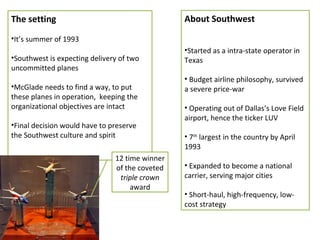
The setting It’s summer of 1993 Southwest is expecting delivery of two uncommitted planes  McGlade needs to find a way, to put these planes in operation,  keeping the organizational objectives are intact Final decision would have to preserve the Southwest culture and spirit About Southwest Started as a intra-state operator in Texas Budget airline philosophy, survived a severe price-war Operating out of Dallas’s Love Field airport, hence the ticker LUV 7 th  largest in the country by April 1993 Expanded to become a national carrier, serving major cities Short-haul, high-frequency, low-cost strategy 12 time winner of the coveted  triple crown  award
The Southwest Model
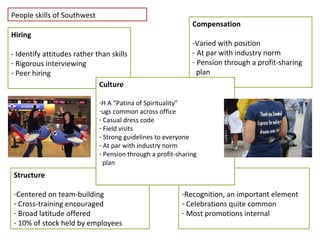
Hiring - Identify attitudes rather than skills Rigorous interviewing Peer hiring  People skills of Southwest Structure Centered on team-building Cross-training encouraged Broad latitude offered  10% of stock held by employees Advancement Recognition, an important element Celebrations quite common Most promotions internal Compensation Varied with position At par with industry norm Pension through a profit-sharing plan  Culture H A “Patina of Spirituality”  ugs common across office Casual dress code Field visits Strong guidelines to everyone At par with industry norm Pension through a profit-sharing plan
“ After lengthy deliberation at the highest executive levels, and extensive consultation with our legal department, we have arrived at an official corporate response to Northwest Airlines Claim to be number one in Customer Satisfaction…… … Liar Liar. Pants on Fire”
Product: Southwest’s product is  travel Competition  - not just other airlines but any mode of transportation. frequent, conveniently timed flights and low fares.  point-to-point route system as compared to hub-and-spoke direct nonstop Target Market: Market Segmentation cost- and value-conscious consumers. mostly male small business executives travel short distances prefer low cost fares frequent schedules  The other half consists of  value-conscious consumers (male, female, families, and senior citizens) best value for their dollars Senior citizens are a sub-segment that receives special attention  than a loyal customer -  customer evangelist
Competitors and Competition   11 major carriers (2003):  Alaska Airlines Aloha Airline  America West  American Airlines  Continental Airlines Delta Airlines Northwest Airlines  TWA United Airlines U.S. Air Southwest Airlines Southwest’s  brand exudes an element of fun:  Obviously Fun  Love Theme,  Love Potions(on-board drinks) Love Machines( ticket writing machines) Product Positioning only low-fare short-haul high-frequency point-to-point carrier  fun to fly Average cost of serving meals per passenger in the industry -  $5  For Southwest’s - 20 cents  Seemingly weird things- Not assigning seats Weird Color Scheme
Product Positioning Example of Southwest Airlines nuttiness - use of the word “love” One ad titled " How Do We Love You? " - flight schedule.  Another ad titled " We're Spreading Love " - the rapid growth of the airline.  Word " love “ - dedication to customer service Marketing Strategies Southwest offers a travel product that is built around flights targeted to  specific demographics  and ticket pricing that is simplified so that passengers know exactly  what they are getting for what they pay.  Building Brand Loyalty What is the Southwest Effect?  Air fares go down  Tourist traffic increases  Economic mini-boom ensues Marketing Blitz !!!! -  Smart Campaign
Pricing Strategies Charge the lowest possible fare  Compete with all other forms of transportation, including automobiles  Instead of increasing fares when market gets busier and more people are flying, it simply increases the number of flights.  Distribution and Promotion   Product Distribution Strategies SWA does not rely on travel agents  Travel bookings -  direct marketing   Does not interline or offer joint fares with other airlines Southwest's Internet ticketing saves it $50 million a year, or 1% of revenue  "We're not competing with other airlines. We're competing with ground transportation"
Promotion Strategies: Marketing Mix   Southwest Airlines wants to differentiate itself from other airlines as the airline that can get passengers to their destinations when they want to get there, on time, at the lowest possible fares –  while having fun.  Frequent Flyer Awards Rapid Rewards-based on number of trips taken Way of showing Southwest’s philosophy that  every customer is equally important as the other  and making ALL passengers feel special.  Advertising “ Don’t believe the hype.”  Fares offered by other discounters and airlines on the Web are not good buys.  Southwest attempts to do three things in their advertising:  intrigue  Entertain persuade “ We’d like to match their new fares but we’d have to raise ours!!"
Television Sports Advertising Sports television programming  Reaching the corporate set via sports and other venues In 2000, Southwest renewed its multi-year sponsorship agreement with the National Football League (NFL).  Public Relations   Aims for “Free publicity”  Triple Crown Award for the fifth time in a row Named a plane Triple Crown One and painted 24,000 employee names on it  Internal Marketing   Core Business - Customer Service business—they just happen to provide airline transportation Southwest’s philosophy - “Service for Smiles and Profits”  Encourages employees to treat customer service as the most important aspect of their job CEO Kelleher, " We want people who do things well, with laughter and grace. "
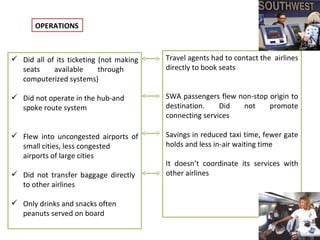
OPERATIONS Did all of its ticketing  (not making seats available through  computerized systems) Did not operate in the hub-and spoke route system Flew into uncongested airports of small cities, less congested airports of large cities Did not transfer baggage directly  to other airlines Only drinks and snacks often peanuts served on board Travel agents had to contact the  airlines directly to book seats SWA passengers flew non-stop origin to destination. Did not promote connecting services Savings in reduced taxi time, fewer gate holds and less in-air waiting time It doesn’t coordinate its services with other airlines
OPERATIONS Usually do not share the ground handling crew until unavoidable Other airlines flew variety of jet aircrafts, as many as 5 distinct ones including McDonnell Douglas, Airbus and Boeing 737’s had average life of 20 years US industry average was 55 mins. 84% unionized labor force but its labor relations were excellent Only flew Boeing 737 - Fleet of  150 and avg of 1500 trips per day.  Average age of SWA was 7 years (lowest in the industry) Differentiation in terms of “turnaround” time , 2 out of 3 planes were turned-around in 15 mins.
COST CONTROL “ Airlines don’t have revenue problems, they have cost problems”
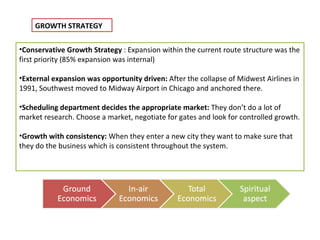
GROWTH STRATEGY Conservative Growth Strategy  : Expansion within the current route structure was the first priority (85% expansion was internal) External expansion was opportunity driven:  After the collapse of Midwest Airlines in 1991, Southwest moved to Midway Airport in Chicago and anchored there. Scheduling department decides the appropriate market:  They don’t do a lot of market research. Choose a market, negotiate for gates and look for controlled growth. Growth with consistency:  When they enter a new city they want to make sure that they do the business which is consistent throughout the system.
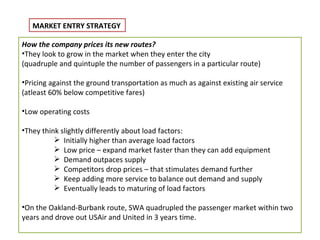
MARKET ENTRY STRATEGY How the company prices its new routes? They look to grow in the market when they enter the city  (quadruple and quintuple the number of passengers in a particular route) Pricing against the ground transportation as much as against existing air service (atleast 60% below competitive fares) Low operating costs They think slightly differently about load factors: Initially higher than average load factors Low price – expand market faster than they can add equipment Demand outpaces supply Competitors drop prices – that stimulates demand further Keep adding more service to balance out demand and supply Eventually leads to maturing of load factors On the Oakland-Burbank route, SWA quadrupled the passenger market within two years and drove out USAir and United in 3 years time.
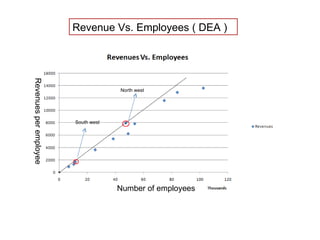
South west North west Number of employees Revenues per employee Revenue Vs. Employees ( DEA )
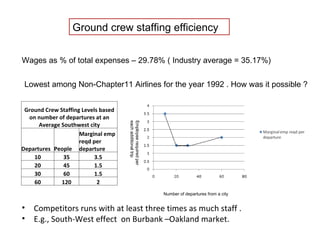
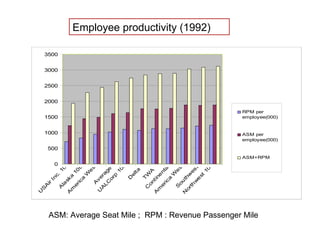
Wages as % of total expenses – 29.78% ( Industry average = 35.17%) Lowest among Non-Chapter11 Airlines for the year 1992 . How was it possible ? Employee required per each additional trip Number of departures from a city Ground crew staffing efficiency Competitors runs with at least three times as much staff . E.g., South-West effect  on Burbank –Oakland market. Ground Crew Staffing Levels based on number of departures at an Average Southwest city Departures People Marginal emp reqd per departure 10 35 3.5 20 45 1.5 30 60 1.5 60 120 2
ASM: Average Seat Mile ;  RPM : Revenue Passenger Mile Employee productivity (1992)
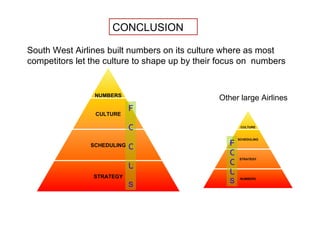
South West Airlines built numbers on its culture where as most competitors let the culture to shape up by their focus on  numbers Other large Airlines F O C U S CONCLUSION F O C U S NUMBERS CULTURE SCHEDULING STRATEGY CULTURE SCHEDULING STRATEGY NUMBERS
Thank You