Support organizations: National level – UGC
with reference to their roles and functions
By- Monali Madhuchhanda Pradhan
INTRODUCTION
• UGC is the acronym for University Grants Commission.
• Founded in the year 1956, the University Grants Commission (UGC) is a
statutory body set up by the Department of Higher Education, Ministry of
Education, Government of India in accordance to the UGC Act 1956.
• It became a statutory Organization of the Government of India by an Act of
Parliament in 1956, for the coordination, determination and maintenance of
standards of teaching, examination and research in university education.
• The motto of UGC is - Gyan-Vigyan Vimuktaye, meaning – Knowledge
Liberates. The Logo has Ashoka Chakra at the top and symbolic
representation of an open book, along with shape of a flying bird, thereby
depicting the motto.
Abbreviation UGC
Formation 28 December 1956; 66 years ago
Headquarters New Delhi
Location India
Chairman Prof. Mamidala Jagadesh Kumar
Parent organization Department of Higher Education,
Ministry of Education,
Government of India
Website www.ugc.ac.in
UGC Establishment - Journey So Far
The depiction of UGC we have today is the result of numerous intense steps taken before and after the Indian
Independence. Come, let’s become a part of the establishment journey of the University Grants Commission.
1. The first attempt to have an education system was made in the year 1944 with the Sargent Report. It was
the Report of the Central Advisory Board of Education on Post-War Educational Development in India.
2. Through the recommendation, the University Grants Committee was formed in 1945, which took upon
the responsibility of supervision of three Central Universities of Aligarh, Banaras, and Delhi.
3. In the year 1947, the committee got the responsibility to control all the universities of that era.
4. In 1948, the University Education Commission was set up, whose chairman was Dr. Sarvapalli
Radhakrishnan. The commission suggested that the existing University Grants Committee should be
transformed into University Grants Commission India like the UK.
Cont...
5. On 28 December 1953, Maulana Abul Kalam Azad (former Minister of Education)
inaugurated University Grants Commission.
6. And in November 1956, UGC (University Grants Commission) was formally established as
a statutory body of the Government of India via ‘University Grants Commission Act, 1956’ of the
Parliament. The vision was to supervise the coordination, determination, and maintenance of
standards of university education in our country.
7. Thereafter in 1994 and 1995, UGC introduced six regional centers at Pune, Hyderabad,
Kolkata, Bhopal, Guwahati, and Bangalore to control the region-wise education system in India.
Currently, the head office is locating at Bahadur Shah Zafar Marg in New Delhi.
Objectives:
• To coordinate, determine and maintain the standards of university education.
• To ensure the quality of university education
• To develop universities as centres of excellence
• To assess the financial needs of the universities and formulate and implement proper plans and
programs
• To foster national, regional and international linkages and collaboration in the field of teaching
and learning
• To helps the universities in staff development, student mobility etc.
• To organize and motivate the universities to act as agents of change by creating new frontiers of
knowledge.
Mandate
The UGC has the unique distinction of being the only grant-giving agency in the country which has been vested
with two responsibilities: that of providing funds and that of coordination, determination and maintenance of
standards in institutions of higher education.
The UGC`s mandate includes:
• Promoting and coordinating university education.
• Determining and maintaining standards of teaching, examination and research in universities.
• Framing regulations on minimum standards of education.
• Monitoring developments in the field of collegiate and university education; disbursing grants to the universities
and colleges.
• Serving as a vital link between the Union and state governments and institutions of higher learning.
• Advising the Central and State governments on the measures necessary for improvement of university
education.
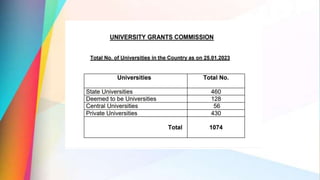
Types of Universities controlled by UGC
The types of universities include:
• Central universities, or Union universities, are established by an Act of Parliament and are under the
purview of the Department of Higher Education in the Ministry of Education.
• State universities are run by the state government of each of the states and territories of India and are
usually established by a local legislative assembly act.
• Deemed university, or "Deemed to be University", is a status of autonomy granted by the Department of
Higher Education on the advice of the UGC, under Section 3 of the UGC Act.
• Private universities are approved by the UGC. They can grant degrees but they are not allowed to have off-
campus affiliated colleges.
Roles of the UGC:
The UGC has the unique distinction of being the only grant-giving agency in the country which has
been vested with two responsibilities:
• providing funds and
• coordination, determination and maintenance of standards in institutions of
higher education.
 The commission upholds the interpretation among the universities, government, and the
community.
 The commission has the power to allocate funds to Universities and Institutions of Higher
Learning as well as ensuring that these institutions abide by the standards imposed by the
commission. Institutions that fail to fall under the category are deemed fake universities or
colleges, and the University Grants Commission generates a list of the same regularly.
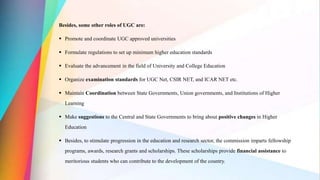
Besides, some other roles of UGC are:
 Promote and coordinate UGC approved universities
 Formulate regulations to set up minimum higher education standards
 Evaluate the advancement in the field of University and College Education
 Organize examination standards for UGC Net, CSIR NET, and ICAR NET etc.
 Maintain Coordination between State Governments, Union governments, and Institutions of Higher
Learning
 Make suggestions to the Central and State Governments to bring about positive changes in Higher
Education
 Besides, to stimulate progression in the education and research sector, the commission imparts fellowship
programs, awards, research grants and scholarships. These scholarships provide financial assistance to
meritorious students who can contribute to the development of the country.
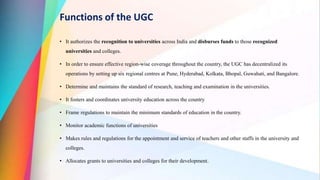
Functions of the UGC
• It authorizes the recognition to universities across India and disburses funds to those recognized
universities and colleges.
• In order to ensure effective region-wise coverage throughout the country, the UGC has decentralized its
operations by setting up six regional centres at Pune, Hyderabad, Kolkata, Bhopal, Guwahati, and Bangalore.
• Determine and maintains the standard of research, teaching and examination in the universities.
• It fosters and coordinates university education across the country
• Frame regulations to maintain the minimum standards of education in the country.
• Monitor academic functions of universities
• Makes rules and regulations for the appointment and service of teachers and other staffs in the university and
colleges.
• Allocates grants to universities and colleges for their development.
Cont..
• Scrutinize growth in the field of college and university education.
• Collect and disseminate information on all matters relating to university education in India and in other
countries.
• Maintain connection between the Union and State Governments and institutions of higher education.
• It also advises the Central and State government about the steps to be taken in order to improve the
education system.
• Advises any authority on the establishment of new university or on the proposal seeking expansion of any
university.
• Seek information from the universities from time to time. It can be financial, academic or administrative.
University Grants Commission(UGC) -  PPT

University Grants Commission(UGC) - PPT

  • 1.
    Support organizations: Nationallevel – UGC with reference to their roles and functions By- Monali Madhuchhanda Pradhan
  • 2.
    INTRODUCTION • UGC isthe acronym for University Grants Commission. • Founded in the year 1956, the University Grants Commission (UGC) is a statutory body set up by the Department of Higher Education, Ministry of Education, Government of India in accordance to the UGC Act 1956. • It became a statutory Organization of the Government of India by an Act of Parliament in 1956, for the coordination, determination and maintenance of standards of teaching, examination and research in university education. • The motto of UGC is - Gyan-Vigyan Vimuktaye, meaning – Knowledge Liberates. The Logo has Ashoka Chakra at the top and symbolic representation of an open book, along with shape of a flying bird, thereby depicting the motto.
  • 3.
    Abbreviation UGC Formation 28December 1956; 66 years ago Headquarters New Delhi Location India Chairman Prof. Mamidala Jagadesh Kumar Parent organization Department of Higher Education, Ministry of Education, Government of India Website www.ugc.ac.in
  • 4.
    UGC Establishment -Journey So Far The depiction of UGC we have today is the result of numerous intense steps taken before and after the Indian Independence. Come, let’s become a part of the establishment journey of the University Grants Commission. 1. The first attempt to have an education system was made in the year 1944 with the Sargent Report. It was the Report of the Central Advisory Board of Education on Post-War Educational Development in India. 2. Through the recommendation, the University Grants Committee was formed in 1945, which took upon the responsibility of supervision of three Central Universities of Aligarh, Banaras, and Delhi. 3. In the year 1947, the committee got the responsibility to control all the universities of that era. 4. In 1948, the University Education Commission was set up, whose chairman was Dr. Sarvapalli Radhakrishnan. The commission suggested that the existing University Grants Committee should be transformed into University Grants Commission India like the UK.
  • 5.
    Cont... 5. On 28December 1953, Maulana Abul Kalam Azad (former Minister of Education) inaugurated University Grants Commission. 6. And in November 1956, UGC (University Grants Commission) was formally established as a statutory body of the Government of India via ‘University Grants Commission Act, 1956’ of the Parliament. The vision was to supervise the coordination, determination, and maintenance of standards of university education in our country. 7. Thereafter in 1994 and 1995, UGC introduced six regional centers at Pune, Hyderabad, Kolkata, Bhopal, Guwahati, and Bangalore to control the region-wise education system in India. Currently, the head office is locating at Bahadur Shah Zafar Marg in New Delhi.
  • 6.
    Objectives: • To coordinate,determine and maintain the standards of university education. • To ensure the quality of university education • To develop universities as centres of excellence • To assess the financial needs of the universities and formulate and implement proper plans and programs • To foster national, regional and international linkages and collaboration in the field of teaching and learning • To helps the universities in staff development, student mobility etc. • To organize and motivate the universities to act as agents of change by creating new frontiers of knowledge.
  • 7.
    Mandate The UGC hasthe unique distinction of being the only grant-giving agency in the country which has been vested with two responsibilities: that of providing funds and that of coordination, determination and maintenance of standards in institutions of higher education. The UGC`s mandate includes: • Promoting and coordinating university education. • Determining and maintaining standards of teaching, examination and research in universities. • Framing regulations on minimum standards of education. • Monitoring developments in the field of collegiate and university education; disbursing grants to the universities and colleges. • Serving as a vital link between the Union and state governments and institutions of higher learning. • Advising the Central and State governments on the measures necessary for improvement of university education.
  • 8.
    Types of Universitiescontrolled by UGC The types of universities include: • Central universities, or Union universities, are established by an Act of Parliament and are under the purview of the Department of Higher Education in the Ministry of Education. • State universities are run by the state government of each of the states and territories of India and are usually established by a local legislative assembly act. • Deemed university, or "Deemed to be University", is a status of autonomy granted by the Department of Higher Education on the advice of the UGC, under Section 3 of the UGC Act. • Private universities are approved by the UGC. They can grant degrees but they are not allowed to have off- campus affiliated colleges.
  • 10.
    Roles of theUGC: The UGC has the unique distinction of being the only grant-giving agency in the country which has been vested with two responsibilities: • providing funds and • coordination, determination and maintenance of standards in institutions of higher education.  The commission upholds the interpretation among the universities, government, and the community.  The commission has the power to allocate funds to Universities and Institutions of Higher Learning as well as ensuring that these institutions abide by the standards imposed by the commission. Institutions that fail to fall under the category are deemed fake universities or colleges, and the University Grants Commission generates a list of the same regularly.
  • 11.
    Besides, some otherroles of UGC are:  Promote and coordinate UGC approved universities  Formulate regulations to set up minimum higher education standards  Evaluate the advancement in the field of University and College Education  Organize examination standards for UGC Net, CSIR NET, and ICAR NET etc.  Maintain Coordination between State Governments, Union governments, and Institutions of Higher Learning  Make suggestions to the Central and State Governments to bring about positive changes in Higher Education  Besides, to stimulate progression in the education and research sector, the commission imparts fellowship programs, awards, research grants and scholarships. These scholarships provide financial assistance to meritorious students who can contribute to the development of the country.
  • 12.
    Functions of theUGC • It authorizes the recognition to universities across India and disburses funds to those recognized universities and colleges. • In order to ensure effective region-wise coverage throughout the country, the UGC has decentralized its operations by setting up six regional centres at Pune, Hyderabad, Kolkata, Bhopal, Guwahati, and Bangalore. • Determine and maintains the standard of research, teaching and examination in the universities. • It fosters and coordinates university education across the country • Frame regulations to maintain the minimum standards of education in the country. • Monitor academic functions of universities • Makes rules and regulations for the appointment and service of teachers and other staffs in the university and colleges. • Allocates grants to universities and colleges for their development.
  • 13.
    Cont.. • Scrutinize growthin the field of college and university education. • Collect and disseminate information on all matters relating to university education in India and in other countries. • Maintain connection between the Union and State Governments and institutions of higher education. • It also advises the Central and State government about the steps to be taken in order to improve the education system. • Advises any authority on the establishment of new university or on the proposal seeking expansion of any university. • Seek information from the universities from time to time. It can be financial, academic or administrative.