Seminar on UGC
 Presented By:-Bhavesh Choudhary
 1st year M.pharm
Contents:-
 University Grants Commission(UGC)
 Introduction
 History
 OBJECTIVES
 Professional councils
 Functions of UGC
 Future
 References
University Grants Commission(UGC)
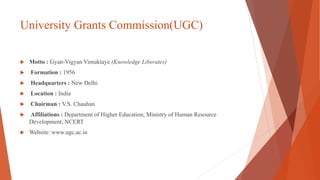
 Motto : Gyan-Vigyan Vimuktaye (Knowledge Liberates)
 Formation : 1956
 Headquarters : New Delhi
 Location : India
 Chairman : V.S. Chauhan
 Affiliations : Department of Higher Education, Ministry of Human Resource
Development, NCERT
 Website: www.ugc.ac.in
Introduction
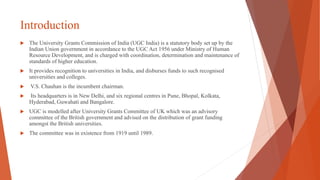
 The University Grants Commission of India (UGC India) is a statutory body set up by the
Indian Union government in accordance to the UGC Act 1956 under Ministry of Human
Resource Development, and is charged with coordination, determination and maintenance of
standards of higher education.
 It provides recognition to universities in India, and disburses funds to such recognised
universities and colleges.
 V.S. Chauhan is the incumbent chairman.
 Its headquarters is in New Delhi, and six regional centres in Pune, Bhopal, Kolkata,
Hyderabad, Guwahati and Bangalore.
 UGC is modelled after University Grants Committee of UK which was an advisory
committee of the British government and advised on the distribution of grant funding
amongst the British universities.
 The committee was in existence from 1919 until 1989.
History
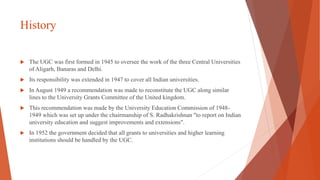
 The UGC was first formed in 1945 to oversee the work of the three Central Universities
of Aligarh, Banaras and Delhi.
 Its responsibility was extended in 1947 to cover all Indian universities.
 In August 1949 a recommendation was made to reconstitute the UGC along similar
lines to the University Grants Committee of the United kingdom.
 This recommendation was made by the University Education Commission of 1948-
1949 which was set up under the chairmanship of S. Radhakrishnan "to report on Indian
university education and suggest improvements and extensions".
 In 1952 the government decided that all grants to universities and higher learning
institutions should be handled by the UGC.
 Subsequently, an inauguration was held on 28 December 1953 by Maulana Abul Kalam
Azad, the Minister of Education, Natural Resources and Scientific Research.
 In November 1956 the UGC became a statutory body upon the passing of the
"University Grants Commission Act, 1956" by the Indian Parliament.
 In 1994 and 1995 the UGC decentralised its operations by setting up six regional
centres at Pune, Hyderabad, Kolkata, Bhopal, Guwahati and Bangalore.
 The head office of the UGC is located at Bahadur Shah Zafar Marg in New Delhi, with
two additional bureaus operating from 35, Feroze Shah Road and the South Campus of
University of Delhi as well.
OBJECTIVES
 To coordinate , determine & maintain the standards of university education.
 To ensure the quality of university education
 To develop universities as centers of excellence
 To assess the financial needs of the universities & formulate and implement proper
plans and programs
 To foster national, regional and international linkages & collaboration in the field of
teaching and learning
 To helps the universities in staff development,student mobility etc.
 To organize & motivate the universities to act as agents of change by creating new
frontiers of knowledge.
Professional councils
 UGC, along with CSIR currently conducts NET for appointments of teachers in
colleges and universities.
 It has made NET qualification mandatory for teaching at Graduation level and at Post
Graduation level since July 2009.
 However, those with Ph.D are given five percent relaxation.
 Accreditation for higher learning over Universities under the aegis of University Grants
Commission is overseen by following fifteen autonomous statutory institutions.
• All India Council for Technical Education (AICTE)
• Distance Education Council (DEC)
• Indian Council of Agricultural Research (ICAR)
• Bar Council of India (BCI)
• Board of Theological Education of the Senate of Serampore College (BTESSC)
• National Council for Teacher Education (NCTE)
• Rehabilitation Council of India (RCI)
• Medical Council of India (MCI)
• Pharmacy Council of India (PCI)
• Indian Nursing Council (INC)
• Dental Council of India (DCI)
• Central Council of Homoeopathy (CCH)
• Central Council of Indian Medicine (CCIM)
• National Council for Rural Institutes (NCRI)
• State Councils of Higher Education (SCHE)
• Council of Architecture
• Veterinary Council of India (VCI)
Functions of UGC
 To enquire into the financial needs of the universities
 Allocate and disburse grants to universities and colleges for their development and
maintenance
 Advising central & state governments on the measures for the improvement of
university education
 Promote & co-ordinate university education
 Institute fellowship and scholarships
 Determine and maintains standards of teaching, examination & research in universities
 Support and co-ordinate research programmes of universities
 Frame regulations on minimum standards of university education
 Monitor academic functions of universities
 Make rules and regulations for the appointment & service of teachers and other staffs in
the university and colleges.
 Conducts examinations like NET, JRF, SRF etc.
 Serving as a vital link b/w the central & state governments and institutions of higher
learning
 Collect and disseminate information on all matters relating to university education in
India and abroad.
Future
 In 2009, the Union Minister of Human Resource Development, Kapil Sibal made
known the government of India's plans to consider the closing down of the UGC and
the related body All India Council for Technical Education (AICTE), in favour of a
higher regulatory body with more sweeping powers.
 This goal, proposed by the Higher Education and Research (HE&R) Bill, 2011, intends
to replace the UGC with a "National Commission for Higher Education & Research
(NCHER)" "for determination, coordination, maintenance and continued enhancement
of standards of higher education and research".
 The bill proposes absorbing the UGC and other academic agencies into this new
organisation.
 Those agencies involved in medicine and law would be exempt from this merger "to set
minimum standards for medical and legal education leading to professional practice".
 The bill has received opposition from the local governments of the Indian states of
Bihar, Kerala, Punjab, Tamil Nadu and West Bengal, but has received general support.
 UGC has directed ten institutions to immediately shut down their off-campus centres.
 In December 2015 the Indian government set a National Institutional of Ranking
Framework under UGC which will rank all educational institutes by April 2016.
 UGC has suggested to all Universities in India to set up an Online Admission System
from the academic session commencing in 2016-2017.
 Recently UGC has released 22 fake universities, 9 are from Uttar Pradesh, 5 from
Delhi, 2 from West Bengal and one each from Bihar, Karnataka, Kerala, Maharashtra,
Tamil Nadu and Odisha.
References:-
 Kothari.C.R,”Research Methodology methods and technquies” 2nd revised edition,new
age International publishers,New Delhi,Page no:-279-292.
 https://en.wikipedia.org/wiki/University_Grants_Commission_(India)
 https://www.ugc.ac.in/journallist/

Rm seminar

  • 1.
    Seminar on UGC Presented By:-Bhavesh Choudhary  1st year M.pharm
  • 2.
    Contents:-  University GrantsCommission(UGC)  Introduction  History  OBJECTIVES  Professional councils  Functions of UGC  Future  References
  • 3.
    University Grants Commission(UGC) Motto : Gyan-Vigyan Vimuktaye (Knowledge Liberates)  Formation : 1956  Headquarters : New Delhi  Location : India  Chairman : V.S. Chauhan  Affiliations : Department of Higher Education, Ministry of Human Resource Development, NCERT  Website: www.ugc.ac.in
  • 4.
    Introduction  The UniversityGrants Commission of India (UGC India) is a statutory body set up by the Indian Union government in accordance to the UGC Act 1956 under Ministry of Human Resource Development, and is charged with coordination, determination and maintenance of standards of higher education.  It provides recognition to universities in India, and disburses funds to such recognised universities and colleges.  V.S. Chauhan is the incumbent chairman.  Its headquarters is in New Delhi, and six regional centres in Pune, Bhopal, Kolkata, Hyderabad, Guwahati and Bangalore.  UGC is modelled after University Grants Committee of UK which was an advisory committee of the British government and advised on the distribution of grant funding amongst the British universities.  The committee was in existence from 1919 until 1989.
  • 5.
    History  The UGCwas first formed in 1945 to oversee the work of the three Central Universities of Aligarh, Banaras and Delhi.  Its responsibility was extended in 1947 to cover all Indian universities.  In August 1949 a recommendation was made to reconstitute the UGC along similar lines to the University Grants Committee of the United kingdom.  This recommendation was made by the University Education Commission of 1948- 1949 which was set up under the chairmanship of S. Radhakrishnan "to report on Indian university education and suggest improvements and extensions".  In 1952 the government decided that all grants to universities and higher learning institutions should be handled by the UGC.
  • 6.
     Subsequently, aninauguration was held on 28 December 1953 by Maulana Abul Kalam Azad, the Minister of Education, Natural Resources and Scientific Research.  In November 1956 the UGC became a statutory body upon the passing of the "University Grants Commission Act, 1956" by the Indian Parliament.  In 1994 and 1995 the UGC decentralised its operations by setting up six regional centres at Pune, Hyderabad, Kolkata, Bhopal, Guwahati and Bangalore.  The head office of the UGC is located at Bahadur Shah Zafar Marg in New Delhi, with two additional bureaus operating from 35, Feroze Shah Road and the South Campus of University of Delhi as well.
  • 7.
    OBJECTIVES  To coordinate, determine & maintain the standards of university education.  To ensure the quality of university education  To develop universities as centers of excellence  To assess the financial needs of the universities & formulate and implement proper plans and programs  To foster national, regional and international linkages & collaboration in the field of teaching and learning  To helps the universities in staff development,student mobility etc.  To organize & motivate the universities to act as agents of change by creating new frontiers of knowledge.
  • 8.
    Professional councils  UGC,along with CSIR currently conducts NET for appointments of teachers in colleges and universities.  It has made NET qualification mandatory for teaching at Graduation level and at Post Graduation level since July 2009.  However, those with Ph.D are given five percent relaxation.  Accreditation for higher learning over Universities under the aegis of University Grants Commission is overseen by following fifteen autonomous statutory institutions. • All India Council for Technical Education (AICTE) • Distance Education Council (DEC) • Indian Council of Agricultural Research (ICAR)
  • 9.
    • Bar Councilof India (BCI) • Board of Theological Education of the Senate of Serampore College (BTESSC) • National Council for Teacher Education (NCTE) • Rehabilitation Council of India (RCI) • Medical Council of India (MCI) • Pharmacy Council of India (PCI) • Indian Nursing Council (INC) • Dental Council of India (DCI) • Central Council of Homoeopathy (CCH) • Central Council of Indian Medicine (CCIM) • National Council for Rural Institutes (NCRI) • State Councils of Higher Education (SCHE) • Council of Architecture • Veterinary Council of India (VCI)
  • 10.
    Functions of UGC To enquire into the financial needs of the universities  Allocate and disburse grants to universities and colleges for their development and maintenance  Advising central & state governments on the measures for the improvement of university education  Promote & co-ordinate university education  Institute fellowship and scholarships  Determine and maintains standards of teaching, examination & research in universities  Support and co-ordinate research programmes of universities  Frame regulations on minimum standards of university education
  • 11.
     Monitor academicfunctions of universities  Make rules and regulations for the appointment & service of teachers and other staffs in the university and colleges.  Conducts examinations like NET, JRF, SRF etc.  Serving as a vital link b/w the central & state governments and institutions of higher learning  Collect and disseminate information on all matters relating to university education in India and abroad.
  • 12.
    Future  In 2009,the Union Minister of Human Resource Development, Kapil Sibal made known the government of India's plans to consider the closing down of the UGC and the related body All India Council for Technical Education (AICTE), in favour of a higher regulatory body with more sweeping powers.  This goal, proposed by the Higher Education and Research (HE&R) Bill, 2011, intends to replace the UGC with a "National Commission for Higher Education & Research (NCHER)" "for determination, coordination, maintenance and continued enhancement of standards of higher education and research".  The bill proposes absorbing the UGC and other academic agencies into this new organisation.
  • 13.
     Those agenciesinvolved in medicine and law would be exempt from this merger "to set minimum standards for medical and legal education leading to professional practice".  The bill has received opposition from the local governments of the Indian states of Bihar, Kerala, Punjab, Tamil Nadu and West Bengal, but has received general support.  UGC has directed ten institutions to immediately shut down their off-campus centres.  In December 2015 the Indian government set a National Institutional of Ranking Framework under UGC which will rank all educational institutes by April 2016.  UGC has suggested to all Universities in India to set up an Online Admission System from the academic session commencing in 2016-2017.  Recently UGC has released 22 fake universities, 9 are from Uttar Pradesh, 5 from Delhi, 2 from West Bengal and one each from Bihar, Karnataka, Kerala, Maharashtra, Tamil Nadu and Odisha.
  • 14.
    References:-  Kothari.C.R,”Research Methodologymethods and technquies” 2nd revised edition,new age International publishers,New Delhi,Page no:-279-292.  https://en.wikipedia.org/wiki/University_Grants_Commission_(India)  https://www.ugc.ac.in/journallist/