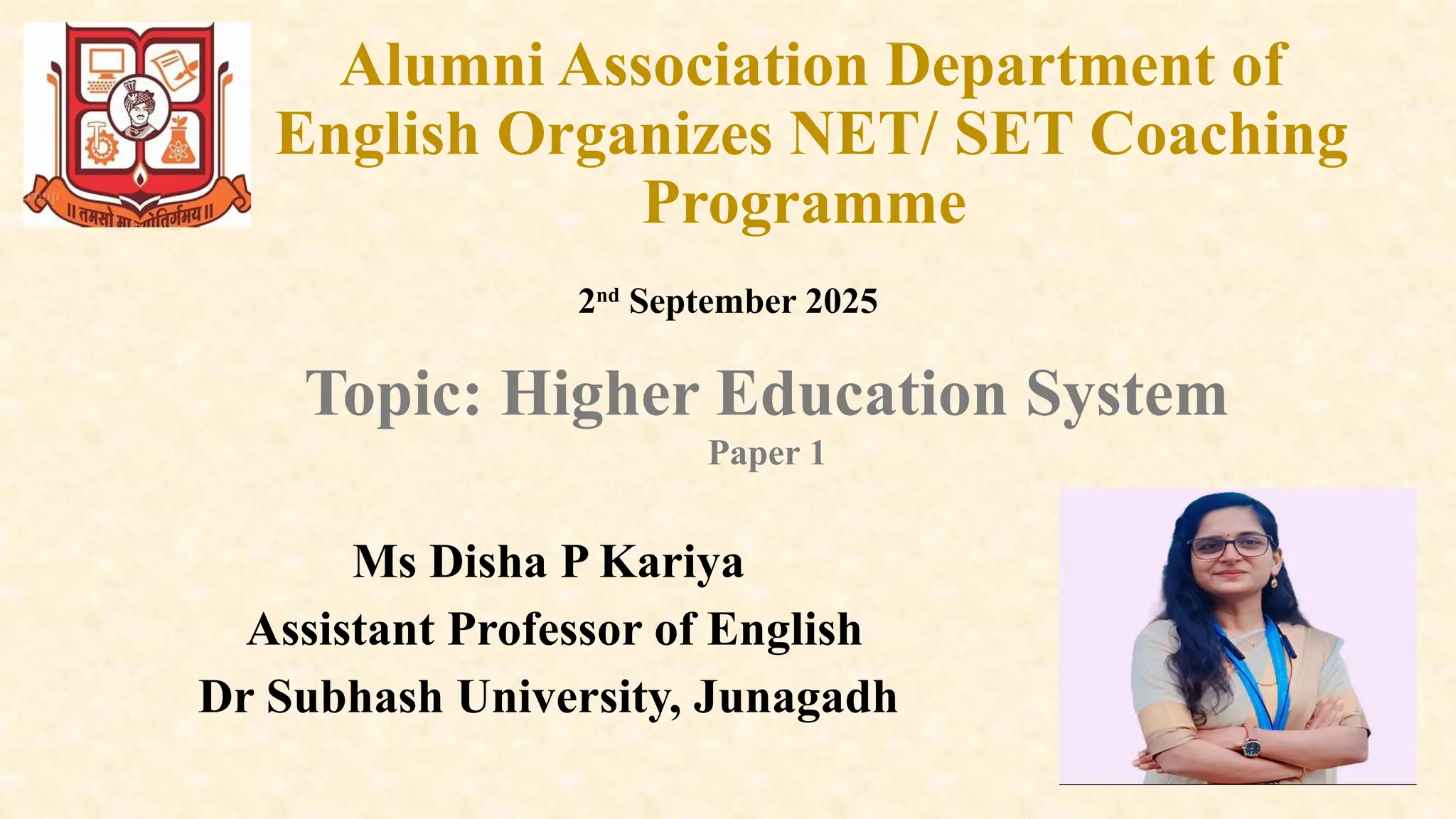
Alumni Association Departmentof
English Organizes NET/ SET Coaching
Programme
Ms Disha P Kariya
Assistant Professor of English
Dr Subhash University, Junagadh
Topic: Higher Education System
Paper 1
2nd
September 2025
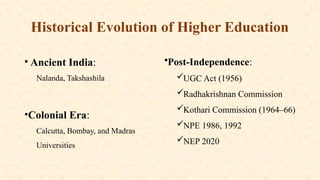
Historical Evolution ofHigher Education
• Ancient India:
Nalanda, Takshashila
•Colonial Era:
Calcutta, Bombay, and Madras
Universities
•Post-Independence:
UGC Act (1956)
Radhakrishnan Commission
Kothari Commission (1964–66)
NPE 1986, 1992
NEP 2020
4.
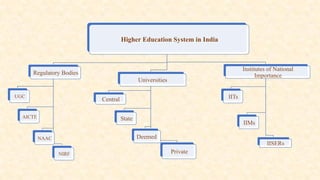
Higher Education Systemin India
Regulatory Bodies
UGC
AICTE
NAAC
NIRF
Universities
Central
State
Deemed
Private
Institutes of National
Importance
IITs
IIMs
IISERs
5.
Governance & Administration
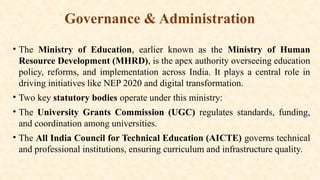
•The Ministry of Education, earlier known as the Ministry of Human
Resource Development (MHRD), is the apex authority overseeing education
policy, reforms, and implementation across India. It plays a central role in
driving initiatives like NEP 2020 and digital transformation.
• Two key statutory bodies operate under this ministry:
• The University Grants Commission (UGC) regulates standards, funding,
and coordination among universities.
• The All India Council for Technical Education (AICTE) governs technical
and professional institutions, ensuring curriculum and infrastructure quality.
6.
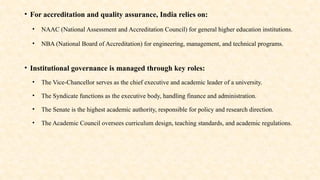
• For accreditationand quality assurance, India relies on:
• NAAC (National Assessment and Accreditation Council) for general higher education institutions.
• NBA (National Board of Accreditation) for engineering, management, and technical programs.
• Institutional governance is managed through key roles:
• The Vice-Chancellor serves as the chief executive and academic leader of a university.
• The Syndicate functions as the executive body, handling finance and administration.
• The Senate is the highest academic authority, responsible for policy and research direction.
• The Academic Council oversees curriculum design, teaching standards, and academic regulations.
7.
Indira Gandhi NationalOpen University
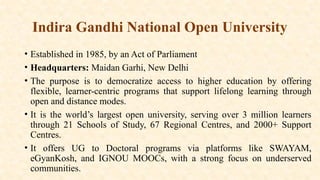
• Established in 1985, by an Act of Parliament
• Headquarters: Maidan Garhi, New Delhi
• The purpose is to democratize access to higher education by offering
flexible, learner-centric programs that support lifelong learning through
open and distance modes.
• It is the world’s largest open university, serving over 3 million learners
through 21 Schools of Study, 67 Regional Centres, and 2000+ Support
Centres.
• It offers UG to Doctoral programs via platforms like SWAYAM,
eGyanKosh, and IGNOU MOOCs, with a strong focus on underserved
communities.
8.
NEP 2020 –Highlights
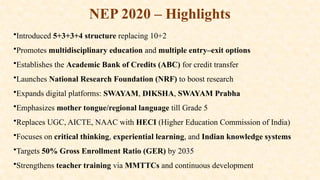
•Introduced 5+3+3+4 structure replacing 10+2
•Promotes multidisciplinary education and multiple entry–exit options
•Establishes the Academic Bank of Credits (ABC) for credit transfer
•Launches National Research Foundation (NRF) to boost research
•Expands digital platforms: SWAYAM, DIKSHA, SWAYAM Prabha
•Emphasizes mother tongue/regional language till Grade 5
•Replaces UGC, AICTE, NAAC with HECI (Higher Education Commission of India)
•Focuses on critical thinking, experiential learning, and Indian knowledge systems
•Targets 50% Gross Enrollment Ratio (GER) by 2035
•Strengthens teacher training via MMTTCs and continuous development
9.
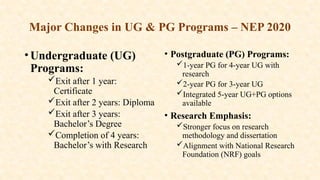
Major Changes inUG & PG Programs – NEP 2020
•Undergraduate (UG)
Programs:
Exit after 1 year:
Certificate
Exit after 2 years: Diploma
Exit after 3 years:
Bachelor’s Degree
Completion of 4 years:
Bachelor’s with Research
• Postgraduate (PG) Programs:
1-year PG for 4-year UG with
research
2-year PG for 3-year UG
Integrated 5-year UG+PG options
available
• Research Emphasis:
Stronger focus on research
methodology and dissertation
Alignment with National Research
Foundation (NRF) goals
10.
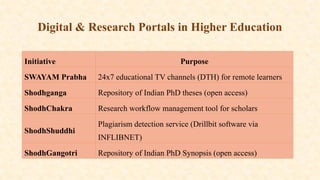
Digital & ResearchPortals in Higher Education
Initiative Purpose
SWAYAM Prabha 24x7 educational TV channels (DTH) for remote learners
Shodhganga Repository of Indian PhD theses (open access)
ShodhChakra Research workflow management tool for scholars
ShodhShuddhi
Plagiarism detection service (Drillbit software via
INFLIBNET)
ShodhGangotri Repository of Indian PhD Synopsis (open access)
11.
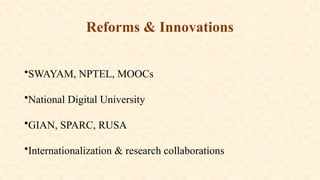
Reforms & Innovations
•SWAYAM,NPTEL, MOOCs
•National Digital University
•GIAN, SPARC, RUSA
•Internationalization & research collaborations
12.
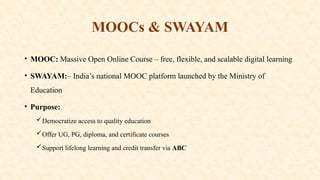
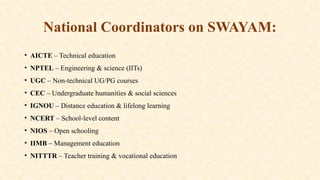
MOOCs & SWAYAM
•MOOC: Massive Open Online Course – free, flexible, and scalable digital learning
• SWAYAM:– India’s national MOOC platform launched by the Ministry of
Education
• Purpose:
Democratize access to quality education
Offer UG, PG, diploma, and certificate courses
Support lifelong learning and credit transfer via ABC
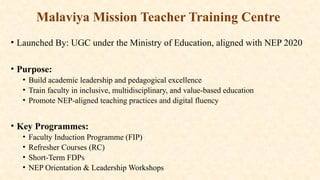
Malaviya Mission TeacherTraining Centre
• Launched By: UGC under the Ministry of Education, aligned with NEP 2020
• Purpose:
• Build academic leadership and pedagogical excellence
• Train faculty in inclusive, multidisciplinary, and value-based education
• Promote NEP-aligned teaching practices and digital fluency
• Key Programmes:
• Faculty Induction Programme (FIP)
• Refresher Courses (RC)
• Short-Term FDPs
• NEP Orientation & Leadership Workshops
15.
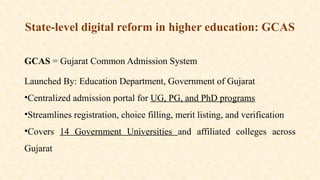
State-level digital reformin higher education: GCAS
GCAS = Gujarat Common Admission System
Launched By: Education Department, Government of Gujarat
•Centralized admission portal for UG, PG, and PhD programs
•Streamlines registration, choice filling, merit listing, and verification
•Covers 14 Government Universities and affiliated colleges across
Gujarat
16.
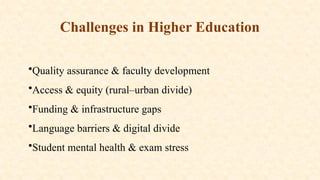
Challenges in HigherEducation
•Quality assurance & faculty development
•Access & equity (rural–urban divide)
•Funding & infrastructure gaps
•Language barriers & digital divide
•Student mental health & exam stress
17.
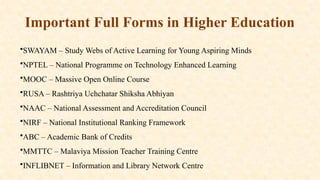
Important Full Formsin Higher Education
•SWAYAM – Study Webs of Active Learning for Young Aspiring Minds
•NPTEL – National Programme on Technology Enhanced Learning
•MOOC – Massive Open Online Course
•RUSA – Rashtriya Uchchatar Shiksha Abhiyan
•NAAC – National Assessment and Accreditation Council
•NIRF – National Institutional Ranking Framework
•ABC – Academic Bank of Credits
•MMTTC – Malaviya Mission Teacher Training Centre
•INFLIBNET – Information and Library Network Centre
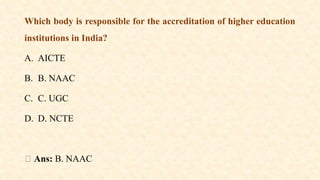
Which body isresponsible for the accreditation of higher education
institutions in India?
A. AICTE
B. B. NAAC
C. C. UGC
D. D. NCTE
✅ Ans: B. NAAC
20.
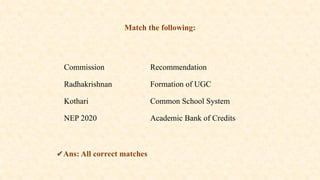
Match the following:
CommissionRecommendation
Radhakrishnan Formation of UGC
Kothari Common School System
NEP 2020 Academic Bank of Credits
✔️
Ans: All correct matches
21.
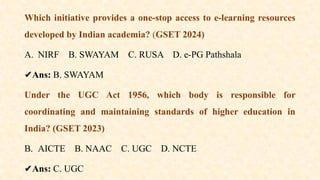
Which initiative providesa one-stop access to e-learning resources
developed by Indian academia? (GSET 2024)
A. NIRF B. SWAYAM C. RUSA D. e-PG Pathshala
✔️
Ans: B. SWAYAM
Under the UGC Act 1956, which body is responsible for
coordinating and maintaining standards of higher education in
India? (GSET 2023)
B. AICTE B. NAAC C. UGC D. NCTE
✔️
Ans: C. UGC
22.
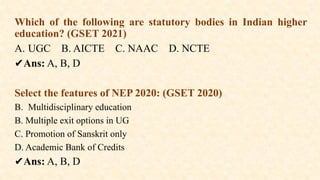
Which of thefollowing are statutory bodies in Indian higher
education? (GSET 2021)
A. UGC B. AICTE C. NAAC D. NCTE
✔️
Ans: A, B, D
Select the features of NEP 2020: (GSET 2020)
B. Multidisciplinary education
B. Multiple exit options in UG
C. Promotion of Sanskrit only
D. Academic Bank of Credits
✔️
Ans: A, B, D
23.
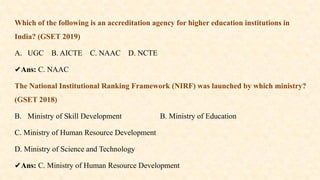
Which of thefollowing is an accreditation agency for higher education institutions in
India? (GSET 2019)
A. UGC B. AICTE C. NAAC D. NCTE
✔️
Ans: C. NAAC
The National Institutional Ranking Framework (NIRF) was launched by which ministry?
(GSET 2018)
B. Ministry of Skill Development B. Ministry of Education
C. Ministry of Human Resource Development
D. Ministry of Science and Technology
✔️
Ans: C. Ministry of Human Resource Development
24.
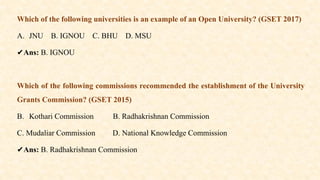
Which of thefollowing universities is an example of an Open University? (GSET 2017)
A. JNU B. IGNOU C. BHU D. MSU
✔️
Ans: B. IGNOU
Which of the following commissions recommended the establishment of the University
Grants Commission? (GSET 2015)
B. Kothari Commission B. Radhakrishnan Commission
C. Mudaliar Commission D. National Knowledge Commission
✔️
Ans: B. Radhakrishnan Commission
25.
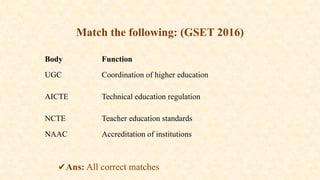
Match the following:(GSET 2016)
Body Function
UGC Coordination of higher education
AICTE Technical education regulation
NCTE Teacher education standards
NAAC Accreditation of institutions
✔️
Ans: All correct matches
26.
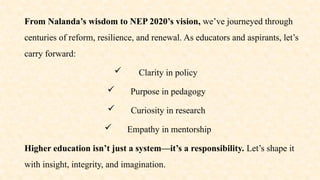
From Nalanda’s wisdomto NEP 2020’s vision, we’ve journeyed through
centuries of reform, resilience, and renewal. As educators and aspirants, let’s
carry forward:
Clarity in policy
Purpose in pedagogy
Curiosity in research
Empathy in mentorship
Higher education isn’t just a system—it’s a responsibility. Let’s shape it
with insight, integrity, and imagination.