Social Media and the New Populism: Reflections
on the Australian Case
Terry Flew, Professor of Media and Communication
Creative Industries Faculty/Digital Media Research Centre
Queensland University of Technology
Presentation to Universitas Indonesia, Jakarta, Indonesia
20 November 2016
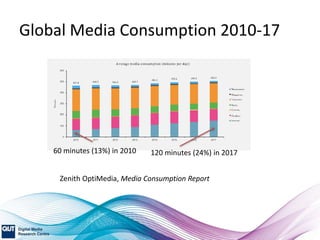
Global Media Consumption 2010-17
60 minutes (13%) in 2010 120 minutes (24%) in 2017
Zenith OptiMedia, Media Consumption Report
Australian Media Consumption
2010-17
100 minutes (22.5%) in 2010 170 minutes (37%) in 2017
Zenith OptiMedia, Media Consumption Report
Studying Digital and Social Media
Artefacts
•infrastructrues
•devices
•services
•platforms
Practices
•activities
•uses
•communication
•information/knowledge
Social arrangements
•institutions
•organisations
•laws/policies
•politics/economics
From Leah Lievrouw and Sonia Livingstone (eds.),
Handbook of New Media (SAGE, 2006)
Media, Technology and Politics
Artefacts
•infrastructrues
•devices
•services
•platforms
Practices
•activities
•uses
•communication
•information/knowledge
Social arrangements
•institutions
•organisations
•laws/policies
•politics/economics
Journalists, politicians,
political communicators
and strategists
Media institutions,
Political parties
Media platforms
and technologies
From mass media to social media?
Mass communications media
(20th century)
Convergent social media
(21st century)
Media distribution Large-scale; high barriers to entry Internet dramatically reduces barriers
to entry
Media production Complex division of labour; media
content gatekeepers;
professional ideologies
Easy-to-use Web 2.0 technologies;
multi-skilling; small collaborative teams
Media power One way communications flow Greater empowerment of
users/audiences
Media content Tendency towards standardised mass
appeal content to maximise
audience share
‘Long tail’ economics; de-massification
and segmentation of media content
markets
Producer/consumer
relationship
Impersonal, anonymous and
commoditised (audiences as target
mass market)
Potential to be more personalised and
user-driven (user created content –
UCC)
Australian Case Study
• Politics, Media and Democracy in Australia: public
and producer perceptions of the Australian public
sphere
• Brian McNair, Stephen Harrington, Terry Flew and
Adam Swift
• To be published by Routledge, 2017
Research Methodology
• Australian Research Council
project 2013-16:
• Interviews with political
leaders and journalists
• 24 focus groups in eight
Australian cities
• Content analysis of political TV
shows
• Broad interpretation of
“political television” –
included comedies and
“infotainment”
The Australian Political Mediasphere
Mainstream Political
Media (major
newspapers, Insiders,
7.30 Report)
Innovative formats
(Q&A, The Project)
Satire and
Infotainment (Mad as
Hell, Kitchen Cabinet,
Gruen Nation)
Insiders
• Traditional panel
program on ABC TV
• Interview with leading
politicians
• Senior journalists
discuss current political
issues
Digital Media Research Centre
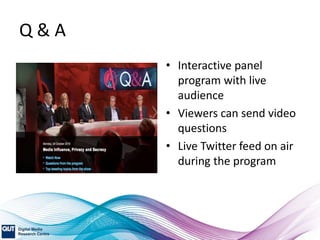
Q & A
• Interactive panel
program with live
audience
• Viewers can send video
questions
• Live Twitter feed on air
during the program
Mad As Hell
• Satirical/sketch comedy
broadcast on ABC TV
• Hosted by Sean
Micallef, the program
has various interview
subjects who comment
on current issues
• Strong focus on
Australian politics
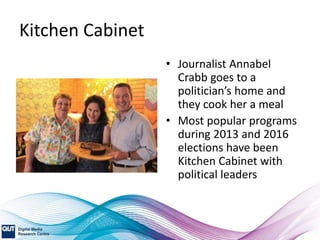
Kitchen Cabinet
• Journalist Annabel
Crabb goes to a
politician’s home and
they cook her a meal
• Most popular programs
during 2013 and 2016
elections have been
Kitchen Cabinet with
political leaders
Stable electoral democracy: the two-
party model
Stages of the Politics/Media
relationship
"Golden Age"
• Stable party
system
• Specialist
political
reporting
• Dominance of
print media
Mediatization
of politics
• more fluid political
allegiances
• 'Presidential' mode of
campaigning
• Dominance of broadcast
media
• Rise of political 'spin'
A new age in
politics/media?
•Resurgence of
political
populism
•Growing
importance of
social media
•Political 'neo-
tribes'?
Mediatization of politics
• ‘If you're the Prime Minister or the Leader of the Opposition, it’s a media job.’
(Russel Howcroft, Gruen Nation, 4 September 2013).
• ‘Guess what? There’s a whole bunch of people out there who you may be
surprised to know don't watch Insiders but do listen to FM radio. And my job
as the alternative prime minister is to communicate with the entire country’
(Kevin Rudd, quoted in Wilson, 2010: 98).
•
‘You know that old line when Daniel Schorr, a prominent American journalist
who came up through print, decided in the early years of television decided he
was going to move across. And at his first job at CBS he said to the producer,
“You know, I understand print fine, but television has got me a bit puzzled,
what’s the secret?” And the producer said to him, “Well, the key to success on
television is sincerity, and if you can fake that you’ve got it made.”’(Kerry
O’Brien, interview, 29 August, 2014).
Mediatization of Politics
Mediatization of Politics (Mazzoleni &
Schulz, 1999)
• Growing influence of “news values” over political actors
• Political agenda increasingly shaped by needs of media
institutions
• Politicians compete for attention, not just with other
politicians, but with all other priorities of the media
• Political communication needs to be conducted by media
experts
• Political institutions and media institutions deal with
each other instrumentally
Problems with mediated politics
• Politics becomes a branch of promotional culture, where
‘politics, markets, popular culture and media, civil
society, work and individual social relations have all
adapted to promotional needs and practices’ (Davis,
2013, p. 4)
• Elite source dependency of journalists (“political
insiders”)
• Managed communication with the media (“spin”)
• Limited array of forms of reporting politics – soundbites,
pseudo-events, “horse-race” journalism
#faketradie
“Political leaders are beginning to resemble seaside comics who have
failed to recognise that the deckchairs are empty. Repertoires that had
them rolling in the aisles in the era of Churchill and Roosevelt – or
even Nixon and Wilson – now look like mediocre impersonations.
Not only are political speeches replete with linguistically risk-averse
clichés borrowed from middle management – “facing important
challenges”, “we’re listening very carefully”, “moving forward”, “all in it
together”, “people who do the right thing” – but the semiotic
production has been reduced to a constant replay of metaphors
designed for idiots.
Politicians wear hard-hats and orange protective jackets, as if to prove
they thrive on the shop floor. Leaders have a routine habit of making
speeches surrounded by “ordinary people” who look like involuntary
participants in the opening ceremony of the Beijing Olympics.
The surprise is surely not that whole sections of the population are
turned off by these preposterous rituals, but that some people are
still paying any attention.”
• Stephen Coleman, “Donald Trump: Both the old crazy and the new
normal”, The Conversation, May 14, 2016
Political “spin”
• And through history we’ve never had so many information like
now, and so little truth. (male and female participants, Focus
Group #24, Brisbane, 18/5/15)
• I tend to take about ninety percent of what the politicians say
as Chinese whispers. You know they’re not going to tell you
the truth no matter what. Their job is spin. (Male participant,
Focus Group #10, Lismore, 18/6/14)
• The spin machine is out there. These guys get their speeches
written for them. (Female participant, Focus Group #9,
Lismore, 17/6/14)
The populist challenge to the
politics/media establishment
Digital Media Research Centre
“I have never voted. Like most people I am utterly
disenchanted by politics. Like most people I regard
politicians as frauds and liars and the current political
system as nothing more than a bureaucratic means for
furthering the augmentation and advantages of
economic elites …
As far as I’m concerned there is nothing to vote for. I
feel it is a far more potent political act to completely
renounce the current paradigm than to participate in
even the most trivial and tokenistic manner, by
obediently X-ing a little box”. (Russell Brand, New
Statesman editorial, October 2013)
Digital Media Research Centre
Crisis of representative democracy?
(UK General Election Voter Turnout)
Digital Media Research Centre
Decline in major party voting
Australian Senate election Combined Liberal/LNP &
Labor Senate vote (%)
1983 85.4
2013 66.6
2016 63.6
The new politics of the street
Connective action
• Connective action networks are ‘typically far more individualised and
technologically organised sets of processes that result in action
without the requirement of collective identity framing or the level of
organisational resources required to respond effectively to
opportunities’ (Bennett & Segerberg, 2012, p. 750).
• “In this connective logic, taking public action or contributing to a
common good becomes an act of personal expression and recognition
or self-validation achieved by sharing ideas and actions in trusted
relationships … This ‘sharing’ may take place in networked sites such as
Facebook … Twitter and YouTube … Action networks characterised by
this logic may scale up rapidly through the combination of easily
spreadable personal action frames and digital technology enabling
such communication. This invites analytical attention to the network as
an organisational structure in itself” (Bennett & Segerberg, 2012, pp.
752-53).
Collective action and connective action
Collective Action Connective Action
Logic of formation Institutions/organisations to
enable action around shared
concerns (e.g. political
parties)
Networks based around social
media and “weak ties” –
importance of “personal action
frames”
Resource
mobilisation
High – requires aggregation
of resources to achieve
political goals
Low – participants can “piggy
back” off digital infrastructure of
social media
Decision-making Formal and membership-
based; office holders;
elections
Informal: consensus sought
through sharing of actions and
ideas – allows for rapid “scaling
up”
Alignment and
identity
Individuals collectively agree
to adopt a shared communal
identity
Affective publics (Papacharrissi) –
people choose to have a shared
affinity with particular groups
Connective action and the new
populism
Bernie Sanders – US Democratic Party
Presidential contender
Jeremy Corbyn - UK Labour Party leader
The New Populism and the Media
• Populists typically construct an opposition between
“the people” and “the elites” or ‘the political class”
• Mainstream media are a part of “the elites”, so they
are distrusted as information sources
• Populist politicians and mainstream media have an
ambivalent relationship to each other – most
populists want to be in the media
• Social media can and do provide alternative outlets
for populist politics
The New Populism
Donald Trump – US Republican Party
Presidential candidate
Nigel Farage –UK Independence Party
founder
Populism in Australian politics
Pauline Hanson
Nick
Xenophon
Clive
Palmer
One Nation Senators Pauline Hanson and Malcolm Roberts toast victory of Donald Trump
Post-truth politics?
Populism and “post-truth politics”
• Political polarisation and the rise of “echo chambers”
and “filter bubbles”
• Commercial success in media more about “niches”
than mass audiences
• Social media data analytics can identify political
preferences and deliver preferred news to you
• Populism tends to promote candidates representing
extremes (“the base”) rather than the political centre
Focus group responses on social media
• Through social media, the underdog, the public, they can
express what they’re saying and the corporate world has
really no place in social media. It’s really kind of the
public that push their opinions forward (R1, Focus Group
1, 6 March, 2012, Brisbane).
• Social media probably makes political debates more
transparent, and puts more opinions out there. Then
everybody’s a little bit more informed, they can see
subjects from different points of view and angles. So
there’s just more information (Focus Group 8, 3 June,
2014, Toowoomba).
•
Focus group responses on social media
• Used correctly, social media and the debates that the public have
between the public, they can be very educational because you get
lots of people’s points of view … [but] I’ve seen a lot of political
discussions on social media spin out of control into just, insults, and
kind of like it actually happens in politics. But, there’s a good and a
bad. I mean, you’re never going to have a system that’s completely
correct. But I think there can be some use to it if we find some way
to make people stop and think before they post (R9, Focus Group 6,
Brisbane, 24 May 2014).
• Social media is an infant market still. You know, it’s got a lot of
maturing to do, and it is gradually, and I think maybe that’ll be a
force to be reckoned with, we’ll democratise things (R6, Focus
Group 15, Geelong, 25 February 2015).
Main Findings from Australian Case
• Australian public are engaged with political process
• Social media do not replace traditional media –
relationship is a more complementary one
• Rise of hybrid formats to engage audiences in politics
that co-exist with more “serious” programs
• Opinion journalism is increasing as the number of
political journalists employed in newsrooms declines
• Public service media become important to counter
growth of “filter bubbles”
Challenges for social media
• Social media platforms (Facebook, Twitter etc.) both
provide sources of political information and structure
political conversation
• In contrast to mainstream media, there have never been
ethical or public good obligations attached to such
platforms
• Platforms both enable and structure interactions, and do
so for commercial ends
Phil Howard, ‘Is social media killing democracy?’, Culture
Digitally, 16 November 2016
Problems with social media driven
politics?
• ‘Fake news’ and information from untrustworthy
sources
• Structure of feeds leads to preponderance of sources
that reinforce existing affinities – ‘filter bubble’
• High quality, verifiable information is crowded out by
low quality opinion and ‘factoids’
• The capacity for influence remains opaque, as little is
known about organising algorithms form outside of
these organisations – ‘trust us’
Possible responses
• Requirement that social media platforms more
clearly label information types – news, opinion etc. –
and monitor ‘fake news’ sites
• Making mandatory requirements about data sharing
and disclosure of pertinent research findings
• Clearer clarification of what is advertising-driven
content
• Understanding social media platforms as media
companies
Questions?

Universitas Indonesia presentation

  • 1.
    Social Media andthe New Populism: Reflections on the Australian Case Terry Flew, Professor of Media and Communication Creative Industries Faculty/Digital Media Research Centre Queensland University of Technology Presentation to Universitas Indonesia, Jakarta, Indonesia 20 November 2016
  • 2.
    Global Media Consumption2010-17 60 minutes (13%) in 2010 120 minutes (24%) in 2017 Zenith OptiMedia, Media Consumption Report
  • 3.
    Australian Media Consumption 2010-17 100minutes (22.5%) in 2010 170 minutes (37%) in 2017 Zenith OptiMedia, Media Consumption Report
  • 4.
    Studying Digital andSocial Media Artefacts •infrastructrues •devices •services •platforms Practices •activities •uses •communication •information/knowledge Social arrangements •institutions •organisations •laws/policies •politics/economics From Leah Lievrouw and Sonia Livingstone (eds.), Handbook of New Media (SAGE, 2006)
  • 5.
    Media, Technology andPolitics Artefacts •infrastructrues •devices •services •platforms Practices •activities •uses •communication •information/knowledge Social arrangements •institutions •organisations •laws/policies •politics/economics Journalists, politicians, political communicators and strategists Media institutions, Political parties Media platforms and technologies
  • 6.
    From mass mediato social media? Mass communications media (20th century) Convergent social media (21st century) Media distribution Large-scale; high barriers to entry Internet dramatically reduces barriers to entry Media production Complex division of labour; media content gatekeepers; professional ideologies Easy-to-use Web 2.0 technologies; multi-skilling; small collaborative teams Media power One way communications flow Greater empowerment of users/audiences Media content Tendency towards standardised mass appeal content to maximise audience share ‘Long tail’ economics; de-massification and segmentation of media content markets Producer/consumer relationship Impersonal, anonymous and commoditised (audiences as target mass market) Potential to be more personalised and user-driven (user created content – UCC)
  • 7.
    Australian Case Study •Politics, Media and Democracy in Australia: public and producer perceptions of the Australian public sphere • Brian McNair, Stephen Harrington, Terry Flew and Adam Swift • To be published by Routledge, 2017
  • 8.
    Research Methodology • AustralianResearch Council project 2013-16: • Interviews with political leaders and journalists • 24 focus groups in eight Australian cities • Content analysis of political TV shows • Broad interpretation of “political television” – included comedies and “infotainment”
  • 9.
    The Australian PoliticalMediasphere Mainstream Political Media (major newspapers, Insiders, 7.30 Report) Innovative formats (Q&A, The Project) Satire and Infotainment (Mad as Hell, Kitchen Cabinet, Gruen Nation)
  • 10.
    Insiders • Traditional panel programon ABC TV • Interview with leading politicians • Senior journalists discuss current political issues Digital Media Research Centre
  • 11.
    Q & A •Interactive panel program with live audience • Viewers can send video questions • Live Twitter feed on air during the program
  • 12.
    Mad As Hell •Satirical/sketch comedy broadcast on ABC TV • Hosted by Sean Micallef, the program has various interview subjects who comment on current issues • Strong focus on Australian politics
  • 13.
    Kitchen Cabinet • JournalistAnnabel Crabb goes to a politician’s home and they cook her a meal • Most popular programs during 2013 and 2016 elections have been Kitchen Cabinet with political leaders
  • 14.
    Stable electoral democracy:the two- party model
  • 15.
    Stages of thePolitics/Media relationship "Golden Age" • Stable party system • Specialist political reporting • Dominance of print media Mediatization of politics • more fluid political allegiances • 'Presidential' mode of campaigning • Dominance of broadcast media • Rise of political 'spin' A new age in politics/media? •Resurgence of political populism •Growing importance of social media •Political 'neo- tribes'?
  • 16.
    Mediatization of politics •‘If you're the Prime Minister or the Leader of the Opposition, it’s a media job.’ (Russel Howcroft, Gruen Nation, 4 September 2013). • ‘Guess what? There’s a whole bunch of people out there who you may be surprised to know don't watch Insiders but do listen to FM radio. And my job as the alternative prime minister is to communicate with the entire country’ (Kevin Rudd, quoted in Wilson, 2010: 98). • ‘You know that old line when Daniel Schorr, a prominent American journalist who came up through print, decided in the early years of television decided he was going to move across. And at his first job at CBS he said to the producer, “You know, I understand print fine, but television has got me a bit puzzled, what’s the secret?” And the producer said to him, “Well, the key to success on television is sincerity, and if you can fake that you’ve got it made.”’(Kerry O’Brien, interview, 29 August, 2014).
  • 17.
  • 18.
    Mediatization of Politics(Mazzoleni & Schulz, 1999) • Growing influence of “news values” over political actors • Political agenda increasingly shaped by needs of media institutions • Politicians compete for attention, not just with other politicians, but with all other priorities of the media • Political communication needs to be conducted by media experts • Political institutions and media institutions deal with each other instrumentally
  • 19.
    Problems with mediatedpolitics • Politics becomes a branch of promotional culture, where ‘politics, markets, popular culture and media, civil society, work and individual social relations have all adapted to promotional needs and practices’ (Davis, 2013, p. 4) • Elite source dependency of journalists (“political insiders”) • Managed communication with the media (“spin”) • Limited array of forms of reporting politics – soundbites, pseudo-events, “horse-race” journalism
  • 22.
  • 23.
    “Political leaders arebeginning to resemble seaside comics who have failed to recognise that the deckchairs are empty. Repertoires that had them rolling in the aisles in the era of Churchill and Roosevelt – or even Nixon and Wilson – now look like mediocre impersonations. Not only are political speeches replete with linguistically risk-averse clichés borrowed from middle management – “facing important challenges”, “we’re listening very carefully”, “moving forward”, “all in it together”, “people who do the right thing” – but the semiotic production has been reduced to a constant replay of metaphors designed for idiots. Politicians wear hard-hats and orange protective jackets, as if to prove they thrive on the shop floor. Leaders have a routine habit of making speeches surrounded by “ordinary people” who look like involuntary participants in the opening ceremony of the Beijing Olympics. The surprise is surely not that whole sections of the population are turned off by these preposterous rituals, but that some people are still paying any attention.” • Stephen Coleman, “Donald Trump: Both the old crazy and the new normal”, The Conversation, May 14, 2016
  • 24.
    Political “spin” • Andthrough history we’ve never had so many information like now, and so little truth. (male and female participants, Focus Group #24, Brisbane, 18/5/15) • I tend to take about ninety percent of what the politicians say as Chinese whispers. You know they’re not going to tell you the truth no matter what. Their job is spin. (Male participant, Focus Group #10, Lismore, 18/6/14) • The spin machine is out there. These guys get their speeches written for them. (Female participant, Focus Group #9, Lismore, 17/6/14)
  • 25.
    The populist challengeto the politics/media establishment Digital Media Research Centre
  • 26.
    “I have nevervoted. Like most people I am utterly disenchanted by politics. Like most people I regard politicians as frauds and liars and the current political system as nothing more than a bureaucratic means for furthering the augmentation and advantages of economic elites … As far as I’m concerned there is nothing to vote for. I feel it is a far more potent political act to completely renounce the current paradigm than to participate in even the most trivial and tokenistic manner, by obediently X-ing a little box”. (Russell Brand, New Statesman editorial, October 2013) Digital Media Research Centre
  • 27.
    Crisis of representativedemocracy? (UK General Election Voter Turnout) Digital Media Research Centre
  • 28.
    Decline in majorparty voting Australian Senate election Combined Liberal/LNP & Labor Senate vote (%) 1983 85.4 2013 66.6 2016 63.6
  • 29.
    The new politicsof the street
  • 30.
    Connective action • Connectiveaction networks are ‘typically far more individualised and technologically organised sets of processes that result in action without the requirement of collective identity framing or the level of organisational resources required to respond effectively to opportunities’ (Bennett & Segerberg, 2012, p. 750). • “In this connective logic, taking public action or contributing to a common good becomes an act of personal expression and recognition or self-validation achieved by sharing ideas and actions in trusted relationships … This ‘sharing’ may take place in networked sites such as Facebook … Twitter and YouTube … Action networks characterised by this logic may scale up rapidly through the combination of easily spreadable personal action frames and digital technology enabling such communication. This invites analytical attention to the network as an organisational structure in itself” (Bennett & Segerberg, 2012, pp. 752-53).
  • 31.
    Collective action andconnective action Collective Action Connective Action Logic of formation Institutions/organisations to enable action around shared concerns (e.g. political parties) Networks based around social media and “weak ties” – importance of “personal action frames” Resource mobilisation High – requires aggregation of resources to achieve political goals Low – participants can “piggy back” off digital infrastructure of social media Decision-making Formal and membership- based; office holders; elections Informal: consensus sought through sharing of actions and ideas – allows for rapid “scaling up” Alignment and identity Individuals collectively agree to adopt a shared communal identity Affective publics (Papacharrissi) – people choose to have a shared affinity with particular groups
  • 32.
    Connective action andthe new populism Bernie Sanders – US Democratic Party Presidential contender Jeremy Corbyn - UK Labour Party leader
  • 33.
    The New Populismand the Media • Populists typically construct an opposition between “the people” and “the elites” or ‘the political class” • Mainstream media are a part of “the elites”, so they are distrusted as information sources • Populist politicians and mainstream media have an ambivalent relationship to each other – most populists want to be in the media • Social media can and do provide alternative outlets for populist politics
  • 34.
    The New Populism DonaldTrump – US Republican Party Presidential candidate Nigel Farage –UK Independence Party founder
  • 35.
    Populism in Australianpolitics Pauline Hanson Nick Xenophon Clive Palmer
  • 36.
    One Nation SenatorsPauline Hanson and Malcolm Roberts toast victory of Donald Trump
  • 37.
  • 38.
    Populism and “post-truthpolitics” • Political polarisation and the rise of “echo chambers” and “filter bubbles” • Commercial success in media more about “niches” than mass audiences • Social media data analytics can identify political preferences and deliver preferred news to you • Populism tends to promote candidates representing extremes (“the base”) rather than the political centre
  • 39.
    Focus group responseson social media • Through social media, the underdog, the public, they can express what they’re saying and the corporate world has really no place in social media. It’s really kind of the public that push their opinions forward (R1, Focus Group 1, 6 March, 2012, Brisbane). • Social media probably makes political debates more transparent, and puts more opinions out there. Then everybody’s a little bit more informed, they can see subjects from different points of view and angles. So there’s just more information (Focus Group 8, 3 June, 2014, Toowoomba). •
  • 40.
    Focus group responseson social media • Used correctly, social media and the debates that the public have between the public, they can be very educational because you get lots of people’s points of view … [but] I’ve seen a lot of political discussions on social media spin out of control into just, insults, and kind of like it actually happens in politics. But, there’s a good and a bad. I mean, you’re never going to have a system that’s completely correct. But I think there can be some use to it if we find some way to make people stop and think before they post (R9, Focus Group 6, Brisbane, 24 May 2014). • Social media is an infant market still. You know, it’s got a lot of maturing to do, and it is gradually, and I think maybe that’ll be a force to be reckoned with, we’ll democratise things (R6, Focus Group 15, Geelong, 25 February 2015).
  • 41.
    Main Findings fromAustralian Case • Australian public are engaged with political process • Social media do not replace traditional media – relationship is a more complementary one • Rise of hybrid formats to engage audiences in politics that co-exist with more “serious” programs • Opinion journalism is increasing as the number of political journalists employed in newsrooms declines • Public service media become important to counter growth of “filter bubbles”
  • 42.
    Challenges for socialmedia • Social media platforms (Facebook, Twitter etc.) both provide sources of political information and structure political conversation • In contrast to mainstream media, there have never been ethical or public good obligations attached to such platforms • Platforms both enable and structure interactions, and do so for commercial ends Phil Howard, ‘Is social media killing democracy?’, Culture Digitally, 16 November 2016
  • 44.
    Problems with socialmedia driven politics? • ‘Fake news’ and information from untrustworthy sources • Structure of feeds leads to preponderance of sources that reinforce existing affinities – ‘filter bubble’ • High quality, verifiable information is crowded out by low quality opinion and ‘factoids’ • The capacity for influence remains opaque, as little is known about organising algorithms form outside of these organisations – ‘trust us’
  • 45.
    Possible responses • Requirementthat social media platforms more clearly label information types – news, opinion etc. – and monitor ‘fake news’ sites • Making mandatory requirements about data sharing and disclosure of pertinent research findings • Clearer clarification of what is advertising-driven content • Understanding social media platforms as media companies
  • 46.

Editor's Notes

  • #16 Content slide for presentations