Markets, Values and Governance:
Economic Aspects of Public Service
Media in Transition
Terry Flew
Digital Media Research Centre, Queensland University of
Technology, Brisbane, Australia
Presentation to International Media Management Academic
Associaition (IMMAA) Annual Conference, Moscow State
University, Moscow, Russia, 17-18 September, 2015
Digital Media Research Centre
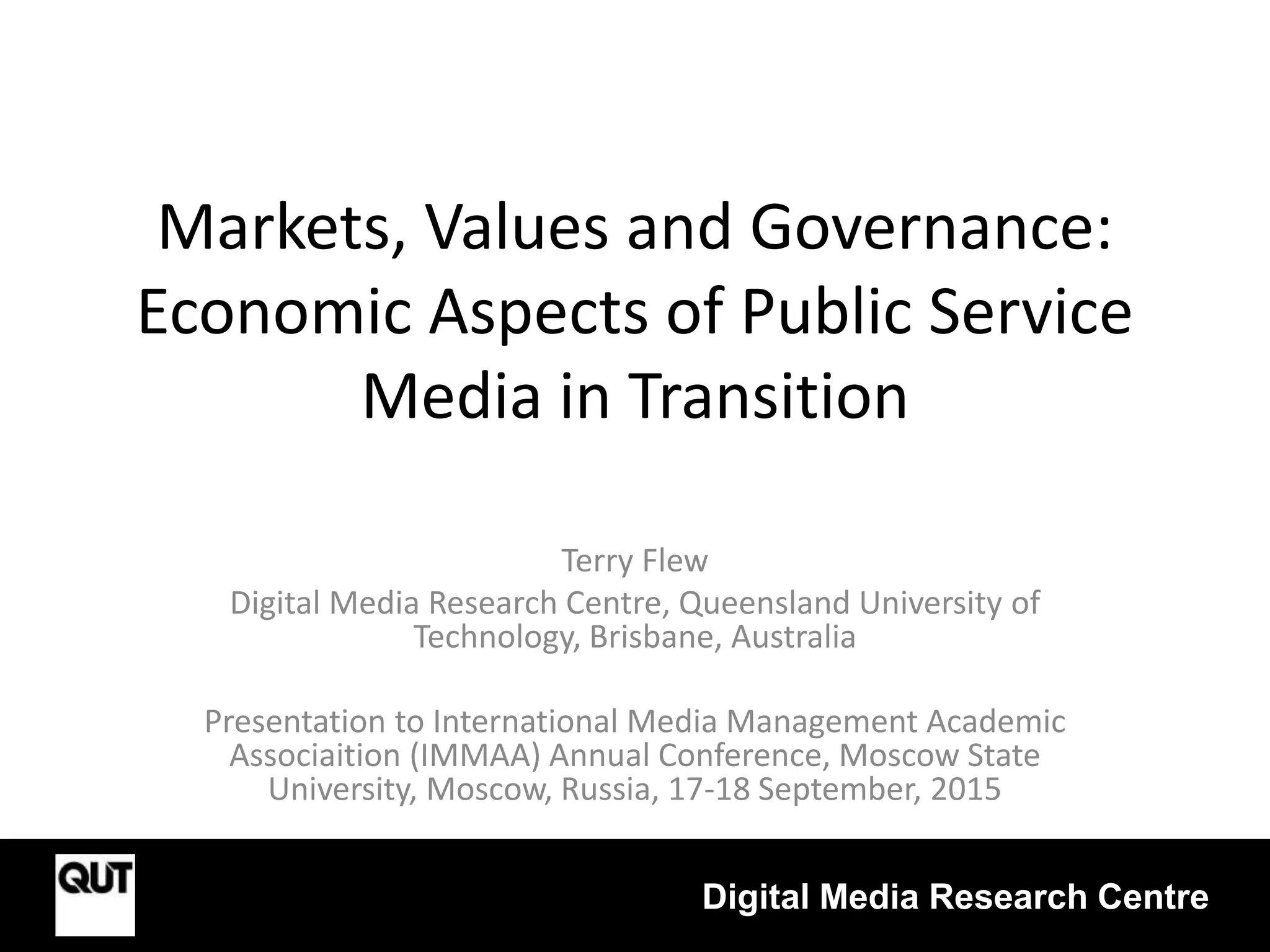
Most public service media debates are
about content
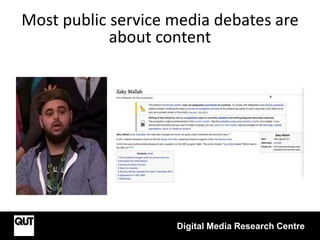
… and Politics
Digital Media Research Centre
The 20th century public servive
broadcasting settlement
“The rise of broadcasting in the 20th century established new
relationships among states, publics, and the media. Alongside private
media, some countries established broadcasters with closer links to
the state and a nonmarket model of accountability to the public.
Relationships between these institutions and governments as well as
other centers of power became key challenges, with some countries
adopting direct state administration of broadcasters and others
favoring independent public-service broadcasting.”
• Damian Tambini, “Five Theses on Public Media and Digitization:
From a 56-country study”, International Journal of Communication
9(2015): 1400-24.
Digital Media Research Centre
The challenge of governance in the
context of change
“A unique set of institutional arrangements for broadcasting
evolved in each national setting. In some cases, the constitutional
framework defined fundamental duties for all broadcasters. In others,
ownership and operation remained in private hands, with duties left
undefined. In some countries, the market share of publicly owned
broadcasters was small, and in others they were—and in many cases,
still are—dominant. In all countries, allocation of broadcasting
frequencies was the responsibility of agencies of the state.
Broadcasting institutions generate the meanings and narratives that
frame reality for citizens. For this reason, governance of these
institutions has been a source of conflict that resurfaces during times
of change.”
• Damian Tambini, “Five Theses on Public Media and Digitization:
From a 56-country study”, International Journal of Communication
9(2015): 1400-24.
Digital Media Research Centre
Context for PSM worldwide
1. Declining share of national audience
(although highly variable between nations)
2. Declining public funding
3. Need to develop new digital services in order
to maintain relevance
4. Uncertain relationship to Charter/remit
5. New regulatory questions (e.g. relevance of
competition policy)
Digital Media Research Centre
New governance challenges for public
service media
• Is the ‘scarcity’ rationale still relevant as a
basis of support for PSB/PSM?
• How much expansion into new digital services
should PSM be undertaking?
• Charter implications of PSB-to-PSM transition
• Can PSM ‘crowd out’ commercial services in
new digital markets, or do they ‘crowd in’?
• Should new services be taxpayer funded or
funded through other revenue streams?
Digital Media Research Centre
Who decides?
• The Managing Director?
• The Board?
• The government of the day?
• The Parliament?
• The community? If so, how?
Digital Media Research Centre
Configurations of ‘the public’ in PSM
debates
1. As collective beneficiaries of public good
aspects of PSM (e.g. national events,
documentaries, disasters, international
coverage, specialist programming)
2. As consumers of PSM services (how many
watch/listen to/download XXX?)
3. As taxpayers funding PSM: how to ensure
value-for-money in uses of funds?
Digital Media Research Centre
Media economics and the governance
question
• NEOCLASSICAL ECONOMICS (market failure,
public goods, public value tests)
• CRITICAL POLITICAL ECONOMY (market vs.
state, public interest, media citizenship)
• NEW APPROACHES
– INSTITUTIONAL ECONOMICS
– INNOVATION/EVOLUTIONARY ECONOMICS
Digital Media Research Centre
Neoclassical media economics
• ‘Market failure’ rationale for PSM
– Merit goods
– Externalities
– Public goods
• Spectrum scarcity case for PSB no longer plausible
• Public good/merit good case (possibly) challenged in
multichannel environment
• PSBs not the only providers of ‘quality’, ‘niche’ or
‘minority’ content
• Diversity of PSB histories – no single template
Digital Media Research Centre
Public Value Tests (PVT) and PSM
innovation
• Public Value Tests being applied to digital
expansion of PSBs in EU
• How is ‘public benefit’ to be assessed?
• EU: media pluralism established in
broadcasting context (PSB) but role of PSM in
digital environment is contested
• Ex ante tests as an inhibitor of PSM innovation
• Innovation increasingly central to PSM remit
Digital Media Research Centre
Political economy, PSM and citizenship
• PSM seen as central to nation building, media
citizenship and the public sphere – market versus state
rationale
• Not all PSM are non-commercial, and even ‘non-
commercial’ PSM have commercial activities
• Normative definition of PSM: does not include, for
instance, CCTV as world’s largest state-run broadcaster
• Challenges of PSM Charters – lead or follow ‘public
taste’?
• Private providers can achieve public good e.g. Google
Books case
Digital Media Research Centre
Does the political economy case lead us to
uncritically defend PSM management?
• Critical analyses of PSB have changed over time: earlier
accounts (e.g. Schlesinger, Hall, Sparks) more critical
• Demand for greater institutional accountability exists
across the board
• High profile governance failures e.g. failure of BBC
Trust to deal with Jimmy Savile case adequately
• Peter Goodwin (2014, p. 84): ‘the friends of PSM …
must adopt a more critical tone in addressing existing
PSB operations’: problems of ‘bloated executive
salaries, conservative programming policies, corporate
arrogance, and lack of inclusiveness – to name but four
in a list that is not short’ (Goodwin, 2014, p. 84).
Digital Media Research Centre
Relational contracting in public sector media –
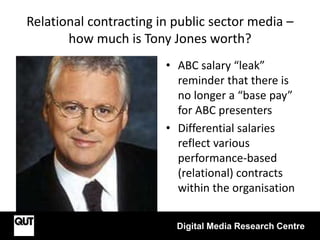
how much is Tony Jones worth?
• ABC salary “leak”
reminder that there is
no longer a “base pay”
for ABC presenters
• Differential salaries
reflect various
performance-based
(relational) contracts
within the organisation
Digital Media Research Centre
New Institutional Economics (NIE)
• Institutions as ‘the humanly devised constraints
that structure human interaction’ (North, 1994, p.
360)
• Institutional arrangements/governance structures
(micro)
• Institutional environment/ ‘rules of the game’
(macro)
– Formal institutions: rules, laws, policies etc.
– Informal constraints: norms, conventions, cultural
codes etc. – links to history and culture
Digital Media Research Centre
The firm as a nexus of contracts
• Origins with Ronald Coase (1937)
• The firm is an institutional form that
economises on transaction costs
• Implicit and relational contracting
• Contracts rely upon trust, social networks,
reputation – importance of institutional
cultures
• Applicable across both private and public
sector institutions
Digital Media Research Centre
Core NIE propositions relevant to PSM
• Concepts applicable to both public and private sector
organisations
• Firm as a ‘nexus of contracts’
• Separation of ownership from management, and
principal-agent problem
• Tendency to expand into conglomerates – risk of
becoming too big
• Relational or incentive-based contracting – comparable
employment arrangements across public and
commercial media
• Governance issues arise in context of principal-agent
problem: how is the public interest safeguarded while
also ensuring value-for-money in public provision?
Digital Media Research Centre
Governance challenges for PSM
• Accountability of PSM managers to the public
– via the government?
• Should a PSM be trusted to regulate itself?
• Distinctiveness of PSM histories and
organisational cultures
• Political problem: electoral politics increasing
a ‘battle for political property rights’ – loss of
autonomy for public institutions
Digital Media Research Centre
UK Debate on Future Governance of
the BBC
• House of Commons, Culture, Media and Sport
Committee, Fourth Report 2014-15
• Failure of BBC Trust: required to be both
“regulator and cheerleader” of the BBC
• Three part structure proposed:
– Board responsible for BBC performance
– Ofcom responsible for content regulation
– Public Service Broadcasting Commission
responsible for assessing value-for-money
Digital Media Research Centre
Governance challenges
• Can PSM argue against external regulatory
scrutiny across all aspects of their operations?
• Would better “arm’s length” relationships
reduce scope for arbitrary political
interference?
• How best to enable checks and balances on
PSM management, and address principal-
agent problem?
Digital Media Research Centre

Immaa msu presentation flew

  • 1.
    Markets, Values andGovernance: Economic Aspects of Public Service Media in Transition Terry Flew Digital Media Research Centre, Queensland University of Technology, Brisbane, Australia Presentation to International Media Management Academic Associaition (IMMAA) Annual Conference, Moscow State University, Moscow, Russia, 17-18 September, 2015 Digital Media Research Centre
  • 2.
    Digital Media ResearchCentre Most public service media debates are about content
  • 3.
    … and Politics DigitalMedia Research Centre
  • 4.
    The 20th centurypublic servive broadcasting settlement “The rise of broadcasting in the 20th century established new relationships among states, publics, and the media. Alongside private media, some countries established broadcasters with closer links to the state and a nonmarket model of accountability to the public. Relationships between these institutions and governments as well as other centers of power became key challenges, with some countries adopting direct state administration of broadcasters and others favoring independent public-service broadcasting.” • Damian Tambini, “Five Theses on Public Media and Digitization: From a 56-country study”, International Journal of Communication 9(2015): 1400-24. Digital Media Research Centre
  • 5.
    The challenge ofgovernance in the context of change “A unique set of institutional arrangements for broadcasting evolved in each national setting. In some cases, the constitutional framework defined fundamental duties for all broadcasters. In others, ownership and operation remained in private hands, with duties left undefined. In some countries, the market share of publicly owned broadcasters was small, and in others they were—and in many cases, still are—dominant. In all countries, allocation of broadcasting frequencies was the responsibility of agencies of the state. Broadcasting institutions generate the meanings and narratives that frame reality for citizens. For this reason, governance of these institutions has been a source of conflict that resurfaces during times of change.” • Damian Tambini, “Five Theses on Public Media and Digitization: From a 56-country study”, International Journal of Communication 9(2015): 1400-24. Digital Media Research Centre
  • 6.
    Context for PSMworldwide 1. Declining share of national audience (although highly variable between nations) 2. Declining public funding 3. Need to develop new digital services in order to maintain relevance 4. Uncertain relationship to Charter/remit 5. New regulatory questions (e.g. relevance of competition policy) Digital Media Research Centre
  • 7.
    New governance challengesfor public service media • Is the ‘scarcity’ rationale still relevant as a basis of support for PSB/PSM? • How much expansion into new digital services should PSM be undertaking? • Charter implications of PSB-to-PSM transition • Can PSM ‘crowd out’ commercial services in new digital markets, or do they ‘crowd in’? • Should new services be taxpayer funded or funded through other revenue streams? Digital Media Research Centre
  • 8.
    Who decides? • TheManaging Director? • The Board? • The government of the day? • The Parliament? • The community? If so, how? Digital Media Research Centre
  • 9.
    Configurations of ‘thepublic’ in PSM debates 1. As collective beneficiaries of public good aspects of PSM (e.g. national events, documentaries, disasters, international coverage, specialist programming) 2. As consumers of PSM services (how many watch/listen to/download XXX?) 3. As taxpayers funding PSM: how to ensure value-for-money in uses of funds? Digital Media Research Centre
  • 10.
    Media economics andthe governance question • NEOCLASSICAL ECONOMICS (market failure, public goods, public value tests) • CRITICAL POLITICAL ECONOMY (market vs. state, public interest, media citizenship) • NEW APPROACHES – INSTITUTIONAL ECONOMICS – INNOVATION/EVOLUTIONARY ECONOMICS Digital Media Research Centre
  • 11.
    Neoclassical media economics •‘Market failure’ rationale for PSM – Merit goods – Externalities – Public goods • Spectrum scarcity case for PSB no longer plausible • Public good/merit good case (possibly) challenged in multichannel environment • PSBs not the only providers of ‘quality’, ‘niche’ or ‘minority’ content • Diversity of PSB histories – no single template Digital Media Research Centre
  • 12.
    Public Value Tests(PVT) and PSM innovation • Public Value Tests being applied to digital expansion of PSBs in EU • How is ‘public benefit’ to be assessed? • EU: media pluralism established in broadcasting context (PSB) but role of PSM in digital environment is contested • Ex ante tests as an inhibitor of PSM innovation • Innovation increasingly central to PSM remit Digital Media Research Centre
  • 13.
    Political economy, PSMand citizenship • PSM seen as central to nation building, media citizenship and the public sphere – market versus state rationale • Not all PSM are non-commercial, and even ‘non- commercial’ PSM have commercial activities • Normative definition of PSM: does not include, for instance, CCTV as world’s largest state-run broadcaster • Challenges of PSM Charters – lead or follow ‘public taste’? • Private providers can achieve public good e.g. Google Books case Digital Media Research Centre
  • 14.
    Does the politicaleconomy case lead us to uncritically defend PSM management? • Critical analyses of PSB have changed over time: earlier accounts (e.g. Schlesinger, Hall, Sparks) more critical • Demand for greater institutional accountability exists across the board • High profile governance failures e.g. failure of BBC Trust to deal with Jimmy Savile case adequately • Peter Goodwin (2014, p. 84): ‘the friends of PSM … must adopt a more critical tone in addressing existing PSB operations’: problems of ‘bloated executive salaries, conservative programming policies, corporate arrogance, and lack of inclusiveness – to name but four in a list that is not short’ (Goodwin, 2014, p. 84). Digital Media Research Centre
  • 15.
    Relational contracting inpublic sector media – how much is Tony Jones worth? • ABC salary “leak” reminder that there is no longer a “base pay” for ABC presenters • Differential salaries reflect various performance-based (relational) contracts within the organisation Digital Media Research Centre
  • 16.
    New Institutional Economics(NIE) • Institutions as ‘the humanly devised constraints that structure human interaction’ (North, 1994, p. 360) • Institutional arrangements/governance structures (micro) • Institutional environment/ ‘rules of the game’ (macro) – Formal institutions: rules, laws, policies etc. – Informal constraints: norms, conventions, cultural codes etc. – links to history and culture Digital Media Research Centre
  • 17.
    The firm asa nexus of contracts • Origins with Ronald Coase (1937) • The firm is an institutional form that economises on transaction costs • Implicit and relational contracting • Contracts rely upon trust, social networks, reputation – importance of institutional cultures • Applicable across both private and public sector institutions Digital Media Research Centre
  • 18.
    Core NIE propositionsrelevant to PSM • Concepts applicable to both public and private sector organisations • Firm as a ‘nexus of contracts’ • Separation of ownership from management, and principal-agent problem • Tendency to expand into conglomerates – risk of becoming too big • Relational or incentive-based contracting – comparable employment arrangements across public and commercial media • Governance issues arise in context of principal-agent problem: how is the public interest safeguarded while also ensuring value-for-money in public provision? Digital Media Research Centre
  • 19.
    Governance challenges forPSM • Accountability of PSM managers to the public – via the government? • Should a PSM be trusted to regulate itself? • Distinctiveness of PSM histories and organisational cultures • Political problem: electoral politics increasing a ‘battle for political property rights’ – loss of autonomy for public institutions Digital Media Research Centre
  • 20.
    UK Debate onFuture Governance of the BBC • House of Commons, Culture, Media and Sport Committee, Fourth Report 2014-15 • Failure of BBC Trust: required to be both “regulator and cheerleader” of the BBC • Three part structure proposed: – Board responsible for BBC performance – Ofcom responsible for content regulation – Public Service Broadcasting Commission responsible for assessing value-for-money Digital Media Research Centre
  • 21.
    Governance challenges • CanPSM argue against external regulatory scrutiny across all aspects of their operations? • Would better “arm’s length” relationships reduce scope for arbitrary political interference? • How best to enable checks and balances on PSM management, and address principal- agent problem? Digital Media Research Centre