Culture, Technology and the City

   Presentation to Beijing Research Centre for
               Science of Science,
   Beijing Academy of Science and Technology,
                11 October 2012

    Professor Terry Flew, Journalism, Media and
       Communications, Creative Industries
   Faculty, Queensland University of Technology,
      Brisbane, Australia (t.flew@qut.edu.au)
21 st Century: the Century of Cities

• No. of people living in cities exceeded those living
  outside for first time in human history in 2007
• 70% of world‟s population will live in cities by 2030
• Urban populations of developing world 4x larger than the
  developed nations
• World cities: centres of
  finance, industry, information, logistics and creative
  industries
Cities and globalisation

• Historically
   – Cosmopolitan places with diverse populations
   – Cities exert considerable influence on the regions
     surrounding them
   – Cities exist within a “global system of cities” – hubs in
     global networks
• Rise of the Internet has not diminished the importance of
  cities – informational cities in global space of flows
  (Manuel Castells)
There appears little evidence to support the claim
that cities are becoming less important in an
economy marked by increasing geographical
dispersal … *they+ assert, one way or another, the
powers of agglomeration, proximity, and density,
now perhaps less significant for the production of
mass manufactures than for the production of
knowledge, information and innovation, as well as
specialized inputs … in terms of the territorial base
of the economy, there can be no question that the
city remains the economic motor of postindustrial
society (Amin, 2003: 120).
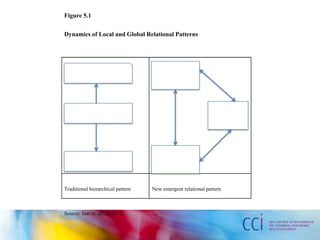
Figure 5.1


Dynamics of Local and Global Relational Patterns


             Global                       Global


             Nation                                              Nation


               City                        City


Traditional hierarchical pattern   New emergent relational pattern


Source: Isar et. al., 2012: 2.
Social shaping of technology

• need to analyse „the socio-economic patterns embedded
  in both the content of technologies and the processes of
  innovation‟ (Williams & Edge 1996).
• „Technological development is constrained by cultural
  norms originating in economics, ideology, religion, and
  tradition‟ (Andrew Feenberg)
• „technologies are … processes that structure the world in
  particular ways … we should not see technology and the
  social as separate domains‟ (David Sholle)
‘A technology such as the computer is a
product of social processes from the
beginning. The particular construction of
knowledge in institutions of science and
engineering, the economic interests of
companies, the cultural patterns of
consumption, the spatial arrangements of
communities and nations, the political
motives of government policies are
inscribed into the technology from the very
beginning’ (Sholle, 2002: 7).
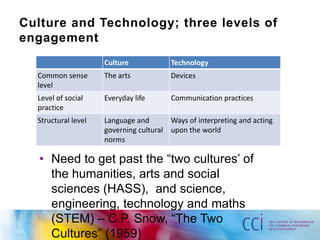
Culture and Technology; three levels of
engagement
                     Culture            Technology
  Common sense       The arts           Devices
  level
  Level of social    Everyday life      Communication practices
  practice
  Structural level   Language and       Ways of interpreting and acting
                     governing cultural upon the world
                     norms

   • Need to get past the “two cultures‟ of
     the humanities, arts and social
     sciences (HASS), and science,
     engineering, technology and maths
     (STEM) – C.P. Snow, “The Two
     Cultures” (1959)
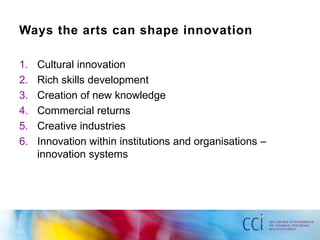
Ways the arts can shape innovation

1.   Cultural innovation
2.   Rich skills development
3.   Creation of new knowledge
4.   Commercial returns
5.   Creative industries
6.   Innovation within institutions and organisations –
     innovation systems
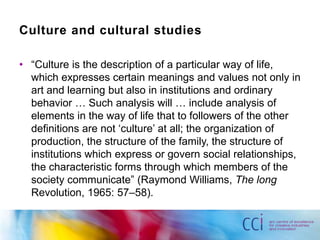
Culture and cultural studies

• “Culture is the description of a particular way of life,
  which expresses certain meanings and values not only in
  art and learning but also in institutions and ordinary
  behavior … Such analysis will … include analysis of
  elements in the way of life that to followers of the other
  definitions are not „culture‟ at all; the organization of
  production, the structure of the family, the structure of
  institutions which express or govern social relationships,
  the characteristic forms through which members of the
  society communicate” (Raymond Williams, The long
  Revolution, 1965: 57–58).
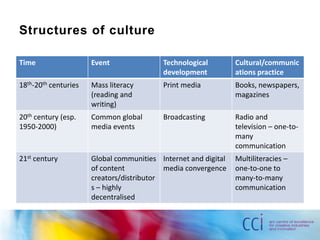
Structures of culture

Time                  Event               Technological         Cultural/communic
                                          development           ations practice
18th-20th centuries   Mass literacy       Print media           Books, newspapers,
                      (reading and                              magazines
                      writing)
20th century (esp.    Common global       Broadcasting          Radio and
1950-2000)            media events                              television – one-to-
                                                                many
                                                                communication
21st century          Global communities Internet and digital   Multiliteracies –
                      of content           media convergence    one-to-one to
                      creators/distributor                      many-to-many
                      s – highly                                communication
                      decentralised
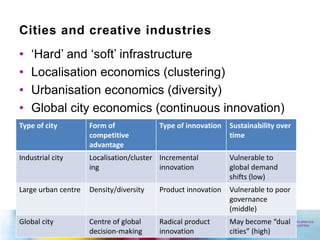
Cities and creative industries
•   „Hard‟ and „soft‟ infrastructure
•   Localisation economics (clustering)
•   Urbanisation economics (diversity)
•   Global city economics (continuous innovation)
Type of city         Form of             Type of innovation   Sustainability over
                     competitive                              time
                     advantage
Industrial city      Localisation/cluster Incremental         Vulnerable to
                     ing                  innovation          global demand
                                                              shifts (low)
Large urban centre   Density/diversity   Product innovation   Vulnerable to poor
                                                              governance
                                                              (middle)
Global city          Centre of global    Radical product      May become “dual
                     decision-making     innovation           cities” (high)
New York as a global creative city

Economists often talk of the agglomeration of labour
pools, firms, suppliers, and resources as producing an ensuing social
environment where those involved in these different sectors engage each
other in informal ways … But this informal social life that economists often
hail as a successful by-product (what they call a positive spillover or
externality) of an economic cluster is actually the central force, the raison
d’être, for art and culture.
The cultural economy is most efficient in the informal social realm and social
dynamics underlie the economic system of cultural production. Creativity
would not exist as successfully or efficiently without its social world –- the
social is not the by-product –- it is the decisive mechanism by which cultural
products and cultural producers are generated, evaluated and sent to the
market (Elizabeth Currid, The Warhol Economy, 2007: 4 – emphasis added).
Social network markets

•   High consumer productivity
•   Fast flows of information and new knowledge
•   Population diversity
•   High levels of skills and education
•   Willingness to adapt to change and adopt new ideas
•   „Because of inherent novelty and uncertainty, decisions
    both to produce and to consume are determined by the
    choice of others in a social network‟ (Potts et. al., 2008:
    169).
Social network markets in the creative
industries

• “The CIs rely, to a greater extent than other socio-
  economic activity, on word of mouth, taste, cultures, and
  popularity, such that individual choices are dominated by
  information feedback over social networks rather than
  innate preferences and price signals … other people‟s
  preferences have commodity status over a social
  network because novelty by definition carries uncertainty
  and other people‟s choices, therefore, carry information”
 Potts et. al., 2008: 170.
Urban Policy and Innovation

• Untraded interdependencies (Michael Storper):
  conventions, informal rules, and habits that coordinate
  economic actors under conditions of uncertainty – region-
  specific assets
• Soft infrastructure (Charles Landry) : associative structures
  and social networks, connections and human interactions that
  link individuals and institutions
• Features of successful creative clusters (DePropris and
  Hypponen): „geographical proximity, face-to-face
  collaborations, co-location of specialized activities, low
  transaction costs, thick networks of social business
  activities, high levels of competence and
  specialization, innovation, and pools of skilled labour‟.
Problems with cluster theories

•   Too many clusters
•   Top-down approach
•   Generic solutions
•   Risks of „groupthink‟
•   Need for external catalyst of consumer demand
•   Local or global markets?
•   Too producer-driven?
Creative Cities

    The concept of a ‘creative city’ describes an urban complex where
    cultural activities of various sorts are an integral component of the
    city’s economic and social functioning. Such cities tend to be built
    upon a strong social and cultural infrastructure; to have relatively high
    concentrations of creative employment; and to be attractive to inward
    investment because of their well-established arts and cultural facilities
    (Throsby, 2010: 139).

    At its best … a creative city strategy will pay attention to cultural
    infrastructure, local cultural participation and involvement, the
    development of a flourishing and dynamic creative arts sector,
    community-oriented heritage conservation, and support for wider
    creative industries that are fully integrated into the local economy
    (Throsby, 2010: 140).
Problems with creative cities models

• Generic urban cultural policy
• Are the beneficiaries artists or urban professionals?
• Amenities-based growth models ignore global economic
  dynamics
• Prosperity of cities drives provision of urban amenities,
  not vice versa
• Creative cities often socially divided cities
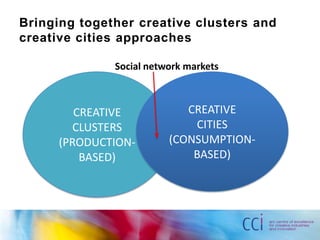
Bringing together creative clusters and
creative cities approaches

              Social network markets


         CREATIVE           CREATIVE
        CLUSTERS             CITIES
      (PRODUCTION-       (CONSUMPTION-
          BASED)             BASED)

Beijing presentation flew 11 oct 12

  • 1.
    Culture, Technology andthe City Presentation to Beijing Research Centre for Science of Science, Beijing Academy of Science and Technology, 11 October 2012 Professor Terry Flew, Journalism, Media and Communications, Creative Industries Faculty, Queensland University of Technology, Brisbane, Australia (t.flew@qut.edu.au)
  • 2.
    21 st Century:the Century of Cities • No. of people living in cities exceeded those living outside for first time in human history in 2007 • 70% of world‟s population will live in cities by 2030 • Urban populations of developing world 4x larger than the developed nations • World cities: centres of finance, industry, information, logistics and creative industries
  • 3.
    Cities and globalisation •Historically – Cosmopolitan places with diverse populations – Cities exert considerable influence on the regions surrounding them – Cities exist within a “global system of cities” – hubs in global networks • Rise of the Internet has not diminished the importance of cities – informational cities in global space of flows (Manuel Castells)
  • 4.
    There appears littleevidence to support the claim that cities are becoming less important in an economy marked by increasing geographical dispersal … *they+ assert, one way or another, the powers of agglomeration, proximity, and density, now perhaps less significant for the production of mass manufactures than for the production of knowledge, information and innovation, as well as specialized inputs … in terms of the territorial base of the economy, there can be no question that the city remains the economic motor of postindustrial society (Amin, 2003: 120).
  • 5.
    Figure 5.1 Dynamics ofLocal and Global Relational Patterns Global Global Nation Nation City City Traditional hierarchical pattern New emergent relational pattern Source: Isar et. al., 2012: 2.
  • 6.
    Social shaping oftechnology • need to analyse „the socio-economic patterns embedded in both the content of technologies and the processes of innovation‟ (Williams & Edge 1996). • „Technological development is constrained by cultural norms originating in economics, ideology, religion, and tradition‟ (Andrew Feenberg) • „technologies are … processes that structure the world in particular ways … we should not see technology and the social as separate domains‟ (David Sholle)
  • 7.
    ‘A technology suchas the computer is a product of social processes from the beginning. The particular construction of knowledge in institutions of science and engineering, the economic interests of companies, the cultural patterns of consumption, the spatial arrangements of communities and nations, the political motives of government policies are inscribed into the technology from the very beginning’ (Sholle, 2002: 7).
  • 8.
    Culture and Technology;three levels of engagement Culture Technology Common sense The arts Devices level Level of social Everyday life Communication practices practice Structural level Language and Ways of interpreting and acting governing cultural upon the world norms • Need to get past the “two cultures‟ of the humanities, arts and social sciences (HASS), and science, engineering, technology and maths (STEM) – C.P. Snow, “The Two Cultures” (1959)
  • 9.
    Ways the artscan shape innovation 1. Cultural innovation 2. Rich skills development 3. Creation of new knowledge 4. Commercial returns 5. Creative industries 6. Innovation within institutions and organisations – innovation systems
  • 10.
    Culture and culturalstudies • “Culture is the description of a particular way of life, which expresses certain meanings and values not only in art and learning but also in institutions and ordinary behavior … Such analysis will … include analysis of elements in the way of life that to followers of the other definitions are not „culture‟ at all; the organization of production, the structure of the family, the structure of institutions which express or govern social relationships, the characteristic forms through which members of the society communicate” (Raymond Williams, The long Revolution, 1965: 57–58).
  • 11.
    Structures of culture Time Event Technological Cultural/communic development ations practice 18th-20th centuries Mass literacy Print media Books, newspapers, (reading and magazines writing) 20th century (esp. Common global Broadcasting Radio and 1950-2000) media events television – one-to- many communication 21st century Global communities Internet and digital Multiliteracies – of content media convergence one-to-one to creators/distributor many-to-many s – highly communication decentralised
  • 12.
    Cities and creativeindustries • „Hard‟ and „soft‟ infrastructure • Localisation economics (clustering) • Urbanisation economics (diversity) • Global city economics (continuous innovation) Type of city Form of Type of innovation Sustainability over competitive time advantage Industrial city Localisation/cluster Incremental Vulnerable to ing innovation global demand shifts (low) Large urban centre Density/diversity Product innovation Vulnerable to poor governance (middle) Global city Centre of global Radical product May become “dual decision-making innovation cities” (high)
  • 13.
    New York asa global creative city Economists often talk of the agglomeration of labour pools, firms, suppliers, and resources as producing an ensuing social environment where those involved in these different sectors engage each other in informal ways … But this informal social life that economists often hail as a successful by-product (what they call a positive spillover or externality) of an economic cluster is actually the central force, the raison d’être, for art and culture. The cultural economy is most efficient in the informal social realm and social dynamics underlie the economic system of cultural production. Creativity would not exist as successfully or efficiently without its social world –- the social is not the by-product –- it is the decisive mechanism by which cultural products and cultural producers are generated, evaluated and sent to the market (Elizabeth Currid, The Warhol Economy, 2007: 4 – emphasis added).
  • 14.
    Social network markets • High consumer productivity • Fast flows of information and new knowledge • Population diversity • High levels of skills and education • Willingness to adapt to change and adopt new ideas • „Because of inherent novelty and uncertainty, decisions both to produce and to consume are determined by the choice of others in a social network‟ (Potts et. al., 2008: 169).
  • 15.
    Social network marketsin the creative industries • “The CIs rely, to a greater extent than other socio- economic activity, on word of mouth, taste, cultures, and popularity, such that individual choices are dominated by information feedback over social networks rather than innate preferences and price signals … other people‟s preferences have commodity status over a social network because novelty by definition carries uncertainty and other people‟s choices, therefore, carry information” Potts et. al., 2008: 170.
  • 16.
    Urban Policy andInnovation • Untraded interdependencies (Michael Storper): conventions, informal rules, and habits that coordinate economic actors under conditions of uncertainty – region- specific assets • Soft infrastructure (Charles Landry) : associative structures and social networks, connections and human interactions that link individuals and institutions • Features of successful creative clusters (DePropris and Hypponen): „geographical proximity, face-to-face collaborations, co-location of specialized activities, low transaction costs, thick networks of social business activities, high levels of competence and specialization, innovation, and pools of skilled labour‟.
  • 17.
    Problems with clustertheories • Too many clusters • Top-down approach • Generic solutions • Risks of „groupthink‟ • Need for external catalyst of consumer demand • Local or global markets? • Too producer-driven?
  • 18.
    Creative Cities The concept of a ‘creative city’ describes an urban complex where cultural activities of various sorts are an integral component of the city’s economic and social functioning. Such cities tend to be built upon a strong social and cultural infrastructure; to have relatively high concentrations of creative employment; and to be attractive to inward investment because of their well-established arts and cultural facilities (Throsby, 2010: 139). At its best … a creative city strategy will pay attention to cultural infrastructure, local cultural participation and involvement, the development of a flourishing and dynamic creative arts sector, community-oriented heritage conservation, and support for wider creative industries that are fully integrated into the local economy (Throsby, 2010: 140).
  • 19.
    Problems with creativecities models • Generic urban cultural policy • Are the beneficiaries artists or urban professionals? • Amenities-based growth models ignore global economic dynamics • Prosperity of cities drives provision of urban amenities, not vice versa • Creative cities often socially divided cities
  • 20.
    Bringing together creativeclusters and creative cities approaches Social network markets CREATIVE CREATIVE CLUSTERS CITIES (PRODUCTION- (CONSUMPTION- BASED) BASED)