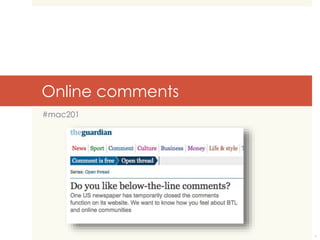
Online comments 
#mac201 
1
In the beginning, the technology gods created the Internet 
and saw that it was good. Here, at last, was a public sphere 
with unlimited potential for reasoned debate and the 
thoughtful exchange of ideas, an enlightening conversational 
bridge across the many geographic, social, cultural, 
ideological and economic boundaries that ordinarily separate 
us in life, a way to pay bills without a stamp. 
Then someone invented “reader comments” and paradise was 
lost. 
- Brossard and Scheufele, 2013 
2
Internet post web 2.0… 
 User Generated Content (UGC) 
 Video 
 Photos 
 Eye-witness reports 
 Blogs 
 Tweets 
 The comment 
3
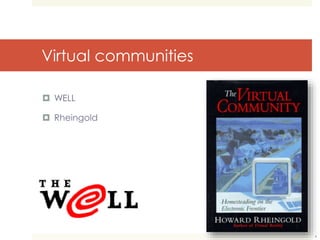
Virtual communities 
 WELL 
 Rheingold 
4
News = one-time resource 
 Increase page impressions? 
 Advertisers? 
 Increase reach? 
 Sentiment analysis? 
 How to better serve the audience? 
5
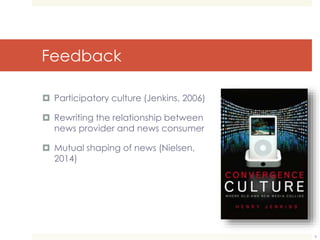
Feedback 
 Participatory culture (Jenkins, 2006) 
 Rewriting the relationship between 
news provider and news consumer 
 Mutual shaping of news (Nielsen, 
2014) 
6
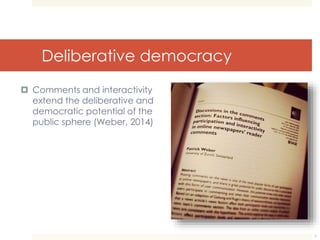
Deliberative democracy 
 Comments and interactivity 
extend the deliberative and 
democratic potential of the 
public sphere (Weber, 2014) 
7
Deliberative democracy 
 Newsworthiness affects: 
1. participation levels of the readers 
2. interactivity in the comments section 
 Both story & comments have to be interesting 
8
‘Nasty’ readers 
 In the beginning, the technology gods created the Internet and 
saw that it was good. Here, at last, was a public sphere with 
unlimited potential for reasoned debate and the thoughtful 
exchange of ideas, an enlightening conversational bridge 
across the many geographic, social, cultural, ideological and 
economic boundaries that ordinarily separate us in life, a way to 
pay bills without a stamp. 
 Then someone invented “reader comments” and paradise was 
lost. 
 - Brossard and Scheufele, 2013 
9
‘Nasty’ readers 
10 
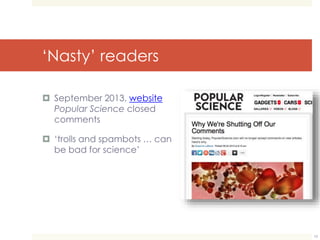
 September 2013, website 
Popular Science closed 
comments 
 ‘trolls and spambots … can 
be bad for science’
The ‘Nasty Effect’ 
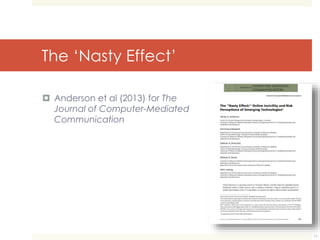
 Anderson et al (2013) for The 
Journal of Computer-Mediated 
Communication 
11
The ‘Nasty Effect’ 
 1,183 participants read a fictitious blog article about 
nanosilver 
 Half of the sample was exposed to civil reader comments 
and the other half to rude ones 
12
‘This story stinks’ 
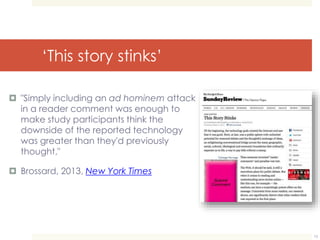
 "Simply including an ad hominem attack 
in a reader comment was enough to 
make study participants think the 
downside of the reported technology 
was greater than they'd previously 
thought," 
 Brossard, 2013, New York Times 
13
‘This story stinks’ 
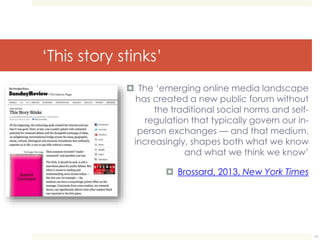
 The ‘emerging online media landscape 
has created a new public forum without 
the traditional social norms and self-regulation 
that typically govern our in-person 
exchanges — and that medium, 
increasingly, shapes both what we know 
and what we think we know’ 
 Brossard, 2013, New York Times 
14
15
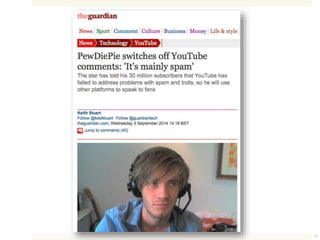
YouTube’s comment problem 
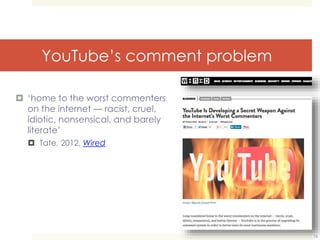
 ‘home to the worst commenters 
on the internet — racist, cruel, 
idiotic, nonsensical, and barely 
literate’ 
 Tate, 2012, Wired 
16
17
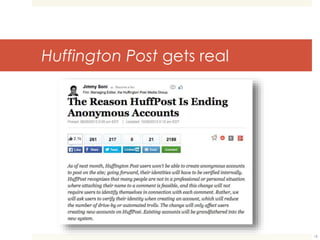
Huffington Post gets real 
18
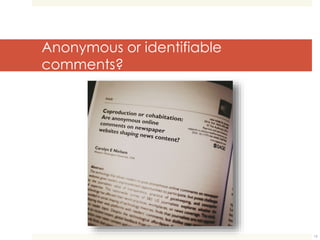
Anonymous or identifiable 
comments? 
19
Balance 
 News sites must strike a delicate balance when deciding 
whether to allow those who comment to remain 
anonymous: To attract users, sites want to make it as easy 
as possible for people to participate, and anonymity 
allows users to feel less inhibited when they comment 
 Gsell in Neilesen, 2014 
20
21
22
Bassey Etim (2014) community 
manager New York Times 
 In the past, we did see real identity as the key to ensuring 
a more civil comments space. It makes perfect sense in 
theory – after all, who would say such awful, hateful 
things in public with their names and job titles attached? 
 Turns out the answer is: An enormous amount of people 
would say awful and hateful things with their names 
attached 
23
Bassey Etim (2014) community 
manager New York Times 
 And even worse, many great commenters with innocent 
reasons to withhold their identities begin to self-censor, 
and then abandon the comment threads entirely. 
 Real ID, in summation, may be the worst great idea the 
community industry has ever had. 
24
Summary 
 The internet as a ‘public sphere’ is problematic, despite 
initial enthusiasm 
 Comment communities can add value to a platform 
 Unmoderated/poorly moderated communities can be 
counter-productive 
 Ripe for abuse 
25
Sources 
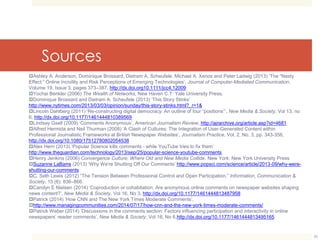
Ashley A. Anderson, Dominique Brossard, Dietram A. Scheufele, Michael A. Xenos and Peter Ladwig (2013) ‘The “Nasty 
Effect:” Online Incivility and Risk Perceptions of Emerging Technologies’, Journal of Computer-Mediated Communication, 
Volume 19, Issue 3, pages 373–387, http://dx.doi.org10.1111/jcc4.12009 
Yochai Benkler (2006) The Wealth of Networks, New Haven C.T: Yale University Press. 
Dominique Brossard and Dietram A. Scheufele (2013) ‘This Story Stinks’ 
http://www.nytimes.com/2013/03/03/opinion/sunday/this-story-stinks.html?_r=1& 
Lincoln Dahlberg (2011) ‘Re-constructing digital democracy: An outline of four “positions”’, New Media & Society, Vol 13, no 
6, http://dx.doi.org/10.1177/1461444810389569 
Lindsay Gsell (2009) ‘Comments Anonymous’, American Journalism Review, http://ajrarchive.org/article.asp?id=4681 
Alfred Hermida and Neil Thurman (2008) ‘A Clash of Cultures: The Integration of User-Generated Content within 
Professional Journalistic Frameworks at British Newspaper Websites’, Journalism Practice, Vol. 2, No. 3, pp. 343-356, 
http://dx.doi.org/10.1080/17512780802054538 
Alex Hern (2013) ‘Popular Science kills comments - while YouTube tries to fix them’ 
http://www.theguardian.com/technology/2013/sep/25/popular-science-youtube-comments 
Henry Jenkins (2006) Convergence Culture: Where Old and New Media Collide. New York: New York University Press 
Suzanne LaBarre (2013) ‘Why We're Shutting Off Our Comments’ http://www.popsci.com/science/article/2013-09/why-were-shutting- 
our-comments 
C. Seth Lewis (2012) “The Tension Between Professional Control and Open Participation.” Information, Communication & 
Society, 15 (6): 836–866. 
Carolyn E Nielsen (2014) ‘Coproduction or cohabitation: Are anonymous online comments on newspaper websites shaping 
news content?’, New Media & Society, Vol 16, No 3, http://dx.doi.org/10.1177/1461444813487958 
Patrick (2014) ‘How CNN and The New York Times Moderate Comments’, 
http://www.managingcommunities.com/2014/07/17/how-cnn-and-the-new-york-times-moderate-comments/ 
Patrick Weber (2014) ‘Discussions in the comments section: Factors influencing participation and interactivity in online 
newspapers’ reader comments’, New Media & Society, Vol 16, No 6,http://dx.doi.org/10.1177/1461444813495165 
26

Mac201 online comments

  • 1.
  • 2.
    In the beginning,the technology gods created the Internet and saw that it was good. Here, at last, was a public sphere with unlimited potential for reasoned debate and the thoughtful exchange of ideas, an enlightening conversational bridge across the many geographic, social, cultural, ideological and economic boundaries that ordinarily separate us in life, a way to pay bills without a stamp. Then someone invented “reader comments” and paradise was lost. - Brossard and Scheufele, 2013 2
  • 3.
    Internet post web2.0…  User Generated Content (UGC)  Video  Photos  Eye-witness reports  Blogs  Tweets  The comment 3
  • 4.
    Virtual communities WELL  Rheingold 4
  • 5.
    News = one-timeresource  Increase page impressions?  Advertisers?  Increase reach?  Sentiment analysis?  How to better serve the audience? 5
  • 6.
    Feedback  Participatoryculture (Jenkins, 2006)  Rewriting the relationship between news provider and news consumer  Mutual shaping of news (Nielsen, 2014) 6
  • 7.
    Deliberative democracy Comments and interactivity extend the deliberative and democratic potential of the public sphere (Weber, 2014) 7
  • 8.
    Deliberative democracy Newsworthiness affects: 1. participation levels of the readers 2. interactivity in the comments section  Both story & comments have to be interesting 8
  • 9.
    ‘Nasty’ readers In the beginning, the technology gods created the Internet and saw that it was good. Here, at last, was a public sphere with unlimited potential for reasoned debate and the thoughtful exchange of ideas, an enlightening conversational bridge across the many geographic, social, cultural, ideological and economic boundaries that ordinarily separate us in life, a way to pay bills without a stamp.  Then someone invented “reader comments” and paradise was lost.  - Brossard and Scheufele, 2013 9
  • 10.
    ‘Nasty’ readers 10  September 2013, website Popular Science closed comments  ‘trolls and spambots … can be bad for science’
  • 11.
    The ‘Nasty Effect’  Anderson et al (2013) for The Journal of Computer-Mediated Communication 11
  • 12.
    The ‘Nasty Effect’  1,183 participants read a fictitious blog article about nanosilver  Half of the sample was exposed to civil reader comments and the other half to rude ones 12
  • 13.
    ‘This story stinks’  "Simply including an ad hominem attack in a reader comment was enough to make study participants think the downside of the reported technology was greater than they'd previously thought,"  Brossard, 2013, New York Times 13
  • 14.
    ‘This story stinks’  The ‘emerging online media landscape has created a new public forum without the traditional social norms and self-regulation that typically govern our in-person exchanges — and that medium, increasingly, shapes both what we know and what we think we know’  Brossard, 2013, New York Times 14
  • 15.
  • 16.
    YouTube’s comment problem  ‘home to the worst commenters on the internet — racist, cruel, idiotic, nonsensical, and barely literate’  Tate, 2012, Wired 16
  • 17.
  • 18.
  • 19.
  • 20.
    Balance  Newssites must strike a delicate balance when deciding whether to allow those who comment to remain anonymous: To attract users, sites want to make it as easy as possible for people to participate, and anonymity allows users to feel less inhibited when they comment  Gsell in Neilesen, 2014 20
  • 21.
  • 22.
  • 23.
    Bassey Etim (2014)community manager New York Times  In the past, we did see real identity as the key to ensuring a more civil comments space. It makes perfect sense in theory – after all, who would say such awful, hateful things in public with their names and job titles attached?  Turns out the answer is: An enormous amount of people would say awful and hateful things with their names attached 23
  • 24.
    Bassey Etim (2014)community manager New York Times  And even worse, many great commenters with innocent reasons to withhold their identities begin to self-censor, and then abandon the comment threads entirely.  Real ID, in summation, may be the worst great idea the community industry has ever had. 24
  • 25.
    Summary  Theinternet as a ‘public sphere’ is problematic, despite initial enthusiasm  Comment communities can add value to a platform  Unmoderated/poorly moderated communities can be counter-productive  Ripe for abuse 25
  • 26.
    Sources Ashley A.Anderson, Dominique Brossard, Dietram A. Scheufele, Michael A. Xenos and Peter Ladwig (2013) ‘The “Nasty Effect:” Online Incivility and Risk Perceptions of Emerging Technologies’, Journal of Computer-Mediated Communication, Volume 19, Issue 3, pages 373–387, http://dx.doi.org10.1111/jcc4.12009 Yochai Benkler (2006) The Wealth of Networks, New Haven C.T: Yale University Press. Dominique Brossard and Dietram A. Scheufele (2013) ‘This Story Stinks’ http://www.nytimes.com/2013/03/03/opinion/sunday/this-story-stinks.html?_r=1& Lincoln Dahlberg (2011) ‘Re-constructing digital democracy: An outline of four “positions”’, New Media & Society, Vol 13, no 6, http://dx.doi.org/10.1177/1461444810389569 Lindsay Gsell (2009) ‘Comments Anonymous’, American Journalism Review, http://ajrarchive.org/article.asp?id=4681 Alfred Hermida and Neil Thurman (2008) ‘A Clash of Cultures: The Integration of User-Generated Content within Professional Journalistic Frameworks at British Newspaper Websites’, Journalism Practice, Vol. 2, No. 3, pp. 343-356, http://dx.doi.org/10.1080/17512780802054538 Alex Hern (2013) ‘Popular Science kills comments - while YouTube tries to fix them’ http://www.theguardian.com/technology/2013/sep/25/popular-science-youtube-comments Henry Jenkins (2006) Convergence Culture: Where Old and New Media Collide. New York: New York University Press Suzanne LaBarre (2013) ‘Why We're Shutting Off Our Comments’ http://www.popsci.com/science/article/2013-09/why-were-shutting- our-comments C. Seth Lewis (2012) “The Tension Between Professional Control and Open Participation.” Information, Communication & Society, 15 (6): 836–866. Carolyn E Nielsen (2014) ‘Coproduction or cohabitation: Are anonymous online comments on newspaper websites shaping news content?’, New Media & Society, Vol 16, No 3, http://dx.doi.org/10.1177/1461444813487958 Patrick (2014) ‘How CNN and The New York Times Moderate Comments’, http://www.managingcommunities.com/2014/07/17/how-cnn-and-the-new-york-times-moderate-comments/ Patrick Weber (2014) ‘Discussions in the comments section: Factors influencing participation and interactivity in online newspapers’ reader comments’, New Media & Society, Vol 16, No 6,http://dx.doi.org/10.1177/1461444813495165 26