Globalization, Media Policy
   and Regulatory Design:
  Rethinking the Australian
 Media Classification Scheme
 Paper presented to Communications and Community,
62nd International Communications Association Annual
             Conference, Phoenix, AZ, USA

      Professor Terry Flew, Creative Industries Faculty
           Queensland University of Technology
                    Brisbane, Australia
Does economic globalization weaken
nation-states?

• New Left Review debates of the 1970s
• Globalization literature: yes
   – Large transnational corporations have effectively surpassed the
     jurisdiction and authority of nation-states … the concept of
     national sovereignty is losing its effectiveness … [as]
     government and politics come to be completely integrated into
     the system of transnational command (Michael Hardt and
     Antonio Negri, Empire (2000), pp. 306, 307).
• Critics
   – East Asian developmental states
   – Economic geography of global corporations
   – How global are media corporations?
Australian media inquiries 2011-2012

•   Convergence Review
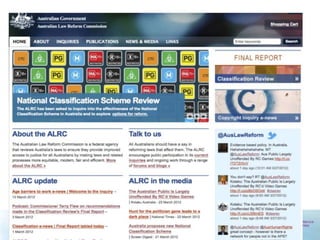
•   Review of the National Classification Scheme
•   Independent Media Inquiry (Finkelstein Report)
•   National Cultural Policy
•   National Broadband Network (NBN) as a
    significant contextual factor
Background to the National Classification
Scheme Review

• Australian Law Reform Commission (ALRC) review of
  Censorship and Classification (1991)
• Rapid pace of technological change and community
  uptake of new media technologies
• Community needs and expectations in an evolving
  technological environment
• ALRC given Terms of Reference Feb 2011 – I was
  seconded from QUT to head inquiry May 2011 – final
  report tabled in Parliament March 2012
Terms of Reference
Consider the extent to which
   • the Classification (Publications, Films and
     Computer Games) Act 1995;
   • State and Territory enforcement legislation;
   • Schedules 5 and 7 of the Broadcasting Services
     Act 1992; and
   • the Intergovernmental Agreement on Censorship
     and related laws
continue to provide an effective framework for the
classification of media content in Australia

                                    The Hon R McClelland MP
                                    Attorney-General
Situating Media Classification

• Form of media content policy – related to community
  standards and consumer information
• Media classification a combination of:
   – Legislation based on underlying principles (media law &
     policy);
   – activities of relevant agencies (media regulation);
   – informal norms and self-regulation (media governance)
• Media classification as a form of governmentality – „a
  diverse range of regulatory practices by which social control
  is sought through the deployment of devices for gathering
  intelligence, establishing standards, applying categories and
  monitoring effects, as well as enforcement‟ (Livingstone et.
  al., 2007, p. 615).
Australian context

• No Constitutional guarantee of free speech
• Move from censorship to classification from late 1960s
  onwards – very little content is actually banned (changes
  in Internet context)
• Elements of fragmentation
   – States and Commonwealth (failure to reach agreement on
     “X” rating)
   – Government departments: Attorney-General‟s Dept. and
     Communications
   – Broadcasting laws and classification laws
Context of Media Convergence

1. Increased access to high-speed broadband
   networks
2. Digitisation of media products and services
3. Convergence of media platforms and services
4. Globalisation of media platforms, content and
   services
5. Acceleration of innovation
6. Rise of user-created content
7. Greater media user empowerment
8. Blurring of public/private and age-based
   distinctions
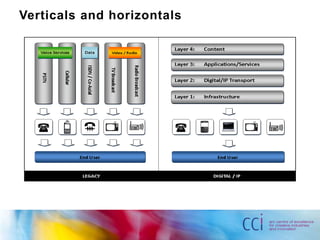
Verticals and horizontals
ALRC Recommendations

• Classification—Content Regulation and Convergent Media
  (ALRC Report 118 – Feb. 2012)
• Need for platform neutrality in future regulation –
  separation of content/platforms
• Extending industry co-regulation based on approved
  codes overseen by a convergent regulator
• Focus of online content regulation on restricting access to
  adult content
• Narrowing scope of current Refused Classification (RC)
  category to Prohibited content
• Further research into community expectations around
  access to media content
Globalization and media content
regulations
• Shift from tangible media to digital media - content is typically
  not nationally-based; is sourced, distributed and accessed
  globally; and is available in such volumes that government
  pre-classification no longer possible
• Regulations that are platform-based and tied to tangible
  media apply to ever-diminishing proportion of total media
  content
• Limits to traditional command-and-control approaches to
  media policy and regulation – need to engage not only
  content providers by media users
• Parity of regulatory treatment between traditional and
  emergent media platforms, and local and offshore media
  content providers
Globalization and media content
regulations

1. The vast array of digital content, from movies and TV
   programs to apps and mobile games, distributed and
   purchased from international platforms such as Apple‟s
   iTunes Store and Google Market;
2. The huge volume of media content, much of it user-
   generated, that is distributed from social media
   platforms such as YouTube and Facebook;
3. The one trillion-plus URLs that exist on the World Wide
   Web.
Approaches taken in ALRC Review

• Only limited demand for classification below certain
  threshold levels – considerable scope for industry
  innovation in lower-level classification
• Deeming international standards to apply in Australia
  e.g. ESRB and PEGI schemes for computer
  games, Apple and Google content guidelines?
• Narrowing scope of prohibited online content to be more
  in lines with international norms (e.g. Interpol “blacklist”)

Ica presentation 2012

  • 1.
    Globalization, Media Policy and Regulatory Design: Rethinking the Australian Media Classification Scheme Paper presented to Communications and Community, 62nd International Communications Association Annual Conference, Phoenix, AZ, USA Professor Terry Flew, Creative Industries Faculty Queensland University of Technology Brisbane, Australia
  • 2.
    Does economic globalizationweaken nation-states? • New Left Review debates of the 1970s • Globalization literature: yes – Large transnational corporations have effectively surpassed the jurisdiction and authority of nation-states … the concept of national sovereignty is losing its effectiveness … [as] government and politics come to be completely integrated into the system of transnational command (Michael Hardt and Antonio Negri, Empire (2000), pp. 306, 307). • Critics – East Asian developmental states – Economic geography of global corporations – How global are media corporations?
  • 3.
    Australian media inquiries2011-2012 • Convergence Review • Review of the National Classification Scheme • Independent Media Inquiry (Finkelstein Report) • National Cultural Policy • National Broadband Network (NBN) as a significant contextual factor
  • 4.
    Background to theNational Classification Scheme Review • Australian Law Reform Commission (ALRC) review of Censorship and Classification (1991) • Rapid pace of technological change and community uptake of new media technologies • Community needs and expectations in an evolving technological environment • ALRC given Terms of Reference Feb 2011 – I was seconded from QUT to head inquiry May 2011 – final report tabled in Parliament March 2012
  • 5.
    Terms of Reference Considerthe extent to which • the Classification (Publications, Films and Computer Games) Act 1995; • State and Territory enforcement legislation; • Schedules 5 and 7 of the Broadcasting Services Act 1992; and • the Intergovernmental Agreement on Censorship and related laws continue to provide an effective framework for the classification of media content in Australia The Hon R McClelland MP Attorney-General
  • 7.
    Situating Media Classification •Form of media content policy – related to community standards and consumer information • Media classification a combination of: – Legislation based on underlying principles (media law & policy); – activities of relevant agencies (media regulation); – informal norms and self-regulation (media governance) • Media classification as a form of governmentality – „a diverse range of regulatory practices by which social control is sought through the deployment of devices for gathering intelligence, establishing standards, applying categories and monitoring effects, as well as enforcement‟ (Livingstone et. al., 2007, p. 615).
  • 8.
    Australian context • NoConstitutional guarantee of free speech • Move from censorship to classification from late 1960s onwards – very little content is actually banned (changes in Internet context) • Elements of fragmentation – States and Commonwealth (failure to reach agreement on “X” rating) – Government departments: Attorney-General‟s Dept. and Communications – Broadcasting laws and classification laws
  • 9.
    Context of MediaConvergence 1. Increased access to high-speed broadband networks 2. Digitisation of media products and services 3. Convergence of media platforms and services 4. Globalisation of media platforms, content and services 5. Acceleration of innovation 6. Rise of user-created content 7. Greater media user empowerment 8. Blurring of public/private and age-based distinctions
  • 10.
  • 11.
    ALRC Recommendations • Classification—ContentRegulation and Convergent Media (ALRC Report 118 – Feb. 2012) • Need for platform neutrality in future regulation – separation of content/platforms • Extending industry co-regulation based on approved codes overseen by a convergent regulator • Focus of online content regulation on restricting access to adult content • Narrowing scope of current Refused Classification (RC) category to Prohibited content • Further research into community expectations around access to media content
  • 12.
    Globalization and mediacontent regulations • Shift from tangible media to digital media - content is typically not nationally-based; is sourced, distributed and accessed globally; and is available in such volumes that government pre-classification no longer possible • Regulations that are platform-based and tied to tangible media apply to ever-diminishing proportion of total media content • Limits to traditional command-and-control approaches to media policy and regulation – need to engage not only content providers by media users • Parity of regulatory treatment between traditional and emergent media platforms, and local and offshore media content providers
  • 13.
    Globalization and mediacontent regulations 1. The vast array of digital content, from movies and TV programs to apps and mobile games, distributed and purchased from international platforms such as Apple‟s iTunes Store and Google Market; 2. The huge volume of media content, much of it user- generated, that is distributed from social media platforms such as YouTube and Facebook; 3. The one trillion-plus URLs that exist on the World Wide Web.
  • 14.
    Approaches taken inALRC Review • Only limited demand for classification below certain threshold levels – considerable scope for industry innovation in lower-level classification • Deeming international standards to apply in Australia e.g. ESRB and PEGI schemes for computer games, Apple and Google content guidelines? • Narrowing scope of prohibited online content to be more in lines with international norms (e.g. Interpol “blacklist”)

Editor's Notes

  • #4 R18+ games consultation received over 58,000 submissions, of which 98% supported introduction of the new category – “Grow Up Australia” campaignSenate Legal and Constitutional Affairs Affairs Reference Committee (Chair Sen. Guy Barnett): Review of the National Classification Scheme: Achieving the Right Balance – extending NCS to art works, outdoor billboards and music videos – little to say about new media – recommended national scheme with abolition of X18+ categoryConvergence Review Committee (Chair Glen Boreham): reviewing “the operation of media and communications legislation in Australia … to assess its effectiveness in achieving appropriate policy objectives for the convergent era” – Final Report presented to Communications Minister, Sen. Stephen Conroy 30 March 2012 – public release expected in mid-late April
  • #6 technological convergence and associated transformations in media consumption; community expectations about content regulation in a changing media environment; the impact of media on children across a range of media types; future development of the Australian media and digital content industries; the scope to reduce regulatory burdens on relevant industries;classification schemes operating in other jurisdictions; and Commonwealth, State and Territory laws and practices relevant to the classification of media content
  • #11 In an overview of Australian broadcasting and telecommunications regulations undertaken for the Convergence Review, the ACMA (2011) identified 55 ‘broken concepts’ in current legislation, including: the concept of ‘influence’ in broadcasting; the ‘Australian identity’ of media owners’; the concept of a ‘program’ in broadcasting; the distinction between a ‘content service provider’ and a ‘carriage service provider’ in relation to the Internet; regulations specifically applied to activities such as telemarketing or interactive gambling. At the core of these ‘broken concepts’ was the manner in which digital convergence is making media services and content increasingly independent of particular delivery technologies; its central regulatory consequence is that ‘regulation constructed on the premise that content could (and should) be controlled by how it is delivered is losing its force, both in logic and in practice’ (ACMA, 2011: 6).