Reconsidering Media Economics 
Media@Sydney 
University of Sydney 
24 October 2014 
Stuart Cunningham and Terry Flew 
Creative Industries Faculty 
Queensland University of Technology
• Dominant media-economic theories 
– Mainstream (neoclassical) media economics 
– Critical political economy 
• Emergent economic approaches 
– Institutional economics 
• New Institutional Economics (NIE) 
– Evolutionary economics 
• Major case studies 
– Public service media (PSM) 
– The changing ecology of television
• Mainstream (neoclassical) media economics (Picard, 1989; 
Albarran 2002, 2010; Alexander et. al., 2004; De Vany, 2004; 
Doyle, 2006, 2013; Hoskins et. al., 2004) 
• Critical political economy (Mosco, 2009; Hardy, 2014)
Beyond dualistic thinking 
• Economics as a discipline is more diverse and pluralistic 
than it appears from the outside 
• Keynesian revolution of 1930s; other challenges to 
hegemony of neoclassical theory from institutionalism, 
behaviouralism, network economics, post-Keynesian 
economics etc. 
• ‘the neoclassical approach … [is] no longer the 
overwhelmingly dominant paradigm it once was’ 
(Wildman, 2006, p. 68) 
• ‘an economic approach to the media needs to be 
informed by information economics, and network 
economics, institutional economics and evolutionary or 
innovation economics’ (Ballon 2014, p. 76)
Why is this relevant to media studies? 
• new developments in media industries and markets are 
stretching the capacity of the established neoclassical 
and critical political economy paradigms: 
• convergent digital media 
• Socio-economic value of premarket and nonmarket 
forms 
• Disruption of long established media business models 
• agentive nature of media audiences 
• New media/digital content as sources of wealth creation 
and economic innovation
Mainstream media economics 
• Application of neoclassical microeconomics 
– Individual as primary unit of analysis 
– Rational choice assumptions 
– Market equilibrium prices 
– Theory of supply and demand 
• Influence among media decision-makers 
• Media policy influence
• ‘Economics, as a discipline, is highly relevant to 
understanding how media firms and industries 
operate … [because] most of the decisions taken by 
those who run media organisations are, to a greater or 
lesser extent, influenced by resource and financial 
issues’ (Gillian Doyle, Understanding Media Economics, 
2013, p. 1). 
• ‘Policy researchers seem to divide roughly between … 
the “market economics” and “social value” schools of 
thought, and the two are often so far apart in their 
assumptions and languages that they are unable to 
communicate with each other’ (Entman and Wildman, 
1992, p. 5).
Worked example of applied media 
economics: tablet PCs 
1. Apple iPad revealed unmet consumer demand for 
tablets 
2. Tablet PCs generated monopoly profits for Apple 
3. New suppliers entered the market with lower-cost 
products (also network effects of Android platform) 
4. Apple forced to lower prices and introduce lower cost 
competitor: iPad Mini
Challenges of media for economics 
• Heterogeneous nature of media ‘product’ – difficulty in 
determining what the ‘price’ is for 
• Dual media markets: consumers/advertisers 
• Tendencies towards concentration of ownership and 
market oligopoly 
• Importance of non-economic principles in media policy 
e.g. diversity and media pluralism, public goods, socio-cultural 
dimensions of media content
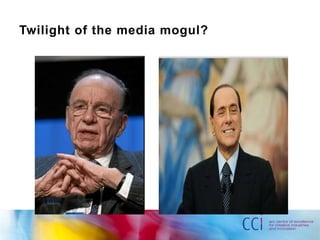
Twilight of the media mogul?
Digital transformation of media industries 
and markets 
• Shift from content scarcity to content abundance 
• What is the content of digital media – products, services 
or platforms? 
• Freely available content and implications for professional 
media production 
• Are content aggregators (Google, Apple etc.) in the 
media industries?
Critical Political Economy (CPE) 
• understanding historical processes of social change; 
• mutually constitutive relationship between economic, 
social and cultural institutions, relations and practices; 
• moral philosophy oriented towards critiquing the 
industrial structures and social relations of capitalism; 
• commitment to linking intellectual work with progressive 
social movements. (Mosco 2009, p. 4).
Is CPE a ‘big tent’? 
• Winseck (2011) proposes that institutional, evolutionary 
and (some) neoclassical economics is broadly within a 
commodious CPE 
• Contested within the field, where CPE has been defined 
in opposition to: 
– Cultural studies 
– Neoclassical economics 
– Media industry studies (Meehan and Wasko, 2014)
Revisiting the ‘active audience’ debate 
• Cultural studies questioned degree that audiences 
adhered to ‘dominant ideologies’, pointing to active 
audience/user agency 
• Critiqued among CPE theorists as ‘cultural populism’ 
(McGuigan 1992) 
• The cultural as formative of industrial/market structures 
or ‘residual and merely reflective’ (Stuart Hall, 1986)? 
• But heartland debates in media and cultural studies have 
done little to conceptually advance what form of media 
economics should supplement or contend with critical 
political economy
Power: an immanent critique 
• Power (Thompson 1995) 
– Asked to do too much theoretically? 
– Relationship between economic, political and 
cultural/symbolic power? 
– Power as top-down (domination) or relational? 
• examples
Impasse in media economics 
• Neoclassical ME vs. CPE has become a stale rehearsal 
of well-worn pro/anti-market arguments 
• ‘My main argument with many of the versions of the 
return to Marxism today [is] they share exactly the same 
worldview as the so-called neoliberals. They think there 
is one solution to the problem. One thinks that the 
market will solve everything, the other that doing away 
with the market will’ (Nicholas Garnham, interview with 
Christian Fuchs, 2014, p. 121).
Institutionalism 
• Long history in the social sciences 
– Middle-range theories (Merton) 
– Structure/agency dialectic (Giddens) 
– Historical path-dependency 
• Neoclassical focus on rational choice individualism has 
historically marginalised institutional economics 
• Dissenting tradition: Veblen, Galbraith 
• Communication studies: political economy of Harold Innis and 
Canadian comms. school 
• ‘it is … on individuals that the system of institutions imposes 
those conventional standards, ideals, and canons of conduct 
that make up the community’s system of life’ (Veblen 1909 
[1961], p. 38).
New Institutional Economics (NIE) 
• Douglass North, 1993 Nobel prize winner - economics 
had cut itself off from history, neglecting the historically 
evolving role of institutions and the significance of how 
such institutions develop over time 
• NIE maintains continuities with mainstream 
microeconomics, particularly in retaining architecture of 
rational choice theory in its analyses of individual 
behaviour – different to ‘old’ institutionalism and 
economic sociology
Key NIE concepts 
• Bounded rationality 
– while individual behaviour can be intentionally rational, ‘in 
practice … all decision makers (entrepreneurs, consumers, 
politicians, etc.) act subject to imperfect information and limited 
cognition’ (Furubotn and Richter, 2005, p. 556). 
• Transaction costs 
– ‘costs of running the economic system’ (Kenneth Arrow) - include 
market engagement costs, managerial transaction costs, and 
political transaction costs 
• Uncertainty and imperfect information 
– Ex ante/ex post imperfect information 
• Asset specificity 
– both the nature of the asset and its use are incompletely defined 
– ‘A list/B list’ in creative industries (Richard Caves)
The firm as a nexus of contracts 
• Origins with Coase (1937) 
• Institutional form than economises on transaction costs 
• Implicit and relational contracting 
• Contracts rely upon trust, social networks, reputation 
• Applicable across both private and public sector 
institutions
Institutions in NIE 
• institutions as ‘the humanly devised constraints that 
structure human interaction’ (North, 1994, p. 360) 
• Institutional arrangements/governance structures (micro) 
• Institutional environment/ ‘rules of the game’ (macro) 
– Formal institutions: rules, laws, policies etc. 
– Informal constraints: norms, conventions, cultural codes etc. – 
links to history and culture
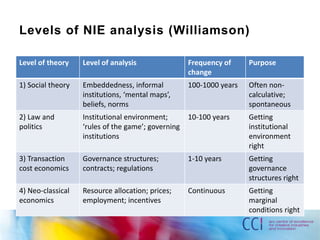
Levels of NIE analysis (Williamson) 
Level of theory Level of analysis Frequency of 
change 
Purpose 
1) Social theory Embeddedness, informal 
institutions, ‘mental maps’, 
beliefs, norms 
100-1000 years Often non-calculative; 
spontaneous 
2) Law and 
politics 
Institutional environment; 
‘rules of the game’; governing 
institutions 
10-100 years Getting 
institutional 
environment 
right 
3) Transaction 
cost economics 
Governance structures; 
contracts; regulations 
1-10 years Getting 
governance 
structures right 
4) Neo-classical 
economics 
Resource allocation; prices; 
employment; incentives 
Continuous Getting 
marginal 
conditions right
Public Service Media (PSM) case study 
• Transition from PSB to PSM in context of media 
convergence 
• Spectrum scarcity case for PSB no longer plausible 
• Public good/merit good case challenged in multichannel 
environment 
• PSBs not the only providers of ‘quality’, ‘niche’ or 
‘minority’ content 
• Diversity of PSB histories – no single template
Political economy, PSBs and citizenship 
• PSBs seen as central to nation building, citizenship and 
the public sphere 
• Not all PSBs are non-commercial, and even ‘non-commercial’ 
PSBs have commercial activities 
• Normative definition of PSB: does not include, for 
instance, CCTV as world’s largest state-run broadcaster 
• Challenges of PSB Charters – lead or follow ‘public 
taste’? 
• Private providers can achieve public good e.g. Google 
Books case
Core NIE propositions relevant to PSM 
• Public and private sector organisations/firms as a ‘nexus 
of contracts’ 
• Separation of ownership from management, and 
principal-agent problem 
• Tendency to expand into conglomerates – risk of 
becoming too big 
• Relational or incentive-based contracting – comparable 
employment arrangements across public and 
commercial media
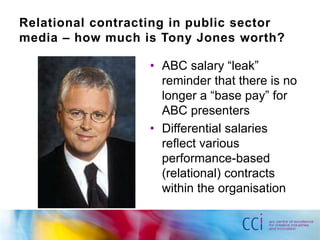
Relational contracting in public sector 
media – how much is Tony Jones worth? 
• ABC salary “leak” 
reminder that there is no 
longer a “base pay” for 
ABC presenters 
• Differential salaries 
reflect various 
performance-based 
(relational) contracts 
within the organisation
Governance challenges for PSM 
• Accountability of PSM managers to the public – via the 
government? 
• Should a PSM be trusted to regulate itself? 
• Distinctiveness of PSM histories and organisational 
cultures 
• Political problem: electoral politics increasing a ‘battle for 
political property rights’ – loss of autonomy for public 
institutions
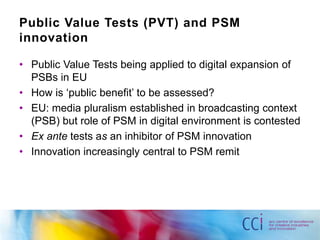
Public Value Tests (PVT) and PSM 
innovation 
• Public Value Tests being applied to digital expansion of 
PSBs in EU 
• How is ‘public benefit’ to be assessed? 
• EU: media pluralism established in broadcasting context 
(PSB) but role of PSM in digital environment is contested 
• Ex ante tests as an inhibitor of PSM innovation 
• Innovation increasingly central to PSM remit
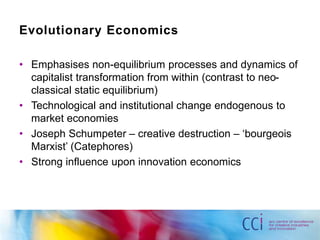
Evolutionary Economics 
• Emphasises non-equilibrium processes and dynamics of 
capitalist transformation from within (contrast to neo-classical 
static equilibrium) 
• Technological and institutional change endogenous to 
market economies 
• Joseph Schumpeter – creative destruction – ‘bourgeois 
Marxist’ (Catephores) 
• Strong influence upon innovation economics
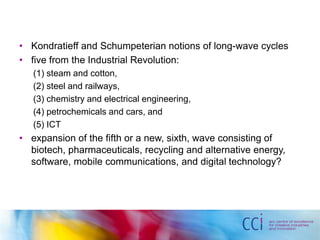
• Kondratieff and Schumpeterian notions of long-wave cycles 
• five from the Industrial Revolution: 
(1) steam and cotton, 
(2) steel and railways, 
(3) chemistry and electrical engineering, 
(4) petrochemicals and cars, and 
(5) ICT 
• expansion of the fifth or a new, sixth, wave consisting of 
biotech, pharmaceuticals, recycling and alternative energy, 
software, mobile communications, and digital technology?
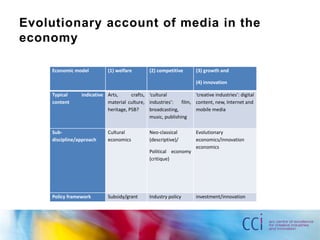
Evolutionary account of media in the 
economy 
Economic model (1) welfare (2) competitive (3) growth and 
(4) innovation 
Typical indicative 
content 
Arts, crafts, 
material culture, 
heritage, PSB? 
‘cultural 
industries’: film, 
broadcasting, 
music, publishing 
‘creative industries’: digital 
content, new, Internet and 
mobile media 
Sub-discipline/ 
approach 
Cultural 
economics 
Neo-classical 
(descriptive)/ 
Political economy 
(critique) 
Evolutionary 
economics/innovation 
economics 
Policy framework Subsidy/grant Industry policy investment/innovation
• evolutionary economics provides a non-teleological, non-totalistic 
account of the dynamics of capitalism that is as 
dynamically conflictual as its Marxist counterpart 
• a theoretical and historical framework for a more adequate 
understanding of the nature, scope and rate of change media 
industries are undergoing,
Conclusion 
• Intention of the book is not polemical – for or against one or 
other school of thought – but rather to identify merits of 
diverse strands of economic thought in understanding 
changing media environment 
• ‘Trade’ (Nelson and Winter) between economics and media, 
comms. & cultural studies can generate new insights into long 
established issues e.g. technological determinism 
• Opening the ‘black box’ of capitalist dynamics promotes a 
better understanding of the economy/culture interface 
• ‘dual face’ of capitalism as ‘both a system fundamentally 
grounded in violence and the most effective engine for 
bettering the material condition of mankind ever known’ (Ott & 
Milberg, 2004- Centre for Capitalism Studies) 
• Merits from point of view of policy advocacy (Entman & 
Wildman)

Renovating Media Economics

  • 1.
    Reconsidering Media Economics Media@Sydney University of Sydney 24 October 2014 Stuart Cunningham and Terry Flew Creative Industries Faculty Queensland University of Technology
  • 3.
    • Dominant media-economictheories – Mainstream (neoclassical) media economics – Critical political economy • Emergent economic approaches – Institutional economics • New Institutional Economics (NIE) – Evolutionary economics • Major case studies – Public service media (PSM) – The changing ecology of television
  • 4.
    • Mainstream (neoclassical)media economics (Picard, 1989; Albarran 2002, 2010; Alexander et. al., 2004; De Vany, 2004; Doyle, 2006, 2013; Hoskins et. al., 2004) • Critical political economy (Mosco, 2009; Hardy, 2014)
  • 5.
    Beyond dualistic thinking • Economics as a discipline is more diverse and pluralistic than it appears from the outside • Keynesian revolution of 1930s; other challenges to hegemony of neoclassical theory from institutionalism, behaviouralism, network economics, post-Keynesian economics etc. • ‘the neoclassical approach … [is] no longer the overwhelmingly dominant paradigm it once was’ (Wildman, 2006, p. 68) • ‘an economic approach to the media needs to be informed by information economics, and network economics, institutional economics and evolutionary or innovation economics’ (Ballon 2014, p. 76)
  • 6.
    Why is thisrelevant to media studies? • new developments in media industries and markets are stretching the capacity of the established neoclassical and critical political economy paradigms: • convergent digital media • Socio-economic value of premarket and nonmarket forms • Disruption of long established media business models • agentive nature of media audiences • New media/digital content as sources of wealth creation and economic innovation
  • 7.
    Mainstream media economics • Application of neoclassical microeconomics – Individual as primary unit of analysis – Rational choice assumptions – Market equilibrium prices – Theory of supply and demand • Influence among media decision-makers • Media policy influence
  • 8.
    • ‘Economics, asa discipline, is highly relevant to understanding how media firms and industries operate … [because] most of the decisions taken by those who run media organisations are, to a greater or lesser extent, influenced by resource and financial issues’ (Gillian Doyle, Understanding Media Economics, 2013, p. 1). • ‘Policy researchers seem to divide roughly between … the “market economics” and “social value” schools of thought, and the two are often so far apart in their assumptions and languages that they are unable to communicate with each other’ (Entman and Wildman, 1992, p. 5).
  • 9.
    Worked example ofapplied media economics: tablet PCs 1. Apple iPad revealed unmet consumer demand for tablets 2. Tablet PCs generated monopoly profits for Apple 3. New suppliers entered the market with lower-cost products (also network effects of Android platform) 4. Apple forced to lower prices and introduce lower cost competitor: iPad Mini
  • 10.
    Challenges of mediafor economics • Heterogeneous nature of media ‘product’ – difficulty in determining what the ‘price’ is for • Dual media markets: consumers/advertisers • Tendencies towards concentration of ownership and market oligopoly • Importance of non-economic principles in media policy e.g. diversity and media pluralism, public goods, socio-cultural dimensions of media content
  • 11.
    Twilight of themedia mogul?
  • 12.
    Digital transformation ofmedia industries and markets • Shift from content scarcity to content abundance • What is the content of digital media – products, services or platforms? • Freely available content and implications for professional media production • Are content aggregators (Google, Apple etc.) in the media industries?
  • 13.
    Critical Political Economy(CPE) • understanding historical processes of social change; • mutually constitutive relationship between economic, social and cultural institutions, relations and practices; • moral philosophy oriented towards critiquing the industrial structures and social relations of capitalism; • commitment to linking intellectual work with progressive social movements. (Mosco 2009, p. 4).
  • 14.
    Is CPE a‘big tent’? • Winseck (2011) proposes that institutional, evolutionary and (some) neoclassical economics is broadly within a commodious CPE • Contested within the field, where CPE has been defined in opposition to: – Cultural studies – Neoclassical economics – Media industry studies (Meehan and Wasko, 2014)
  • 15.
    Revisiting the ‘activeaudience’ debate • Cultural studies questioned degree that audiences adhered to ‘dominant ideologies’, pointing to active audience/user agency • Critiqued among CPE theorists as ‘cultural populism’ (McGuigan 1992) • The cultural as formative of industrial/market structures or ‘residual and merely reflective’ (Stuart Hall, 1986)? • But heartland debates in media and cultural studies have done little to conceptually advance what form of media economics should supplement or contend with critical political economy
  • 16.
    Power: an immanentcritique • Power (Thompson 1995) – Asked to do too much theoretically? – Relationship between economic, political and cultural/symbolic power? – Power as top-down (domination) or relational? • examples
  • 17.
    Impasse in mediaeconomics • Neoclassical ME vs. CPE has become a stale rehearsal of well-worn pro/anti-market arguments • ‘My main argument with many of the versions of the return to Marxism today [is] they share exactly the same worldview as the so-called neoliberals. They think there is one solution to the problem. One thinks that the market will solve everything, the other that doing away with the market will’ (Nicholas Garnham, interview with Christian Fuchs, 2014, p. 121).
  • 18.
    Institutionalism • Longhistory in the social sciences – Middle-range theories (Merton) – Structure/agency dialectic (Giddens) – Historical path-dependency • Neoclassical focus on rational choice individualism has historically marginalised institutional economics • Dissenting tradition: Veblen, Galbraith • Communication studies: political economy of Harold Innis and Canadian comms. school • ‘it is … on individuals that the system of institutions imposes those conventional standards, ideals, and canons of conduct that make up the community’s system of life’ (Veblen 1909 [1961], p. 38).
  • 19.
    New Institutional Economics(NIE) • Douglass North, 1993 Nobel prize winner - economics had cut itself off from history, neglecting the historically evolving role of institutions and the significance of how such institutions develop over time • NIE maintains continuities with mainstream microeconomics, particularly in retaining architecture of rational choice theory in its analyses of individual behaviour – different to ‘old’ institutionalism and economic sociology
  • 20.
    Key NIE concepts • Bounded rationality – while individual behaviour can be intentionally rational, ‘in practice … all decision makers (entrepreneurs, consumers, politicians, etc.) act subject to imperfect information and limited cognition’ (Furubotn and Richter, 2005, p. 556). • Transaction costs – ‘costs of running the economic system’ (Kenneth Arrow) - include market engagement costs, managerial transaction costs, and political transaction costs • Uncertainty and imperfect information – Ex ante/ex post imperfect information • Asset specificity – both the nature of the asset and its use are incompletely defined – ‘A list/B list’ in creative industries (Richard Caves)
  • 21.
    The firm asa nexus of contracts • Origins with Coase (1937) • Institutional form than economises on transaction costs • Implicit and relational contracting • Contracts rely upon trust, social networks, reputation • Applicable across both private and public sector institutions
  • 22.
    Institutions in NIE • institutions as ‘the humanly devised constraints that structure human interaction’ (North, 1994, p. 360) • Institutional arrangements/governance structures (micro) • Institutional environment/ ‘rules of the game’ (macro) – Formal institutions: rules, laws, policies etc. – Informal constraints: norms, conventions, cultural codes etc. – links to history and culture
  • 23.
    Levels of NIEanalysis (Williamson) Level of theory Level of analysis Frequency of change Purpose 1) Social theory Embeddedness, informal institutions, ‘mental maps’, beliefs, norms 100-1000 years Often non-calculative; spontaneous 2) Law and politics Institutional environment; ‘rules of the game’; governing institutions 10-100 years Getting institutional environment right 3) Transaction cost economics Governance structures; contracts; regulations 1-10 years Getting governance structures right 4) Neo-classical economics Resource allocation; prices; employment; incentives Continuous Getting marginal conditions right
  • 24.
    Public Service Media(PSM) case study • Transition from PSB to PSM in context of media convergence • Spectrum scarcity case for PSB no longer plausible • Public good/merit good case challenged in multichannel environment • PSBs not the only providers of ‘quality’, ‘niche’ or ‘minority’ content • Diversity of PSB histories – no single template
  • 25.
    Political economy, PSBsand citizenship • PSBs seen as central to nation building, citizenship and the public sphere • Not all PSBs are non-commercial, and even ‘non-commercial’ PSBs have commercial activities • Normative definition of PSB: does not include, for instance, CCTV as world’s largest state-run broadcaster • Challenges of PSB Charters – lead or follow ‘public taste’? • Private providers can achieve public good e.g. Google Books case
  • 26.
    Core NIE propositionsrelevant to PSM • Public and private sector organisations/firms as a ‘nexus of contracts’ • Separation of ownership from management, and principal-agent problem • Tendency to expand into conglomerates – risk of becoming too big • Relational or incentive-based contracting – comparable employment arrangements across public and commercial media
  • 27.
    Relational contracting inpublic sector media – how much is Tony Jones worth? • ABC salary “leak” reminder that there is no longer a “base pay” for ABC presenters • Differential salaries reflect various performance-based (relational) contracts within the organisation
  • 28.
    Governance challenges forPSM • Accountability of PSM managers to the public – via the government? • Should a PSM be trusted to regulate itself? • Distinctiveness of PSM histories and organisational cultures • Political problem: electoral politics increasing a ‘battle for political property rights’ – loss of autonomy for public institutions
  • 29.
    Public Value Tests(PVT) and PSM innovation • Public Value Tests being applied to digital expansion of PSBs in EU • How is ‘public benefit’ to be assessed? • EU: media pluralism established in broadcasting context (PSB) but role of PSM in digital environment is contested • Ex ante tests as an inhibitor of PSM innovation • Innovation increasingly central to PSM remit
  • 30.
    Evolutionary Economics •Emphasises non-equilibrium processes and dynamics of capitalist transformation from within (contrast to neo-classical static equilibrium) • Technological and institutional change endogenous to market economies • Joseph Schumpeter – creative destruction – ‘bourgeois Marxist’ (Catephores) • Strong influence upon innovation economics
  • 31.
    • Kondratieff andSchumpeterian notions of long-wave cycles • five from the Industrial Revolution: (1) steam and cotton, (2) steel and railways, (3) chemistry and electrical engineering, (4) petrochemicals and cars, and (5) ICT • expansion of the fifth or a new, sixth, wave consisting of biotech, pharmaceuticals, recycling and alternative energy, software, mobile communications, and digital technology?
  • 32.
    Evolutionary account ofmedia in the economy Economic model (1) welfare (2) competitive (3) growth and (4) innovation Typical indicative content Arts, crafts, material culture, heritage, PSB? ‘cultural industries’: film, broadcasting, music, publishing ‘creative industries’: digital content, new, Internet and mobile media Sub-discipline/ approach Cultural economics Neo-classical (descriptive)/ Political economy (critique) Evolutionary economics/innovation economics Policy framework Subsidy/grant Industry policy investment/innovation
  • 33.
    • evolutionary economicsprovides a non-teleological, non-totalistic account of the dynamics of capitalism that is as dynamically conflictual as its Marxist counterpart • a theoretical and historical framework for a more adequate understanding of the nature, scope and rate of change media industries are undergoing,
  • 34.
    Conclusion • Intentionof the book is not polemical – for or against one or other school of thought – but rather to identify merits of diverse strands of economic thought in understanding changing media environment • ‘Trade’ (Nelson and Winter) between economics and media, comms. & cultural studies can generate new insights into long established issues e.g. technological determinism • Opening the ‘black box’ of capitalist dynamics promotes a better understanding of the economy/culture interface • ‘dual face’ of capitalism as ‘both a system fundamentally grounded in violence and the most effective engine for bettering the material condition of mankind ever known’ (Ott & Milberg, 2004- Centre for Capitalism Studies) • Merits from point of view of policy advocacy (Entman & Wildman)

Editor's Notes

  • #3 Book due for publication by Palgrave in April-May 2015 Part of Key Concerns in Media Studies series edited by Andrew Crisell – Gerard Goggin and Tim Dwyer also authors in this series 50,000 word books potentially able to be adopted in udnergraduate courses
  • #4 The challenge in writing the book was threefold: To be able to explicate the key concepts of economic theory in an accessible form and in a way of relevance to students & researchers in media, comms. & cultural studies – importance of case studies and worked examples in the book To critically engage with the major paradigms of media economics (mainstream/NC theories and critical political economy) in ways that would be considered fair to those within those paradigms, while also outlining alternative approaches that would be less familiar to those in the field, such as institutional and evolutionary economics To do all of this in a 50,000 word book intended for a non-specialist audience, that would nonetheless also be critically analysed by specialist in the discipline(s).
  • #5 Both the mainstream media economics tradition and critical political economy are well served by general texts in these fields. However, the two dominant approaches are in many ways so divergent in terms of their objects of analysis, their methodologies, and their founding assumptions that a conscientious student, coming at the topic from disciplines such as media, cultural and communication studies, may find that such a divergence makes it difficult to get to grips with media economics as a whole. Moreover, neither approach has typically held a particularly charitable view towards the other. Mainstream media economics, like economics more generally, has only occasionally acknowledged much that is of value in critical approaches to the field, and typically only in periods of crisis in the discipline, such as the Great Depression of the 1930s, and the more recent Global Financial Crisis of 2008. The Nobel Prize winning economist Joseph Stiglitz argued that economists were culpable in the events that led up to the GFC, as many were ‘so blinded by their faith in free markets that they couldn’t see the problems it was creating. Economists had moved … from being a scientific discipline into becoming free market capitalism’s biggest cheerleader’ (Stiglitz, 2010, p. 238). At the same time, critical political economy has not only defined itself in opposition to the mainstream approaches, but has at times presented those approaches, and the media economists who use them, as being politically regressive and lacking in an ethic of the common good. Mainstream neoclassical economics is often simply taken as an elaborate intellectual framework used on behalf of powerful interests to justify the political ideology of neoliberalism, and attacks on trade unions, public ownership and the welfare state (e.g. Harvey 2005).
  • #6 scholars in media, communication and cultural studies need to revisit media economics in its various forms, as there has too often been a static and one-dimensional account in these field of what economics is. It is wrongly assumed that: the field of economics is relatively homogeneous in its scope and methods; economics as represented in undergraduate courses and standard textbook constitutes the leading edges of thought in the discipline; and economic methodologies easily map onto particular political orthodoxies. The latter premise is sometimes stated in terms of neoclassical economics being synonymous with a form of neoliberal politics, that is inimical to both understanding the intrinsic value of culture, and engaging with what matters in the critical humanities.