Creative Economy and Culture: Does it Require
Globalization?
Terry Flew
Professor of Media and Communication
Creative Industries Faculty/Digital Media Research Centre
Brisbane, Australia
Presentation to Institute for Cultural Industries, Shenzhen University, 27 October 2016
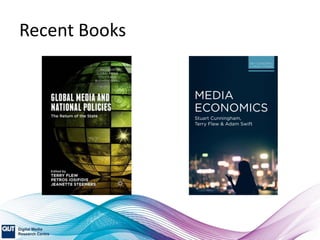
Recent Books
Recent paper
• Terry Flew, “Entertainment media, cultural power,
and post-globalization: The case of China’s
international media expansion and the discourse of
soft power”, Global Media and China, SAGE
OnlineFirst, 1 August 2016 (open access)
• http://gch.sagepub.com/content/early/2016/07/2
9/2059436416662037.full.pdf+html
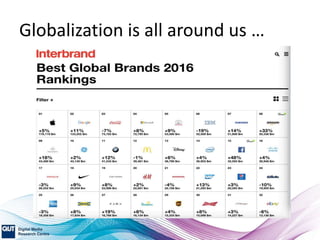
Globalization is all around us …
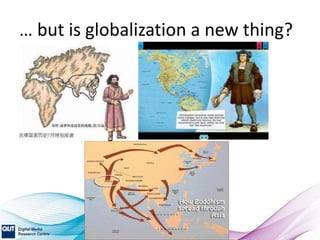
… but is globalization a new thing?
Cultural Trade
• Intercultural exchange: equality and diversity of
world’s cultures intermixing and exchanging ideas
and cultural products
• Cultural trade can enhance intercultural
communication, and contribute to global peace and
improved understanding across nations and societies
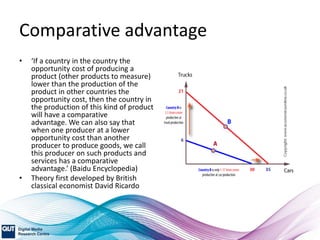
Comparative advantage
• ‘If a country in the country the
opportunity cost of producing a
product (other products to measure)
lower than the production of the
product in other countries the
opportunity cost, then the country in
the production of this kind of product
will have a comparative
advantage. We can also say that
when one producer at a lower
opportunity cost than another
producer to produce goods, we call
this producer on such products and
services has a comparative
advantage.’ (Baidu Encyclopedia)
• Theory first developed by British
classical economist David Ricardo
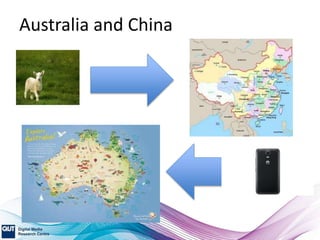
Australia and China
But there is a paradox of cultural trade
• If all cultures are equal, then how can some nations
have a cultural trade surplus and others have a
cultural trade deficit?
• Is this a sign of an unequal economic order?
• Tension behind globalization – both greater global
interconnectedness and uneven development on a
world scale
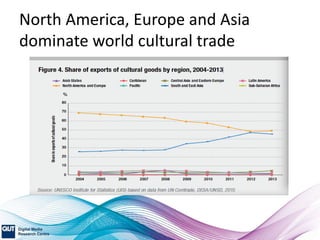
North America, Europe and Asia
dominate world cultural trade
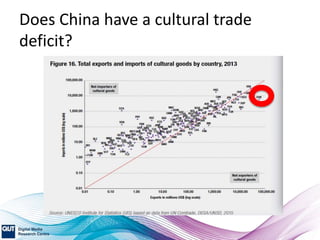
Does China have a cultural trade
deficit?
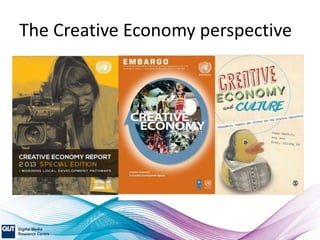
The Creative Economy perspective
The ‘soft power’ perspective
• ‘The overall strength of China’s
culture and its international
influence is not commensurate
with China’s international status’
(Hu Jintao, 2007)
• ‘To strengthen our cultural soft
power, we should disseminate
the values of modern China …
More work should be done to
refine and explain our ideas,
and extend the platform for
overseas publicity, so as to
make our culture known
through international
communication and
dissemination’ (Xi Jinping, 2015)
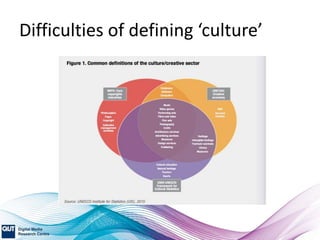
Difficulties of defining ‘culture’
China ‘s Cultural and Creative
Industries (CCI)
• In surplus if one includes manufactured goods in the
CCI definition (UNCTAD Creative Economy Report
2010)
• In deficit if we focus on the arts, media and design
more specifically (e.g. substantial deficit in cultural
services – advertising, design, architecture etc.)
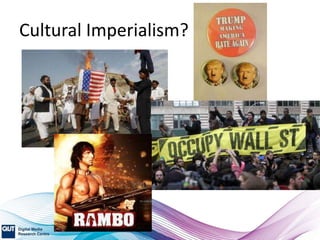
Cultural Imperialism?
Critical Political Economy
• World’s largest media (and Internet) companies are
U.S. based
• Global companies with a global corporate culture
• New International Division of Cultural Labor (Toby
Miller) – knowledge work in the West/low-cost
assembly in rest of the world
• “Runaway” cultural productions – “Global
Hollywood”
Is the cultural imperialism thesis in
decline?
• National media content continues to prevail in most
countries
• Global media corporations often have to negotiate
with nation-states
• Media industries often less “global” than other
industries
• Growth of “second tier” production centers
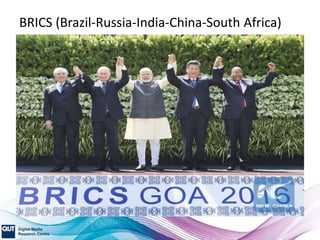
• Growing global competition for cultural influence
(e.g. EU as counter to US, BRICS countries)
BRICS (Brazil-Russia-India-China-South Africa)
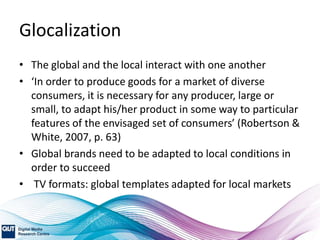
Glocalization
• The global and the local interact with one another
• ‘In order to produce goods for a market of diverse
consumers, it is necessary for any producer, large or
small, to adapt his/her product in some way to particular
features of the envisaged set of consumers’ (Robertson &
White, 2007, p. 63)
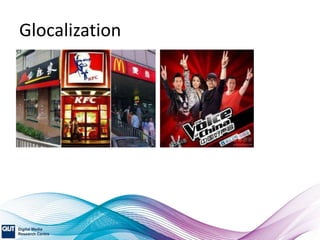
• Global brands need to be adapted to local conditions in
order to succeed
• TV formats: global templates adapted for local markets
Glocalization
New competition to “Global Hollywood”
• ‘Although Hollywood’s supremacy is unlikely to be
broken at any time in the foreseeable future, at least
some of these other centres will conceivably carve
out stable niches for themselves in world markets,
and all the more so as they develop more effective
marketing and distribution capacities … This
argument, if correct, points toward a much more
polycentric and polyphonic global audiovisual
production system than has been the case in the
recent past’ (Scott, 2004, p. 475).
Cities as central to globalization
• ‘Cities … have become the “mixing bowls” in which all the
combined and uneven processes of globalisation play out,
particularly in the cultural field. Cities are becoming the
protagonists in cultural policy and politics whose
importance equals and sometimes exceeds that of national
governments’ (Isar et. al., 2012, p. 3).
• ‘Cities … [that] function less as centres of national media
than as central nodes in the transnational flow of culture,
talent and resources. Rather than asking about relations
among and between nations, we should explore the ways
in which media industries based in particular cities are
participating in the restructuring of spatial and cultural
relations worldwide’ (Curtin, 2009, p 111).
Media Capitals
• Concept first developed by US media theorist Michael
Curtin
• Proposes the emergence of alternative global media
production centres
• ‘Second-tier’ media capitals often cater to specialist geo-
linguistic markets (Mumbai, Cairo, Hong Kong, Miami,
Seoul)
• Trajectories of creative migration is an important
concept: where do creative talents want to locate
themselves?
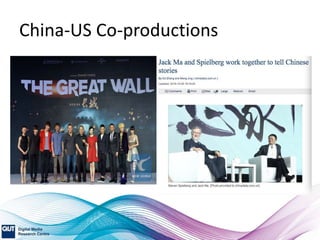
China-US Co-productions
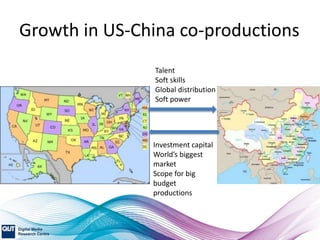
Growth in US-China co-productions
Talent
Soft skills
Global distribution
Soft power
Investment capital
World’s biggest
market
Scope for big
budget
productions
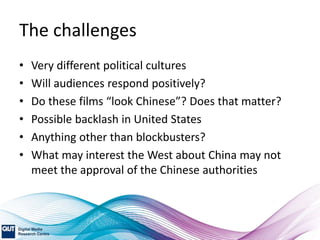
The challenges
• Very different political cultures
• Will audiences respond positively?
• Do these films “look Chinese”? Does that matter?
• Possible backlash in United States
• Anything other than blockbusters?
• What may interest the West about China may not
meet the approval of the Chinese authorities
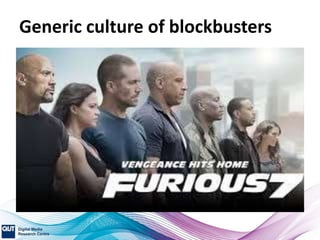
Generic culture of blockbusters
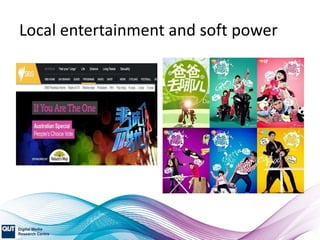
Local entertainment and soft power
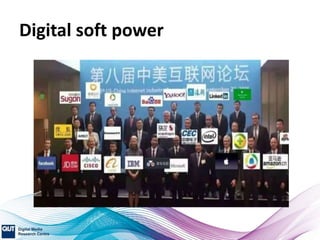
Digital soft power
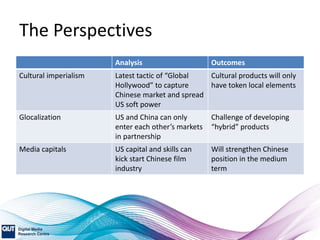
The Perspectives
Analysis Outcomes
Cultural imperialism Latest tactic of “Global
Hollywood” to capture
Chinese market and spread
US soft power
Cultural products will only
have token local elements
Glocalization US and China can only
enter each other’s markets
in partnership
Challenge of developing
“hybrid” products
Media capitals US capital and skills can
kick start Chinese film
industry
Will strengthen Chinese
position in the medium
term
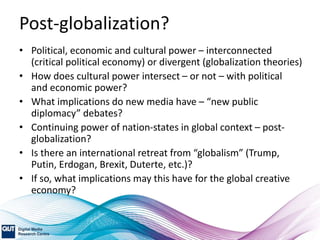
Post-globalization?
• Political, economic and cultural power – interconnected
(critical political economy) or divergent (globalization theories)
• How does cultural power intersect – or not – with political
and economic power?
• What implications do new media have – “new public
diplomacy” debates?
• Continuing power of nation-states in global context – post-
globalization?
• Is there an international retreat from “globalism” (Trump,
Putin, Erdogan, Brexit, Duterte, etc.)?
• If so, what implications may this have for the global creative
economy?

Shenzhen university presentation 27 oct 16

  • 1.
    Creative Economy andCulture: Does it Require Globalization? Terry Flew Professor of Media and Communication Creative Industries Faculty/Digital Media Research Centre Brisbane, Australia Presentation to Institute for Cultural Industries, Shenzhen University, 27 October 2016
  • 2.
  • 3.
    Recent paper • TerryFlew, “Entertainment media, cultural power, and post-globalization: The case of China’s international media expansion and the discourse of soft power”, Global Media and China, SAGE OnlineFirst, 1 August 2016 (open access) • http://gch.sagepub.com/content/early/2016/07/2 9/2059436416662037.full.pdf+html
  • 4.
    Globalization is allaround us …
  • 5.
    … but isglobalization a new thing?
  • 6.
    Cultural Trade • Interculturalexchange: equality and diversity of world’s cultures intermixing and exchanging ideas and cultural products • Cultural trade can enhance intercultural communication, and contribute to global peace and improved understanding across nations and societies
  • 7.
    Comparative advantage • ‘Ifa country in the country the opportunity cost of producing a product (other products to measure) lower than the production of the product in other countries the opportunity cost, then the country in the production of this kind of product will have a comparative advantage. We can also say that when one producer at a lower opportunity cost than another producer to produce goods, we call this producer on such products and services has a comparative advantage.’ (Baidu Encyclopedia) • Theory first developed by British classical economist David Ricardo
  • 8.
  • 9.
    But there isa paradox of cultural trade • If all cultures are equal, then how can some nations have a cultural trade surplus and others have a cultural trade deficit? • Is this a sign of an unequal economic order? • Tension behind globalization – both greater global interconnectedness and uneven development on a world scale
  • 10.
    North America, Europeand Asia dominate world cultural trade
  • 11.
    Does China havea cultural trade deficit?
  • 12.
  • 13.
    The ‘soft power’perspective • ‘The overall strength of China’s culture and its international influence is not commensurate with China’s international status’ (Hu Jintao, 2007) • ‘To strengthen our cultural soft power, we should disseminate the values of modern China … More work should be done to refine and explain our ideas, and extend the platform for overseas publicity, so as to make our culture known through international communication and dissemination’ (Xi Jinping, 2015)
  • 15.
  • 16.
    China ‘s Culturaland Creative Industries (CCI) • In surplus if one includes manufactured goods in the CCI definition (UNCTAD Creative Economy Report 2010) • In deficit if we focus on the arts, media and design more specifically (e.g. substantial deficit in cultural services – advertising, design, architecture etc.)
  • 17.
  • 18.
    Critical Political Economy •World’s largest media (and Internet) companies are U.S. based • Global companies with a global corporate culture • New International Division of Cultural Labor (Toby Miller) – knowledge work in the West/low-cost assembly in rest of the world • “Runaway” cultural productions – “Global Hollywood”
  • 19.
    Is the culturalimperialism thesis in decline? • National media content continues to prevail in most countries • Global media corporations often have to negotiate with nation-states • Media industries often less “global” than other industries • Growth of “second tier” production centers • Growing global competition for cultural influence (e.g. EU as counter to US, BRICS countries)
  • 20.
  • 21.
    Glocalization • The globaland the local interact with one another • ‘In order to produce goods for a market of diverse consumers, it is necessary for any producer, large or small, to adapt his/her product in some way to particular features of the envisaged set of consumers’ (Robertson & White, 2007, p. 63) • Global brands need to be adapted to local conditions in order to succeed • TV formats: global templates adapted for local markets
  • 22.
  • 23.
    New competition to“Global Hollywood” • ‘Although Hollywood’s supremacy is unlikely to be broken at any time in the foreseeable future, at least some of these other centres will conceivably carve out stable niches for themselves in world markets, and all the more so as they develop more effective marketing and distribution capacities … This argument, if correct, points toward a much more polycentric and polyphonic global audiovisual production system than has been the case in the recent past’ (Scott, 2004, p. 475).
  • 24.
    Cities as centralto globalization • ‘Cities … have become the “mixing bowls” in which all the combined and uneven processes of globalisation play out, particularly in the cultural field. Cities are becoming the protagonists in cultural policy and politics whose importance equals and sometimes exceeds that of national governments’ (Isar et. al., 2012, p. 3). • ‘Cities … [that] function less as centres of national media than as central nodes in the transnational flow of culture, talent and resources. Rather than asking about relations among and between nations, we should explore the ways in which media industries based in particular cities are participating in the restructuring of spatial and cultural relations worldwide’ (Curtin, 2009, p 111).
  • 25.
    Media Capitals • Conceptfirst developed by US media theorist Michael Curtin • Proposes the emergence of alternative global media production centres • ‘Second-tier’ media capitals often cater to specialist geo- linguistic markets (Mumbai, Cairo, Hong Kong, Miami, Seoul) • Trajectories of creative migration is an important concept: where do creative talents want to locate themselves?
  • 26.
  • 27.
    Growth in US-Chinaco-productions Talent Soft skills Global distribution Soft power Investment capital World’s biggest market Scope for big budget productions
  • 28.
    The challenges • Verydifferent political cultures • Will audiences respond positively? • Do these films “look Chinese”? Does that matter? • Possible backlash in United States • Anything other than blockbusters? • What may interest the West about China may not meet the approval of the Chinese authorities
  • 29.
    Generic culture ofblockbusters
  • 30.
  • 31.
  • 35.
    The Perspectives Analysis Outcomes Culturalimperialism Latest tactic of “Global Hollywood” to capture Chinese market and spread US soft power Cultural products will only have token local elements Glocalization US and China can only enter each other’s markets in partnership Challenge of developing “hybrid” products Media capitals US capital and skills can kick start Chinese film industry Will strengthen Chinese position in the medium term
  • 36.
    Post-globalization? • Political, economicand cultural power – interconnected (critical political economy) or divergent (globalization theories) • How does cultural power intersect – or not – with political and economic power? • What implications do new media have – “new public diplomacy” debates? • Continuing power of nation-states in global context – post- globalization? • Is there an international retreat from “globalism” (Trump, Putin, Erdogan, Brexit, Duterte, etc.)? • If so, what implications may this have for the global creative economy?

Editor's Notes

  • #4 Content slide for presentations