PUBLIC MEDIA AND
POLITICAL INDEPENDENCE:
Lessons for the Future of Journalism
from Around the World
By Rodney Benson and Matthew Powers
New York University
Department of Media, Culture and Communication
FEBRUARY 2011
2
PUBLIC MEDIA AND POLITICAL INDEPENDENCE: Lessons for the Future of Journalism from Around the World
ABOUT THE AUTHORS
Rodney Benson is associate professor and director of graduate studies in the Department
of Media, Culture and Communication at New York University.
Matthew Powers is a Ph.D. student in NYU’s Department of Media, Culture and
Communication.
NYU Ph.D. student Beza Merid also conducted research for this report.
The authors would like to gratefully acknowledge the close readings and helpful editing
of this text by Josh Stearns, S. Derek Turner and Craig Aaron of Free Press, and by our
academic and journalistic colleagues around the globe (listed at the end of this report).
The conclusions of this study, and any factual errors, are our own.
ABOUT FREE PRESS
Free Press is a national, nonpartisan, nonprofit organization working to reform the media.
Through education, organizing and advocacy, we promote diverse and independent
media ownership, strong public media, quality journalism, and universal access to
communications.
www.freepress.net
Supported by a grant from the Foundation to Promote Open Society.
3
PUBLIC MEDIA AND POLITICAL INDEPENDENCE: Lessons for the Future of Journalism from Around the World
EXECUTIVE SUMMARY
We live in paradoxical times. The core institutions and systems that have supported
journalism in America for decades are weathering a perfect storm of challenges that have
undercut our country’s longstanding information infrastructure. At the same time, a
new generation of news and journalism organizations are driving a renaissance in local
reporting and reinvigorating our media system. This shifting media landscape has inspired
a range of important reports and initiatives designed to help chart a course toward stronger
journalism and media in America.
A diverse set of stakeholders – policymakers, academics, foundations, nonprofits, and
former and current journalists – have weighed what the future of journalism might
look like and what it might take to get there. In report after report, America’s public and
noncommercial media sector has been held up as a core component to the future of hard-
hitting, accountability journalism. All of the major reports released in 2009 and 2010
agreed that there is a vital role for public and noncommercial media to play, and that the
federal government must work to strengthen and expand funding for it.1
Together, these
reports sparked inquiries at both the Federal Communications Commission and the
Federal Trade Commission.
However, too often the moderate proposals for federal funding and public media run into
a wave of protest and knee-jerk reactions against any and all government action. In fact,
government has always and will always influence how our media system functions, from
the early newspaper postal subsidies to handing out broadcast licenses and subsidizing
broadband deployment. The question is not if government should be involved, but how,
and that is a question that demands an in-depth conversation, not a shouting match.
Those concerned about government involvement in journalism have legitimate concerns
about the ways federal funding can open the door to undue political pressure. While there
is broad agreement that the current situation in American journalism is a classic case of
market failure, remedial action has been stymied by the fear that any public policy cure
would be worse than the disease. The proper response to these concerns, however, should
1
	 See Leonard Downie, Jr. and Michael Schudson,“The Reconstruction of American Journalism,”Columbia Journal-
ism Review, published online October 19, 2009. This report was endorsed in a CJR editorial,“A Helping Hand: The
case for (smart) government support of journalism,”Columbia Journalism Review (November / December 2009). For
other positive evaluations of targeted government support of U.S. journalism, see Geneva Overholser and Geoffrey
Cowan,“Free press, with profits,”Los Angeles Times, January 19, 2009; Bree Nordenson,“The Uncle Sam Solution,”
Columbia Journalism Review (September/October 2007); Victor Pickard, Josh Stearns, and Craig Aaron,“Saving the
News: Toward a National Journalism Strategy,”Free Press Policy Report, Washington, D.C., 2009; The Knight Commis-
sion on the Information Needs of Communities in a Democracy,“Informing Communities: Sustaining Democracy in
the Digital Age,”The Aspen Institute, 2009; and David Westphal and Geoffrey Cowan,“Public Policy and Funding the
News,”USC Annenberg School of Communications and Journalism, 2010.
4
PUBLIC MEDIA AND POLITICAL INDEPENDENCE: Lessons for the Future of Journalism from Around the World
be to identify how best to insulate journalists and newsrooms from political pressure, not
to throw the baby out with the bathwater.
Although U.S. public broadcasting has accomplished much in the 40 years since its
founding, today there is a growing sense that we can and must do better. In the global
context, our public media system’s independent civic mission is woefully underfunded:
U.S. per capita public spending is less than $4, far less than the $30 to $134 per capita
for the 14 countries examined in this study. And as the recent efforts by politicians to
punish NPR for its firing of Juan Williams suggest, public media in America possess little
autonomy from direct political pressure. How can public media be adequately funded and
adequately protected from partisan political meddling? These decisions do not need to be
made in a vacuum. The lessons of other democratic nations, many of whose public media
systems have been around long before American public broadcasting, are instructive.
In this report, we survey the concrete ways that a cross-section of democratic nation-
states around the world fund and protect the autonomy of public media. Countries
examined in this report are: Australia, Belgium, Canada, Denmark, Finland, France,
Germany, Ireland, Japan, The Netherlands, New Zealand, Norway, Sweden and the United
Kingdom. Most of our focus will be on television and radio public service broadcasters,
increasingly reaching citizens via online platforms, though where appropriate we will also
document public support for newspapers (in Belgium, Finland, France, the Netherlands,
Norway and Sweden).
In the 14 nations examined in this study, public media independence and democratic
functioning are promoted through a variety of means.
•	 First, in several countries, funding is established for multiyear periods, thus
lessening the capacity of the government to directly link funding to either approval
or disapproval of programming.   
•	 Second, public media seem to be strongest when citizens feel that media are
responsive to them rather than to politicians or advertisers (i.e., when they are truly
“public”). Funding structures and oversight organizations that create a direct link
between public media and their audiences foster citizen engagement, involvement
and accountability.
•	 Third, the legal and administrative charters establishing public broadcasters work
to assure that public funds are spent in the public interest — providing diverse,
high-quality news and other content. At the same time, these charters and related
media laws restrict the capacity of governments to exert influence over content in a
partisan direction.
•	 Fourth, public agencies, administrative boards, and/or trusts of one type or
another exist in all countries to serve as a buffer between the broadcasters and the
government in power. The independence of such agencies, boards, and trusts is
5
PUBLIC MEDIA AND POLITICAL INDEPENDENCE: Lessons for the Future of Journalism from Around the World
bolstered through a variety of means and by creating an “arms-length” institutional
relationship between the public broadcaster and partisan political interference or
meddling.
As a result of these policies, not only have public broadcasters continued to provide
high-quality, diverse programming, they have also been responsible for airing critical
investigations of government performance. According to a growing body of scholarly
research, public broadcasters across western Europe and other democracies examined
in this study provide more and higher quality public affairs programming and a greater
diversity of genres and unique perspectives than their commercial counterparts. Publicly
subsidized newspapers are just as or more critical of government than their advertising-
subsidized competitors.
Today, democratic public media systems in Europe, North America and elsewhere face
challenges on a number of fronts. European scholars and journalists we consulted
for this study emphasized the threat to public broadcasters posed by increasing
commercial pressures, and, in general, the increasing difficulty of balancing demands
to simultaneously appeal to large audiences and to uphold public service values such as
high-quality programming across multiple genres, in-depth information, promotion of
democratic citizenship, and representation of diverse voices and viewpoints.
Some public broadcasters are better funded and operated than others. Our survey
highlights the notable strengths of public media systems in the U.K., Germany and
Scandinavian countries. In contrast, due to erosion in either the amount of funding or
procedures for assuring arms-length autonomy from direct governmental control, public
media have arguably been weakened in recent years in Australia, Canada, France, The
Netherlands and New Zealand.
Likewise, in the transition to digital and Internet platforms, countries with public service
broadcasting are adopting a variety of approaches to maintain or increase public funding,
some more conducive than others to maintaining an important role for public service
media. While advertising or online merchandising might seem to offer an additional
means of funding online expansion, public media are facing stiff opposition from
commercial media, as well as from the European Commission, which are raising the
specter of unfair state-sponsored competition against market actors (a criticism, it should
be noted, that commercial channels, many of them privatized in the 1980s, have been
making since their inception).
In sum, even as public media face new challenges and difficulties, this report establishes
the continuing international viability, indeed vitality, of the public service model and
provides a range of positive policy prescriptions, from funding mechanisms to citizen
engagement and governance structures, for the United States as it considers needed
expansions of its own very modest public media system. While it is unlikely that
6
PUBLIC MEDIA AND POLITICAL INDEPENDENCE: Lessons for the Future of Journalism from Around the World
the United States would adopt any of these models directly, the report quite clearly
demonstrates that public service broadcasters play an important civic role in overseas
markets, remedying the classic market failure in the production of quality, independent,
commercial-free journalism. The models herein should be considered a starting point for
discussion, acknowledging that each would have to be modified for the American media
and political context.
7
PUBLIC MEDIA AND POLITICAL INDEPENDENCE: Lessons for the Future of Journalism from Around the World
TABLE OF CONTENTS
PART I: PUBLIC MEDIA AROUND THE WORLD 8
Research Questions and Methodology 9
Key Findings 11
PART II: COUNTRY PROFILES 15
Australia15
Belgium17
Canada20
Denmark25
Finland28
France30
Germany35
Ireland39
Japan40
The Netherlands 42
New Zealand 45
Norway48
Sweden51
United Kingdom 54
PART III: TABLES 61
Table 1: Funding Public Media in the U.S. and 14 Leading Democracies  61
Table 2: Types of Funding and Firewalls in 14 Leading Democracies 62
PART IV: SUPPORTING DOCUMENTS 67
United Kingdom, The Royal Charter of 2006  67
Canada, Broadcasting Act of 1991 67
Denmark, Radio and Television Broadcasting Act of 2010 67
Norway, NRK’s Articles of Association 67
PART V: SOURCES OF INFORMATION 68
List of Personal E-Mail Communications 68
Bibliography  72
8
PUBLIC MEDIA AND POLITICAL INDEPENDENCE: Lessons for the Future of Journalism from Around the World
PART I: PUBLIC MEDIA AROUND THE WORLD
America is unique among western democracies in its nearly complete reliance on
commercial media to present comprehensive information about government and
politics, to hold political and business elites to account through critical commentary and
investigative reporting, and to provide a forum for a broad range of voices and viewpoints.
At its best, this system has produced Pulitzer Prize-winning investigative reporting and
in-depth, long form journalism. But for much of the time and for most media outlets and
their audiences, entertainment, crime and disaster news, and light, human-interest stories
have been the dominant tendency. PBS and NPR, created in the early 1970s, were a very
modest attempt to add a little more public affairs to the media content balance. In recent
years, of course, cable television and the Internet have provided additional outlets for
public affairs content. But few of these outlets, whether privately or publicly funded, reach
a broad public audience.
In contrast to the highly fragmented and mostly commercial American media, the media
in virtually every other western democratic nation-state are a mix of private and public.
And in many cases public media are the leading media, both in terms of audience size and
in terms of quality and independence, as numerous comparative studies have shown:
•	 In a comparative study of election news coverage by national private and public
television channels in Germany, England and France, and national private channels
in the United States, Zurich-based scholar Frank Esser (2008: 412, 416, 422-425)
found “more extensive [election] coverage on public than commercial channels” in
all of the European countries. He also reports that French public channel France 2’s
coverage was the most likely to focus on policy substance, and that “the toughest
candidate interviews aired on the British channels,” including the public BBC.
•	 Recent research comparing publicly and privately owned television news in
Denmark, Finland, the United Kingdom and the United States by scholars James
Curran, Shanto Iyengar, Anker Brink Lund and Inka Salovaara-Moring (2009)
shows that “public service television gives greater attention to public affairs and
international news, and thereby fosters greater [public] knowledge in these areas,
than the market model.” In this sophisticated study, which combines content
analysis with survey research, Curran and colleagues also found that public service
television “encourages higher levels of news consumption and contributes to a
smaller within-nation gap between the advantaged and disadvantaged.”
9
PUBLIC MEDIA AND POLITICAL INDEPENDENCE: Lessons for the Future of Journalism from Around the World
•	 Research has also shown that publicly subsidized newspapers in Sweden, Norway
and France (Strömbäck and Dimitrova 2006; Skogerbø 1997; Benson and Hallin
2007; Benson 2009b, 2010) tend to provide more original, critical, in-depth and
multiperspectival coverage than their advertising-dependent counterparts (either in
their own countries, or in the United States).  
How is it possible that publicly funded media can perform just as well or better than
commercial media? For starters, it needs to be kept in mind that the alternative to
government-facilitated public support for media is not a blank check providing no-
strings-attached “independence,” but rather alternative forms of dependence. Advertising
support, generally from large business corporations, can be just as or more problematic
as state funding. Research has documented the ways in which advertising funding tends
to dampen, to say the least, critical reporting of business (Collins 1992; Baker 1994;
Davis 2002; Hamilton 2004). But given that businesses also want to assure good relations
with government and diverse consumer publics, they also tend to push (subtly or not
so subtly) for news that will avoid causing offense or disturbing the status quo. For this
reason, paradoxically, publicly funded media such as the BBC are often more willing to
take risks than commercial media. During the Iraq war, which involved significant British
involvement, the “BBC was more likely to be accused of being an enemy of the state than a
patriotic cheerleader” (Robertson 2003).
What matters for both public and private media are the procedures and policies in place
to assure both adequate funding and independence from any single owner, funder or
regulator. Inside corporate-owned newsrooms, as profit pressures have increased, informal
“walls” protecting the editorial side from business interference have crumbled. In contrast,
the walls protecting public media are often made of firmer stuff such as independent
oversight boards and multiyear advance funding to assure that no publicly funded media
outlet will suffer from political pressure or funding loss because of critical news coverage.
RESEARCH QUESTIONS AND METHODOLOGY
This report documents the precise mechanisms for funding and protecting the journalistic
autonomy of public media in leading western European democracies, as well as Canada,
Australia, New Zealand and Japan. Our aim is to survey a range of democratic solutions
to the common challenges posed by public media: How can they be adequately funded?
And how can they maintain their independence from undue governmental interference or
partisan political meddling?
In Part II of this report, countries are listed alphabetically for ease of reading and reference
purposes. Broadly, though, the countries follow three primary funding models: license fee
only or primarily2
(Denmark, Finland, Japan, Norway, Sweden, and the United Kingdom),
2
	 A few of the countries in this category also receive small amounts of sponsorships or other commercial revenues,
10
PUBLIC MEDIA AND POLITICAL INDEPENDENCE: Lessons for the Future of Journalism from Around the World
mixed license fee and advertising funding (France, Germany, Ireland), and mixed public
funding and advertising (Australia, Belgium, Canada, The Netherlands, New Zealand).
License fees refer to fees assessed to television-owning households and set aside only for
the purpose of public media, generally television and radio. Public funding means that
public broadcasters compete directly with all other general tax supported programs in the
national (or regional) government’s budget.
For each country, we document: 1) basic background information about the major public
broadcasters; 2) the amount, means, mechanisms and duration of funding (all funding
amounts are expressed in U.S. dollars, converted using Oanda Currency Converter,
http://www.oanda.com/currency/converter, at the rate of July 1 for the year reported);
3) the “external” government branches and agencies and “internal” media boards
which oversee public media and help insulate them from political pressure, as well as
procedures and laws governing appointments and purview; 4) new policy issues arising
out of the transition to Internet platforms; 5) information about newspaper subsidies for
those countries where they are offered; and 6) when available, content analysis research
comparing the form and content of public media programming, especially news, with its
commercial competitors.
Our focus in this report is on audio-visual media, particularly television. In most countries,
provisions for television and radio are closely linked. We also document procedures for
public funding for newspapers, an important additional type of public media funding
in France, Belgium, the Netherlands, and most Scandinavian countries. Our findings are
based on original source documents (including annual reports and websites), the latest
scholarly research, and personal e-mail communications with more than 30 journalists,
scholars, media executives, and government regulators with expertise on public media in
the 14 countries examined in this report.
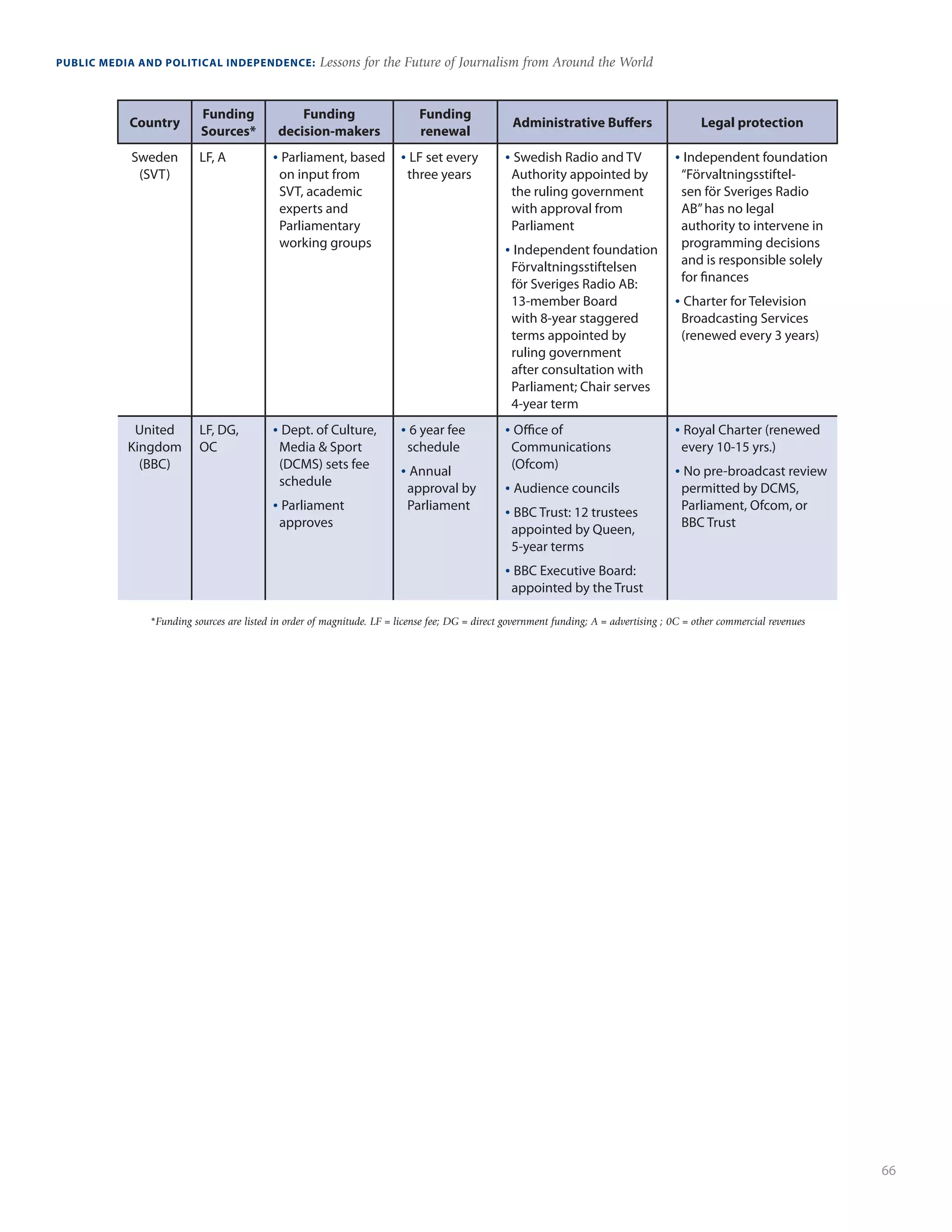
In Part III, Table 1 provides up-to-date data on precise amounts and types of funding for
public service broadcasting media in all countries studied, as well as for the United States.
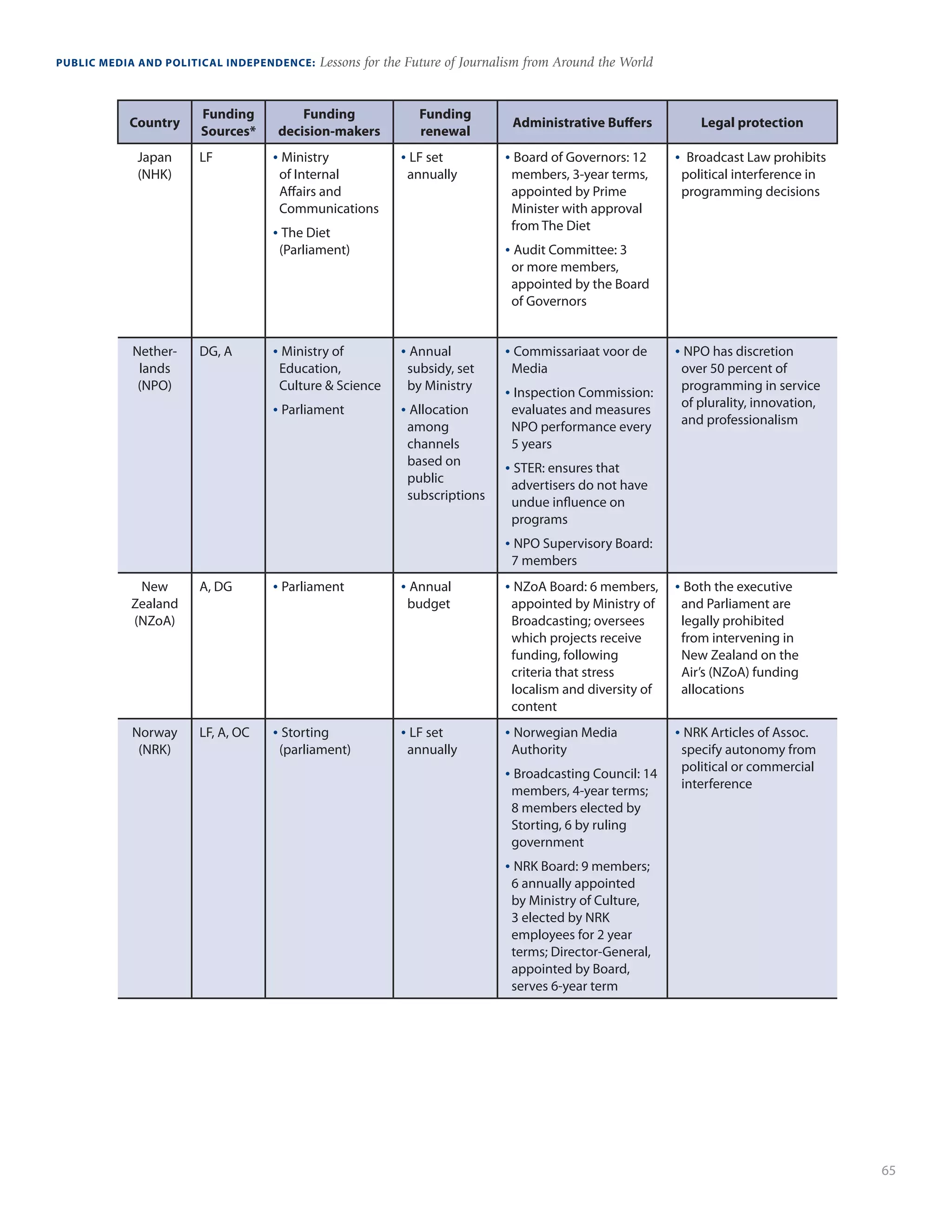
Table 2 provides a short summary for each country of funding sources, funding approvers,
funding renewal process, legal protections of independence, and administrative buffers.
It may be tempting to quickly dismiss European ways as products of vastly different
civilizations: It may work in Europe, so this common argument goes, but it could never
work here. Certainly, America will adopt its own unique policies, just as approaches vary
across European and other democracies. Decisions about the role of the state and the
market, however, are unavoidable. The history of American media, as numerous historians
(see, e.g., McChesney 1993, Starr 2004) have shown, has been shaped by political struggles
(not predetermined by “culture”) to decide how and under what conditions media should
be oriented toward serving civic or commercial needs. And the truth is that American
but these typically account for less than 5 percent of total revenues. BBC receives about 20 percent of its total
revenues from the commercial operations of BBC World or direct government grants. However, domestic BBC is
entirely funded by the license fee.
11
PUBLIC MEDIA AND POLITICAL INDEPENDENCE: Lessons for the Future of Journalism from Around the World
media — TV, radio, newspapers, magazines, and Internet — have and continue to receive
significant public subsidies (Cook 1998, Cowan and Westphal 2010): The question is
whether this public support is sufficient and whether it is being used as effectively as it
could be to support democratic civic ends.
Is the role of the government and media policy moot in the age of the Internet? While it
is surely true that the social organization of news media and their relations with diverse
publics are complicated by the Internet, it is highly debatable whether this has led to a
disintegration or dispersal of power, as some philosophers have argued. And while the
Internet enables new forms of democratic public engagement, there is already considerable
empirical evidence that old commercial media patterns are reappearing or even being
accentuated on the Web, such as the continued dominance of a handful of large media
conglomerates, homogeneous or ideologically narrow news coverage, and scoop-driven
sensationalism. The title of one recent study (Fenton 2010) of the Internet’s effects on
journalism sums up an all-too-frequent outcome: “New Media, Old News.” As noted,
however, the Internet clearly poses new challenges for public media, and we will document
the various ways in which these are being addressed.
Finally, we want to be clear about the purpose of our report. Even given the demonstrated
virtues of European public media, we are not suggesting that public media can or should
replace private enterprises. Commercial and public media each have their blind spots.
That’s why it’s important to have both. This report simply shows a range of concrete,
workable ways that public media can be a stronger part of the mix.
KEY FINDINGS
Public media, whether TV, radio or newspapers, attract sizeable audiences and are the
market leaders in many countries. Without exception, the western European public
broadcasting channels examined in this survey attract one-third or more of the national
television audience. In contrast, audiences for public service channels in Canada, Australia
and New Zealand, as well as the United States, tend to be significantly smaller.
Public media are funded by a variety of sources, including license fees (assessed
only to television set owners with revenues reserved for the media organization),
direct government funding (general tax revenues), taxes on commercial media or
telecommunications companies, advertising, and other commercial sources. The best
funded public broadcasters, such as the U.K.’s BBC, Germany’s ARD/ZDF, and the various
Scandinavian public broadcasters, tend to receive the lion’s share of their funding from
license fees. In the Netherlands, the license fee was replaced with direct government
appropriations beginning in 2000, with one result being a gradual decline of funding in
subsequent years (Papathanassopoulos 2007: 155-156).
12
PUBLIC MEDIA AND POLITICAL INDEPENDENCE: Lessons for the Future of Journalism from Around the World
The license fee itself is defended by many as a guarantee of autonomy and the means to
provide a direct link between broadcasters and the public. As Papathanassopoulos (2007:
156) argues, in contrast to the license fee, “Direct public or government funding may,
in one way or another, seriously affect public broadcasters’ independence, or in the best
case, the public perception of their independence.” In addition to establishing a buffer
against dramatic changes in governmental funding, the license fee also has historically
had “a social dimension,” in that “by contributing to their national public broadcaster,
citizens felt that it was more accountable to them than to the politicians.” (ibid.: 156).
In the American context, public broadcasters have long argued that direct charitable
contributions from local citizens to local stations serve a similar role. The question then is
how public policy can help strengthen that connection without implementing a license-fee
model.
Public service media’s professional autonomy and optimal democratic functioning are
promoted through a variety of means:
•	 First, in several countries, including Australia, the U.K., Denmark, and Germany,
funding is established for multiyear periods, thus lessening the capacity of
the government to directly link funding to either approval or disapproval of
programming.   
•	 Second, public media seem to be strongest when citizens feel that media are
responsive to them rather than to politicians or advertisers (i.e., when they are
truly “public”). Funding structures and oversight organizations that create a direct
link between public media and their audiences, such as in Denmark, Germany,
the Netherlands, and the U.K., foster citizen engagement, involvement and
accountability.
•	 Third, the legal and administrative charters establishing public broadcasters almost
uniformly emphasize mandates to provide diverse, high-quality programming, and
inclusion of a wide variety of voices and viewpoints. At the same time, in many
cases, these charters and related media laws have strictly restricted the capacity
of governments to attempt to influence programming in a partisan direction,
or even to determine funding except according to very narrow technical criteria
(as in Germany). In the United Kingdom, the BBC “Trust” oversees the BBC; the
government has its most significant power during the negotiations over the BBC’s
10-year Royal Charter. However, between charter negotiations, the BBC Trust and by
extension the BBC have significant autonomy from governmental interference.3
The
Swedish public broadcaster, SVT, is likewise governed by a multiyear charter (in this
case, three years) and owned by an independent foundation, Förvaltningsstiftelsen
för Sveriges Radio AB, specifically designed to insulate SVT from both state and
market pressures.   
3
	 Remarks of BBC Director-General Mark Thompson, Conference on“Public Media in a Digital Age,”sponsored by
The New America Foundation and Free Press, Washington, D.C., October 5, 2010.
13
PUBLIC MEDIA AND POLITICAL INDEPENDENCE: Lessons for the Future of Journalism from Around the World
•	 Fourth, oversight agencies and/or administrative boards of one type or another
exist in all countries to serve as a buffer between the public broadcasters and the
government in power. The independence of such agencies or boards is bolstered
through a variety of means: through staggered terms, limiting the capacity of a new
government to immediately control all appointments (Canada, France); through
dispersal of authority to make appointments; and through multiple layers of
“external” and “internal” oversight, creating an “arms-length” relationship between
the public broadcaster and partisan political interference or meddling (in all
countries, but especially in the U.K., Germany, and the Scandinavian countries). In
all the countries in our study, governments and oversight agencies are prohibited,
by law and by custom, from engaging in any pre-broadcasting censorship.
As a result of these policies, not only have public service broadcasters continued to
provide high quality, diverse programming, they have also been responsible for airing
critical investigations of government performance (notably in Denmark, Canada and the
U.K.). Likewise, subsidized newspapers in Sweden, Norway and France have provided
consistently high-quality, in-depth, and often critical news coverage of government and
the leading political parties.4
Numerous scholarly content analyses demonstrating the
democratic virtues of public over commercial media and many examples of outstanding
critical news coverage by public media are presented in the individual country profiles.
In the United States, public media are funded through direct government annual
appropriations, which have been and will continue to be problematic. While we
acknowledge that the license fee model will likely never gain a foothold in the United
States, nor do we think a regressive tax is the right answer, we do need to look for new
ways of more deeply connecting citizens to their public media system. If we seek to create
strong public media — as free as possible from both political and commercial influences,
yet deeply committed to a democratic civic mission — then a sustainable, long-term trust
fund is perhaps the best model. This approach could build upon the experiences of trust
ownership forms developed in the United Kingdom and Sweden.
Today, democratic public media systems in Europe, North America, and elsewhere face
challenges on a number of fronts. Far more than partisan political meddling (though
this has occurred in some cases, notably in France), European scholars and journalists we
consulted for this study emphasized the threat to public broadcasters posed by increasing
commercial pressures, and, in general, the increasing difficulty of balancing the need
to appeal to a broad audience (to justify the license fee) and to uphold public service
values such as high-quality programming across multiple genres, in-depth information,
promotion of democratic citizenship, and provision of “access to and reflection of
society in diverse or proportional ways” (McQuail 2003: 27; Blumler 2010, personal
communication).
4
	 For another survey of research demonstrating the critical, in-depth, and ideologically diverse character of public
media, both audio-visual and print, see Benson (2011, in press).
14
PUBLIC MEDIA AND POLITICAL INDEPENDENCE: Lessons for the Future of Journalism from Around the World
Public media face increasing competition from commercial channels, which in turn see
public media’s access to both public funds and advertising (in some cases), as well as
unfettered access to the Internet, as unfair competition. Commercial television owners
argue for the obsolescence of public service television in the age of cable television and
the Internet, even though research has shown that public broadcasters continue to offer
programming (news, educational and children’s programs, and programs appealing
to diverse minorities) generally not offered by commercial stations. At the same time,
increases in license fees or direct government appropriations have often failed to keep pace
with increasing costs, forcing a dilution of programming quality.
Some public broadcasters are better funded and operated than others. Our survey
highlights the notable strengths of public media systems in the U.K., Germany and
Scandinavian countries. In contrast, due to erosion in both the amount of funding and
procedures for assuring “arms-length” autonomy from direct governmental control (shift
from license fee to direct government funding, shift from multiyear to annual funding,
etc.), public media have arguably been weakened in recent years in the Netherlands,
Canada, New Zealand, and Australia.
Likewise, in the transition to digital and Internet platforms, countries with public service
broadcasting are adopting a variety of approaches to maintain or increase public funding,
some more conducive than others to maintaining an important role for public service
media. Historically, license fees were determined simply by the presence or absence of a
television in the home (as is still the case in the U.K., Germany and Finland). Recently,
though, countries such as Denmark have altered this definition somewhat to include any
device that can display television content (e.g., computers). Other Scandinavian countries
are discussing a shift from the narrowly conceived television license fee to a more general
media fee (Finland) or replacing it with direct government funding (Norway). While
advertising or online merchandising might seem to offer an additional means of funding
public media’s online expansion, public service broadcasters already are facing stiff
opposition from commercial media, as well as from the European Commission, which are
raising the specter of unfair state-sponsored competition against market actors.5
In sum, even as public media face new challenges and difficulties, this report establishes
the continuing international viability, indeed vitality, of the public service model and
provides a range of positive policy prescriptions for the United States as it considers
needed expansions of its own public media.
5
	 As detailed in this report, much of European public service broadcasters’transition to online has involved the
adjudication of the European Commission. Commercial broadcasters in several member countries (Netherlands,
Denmark, Germany and the U.K.) have questioned the legality of funding public broadcasters online. Questions
focus on whether and how public broadcasters may be permitted to expand online services. Broadly, the European
Commission has tended to favor a solution known as“public value tests.” To introduce a new online service, public
broadcasters must submit a plan to their national regulatory authority that demonstrates a social need for the ser-
vice and the estimated effect such a service will have on commercial competitors. These tests must be carried out
prior to the approval of any new service. See, e.g., Aslama and Syvertsen (2007), Donders and Pauwels (2008) and
Open Society Institute (2005).
15
PUBLIC MEDIA AND POLITICAL INDEPENDENCE: Lessons for the Future of Journalism from Around the World
PART II: COUNTRY PROFILES
AUSTRALIA
Overview
Australia has two public service broadcasters: the Australian Broadcasting Corporation
(ABC) and the Special Broadcasting Service (SBS). ABC is modeled after the BBC and aims
to provide traditional public service content on TV and radio; SBS aims to provide a more
specialized service of multicultural and multilingual programming (Hitchens 2006: 24).
ABC (all channels included) has an audience share of 14 percent; SBS reaches 5 percent
of the total audience (OzTAM 2010). Due to ABC’s status as the major public broadcaster,
we focus primarily below on its funding and oversight. Australia is also notable for its
Community Broadcasting Association which coordinates nonprofit community radio
stations (CBAA 2010).
Funding
ABC receives nearly all its funding directly from the government via legislative
appropriations, and is prohibited by law from airing commercial advertising on domestic
television and radio services (although it does have the capacity to earn additional revenue
via merchandising). Early in its history, ABC was funded by a license fee, though this
was abolished in 1973 when the Labor government argued that the near-universality of
television and radio meant that direct public funding was a more equitable method of
providing revenue (Inglis 2006). In 2008, ABC received $728.9 million (A$858.4 million)
directly from the government (ABC 2009). SBS, by contrast, receives less funding from the
government ($183.6 million, A$191 million in 2008), though it is permitted to carry some
advertising (five minutes per hour of advertising and sponsorships)(SBS 2010; Hawkins
2010: 289). Funding now occurs triennially. The public service broadcasters initiate the
process by preparing a three-year budget proposal, which is then submitted to the federal
government. The government then determines whether to accept or revise those figures
in that year’s annual budget. This budget is then brought before Parliament for approval
(Department of Broadband, Communications and the Digital Economy 2010).
16
PUBLIC MEDIA AND POLITICAL INDEPENDENCE: Lessons for the Future of Journalism from Around the World
Protections of Autonomy and Accountability
Both ABC and SBS are statutory authorities functioning as independent corporations with
their own legislation and charters. ABC is governed by the Australian Broadcasting Act of
1983, while SBS is regulated according to the Special Broadcasting Service Act of 1991. Both
acts set forth a variety of legal protocols to ensure editorial independence (Hitchens 2006).
The Australian Communications and Media Authority is an independent agency with
regulatory oversight over all broadcasting, radio, and telecommunications. It is governed
by a board of seven members.
ABC is presided over by a board of directors with eight members: seven are appointed
by the governor-general on the recommendation of the government in power, and
the eighth is the managing director appointed by the board who serves for five years.
In 2007, Labor announced a plan for a new system to appoint board members
“assessed on merit” through a nomination panel ”established at arm’s length from
government.” The government would then be required to either select a candidate from
the panel’s recommendation or to explain in detail its alternative choice. As of July
2010, six appointments had been made using this process (Department of Broadband,
Communications and the Digital Economy 2010).
Transition to the Internet
In October 2008, the government released a discussion paper entitled, “ABC and SBS:
Towards a Digital Future,” in which it sought comments regarding how to deal with the
online transition. The report broadly posed two questions: What sort of content should
public service broadcasters be expected to provide? And how should this be funded?
The report drew 2,431 comments from both groups and individuals and led to the
development of a new online strategy, titled “Strengthening our National Broadcasters”
(Department of Broadband, Communications and the Digital Economy 2009). “The
importance of the ABC’s information services was particularly prominent in submissions
to the review, with over 1,600 respondents stating that public broadcasters should
provide credible, independent news and current affairs programming” (OECD 2009:
77). This report included both major funding increases for ABC and SBS as well as a
significant policy statement regarding expectations for the public service broadcasters. The
government promised an additional $178.2 million (A$185.3) over three years to expand
the range of programming, including a new television channel and website dedicated to
commercial-free children’s programming and a Continuous News Centre designed to help
ABC create 24-hour news across digital and broadcast platforms.
Comments to the initial government inquiry overwhelmingly supported the continuation
of commercial-free services. SBS’s mixed model received criticism for allowing advertising
during programming and, while the report acknowledged such criticisms, it stated that
due to the economic recession, a new restriction on “in-program advertising would
17
PUBLIC MEDIA AND POLITICAL INDEPENDENCE: Lessons for the Future of Journalism from Around the World
substantially reduce the amount of funding available to SBS to support the provision
of high quality diverse programming” (ibid.: 17) and concluded that the current model
should be left as is for the moment.
Why It Matters: News Content and Public Knowledge
Both ABC and SBS enjoy broad public support. Additionally, viewers of public service
broadcasters in Australia have higher levels of political knowledge than consumers of
commercial news. Jones and Pusey (2010), for instance, find positive correlations between
respondents who watch ABC or SBS regularly and are able to provide correct answers to
basic questions concerning the Australian political system and current events. Conversely,
those responding incorrectly to these questions were correlated with a preference for
commercial sources, leading the authors to write: “the high correlation between reliance
on commercial television for news and information and lack of political knowledge is
remarkable” (p. 465).
Survey research (ABC 2009) has shown that 89 percent of respondents believe that ABC
provides quality programming and 83 percent believe ABC provides “fair and impartial
reporting” of news and current affairs. In the government’s recent policy statement about
the future of public broadcasters, the level of positive response in the public commenting
period led the report authors to note “clear evidence of the esteem in which the two
organizations [ABC and SBS] are held by Australians” (ibid.: 2).
BELGIUM
Overview
The television industry in Belgium is linguistically split, primarily between Flemish and
French-speaking communities with a relatively small German-language sector. The primary
focus here will be on the Flemish and French broadcasters. Within the Flemish-language
market, the public broadcaster, VRT (1930), captures the largest audience share (32 percent
in 2008), followed by the lead commercial broadcaster, VTM (1989, 21 percent). A second
public channel, Ketnet (also run by VRT) receives 9 percent, while a smattering of niche
channels, typically originating either in the Netherlands or Britain receive the remainder
of the audience.6
The French market is led by commercial broadcaster RTL (1989) with
19 percent of the 2008 audience. France’s TF-1 ranks second, with 17 percent, and the
public broadcaster, RTBF (1930) takes third with 15 percent (De Bens 2004; European
Audiovisual Observatory 2009).
6
	 All audience share data are from European Audiovisual Observatory (2009), unless otherwise noted. All figures
are from the latest year available, which may vary across countries.
18
PUBLIC MEDIA AND POLITICAL INDEPENDENCE: Lessons for the Future of Journalism from Around the World
Funding
Each of the language markets has its own public service broadcaster. In the Flemish
sector, total VRT revenues in 2008 were $560.9 million (€457.9 million), of which 74
percent comes from a government grant. The remaining $145.8 million (26 percent) is
secured through advertising. In the French-speaking sector, RTBF’s total revenues for 2008
amounted to $474 million, with $390 million (82 percent) coming from government
grants and the remaining $84 million (18 percent) from advertising and sponsorships.
BRF, the German-language public broadcaster, operates with a comparatively modest $7.3
million (2006 figure, breakdown between public and commercial funding not provided)
(European Audiovisual Observatory 2009; for background, see De Bens 2004).
The primary form of funding for both the Flemish and French-language public
broadcasters is government appropriations that are established between the broadcaster
and ruling government via a “management contract.” These contracts (created every five
years) set forth funding levels for the length of the contract and tie that funding to a
variety of performance criteria (D’Haenens et al. 2009). Objectives are established in four
broad areas — services (e.g. reach and appreciation), innovation, staff policy and financial
management; annual funding increases are contingent upon meeting these criteria. Annual
reports are required to establish whether these objectives have been met; a representative
of the public broadcaster must then present this report to Parliament.
These contracts are themselves relatively recent inventions in Belgium’s media policy
process (Coppens and Saeys 2006). Prior to their creation in 1997, a license-fee system
was used. Critics claimed that this left public service broadcasters both underfunded
and unaccountable. Since the implementation of these contracts, audience shares have
increased for public service broadcasters (De Bens 2004; d’Haenens and Saeys 2001).
Scholars have questioned the general transparency involved in this process: whereas laws
need to go through lengthy parliamentary processes, contracts are formed between a single
department within the ruling government and the public service broadcasters (Coppens
and Saeys 2006).
Protections of Autonomy and Accountability
Public service broadcasters are mandated to “reach a maximum number of viewers and
listeners with a range of programmes which excite and satisfy the interest of viewers and
audiences” (VRT 2010). Both Flemish and French-language broadcasters must produce
relevant national programming designed for intended audiences. This is an issue due to
the high level of cable penetration in the country and the dominance of international
programming from other European countries. Mandates are put forth in “media decrees”
passed by Parliament and then specified under management contracts established between
the ruling government and the public broadcaster (Donders 2010).
19
PUBLIC MEDIA AND POLITICAL INDEPENDENCE: Lessons for the Future of Journalism from Around the World
There are two primary types of external buffers. First, there are national regulatory
authorities — for the Flemish community this is the Vlaamse Regulator voor de Media
(VRM), for the French it is the Conseil Superieur de l’Audiovisuel (CSA). Both agencies are
intended to ensure that the public service broadcasters carry out the objectives set forth
in their contracts. They have no legal authority to intervene in programming decisions.
VRM is led by a five-person general board: by law, this must include a chairman, a judge
and three media professionals. These appointments are made by the Flemish government
and do not require parliamentary approval (Machet 2002). CSA consists of a four-person
council. One member is appointed by the government, and three are appointed by the
lower chamber of the legislature (Machet 2002).
The other buffer is the Media Council (Sectoral Council for the Media). This council is an
independent advisory body composed of industry professionals and academics. Legally, they
have no binding authority and they are not part of the contract creation process. They make
non-binding recommendations to the government whether new services should be enacted,
based on proposals put forth by the public service broadcasters (Donders 2010: 52).
A 12-person Board of Governors oversees the public service broadcasters (VRT 2010).
These individuals are appointed by the ruling government and serve for a period of five
years. Their tasks include: approval of the management contract, oversight of finances,
and the hiring and firing of executive committee members. This executive committee
consists of four individuals: managing director, and three general managers, in charge of
media, production and general affairs, respectively. The three general managers assist the
managing director in the daily management of VRT. The four-person Executive Committee
tends to all matters not explicitly delegated to the Board of Governors and the General
Shareholders Meeting.
Transition to the Internet
VRT online content is funded through the same mixture of public money and advertising
revenues as television and radio. In annual reports, VRT describes itself at a moment of
transition from a “traditional radio and television broadcaster” to a “digital broadcaster,
focusing on radio, televisual, internet and mobile applications” (VRT 2010). To this end,
it has introduced a “digital media factory” project that seeks to have all broadcast content
available online, both for a broad public audience and more narrowly focused niches.
There is some debate about how funding for new VRT services (especially online ones)
will be arranged. In March 2009, the Flemish parliament passed a decree stating that any
new services from VRT must be approved by the Flemish government before actually being
produced; approval would be contingent on the recommendation of the Sectoral Council
for the Media. Some scholars see this move as consistent with the adoption of “public
value tests” (as in the U.K.), whose proponents in Belgium see as crucial to preventing
VRT from gaining an unfair competitive advantage online. Public broadcasting advocates
counter that public media are in no position to threaten commercial competitors and
20
PUBLIC MEDIA AND POLITICAL INDEPENDENCE: Lessons for the Future of Journalism from Around the World
that public value tests are thus a waste of time and money. At the moment, it appears
there is little consensus on the issue and that it is unlikely such a test will be implemented
(Donders 2010).
Newspaper subsidies
Since 1974, Belgium has provided indirect (preferential postal rates, reduced rates for
rail transport, and lower VAT sales taxes) aid to all newspapers and direct subsidies to
newspapers with low circulations and advertising revenues. As of 1989, aid to the press
became the responsibility of the separate French and Flemish communities (Blanchart
2006: 94-95). In 1999, the Flemish government ended direct subsidies but continued
indirect support (de Bens 2010). The French community revised its press aid in 2004 to
create a “Centre for Aid to the Written Press” supported by general government revenues
and a tax on television advertising revenues at the inflation-indexed level of $7.6 million
(€6.2 million). Programs include: 1) support for the creation of new daily newspapers
during their first three years of operation, 2) aid to newspapers linked to the “absolute
number of employed professional journalists” in order to promote high “editorial quality,”
3) initiatives to distribute daily newspapers in educational institutions and to “generate
press awareness among pupils,” and 4) continuation of programs to “ensure the greatest
possible diversity within the daily press” by aiding those newspapers that are “the least
profitable” (Blanchart 2006: 96-97).
Why It Matters: News Content and Public Knowledge
RTBF was found in one analysis to offer “more and longer newscasts” than the
commercial competitors, which tend to import much of their content from abroad
(D’Haenens et al. 2009).
CANADA
Overview
The Canadian television industry is linguistically split between French and English
speaking segments. Within the English-language market, the public broadcaster CBC
(Canadian Broadcasting Corporation, founded in 1936) captured 9 percent of the
audience in 2008. Two commercial broadcasters capture larger audience shares: CTV
(founded in 1961, originally the Canadian Television Network) had a 33 percent audience
share, followed by CanWest’s Global TV (1974) with 19 percent. Shaw Communications
(1966) had a 9 percent audience share. Rogers (1931), which also provides cable and
Internet services, owns CityTV, which accounts for 5 percent audience share. The French
language market is more consolidated. Télévision de Radio-Canada (the French language
version of the CBC) had a 17 percent audience share in 2008. Quebecor Media captured
58 percent and Cogeco (1957) had 25 percent (Winseck 2008: 31; Canadian Broadcasting
Corporation 2009).
21
PUBLIC MEDIA AND POLITICAL INDEPENDENCE: Lessons for the Future of Journalism from Around the World
Funding
Total CBC revenues in 2008 were $1.6 billion (1.7 billion CDN), of which 64 percent
came from government appropriations. This total figure is for all of the CBC, including
television and radio, as well as both CBC in English and Télévision de Radio Canada
in French. The remaining revenues, $579.7 million, came from advertising and other
commercial services, such as licensing and service provisions. CBC Radio has not carried
advertising since 1974, except when required by law (e.g. during federal elections, it
must carry advertising for political parties). On the other hand, limits on the amount of
television advertising were abolished in 2009 (Canadian Radio and Television Council
2010). However, advertising on both public television and online services tend to be “less
pervasive” (no precise figures provided) than advertising on commercial media (Sparks et
al. 2006).
The CBC is funded through a direct annual parliamentary appropriation. Under the
Broadcasting Act of 1991, the CBC is established as a government department reporting
to the Ministry of Heritage (responsible for arts, culture, media, and sports programs and
policies) with a duty to submit an annual budget for approval by the current government.
Some scholars have criticized the annual appropriation process as designed to keep the
CBC “on a short leash” by “making long term planning difficult” (see Skinner 2008: 16).
Likewise, critics have suggested the process submits the CBC to a greater degree of partisan
upheaval than the British model of finance via license fees (Trudel and Abran 1996). In
March 2008, the Conservative Party-controlled House of Commons’ Standing Committee
on Canadian Heritage released a report on the role of the CBC in the 21st
century, calling
for the establishment of a seven-year memorandum of understanding that would set
forth expectations for the CBC and create funding commitments from the government. In
June 2008, the ruling Conservative government announced that it would not support the
conclusions in the report (Canadian Broadcasting Corporation 2009).
Protections of Autonomy and Accountability
The CBC’s mandate is set forth by Parliament in the Broadcasting Act of 1991: to “provide
radio and television services incorporating a wide range of programming that informs,
enlightens and entertains.” Programming is required to be “predominantly Canadian”
and available both in English and French to “contribute to shared national consciousness
and identity.” Independence from government interference is also established in the Act,
Section 46(5): “The Corporation shall, in the pursuit of its objects and in the exercise
of its powers, enjoy freedom of expression and journalistic, creative and programming
independence.”
While the overall mandate is spelled out by Parliament, oversight and enforcement is done
by a separate agency: the Canadian Radio-Television and Telecommunication Commission
(CRTC, created in 1968 through a previous broadcasting act), which regulates all
broadcasting and telecommunications activity in Canada. Mendel (2000) writes that
22
PUBLIC MEDIA AND POLITICAL INDEPENDENCE: Lessons for the Future of Journalism from Around the World
oversight tends to focus more on achieving the principles set forth in the mandate than
on interfering in the day-to-day operations of the CBC. The CRTC has no power to
censor CBC programs. Mendel notes that Perrin Beatty, a former cabinet minister in the
Conservative government of Brian Mulroney, continued to serve as president of the CBC
through two terms of Liberal leadership at the federal level.
The CRTC reports to the Canadian Parliament through the Ministry of Canadian Heritage.
It operates at an “arms-length from government” (Mendel 2000) and while the executive
has legal authority to override CRTC decisions, in the Broadcasting Act it is stated that this
can only happen when the decision taken by the CRTC distracts from attaining the policy
objectives as set out in the Act.
The prime minister appoints individuals to the CRTC, which is composed of a chairman,
two vice-chairmen and 10 commissioners. All positions are appointed to five-year terms
and are staggered. No specific criteria for CRTC appointments are contained in the
broadcasting legislation. One analysis (Gates 1998) noted: “All prime ministers except
[Pierre] Trudeau [1968-1984] and [Louis] St. Laurant [1948-1957] have shown some
willingness to appoint individuals of a differing political affiliation. Every government
has appointed some known non-partisans.” Typically, appointees have experience either
in broadcasting, law or business. Since 1984, CRTC appointees have received salaries and
been employed full-time.
As stipulated in the Broadcasting Act, a 12-person Board of Directors is responsible for the
management of the CBC. The prime minister makes all appointments; all terms last five
years. From 1936-1998, 90 percent of appointees were part time and received a per diem
rather than a salary (Gates 1998).
Transition to the Internet
The transition to online takes place within two broad discussions about (1) the
transformation of CBC/Radio Canada into a multiplatform “content company” rather
than a broadcaster with “separate and discrete media lines” (Canadian Broadcasting
Corporation 2009) and (2) the financial funding necessary for such a set-up. Because
“online” is not treated as a separate channel, funding for it comes from existing television
and radio production budgets and is not broken down separately in annual financial
reports (it has been this way since the launch of Web services was reported in the 1999-
2000 annual report). With 4.8 million unique monthly visitors, CBC.ca is Canada’s most
popular English language news site online. Podcasts prove popular as well, with audiences
downloading more than 2 million podcasts monthly (ibid.: 18).
The second issue of financing the CBC in a digital age is a continuation of long-standing
funding issues for the corporation. Broadly, there are two main issues, and concerns/
initiatives stem from one or the other. First, the CBC is partially dependent on advertising
revenues and is therefore subject to general market fluctuations and more specific
23
PUBLIC MEDIA AND POLITICAL INDEPENDENCE: Lessons for the Future of Journalism from Around the World
transformations in the allocation of advertising dollars. In the 2008-2009 budget,
advertising revenues were off $65 million against budget estimates; estimated shortfalls
against the budget for 2009-2010 are $171 million (Canadian Broadcasting Corporation
2009). Second, the CBC’s primary source of revenue — government appropriations —
is set annually. This arrangement makes long-term financial planning difficult for the
corporation, and it has lobbied repeatedly to institute a multiyear agreement. As noted, the
House of Commons’ Committee on Canadian Heritage released a report in 2008 with this
suggestion — a seven year memorandum of understanding that would set forth funding
commitments — but was not supported by the ruling Conservative government.
Short of broad changes to these two above-mentioned features, the CBC is left to seek
funding initiatives within this structure. One new revenue stream is a CRTC proposal
for value-to-signal models, which would permit conventional television broadcasters to
negotiate compensation from cable and satellite companies for the value of their signals,
which these services (cable and satellite) provide without compensation. This proposal
puts CBC together with other traditional broadcasters (e.g. CTV and Global) in demanding
payments from cable and satellite providers (e.g. Bell, Rogers, and Shaw).
On the side of government appropriations, in March 2009 the Ministry of Canadian
Heritage announced the consolidation of the Canadian Television Fund into a new
Canadian Media Fund whose purpose is to finance original Canadian productions on
a variety of platforms. In the past, 37 percent (roughly $100 million Canadian) of the
CTF was dedicated to the CBC (the rest was competed for by broadcasters and individual
producers). The new CMF broadens the distribution reach beyond television (requiring
recipients to make the work available on a minimum of two distribution platforms),
though it is not clear whether a certain percentage will be set aside solely for the CBC, a
move the corporation prefers.
Why It Matters: News Content and Public Knowledge
A variety of analyses demonstrate that the CBC provides greater, in-depth news coverage,
especially with regards to original “Canadian” programming7
and international news, than
its commercial competitors. Hoskins et al. (2001) find that the CBC shows a much higher
percentage of Canadian programming than private broadcasters. CBC English Television is
81 percent Canadian throughout the day, with the percentage rising to 91 percent during
prime time. In contrast, commercial broadcasters hover consistently around the 50 percent
level required by the CRTC. On international coverage, the CBC employs more reporters
and operates more foreign bureaus than CTV or any other commercial broadcaster.
One analysis (Morrison 1998) finds CBC coverage to be more informational and less
sensational, with “more in-depth reporting” than commercial counterparts.
7
	 Concerns regarding the amount of available Canadian programming are a perennial issue in Canadian broadcast
policy. Due to the relatively cheap and accessible programming available from the United States, a primary reason
for creating a public broadcaster was to assure that programming produced by Canadians and for Canadians would
be available. At times, this has led to strategic equivalence between“national”programming and“public”program-
ming to the protest of French-speaking Québécois (Raboy 1990).
24
PUBLIC MEDIA AND POLITICAL INDEPENDENCE: Lessons for the Future of Journalism from Around the World
Within the CBC, producers have generally been free of constraints from management (e.g.
boards of directors), just as the CBC as an institution has generally been free of constraints
imposed by government (Raboy 1990: 167). Occasional examples to the contrary are
generally seen as proving the rule. In the 1960s, a popular (and entertaining) public affairs
show, “This Hour Has Seven Days,” was taken off the air amidst a crisis of national unity
for highlighting divisions between English- and French-speaking Canadians (Raboy and
Koch 1986). More indicative of the contemporary relationship between CBC producers and
the state was the airing on CBC News of three documentary films in March and April 1992
about Canadian involvement in World War II. Media scholar David Taras (1995: 725) writes
that the films “aggressively challenged the conventional wisdom that Canadian servicemen
had performed magnificently and with great chivalry in a cause unblemished by the stain of
dishonor. Though the documentary emphasized the dignity and bravery of ordinary soldiers
in a graphic and powerful way, it delivered a seething indictment of what it depicted as the
immorality and incompetence of senior Canadian and British commanders.”
The CBC enjoys broad public support. A 2008 poll by Friends of Canadian Public
Broadcasting found that, nationwide, about 76 percent of respondents either favored the
CBC’s current funding levels or wanted them increased. Only 14 percent said they favored
cutting the CBC budget (Cobb 2008).
The CBC has garnered prestigious national awards (the Michener Award) for journalistic
excellence. In 2008, it shared honors with the Canadian Press Agency for bringing to light
the widespread use of taser guns by the RCMP (national police). In 1999, CBC radio was
honored for its coverage of a vote-splitting scheme (in which independent candidates
were encouraged and funded to run for office by the Conservative Party in an attempt to
“split” the left-of-center votes away from the New Democratic Party) in the province of
Manitoba. The CBC has also provided crucial investigative coverage in recent political
scandals, both foreign (the case of the Afghan detainee scandal) and domestic (the Liberal
Party sponsorship scandal). In the case of the Afghan detainees (which involved Canadian
forces transferring prisoners to Afghan security forces who in turn tortured the prisoners),
the CBC acquired and reported on crucial government documents implicating the national
government in the scandal. In the case of the Liberal sponsorship scandal (Kozolanka
2006), which entailed the funneling of public funds to the province of Quebec (for pro-
Canada sponsorship at public events) back into the coffers of the Liberal Party, CBC
reporters were crucial in uncovering and broadcasting evidence of the issue. The event was
key in leading to the subsequent electoral defeat of the Liberal Party, which had been in
power for over a decade. Thus, while often accused of a “liberal” bias, the CBC has been
considered by some a key actor in bringing down the Liberal Party.8
8
	 In Canada, ruling governments can be forced to hold a new election when the opposition parties refuse to pass
the budget. This happened in the case described above. Canada’s Liberal Party is a center-left party that is generally
leftist on social issues (e.g. environment, health care, same-sex marriage) while championing balanced budgets and
strong economic growth. In many ways it can be seen as comparable to the U.S. Democratic Party. Further to the
left is the National Democratic Party, which has never controlled the executive but remains a key minority player in
parliamentary politics, as Conservatives and Liberals need to consult with them in order to pass budgets.
25
PUBLIC MEDIA AND POLITICAL INDEPENDENCE: Lessons for the Future of Journalism from Around the World
DENMARK
Overview
Public broadcasters are central players in Danish television, accounting for 69 percent of
the total daily viewing audience (and 76 percent of the prime time audience). The older
of the two primary public broadcasters, the Danish Broadcasting Corporation (DR), was
founded in 1925, and in 2008 its two channels captured 29 percent of the total daily
viewing audience. The newer public broadcaster, TV2, was founded in 1988: its seven
channels had 40 percent of the 2008 audience share. Danish private channels (chiefly
Kanals 4 and 5) account for only a slim portion of the total audience (1.5 percent); the
bulk of the competition for public media comes from foreign channels, which account for
30 percent of the total audience.
Funding
In 2008, total revenues for DR were $787.9 million (€499.4 million), of which 91 percent
came from the license fee. The remaining 9 percent derives from licensing and service
provisions; there are no revenues from advertising. TV2 is also publicly owned; however,
it is financed almost entirely by advertising and other commercial sources (some regional
services of TV2 receive public funding). Total TV2 revenues in 2008 were $473.2 million
(€299.9 million). While TV2 captures the largest audience share, it is in poor financial
health and faces an uncertain legal future, as the Danish government has sought to
privatize it, so far without success, since 2003 (European Audiovisual Observatory 2009).
The focus of the analysis to follow is on DR.
In 2010, the license fee was $389 per year. The fee is paid per household on the basis of
owning a television or any other media device that can receive television broadcasters
(e.g. personal computers with Internet access, mobile phones, etc.). DR itself collects the
fee biannually, through an administrative arm known as DR Licens. Parliament sets the
license fee every four years, as stipulated in the Radio and Television Act. DR’s executive
board sets the budget for its activities annually. This budget is submitted for approval to
both the Ministry of Culture and the Danish Parliament (Denmark Radio and Television
Broadcasting Act 2010).
Protections of Autonomy and Accountability
Every four years, DR and the Ministry of Culture enter into a contract that sets forth the
tasks DR is expected to perform in that period. The contract defines DR’s public service
purposes, including: strengthening citizens’ capacity for democratic self-governance,
reflecting the diversity of Denmark, stimulating creativity and culture, and promoting
interest in a wide range of knowledge. Specific obligations include broadcasting a
26
PUBLIC MEDIA AND POLITICAL INDEPENDENCE: Lessons for the Future of Journalism from Around the World
minimum of 560 hours of original news programming a year between the hours of 5 p.m.
and midnight; providing online news in the languages most commonly used by Danes
and resident immigrants; and increasing the time devoted to Danish-produced drama by
10 percent over the average output in the previous four-year contract (Danish Ministry of
Culture 2007).
Enforcement and oversight of that contract fall to the Radio and Television Board (RTB),
an independent regulatory authority established in 2001. The RTB monitors both public
and private broadcasters to ensure they are fulfilling their legal obligations (in DR’s
case, this means fulfilling its public service function as set forth in the contract). As with
many independent authorities in the realm of Danish cultural production, RTB is based
on an “arm’s length principle,” the idea that while the Ministry of Culture may operate
as the “architect” of cultural policy, it cannot intervene in the actual process of cultural
production (Duelund and Valtysson 2010). It consists of eight members, seven appointed
by the Ministry of Culture (i.e. neither parliamentary approval nor proportionality are
required) (Fievé 2010, personal communication) and coming from backgrounds in law,
finance, administration, business and media/cultural policy (Jauert and Sondergaard
2007), and one nominated by the Cooperative Forum for Danish Listeners and Viewers
Association (Denmark Radio and Television Broadcasting Act 2010). All members serve
four-year terms (Herzog 2004). While all members are appointed at the same time, there
are no term limits on reappointments; since establishment in 2001, there have been
several members who continued from one four-year term to the next (Fievé 2010, personal
communication). The RTB replaced the Broadcasting Councils, which were often referred
to as “mini-parliaments” because the appointments were largely based on political
affiliations (Humphreys 1996: 156) as opposed to the professional backgrounds that
are necessary for appointments today. RTB was thus created to be a regulatory authority
characterized more by professionalism and less by political partisanship.
Internally, the Executive Board, made up of 11 members elected for four-year terms,
provides a buffer between the public broadcasters and the government in power. The
Ministry of Culture appoints three members, including the chairman; six are appointed
by parliament, and two are selected by the employees of DR (DR Executive Board 2010).
Parliamentary appointments are made proportionally, so that all of the major political
parties can put forward their own appointee (Radio and Television Board of Denmark
2004). The primacy of political affiliations is tempered somewhat by the requirement that
Executive Board members be drawn from the realm of media and arts, as well as from
politics, business, and management (Jauert, Poulsen and Sondergaard 2007; Radio and
Television Board of Denmark 2004). Executive Board terms are not staggered, though
board members can be re-appointed and frequently are. Since the model was introduced
in 1988, it has never been the case that all members left at the same time. Typically, after
an election some of the members appointed by the previous parliament will leave and if a
new government takes power, the three members appointed by the previous minister will
leave (Jauert 2010, personal communication).
27
PUBLIC MEDIA AND POLITICAL INDEPENDENCE: Lessons for the Future of Journalism from Around the World
The Executive Board maintains responsibility for the financial management of DR and
conducts internal “value tests” to ensure that programming services meet the “cultural,
democratic and social needs of society” (Danish Ministry of Culture 2007). The Executive
Board, in turn, appoints members of the Management Board, which oversees day-to-day
operations (especially programming decisions) of DR broadcasting. In sum, as Hallin
and Mancini (2004: 169-170) note, Danish public broadcasters “shade more towards the
parliamentary model [e.g. proportional representation in oversight divided among the
relevant social and political groups], though still with a high level of autonomy.”
Transition to the Internet
DR Online is the largest Danish online news provider and has 24-hour staffing for its site
(Danish Broadcasting Corporation 2008). Recent initiatives include a portal with health
information, a portal that provides personal advice for young people, and a new delivery
system that provides news content to screen at bus and train stations. Currently, the public
broadcaster is free to develop online initiatives at it sees fit. There is a formal process
wherein it submits plans to the RTB, which in turn provides “comments” on the proposed
services. These comments are non-binding, though positive comments are typically seen
as approval. It is expected that the board is “likely to have formal decision making powers
[over online, just as it does for radio and television] in the near future” (Bron 2010: 49)
Why It Matters: News Content and Public Knowledge
Several content analyses demonstrate that Danish public broadcasters provide more
hard news coverage than their domestic commercial competitors and U.S. commercial
television. Curran et al. (2009) find 71 percent of all DR evening news programming to
be “hard news,” while only 63 percent could be similarly classified in the United States.
Public broadcasters are also found to do a more complete job of exposing the entire
citizenry to public affairs news content. Whereas only 34 percent of low education (up
to high school diploma) persons in the United States watch national television news, 72
percent of similarly low educated citizens do so in Denmark. Another content analysis
(Lund and Berg 2009) shows news and current affairs accounting for 49 percent of all
programming content on the public broadcaster (DR) versus only 2 percent of all content
on the leading domestic commercial channels (Kanals 4 and 5, combined). A recent
study examining election news coverage of both DR and TV2 in 1994, 1998, 2001, 2005
and 2007 found that the public channels “were not biased” and “were professionally
balanced,” providing proportional coverage to all of the political parties according to their
electoral strength (Hopmann 2009).
In 2007, DR purchased, aired and defended a lengthy television documentary (“Den
Hemmelige Krig”), which found the Danish government’s involvement in the Afghanistan
War to have been established on a dubious legal basis in violation of the Geneva
conventions. It also demonstrated the Danish government’s (a center-right coalition
at the time) complicity in handing over prisoners to the American government, with
28
PUBLIC MEDIA AND POLITICAL INDEPENDENCE: Lessons for the Future of Journalism from Around the World
the knowledge that they, too, broke the conventions. The documentary was subject to
harsh criticism from the prime minister, the minister of defense and several newspapers
sympathetic to the center-right government. DR defended both the documentary and
the decision to broadcast it. Eventually, it was subject to review by a group of experts at
a journalism school and found to be a credible work of journalism (Kleis Nielsen 2010,
personal communication; Bondbjerg 2009).
FINLAND
Overview
In Finland, the public broadcaster, YLE (Yleisradio Oy), captures 41 percent of the daily
audience share. That figure is spread out between its two channels, TV1 (the main news
channel), which has 24 percent audience share and TV2, with 17 percent. The leading
private channels are MTV3, Nelonen, and SubTV.
Funding
YLE’s total 2007 revenues were $553.7 million (€409.1 million), with 95 percent derived
from license fees. The remaining portion was generated through private broadcasters’
licensing fees (a separate fee paid by commercial broadcasters for broadcast rights) and
service provisions (e.g. sales of programs). Under current law, YLE may not generate
additional income through advertising (Bron 2010). The fee is set annually by the Ministry
of Transport and Communications and collected by the television fee office, a department of
the ministry. The current license fee (2010), paid by all households with a television, is $295.
Protections of Autonomy and Accountability
The Finnish Communications Regulatory Authority (FICORA) is an independent
regulatory authority (operating under the Ministry of Transport and Communications)
of both private and public broadcasters. The agency’s duties include collecting the license
fee and monitoring content and advertising amounts of television and radio programs.
It has no legal authority to intervene in programming decisions prior to broadcast. It is
headed by a Board of Directors, including a director-general (appointed by the Ministry
of Transport and Communication) who serves for five years and may be reappointed. The
other seven directors are appointed by the director-general (Lappalainen 2010, personal
communication).
YLE is overseen internally by a 21-member Administrative Council. Members are elected
by parliament during the first parliamentary session and continue to serve until the end
of the session (which normally lasts four years); they may be re-elected. Two additional
representatives are appointed by YLE personnel and are entitled to attend and speak at
the meetings of the Council (though they hold no voting power) (Prakke et al. 2004:
219). Members of the YLE Administrative Council are elected by members of the different
political parties and their political affiliations are listed on the annual reports. As of
29
PUBLIC MEDIA AND POLITICAL INDEPENDENCE: Lessons for the Future of Journalism from Around the World
2009, seven members belonged to the Centre Party, six to the Coalition Party, five to the
Social Democratic Party9
and one each to the Swedish People’s Party, Green Party and Left
Alliance. While members of the Administrative Council are political appointees, they are
required by law (in the Act on Yleisradio Oy) to “comprise people familiar with science,
art, educational work and business and economic life, and who represent different social
and language groups” (Ministry of Transport and Communications in Finland 2005:
2). The Council is charged with monitoring the administration of YLE and assuring that
finances are properly spent.10
In turn, the Administrative Council elects annually the Board of Directors, which
comprises a minimum of five and a maximum of eight members. By law, Board members
are not allowed to be members of the Administrative Council, nor belong to YLE’s senior
management and should represent “diverse expertise.” By law, the Board’s task is to decide
on the budget for the following year, to provide an annual report on finances and to elect
and/or fire the public broadcaster’s managing director and to set his/her salary. It also
hires and fires other members of the senior management. Finally, the Management Group
is charged with day-to-day management of YLE: positions include the director-general,
program areas directors (e.g. children’s TV, news, entertainment), etc.
Transition to the Internet
Since 2004, the number of citizens paying the license fee has fallen. In 2009, a
parliamentary working group issued a report recommending the replacement of the
license fee with a tax or “media fee” to be levied on all citizens, regardless of ownership
of a transmission device, beginning in 2011. The idea is to reduce the annual contribution
per citizen, increase the total funding for YLE, and avoid direct government funding to
maintain YLE’s political independence (Nieminen 2010: 11). YLE has been very pro-active
in making its news programs available through the internet, with plans to extend its
regional services online as well (Nieminen 2010: 4), and it has also been expanding its
multi-cultural programming both online and on television for linguistic minorities as well
as new immigrant populations (Horsti 2010).
Newspaper subsidies
Public funding has been used since the early 1970s to support Finnish newspapers
affiliated with political parties to promote “political discourse,” to support non-
newspaper publications “devoted to political and social opinion,” and to selectively aid
those newspapers in financial distress. In 1999, these subsidies were $16 million (80
million FIM) (Picard and Gronlund 2003: 112). Additional small subsidies are provided
to newspapers and electronic publishing in the Swedish, Samí and Romani languages.
Subsidies have helped keep alive politically oriented newspapers and viewpoints that
would be marginalized if left only to market forces. In 2008, however, subsidies to party-
9
	 On the political spectrum, the Social Democrats are left, Coalition Party is right and Centre falls between the two.
10
	 The information in this section was also verified by Horsti (2010, personal communication).
30
PUBLIC MEDIA AND POLITICAL INDEPENDENCE: Lessons for the Future of Journalism from Around the World
affiliated newspapers were ended, and by 2009 only direct subsidies to minority language
publications ($0.7 million) and cultural and opinion journals ($1.4 million), shared by
about 150 publications, remained (Nieminen 2010: 63). However, all newspapers continue
to receive significant tax breaks (0 percent VAT sales tax) and delivery subsidies, which
together amount to more than $400 million per year (ibid.).
Why It Matters: News Content and Public Knowledge
Curran et al. (2009: 13) find Finnish public television to be “more hard news oriented and
outward looking than American commercial television,” with 83 percent of all evening
news programming on YLE classified as hard news, compared with 63 percent in the
United States. Further, public service television is found to expose a greater diversity of
individuals to the news. Whereas only 34 percent of low education (up to a high school
diploma) persons in the United States watch national television news, 73 percent of
similarly low educated persons do so in Finland; and whereas only 30 percent of low
income ($24,999 or less annually) watch national news in the United States, 82 percent
do so in Finland. Building on a study of French and U.S. newspapers (Benson and Hallin
2007), Väliverronen and Kunelius (2008) show that Finnish newspapers are more likely to
incorporate civil society viewpoints and provide background historical information than
the U.S. press.
FRANCE
Overview
The French public broadcaster, France Télévisions (FTV), operates two primary channels,
France 2, the national public television station and France 3, the network of regional
television services.11
Together, the two channels capture 17 percent and 13 percent of
the viewing audience, respectively (2008 figures). The French-German state-funded
cultural channel Arte, which offers evening programming only, including a short
newscast, also competes for a small audience share. The single most watched channel
is TF1, with 27 percent audience share. Formerly a public station, TF1 was privatized
in 1987. M6 (launched in 1987) is privately held and captured 13 percent of the 2008
viewing audience. Canal+ (founded in 1984) operates as a premium channel (with some
programming only available to subscribers) and had a 3 percent audience share in 2008.
11
	 France Télévisions also operates several smaller channels, including the digital-only France 4, France 5 (which
shares half of the broadcasting day with Arte, the French-German cultural channel), and RFO/Reseau France Outre-
Mer, a network of television and radio channels for overseas French departments. The French public broadcaster
also has a financial interest in several thematic digital channels. Other publicly-funded media include France 24
(television) and Radio France Internationale (RFI), internationally-oriented news channels available in both French
and English, as well as a host of domestic radio channels including France Inter, France Culture, and France Mu-
sique.
31
PUBLIC MEDIA AND POLITICAL INDEPENDENCE: Lessons for the Future of Journalism from Around the World
Funding
Total funding for public broadcasting (including both radio and television) amounted
to $4.3 billion (€2.75 billion) in 2008. Of that amount, 74 percent is generated through
public funding and the remainder from commercial advertisements.
Public funding is provided through a license fee (known as the contribution à l’audiovisuel
public) and is paid annually with the residence tax (known as the taxe d’habitation) based
on possession of a television set. Thus, the license fee covers all family members residing
under the same roof. At present, the license fee amounts to $158 (121€) annually (Bron
2010; Open Society Institute 2005).
The overall process of funding public service broadcasting begins in July each year, when
the budgets for France Télévisions and France Radio are drafted by the government in
power via both the Ministry of Culture and Communication and the Ministry of Finance.
The prime minister sets the budget and then, generally in November, sends it on to the
National Assembly and Senate (Sénat), which approve the final budget and license fee.
In 2008, President Nicholas Sarkozy announced his intention to end commercial
advertising as a funding source for France Télévisions. In March 2009, legislation was
passed that removed advertising from public service television between the hours of 8
p.m. and 6 a.m. The legislation called for further discussions in 2011 to decide whether
to extend the ban to hours prior to 8 p.m.; because of political and judicial opposition
(including from the Conseil d’Etat, as well as complaints filed before the European
Commission), a “moratorium” on any action to ban daytime advertising has been put in
place for five years (Berretta 2010; see also Levy 2010). Jean-François Copé, the leader of
the UMP majority party in the National Assembly and the chair of the commission that
proposed the specific funding and other changes (see more below), recently stated: “On
a personal level, I think that this moratorium of five years should be renewed eternally”
(Berretta 2010; see also Levy 2010).
Ironically, the ban on advertising was a goal long sought by the left in France as a way to
make FTV more like the BBC, providing a clear public service alternative to the commercial
TF1. For example, the Copé commission report notes: “For the new public television,
[attracting] audiences must be an ambition and not an obsession. New audience measures
will take into account the quality of the programs as well as audience satisfaction” (Copé
2008: 7). Sarkozy’s reforms, however, have been generally interpreted as driven by different
kinds of motivations, notably the desire to strengthen TF1, owned by a close political ally
of the president, and to weaken public service television by simultaneously cutting its
budget and increasing its dependence on the state (Levy 2010: 8). Sarkozy nevertheless
guaranteed to replace public television’s lost advertising funding “euro for euro” with new
public funding.
32
PUBLIC MEDIA AND POLITICAL INDEPENDENCE: Lessons for the Future of Journalism from Around the World
While it is not clear yet that this goal has been accomplished, several new fees and taxes
are being enacted to at least partially meet the shortfall: 1) a small license fee increase
(€3), 2) a turnover tax on telecommunications companies and Internet providers initially
planned at 0.9 percent of turnover but cut in half after intensive industry lobbying against
it, and 3) a yearly tax of €80 million “on those commercial television companies which it
was expected would benefit by the end of advertising in peak time on FTV” (Levy 2010: 7).
Protections of Autonomy and Accountability
French public television has had a long, hard road from being under the thumb of the
state (as during the de Gaulle years in the 1960s) to achieving a certain measure of
independence in recent years. By broad consensus, this gradually won autonomy has been
weakened by unilateral measures taken by President Nicolas Sarkozy beginning in 2008.
There remains a High Council for Broadcasting, or CSA (Conseil superieur de l’audiovisuel),
which serves in principle as the chief buffer between the government in power and the
public service broadcasters. Established in 1989, the CSA is led by nine commissioners.
Three of the commissioners, including the chair, are appointed by the president, three
by the Senate president, and three by the president of the National Assembly (based on
the model of the French Supreme Court). While there are no legal prohibitions per se to
prevent a “packing” of the CSA in the case where a single party controls the presidency,
Senate, and National Assembly, the actual practice has been to nominate commissioners
without strong partisan attachments and who possessed needed expertise (Méon 2010,
personal communication; see also Méon 2003). CSA commissioners serve six-year
terms with mandates staggered so that one third of the Council leave every two years.
Additionally, commissioners are legally required to refrain from making public comments
on positions before the Conseil (CSA 2010).
The CSA has no authority to set funding levels and is charged primarily with monitoring
television programming to see that it fulfills its public service obligations, as well as
providing “youth ratings” for programs similar to the U.S. film ratings (Méon 2003). Prior
to the Iraq war, the CSA advised journalists to correctly identify sources of information;
during the war, it issued recommendations regarding the portrayal of prisoners. Similarly,
the CSA monitors and reports its findings about the amount of news coverage accorded
to the various political parties to assure a degree of “pluralism and equity” in their
treatment, especially of the opposition parties in relation to “the executive and the parties
of the governing majority” (Kuhn 2010b: 11). All recommendations, it should be noted,
are issued after the broadcast, and the CSA is not legally capable of censoring broadcast
materials (Open Society Institute 2005; Kuhn 2010a).
In the past, the CSA has appointed the directors of France Télévisions and France Radio.
These are crucial positions in that the directors have a great deal of discretion in hiring
personnel and in choosing and scheduling programs. As French media scholar Raymond
Kuhn (2010b: 11) sums up: “Prior to the start of the Sarkozy presidency the Council has
33
PUBLIC MEDIA AND POLITICAL INDEPENDENCE: Lessons for the Future of Journalism from Around the World
survived alterations in government between left and right over an eighteen year period …
its existence had constrained the freedom of maneuver of president and government to
interfere directly in the management of public television.”
In addition, an Administrative Board is responsible for more direct oversight of France
Télévisions. The primary task of the board is to oversee the long-term financial planning
for France Télévisions; an independent external evaluation concluded that the board is
“hardly involved in daily management” (Open Society Institute 2005: 673). The board has
14 members, each serving five-year terms, and is composed of two members of parliament
(one appointed by the National Assembly, the other by the Senate); five civil servants
appointed by the government in power; five members appointed by the CSA who must be
“qualified” to serve in the capacity of broadcast regulation; and two members appointed
by the staff of France Télévisions.
Similar to the Charter Review process in the United Kingdom, FTV periodically negotiates
“contracts” with the government over its public service rights and responsibilities. In 2007,
a new contract was agreed upon (Levy 2010: 2). This contractual process has also been
undermined by President Sarkozy’s recent interventions. Less than a year after the 2007
contract was finalized, Sarkozy effectively nullified it, calling for the end of all advertising
on public television and other reforms he deemed necessary (no prior notice had been
given to CSA or other television officials). He launched a commission, chaired by Copé,
to undertake a wide-ranging review of FTV. Recommendations of the commission (whose
opposition party members had quit in protest midway through the process) led to new
legislation passed in March 2009. In addition to dramatic changes in funding, by far the
most important additional “reform” is shifting the power to name the director of FTV
and France Radio. Previously, as noted, the CSA held this prerogative; henceforth, the
president will make these five-year appointments (coinciding with the president’s term
of office) directly, with consultation with the CSA and in agreement with parliamentary
commissions (requiring a 3/5 majority). However, “most commentators saw these
[limitations] as little more than window dressings in a futile attempt to mask a dramatic
increase in presidential direct control of FTV” (Levy 2010: 8). In general, the CSA was
sidelined and did not play a major role during the Copé commission proceedings.
Resistance on the part of French public television has not disappeared entirely. Sarkozy’s
push to eliminate all advertising for France Télévisions has been delayed in part because of
the opposition of FTV staff and administration, including former CEO/director Patrick de
Carolis, who as a result was not reappointed to the post (Psenny 2010).
34
PUBLIC MEDIA AND POLITICAL INDEPENDENCE: Lessons for the Future of Journalism from Around the World
Transition to the Internet
According to several observers, French public service broadcasters’ “online presence is
underdeveloped compared to that of the BBC” (Kuhn 2010b: 1; see also Levy 2010: 3).
Given the current French preoccupation with questions of control, direction, and funding
of public television, questions of how it will adapt to the online environment have not
been central.
Notably, however, the French government justified its tax on telecommunications
companies to help make up the shortfall in decreased advertising funding for FTV by
arguing that “convergence means a wider range of operators benefit from, and hence
should contribute to, the costs of public service content” (Levy 2010: 12). The Copé
commission report (Copé 2008: 40) also explicitly exempted the FTV Internet sites from
any ban on advertising.
Newspaper subsidies
Press subsidies now make up about 13 percent of total French newspaper revenues,
reportedly the highest percentage in Western Europe (Mathien 2003: 146). At first, general
subsidies were made available to all newspapers in the form of reduced postal rates,
distribution aid, and preferential tax rates to journalists as individuals (Charon 2005).
Beginning in the early 1970s, additional small direct subsidies were provided to politically
oriented newspapers with low advertising receipts and circulation that provide “ideological
diversity.” These subsidies are content neutral and have been granted to newspapers
from the far-right to the far-left, including the Front National-linked Présent, left-leaning
Libération, the Catholic La Croix, and the communist L’Humanité (Albert 2004: 105).
Press subsidies have been paid for at least in part by “a national tax on public and private
television advertising revenue” (Dennis 2004: 11).
After a lengthy process of consultation with publishers, journalists, and concerned publics
(“Etats généraux de la presse écrite “) during the fall of 2008, the French government
announced additional measures totaling $946.7 million (€600 million) over three years
beginning in 2009 to help newspapers during the current economic crisis, including: a
“ninefold” increase in funding for home delivery of newspapers (from €8 million to €70
million, about $100 million), reductions in taxes, free weekly newspaper subscriptions
to 18-24 year olds (given by publishers, with the state paying for delivery), and grants
(€20 million, or $28.2 million) to support online-only news operations as well as to help
newspapers improve and expand their websites (Wauters 2009; see also Etats généraux de
la presse écrite 2009 and Pirot 2009).
35
PUBLIC MEDIA AND POLITICAL INDEPENDENCE: Lessons for the Future of Journalism from Around the World
Why It Matters: News Content and Public Knowledge
Research on French media shows that public service broadcasters provide a wide range of
coverage addressing issues of public relevance. Public channels, for instance, regularly air
political shows that cannot be found on the channels of commercial broadcasters. These
have included 100 minutes pour convaincre (100 minutes to convince) on France 2 and
France Europe Express on France 3 (Open Society Institute 2005). Holtz-Bacha et al. (1994)
show that broadcast election coverage in France tends to focus more on logical appeals,
whereas comparable U.S. election coverage focused more heavily on emotional appeals.
In a comparative study of election news coverage by national private and public television
channels in Germany, U.K., and France, and national private channels in the United States,
Esser (2008: 412, 416, 422-425) found “more extensive [election] coverage on public than
commercial channels” in all of the European countries. He also reports that French public
channel France 2’s coverage was the most likely to focus on policy substance.
Leidenberger (2010) compares public and commercial television news in Germany and
France and finds that the public news in both countries is more focused on politics than
the commercial channels. He also reports, however, that French public (France 2) and
commercial (TF1) news are very similar on a number of dimensions, including their focus
on sensational news (catastrophes, disasters, and delinquency, etc.), which he attributes
to France 2’s reliance on advertising and market pressures to imitate its commercial
competitor. Presumably, in the future, a less-advertising-reliant France 2 might differentiate
itself to a greater degree from TF1. Benson’s (2009a) case study of immigration news
coverage likewise found France 2 and TF1 to be similar in many respects (length of
news segments and sound bites, diversity of voices and viewpoints, proportion of news
generated by the political field, etc.), but showed that France 2 — as well as the German-
French entirely publicly funded Arte — was more likely to be critical of the government
and the majority party than TF1.
Research comparing French and U.S. newspapers both offline (Benson and Hallin 2007;
Benson 2009b, 2010) and online (Benson, Orsten, Powers, Willig, and Vera 2010) has
found the French press to be both more internally and externally pluralist, just as or more
critical of the major political parties and government, and more likely to make room
for in-depth debate and analysis of issues. French newspapers receiving direct subsidies
such as La Croix or L’Humanité were just as ideologically diverse and critical as American
newspapers as well as other French newspapers (Benson 2009b, 2010).
GERMANY
Overview
German public broadcasting comprises two basic elements. The older ARD was created
in 1950 as a network of regional broadcasters and today captures 27 percent of the total
36
PUBLIC MEDIA AND POLITICAL INDEPENDENCE: Lessons for the Future of Journalism from Around the World
audience. The national broadcaster ZDF was set up in 1961; it holds 13 percent of the daily
audience share. These two public broadcasters compete primarily with four commercial
broadcasters: RTL (18 percent audience share, distributed through cable), Sat.1 (10
percent), ProSieben (7 percent) and Vox (5 percent).
As a network of regional broadcasters, ARD is responsible for producing “Das Erste,”
the so-called first channel that broadcasts nationwide. This channel does not vary from
one region to another. But ARD also produces the Dritte Programme, the so-called third
channels, which are regionally produced and vary from state to state. ZDF, by contrast,
provides strictly national programming (Libertus 2004: 8).
Funding
In 2008, total combined revenues for ARD and ZDF were $12.5 billion (roughly €8
billion), making it the largest public broadcasting system in Europe. ARD is the larger
of the two, with $9.5 billion (€6 billion) in total 2008 revenues. Of that number, 86
percent was provided through license fees. In the same year, ZDF brought in $3 billion
(€1.9 billion), also with 86 percent from license fees.12
The remaining funding comes
from advertising, sponsorships and program sales. No advertisements are allowed after
8 p.m. or on Sundays (van Dijk, Nahuis, and Waagmeester 2006: 6; Wessler 2010, personal
communication).
As of 2009, the annual license fee was $279 and was required to be paid for each television
in the household (though this rule is not always actively enforced, and some very low-
income households are exempted from paying any fee). The fee is set every two years by
an independent commission, the KEF (which means literally the “Commission for the
Determination of the Financial Needs of Broadcasters”), based on the budgetary plans of
the public broadcasters and is then sent to the Lander parliaments (German states, which
have sole responsibility for culture and media) for approval. In 2010, the prime ministers
of the Lander announced that funding would be changed to a household payment,
irrespective of the presence or absence of a television, beginning in 2013 (Krieger 2010).
Protections of Autonomy and Accountability
The combination of a strong constitutional principle of non-interference of the state in
broadcasting and a federal political structure provide journalists at both ARD and ZDF
with ample autonomy from any direct political interference (Humphreys 1996; Williams
1976; van Dijk et al. 2006).
Per order of the German Constitutional Court, the central political executive has no
authority to set funding levels (Humphreys 1996: 137-138). Founded in 1975 and granted
a constitutional mandate in 1994 by the Constitutional Court to determine the license
12
	 Article 13 of the Inter-State Broadcasting Agreement mandates that“the primary source of income is the broad-
casting license fee”(Bron 2010: 11).
37
PUBLIC MEDIA AND POLITICAL INDEPENDENCE: Lessons for the Future of Journalism from Around the World
fee, the KEF consists of 16 members (one for each German “Land”) (KEF 2010). Each
Land appoints one expert from a given field (it is pre-arranged for each Land what field
the expert must come from, chiefly, law, academia, business, politics, and media). Then
the 16 Land Premiers decide together on all 16 KEF members (Wegner 2010, personal
communication; see also Holtz-Bacha 2002). Land legislators can only examine whether
the financial needs of the broadcasters have been established accurately and in accordance
with norms of economic efficiency (Bron 2010).
Typically, the recommendation of the KEF is put forward into law through an inter-state
agreement between the various Lander, whereupon the duty of fee collection falls to the
GEZ, a joint body of the ARD and ZDF (Bron 2010). Thus the decision made by KEF is
generally approved pro forma. However, in 2004 a number of Lander governments for the
first time refused the KEF’s proposed license fee hike and the issue was taken to the Federal
Constitutional Court of Germany, which ruled in favor of the public broadcasters that the
“politically motivated handling of the license fee issue by the Lander had been a violation
of the principle of broadcasting freedom” (Woldt 2010: 178). The court’s argument was
that when the political field begins determining the funding of public broadcasting, it
constitutes an illegal influence that detrimentally impacts public broadcasting functions.
Such a maneuver would mean that public broadcasters would “no longer be availing
themselves of a freedom, but merely be executing predetermined programmes” (Karstens
2007; Meier 2006, 2007; Sumrada and Nohlen 2005).
German public service broadcasters are overseen internally by Broadcasting Councils,
made up of nine members serving four-year terms. The councils (sometimes called
governing councils) are found at each public broadcaster (Humphreys 1996: 134) and
are responsible for electing public broadcasting directors, advising on program design,
monitoring compliance with program standards and approving the budget and annual
report. Broadcasting councils are responsible for setting out the general programming
guidelines for the public service broadcaster (e.g. the mixture of scheduled programs),
consistent with the public service mandate established via treaty among all the
regional Lander governments that programming should be comprehensive, including
entertainment as well as news, and that there should be a plurality of opinion (van Dijk
et al. 2006: 6). Council members typically are representatives of political parties, unions,
trade and industry groups, churches, universities and cultural institutions. In the past,
many members have had allegiances to particular parties. Due to the federal nature of
the broadcasting system, though, it has been difficult for any one party to influence
programming decisions, leading Humphreys (1996: 153) to write that “no single party
ever enjoyed undue influence over the entire public-service broadcasting system.”
Administrative Councils are responsible for overseeing the financial activities of public
service broadcasters (at ARD, each regional member station has its own Administrative
Council; the centralized ZDF has only one council) (Wessler 2011, personal
communication). Members are appointed by the relevant Broadcasting Council and thus
tend to represent a variety of distinct social groups. Administrative Councils have 14
38
PUBLIC MEDIA AND POLITICAL INDEPENDENCE: Lessons for the Future of Journalism from Around the World
members, appointed for five-year terms. Five members are representatives of the Lander,
one represents the ruling federal government and eight members are elected by the
Broadcasting Council. Tasks include budget control and approval of the director general’s
appointment of upper-level management (Eberle 2002). In 2010, the Administrative
Council’s authority to approve upper-level management positions led to problems that
were hotly debated. The ZDF Administrative Council, dominated by CDU (conservative)
representatives and their allies, refused to extend the contract of ZDF’s news and
information programming editor-in-chief Nikolaus Brender. Brender was replaced. But
there was a public outcry, and there is a debate in media stakeholder circles currently as to
whether regulations should be changed to diminish the direct influence of party officials
on personnel appointments. For instance, some legal experts believe that the current
practice of allowing Land Premiers to serve on the Administrative Council is a violation of
the German Constitution (Wessler 2010, personal communication).
Transition to the Internet
New public broadcasting services must be approved by the Broadcasting Councils
following a “three-step” test. This test states that the Council must find that the new service
(1) meets democratic, social and cultural needs of society; (2) contributes positively to
editorial quality; (3) and has costs that are proportional to the expected benefits. Decisions
taken by the Broadcasting Council are then reviewed by the court (Holznagel and Jansen
2010). Compared to the U.K., Germany’s public broadcasters have been more legally
constrained in their efforts to expand online due largely to opposition from commercial
media; since 2003, ARD and ZDF have limited themselves to spending no more than 0.75
percent of their total budgets for online services (Humphreys 2010).
Why It Matters: News Content and Public Knowledge
Recent scholarship shows that ARD and ZDF carry significantly more original news
programming than commercial broadcasters, which tend to focus more on entertainment
programming. Woldt (2010) finds nearly 10 percent of all public programming to
be original news reporting. By contrast, the amount of news coming from the main
commercial stations, RTL, Sat.1 and ProSieben, ranges from 1 percent to 4 percent.
Comparing the news programs of public and commercial stations, Woldt also finds that
commercial stations devote much higher percentages of their news coverage to accident/
disaster, crime and human-interest stories. ARD and ZDF, for instance, devote 48 and 38
percent, respectively, of their news coverage to political news, whereas RTL and Sat.1 (the
commercial broadcasters) devote only 18 and 27 percent, respectively, to these topics. New
research by German communication scholar Hartmut Wessler shows that news on ARD
is more in-depth and more “deliberative” on several important dimensions (e.g., share of
political content, dialogic engagement of opposing viewpoints, justification of positions
by speakers, meta-communication about the rules and conduct of public debate) than the
commercial channels RTL and n-tv (a commercial news-only channel) (Rinke and Wessler
2010; see also Wessler 2008).
39
PUBLIC MEDIA AND POLITICAL INDEPENDENCE: Lessons for the Future of Journalism from Around the World
IRELAND
Overview
Television in Ireland is characterized by a strong public broadcaster and the strong
presence of British television channels. The public broadcaster, RTE (Raidió Teilifís
Éireann, founded in 1960), broadcasts mainly on two channels, RTE 1 and RTE 2, for a
combined 2008 audience share of 36.5 percent (25 percent RTE 1, 11.5 percent RTE 2).
The commercial channel TV3 (founded in 1998) captured 11.4 percent audience share.
The primary British channels are BBC (8.5 percent audience share), UTV (4.4 percent) and
Channel 4 (3.7 percent).
Funding
Total funding for RTE in 2008 was $695.4 million (€440.8 million), with 45.6 percent
from public funds and the remainder generated from commercial revenues, especially
advertising.
The current license fee is $208.59 (160€) per household (RTE 2010) and is set annually by
the Broadcasting Authority of Ireland, as stipulated in Section 124 of the Broadcasting Act
(Ireland Broadcasting Act 2009). The Authority must follow a formula in setting the license
fee (calculated as the change in the national consumer price index plus 1 percentage
point minus the adjustment recommended by the Authority). Funds are issued to RTE
by the Ministry of Communications, with the approval of the Finance Ministry (Ireland
Broadcasting Act 2009; RTE 2010; Bron 2010).
Protections of Autonomy and Accountability
The Broadcasting Authority of Ireland (created in 2009, replacing the Independent Radio
and Television Commission) is responsible for ensuring that broadcasters, both public and
private, provide programming that can “best serve the needs of the people of the island
of Ireland, bearing in mind their languages and traditions and their religious, ethical and
cultural diversity” (BAI 2010). It comprises nine members, with five appointed by the
minister of culture and four appointed following their nomination by a parliamentary
committee with a focus on communications issues. Terms last five years, with the possibility
of one reappointment. Board members elect a chair from among their members to serve a
single five-year term (BAI 2010; Ireland Broadcasting Act 2009). Criteria for appointment
include experience or capacity in one or more of the following areas: media industry,
trade union affairs, business or commercial affairs, arts and culture, law and education.
Appointees may not hold employment or interest in broadcasting or newspaper publishing.
The governing board of the RTE serves as a buffer between parliament and RTE. It
elects the director-general of RTE and monitors the broadcaster’s finances. The board is
comprised of 12 members: the minister of communication appoints six, the parliamentary
40
PUBLIC MEDIA AND POLITICAL INDEPENDENCE: Lessons for the Future of Journalism from Around the World
committee on communication chooses four (who are then brought to the minister for
official appointment), and RTE staff elect one. The director-general is the 12th
member,
serving ex-officio. Terms are for five years (section 81, Ireland Broadcasting Act 2009)
and are not staggered by law, though some staggering tends to occur. Some members are
reappointed, while others resign prior to serving their full five-year terms (Kelly 2010,
personal communication). Day-to-day management of RTE is handled by an executive
board, which is comprised of six members, including the director-general.
Transition to the Internet
RTE Online is commercially funded and is under the purview of RTE Publishing (RTE
2006; Silicon Republic 2010). Online activities are described as a “visual version” of
traditional public programming. RTE.ie ranks first among Irish media sites with a monthly
reach of 18.3 percent of the adult Internet population (RTE 2009).
JAPAN
Overview
Founded in 1925 as a radio service modeled on Britain’s BBC, NHK expanded to include
television in 1953 (NHK Profile 2010). NHK now has two main domestic terrestrial
television channels (one generalist, the other educational) which together had an
audience share of 17 percent in 2007 (Nakamura 2009), a significant decline from
its audiences during the 1980s (Krauss 2000). In addition to its two radio channels,
NHK also operates one high-definition and two satellite television channels. Its main
commercial competition comes from Tokyo Broadcasting System (TBS), Nippon
Television (NTV), Fuji Television (CX), TV Asahi (ANN), and the local TV Tokyo (TN), all
of which enjoy close ties to influential national newspapers. Altogether, the NHK group is
larger than all these commercial companies combined, in terms of annual budget and the
number of employees.
Funding
NHK revenues are obtained from license fees (called “reception” or “receiving” fees) and
were $6.9 billion (662 billion yen) in 2009 (NHK 2010). Yearly budget and reception fee
increases are subject to approval by the Ministry of Internal Affairs and Communications
and the National Diet (Parliament). In 2010, the receiving fee for a 12-month advance
contract was $168.29 for terrestrial service and $288.61 for satellite service (14,910 and
25,570 yen, respectively) (NHK 2009).
41
PUBLIC MEDIA AND POLITICAL INDEPENDENCE: Lessons for the Future of Journalism from Around the World
Protections of Autonomy and Accountability
NHK’s Board of Governors consists of 12 members who are appointed by the prime
minister (with consent of both Houses of the Diet) to serve three-year terms (Krauss
2000). The Board is the decision-making body charged with matters that include policy,
operation and budgeting for the network (NHK Profile 2010). The prime minister is to
appoint or reappoint members who are “well informed and experienced,” which is to say
they are to represent the fields of education, culture, science and industry. Directors may
not be government officials or staff members for any political party, and no more than
four should belong to the same political party. A presiding chair is elected from among the
12 members (Krauss 2000: 103).
The Executive Board, separate from the Board of Governors, is comprised of the president,
the vice president and nine managing directors (NHK Profile 2010). The president serves a
three-year tenure with the possibility of reappointment (Krauss 2000: 103). A third entity,
an Audit Committee, exists as a check on both the Board of Governors and the Executive
Board. Consisting of three or more members, the Audit Committee audits all business
done by the Board of Governors and the Executive Board. However, while the NHK
claims that the committee exists independently of the two Boards, the Audit Committee
is appointed by the Board of Governors and reports to the Board of Governors (NHK
Profile 2010). The government has no control over the daily administration of the NHK.
Ultimately, governance of the NHK is autonomous from but still accountable to the state
(Krauss 2000: 103). 
Transition to the Internet
In 2000, NHK World began to offer broadcast content online, primarily news and
educational programming (Krauss 2005), but expansion has been hampered by declines
in license-fee revenues due to increasing numbers of viewers not paying. NHK’s latest
corporate plan (NHK 2009) calls for increasing the receiving fee payment rate from 71
percent to 78 percent over five years, by increasing audience satisfaction through more
diverse programming and by beefing up historically lax enforcement of receiver-fee
contracts.
Why It Matters: News Content and Public Knowledge
Although Japan’s Broadcast Law prohibits “political interference in programming content”
(Krauss 2005: 10), Japanese politicians have periodically been accused of attempting
to exert influence on NHK news. The most notorious example was when part of a 2001
program on “Comfort Women” was allegedly edited out (the portion linking Emperor
Hirohito to the World War II policy of “sexually enslaving women for the Japanese
military”) in response to political pressure. Allegations surfaced in a January 2005 article
in the leading Asahi Shinbun newspaper and prompted strict denials on the part of NHK
and government politicians (Pulvers 2006; Krauss 2005: 10). Whether or not the incident
42
PUBLIC MEDIA AND POLITICAL INDEPENDENCE: Lessons for the Future of Journalism from Around the World
occurred, it demonstrated NHK’s continuing vulnerability to political interference given its
reliance on annual funding decisions by the government and the Diet (Krauss 2005: 12);
more positively, the brouhaha accompanying the revelations demonstrated the persistence
of journalistic and public expectations that such partisan influence is not proper. In 2006,
the Ministry of Internal Affairs and Communications ordered NHK to broadcast shortwave
information about “abductions of Japanese nationals by North Korea,” but NHK’s
executive director resisted the directive, saying: “We base our choice of programs on our
own judgment, from the point of view of journalism” (Pulvers 2006).
UC-San Diego political scientist Ellis Krauss’ (2000: 33) content analysis of NHK finds “no
consistent bias in [the] extent of coverage in favor of the governing party or the opposition
parties”; furthermore, he finds that NHK was the only Japanese television network to
cover all political parties. In comparison to television news in the United States and other
western democracies, Krauss (2005: 13) identifies one of the chief characteristics of the
NHK to be its “tendency to broadcast more news about the bureaucracy in a factual, non-
exciting, non-visual way.”
THE NETHERLANDS
Overview
Three players are dominant in the national Dutch television industry: the Netherlands
Public Broadcasting (or NPO, founded in 1919, and nowadays including Ned 1, Ned 2 and
Ned 313
), the RTL Nederland group (RTL 4, RTL 5, RTL 7, RTL 8, and RTL Lounge) and SBS
Broadcasting (which was taken over in 2007 by the German group ProSiebenSat.1 Media
(channel 5, SBS 6 and Veronica). Ned 1 has the highest audience share, with 21 percent
in 2008.14
The primary commercial competitors, RTL 4 and SBS 6, are behind with 13
percent and 11 percent audience shares, respectively. The two other public channels (Ned
2 and Ned 3) each have a daily share of about 7 percent. The percentage for the other
commercial channels (Net 5, RTL 5, RTL 7, Veronica) are between 3 percent and 5 percent.
The Dutch public system is often described as “pillarized” (Hoffman Riem 1996; Hallin
and Mancini 2004), meaning that it is organized and run not by a single professional
broadcaster but by various segments or “pillars” (along religious and political
denominations) of society. Currently, the main body of the public broadcasting system
consists of 11 national broadcasting associations.15
No broadcaster has its own station;
13
	 Ned 1 broadcasts primarily news and sports; Ned 2 concentrates on arts and culture, with some politics and
news coverage; Ned 3 is oriented toward youth.
14
	 In contrast to the trend in many other European countries, its audience share has actually increased over the past
few years, up from 12 percent in 2005 (European Audiovisual Observatory 2009).
15
	 The associations are: AVRO (General Radio Broadcasting Association), the oldest broadcasting group, originally
intended for a right-wing secular audience though now intended for a broader audience; BNN (Bart’s News Net-
work), named after a Dutch celebrity who died in 2002, this association aims programming at youth, particularly
teenagers, and produces a fair amount of pop culture programming; KRO (Catholic Broadcasting), one of the oldest
associations, though currently its programming tends to be secular and left-of-center politically; EO (Evangeli-
cal Broadcasting), which promotes evangelical materials; VARA (United Radio Workers Amateur), an association
43
PUBLIC MEDIA AND POLITICAL INDEPENDENCE: Lessons for the Future of Journalism from Around the World
rather, to simplify a very complex process, NPO allocates time on the three national
channels (Ned 1, 2, 3) and six radio stations to each broadcaster (as detailed below). In
spite of the pillarized system, publicly funded news is produced by NOS, a collaborative
undertaking of the various member broadcasters (Magder 2011, personal communication).
Funding
In 2000, the Netherlands public broadcasting system shifted its primary mode of funding
from license fees to annual state subsidies. In 2007, public funds accounted for 68 percent
($822.3 million) of total NPO revenues ($1.2 billion; €893.3 million). The remaining
revenues are drawn from advertising and “self-generated funds,” such as member
contributions and publication of program guides (Bron 2010: 15).
The Ministry of Education, Culture and Science sets NPO’s budget annually (Bron 2010).
The budget for each national broadcaster is distributed in turn by NPO after approval of
the fee by the parliament.
NPO allocates time on the three national channels (Ned 1, 2, 3) to the various
broadcasters on the basis of the size of their membership and their capacity to add value to
the public broadcasting system. The size of membership has historically been determined
largely by sales of program guides (similar to TV Guide), sold by each of the broadcasters,
with each sale counting as a single member; to ensure accuracy in membership figures, the
private sale of weekly or monthly program guides violates Dutch broadcasting law (Magder
2011, personal communication). However, this method may now be changed as a variety
of new, small social, religious and ethnic broadcasting associations enter the field (Van
Vree 2010, personal communication). NPO has discretionary capacity of 50 percent of
broadcast time to decide what programming is needed. Bardoel (2008: 211) writes that this
is intended to “allow external plurality to develop in line with the dynamics of present-day
society, while at the same time securing enough innovation and professionalism.”
Protections of Autonomy and Accountability
The “Commission for the Media” (Commissariaat voor de Media) oversees all broadcasters
and ensures that they live up to their obligations as defined in the Media Act (updated
in 2008). In this capacity, the commission decides which associations and organizations
will be incorporated into the Public Media system (Commissariaat voor de Media
2010). To receive time and funding, generally associations must have a minimum of
50,000 to 300,000 members (depending on the type of license accorded) and must
agree to broadcast certain amounts of news and information (Bakker and Vasterman
with a left-of-center, labor orientation; NCRV (Dutch Christian Radio Association), the primary mainline Protestant
association, which produces largely secular, slightly left-of-center programming; LLINK, an association focused
on environmental and human rights concerns; MAX, an association aimed at viewers over the age of fifty; TROS
(Television Radio Broadcasting Foundation), one of the oldest and most popular, with an emphasis on entertain-
ment programs; VPRO (Liberal Protestant Radio Broadcasting), a liberal Protestant association with a reputation for
high-quality cultural programming (NPO 2010).
44
PUBLIC MEDIA AND POLITICAL INDEPENDENCE: Lessons for the Future of Journalism from Around the World
2010). In addition, the agency STER (Stichting Ether Reklame – Foundation for Broadcast
Advertising) ensures that advertisers have no undue influence on programs (STER 2010;
Bardoel 2008). Every five years, an Inspection Commission (Visitatiecommissie) evaluates
and measures the performance of the national public broadcasters. This commission
consists of eight independent experts drawn from the fields of business management and
academia who have special expertise in media. Their findings and recommendations are
made available to NPO (NPO 2010).
Internally, the NPO is responsible for overseeing the distribution of audio-visual content
on the public channels and ensures cooperation among the various national broadcasting
associations. It is headed by a seven-member Supervisory Board (NPO 2010).
Transition to the Internet
Funding for NPO digital initiatives has been a topic of debate since at least 2002,
when commercial broadcasters first raised questions. In January of 2010, the European
Commission broadly approved the current process for funding online services, in which
the Ministry of Education, Culture and Society conducts value tests (to establish the need
for any new service balanced against effects on commercial media) prior to approval of a
new service.
Omroep.nl is the main portal for all public broadcasting (providing access to all programs
from all broadcasting associations, though most associations also have their own web
portals as well), and Nos.nl is the primary news site. Funding is from a mixture of public
revenues and advertising. A video-on-demand service launched in 2009 enabling content
to be available online 10 minutes after broadcast is expected to generate additional
revenues.
Newspaper subsidies
Beginning in the early 1970s, the Netherlands moved from an “inactive” press policy
(legal protections against censorship) to a more “active” press policy that involved a
“duty of care” to promote and enhance media diversity (Lichtenberg 2006: 108). The
Netherlands “Press Fund” was established for such purposes in 1971 and was financed
by a tax of 4 percent on public service and commercial television advertising (Dennis
2004: 12). Funding decisions are made on an annual basis by the Ministry of Culture. The
Press Fund’s board members, who may not be employed either by a government ministry
or a publishing company, are appointed by royal decree on the recommendation of the
minister of culture.
Newspapers receiving subsidies (in either the form of loans or grants) must be focused
on news with “a view to political opinion-forming”; must be edited by an independent
editing team; must be available for purchase (making “free” papers ineligible); and must
45
PUBLIC MEDIA AND POLITICAL INDEPENDENCE: Lessons for the Future of Journalism from Around the World
be facing severe financial difficulties threatening their “continued existence” and unable to
find support elsewhere (Lichtenberg 2006: 110).
Between 1972 and 2005, the Press Fund distributed a total of $77 million (€55 million)
in grants and $19 million (€14 million) in loans to newspapers (2005 exchange rates).
After a targeted “temporary compensation measure” for distressed secondary newspapers
was ended in 1990, the share of newspaper circulation controlled by the three largest
corporations increased from 45 percent to 90 percent due to mergers and takeovers
(Lichtenberg 2006: 111-112). In 2007, the Press Fund changed its policy, aiming to more
actively support research and innovation; in 2009, this policy was supported by the
Ministry of Culture, which raised the Press Fund’s budget to €8 million with provisions
to fund experiments in cross-platform and multimedia journalism as well as research on
journalism quality. The government also allocated new funds to help both national and
local newspapers hire new young journalists for two year periods (up to 60 journalists in
total) (Van Vree 2010, personal communication).
NEW ZEALAND
Overview
New Zealand’s recent history in some ways offers a cautionary tale of how not to structure
and fund public media. After struggling since its inception in 1960 to receive consistent,
adequate public support, TVNZ (the public broadcaster) was in 1989 stripped of nearly
all its public service obligations and public funding, relying almost entirely on advertising
and expected to produce dividends to be returned to the national treasury. In its place came
New Zealand on the Air (NZoA), a public media agency rather than broadcaster (Dunleavy
2010a: 298) that is one and the same as the Broadcasting Commission (see below). NZoA’s
statutory mission is to disburse public funds for the creation of programs, which are then
sold via competitive bidding to TVNZ or private commercial channels. Radio New Zealand,
though, has remained noncommercial and entirely publicly funded.
In 2002, TVNZ’s public service mission was restored via a new charter formalized in the
Television New Zealand Act of 2003 (Dunleavy 2010b: 3). The new public service charter
emphasized four purposes: “the role of building community and citizenship capacity,
the call for quality and integrity, the role of nurturing the creative industries and pushing
creative boundaries, and the provision for a wide range of interests with a special emphasis
on neglected minority interests” (ibid.). Though well-intentioned, this revival of TVNZ’s
public service mandate ultimately failed because it was only supported with minimal
public funding ($12-$15 million per year) and because the channel was never relieved
of a simultaneous demand to be commercially profitable (ibid.: 5; see also Comrie and
Fountaine 2005). A new conservative National Party government, elected in 2009, has
signaled its intention to “scrap” the charter and move all public funds to NZoA, though
this policy has not yet been officially legislated (see Thompson 2009).
46
PUBLIC MEDIA AND POLITICAL INDEPENDENCE: Lessons for the Future of Journalism from Around the World
Funding
For 10 years after its founding in 1989, New Zealand On Air was funded by a license fee.
In 1999, the government shifted to annual parliamentary appropriations. Don Hunn,
a former chairman of NZoA, believes the change compromised the agency’s autonomy:
“In the public broadcasting fee era [from 1989 to 1999], NZ on Air was, if you like, more
independent from government. Independent may not be exactly the right term, but what
I mean is there was little or no political involvement” (Hunn 2004). In 2008, NZoA and
TVNZ received about $126.5 million total in public funding, representing 38.5 percent of
total funding; the remaining 61.5 percent of funding ($202.4 million) was commercially
generated. Because funding is so low and appropriated on an annual basis, New Zealand
on Air is generally only able to help support rather than fully fund productions (Hunn
2004; Dunleavy 2010b), ultimately watering down the public service orientation of the
programming it sponsors.
Protections of Autonomy and Accountability
In 1989, the newly-created New Zealand Broadcasting Commission renamed itself “New
Zealand on Air.” It has a six-person board, appointed by the Ministry of Broadcasting.
Terms last five years. This board develops a set of criteria used by NZoA in deciding which
projects receive support: the two primary components have to do with localism and
diversity of content. In principle, both the executive and parliament are legally prohibited
from intervening in the commission’s decisions (Debrett 2004). However, as noted,
funding scarcity and insecurity have compromised NZoA’s public service mission.
According to New Zealand media policy scholar Trisha Dunleavy, “There is no
organization overseeing TVNZ … and has not been since 1988.” Dunleavy adds that the
“complete absence of any independent body between broadcasting and government …
leaves TV at the mercy of governments and that really is a big problem because different
governments have vastly different ideas about its worth. Hence we chop and change with
every new political regime” (Dunleavy 2010, personal communication; also Comrie 2010,
personal communication).
On the other hand, as a public agency, NZoA’s capacity to control programming is also
limited. As Dunleavy explains, “NZoA is a funder not a producer. … Its money is allocated
directly to producers so that they can do this work. This is how NZoA remains at some
distance from [commercial] networks; it liaises with producers who in their turn liaise
with the networks. Although it can certainly influence what is commissioned by networks,
NzoA cannot influence decisions about the actual broadcast time-slot of this material. It
also holds no editorial control after the money has been handed over to the producers”
(Dunleavy 2010, ibid.).
47
PUBLIC MEDIA AND POLITICAL INDEPENDENCE: Lessons for the Future of Journalism from Around the World
Why It Matters: News Content and Public Knowledge
During the long period from the mid-1970s through the 1990s as TVNZ was subject to
increasing deregulation and commercialization, research has shown that TVNZ news
adopted an increasingly sensational, tabloid style of journalism (Comrie and Fountaine
2005).
In order to be able to pay profit dividends to the national treasury (about $30 million
per year), TVNZ’s current non-commercial programming has mostly been relegated to
Sunday mornings and two new entirely noncommercial digital channels, TVNZ 6 and
7 (Thompson 2009). But even this will probably end if the current government carries
through with its promise to end public funding.
Despite problems with implementation and funding, there is ample evidence that TVNZ
programming improved during the brief interlude (especially 2003-2008) of the public
service charter, increasing the amount of “local” programming and creating new public
affairs programs such as Face to Face, Agenda, and Eye to Eye. As New Zealand media
policy scholar Peter Thompson (2009) comments, “The Charter remains significant
because it specifies a set of broadcasting principles and goals in an otherwise normatively
rudderless commercial environment, in which transitory ratings and revenues are the
only operational goals. Even placing a half-hearted public service operator within the
ecology can have an ‘anchoring’ influence by making other broadcasters reflect on their
own performance and motivating them to uphold some semblance of social responsibility
beyond their own commercial self-interest.”
While the public service programmer New Zealand on Air has “made possible a range
of good quality local programmes, there is a propensity for these to be concentrated on
genres/formats that can be most easily accommodated in a commercial schedule relegated
to peripheral slots in the schedule or else rejected by the schedulers” (Thompson 2009).
In other words, since NZoA has no control over where and how its programs are placed, it
has every incentive to produce for market demands and virtually no incentive to produce
noncommercial alternatives that nevertheless could add significantly to content diversity;
on the other hand, Dunleavy (2010, personal communication) notes that audience
research has shown that viewers “are extremely pleased … with what NZoA funds.”
Despite inconsistent policies and uneven, generally low funding, concerned citizens and
public media professionals have nevertheless struggled mightily to create noncommercial
alternatives. For example, in 2004, a public Maori Television channel was launched with
the goal of revitalizing the indigenous Maori culture while at the same time informing,
educating, and entertaining a “broad viewing audience” (Smith and Abel 2008: 5). The
channel has its own board of directors and is advised by a Maori Elders Council. Its main
intent “is to ‘zig’ where other channels ‘zag,’ ” with one example being the start of “current
affairs show Native Affairs at a time when the news media [in New Zealand] are under
severe threat” (ibid.).
48
PUBLIC MEDIA AND POLITICAL INDEPENDENCE: Lessons for the Future of Journalism from Around the World
NORWAY
Overview
In Norway, the public broadcaster is the Norwegian Broadcasting Corporation (NRK),
which operates three national and 10 regional channels (Vaagan 2008). Begun in 1933,
its total audience share in 2008 was 32 percent. Its closest competitor is the private TV2
(founded in 1992), with a 25 percent audience share. Other private channels include
TVNorge (owned by ProSiebenSat.1, begun in 1988) and TV3 (owned by Modern Times
Group, founded in 1987) (Østbye 2010; Lund and Berg 2009; Vaagan 2008).
Funding
Total 2007 NRK revenues were $670.5 million (€495.3 million), nearly all (95 percent)
derived from license fees. The remaining revenues are generated through a combination
of sponsorships, advertisements, program sales, and spin-off products (NRK 2010a). By
law, commercial activities must be maintained separately from public service activities. In
practice, this means that commercial activities are handled by a subsidiary, commercial
arm of NRK, established in 1997 and called NRK Aktivum (Roppen 2008).
In 2009, the license fee per household was $392 (NRK 2010a). Norway’s Parliament,
the Storting, sets the fee annually (Noam 1991; Radio and Television Board of Denmark
2004). There are ongoing discussions of whether to scrap the license fee and replace it with
direct state budget finance (Vaagan 2008). The fee is collected by NRK itself.
Protections of Autonomy and Accountability
NRK’s Articles of Association (NRK 2010b), which provides the legal basis for the public
broadcaster, guarantee editorial independence both from political and commercial
intrusion. The Articles stipulate that the NRK be able to “operate free and independently
in relation to persons or groups that, for political, ideological, economic or other reasons,
wish to exert influence on its editorial content.” This legal framework helps explain how
NRK has been able to combine “strong governmental influence at the structural level …
with a high level of autonomy in programming” (Roppen 2008: 80).
Externally, the Norwegian Media Authority (NMA) serves as a buffer between government
and all Norwegian broadcasters. This independent regulatory body ensures that NRK
follows the obligations stated in the Broadcasting Act. A central function of the NMA is to
ensure that NRK follows its obligations regarding appropriate levels of news and current
affairs programming, as well as content for children. Each year NRK submits a public
broadcasting report to the NMA (NRK’s bylaws, article 11). The NMA then delivers its views
on this report to the Ministry of Culture. However, neither the Ministry nor the NMA has
legal authority to interfere in the programming and production decisions of journalists at
NRK (Thorbjornsrud and Beyer 2010 and 2011, personal communications).
49
PUBLIC MEDIA AND POLITICAL INDEPENDENCE: Lessons for the Future of Journalism from Around the World
The Broadcasting Council is an additional important external body. Its primary function
is to hear audience concerns regarding programming and relate those concerns to NRK;
however, it has no compliance enforcement authority over NRK. The Council consists
of 14 members, with eight appointed by the Storting (parliament), according to party
strength (Thorbjornsrud and Beyer 2010) and six appointed by the ruling government.
Council members serve four-year terms.
NRK’s governing board, known as The Board, consists of nine members, six of whom
(including the chair and vice-chair) are appointed or reappointed on an annual basis
by the Ministry of Culture. The remaining three members are NRK employees who are
elected by their peers for two year terms. Programming and administration are controlled
by a director-general, who is appointed by The Board and serves a 6-year term, with the
possibility of serving one additional term of the same length (NRK 2010b; Noam 1991).
Transition to the Internet
NRK presents itself as a content provider, treating the Internet as a “new interactive
medium” and not simply an extension of broadcast programming (Moe 2008).
Downloadable services containing public service material are free of commercial
advertising (NRK 2010b). NRK has received substantial government support to expand
online, prompting complaints of unfair competition from commercial competitors TV2
and TVNorge (Roppen 2008). In response, NRK’s Board made the decision recently to
cease use of advertisements online. No regulations mandated this development, so the
Board is in theory free to reverse its decision (Thorbjornsrud and Beyer 2010, personal
communication).
Newspaper subsidies
Direct subsidies were established in 1969 by a center-conservative government to
help support the “number two” newspapers in markets with local competition, small
local newspapers, and national political newspapers representing diverse ideological
perspectives (Østbye 2010; Østeraas 2006: 83; Murschetz 1998: 293). To be eligible,
newspapers have to have a “general news profile” (not be a specialized publication);
the editor has to adhere to the code of ethics established by the editors’ and publishers
association; no dividends can be paid to the owners; and the profits cannot exceed a
certain amount ($280,000 in 2006) (Østeraas 2006: 82-83). Subsidies are coordinated
by the same agency that oversees broadcasting, the Norwegian Media Authority
(Medietilsynet), and amounted to $45.8 million (€36 million) in 2006, or 2 percent of
total press revenues.
Of the nation’s 220 (non-free) newspapers, 157 received direct subsidies (Østeraas 2006:
81-82; Østbye 2010). According to Bjorn Tore Østeraas (2006: 81-82) of Medietilsynet,
newspapers “will receive the subsidy according to the criteria, no matter what [they] print.”
50
PUBLIC MEDIA AND POLITICAL INDEPENDENCE: Lessons for the Future of Journalism from Around the World
Østeraas illustrated this principle with the recent incident of a Norwegian newspaper that
printed a “rather infamous cartoon of Muhammad” and which had applied for a subsidy
the following year, saying: “there is no way that you can exclude that newspaper” from
receiving the subsidy (ibid.: 81). As in many European countries, all newspapers receive
indirect subsidies: in Norway, these take the form of an exemption from the VAT sales tax,
valued at $194 million (€160 million in 2005) (Østeraas 2006: 82).
Why It Matters: News Content and Public Knowledge
Content analysis (Lund and Berg 2009) finds that the NRK offers significantly more
original news programming as a percentage of all program content (18.4 percent) in
comparison to its commercial competitors TV2 (10.1 percent) and TV Norge (3 percent).
In the time since this study, TV Norge has ceased to broadcast news entirely.
In the most recent parliamentary election cycle, NRK’s program VELG!09 was the most
watched election news coverage program in the country (NRK Annual Report 2009:
79). More generally, NRK is well known for both critical documentaries as well as tough
questioning of politicians (its program Question Time brings parliamentarians together to
discuss issues of public importance), particularly during election periods (NRK Annual
Report 2009; Thorbjornsrud and Beyer 2010, personal communication).
In 2008, NRK 1 aired Fight for the Winter Games, the first film in a documentary series
entitled Behind Closed Doors. The film examined the fight between Oslo, Trondheim and
Tromso for the Winter Olympics in 2018, subjecting the relationship between the Tromso
2018 committee, government, and opposition politicians to critical scrutiny. The film’s
intent was to investigate lobbying activities in Norway. Other films in the series examined
Norway’s procurement of 48 fighter jets and the battle over outstanding taxes owed to
the Norwegian government. The series sought to provide a behind-the-scenes look into
procedures of government, offering citizens a sense of involvement not normally extended
to the public.
When Norwegian researcher Erling Sivertsen (cited in Skogerbø 1997: 111) directly
compared subsidized and non-subsidized newspapers in Norway, he found “journalists
working in subsidized newspapers produce far more original news stories than journalists
in non-subsidized newspapers.” Another researcher, Helge Østbye, concluded that “the
process of monopolization [in the newspaper sector] has been substantially curbed as a
result of press subsidies.”16
16
	 Helge Østbye (2002),“Relations Between State and Press in Norway,”in Odin, Norwegian Ministry of Affairs, cited
in Dennis (2004: 16).
51
PUBLIC MEDIA AND POLITICAL INDEPENDENCE: Lessons for the Future of Journalism from Around the World
SWEDEN
Overview
Sweden’s public television17
broadcaster SVT runs two primary channels, SVT 1 (20 percent
audience share) and SVT 2 (10 percent), as well as a few niche channels (children’s and
regional programming), which altogether command 34 percent of the Swedish daily
audience. The major private competitor is TV4 (owned by the Bonnier group), with about
20 percent of the audience share, followed at a distance by TV 3 and TV 6 (both of the
Modern Times Group) and Kanal 5 (of ProSiebenSat.1 Media AG).
Funding
SVT’s total revenues in 2008 were $573.6 million (€363.6 million). Almost all (93
percent) of that funding comes from the license fee, with the remaining portion generated
through program sales and sponsorships of sporting events. The license fee is set every
three years by parliament based on a variety of inputs, including: annual reports provided
by SVT, reports from academic experts on the needs of public broadcasters, and joint
parliamentary working groups that work under E.U. regulations to ensure the broadcaster
receives adequate, though not disproportionate, funding (Hulten 2003). In 2009, the
license fee was $287 (2,076 Kronor) (SVT 2010).
Protections of Autonomy and Accountability
SVT operates by law according to a section in the Radio and Television Law called the
“Charter for Television Broadcasting Services in Sweden.” Known as the Charter, this
document states that SVT must “provide terrestrially transmitted television services in the
service of the public” and that these services need to be “carried out independently in
relation to the state, organized interest groups and other influential groups and bodies”
(SVT 2010). The Charter must be renewed every three years (Nakamura 2009).18
External regulatory oversight is conducted by the Swedish Radio and TV Authority, which
reports to the Ministry of Culture. It is headed by a director-general, who is appointed by
the government in power. Scholars have noted that Swedish regulators tend to broadly
reflect the political balance among parties in parliament (Humphreys 1996: 156; Hallin
and Mancini 2004: 169; Hessérus 2010, personal communication). The Authority
includes a Complaints Commission, which citizens can contact if they feel public or
private television programs have breached ethical standards (Örnebring 2010, personal
communication).
17
	 Sweden has three separate institutions that direct public broadcasting: SVT for television, SR for radio, and UR,
which produces educational programs. All three are overseen by an independent foundation, and UR receives the
smallest portion of funds (5 percent of all funding in 2005) (Nordic PSB 2005).
18
	 Previously, it lasted for six years. The change occurred in 2006 with the arrival of a new conservative government
to power.
52
PUBLIC MEDIA AND POLITICAL INDEPENDENCE: Lessons for the Future of Journalism from Around the World
SVT is legally controlled by an independent foundation, Förvaltningsstiftelsen för Sveriges
Radio AB, established in 1997. Prior to setting up the foundation, the public broadcasters
were owned by various social groups and news media organizations. Foundation
ownership was established as a means of creating a buffer between the state and market
(Management Foundation 2010). The foundation’s board consists of 13 members,
including the chair, who serves four years; other members’ terms last eight years. Terms
are staggered so that half the board, including the chair, leaves every four years, while
the other half remains. Parliament begins the process with each party recommending
members (based on party affiliation but also expertise in the areas of media, law, business
and the arts). The ruling government then makes appointments from this list. As of 2007,
all parties in parliament must be represented on the board (Management Foundation
2010). The foundation has no legal authority to intervene in programming decisions and is
responsible for the financial direction of SVT.
Transition to the Internet
SVT has expanded its online offerings incrementally and the basic funding model — no
advertising accepted — has been maintained. Public discussions about the possibility of
accepting advertising produced widespread criticism, thus confirming the basic values of
the public service mission (Roppen et al. 2006).
Newspaper subsidies
Sweden’s Freedom of the Press Act of 1766 was the first constitutional law of its kind in
the world to guard press freedom (Weibull 2003: 89), and, historically, as in the rest of
Scandinavia, Swedish newspaper readership rates have been among the highest in the
world. Newspaper subsidies were first proposed in the 1960s in response to a decline in
the number of newspapers, especially “secondary” dailies that were “losing out in the
commercial contest for advertising” because of their weaker market position. According
to the principle set out by a 1972 press commission, these “operational” (Karlsson 2006:
100) subsidies are based on “automatic rules, with no special concern for individual
papers” and “no conditions for reporting” (i.e. content-neutral): support was accorded
on a formulaic basis to newspapers of “newspaper character (i.e. general or political
news, “with more than half of the material … their own editorial material”; see Karlsson
2006: 101), published at least once a week, being mainly subscribed, and having at least
2,000 subscribers,” whose household coverage in a given market does not exceed 40
percent (Weibull 2003: 100, 104; see also Murschetz 1998: 294-295). In addition, some
small regional monopoly newspapers and “special newspapers of religious and cultural
significance” have received support (Murschetz 1998: 294-295; Weibull 2003).
Total operational subsidies amounted to $56.9 million (€47 million) in 2005, spread
among 74 of Sweden’s 168 newspapers (of which 24 actually appear three to seven times
per week, and 50 are published one or two times per week). These subsidies represent
about 3 percent of total Swedish press revenues, though for some newspapers they make
up a much more substantial percentage (Weibull and Jönsson 2010). Historically, Swedish
53
PUBLIC MEDIA AND POLITICAL INDEPENDENCE: Lessons for the Future of Journalism from Around the World
newspaper subsidies have been “funded through a levy of 10 percent on all advertising
except that for newspaper advertising which is set at 3 percent” (Dennis 2004: 12); this tax
“has so far covered the costs of the subsidy system and generated a surplus for the state”
(Gustafsson, Örnebring, and Levy 2010: 8). Although most subsidies are automatic based
on the criteria noted above, a Press Subsidies Council oversees the process. This Council
consists of 10 members, seven nominated by political parties in the parliament, and is
presided over by a senior legal official (in recent years a Supreme Court Justice) (Karlsson
2006: 99).
Economic cooperation (in administration or advertising) among newspapers in the same
market is also encouraged by a program similar to the U.S. Joint Operation Agreement
(JOA) model (Weibull 2003: 97). In the past, two-year loans exempt from interest and
free of amortization were offered to “new market entrants” as a way to promote “editorial
diversity.” During the 20 years that the program was in effect in Sweden, 25 new titles were
launched (Murschetz 1998: 294, 310 fn 6). More recently, the circulation threshold for
receiving subsidies was lowered from 2,000 to 1,500 to “stimulate new newspapers to start
up to increase diversity” (Karlsson 2006: 101). In addition, all newspapers benefit from a
distribution subsidy and a reduction in the VAT sales tax (Karlsson 2006: 100).
Subsidy programs are now being adapted to help online newspapers as well: In 2007, “the
online-only newspaper Politiken.se was deemed eligible for a (reduced) production support
(55 percent of the full subsidy) as a weekly newspaper” (Gustafsson, Örnebring, and Levy
2010: 21).
Why It Matters: News Content and Public Knowledge
SVT and local paid-for newspapers, both of which receive significant public aid, are the
most trusted news media in Sweden, accorded “high trust” by 72 and 62 percent of the
public, respectively (reported in Gustafsson, Örnebring, and Levy 2010: 12).
Existing scholarship demonstrates that SVT produces significant amounts of news,
cultural, and children’s programming, especially relative to commercial competitors.
Shows like Uppdrag granskning (Mission: Investigation) are well known for exploring
political malfeasance at both the local and national levels (Hessérus 2010, personal
communication). Lund and Berg (2009) find news programming to account for 34
percent of all SVT programming, while constituting only 10 percent of program time for
commercial broadcasters. An earlier study by McKinsey  Co. (1999) suggests that even
this relatively small amount of news on commercial broadcasts was prompted by the
existence of SVT’s news programming.
Media researchers Jesper Strömbäck and Daniela Dimitrova (2006) compared Swedish
and U.S. news coverage of elections and found that whereas the U.S. coverage tended to
focus on the “horse race” and political strategies, the coverage of publicly funded Swedish
newspapers tended to be more “issue-oriented, providing more interpretive reporting.”
54
PUBLIC MEDIA AND POLITICAL INDEPENDENCE: Lessons for the Future of Journalism from Around the World
Ekström, Johansson and Larsson (2006) looked at Swedish news reporting of local politics
over time and found that coverage actually became more critical beginning in the 1970s,
around the time that government subsidies were enacted.
However, another Swedish study (Nord and Nygren 2002) chides the Swedish local
press in recent years for being “too decent,” that is, for not being critical enough of local
politicians and political parties, and for “factually and faithfully reporting statements made
by local politicians … [rather] than questioning them” (cited in Gustafsson, Örnebring,
and Levy 2010: 18). The Swedish authors of this study however did not call for ending
subsidies; in fact, one of the authors called for increasing subsidies to local newspapers in
some regions as well as encouraging more “critical self-examination by journalists” and
new “editorial priorities” (ibid.: 19).
Subsidies have not entirely prevented the continued loss of many newspapers. However,
Leonard Weibull (2003: 105), a leading Swedish scholar of subsidies, concludes that
they successfully “stimulated pluralism in the press”; since the 1970s, this pluralism
has become less tied to partisan political newspapers and more to a rising culture of
journalistic “critical surveillance,” the importance of which was acknowledged by a 1990s
press commission report (ibid.: 105). Media scholars Gustafsson, Örnebring, and Levy
(2010: 20-21) concur that “press subsidies have largely achieved their goal of maintaining
structural diversity at a relatively moderate cost”; they estimate that abolishing the current
subsidies would “lead to the immediate closure of 50-60 newspapers.”
Press subsidies have not only prevented newspapers from dying, they have also in some
cases “made market entry easier: there is at least one example of a newspaper that began
as a weekly paper in 2002 and was then able to increase its publication frequency to three
issues per week thanks to the subsidy system” (Gustafsson, Örnebring, and Levy 2010: 20).
UNITED KINGDOM
Overview
The country’s public broadcaster, the British Broadcasting Corporation (BBC), which now
includes several channels, is both the oldest and most watched media outlet in the nation.
Founded in 1922, its 2008 portion of the audience share was 38 percent of all viewers.
Following the BBC in audience reach is ITV, the oldest commercial television broadcaster
in the country launched in 1955, also now including several portfolio channels; ITV’s 2008
share of the audience was 23 percent. While publicly owned, Channel 4 (and its portfolio
of sister channels) is funded largely through commercial revenues and draws 12 percent
of the audience share. (While Channel 4 is technically part of the U.K.’s public service
broadcasting sector, the focus here will be on BBC.) Relatively more recent media outlets
in the television field are Sky (a satellite service, est. 1990) and Five (a free-to-air channel
like BBC or ITV, est. 1997), each accounting for about 6 percent of audience share.19
19
	 Audience share data from both Ofcom (2010) and European Audiovisual Observatory (2009). Historical accounts
55
PUBLIC MEDIA AND POLITICAL INDEPENDENCE: Lessons for the Future of Journalism from Around the World
Funding
In 2009, BBC revenues totaled $7.2 billion (£4.8 billion), of which 72 percent is drawn
from the license fee. The remaining amount is primarily generated by the BBC’s foreign
services through a combination of direct grants from the Foreign and Commonwealth
Office (6 percent) and commercial revenues (22 percent) raised by BBC Worldwide,
the for-profit arm of the BBC that operates internationally, through a combination of
licensing, advertising and provisioning of services (BBC Strategy Review 2010).
As of April 1, 2010, the annual license fee was $224 per household (£146). In negotiation
with the BBC, the Department of Culture, Media and Sport sets the terms of the fee for a
six-year period. In the current period, it is set to rise from £136 in 2007 to £152 in 2012.
The fee is collected by the BBC, as required under the terms of the 2003 Communications
Act. Upon collection, funds are placed in a central government Consolidated Fund and
then voted on by Parliament in the annual Appropriation Act as part of the Department of
Culture, Media and Sport’s budget. Tunstall (2010: 150) notes the favorable position of the
BBC relative to commercial broadcasters following the 2008 crisis: “As with other ‘funding
crises’ in the past, the two systems (BBC and commercial) were diverging rapidly in terms
of financial prospects. ITV, and Channels 4 and Five, all faced massive drops in funding
and new difficulties in meeting their (modest) public service obligations. By contrast, the
BBC had been awarded a relatively favorable (and slowly rising) license fee from 2007 to
April 2013.”
Protections of Autonomy and Accountability
The constitutional basis for the BBC is the Royal Charter, which guarantees its legal
existence for at least 10-15 years. BBC’s “independent status” is thus rooted in the fact
that it was originally “established by the crown and not by parliament, which means it
is constitutionally separated from the government” (van Dijk, Nahuis, and Waagmeester
2006: 4). The most recent charter renewals were in 1981, 1996 and 2006. The current
charter will expire in 2016.20
The BBC’s mandate as set forth in the Royal Charter (2006 version) stipulates that it
must be involved in several functions: “(a) sustaining citizenship and civil society; (b)
promoting education and learning; (c) stimulating creativity and cultural excellence;
(d) representing the U.K., its nations, regions and communities; (e) bringing the U.K. to
the world and the world to the U.K.; (f) … helping to deliver to the public the benefit of
emerging communications technologies and services” (BBC Strategy Review 2010).
of the BBC can be found in Briggs (1979, 1985) and Born (2004). Humphreys (1996) discusses the emergence of both
ITV and Channel 4. Regarding Sky and Channel 5, see King (1998) and Smith (2006).
20
	 The Royal Charter can be found in full at the BBC website: http://www.bbc.co.uk/bbctrust/assets/files/pdf/about/
how_we_govern/charter.pdf. For commentary on the importance of the charter in assuring the corporation’s stabil-
ity over time, see Tunstall (2010).
56
PUBLIC MEDIA AND POLITICAL INDEPENDENCE: Lessons for the Future of Journalism from Around the World
The BBC Trust (replacing the Board of Governors as of 2007) legally controls the
corporation. The Queen, on advice from government ministers and an independent
commissioner for public appointments, appoints its 12 trustees, including one
chairperson, a vice-chairperson and 10 “ordinary members.” Of those 10 ordinary
members, four must be designated as representatives of England, Scotland, Wales or
Northern Ireland, respectively. Trustees can serve up to two five-year terms.21
In Briggs’
(1979: 32-34) history of the BBC’s first 50 years, he found that trustees (then called
governors) typically included former politicians, finance and business leaders, ex-
diplomats, social service or trade union leaders, authors, journalists and retired military
officers. A review of the biographies and backgrounds of the most recent trustees suggest
that, roughly speaking, this general mixture remains to the present day.22
Transparency of
trustee decision-making is furthered by publication on the BBC website of a “register of
interests,” including detailed information about investments of trustees and their family
members, paid or voluntary positions, expense reports, gifts or other benefits received
during their terms of office, and procedures for handling potential conflicts of interest.23
According to the 2006 Royal Charter, the Trust is the guardian of both the finances and
public interest of the BBC. It grants five-year licenses for individual BBC services and
channels to the Executive Board, which oversees the day-to-day operational management
of the corporation.24
These licenses set out the objectives and characteristics of new
services, specify the benefits to license fee payers (i.e., the public) and set the required
budget for the service’s provision (Born 2004; Bron 2010). To either introduce a new
service or substantially modify an existing one, the Executive Board must submit to
the Trust a detailed proposal, oftentimes followed by a public value test (PVT). Begun
in 2007, the PVT is a procedure25
designed to ascertain whether new services are in the
public interest26
and requires taking into account several criteria, as specified in the BBC
Agreement with the Department of Culture, Media and Sport: impact (e.g. the extent
21
	 Terms are not staggered, though reappointments are common, thus ensuring continuity between some ele-
ments of the Trust who remain while others leave. In June 2009, there was some discussion and speculation about
‘too many’Trust members’terms ending (eight total at the time), though several were in fact reappointed (Brown
and Conlan 2009).
22
	 See http://www.bbc.co.uk/bbctrust/about/who_we_are/trustees/index.shtml
23
	 http://www.bbc.co.uk/bbctrust/about/who_we_are/trustees/register_of_interests.shtml
24
	 There are 10 positions on the executive board, including that of Director-General, Deputy Director General, Chief
Operating Officer, Chief Financial Officer, Director of Marketing, Director of Vision, Director of Future Media, Director
of Audio  Music, Director of BBC North, Director of BBC People. See http://www.bbc.co.uk/aboutthebbc/running/
executive/
25
	 The PVT is carried out by the Trust Unit, an advisory group to the BBC Trust. In the Royal Charter, the Trust is given
legal authority to appoint and remunerate such advisory groups.
26
	 Public interest is invoked throughout the regulatory documentation for the BBC. In fact, the mission of the BBC
in the most recent Royal Charter is to“serve the public interest.”A definition of public interest is not provided. A BBC
commissioned report (Morrison and Svennevig 2002: 7) found that“regulators, media personnel, trade associations
and others…do not have a precise definition of the public interest.” They suggest that the definitional ambiguity
is functional as it permits“post hoc defense of practices where no public interest is obvious”(p. 7). In the specific
context of PVTs, the public interest can be understood to be operationalized as providing high value for license fee
payers (the public) in a way that does not negatively impact user experience (Bron 2010). One point by Born (2004)
is that these sorts of tests are about enacting financial oversight over the BBC and assessing the effects of new
services on commercial competitors.
57
PUBLIC MEDIA AND POLITICAL INDEPENDENCE: Lessons for the Future of Journalism from Around the World
to which a new service will affect relevant users), cost (the financial implications of the
change), novelty (the extent to which the change would involve the BBC in a new area of
activity), and duration (i.e. how long the service ought to last).
After this test, the regulatory agency Ofcom27
(see below) assesses the impact on
innovation and investment by other commercial sector media providers against the public
value delivered before approving the new services (OECD 2009: 75). Though relatively
recent, the BBC has received negative decisions on new services, most notably a 2008
proposal to provide additional local video news, sports and weather services in 60 areas
of the U.K. on local BBC news sites. The project was to have required 400 staff and a
total budget of $104.8 million. It was rejected by the Trust before reaching Ofcom on
the grounds that the service would not be the best use of the license fee funds and might
negatively impact commercial media at the local level (Prosser 2009).
Ofcom (Office of Communications, the British equivalent of the U.S. Federal
Communications Commission) has only limited oversight of the BBC, as was
stressed to the authors by leading British scholars (Blumler, Freedman 2010, personal
communications). As Negrine (2007: 93) clarifies, “The BBC Governors [now known
as trustees] retain powers and responsibilities over the governance of the BBC and such
matters as editorial policy. In this respect, the governance of the BBC remains within the
hands of the [trustees]. Ofcom nevertheless does have some regulatory powers. … The BBC
needs to consult or seek guidance from Ofcom over matters such as programming policy.”
In addition, Ofcom conducts performance reviews, based in part on responses of viewers,
of all of the U.K. public service broadcasters including BBC, that “feed into Government’s
review of the BBC’s Charter” (ibid.: 93).
Neither the internal (BBC Trust) or external (Ofcom or the Department of Media, Culture
and Sport) authorities have the legal capacity to preview specific content prior to its airing
(Bron 2010). Ofcom does, however, annually monitor compliance with program quality
standards across the entire field of broadcasting. Following the 2003 Communications
Act, these are defined as: dealing with a wide range of subjects, catering to the widest
possible range of audiences across different times of the day and through different types of
programming, and maintaining high standards of production (Communications Act 2003,
clause 264; Ofcom 2010). In the most recent evaluation, Ofcom found the BBC to deliver
high quality, original programming that is made widely available. They did, however, find
spending on regional programming to decline by 32 percent from 2005 to 2009. While
total output of such programming did meet public service quotas, the commission’s report
nonetheless signaled the decline as a concern (see Ofcom 2010).
27
	 Ofcom’s role is stipulated in Article 30 of the BBC Agreement.
58
PUBLIC MEDIA AND POLITICAL INDEPENDENCE: Lessons for the Future of Journalism from Around the World
As noted, the BBC is operated on a daily basis by the Executive Board, led by the Director-
General. In the past, Directors-General almost always came from within the BBC, though
this pattern changed in the 1990s as two directors—John Birt and Greg Dyke—had careers
in commercial television. The current Director-General, Mark Thompson, has worked at
the BBC since 1979.
It is not legally possible for the political party in power to directly remove the Director-
General, though since the input of government ministers is required for the appointment
of trustees,28
there is some potential of indirect political interference. One prominent
example of this happening occurred in the 1980s when Director-General Alasdair Milne
was forced to resign by the Trust (then known as the Board of Governors) following
pressure from the Thatcher administration, which claimed a general BBC left-wing bias
and was specifically aggravated about coverage of the Falklands War. In 2004, Director-
General Greg Dyke resigned amidst controversy regarding BBC reporting of British
involvement in claims about weapons of mass destruction in the lead-up to the Iraq
War. The controversy did not concern the factual nature of the reporting, but rather the
subsequent suicide of an employee at the Ministry of Defense after being named as a
source in BBC reports that the Labor government of Tony Blair had “sexed up” the case for
war. In a review of these developments, Barnett (2005: 338) notes that there continues to
exist a “deeply rooted journalistic culture within the BBC that places enormous value on
impartiality, professionalism and above all independence.”
David Levy (2010: 3), director of the Reuters Institute for the Study of Journalism at the
University of Oxford, estimates that the ultimate outcome of the forced resignation of
Dyke was a reinforcement of BBC’s independence: “There was a sense in the public and
press that while the BBC’s journalism and governance processes may have been imperfect,
the bigger fear threat was from a government that had overreached itself and could
threaten the BBC’s independence. The government was therefore extremely keen to present
itself as respecting that independence during the Charter Review [of 2006].” All in all, Levy
judges the new Charter a “surprisingly good settlement for the BBC” (ibid.: 7).
Audience councils constitute an additional mechanism to ensure BBC’s public
accountability. Established by the most recent Royal Charter (2006: 15), these councils
(there are four, one for each of the four U.K. nations) are required to be “consulted on the
BBC’s performance in promoting [its] public purposes.” The councils are required in turn
to publish an annual report assessing how well the BBC met the needs of its license payers.
These are unpaid, volunteer positions.
Scholars have also noted that the BBC has managed to achieve professional autonomy
(from government intervention) as much through informal public support as through the
above outlined forms of oversight. Tunstall (2010: 149) writes that “although many British
28
	 Trustees are not replaced with the election of a new government. They fill out their terms. As noted above, these
are five years long and can be renewed once for a total of 10 years’service.
59
PUBLIC MEDIA AND POLITICAL INDEPENDENCE: Lessons for the Future of Journalism from Around the World
politicians have tried to steer the BBC in particular partisan directions, most such attempts
have been somewhat hesitant and of limited success. Both the relevant politicians and the
relevant senior civil servants recognize the BBC usually scores more highly in opinion polls
than does the incumbent government.”
Transition to the Internet
The BBC was an early adopter of online services, developing websites as early as 1994 and
fully launching BBC Online in 1997 (Humphreys 2010). A 2005 review of online services
by one think tank drew the following conclusion: “No other European broadcaster can
boast the range and depth of BBC’s online activities or range of niche channels” (Open
Society Institute 2005: 336). 
In large part due to the BBC’s exceptional online popularity and success, commercial
competitors in the U.K. have claimed that the BBC engages in unfair competition under
E.U. law (Brevini 2010; Humphreys 2010). In the lead-up to the most recent charter
renewal in 2006, these concerns became especially vocal. As a response, “public value
tests” were introduced. This procedure (detailed above) requires the BBC to assess the
market impact of any new service against the public value created through it (OECD
2009). As a result of these tests, several existing BBC niche sites have been shuttered
(Brevini 2010). One of the most recent white papers from the government suggests
a continuation of such trends, claiming that “given the current nature of the market,
new BBC activity has a higher risk than in the past of chilling or foreclosing market
developments” (Department of Culture, Media and Sport 2009: 140). In response to
this paper, a recent BBC Strategy Review discussed the possibility of a 25 percent budget
reduction for online projects in 2013 (BBC Strategy Review 2010: 9). 
Despite these concerns, surveys continue to show bbc.co.uk to be highly valued by the
public. Its release in 2008 of an online seven-day “catch up” service called iPlayer was
roundly deemed a success, with download requests increasing at a rate of 20 percent month
over month and, within five months, attracting 750,000 download requests daily. The
player is provided free to all U.K. license-fee payers (Bulkley 2008; Humphreys 2010). 
Why It Matters: News Content and Public Knowledge
A variety of studies from the 1980s to the present day conclude that BBC provides
more original news programs and a greater diversity of programming of all types than
commercial broadcasters. Blumler et al. (1985: 348-349) compared major broadcasting
systems in Western Europe and the United States and found that the range of programs
offered (news, original television series, minority programming, etc.) was most extensive
at the BBC, especially in comparison to the United States, where all three commercial
networks tended to broadcast the same types of programs at the same times. This led the
authors to conclude: “This evidence suggests that broadcasting systems which are most
dependent on advertising also schedule the narrowest range of programming” (ibid.: 351).
60
PUBLIC MEDIA AND POLITICAL INDEPENDENCE: Lessons for the Future of Journalism from Around the World
This finding is echoed by the research of Goddard et al. (2007) who recount the demise of
World in Action, an investigative journalism program on the commercial ITV network from
1963-1998 that was ultimately cancelled primarily due to commercial (lack of advertising
and high cost of production) rather than journalistic reasons.
More recently, Curran et al. (2009) compared British and U.S. television and found
that public service television devotes more attention than commercial outlets to public
affairs and international news while also fostering greater knowledge in these areas than
market-driven broadcasters. Whereas only 34 percent of low educated persons in the U.S.
watch national television news more than four times a week, 75 percent of similarly low
educated persons do so in the U.K.; likewise, whereas only 30 percent of low-income
persons watch national news in the United States, 69 percent do so in the U.K.29
Lastly,
whereas only 35 percent of ethnic minorities (defined as non-white in both the U.S. and
U.K.) watch evening news in the U.S., 73 percent watch the evening news in the U.K.
(ibid.: 20). These findings corroborate with those of a study across E.U. nations, which
found that citizens who report preference for public over commercial television programs
tend to be more informed (Holtz-Bacha and Norris 2001).
Additional research suggests the BBC increases the general national diversity of
programming across all broadcasters, public and commercial. A McKinsey  Co. (1999: 4)
report notes that due to its unique funding method and public service role, the BBC is able
to popularize new styles of programming, and in doing so exert pressure on commercial
competitors to follow suit. An example: the BBC spent large amounts of both time and
money in producing “costume-rated dramas” (e.g. period pieces) like Pride and Prejudice.
The competing commercial channels, rather than concede the genre to the BBC, created
their own high-quality dramas in response. “The competition among the … broadcasters
raises quality and reinforces taste for the genre.”
Though the BBC is often lauded for its national news services, since the early 1990s it has
also aimed at strengthening and reinventing its news-based identity in local radio markets
with a specific focus on including ethnic minorities. As Lang (2004: 160) notes: “The BBC
has … introduced formats such as ‘talk shows’ and ‘studio debates’ that engage citizens in
meaningful complex discussions about their communities.” In terms of both the quality
of discussion and the level of community participation, she suggests these formats to be
“models for devising community-oriented participation venues with less inflammatory
content than found on American talk radio.”
29
	 In the United States, individuals with incomes below $24,999 are considered low-income. In the United Kingdom,
individuals with incomes below £19,999 are similarly considered low income.
61
PUBLIC MEDIA AND POLITICAL INDEPENDENCE: Lessons for the Future of Journalism from Around the World
PART III: TABLES
Table 1: Funding Public Media in the U.S. and 14 Leading Democracies
(figures in U.S. Dollars)1
Country Year
Public Funding
(millions)
Non-Public
Funding2
(millions)
Total
Revenue
(millions)
Per
Capita3
Public
Funding
Per Capita
Total
Revenue
Australia (ABC) 2008 728.9 (82.3%) 157.0 (17.7%) 885.9 34.01 41.34
Belgium (VRT/RTBF) 2008 805.1 (77.8%) 229.8 (22.2%) 1,034.9 74.62 95.92
Canada (CBC) 2008 1,013.3 (63.6%) 579.7 (36.4%) 1,593.0 30.42 47.83
Denmark (DR) 2008 717.0 (91.0%) 70.9 (9.0%) 787.9 130.52 143.42
Finland (YLE) 2007 526.0 (95.0%) 27.7 (5.0%) 553.7 99.00 104.21
France4
(F2/F3) 2008 3,211.1 (74.0%) 1,128.2 (26.0%) 4,339.3 51.56 69.68
Germany (ARD/ZDF) 2008 10,778.5 (86.2%) 1,721.5 (13.8%) 12,500.0 131.27 152.23
Ireland (RTE) 2008 317.1 (45.6%) 378.3 (54.4%) 695.4 71.65 157.13
Japan (NHK) 2009 6,900.0 (100%) --- 6,900.0 54.03 54.03
Netherlands (NPO) 2007 822.3 (68.0%) 386.9 (32.0%) 1,209.2 50.00 73.53
New Zealand
(TVNZ/NZoA)
2008 126.5 (38.5%) 202.4 (61.5%) 328.9 29.63 77.05
Norway (NRK) 2007 636.9 (95.0%) 33.6 (5.0%) 670.5 133.57 140.62
Sweden (SVT) 2008 533.5 (93.0%) 40.1 (7.0%) 573.6 57.87 62.22
United Kingdom
(BBC)
2009 5,608.8 (77.9%)5
1,593.4 (22.1%) 7,202.2 90.70 116.43
United States
(PBS/NPR)
2008 1,139.3 (40.0%)6
1,710.0 (60.0%) 2,849.3 3.75 9.37
Sources: For Europe, 2009 Yearbook of the European Audiovisual Observatory. For Australia, ABC Annual report 2009; for Canada, CBC Annual Report
2009; for Japan, NHK Annual Report 2010-2011; for New Zealand, New Zealand Annual TV Report and New Zealand on the Air Annual Report, 2009;
for United States, Corporation for Public Broadcasting 2008 Annual Report.
1
	 All currency exchanges have been calculated using Oanda Currency Converter on July 1 for the relevant year.
2	
Non-public funding includes licensing fees, sponsorships, program sales, as well as advertising in those countries that allow it. U.S. figure includes
business sponsorships, foundation grants, and subscriptions.
3
	 Per capita calculated by dividing total funds by total population as reported by the World Bank (2010): World Bank Development Indicators. URL:
http://data.worldbank.org/data-catalog/world-development-indicators.
4
	 Figure represents both France Télévisions and France Radio.
5
	 Figure represents both license fee and government grants.
6
	 Figure includes federal, state, and local government funding.
62
PUBLIC MEDIA AND POLITICAL INDEPENDENCE: Lessons for the Future of Journalism from Around the World
Table 2: Types of Funding and Firewalls in 14 Leading Democracies
Country
Funding
Sources*
Funding
decision-makers
Funding
renewal
Administrative Buffers Legal protection
Australia
(ABC)
DG, A • Federal
government
• Parliament
• Budget
approved for
three-year
periods
• ABC Board: 8 members;
7 appointed by the
Governor-General on
recommendation of
ruling government
• Managing director
appointed by the board
• Australian Broadcasting
Act sets forth protocols
to ensure editorial
independence
Belgium
(VRT/
RTBF)
DG, A • Contract estab.
between VRT/
RTBF and ruling
govt.
• Every 5 years
through
estab. of new
contracts
• Vlaame Regulator
voor de Media (VRM):
Flemish-lang. regulatory
authority
• Conseil Superieur de
l’Audiovisuel (CSA):
French-lang. regulatory
authority
• Sector Council for the
Media
• Board of Governors:
12-members, 5-year
terms, appointed by
ruling government
• Management Contract
sets forth funding levels
and ties those levels to
performance criteria
• VRM and CSA have
no legal authority
to intervene in
programming decisions
Canada
(CBC)
DG, A, OC • Ministry of
Heritage (MH)
• Parliament
• Annual
amount
proposed by
MH
• Annual
approval by
Parliament
• Canadian Radio-
Television and
Telecomm. Commission
(CRTC): 12 members with
5-year staggered terms
appointed by Prime
Minister
• CBC Board of Directors:
12 members, 5-year
terms, appointed by
Prime Minister
• Broadcasting Act of 1991
• CRTC has no power to
censor programs
63
PUBLIC MEDIA AND POLITICAL INDEPENDENCE: Lessons for the Future of Journalism from Around the World
Country
Funding
Sources*
Funding
decision-makers
Funding
renewal
Administrative Buffers Legal protection
Denmark
(DR)
LF • Ministry of
Culture
• Parliament
• LF set every
four years
• Radio and Television
Board (RTB): 8 members
with diverse professional
backgrounds, 7
appointed by the
Ministry of Culture, 1 by
the Cooperative Forum
for Danish Listeners and
Viewers Association;
oversees both public and
private media
• DR Executive Board: 11
members, 4-year terms;
Ministry of Culture
appoints 3 (including
Chairman), Parliament
appoints 6 (proportional
to party strength), DR
employees appoint 2
• Radio and Television Act
• Contract (set every 4
years and agreed upon
by DR and the Ministry of
Culture)
Finland
(YLE)
LF • Ministry of
Transport and
Communications
• LF set
annually
• FICORA (Finnish
Communications
Regulatory Authority):
director-general
appointed by Ministry
of Transport and
Communication;
director-general
appoints other 7
members of Board of
Directors
• YLE Administrative
Council: 21 members
with diverse professional
and social backgrounds,
elected by Parliament
(proportional to party
strength); 2 additional
non-voting members
elected by YLE staff
• YLE Board of Directors:
5-8 members with
diverse expertise,
elected annually
by Administrative
Council (who may not
be members of the
Adm. Council nor YLE
employees); decides
budget and appoints
managing director
• FICORA has no legal
authority to intervene in
programming decisions
prior to broadcast
64
PUBLIC MEDIA AND POLITICAL INDEPENDENCE: Lessons for the Future of Journalism from Around the World
Country
Funding
Sources*
Funding
decision-makers
Funding
renewal
Administrative Buffers Legal protection
France
(F2/F3)
LF, A • Ministry of
Culture and
Communication
• Ministry of
Finance
• Prime Minister
• National
Assembly and
Senate
• LF set
annually
• Conseil superieur de
l’audiovisuel (CSA):
9 commissioners, 3
appointed by President,
3 appointed by
Senate President, 3 by
President of the National
Assembly; staggered
6-year terms
• Administrative Board: 14
members, 5-year terms;
includes 2 members of
Parliament (one elected
by Senate, the other by
the National Assembly), 5
civil servants appointed
by ruling government, 5
appointed by CSA, 2 by
FTV staff
• CSA issues programming
recommendations only
after broadcasts and is
not legally capable of
censoring
Germany
(ARD
regional/
ZDF)
LF, A • KEF (Commission
for the
Determination
of the Financial
Needs of
Broadcasters)
• Lander
parliaments
• LF set every 2
years by KEF
• Approved
by regional
Lander
parliaments,
generally pro
forma
• KEF: 16 members
appointed by Premiers of
the 16 federal states
• Broadcasting Councils
for each channel, made
up of individuals from
political parties and civil
society groups: appoint
and advise Directors
General
• Administrative
councils, for financial
oversight (appointed by
Broadcasting Councils)
• Strong constitutional
principle of state
non-interference in
broadcasting
• Central political exec.
has no authority to set
funding
• Lander prohibited
from evaluating public
service performance in
determining funding
Ireland
(RTE)
LF, A • Broadcast.
Authority of
Ireland
• Ministry of
Communications
(MC)
• Ministry of
Finance (MF)
• LF set
annually
• Broadcasting Authority
of Ireland: 9 members,
with 5 appointed by
ruling government
and 4 appointed by
parliamentary committee
• RTE Board: 12 members,
5-year, non-staggered
terms (6 appointed by
MC, 4 by Parliament
Committee on
communication, 1 by RTE
staff, 1 – the Director-
General – elected by
Board)
• RTE Executive Board:
6 members, including
Director-General; in
charge of day-to-day
management
• Broadcasting Act, which
stipulates the formula to
be used when deciding
funding levels
65
PUBLIC MEDIA AND POLITICAL INDEPENDENCE: Lessons for the Future of Journalism from Around the World
Country
Funding
Sources*
Funding
decision-makers
Funding
renewal
Administrative Buffers Legal protection
Japan
(NHK)
LF • Ministry
of Internal
Affairs and
Communications
• The Diet
(Parliament)
• LF set
annually
• Board of Governors: 12
members, 3-year terms,
appointed by Prime
Minister with approval
from The Diet
• Audit Committee: 3
or more members,
appointed by the Board
of Governors
• Broadcast Law prohibits
political interference in
programming decisions
Nether-
lands
(NPO)
DG, A • Ministry of
Education,
Culture  Science
• Parliament
• Annual
subsidy, set
by Ministry
• Allocation
among
channels
based on
public
subscriptions
• Commissariaat voor de
Media
• Inspection Commission:
evaluates and measures
NPO performance every
5 years
• STER: ensures that
advertisers do not have
undue influence on
programs
• NPO Supervisory Board:
7 members
• NPO has discretion
over 50 percent of
programming in service
of plurality, innovation,
and professionalism
New
Zealand
(NZoA)
A, DG • Parliament • Annual
budget
• NZoA Board: 6 members,
appointed by Ministry of
Broadcasting; oversees
which projects receive
funding, following
criteria that stress
localism and diversity of
content
• Both the executive
and Parliament are
legally prohibited
from intervening in
New Zealand on the
Air’s (NZoA) funding
allocations
Norway
(NRK)
LF, A, OC • Storting
(parliament)
• LF set
annually
• Norwegian Media
Authority
• Broadcasting Council: 14
members, 4-year terms;
8 members elected by
Storting, 6 by ruling
government
• NRK Board: 9 members;
6 annually appointed
by Ministry of Culture,
3 elected by NRK
employees for 2 year
terms; Director-General,
appointed by Board,
serves 6-year term
• NRK Articles of Assoc.
specify autonomy from
political or commercial
interference
66
PUBLIC MEDIA AND POLITICAL INDEPENDENCE: Lessons for the Future of Journalism from Around the World
Country
Funding
Sources*
Funding
decision-makers
Funding
renewal
Administrative Buffers Legal protection
Sweden
(SVT)
LF, A • Parliament, based
on input from
SVT, academic
experts and
Parliamentary
working groups
• LF set every
three years
• Swedish Radio and TV
Authority appointed by
the ruling government
with approval from
Parliament
• Independent foundation
Förvaltningsstiftelsen
för Sveriges Radio AB:
13-member Board
with 8-year staggered
terms appointed by
ruling government
after consultation with
Parliament; Chair serves
4-year term
• Independent foundation
“Förvaltningsstiftel-
sen för Sveriges Radio
AB”has no legal
authority to intervene in
programming decisions
and is responsible solely
for finances
• Charter for Television
Broadcasting Services
(renewed every 3 years)
United
Kingdom
(BBC)
LF, DG,
OC
• Dept. of Culture,
Media  Sport
(DCMS) sets fee
schedule
• Parliament
approves
• 6 year fee
schedule
• Annual
approval by
Parliament
• Office of
Communications
(Ofcom)
• Audience councils
• BBC Trust: 12 trustees
appointed by Queen,
5-year terms
• BBC Executive Board:
appointed by the Trust
• Royal Charter (renewed
every 10-15 yrs.)
• No pre-broadcast review
permitted by DCMS,
Parliament, Ofcom, or
BBC Trust
*Funding sources are listed in order of magnitude. LF = license fee; DG = direct government funding; A = advertising ; 0C = other commercial revenues
67
PUBLIC MEDIA AND POLITICAL INDEPENDENCE: Lessons for the Future of Journalism from Around the World
PART IV: SUPPORTING DOCUMENTS
UNITED KINGDOM, THE ROYAL CHARTER OF 2006
http://www.bbc.co.uk/bbctrust/assets/files/pdf/about/how_we_govern/charter.pdf
CANADA, BROADCASTING ACT OF 1991
http://laws.justice.gc.ca/PDF/Statute/B/B-9.01.pdf
DENMARK, RADIO AND TELEVISION BROADCASTING ACT
OF 2010
http://kum.dk/Documents/English%20website/Media/Promulgation%20of%20the%20
Radio%20and%20Television%20Broadcasting%20Act%202010.pdf
NORWAY, NRK’S ARTICLES OF ASSOCIATION
http://www.nrk.no/informasjon/about_the_nrk/1.4029867
68
PUBLIC MEDIA AND POLITICAL INDEPENDENCE: Lessons for the Future of Journalism from Around the World
PART V: SOURCES OF INFORMATION
LIST OF PERSONAL E-MAIL COMMUNICATIONS
AUSTRALIA
Doyle, Waddick. Chair, Department of Global Communications, The American University
of Paris. October 15, 2010.
Jones, Paul. Associate Professor of Media and Cultural Sociology, University of New South
Wales. October 14, 2010.
CANADA
CBC/Radio-Canada Liaison. August 23, 2010. 
Fremeth, Howard. Ph.D. student, School of Journalism and Communication, Carleton
University. June 15 and June 19, 2010.
DENMARK
Blach-Ørsten, Mark. Associate Professor, Institut for Kommunikation, Virksomhed og
Informationsteknologier, Roskilde Universitetscenter. October 11, 2010.
Fiéve, Jette. Senior Advisor, Danish Agency for Libraries and Media. October 7, 2010. 
Hopmann, David Nicolas. Post-doctoral researcher, Political Science and Journalism,
University of Southern Denmark. October 16, 2010.
Jauert, Per. Lecturer, Department of Information and Media Studies, Aarhus University.
October 11, 2010. 
Kleis Nielsen, Rasmus. Research Associate, Reuters Institute for the Study of Journalism,
Oxford University. June 16, 2010. 
Thylstrup, Nanna. Ph.D. student, Department of Arts and Cultural Studies, University of
Copenhagen. August 31 and September 25, 2010. 
69
PUBLIC MEDIA AND POLITICAL INDEPENDENCE: Lessons for the Future of Journalism from Around the World
Willig, Ida. Associate Professor, Institut for Kommunikation, Virksomhed og
Informationsteknologier, Roskilde Universitetscenter. October 12, 2010.
FINLAND
Horsti, Karina. Academy of Finland Post-doctoral researcher, CEREN, University of
Helsinki. October 5, 8, 11, 2010.
Kunelius, Risto. Professor and Director of the Journalism Programme, University of
Tampere. August 10, 2010.
Lappalainen, Anne. Information Manager, Finnish Communications Regulatory Authority.
October 8, 2010. 
FRANCE
Boudana, Sandrine. Post-doctoral researcher, Department of Media, Culture, and
Communication, New York University. October 15, 2010.
Duval, Julian. Researcher, CNRS, Paris. October 8 and 10, 2010.
Kuhn, Raymond. Professor and Head of Department of Politics, Queen Mary - University
of London. October 27, 2010.
Méon, Jean-Matthieu. Assistant Professor [Maître de conférences], Information and
Communication Sciences, CREM, Université Paul Verlaine de Metz. October 9, 2010.
Neveu, Erik. Professor, Political Science, Institut d’Etudes Politiques de Rennes. November
7, 2010.
Sedel, Julie. Senior Lecturer, Sociology and Political Science, University of Strasbourg.
October 14 and 16, 2010.
GERMANY
Wegner, Horst. General Secretary of KEF. October 11, 2010. 
Wessler, Hartmut. Professor-Dr., Department of Communication, University of Mannheim.
October 14 and 15, 2010 and January 26, 2011.
IRELAND
Kelly, Patricia. Communications and Sectoral Development Broadcasting Authority of
Ireland. October 13, 2010. 
70
PUBLIC MEDIA AND POLITICAL INDEPENDENCE: Lessons for the Future of Journalism from Around the World
JAPAN
Abe, Yasuhito. Ph.D. student, Annenberg School of Communication, University of
Southern California. October 12, 2010.
Krauss, Ellis. Professor, Department of Political Science, University of California, San
Diego. October 3, 2010.
Tateiwa, Yoi. NHK senior correspondent and Journalist-in-Residence, Investigative
Reporting Workshop, American University School of Communication. October 12, 2010.
THE NETHERLANDS
Magder, Ted. Associate Professor, Department of Media, Culture, and Communication,
New York University, October 13, 2010 and January 26, 2011.
Van Vree, Frank. Professor of Journalism, Department of Media Studies, University of
Amsterdam. October 14, 2010.
NEW ZEALAND
Comrie, Margie. Associate Professor, School of Communication, Journalism, and
Marketing, Massey University. October 18, 2010.
Dunleavy, Trisha. Senior Lecturer in Media Studies, Victoria University of Wellington.
October 14 and 18, 2010.
Phelan, Sean. Senior Lecturer, Department of Communication, Journalism and Marketing,
Massey University. August 24 and October 14, 2010.
NORWAY
Thorbjornsrud, Kjersti and Audun Beyer. Research scholars, Department of
Communication, University of Oslo. October 5, 2010 and January 20, 2011.
SWEDEN
Hessérus, Mattias. Researcher and writer, Axel and Margaret Ax:son Johnson Foundation,
Stockholm. October 19, 2010.
Örnebring, Henrik. Senior Research Fellow, ERC Project on Media and Democracy in
Central and Eastern Europe, European Studies Centre, St Antony’s College, University of
Oxford. October 14, 2010.
71
PUBLIC MEDIA AND POLITICAL INDEPENDENCE: Lessons for the Future of Journalism from Around the World
UNITED KINGDOM
Blumler, Jay. Professor Emeritus of Public Communication, Institute of Communication
Studies, University of Leeds. August 2, 4, 6, 2010, and January 12, 2011. 
Freedman, Des. Reader in Communications and Cultural Studies, Department of Media
and Communications, Goldsmiths-University of London. August 8, 2010, and January 12,
2011. 
72
PUBLIC MEDIA AND POLITICAL INDEPENDENCE: Lessons for the Future of Journalism from Around the World
BIBLIOGRAPHY
ABC. (2009). Annual Report: Redefining the town square. Available at: http://www.abc.net.au/
corp/annual_reports/ar09/pdf/ar2008_09_complete_report.pdf
Albert, Pierre. (2004). La Presse Française. Paris: La Documentation Française.
Antoine, Frédéric, Leen d’Haenens, and Frieda Saeys. (2001). “Belgium.” In L. d’Haenens
and F. Saeys, eds., Western Broadcasting at the Dawn on the 21st Century, pp. 147-190. Berlin
and New York: Mouton de Guyer.
Aslama, Minna and Trine Syvertsen. (2007). “Public service broadcasting and new
technologies: marginalisation or re-monopolisation.” In E. de Bens, ed., Media Between
Culture and Commerce, pp. 167-178. Chicago: University of Chicago Press / Intellect
Books.
Australian Broadcasting Corporation. (2009). Annual Report, 2009. Available at: http://
www.abc.net.au/corp/annual_reports/ar09/
BAI [Broadcasting Authority of Ireland]. (2010). “About us.” Available at: http://www.bai.
ie/about.html
Baker, C. Edwin. (1994). Advertising and a Democratic Press. Princeton, NJ: Princeton
University Press.
Bakker, Piet and Peter Vasterman. (2010). “Media Landscape – The Netherlands.” European
Journalism Centre. Available at: http://www.ejc.net/media_landscape/article/belgium/
Bardoel, Jo. (2008). “Dutch television: between community and commodity.” In D. Ward,
ed., Television and Public Policy: Change and Continuity in an Era of Global Liberalization, pp.
199-222. New York: Taylor and Francis.
Barnett, Steven. (2005). “Opportunity or threat? The BBC, investigative journalism and
the Hutton Report.” In S. Allan, ed., Journalism: Critical Issues, pp. 328-341. London: Open
University Press.
BBC. (2009). “About the License Fee.” Available at: http://www.bbc.co.uk/aboutthebbc/
licencefee/
BBC Strategy Review. (2010). BBC Strategy Review: Initial Conclusions. Available at: http://
www.bbc.co.uk/bbctrust/assets/files/pdf/review_report_research/strategic_review/interim_
conclusions.pdf
73
PUBLIC MEDIA AND POLITICAL INDEPENDENCE: Lessons for the Future of Journalism from Around the World
Benson, Rodney. (2009a). “Does the Medium Matter? Comparing TV News with the Press
in U.S. and French Immigration Coverage.” Yale University Department of Sociology fall
speaker series. New Haven, CT, November 17, 2009.
Benson, Rodney. (2009b). “What makes news more multiperspectival? A field analysis.”
Poetics, 37(5-6): 402-418.
Benson, Rodney. (2010). “What Makes for a Critical Press? A Case Study of French and U.S.
Immigration News Coverage.” International Journal of Press/Politics, 15 (1): 3-24.
Benson, Rodney. (2011). “Public funding and journalistic independence: what does
research tell us?” In R.W. McChesney and V. Picard, eds., Will the Last Reporter Please Turn
Out the Lights: The Collapse of Journalism and What Can Be Done to Fix It. New York: Free
Press (in press).
Benson, Rodney and Daniel Hallin. (2007). “How states, markets and globalization
shape the news: The French and U.S. National Press, 1965-1997.” European Journal of
Communication, 22(1): 27-48.
Benson, Rodney, Mark Oersten, Matthew Powers, Ida Willig and Sandra Vera. (2010).
“Media systems online and off: Comparing the Form of News in the U.S., Denmark, and
France.” Paper presented at the International Communication Association (ICA) annual
conference, Singapore. June.
Berretta, Emmanuel. (2010). “France Télévisions; Jean-François Copé: ‘Un moratoire
sur la publicité pendant 5 ans, renouvelable éternellement.” Le Point.fr., September 21,
2010. Available at: http://www.lepoint.fr/chroniqueurs-du-point/emmanuel-berretta/
jean-francois-cope-un-moratoire-sur-la-publicite-pendant-5-ans-renouvelable-eternelleme
nt-21-09-2010-1239099_52.php
Blanchart, Jean-Louis. (2006). “Aid to the Written Press in the French Community of
Belgium.” In I.F. Alonso, M. de Moragas, J.J. Blasco Gil, and N. Almiron, eds., Press
Subsidies in Europe, pp. 94-98. Barcelona: Generalitat de Catalunya.
Blocman, Amelie. (2010). “Discussion on the maintenance of daytime advertising
on France Télévisions channels.” IRIS Plus, Public Service Media: Money for Content.
Strasbourg, France: European Audiovisual Observatory.
Blumler, Jay G., Malcolm Brynin, and T.J. Nossiter. (1985). “Broadcasting Finance and
Programme Quality: An International Comparison.” European Journal of Communication,
1: 343-364.
74
PUBLIC MEDIA AND POLITICAL INDEPENDENCE: Lessons for the Future of Journalism from Around the World
Bondbjerg, Ib. (2009). “War on terror – war on democracy? The post 9-11 investigative
documentary.” Northern Lights, 7(1): 29-50.
Born, Georgina. (2004). Uncertain Visions: Birt, Dyke and the Reinvention of the BBC.
London: Secker and Warburg.
Brevini, Benedetta. (2010). “Under siege by commercial interests? BBC and DR online
between the national and European policy frameworks.” Paper presented to RIPE@2010:
Public Service Media After the Recession, September 8-11, 2010, London.
Briggs, Asa. (1979). Governing the BBC. London: BBC.
Briggs, Asa. (1985). The BBC: The First Fifty Years. Oxford: Oxford University Press
Bron, Christian M. (2010). “Financing and supervision of public service broadcasting.”
IRIS Plus, Public Service Media: Money for Content. Strasbourg, France: European Audiovisual
Observatory. Available at: http://www.obs.coe.int/oea_publ/iris/iris_plus/iplus4LA_2010.
pdf.en
Brown, Maggie and Tara Conlan. (2010). “BBC Trust’s Sir Michael Lyons reaches out to
Jeremy Hunt.” The Guardian. Available at: http://www.guardian.co.uk/media/2010/jun/09/
sir-michael-lyons-jeremy-hunt
Bulkley, Kate. (2008). “iPlayer came, we watched, it conquered.” The Guardian. June 30.
Available at: http://www.katebulkley.com/page4-5-2.pdf
Canadian Broadcasting Corporation. (2009). CBC Annual Report, 2009. Available at:
http://www.cbc.radio-canada.ca/annualreports/2008-2009/index.shtml
Canadian Radio and Television Council. (2010). “Broadcast advertising basics: revenue,
limits and content.” Available at: http://www.crtc.gc.ca/eng/info_sht/b300.htm
CBAA (Community Broadcasting Association of Australia). (2010). CBAA website.
Available athttp://www.cbaa.org.au/.
Charon, Jean-Marie. (2005). La presse quotidienne. Paris: La Decouverte.
Cobb, Christopher. (2008). “Most voters support public funding for CBC, poll finds.”
National Post (Canada), October 2. Available at: http://network.nationalpost.com/np/
blogs/posted/archive/2008/10/02/most-voters-support-public-funding-for-cbc-poll-finds.
aspx
Collins, Ronald K.L. (1992). Dictating Content: How Advertising Pressure Can Corrupt a Free
Press. Washington, D.C.: Center for the Study of Commercialism.
75
PUBLIC MEDIA AND POLITICAL INDEPENDENCE: Lessons for the Future of Journalism from Around the World
Commissariaat voor de Media. (2010). “About: English.” Available at: http://www.cvdm.
nl/content.jsp?objectid=7264
Communications Act [United Kingdom]. (2003). Available at: http://www.opsi.gov.uk/
acts/acts2003/ukpga_20030021_en_25#pt3-ch4-pb2-l1g264
Comrie, Margie and Susan Fountaine. (2005). “Retrieving public service broadcasting:
Treading a fine line at TVNZ.” Media, Culture and Society, 27 (1): 101-118.
Cook, Timothy E. (1998). Governing with the News. Chicago: University of Chicago Press.
Copé, Jean-François. (2008). Commission pour la nouvelle télévision publique: Rapport. Paris.
Coppens, Tomas and Frieda Saeys. (2006). “Enforcing Performance: New approaches to
govern public service broadcasting.” Media, Culture and Society, 28(2): 261-284.
Corcoran, Farrell. (2004). RTE and the Globalization of Irish Television. Portland,
Oregon: Intellect Books.
Corporation for Public Broadcasting. (2008). Annual Report, 2008. Available at: http://
www.cpb.org/aboutcpb/reports/annual/cpb_2008_annualreport.pdf
Cowan, Geoffrey and David Westphal. (2010). Public Policy and Funding the News. Los
Angeles: USC Annenberg Center on Communication Leadership  Policy, Research Series.
Released in January.
CSA [France]. (2010). “An independent authority to protect audiovisual communication
freedom.” Paris: CSA. Available at: http://www.csa.fr/multi/index.php?l=uk
Curran, James, Shanto Iyenger, Anker Brink Lund, and Inka Salovaara-Moring. (2009).
“Media System, Public Knowledge and Democracy: A comparative study.” European
Journal of Communication, 24(5): 5-26.
Danish Broadcasting Corporation. (2008). “Facts on DR.” Available at: http://www.dr.dk/
NR/rdonlyres/B96D837A-CC87-4F49-B7A6-7B7FE89E1E22/1349984/2009FACTSON
DR1.pdf
Danish Ministry of Culture. (2007). “Public service contract between DR and the
Danish Minister for Culture for the period from 1 January 2007-31 December
2010.” Available at: http://www.dr.dk/NR/rdonlyres/44FFCA8C-B869-4EB9-AC70-
E88D77EE8574/618897/Publicservicekontraktensembelkorrektion1.pdf
76
PUBLIC MEDIA AND POLITICAL INDEPENDENCE: Lessons for the Future of Journalism from Around the World
Davis, Aeron. (2002). Public Relations Democracy. Manchester, U.K.: Manchester University
Press.
De Bens, Els. (2004). “Belgium.”In M. Kelly, G. Mazzoleni, and D. McQuail, eds., The
Media in Europe: The Euromedia Handbook. London: Sage.
De Bens, Els. (2010). “Media Landscape – Belgium.” European Journalism Centre.
Available at: http://www.ejc.net/media_landscape/article/belgium/
Debrett, Mary. (2004). “Branding documentary: New Zealand’s minimalist solution to
cultural subsidy.” Media, Culture  Society, 26(1): 5-23.
Denmark Radio and Television Broadcasting Act. (2010). Available at: http://kum.dk/
Documents/English%20website/Media/Promulgation%20of%20the%20Radio%20
and%20Television%20Broadcasting%20Act%202010.pdf
Dennis, Everette E. (2004). “A Free and Subsidized Press? The European Experience with
Newspaper Subsidies and Other Government Interventions.” Discussion paper presented
at the 2004 Breaux Symposium, “News in the Public Interest: A Free and Subsidized
Press,” March 19-20, 2004, Louisiana State University.
Department of Broadband, Communications and the Digital Economy [Australia]. (2009).
“Strengthening our National Broadcasters.” Available at: http://www.dbcde.gov.au/__data/
assets/pdf_file/0016/112192/Strengthening_our_National_Broadcasters_web.pdf
Department of Broadband, Communications and the Digital Economy [Australia]. (2010).
“ABC and SBS Board Appointments.” Available at: http://www.dbcde.gov.au/television/
abc_and_sbs_board_appointments
Department of Culture, Media and Sport [United Kingdom]. (2009). “Digital Britain:
The Final Report.” Available at: http://webarchive.nationalarchives.gov.uk/+/http://www.
culture.gov.uk/images/publications/digitalbritain-finalreport-jun09.pdf
d’Haenens, Leen, Frédéric Antoine, and Frieda Saeys. (2009). “Belgium: Two communities
with diverging views on how to manage media diversity.” International Communication
Gazette, 71(1-2): 51-66.
D’Haenens, Leen and Frieda Saeys. (2001). Western broadcasting at the dawn of the 21st
century. Berlin: Mouton de Gruyter.
Donders, Karen. (2010). “Flanders.” In Public Service Media: Money for Content. IRIS Plus:
European Audiovisual Observatory.
77
PUBLIC MEDIA AND POLITICAL INDEPENDENCE: Lessons for the Future of Journalism from Around the World
Donders, Karen and Caroline Pauwels. (2008). “Does E.U. Policy Challenge the Digital
Future of Public Service Broadcasting?” Convergence, 14(3): 295-311.
DR Executive Board [Denmark]. (2010). “DR Executive Board.” Available at: http://www.
dr.dk/OmDR/About%20DR/19142335.htm
Duelund, Peter and Bjarki Valtysson. (2010). “Country Profile: Denmark.” In Compendium:
Cultural Policies and Trends in Europe. Available at: http://culturalpolicies.net/down/
denmark_042010.pdf
Dunleavy, Trisha. (2008). “New Zealand television and the struggle for public service.”
Media, Culture  Society, 30(6): 795-811.
Dunleavy, Trisha. (2010a). “New Zealand on Air, Public Service Television and TV
Drama.” In Petros Iosifidis, ed. Reinventing Public Service Communication: European
Broadcasters and Beyond, pp. 298-310. London: Palgrave MacMillan.
Dunleavy, Trisha. (2010b). “Television New Zealand and the Charter: the Uneasy
Reconciliation of Public Service and Commercialism.” Paper presented to RIPE@2010:
Public Service Media After the Recession, September 8-11, 2010, London.
Eberle, Carl-Eugen. (2002). “The regulation of public service broadcasting: The German
example, ZDF.” Remarks at EPRA meeting, Oct. 24-25. Ljubljana.
Ekström, Mats, Bengt Johansson, and Larsake Larsson. (2006). “Journalism and Local
Politics: A Study of Scrutiny and Accountability in Swedish Journalism.” Journalism Studies,
7(2): 292-311.
Esser, Frank. (2008). “Dimensions of Political News Cultures: Sound Bite and Image Bite
News in France, Germany, Great Britain, and the United States.” International Journal of
Press/Politics, 13(4): 401-428.
Etats généraux de la presse écrite [France]. (2009). Available at
http://www.etatsgenerauxdelapresseecrite.fr/home/index.php
European Audiovisual Observatory. (2009). Yearbook. Strasbourg, France: Council of
Europe.
Fenton, Natalie, ed. (2010). New Media, Old News, London: Sage, 2010.
Freedman, Des. (2009). “The Public Service Publisher: An obituary.” Journal of British
Cinema  Television, 6(1): 103-121.
78
PUBLIC MEDIA AND POLITICAL INDEPENDENCE: Lessons for the Future of Journalism from Around the World
Gates, Arlen. (1998). “Appoints to the CBC and CRTC: Criteria and Process.” Available at:
http://www.friends.ca/Resource/Publications/publications02019801
Goddard, Peter, John Corner, and Kay Richardson. (2007). Public Issue Television: World In
Action, 1963-98. Manchester, U.K.: Manchester University Press.
Gustafsson, Karl Erik, Henrik Örnebring, and David A.L. Levy. (2010). Press Subsidies
and Local News: The Swedish Case. Working Paper, Reuters Institute for the Study of
Journalism, University of Oxford.
Hallin, Daniel C. and Paolo Mancini. (2004). Comparing Media Systems: Three Models of
Media and Politics. Cambridge, U.K.: Cambridge University Press.
Hamilton, James T. (2004). All the News That’s Fit to Sell: How the Market Transforms
Information into News. Princeton, NJ: Princeton University Press.
Hawkins, Gay. (2010). “Public service media in Australia: Governing diversity.” In P.
Iosifidis, ed., Reinventing Public Service Communication: European Broadcasters and Beyond,
pp. 287-297. London: Palgrave MacMillan.
Herzog. Anja. (2004). “Denmark.” In P. Baldi, ed. Broadcasting and Citizens: Viewers’
Participation and Media Accountability in Europe, pp. 59-70. Brussels: European Association
for Viewers’ Interests.
Hitchens, Lesley. (2006), Broadcasting Pluralism and Diversity: A Comparative Study of Policy
and Regulation. Oxford: Hart Publishing.
Hoffmann-Riem, Wolfgang. (1996). Regulating Media: The Licensing and Supervision of
Media in Six Countries. New York: Guilford.
Holtz-Bacha, Christina. (2002). “A vicious circle: The difficult position of public
broadcasting in Germany.” Paper presentation at the RIPE Conference in Finland, January
17-19.
Holtz-Bacha, Christina, Lynda Lee Kaid and Anne Johnston. (1994). “Political television
advertising in Western democracies: A comparison of campaign broadcasts in the United
States, Germany and France.” Political Communication, 11(1): 67-80.
Holtz-Bacha, Christina and Pippa Norris. (2001). “To entertain, inform and educate: Still
the role of public television?” Political Communication, 18(2): 123-140.
Holznagel, Bernd and Kathrin Jansen. (2010). “Public service broadcasters under pressure:
German broadcasters face convergence.” Available at: http://www.opendemocracy.net/
public-service-broadcasters-under-pressure-german-broadcasters-face-convergence
79
PUBLIC MEDIA AND POLITICAL INDEPENDENCE: Lessons for the Future of Journalism from Around the World
Hopmann, David Nicolas. (2009). Politically Biased Coverage of National Election
Campaigns? Studies on Danish Television News. Ph.D. dissertation, Faculty of Social
Sciences, University of Southern Denmark.
Horsti, Karina. (2010). “Politicization of the multicultural mission policy: the Finnish
YLE in a changing society.” Working Paper, Center for Research on Ethnic Relations and
Nationalism, Swedish School of Social Sciences, University of Helsinki, Finland.
Hoskins, Colin, Stuart McFadyen and Adam Finn. (2001). “Refocusing the CBC.”
Canadian Journal of Communication, 26(1). Available at: http://www.cjc-online.ca/index.
php/journal/article/viewArticle/1193/1130
Hulten, Olof. (2003). “Value for money: Auditing public broadcasting performance in
Sweden.” Javnost: The Public, 10(3): 97-108.
Humphreys, Peter. (1996). Mass Media and Media Policy in Western Europe. Manchester,
U.K.: Manchester University Press.
Humphreys, Peter. (2010). “Public policies for public service media: the U.K. and the
German cases (with warnings/lessons from the US).” Paper presented to RIPE@2010:
Public Service Media After the Recession, September 8-11, 2010, London.
Hunn, Don. (2004). “The big picture and NZ On Air,” Address to The Association of
Community Access Broadcasters. October 15.
Inglis, Kenneth Stanley. (1983). This is the ABC: The Australian Broadcasting Corporation,
1932-1983. Melbourne: Melbourne University Press.
Inglis, Kenneth Stanley. (2006). Whose ABC? The Australian Broadcasting Corporation 1983–
2006. Melbourne: Black Inc.
Iosifidis, Petros. (2010). Reinventing Public Service Communication: European Broadcasters
and Beyond. London: Palgrave MacMillan.
Ireland Broadcasting Act. (2009): Available at: http://www.oireachtas.ie/documents/
bills28/acts/2009/a1809.pdf
Jauert, Per, Ib Poulsen, and Henrik Sondergaard. (2007). “Denmark.” In L. d’Haenens
and F. Saeys, eds., Western broadcast models: structure, conduct and performance. Berlin:
Mouton de Gruyter.
Jauert, Per and Henrik Sondergaard. (2007). “The Danish Media Landscape.” In G. Terzis,
ed., European media governance: national and regional dimensions. Chicago: Intellect Books.
80
PUBLIC MEDIA AND POLITICAL INDEPENDENCE: Lessons for the Future of Journalism from Around the World
Jones, Paul K. and Michael Pusey. (2010). “Political communication and ‘media system’:
the Australian canary.” Media, Culture  Society, 32(3): 451-471.
Karlsson, Asa-Britt. (2006). “Press subsidies in Sweden.” In I.F. Alonso, M. de Moragas,
J.J. Blasco Gil, and N. Almiron, eds., Press Subsidies in Europe, pp. 99-102. Barcelona:
Generalitat de Catalunya.
Karstens, Eric. (2007). “The public broadcasting license fee and public value.” European
Journalism Centre. Available at: http://www.ejc.net/magazine/article/the_public_
broadcasting_license_fee_and_public_value/
KEF. (2010). “Members and working groups of the KEF [Germany].” Available at: http://
www.kef-online.de/inhalte/bericht17/index.html
King, Anthony. (1998). “Thatcherism and the emergence of Sky Television.” Media, Culture
 Society, 20(2): 277-293.
Kozolanka, Kirsten. (2006). “The sponsorship scandal as communication: The rise of
politicized and strategic communications in the federal government.” Canadian Journal of
Communication, 31(2). Available at: http://www.cjc-online.ca/index.php/journal/article/
view/1745/1858.
Krauss, Ellis S. (2000). Broadcasting politics in Japan: NHK and television news. Ithaca, NY:
Cornell University Press.
Krauss, Ellis S. (2005). Preface to the Japanese Edition. Broadcasting politics in Japan: NHK
and television news. English-language manuscript, 17 pp.
Krauss, Ellis S. and Susan J. Pharr, eds. (1996). Media and Politics in Japan. Honolulu,
Hawaii: University of Hawaii Press.
Krieger, Jorn. (2010). “Germany to change license fee system.” Available at: http://www.
rapidtvnews.com/index.php/201006096800/germany-to-change-tv-licence-fee-system.
html
Kuhn, Raymond. (2010a). “France: Presidential assault on public service.” In P. Iosifidis,
ed., Reinventing Public Service Communication: European Broadcasters and Beyond. London:
Palgrave Macmillan.
Kuhn, Raymond. (2010b). “Public service television in Sarkozy’s France.” Paper presented
to RIPE@2010: Public Service Media After the Recession, September 8-11, 2010, London.
81
PUBLIC MEDIA AND POLITICAL INDEPENDENCE: Lessons for the Future of Journalism from Around the World
Lang, Sabine. (2004). “Local Political Communication.” In F. Esser and B. Pfetsch,
eds., Comparing Political Communication: Theories, Cases and Challenges, pp. 151-183.
Cambridge: Cambridge University Press.
Leidenberger, Jacob. (2010). “The interrelation between funding and diversity: A
comparison of French and German newscasts.” Paper presented to RIPE@2010: Public
Service Media After the Recession, September 8-11, 2010, London.
Levy, David. (2010). “PSB Policymaking in Comparative Perspective: The BBC Charter
Review process and the French Commission pour la nouvelle télévision publique.” Paper
presented to RIPE@2010: Public Service Media After the Recession, September 8-11, 2010,
London.
Libertus, Michael. (2004). “Essential aspects concerning the regulation of the German
broadcasting system: historical, constitutional and legal outlines.” Rundfunk Institut,
Working Paper #193. Available at: http://www.rundfunk-institut.uni-koeln.de/institut/
pdfs/19304.pdf
Lichtenberg, Lou. (2006). “State Aid to the Press in International Perspective: the Dutch
Case.” In I.F. Alonso, M. de Moragas, J.J. Blasco Gil, and N. Almiron, eds., Press Subsidies
in Europe, pp. 107-114. Barcelona: Generalitat de Catalunya.
Lund, Anker Brink and Christian Edelvod Berg. (2009). “Denmark, Sweden and Norway:
Television Diversity by Duopolistic Competition and Co-Regulation.” International
Communication Gazette, 71(1,2): 19-37.
Machet, Emmanuelle. (2002). “The influence of politics on broadcasting.” Plenary
remarks on the 15th
EPRA Meeting, Brussels, May 16-17.
Management Foundation [Sweden]. (2010). “About the foundation.” Available at: http://
www.forvaltningsstiftelsen.se/programbolagen.html
Mathien, Michel. (2003). Economie générale des médias. Paris: Ellipses.
McChesney, Robert W. (1993). Telecommunications, Mass Media, and Democracy: The Battle
for the Control of U.S. Broadcasting, 1928-1935. New York: Oxford University Press.
McKinsey  Co. (1999). Public Service Broadcasters Around the World: A McKinsey Report for
the BBC.
McQuail, Denis. (2003). “Public Service Broadcasting: Both Free and Accountable.” The
Public, 10(3): 13-28.
82
PUBLIC MEDIA AND POLITICAL INDEPENDENCE: Lessons for the Future of Journalism from Around the World
Meier, Henk Erik. (2006). “For a few cents less? Nested Games in German Broadcasting
Regulation.” German Politics, 15(2): 166-191.
Meier, Henk Erik. (2007). “Independent regulatory authorities and impossible jobs: the
failure of German public service broadcasting regulation.” Public Administration, 86(1):
133–148.
Mendel, Tony. (2000). “Public Service Broadcasting: A Comparative Legal Survey.” Kuala
Lumpur: UNESCO, Asia Pacific Institute for Broadcasting Development. Available at:
http://www.unesco.org/webworld/publications/mendel/jaya_index.html
Meon, Jean-Matthieu. (2003). L’euphémisation de la censure: Le contrôle des médias et la
protection de la jeunesse -- de la proscription au conseil. Dissertation in political science,
University of Metz.
Ministry of Transport and Communications in Finland. (2005). “Act on Yleisradio Oy.”
Available at: http://avoinyle.fi/www/en/liitetiedostot/yle_act_en19931380.pdf
Moe, Hallvard. (2008). “Public Service Media Online? Regulating Public Broadcasters’
Internet Services-A Comparative Analysis.” Television  New Media, 9(3): 220-238.
Morrison, David E. and Michael Svennevig. (2002). “The Public Interest, the Media and
Privacy.” A report for the British Broadcasting Corporation. Available at: www.bbc.co.uk/
guidelines/editorialguidelines/assets/research/pubint.pdf
Morrison, Kate. (1998). “A world of news: A comparison of CBC and CTV national TV
news.” On Balance, 11(5): 5-8. Vancouver: The Fraser Institute.
Murschetz, Paul. (1998). “State Support for the Daily Press in Europe: A Critical
Appraisal.” European Journal of Communication, 13(3): 291-313.
Nakamura, Yoshiko. (2009). “Accountability in Public Broadcasting: The evolution of
promises and assessments.” NHK Broadcasting Studies. Available at: http://www.nhk.or.jp/
bunken/english/pdf/090228-03.pdf
Negrine, Ralph. (2007). “Measuring and Assessing Empirical Media Diversity: Some
European Cases - United Kingdom.” In E. de Bens, ed., Media Between Culture and
Commerce, pp. 91-93. Chicago: University of Chicago Press / Intellect Books.
New Zealand on the Air. (2009). New Zealand on the Air Annual Report, 2009. Available at:
http://www.nzonair.govt.nz/media/37891/ar%2008-09.pdf
New Zealand TV. (2009). New Zealand TV Annual Report, 2009. Available at: http://online.
textpacific.com.au/default.aspx?cdn=0xml=TVNZ_Annual_Report
83
PUBLIC MEDIA AND POLITICAL INDEPENDENCE: Lessons for the Future of Journalism from Around the World
NHK [Japan]. (2009). Wherever You Are, NHK: NHK’s Corporate Plan for 2009-2011.
Available at: http://www.nhk.or.jp/pr/english/corporate-plan/corporate-plan.pdf
NHK. (2010). Annual Report, 2010-2011. Available at: http://www.nhk.or.jp/pr/english/
annual/2010/whole.pdf
NHK Profile. (2010). Available at: http://www.nhk.or.jp/pr/english/profile/pforile.html
Nieminen, Hannu. (2010). “The Unravelling Finnish Media Policy Consensus.” In D.A.L.
Levy and R. Kleis Nielsen, eds., The Changing Business of Journalism and its Implications for
Democracy, pp. 55-67. Oxford: Reuters Institute for the Study of Journalism.
Noam, Eli. (1991). Television in Europe. Oxford: Oxford University Press.
Nord, Lars and Gunnar Nygren. (2002). Medieskugga [Media Dark Territory]. Stockholm:
Atlas.
Nordic PSB. (2005). Public Service Broadcasting in the Nordic Countries. Available at: www.
dr.dk/NR/rdonlyres/AE3A5D9B-0C1A.../NordiskPSB1.pdf
NPO [The Netherlands]. (2010). Organization. Available at: http://en.publiekeomroep.nl/
page/organisatie
NRK [Norway]. (2010a). Finance. Available at: http://www.nrk.no/informasjon/about_
the_nrk/1.3698410
NRK. (2010b). NRK Bylaws. Available at: http://www.nrk.no/informasjon/about_the_
nrk/1.4029867
NRK Annual Report. (2008). Available at: http://nrk.no/aarsrapport/2009/content/assets/
pdf/EN_NRK2008.pdf.
NRK Annual Report. (2009). Available at: http://www.nrk.no/aarsrapport/2009/content/
assets/pdf/EN_NRK2009.pdf
OECD [Organization for Economic Cooperation and Development]. (2009). “The
Evolution of News and the Internet.” Working Paper on the Information Economy.
June 11, 2010. Available at: http://www.olis.oecd.org/olis/2009doc.nsf/LinkTo/
NT00009C92/$FILE/JT03285390.PDF
Ofcom. (2010). “Public Service Broadcasting Annual Report 2010.” Available at:
http://stakeholders.ofcom.org.uk/broadcasting/reviews-investigations/public-service-
broadcasting/annrep/psb10/
84
PUBLIC MEDIA AND POLITICAL INDEPENDENCE: Lessons for the Future of Journalism from Around the World
Open Society Institute. (2005). Television Across Europe: Regulation, Policy and Independence.
Available at: http://www.soros.org/initiatives/media/articles_publications/publications/
eurotv_20051011
Østbye, Helge. (2010). “Media Landscape – Norway.” European Journalism Centre Media
Landscapes. Available at: http://www.ejc.net/media_landscape/article/norway/
Østeraas, Bjørn Tore. (2006). “Press subsidies in Norway.” In I.F. Alonso, M. de Moragas,
J.J. Blasco Gil, and N. Almiron, eds. Press Subsidies in Europe, pp. 80-86. Barcelona:
Generalitat de Catalunya.
OzTAM [Australia]. (2010). “Consolidated Total TV Share of All Viewing.” Available at:
http://www.oztam.com.au/documents/2010/D1_20100905.pdf
Papathanassopoulos, Stylianos. (2007). “Financing public service broadcasters in a new
era.” In E. de Bens, ed., Media Between Culture and Commerce, pp. 151-166. Chicago:
University of Chicago Press / Intellect Books.
Picard, Robert G. and Mikko Grönlund. (2003). “Development and Effects of Finnish
Press Subsidies.” Journalism Studies, 4(1): 105-119.
Pirot, Laurent. (2009). “Sarkozy offers new help for French print media.” Associated
Press report, in The Seattle Times. Published January 23. Available at: http://seattletimes.
nwsource.com/html/businesstechnology/2008663052_apeufrancenewspaperaid.html.
Prakke, Lucas, Constantijn Kortmann, and Hans van den Brandhof. (2004). Constitutional
Law of 15 EU Member States. Deventer, The Netherlands: Kluwer Legal Publishers.
Prosser, Tony. (2009). “BBC plans for local video rejected.” IRIS 2009-2:13-22.
Psenny, Daniel. (2010). “France Télévisions (off the record), de Marc Endeweld: service
public contre chaînes privées.” Le Monde.fr, October 5, 2010. Available at: http://
www.lemonde.fr/livres/article/2010/10/05/france-televisions-off-the-record-de-marc-
endeweld_1420531_3260.html.
Pulvers, Roger. (2006). “Counterpoint: Political piper moves to call some of NHK’s
editorial tunes.” The Japan Times, Nov. 12. Available at: http://search.japantimes.co.jp/cgi-
bin/fl20061112rp.html
Raboy, Marc. (1990). Missed Opportunities: The Story of Canada’s Broadcasting Policy.
Montreal and Kingston: McGill-Queen’s University Press.
85
PUBLIC MEDIA AND POLITICAL INDEPENDENCE: Lessons for the Future of Journalism from Around the World
Raboy, Marc. (1994). “The role of the public in broadcasting policy-making and
regulation: Lessons for Europe from Canada.” European Journal of Communication, 9(1):
5-23.
Raboy, Marc and Eric Koch. (1986). Inside Seven Days: The Show That Shook The Nation.
Scarborough, Ontario: Prentice-Hall.
Radio and Television Board of Denmark. (2004). “Danish Report on Public Service
Broadcasting.” Available at: http://www.epra.org/content/english/press/papers/Danish%20
report%20on%20Public%20Service%20Broadcasting.pdf
Rinke, Eike M. and Hartmut Wessler. (2010). “Comparing patterns of mediated
deliberation in Germany, Russia, and the United States.”  Paper presented to ECREA
(European Communication Research and Education Association) Conference, Hamburg,
Germany, October 12-15.
Robertson, Lori. (2003). “The British Invasion: Many Americans Searching for a Different
View of the War in Iraq Turned to the British Broadcasting Corp.” American Journalism
Review, 25.
Roppen, Johann. (2008). “Public service market? Commercial activities of the Norwegian
Broadcasting Corporation (NRK).” Central European Journal of Communication, 1: 79-94.
Roppen, Johann, Anker Brink Lund and Lars Nord. (2006). “Challenges to Scandinavian
public service broadcasting in multimedia markets.” Conference presentation at
Ripe@2006. Available at: http://yle.fi/ripe/Papers/Roppen_et_al.pdf
Royal Charter [United Kingdom]. (2006). “Royal Charter for the continuance of the
British Broadcasting Corporation.” Available at: http://www.bbc.co.uk/bbctrust/assets/
files/pdf/about/how_we_govern/charter.pdf
RTE [Ireland]. (2006). Annual Report. Available at: http://www.rte.ie/about/ar2006/English/
note1.html
RTE. (2008). Annual Report. Available at: http://www.rte.ie/about/pdfs/annual_
report_2008_eng.pdf
RTE. (2009). Annual Report. Available at: http://www.rte.ie/about/pdfs/RTE_annual_
report_%202009_eng.pdf
RTE. (2010). About RTE. Available at: http://www.rte.ie/about/authority.html
RTE Publishing. (2007). Available at: http://www.rte.ie/about/literature/publishing.pdf
86
PUBLIC MEDIA AND POLITICAL INDEPENDENCE: Lessons for the Future of Journalism from Around the World
SBS [Australia]. (2010). “About us.” Available at: http://www.sbs.com.au/shows/aboutus/
about/page/i/1/show/aboutus
Silicon Republic. (2010). “RTE at war with newspapers over online activities.” Available at:
http://www.siliconrepublic.com/new-media/item/17664-rt-at-war-with-newspapers
Skinner, David. (2008). “Television in Canada: Continuity or Change?” In D. Ward, ed.,
Television and public policy: change and continuity in an era of global liberalization, pp. 3-26.
New York: Taylor and Ward.
Skogerbø, Eli. (1997). “The press subsidy system in Norway: Controversial past-
unpredictable future?” European Journal of Communication, 12(1): 99-118.
Smith, Paul. (2006). “The politics of U.K. television policy: the making of Ofcom.” Media,
Culture  Society, 28(6): 929-940.
Smith, Jo and Sue Abel. (2008). “Ka Whawhai Tonu Matou: Indigenous Television in
Aotearoa/New Zealand.” New Zealand Journal of Media Studies, 11(1): 1-14.
Sparks, Robert, Mary Lynn Young and Simon Darnell. (2006). “Convergence,
Corporate Restructuring and Canadian Online News, 2000-2003.” Canadian Journal of
Communication, 31(2). Available at: http://www.cjc-online.ca/index.php/journal/article/
view/1802/1922
Starr, Paul. (2004). The Creation of the Media. New York: Basic Books.
STER [Netherlands]. (2010). “Stichting Ether Reklame.” Available at: http://www.ster.nl/
Stromback, Jesper and Daniela V. Dimitrova. (2006). “Political and media systems
matter: a comparison of election news coverage in Sweden and the United States.”
International Journal of Press/Politics, 11(4): 131-147.
Sugiyama, Mitsunobu. (2000). “Media and power in Japan.” In J. Curran and M. Park,
eds., De-Westernizing Media Studies. New York: Routledge.
Sumrada, Nana and Nicolas Nohlen. (2005). “Control of aid for public service
broadcasting: Analysis of the European Commission’s recent policy.” European State Aid
Law Quarterly, 4: 609-620.
SVT [Sweden]. (2010). “About SVT.” Available at: http://svt.se/2.10775/1.159227/
the_swedish_public_service_broadcaster_-_sveriges_television_
svt?lid=puff_159902lpos=lasMer
87
PUBLIC MEDIA AND POLITICAL INDEPENDENCE: Lessons for the Future of Journalism from Around the World
Taras, David. (1995). “The struggle over ‘The Valour and the Horror’: Media power and
the portrayal of war.” Canadian Journal of Political Science, 28(4): 725-748.
Thompson, Peter A. (2009). “The Demise of the TVNZ Charter: The Arguments the
Government Wants Us to Ignore.” Scoop Independent News, March 30. Available at: www.
scoop.co.nz/stories/print.html?path=HL0903/S00356.htm
Trudel, Pierre and France Abran. (1996). “The Constitutional obligation to finance the
CBC in a way consistent with editorial freedom.” National Journal of Constitutional Law, 7:
43-91.
Tunstall, Jeremy. (2010). “The BBC and U.K. Public Service Broadcasting.” In P. Iosifidis,
ed., Reinventing Public Service Communication: European Broadcasters and Beyond. London:
Palgrave Macmillan.
Vaagan, Robert. (2008). “Media, market, state and politics in Norway.” Informacijos
Mokslai, 48: 22-36.
Väliverronen, Jari and Risto Kunelius. (2008). “On the Emergence of a Journalistic Field
in Democratic Corporatism.” Paper presented at the International Communication
Association annual conference, Montreal.
Van Dijk, Machiel, Richard Nahuis and Daniel Waagmeester. (2006). “A brief history of
Public Service Broadcasting in Europe.” Appendix to M.V. Dijk, R. Nahuis and D.
Waagmeester, “Does public service broadcasting serve the public? The future of television
in the changing media landscape.” De Economist, 154(2).
VRT [Belgium]. (2010). “Public broadcasting company of the Flemish community.”
Available at: http://www.vrt.be/vrt_master/over/vrt_aboutvrt_activities/index.shtml
Wauters, Corentin. (2009). “State aid and 10 commandments to revive the French press.”
European Journalism Centre (published on July 6, 2009). Available at: http://www.ejc.
net/magazine/article/state_aid_and_10_commandments_to_revive_french_press/
Weibull, Lennart. (2002). “Dagspress.” In U. Carlsson and U. Facht, eds. Media Sverige
2001/2002: Statistik och Analys. Goteborg: Nordicom-Sverige.
Weibull, Lennart. (2003). “The Press Subsidy System in Sweden: A Critical Approach.” In
J. Curran and N. Couldry, eds., Contesting Media Power: Alternative Media in a Networked
World, pp. 89-107. Lanham, MD: Rowman and Littlefield.
Weibull, Lennart and Anna Maria Jönsson. (2010). “Media Landscape – Sweden.”
European Journalism Centre Media Landscapes. Available at: http://www.ejc.net/media_
landscape/article/sweden/
88
PUBLIC MEDIA AND POLITICAL INDEPENDENCE: Lessons for the Future of Journalism from Around the World
Wessler, Hartmut. (2008). “Investigating Deliberativeness Comparatively.” Political
Communication, 25: 1-22.
Williams. Arthur. (1976). Broadcasting and democracy in West Germany. London: Bradford
University Press.
Winseck, Dave. (2008). “Media merger mania.” Canadian Dimension, 42(1): 30-32.
Woldt, Runar. (2010). “Public Service Broadcasting in Germany: Stumbling blocks on the
Digital Highway.” In P. Iosifidis, ed., Reinventing Public Service Communication: European
Broadcasters and Beyond. London: Palgrave Macmillan.
YLE [Finland]. (2009). Panel Calls For Media Fee to Replace Licenses. Available at: http://
yle.fi/uutiset/news/2009/04/panel_calls_for_media_fee_to_replace_tv_licenses_700476.
html

public-media-and-political-independence.pdf

  • 1.
    PUBLIC MEDIA AND POLITICALINDEPENDENCE: Lessons for the Future of Journalism from Around the World By Rodney Benson and Matthew Powers New York University Department of Media, Culture and Communication FEBRUARY 2011
  • 2.
    2 PUBLIC MEDIA ANDPOLITICAL INDEPENDENCE: Lessons for the Future of Journalism from Around the World ABOUT THE AUTHORS Rodney Benson is associate professor and director of graduate studies in the Department of Media, Culture and Communication at New York University. Matthew Powers is a Ph.D. student in NYU’s Department of Media, Culture and Communication. NYU Ph.D. student Beza Merid also conducted research for this report. The authors would like to gratefully acknowledge the close readings and helpful editing of this text by Josh Stearns, S. Derek Turner and Craig Aaron of Free Press, and by our academic and journalistic colleagues around the globe (listed at the end of this report). The conclusions of this study, and any factual errors, are our own. ABOUT FREE PRESS Free Press is a national, nonpartisan, nonprofit organization working to reform the media. Through education, organizing and advocacy, we promote diverse and independent media ownership, strong public media, quality journalism, and universal access to communications. www.freepress.net Supported by a grant from the Foundation to Promote Open Society.
  • 3.
    3 PUBLIC MEDIA ANDPOLITICAL INDEPENDENCE: Lessons for the Future of Journalism from Around the World EXECUTIVE SUMMARY We live in paradoxical times. The core institutions and systems that have supported journalism in America for decades are weathering a perfect storm of challenges that have undercut our country’s longstanding information infrastructure. At the same time, a new generation of news and journalism organizations are driving a renaissance in local reporting and reinvigorating our media system. This shifting media landscape has inspired a range of important reports and initiatives designed to help chart a course toward stronger journalism and media in America. A diverse set of stakeholders – policymakers, academics, foundations, nonprofits, and former and current journalists – have weighed what the future of journalism might look like and what it might take to get there. In report after report, America’s public and noncommercial media sector has been held up as a core component to the future of hard- hitting, accountability journalism. All of the major reports released in 2009 and 2010 agreed that there is a vital role for public and noncommercial media to play, and that the federal government must work to strengthen and expand funding for it.1 Together, these reports sparked inquiries at both the Federal Communications Commission and the Federal Trade Commission. However, too often the moderate proposals for federal funding and public media run into a wave of protest and knee-jerk reactions against any and all government action. In fact, government has always and will always influence how our media system functions, from the early newspaper postal subsidies to handing out broadcast licenses and subsidizing broadband deployment. The question is not if government should be involved, but how, and that is a question that demands an in-depth conversation, not a shouting match. Those concerned about government involvement in journalism have legitimate concerns about the ways federal funding can open the door to undue political pressure. While there is broad agreement that the current situation in American journalism is a classic case of market failure, remedial action has been stymied by the fear that any public policy cure would be worse than the disease. The proper response to these concerns, however, should 1 See Leonard Downie, Jr. and Michael Schudson,“The Reconstruction of American Journalism,”Columbia Journal- ism Review, published online October 19, 2009. This report was endorsed in a CJR editorial,“A Helping Hand: The case for (smart) government support of journalism,”Columbia Journalism Review (November / December 2009). For other positive evaluations of targeted government support of U.S. journalism, see Geneva Overholser and Geoffrey Cowan,“Free press, with profits,”Los Angeles Times, January 19, 2009; Bree Nordenson,“The Uncle Sam Solution,” Columbia Journalism Review (September/October 2007); Victor Pickard, Josh Stearns, and Craig Aaron,“Saving the News: Toward a National Journalism Strategy,”Free Press Policy Report, Washington, D.C., 2009; The Knight Commis- sion on the Information Needs of Communities in a Democracy,“Informing Communities: Sustaining Democracy in the Digital Age,”The Aspen Institute, 2009; and David Westphal and Geoffrey Cowan,“Public Policy and Funding the News,”USC Annenberg School of Communications and Journalism, 2010.
  • 4.
    4 PUBLIC MEDIA ANDPOLITICAL INDEPENDENCE: Lessons for the Future of Journalism from Around the World be to identify how best to insulate journalists and newsrooms from political pressure, not to throw the baby out with the bathwater. Although U.S. public broadcasting has accomplished much in the 40 years since its founding, today there is a growing sense that we can and must do better. In the global context, our public media system’s independent civic mission is woefully underfunded: U.S. per capita public spending is less than $4, far less than the $30 to $134 per capita for the 14 countries examined in this study. And as the recent efforts by politicians to punish NPR for its firing of Juan Williams suggest, public media in America possess little autonomy from direct political pressure. How can public media be adequately funded and adequately protected from partisan political meddling? These decisions do not need to be made in a vacuum. The lessons of other democratic nations, many of whose public media systems have been around long before American public broadcasting, are instructive. In this report, we survey the concrete ways that a cross-section of democratic nation- states around the world fund and protect the autonomy of public media. Countries examined in this report are: Australia, Belgium, Canada, Denmark, Finland, France, Germany, Ireland, Japan, The Netherlands, New Zealand, Norway, Sweden and the United Kingdom. Most of our focus will be on television and radio public service broadcasters, increasingly reaching citizens via online platforms, though where appropriate we will also document public support for newspapers (in Belgium, Finland, France, the Netherlands, Norway and Sweden). In the 14 nations examined in this study, public media independence and democratic functioning are promoted through a variety of means. • First, in several countries, funding is established for multiyear periods, thus lessening the capacity of the government to directly link funding to either approval or disapproval of programming. • Second, public media seem to be strongest when citizens feel that media are responsive to them rather than to politicians or advertisers (i.e., when they are truly “public”). Funding structures and oversight organizations that create a direct link between public media and their audiences foster citizen engagement, involvement and accountability. • Third, the legal and administrative charters establishing public broadcasters work to assure that public funds are spent in the public interest — providing diverse, high-quality news and other content. At the same time, these charters and related media laws restrict the capacity of governments to exert influence over content in a partisan direction. • Fourth, public agencies, administrative boards, and/or trusts of one type or another exist in all countries to serve as a buffer between the broadcasters and the government in power. The independence of such agencies, boards, and trusts is
  • 5.
    5 PUBLIC MEDIA ANDPOLITICAL INDEPENDENCE: Lessons for the Future of Journalism from Around the World bolstered through a variety of means and by creating an “arms-length” institutional relationship between the public broadcaster and partisan political interference or meddling. As a result of these policies, not only have public broadcasters continued to provide high-quality, diverse programming, they have also been responsible for airing critical investigations of government performance. According to a growing body of scholarly research, public broadcasters across western Europe and other democracies examined in this study provide more and higher quality public affairs programming and a greater diversity of genres and unique perspectives than their commercial counterparts. Publicly subsidized newspapers are just as or more critical of government than their advertising- subsidized competitors. Today, democratic public media systems in Europe, North America and elsewhere face challenges on a number of fronts. European scholars and journalists we consulted for this study emphasized the threat to public broadcasters posed by increasing commercial pressures, and, in general, the increasing difficulty of balancing demands to simultaneously appeal to large audiences and to uphold public service values such as high-quality programming across multiple genres, in-depth information, promotion of democratic citizenship, and representation of diverse voices and viewpoints. Some public broadcasters are better funded and operated than others. Our survey highlights the notable strengths of public media systems in the U.K., Germany and Scandinavian countries. In contrast, due to erosion in either the amount of funding or procedures for assuring arms-length autonomy from direct governmental control, public media have arguably been weakened in recent years in Australia, Canada, France, The Netherlands and New Zealand. Likewise, in the transition to digital and Internet platforms, countries with public service broadcasting are adopting a variety of approaches to maintain or increase public funding, some more conducive than others to maintaining an important role for public service media. While advertising or online merchandising might seem to offer an additional means of funding online expansion, public media are facing stiff opposition from commercial media, as well as from the European Commission, which are raising the specter of unfair state-sponsored competition against market actors (a criticism, it should be noted, that commercial channels, many of them privatized in the 1980s, have been making since their inception). In sum, even as public media face new challenges and difficulties, this report establishes the continuing international viability, indeed vitality, of the public service model and provides a range of positive policy prescriptions, from funding mechanisms to citizen engagement and governance structures, for the United States as it considers needed expansions of its own very modest public media system. While it is unlikely that
  • 6.
    6 PUBLIC MEDIA ANDPOLITICAL INDEPENDENCE: Lessons for the Future of Journalism from Around the World the United States would adopt any of these models directly, the report quite clearly demonstrates that public service broadcasters play an important civic role in overseas markets, remedying the classic market failure in the production of quality, independent, commercial-free journalism. The models herein should be considered a starting point for discussion, acknowledging that each would have to be modified for the American media and political context.
  • 7.
    7 PUBLIC MEDIA ANDPOLITICAL INDEPENDENCE: Lessons for the Future of Journalism from Around the World TABLE OF CONTENTS PART I: PUBLIC MEDIA AROUND THE WORLD 8 Research Questions and Methodology 9 Key Findings 11 PART II: COUNTRY PROFILES 15 Australia15 Belgium17 Canada20 Denmark25 Finland28 France30 Germany35 Ireland39 Japan40 The Netherlands 42 New Zealand 45 Norway48 Sweden51 United Kingdom 54 PART III: TABLES 61 Table 1: Funding Public Media in the U.S. and 14 Leading Democracies 61 Table 2: Types of Funding and Firewalls in 14 Leading Democracies 62 PART IV: SUPPORTING DOCUMENTS 67 United Kingdom, The Royal Charter of 2006 67 Canada, Broadcasting Act of 1991 67 Denmark, Radio and Television Broadcasting Act of 2010 67 Norway, NRK’s Articles of Association 67 PART V: SOURCES OF INFORMATION 68 List of Personal E-Mail Communications 68 Bibliography 72
  • 8.
    8 PUBLIC MEDIA ANDPOLITICAL INDEPENDENCE: Lessons for the Future of Journalism from Around the World PART I: PUBLIC MEDIA AROUND THE WORLD America is unique among western democracies in its nearly complete reliance on commercial media to present comprehensive information about government and politics, to hold political and business elites to account through critical commentary and investigative reporting, and to provide a forum for a broad range of voices and viewpoints. At its best, this system has produced Pulitzer Prize-winning investigative reporting and in-depth, long form journalism. But for much of the time and for most media outlets and their audiences, entertainment, crime and disaster news, and light, human-interest stories have been the dominant tendency. PBS and NPR, created in the early 1970s, were a very modest attempt to add a little more public affairs to the media content balance. In recent years, of course, cable television and the Internet have provided additional outlets for public affairs content. But few of these outlets, whether privately or publicly funded, reach a broad public audience. In contrast to the highly fragmented and mostly commercial American media, the media in virtually every other western democratic nation-state are a mix of private and public. And in many cases public media are the leading media, both in terms of audience size and in terms of quality and independence, as numerous comparative studies have shown: • In a comparative study of election news coverage by national private and public television channels in Germany, England and France, and national private channels in the United States, Zurich-based scholar Frank Esser (2008: 412, 416, 422-425) found “more extensive [election] coverage on public than commercial channels” in all of the European countries. He also reports that French public channel France 2’s coverage was the most likely to focus on policy substance, and that “the toughest candidate interviews aired on the British channels,” including the public BBC. • Recent research comparing publicly and privately owned television news in Denmark, Finland, the United Kingdom and the United States by scholars James Curran, Shanto Iyengar, Anker Brink Lund and Inka Salovaara-Moring (2009) shows that “public service television gives greater attention to public affairs and international news, and thereby fosters greater [public] knowledge in these areas, than the market model.” In this sophisticated study, which combines content analysis with survey research, Curran and colleagues also found that public service television “encourages higher levels of news consumption and contributes to a smaller within-nation gap between the advantaged and disadvantaged.”
  • 9.
    9 PUBLIC MEDIA ANDPOLITICAL INDEPENDENCE: Lessons for the Future of Journalism from Around the World • Research has also shown that publicly subsidized newspapers in Sweden, Norway and France (Strömbäck and Dimitrova 2006; Skogerbø 1997; Benson and Hallin 2007; Benson 2009b, 2010) tend to provide more original, critical, in-depth and multiperspectival coverage than their advertising-dependent counterparts (either in their own countries, or in the United States). How is it possible that publicly funded media can perform just as well or better than commercial media? For starters, it needs to be kept in mind that the alternative to government-facilitated public support for media is not a blank check providing no- strings-attached “independence,” but rather alternative forms of dependence. Advertising support, generally from large business corporations, can be just as or more problematic as state funding. Research has documented the ways in which advertising funding tends to dampen, to say the least, critical reporting of business (Collins 1992; Baker 1994; Davis 2002; Hamilton 2004). But given that businesses also want to assure good relations with government and diverse consumer publics, they also tend to push (subtly or not so subtly) for news that will avoid causing offense or disturbing the status quo. For this reason, paradoxically, publicly funded media such as the BBC are often more willing to take risks than commercial media. During the Iraq war, which involved significant British involvement, the “BBC was more likely to be accused of being an enemy of the state than a patriotic cheerleader” (Robertson 2003). What matters for both public and private media are the procedures and policies in place to assure both adequate funding and independence from any single owner, funder or regulator. Inside corporate-owned newsrooms, as profit pressures have increased, informal “walls” protecting the editorial side from business interference have crumbled. In contrast, the walls protecting public media are often made of firmer stuff such as independent oversight boards and multiyear advance funding to assure that no publicly funded media outlet will suffer from political pressure or funding loss because of critical news coverage. RESEARCH QUESTIONS AND METHODOLOGY This report documents the precise mechanisms for funding and protecting the journalistic autonomy of public media in leading western European democracies, as well as Canada, Australia, New Zealand and Japan. Our aim is to survey a range of democratic solutions to the common challenges posed by public media: How can they be adequately funded? And how can they maintain their independence from undue governmental interference or partisan political meddling? In Part II of this report, countries are listed alphabetically for ease of reading and reference purposes. Broadly, though, the countries follow three primary funding models: license fee only or primarily2 (Denmark, Finland, Japan, Norway, Sweden, and the United Kingdom), 2 A few of the countries in this category also receive small amounts of sponsorships or other commercial revenues,
  • 10.
    10 PUBLIC MEDIA ANDPOLITICAL INDEPENDENCE: Lessons for the Future of Journalism from Around the World mixed license fee and advertising funding (France, Germany, Ireland), and mixed public funding and advertising (Australia, Belgium, Canada, The Netherlands, New Zealand). License fees refer to fees assessed to television-owning households and set aside only for the purpose of public media, generally television and radio. Public funding means that public broadcasters compete directly with all other general tax supported programs in the national (or regional) government’s budget. For each country, we document: 1) basic background information about the major public broadcasters; 2) the amount, means, mechanisms and duration of funding (all funding amounts are expressed in U.S. dollars, converted using Oanda Currency Converter, http://www.oanda.com/currency/converter, at the rate of July 1 for the year reported); 3) the “external” government branches and agencies and “internal” media boards which oversee public media and help insulate them from political pressure, as well as procedures and laws governing appointments and purview; 4) new policy issues arising out of the transition to Internet platforms; 5) information about newspaper subsidies for those countries where they are offered; and 6) when available, content analysis research comparing the form and content of public media programming, especially news, with its commercial competitors. Our focus in this report is on audio-visual media, particularly television. In most countries, provisions for television and radio are closely linked. We also document procedures for public funding for newspapers, an important additional type of public media funding in France, Belgium, the Netherlands, and most Scandinavian countries. Our findings are based on original source documents (including annual reports and websites), the latest scholarly research, and personal e-mail communications with more than 30 journalists, scholars, media executives, and government regulators with expertise on public media in the 14 countries examined in this report. In Part III, Table 1 provides up-to-date data on precise amounts and types of funding for public service broadcasting media in all countries studied, as well as for the United States. Table 2 provides a short summary for each country of funding sources, funding approvers, funding renewal process, legal protections of independence, and administrative buffers. It may be tempting to quickly dismiss European ways as products of vastly different civilizations: It may work in Europe, so this common argument goes, but it could never work here. Certainly, America will adopt its own unique policies, just as approaches vary across European and other democracies. Decisions about the role of the state and the market, however, are unavoidable. The history of American media, as numerous historians (see, e.g., McChesney 1993, Starr 2004) have shown, has been shaped by political struggles (not predetermined by “culture”) to decide how and under what conditions media should be oriented toward serving civic or commercial needs. And the truth is that American but these typically account for less than 5 percent of total revenues. BBC receives about 20 percent of its total revenues from the commercial operations of BBC World or direct government grants. However, domestic BBC is entirely funded by the license fee.
  • 11.
    11 PUBLIC MEDIA ANDPOLITICAL INDEPENDENCE: Lessons for the Future of Journalism from Around the World media — TV, radio, newspapers, magazines, and Internet — have and continue to receive significant public subsidies (Cook 1998, Cowan and Westphal 2010): The question is whether this public support is sufficient and whether it is being used as effectively as it could be to support democratic civic ends. Is the role of the government and media policy moot in the age of the Internet? While it is surely true that the social organization of news media and their relations with diverse publics are complicated by the Internet, it is highly debatable whether this has led to a disintegration or dispersal of power, as some philosophers have argued. And while the Internet enables new forms of democratic public engagement, there is already considerable empirical evidence that old commercial media patterns are reappearing or even being accentuated on the Web, such as the continued dominance of a handful of large media conglomerates, homogeneous or ideologically narrow news coverage, and scoop-driven sensationalism. The title of one recent study (Fenton 2010) of the Internet’s effects on journalism sums up an all-too-frequent outcome: “New Media, Old News.” As noted, however, the Internet clearly poses new challenges for public media, and we will document the various ways in which these are being addressed. Finally, we want to be clear about the purpose of our report. Even given the demonstrated virtues of European public media, we are not suggesting that public media can or should replace private enterprises. Commercial and public media each have their blind spots. That’s why it’s important to have both. This report simply shows a range of concrete, workable ways that public media can be a stronger part of the mix. KEY FINDINGS Public media, whether TV, radio or newspapers, attract sizeable audiences and are the market leaders in many countries. Without exception, the western European public broadcasting channels examined in this survey attract one-third or more of the national television audience. In contrast, audiences for public service channels in Canada, Australia and New Zealand, as well as the United States, tend to be significantly smaller. Public media are funded by a variety of sources, including license fees (assessed only to television set owners with revenues reserved for the media organization), direct government funding (general tax revenues), taxes on commercial media or telecommunications companies, advertising, and other commercial sources. The best funded public broadcasters, such as the U.K.’s BBC, Germany’s ARD/ZDF, and the various Scandinavian public broadcasters, tend to receive the lion’s share of their funding from license fees. In the Netherlands, the license fee was replaced with direct government appropriations beginning in 2000, with one result being a gradual decline of funding in subsequent years (Papathanassopoulos 2007: 155-156).
  • 12.
    12 PUBLIC MEDIA ANDPOLITICAL INDEPENDENCE: Lessons for the Future of Journalism from Around the World The license fee itself is defended by many as a guarantee of autonomy and the means to provide a direct link between broadcasters and the public. As Papathanassopoulos (2007: 156) argues, in contrast to the license fee, “Direct public or government funding may, in one way or another, seriously affect public broadcasters’ independence, or in the best case, the public perception of their independence.” In addition to establishing a buffer against dramatic changes in governmental funding, the license fee also has historically had “a social dimension,” in that “by contributing to their national public broadcaster, citizens felt that it was more accountable to them than to the politicians.” (ibid.: 156). In the American context, public broadcasters have long argued that direct charitable contributions from local citizens to local stations serve a similar role. The question then is how public policy can help strengthen that connection without implementing a license-fee model. Public service media’s professional autonomy and optimal democratic functioning are promoted through a variety of means: • First, in several countries, including Australia, the U.K., Denmark, and Germany, funding is established for multiyear periods, thus lessening the capacity of the government to directly link funding to either approval or disapproval of programming. • Second, public media seem to be strongest when citizens feel that media are responsive to them rather than to politicians or advertisers (i.e., when they are truly “public”). Funding structures and oversight organizations that create a direct link between public media and their audiences, such as in Denmark, Germany, the Netherlands, and the U.K., foster citizen engagement, involvement and accountability. • Third, the legal and administrative charters establishing public broadcasters almost uniformly emphasize mandates to provide diverse, high-quality programming, and inclusion of a wide variety of voices and viewpoints. At the same time, in many cases, these charters and related media laws have strictly restricted the capacity of governments to attempt to influence programming in a partisan direction, or even to determine funding except according to very narrow technical criteria (as in Germany). In the United Kingdom, the BBC “Trust” oversees the BBC; the government has its most significant power during the negotiations over the BBC’s 10-year Royal Charter. However, between charter negotiations, the BBC Trust and by extension the BBC have significant autonomy from governmental interference.3 The Swedish public broadcaster, SVT, is likewise governed by a multiyear charter (in this case, three years) and owned by an independent foundation, Förvaltningsstiftelsen för Sveriges Radio AB, specifically designed to insulate SVT from both state and market pressures. 3 Remarks of BBC Director-General Mark Thompson, Conference on“Public Media in a Digital Age,”sponsored by The New America Foundation and Free Press, Washington, D.C., October 5, 2010.
  • 13.
    13 PUBLIC MEDIA ANDPOLITICAL INDEPENDENCE: Lessons for the Future of Journalism from Around the World • Fourth, oversight agencies and/or administrative boards of one type or another exist in all countries to serve as a buffer between the public broadcasters and the government in power. The independence of such agencies or boards is bolstered through a variety of means: through staggered terms, limiting the capacity of a new government to immediately control all appointments (Canada, France); through dispersal of authority to make appointments; and through multiple layers of “external” and “internal” oversight, creating an “arms-length” relationship between the public broadcaster and partisan political interference or meddling (in all countries, but especially in the U.K., Germany, and the Scandinavian countries). In all the countries in our study, governments and oversight agencies are prohibited, by law and by custom, from engaging in any pre-broadcasting censorship. As a result of these policies, not only have public service broadcasters continued to provide high quality, diverse programming, they have also been responsible for airing critical investigations of government performance (notably in Denmark, Canada and the U.K.). Likewise, subsidized newspapers in Sweden, Norway and France have provided consistently high-quality, in-depth, and often critical news coverage of government and the leading political parties.4 Numerous scholarly content analyses demonstrating the democratic virtues of public over commercial media and many examples of outstanding critical news coverage by public media are presented in the individual country profiles. In the United States, public media are funded through direct government annual appropriations, which have been and will continue to be problematic. While we acknowledge that the license fee model will likely never gain a foothold in the United States, nor do we think a regressive tax is the right answer, we do need to look for new ways of more deeply connecting citizens to their public media system. If we seek to create strong public media — as free as possible from both political and commercial influences, yet deeply committed to a democratic civic mission — then a sustainable, long-term trust fund is perhaps the best model. This approach could build upon the experiences of trust ownership forms developed in the United Kingdom and Sweden. Today, democratic public media systems in Europe, North America, and elsewhere face challenges on a number of fronts. Far more than partisan political meddling (though this has occurred in some cases, notably in France), European scholars and journalists we consulted for this study emphasized the threat to public broadcasters posed by increasing commercial pressures, and, in general, the increasing difficulty of balancing the need to appeal to a broad audience (to justify the license fee) and to uphold public service values such as high-quality programming across multiple genres, in-depth information, promotion of democratic citizenship, and provision of “access to and reflection of society in diverse or proportional ways” (McQuail 2003: 27; Blumler 2010, personal communication). 4 For another survey of research demonstrating the critical, in-depth, and ideologically diverse character of public media, both audio-visual and print, see Benson (2011, in press).
  • 14.
    14 PUBLIC MEDIA ANDPOLITICAL INDEPENDENCE: Lessons for the Future of Journalism from Around the World Public media face increasing competition from commercial channels, which in turn see public media’s access to both public funds and advertising (in some cases), as well as unfettered access to the Internet, as unfair competition. Commercial television owners argue for the obsolescence of public service television in the age of cable television and the Internet, even though research has shown that public broadcasters continue to offer programming (news, educational and children’s programs, and programs appealing to diverse minorities) generally not offered by commercial stations. At the same time, increases in license fees or direct government appropriations have often failed to keep pace with increasing costs, forcing a dilution of programming quality. Some public broadcasters are better funded and operated than others. Our survey highlights the notable strengths of public media systems in the U.K., Germany and Scandinavian countries. In contrast, due to erosion in both the amount of funding and procedures for assuring “arms-length” autonomy from direct governmental control (shift from license fee to direct government funding, shift from multiyear to annual funding, etc.), public media have arguably been weakened in recent years in the Netherlands, Canada, New Zealand, and Australia. Likewise, in the transition to digital and Internet platforms, countries with public service broadcasting are adopting a variety of approaches to maintain or increase public funding, some more conducive than others to maintaining an important role for public service media. Historically, license fees were determined simply by the presence or absence of a television in the home (as is still the case in the U.K., Germany and Finland). Recently, though, countries such as Denmark have altered this definition somewhat to include any device that can display television content (e.g., computers). Other Scandinavian countries are discussing a shift from the narrowly conceived television license fee to a more general media fee (Finland) or replacing it with direct government funding (Norway). While advertising or online merchandising might seem to offer an additional means of funding public media’s online expansion, public service broadcasters already are facing stiff opposition from commercial media, as well as from the European Commission, which are raising the specter of unfair state-sponsored competition against market actors.5 In sum, even as public media face new challenges and difficulties, this report establishes the continuing international viability, indeed vitality, of the public service model and provides a range of positive policy prescriptions for the United States as it considers needed expansions of its own public media. 5 As detailed in this report, much of European public service broadcasters’transition to online has involved the adjudication of the European Commission. Commercial broadcasters in several member countries (Netherlands, Denmark, Germany and the U.K.) have questioned the legality of funding public broadcasters online. Questions focus on whether and how public broadcasters may be permitted to expand online services. Broadly, the European Commission has tended to favor a solution known as“public value tests.” To introduce a new online service, public broadcasters must submit a plan to their national regulatory authority that demonstrates a social need for the ser- vice and the estimated effect such a service will have on commercial competitors. These tests must be carried out prior to the approval of any new service. See, e.g., Aslama and Syvertsen (2007), Donders and Pauwels (2008) and Open Society Institute (2005).
  • 15.
    15 PUBLIC MEDIA ANDPOLITICAL INDEPENDENCE: Lessons for the Future of Journalism from Around the World PART II: COUNTRY PROFILES AUSTRALIA Overview Australia has two public service broadcasters: the Australian Broadcasting Corporation (ABC) and the Special Broadcasting Service (SBS). ABC is modeled after the BBC and aims to provide traditional public service content on TV and radio; SBS aims to provide a more specialized service of multicultural and multilingual programming (Hitchens 2006: 24). ABC (all channels included) has an audience share of 14 percent; SBS reaches 5 percent of the total audience (OzTAM 2010). Due to ABC’s status as the major public broadcaster, we focus primarily below on its funding and oversight. Australia is also notable for its Community Broadcasting Association which coordinates nonprofit community radio stations (CBAA 2010). Funding ABC receives nearly all its funding directly from the government via legislative appropriations, and is prohibited by law from airing commercial advertising on domestic television and radio services (although it does have the capacity to earn additional revenue via merchandising). Early in its history, ABC was funded by a license fee, though this was abolished in 1973 when the Labor government argued that the near-universality of television and radio meant that direct public funding was a more equitable method of providing revenue (Inglis 2006). In 2008, ABC received $728.9 million (A$858.4 million) directly from the government (ABC 2009). SBS, by contrast, receives less funding from the government ($183.6 million, A$191 million in 2008), though it is permitted to carry some advertising (five minutes per hour of advertising and sponsorships)(SBS 2010; Hawkins 2010: 289). Funding now occurs triennially. The public service broadcasters initiate the process by preparing a three-year budget proposal, which is then submitted to the federal government. The government then determines whether to accept or revise those figures in that year’s annual budget. This budget is then brought before Parliament for approval (Department of Broadband, Communications and the Digital Economy 2010).
  • 16.
    16 PUBLIC MEDIA ANDPOLITICAL INDEPENDENCE: Lessons for the Future of Journalism from Around the World Protections of Autonomy and Accountability Both ABC and SBS are statutory authorities functioning as independent corporations with their own legislation and charters. ABC is governed by the Australian Broadcasting Act of 1983, while SBS is regulated according to the Special Broadcasting Service Act of 1991. Both acts set forth a variety of legal protocols to ensure editorial independence (Hitchens 2006). The Australian Communications and Media Authority is an independent agency with regulatory oversight over all broadcasting, radio, and telecommunications. It is governed by a board of seven members. ABC is presided over by a board of directors with eight members: seven are appointed by the governor-general on the recommendation of the government in power, and the eighth is the managing director appointed by the board who serves for five years. In 2007, Labor announced a plan for a new system to appoint board members “assessed on merit” through a nomination panel ”established at arm’s length from government.” The government would then be required to either select a candidate from the panel’s recommendation or to explain in detail its alternative choice. As of July 2010, six appointments had been made using this process (Department of Broadband, Communications and the Digital Economy 2010). Transition to the Internet In October 2008, the government released a discussion paper entitled, “ABC and SBS: Towards a Digital Future,” in which it sought comments regarding how to deal with the online transition. The report broadly posed two questions: What sort of content should public service broadcasters be expected to provide? And how should this be funded? The report drew 2,431 comments from both groups and individuals and led to the development of a new online strategy, titled “Strengthening our National Broadcasters” (Department of Broadband, Communications and the Digital Economy 2009). “The importance of the ABC’s information services was particularly prominent in submissions to the review, with over 1,600 respondents stating that public broadcasters should provide credible, independent news and current affairs programming” (OECD 2009: 77). This report included both major funding increases for ABC and SBS as well as a significant policy statement regarding expectations for the public service broadcasters. The government promised an additional $178.2 million (A$185.3) over three years to expand the range of programming, including a new television channel and website dedicated to commercial-free children’s programming and a Continuous News Centre designed to help ABC create 24-hour news across digital and broadcast platforms. Comments to the initial government inquiry overwhelmingly supported the continuation of commercial-free services. SBS’s mixed model received criticism for allowing advertising during programming and, while the report acknowledged such criticisms, it stated that due to the economic recession, a new restriction on “in-program advertising would
  • 17.
    17 PUBLIC MEDIA ANDPOLITICAL INDEPENDENCE: Lessons for the Future of Journalism from Around the World substantially reduce the amount of funding available to SBS to support the provision of high quality diverse programming” (ibid.: 17) and concluded that the current model should be left as is for the moment. Why It Matters: News Content and Public Knowledge Both ABC and SBS enjoy broad public support. Additionally, viewers of public service broadcasters in Australia have higher levels of political knowledge than consumers of commercial news. Jones and Pusey (2010), for instance, find positive correlations between respondents who watch ABC or SBS regularly and are able to provide correct answers to basic questions concerning the Australian political system and current events. Conversely, those responding incorrectly to these questions were correlated with a preference for commercial sources, leading the authors to write: “the high correlation between reliance on commercial television for news and information and lack of political knowledge is remarkable” (p. 465). Survey research (ABC 2009) has shown that 89 percent of respondents believe that ABC provides quality programming and 83 percent believe ABC provides “fair and impartial reporting” of news and current affairs. In the government’s recent policy statement about the future of public broadcasters, the level of positive response in the public commenting period led the report authors to note “clear evidence of the esteem in which the two organizations [ABC and SBS] are held by Australians” (ibid.: 2). BELGIUM Overview The television industry in Belgium is linguistically split, primarily between Flemish and French-speaking communities with a relatively small German-language sector. The primary focus here will be on the Flemish and French broadcasters. Within the Flemish-language market, the public broadcaster, VRT (1930), captures the largest audience share (32 percent in 2008), followed by the lead commercial broadcaster, VTM (1989, 21 percent). A second public channel, Ketnet (also run by VRT) receives 9 percent, while a smattering of niche channels, typically originating either in the Netherlands or Britain receive the remainder of the audience.6 The French market is led by commercial broadcaster RTL (1989) with 19 percent of the 2008 audience. France’s TF-1 ranks second, with 17 percent, and the public broadcaster, RTBF (1930) takes third with 15 percent (De Bens 2004; European Audiovisual Observatory 2009). 6 All audience share data are from European Audiovisual Observatory (2009), unless otherwise noted. All figures are from the latest year available, which may vary across countries.
  • 18.
    18 PUBLIC MEDIA ANDPOLITICAL INDEPENDENCE: Lessons for the Future of Journalism from Around the World Funding Each of the language markets has its own public service broadcaster. In the Flemish sector, total VRT revenues in 2008 were $560.9 million (€457.9 million), of which 74 percent comes from a government grant. The remaining $145.8 million (26 percent) is secured through advertising. In the French-speaking sector, RTBF’s total revenues for 2008 amounted to $474 million, with $390 million (82 percent) coming from government grants and the remaining $84 million (18 percent) from advertising and sponsorships. BRF, the German-language public broadcaster, operates with a comparatively modest $7.3 million (2006 figure, breakdown between public and commercial funding not provided) (European Audiovisual Observatory 2009; for background, see De Bens 2004). The primary form of funding for both the Flemish and French-language public broadcasters is government appropriations that are established between the broadcaster and ruling government via a “management contract.” These contracts (created every five years) set forth funding levels for the length of the contract and tie that funding to a variety of performance criteria (D’Haenens et al. 2009). Objectives are established in four broad areas — services (e.g. reach and appreciation), innovation, staff policy and financial management; annual funding increases are contingent upon meeting these criteria. Annual reports are required to establish whether these objectives have been met; a representative of the public broadcaster must then present this report to Parliament. These contracts are themselves relatively recent inventions in Belgium’s media policy process (Coppens and Saeys 2006). Prior to their creation in 1997, a license-fee system was used. Critics claimed that this left public service broadcasters both underfunded and unaccountable. Since the implementation of these contracts, audience shares have increased for public service broadcasters (De Bens 2004; d’Haenens and Saeys 2001). Scholars have questioned the general transparency involved in this process: whereas laws need to go through lengthy parliamentary processes, contracts are formed between a single department within the ruling government and the public service broadcasters (Coppens and Saeys 2006). Protections of Autonomy and Accountability Public service broadcasters are mandated to “reach a maximum number of viewers and listeners with a range of programmes which excite and satisfy the interest of viewers and audiences” (VRT 2010). Both Flemish and French-language broadcasters must produce relevant national programming designed for intended audiences. This is an issue due to the high level of cable penetration in the country and the dominance of international programming from other European countries. Mandates are put forth in “media decrees” passed by Parliament and then specified under management contracts established between the ruling government and the public broadcaster (Donders 2010).
  • 19.
    19 PUBLIC MEDIA ANDPOLITICAL INDEPENDENCE: Lessons for the Future of Journalism from Around the World There are two primary types of external buffers. First, there are national regulatory authorities — for the Flemish community this is the Vlaamse Regulator voor de Media (VRM), for the French it is the Conseil Superieur de l’Audiovisuel (CSA). Both agencies are intended to ensure that the public service broadcasters carry out the objectives set forth in their contracts. They have no legal authority to intervene in programming decisions. VRM is led by a five-person general board: by law, this must include a chairman, a judge and three media professionals. These appointments are made by the Flemish government and do not require parliamentary approval (Machet 2002). CSA consists of a four-person council. One member is appointed by the government, and three are appointed by the lower chamber of the legislature (Machet 2002). The other buffer is the Media Council (Sectoral Council for the Media). This council is an independent advisory body composed of industry professionals and academics. Legally, they have no binding authority and they are not part of the contract creation process. They make non-binding recommendations to the government whether new services should be enacted, based on proposals put forth by the public service broadcasters (Donders 2010: 52). A 12-person Board of Governors oversees the public service broadcasters (VRT 2010). These individuals are appointed by the ruling government and serve for a period of five years. Their tasks include: approval of the management contract, oversight of finances, and the hiring and firing of executive committee members. This executive committee consists of four individuals: managing director, and three general managers, in charge of media, production and general affairs, respectively. The three general managers assist the managing director in the daily management of VRT. The four-person Executive Committee tends to all matters not explicitly delegated to the Board of Governors and the General Shareholders Meeting. Transition to the Internet VRT online content is funded through the same mixture of public money and advertising revenues as television and radio. In annual reports, VRT describes itself at a moment of transition from a “traditional radio and television broadcaster” to a “digital broadcaster, focusing on radio, televisual, internet and mobile applications” (VRT 2010). To this end, it has introduced a “digital media factory” project that seeks to have all broadcast content available online, both for a broad public audience and more narrowly focused niches. There is some debate about how funding for new VRT services (especially online ones) will be arranged. In March 2009, the Flemish parliament passed a decree stating that any new services from VRT must be approved by the Flemish government before actually being produced; approval would be contingent on the recommendation of the Sectoral Council for the Media. Some scholars see this move as consistent with the adoption of “public value tests” (as in the U.K.), whose proponents in Belgium see as crucial to preventing VRT from gaining an unfair competitive advantage online. Public broadcasting advocates counter that public media are in no position to threaten commercial competitors and
  • 20.
    20 PUBLIC MEDIA ANDPOLITICAL INDEPENDENCE: Lessons for the Future of Journalism from Around the World that public value tests are thus a waste of time and money. At the moment, it appears there is little consensus on the issue and that it is unlikely such a test will be implemented (Donders 2010). Newspaper subsidies Since 1974, Belgium has provided indirect (preferential postal rates, reduced rates for rail transport, and lower VAT sales taxes) aid to all newspapers and direct subsidies to newspapers with low circulations and advertising revenues. As of 1989, aid to the press became the responsibility of the separate French and Flemish communities (Blanchart 2006: 94-95). In 1999, the Flemish government ended direct subsidies but continued indirect support (de Bens 2010). The French community revised its press aid in 2004 to create a “Centre for Aid to the Written Press” supported by general government revenues and a tax on television advertising revenues at the inflation-indexed level of $7.6 million (€6.2 million). Programs include: 1) support for the creation of new daily newspapers during their first three years of operation, 2) aid to newspapers linked to the “absolute number of employed professional journalists” in order to promote high “editorial quality,” 3) initiatives to distribute daily newspapers in educational institutions and to “generate press awareness among pupils,” and 4) continuation of programs to “ensure the greatest possible diversity within the daily press” by aiding those newspapers that are “the least profitable” (Blanchart 2006: 96-97). Why It Matters: News Content and Public Knowledge RTBF was found in one analysis to offer “more and longer newscasts” than the commercial competitors, which tend to import much of their content from abroad (D’Haenens et al. 2009). CANADA Overview The Canadian television industry is linguistically split between French and English speaking segments. Within the English-language market, the public broadcaster CBC (Canadian Broadcasting Corporation, founded in 1936) captured 9 percent of the audience in 2008. Two commercial broadcasters capture larger audience shares: CTV (founded in 1961, originally the Canadian Television Network) had a 33 percent audience share, followed by CanWest’s Global TV (1974) with 19 percent. Shaw Communications (1966) had a 9 percent audience share. Rogers (1931), which also provides cable and Internet services, owns CityTV, which accounts for 5 percent audience share. The French language market is more consolidated. Télévision de Radio-Canada (the French language version of the CBC) had a 17 percent audience share in 2008. Quebecor Media captured 58 percent and Cogeco (1957) had 25 percent (Winseck 2008: 31; Canadian Broadcasting Corporation 2009).
  • 21.
    21 PUBLIC MEDIA ANDPOLITICAL INDEPENDENCE: Lessons for the Future of Journalism from Around the World Funding Total CBC revenues in 2008 were $1.6 billion (1.7 billion CDN), of which 64 percent came from government appropriations. This total figure is for all of the CBC, including television and radio, as well as both CBC in English and Télévision de Radio Canada in French. The remaining revenues, $579.7 million, came from advertising and other commercial services, such as licensing and service provisions. CBC Radio has not carried advertising since 1974, except when required by law (e.g. during federal elections, it must carry advertising for political parties). On the other hand, limits on the amount of television advertising were abolished in 2009 (Canadian Radio and Television Council 2010). However, advertising on both public television and online services tend to be “less pervasive” (no precise figures provided) than advertising on commercial media (Sparks et al. 2006). The CBC is funded through a direct annual parliamentary appropriation. Under the Broadcasting Act of 1991, the CBC is established as a government department reporting to the Ministry of Heritage (responsible for arts, culture, media, and sports programs and policies) with a duty to submit an annual budget for approval by the current government. Some scholars have criticized the annual appropriation process as designed to keep the CBC “on a short leash” by “making long term planning difficult” (see Skinner 2008: 16). Likewise, critics have suggested the process submits the CBC to a greater degree of partisan upheaval than the British model of finance via license fees (Trudel and Abran 1996). In March 2008, the Conservative Party-controlled House of Commons’ Standing Committee on Canadian Heritage released a report on the role of the CBC in the 21st century, calling for the establishment of a seven-year memorandum of understanding that would set forth expectations for the CBC and create funding commitments from the government. In June 2008, the ruling Conservative government announced that it would not support the conclusions in the report (Canadian Broadcasting Corporation 2009). Protections of Autonomy and Accountability The CBC’s mandate is set forth by Parliament in the Broadcasting Act of 1991: to “provide radio and television services incorporating a wide range of programming that informs, enlightens and entertains.” Programming is required to be “predominantly Canadian” and available both in English and French to “contribute to shared national consciousness and identity.” Independence from government interference is also established in the Act, Section 46(5): “The Corporation shall, in the pursuit of its objects and in the exercise of its powers, enjoy freedom of expression and journalistic, creative and programming independence.” While the overall mandate is spelled out by Parliament, oversight and enforcement is done by a separate agency: the Canadian Radio-Television and Telecommunication Commission (CRTC, created in 1968 through a previous broadcasting act), which regulates all broadcasting and telecommunications activity in Canada. Mendel (2000) writes that
  • 22.
    22 PUBLIC MEDIA ANDPOLITICAL INDEPENDENCE: Lessons for the Future of Journalism from Around the World oversight tends to focus more on achieving the principles set forth in the mandate than on interfering in the day-to-day operations of the CBC. The CRTC has no power to censor CBC programs. Mendel notes that Perrin Beatty, a former cabinet minister in the Conservative government of Brian Mulroney, continued to serve as president of the CBC through two terms of Liberal leadership at the federal level. The CRTC reports to the Canadian Parliament through the Ministry of Canadian Heritage. It operates at an “arms-length from government” (Mendel 2000) and while the executive has legal authority to override CRTC decisions, in the Broadcasting Act it is stated that this can only happen when the decision taken by the CRTC distracts from attaining the policy objectives as set out in the Act. The prime minister appoints individuals to the CRTC, which is composed of a chairman, two vice-chairmen and 10 commissioners. All positions are appointed to five-year terms and are staggered. No specific criteria for CRTC appointments are contained in the broadcasting legislation. One analysis (Gates 1998) noted: “All prime ministers except [Pierre] Trudeau [1968-1984] and [Louis] St. Laurant [1948-1957] have shown some willingness to appoint individuals of a differing political affiliation. Every government has appointed some known non-partisans.” Typically, appointees have experience either in broadcasting, law or business. Since 1984, CRTC appointees have received salaries and been employed full-time. As stipulated in the Broadcasting Act, a 12-person Board of Directors is responsible for the management of the CBC. The prime minister makes all appointments; all terms last five years. From 1936-1998, 90 percent of appointees were part time and received a per diem rather than a salary (Gates 1998). Transition to the Internet The transition to online takes place within two broad discussions about (1) the transformation of CBC/Radio Canada into a multiplatform “content company” rather than a broadcaster with “separate and discrete media lines” (Canadian Broadcasting Corporation 2009) and (2) the financial funding necessary for such a set-up. Because “online” is not treated as a separate channel, funding for it comes from existing television and radio production budgets and is not broken down separately in annual financial reports (it has been this way since the launch of Web services was reported in the 1999- 2000 annual report). With 4.8 million unique monthly visitors, CBC.ca is Canada’s most popular English language news site online. Podcasts prove popular as well, with audiences downloading more than 2 million podcasts monthly (ibid.: 18). The second issue of financing the CBC in a digital age is a continuation of long-standing funding issues for the corporation. Broadly, there are two main issues, and concerns/ initiatives stem from one or the other. First, the CBC is partially dependent on advertising revenues and is therefore subject to general market fluctuations and more specific
  • 23.
    23 PUBLIC MEDIA ANDPOLITICAL INDEPENDENCE: Lessons for the Future of Journalism from Around the World transformations in the allocation of advertising dollars. In the 2008-2009 budget, advertising revenues were off $65 million against budget estimates; estimated shortfalls against the budget for 2009-2010 are $171 million (Canadian Broadcasting Corporation 2009). Second, the CBC’s primary source of revenue — government appropriations — is set annually. This arrangement makes long-term financial planning difficult for the corporation, and it has lobbied repeatedly to institute a multiyear agreement. As noted, the House of Commons’ Committee on Canadian Heritage released a report in 2008 with this suggestion — a seven year memorandum of understanding that would set forth funding commitments — but was not supported by the ruling Conservative government. Short of broad changes to these two above-mentioned features, the CBC is left to seek funding initiatives within this structure. One new revenue stream is a CRTC proposal for value-to-signal models, which would permit conventional television broadcasters to negotiate compensation from cable and satellite companies for the value of their signals, which these services (cable and satellite) provide without compensation. This proposal puts CBC together with other traditional broadcasters (e.g. CTV and Global) in demanding payments from cable and satellite providers (e.g. Bell, Rogers, and Shaw). On the side of government appropriations, in March 2009 the Ministry of Canadian Heritage announced the consolidation of the Canadian Television Fund into a new Canadian Media Fund whose purpose is to finance original Canadian productions on a variety of platforms. In the past, 37 percent (roughly $100 million Canadian) of the CTF was dedicated to the CBC (the rest was competed for by broadcasters and individual producers). The new CMF broadens the distribution reach beyond television (requiring recipients to make the work available on a minimum of two distribution platforms), though it is not clear whether a certain percentage will be set aside solely for the CBC, a move the corporation prefers. Why It Matters: News Content and Public Knowledge A variety of analyses demonstrate that the CBC provides greater, in-depth news coverage, especially with regards to original “Canadian” programming7 and international news, than its commercial competitors. Hoskins et al. (2001) find that the CBC shows a much higher percentage of Canadian programming than private broadcasters. CBC English Television is 81 percent Canadian throughout the day, with the percentage rising to 91 percent during prime time. In contrast, commercial broadcasters hover consistently around the 50 percent level required by the CRTC. On international coverage, the CBC employs more reporters and operates more foreign bureaus than CTV or any other commercial broadcaster. One analysis (Morrison 1998) finds CBC coverage to be more informational and less sensational, with “more in-depth reporting” than commercial counterparts. 7 Concerns regarding the amount of available Canadian programming are a perennial issue in Canadian broadcast policy. Due to the relatively cheap and accessible programming available from the United States, a primary reason for creating a public broadcaster was to assure that programming produced by Canadians and for Canadians would be available. At times, this has led to strategic equivalence between“national”programming and“public”program- ming to the protest of French-speaking Québécois (Raboy 1990).
  • 24.
    24 PUBLIC MEDIA ANDPOLITICAL INDEPENDENCE: Lessons for the Future of Journalism from Around the World Within the CBC, producers have generally been free of constraints from management (e.g. boards of directors), just as the CBC as an institution has generally been free of constraints imposed by government (Raboy 1990: 167). Occasional examples to the contrary are generally seen as proving the rule. In the 1960s, a popular (and entertaining) public affairs show, “This Hour Has Seven Days,” was taken off the air amidst a crisis of national unity for highlighting divisions between English- and French-speaking Canadians (Raboy and Koch 1986). More indicative of the contemporary relationship between CBC producers and the state was the airing on CBC News of three documentary films in March and April 1992 about Canadian involvement in World War II. Media scholar David Taras (1995: 725) writes that the films “aggressively challenged the conventional wisdom that Canadian servicemen had performed magnificently and with great chivalry in a cause unblemished by the stain of dishonor. Though the documentary emphasized the dignity and bravery of ordinary soldiers in a graphic and powerful way, it delivered a seething indictment of what it depicted as the immorality and incompetence of senior Canadian and British commanders.” The CBC enjoys broad public support. A 2008 poll by Friends of Canadian Public Broadcasting found that, nationwide, about 76 percent of respondents either favored the CBC’s current funding levels or wanted them increased. Only 14 percent said they favored cutting the CBC budget (Cobb 2008). The CBC has garnered prestigious national awards (the Michener Award) for journalistic excellence. In 2008, it shared honors with the Canadian Press Agency for bringing to light the widespread use of taser guns by the RCMP (national police). In 1999, CBC radio was honored for its coverage of a vote-splitting scheme (in which independent candidates were encouraged and funded to run for office by the Conservative Party in an attempt to “split” the left-of-center votes away from the New Democratic Party) in the province of Manitoba. The CBC has also provided crucial investigative coverage in recent political scandals, both foreign (the case of the Afghan detainee scandal) and domestic (the Liberal Party sponsorship scandal). In the case of the Afghan detainees (which involved Canadian forces transferring prisoners to Afghan security forces who in turn tortured the prisoners), the CBC acquired and reported on crucial government documents implicating the national government in the scandal. In the case of the Liberal sponsorship scandal (Kozolanka 2006), which entailed the funneling of public funds to the province of Quebec (for pro- Canada sponsorship at public events) back into the coffers of the Liberal Party, CBC reporters were crucial in uncovering and broadcasting evidence of the issue. The event was key in leading to the subsequent electoral defeat of the Liberal Party, which had been in power for over a decade. Thus, while often accused of a “liberal” bias, the CBC has been considered by some a key actor in bringing down the Liberal Party.8 8 In Canada, ruling governments can be forced to hold a new election when the opposition parties refuse to pass the budget. This happened in the case described above. Canada’s Liberal Party is a center-left party that is generally leftist on social issues (e.g. environment, health care, same-sex marriage) while championing balanced budgets and strong economic growth. In many ways it can be seen as comparable to the U.S. Democratic Party. Further to the left is the National Democratic Party, which has never controlled the executive but remains a key minority player in parliamentary politics, as Conservatives and Liberals need to consult with them in order to pass budgets.
  • 25.
    25 PUBLIC MEDIA ANDPOLITICAL INDEPENDENCE: Lessons for the Future of Journalism from Around the World DENMARK Overview Public broadcasters are central players in Danish television, accounting for 69 percent of the total daily viewing audience (and 76 percent of the prime time audience). The older of the two primary public broadcasters, the Danish Broadcasting Corporation (DR), was founded in 1925, and in 2008 its two channels captured 29 percent of the total daily viewing audience. The newer public broadcaster, TV2, was founded in 1988: its seven channels had 40 percent of the 2008 audience share. Danish private channels (chiefly Kanals 4 and 5) account for only a slim portion of the total audience (1.5 percent); the bulk of the competition for public media comes from foreign channels, which account for 30 percent of the total audience. Funding In 2008, total revenues for DR were $787.9 million (€499.4 million), of which 91 percent came from the license fee. The remaining 9 percent derives from licensing and service provisions; there are no revenues from advertising. TV2 is also publicly owned; however, it is financed almost entirely by advertising and other commercial sources (some regional services of TV2 receive public funding). Total TV2 revenues in 2008 were $473.2 million (€299.9 million). While TV2 captures the largest audience share, it is in poor financial health and faces an uncertain legal future, as the Danish government has sought to privatize it, so far without success, since 2003 (European Audiovisual Observatory 2009). The focus of the analysis to follow is on DR. In 2010, the license fee was $389 per year. The fee is paid per household on the basis of owning a television or any other media device that can receive television broadcasters (e.g. personal computers with Internet access, mobile phones, etc.). DR itself collects the fee biannually, through an administrative arm known as DR Licens. Parliament sets the license fee every four years, as stipulated in the Radio and Television Act. DR’s executive board sets the budget for its activities annually. This budget is submitted for approval to both the Ministry of Culture and the Danish Parliament (Denmark Radio and Television Broadcasting Act 2010). Protections of Autonomy and Accountability Every four years, DR and the Ministry of Culture enter into a contract that sets forth the tasks DR is expected to perform in that period. The contract defines DR’s public service purposes, including: strengthening citizens’ capacity for democratic self-governance, reflecting the diversity of Denmark, stimulating creativity and culture, and promoting interest in a wide range of knowledge. Specific obligations include broadcasting a
  • 26.
    26 PUBLIC MEDIA ANDPOLITICAL INDEPENDENCE: Lessons for the Future of Journalism from Around the World minimum of 560 hours of original news programming a year between the hours of 5 p.m. and midnight; providing online news in the languages most commonly used by Danes and resident immigrants; and increasing the time devoted to Danish-produced drama by 10 percent over the average output in the previous four-year contract (Danish Ministry of Culture 2007). Enforcement and oversight of that contract fall to the Radio and Television Board (RTB), an independent regulatory authority established in 2001. The RTB monitors both public and private broadcasters to ensure they are fulfilling their legal obligations (in DR’s case, this means fulfilling its public service function as set forth in the contract). As with many independent authorities in the realm of Danish cultural production, RTB is based on an “arm’s length principle,” the idea that while the Ministry of Culture may operate as the “architect” of cultural policy, it cannot intervene in the actual process of cultural production (Duelund and Valtysson 2010). It consists of eight members, seven appointed by the Ministry of Culture (i.e. neither parliamentary approval nor proportionality are required) (Fievé 2010, personal communication) and coming from backgrounds in law, finance, administration, business and media/cultural policy (Jauert and Sondergaard 2007), and one nominated by the Cooperative Forum for Danish Listeners and Viewers Association (Denmark Radio and Television Broadcasting Act 2010). All members serve four-year terms (Herzog 2004). While all members are appointed at the same time, there are no term limits on reappointments; since establishment in 2001, there have been several members who continued from one four-year term to the next (Fievé 2010, personal communication). The RTB replaced the Broadcasting Councils, which were often referred to as “mini-parliaments” because the appointments were largely based on political affiliations (Humphreys 1996: 156) as opposed to the professional backgrounds that are necessary for appointments today. RTB was thus created to be a regulatory authority characterized more by professionalism and less by political partisanship. Internally, the Executive Board, made up of 11 members elected for four-year terms, provides a buffer between the public broadcasters and the government in power. The Ministry of Culture appoints three members, including the chairman; six are appointed by parliament, and two are selected by the employees of DR (DR Executive Board 2010). Parliamentary appointments are made proportionally, so that all of the major political parties can put forward their own appointee (Radio and Television Board of Denmark 2004). The primacy of political affiliations is tempered somewhat by the requirement that Executive Board members be drawn from the realm of media and arts, as well as from politics, business, and management (Jauert, Poulsen and Sondergaard 2007; Radio and Television Board of Denmark 2004). Executive Board terms are not staggered, though board members can be re-appointed and frequently are. Since the model was introduced in 1988, it has never been the case that all members left at the same time. Typically, after an election some of the members appointed by the previous parliament will leave and if a new government takes power, the three members appointed by the previous minister will leave (Jauert 2010, personal communication).
  • 27.
    27 PUBLIC MEDIA ANDPOLITICAL INDEPENDENCE: Lessons for the Future of Journalism from Around the World The Executive Board maintains responsibility for the financial management of DR and conducts internal “value tests” to ensure that programming services meet the “cultural, democratic and social needs of society” (Danish Ministry of Culture 2007). The Executive Board, in turn, appoints members of the Management Board, which oversees day-to-day operations (especially programming decisions) of DR broadcasting. In sum, as Hallin and Mancini (2004: 169-170) note, Danish public broadcasters “shade more towards the parliamentary model [e.g. proportional representation in oversight divided among the relevant social and political groups], though still with a high level of autonomy.” Transition to the Internet DR Online is the largest Danish online news provider and has 24-hour staffing for its site (Danish Broadcasting Corporation 2008). Recent initiatives include a portal with health information, a portal that provides personal advice for young people, and a new delivery system that provides news content to screen at bus and train stations. Currently, the public broadcaster is free to develop online initiatives at it sees fit. There is a formal process wherein it submits plans to the RTB, which in turn provides “comments” on the proposed services. These comments are non-binding, though positive comments are typically seen as approval. It is expected that the board is “likely to have formal decision making powers [over online, just as it does for radio and television] in the near future” (Bron 2010: 49) Why It Matters: News Content and Public Knowledge Several content analyses demonstrate that Danish public broadcasters provide more hard news coverage than their domestic commercial competitors and U.S. commercial television. Curran et al. (2009) find 71 percent of all DR evening news programming to be “hard news,” while only 63 percent could be similarly classified in the United States. Public broadcasters are also found to do a more complete job of exposing the entire citizenry to public affairs news content. Whereas only 34 percent of low education (up to high school diploma) persons in the United States watch national television news, 72 percent of similarly low educated citizens do so in Denmark. Another content analysis (Lund and Berg 2009) shows news and current affairs accounting for 49 percent of all programming content on the public broadcaster (DR) versus only 2 percent of all content on the leading domestic commercial channels (Kanals 4 and 5, combined). A recent study examining election news coverage of both DR and TV2 in 1994, 1998, 2001, 2005 and 2007 found that the public channels “were not biased” and “were professionally balanced,” providing proportional coverage to all of the political parties according to their electoral strength (Hopmann 2009). In 2007, DR purchased, aired and defended a lengthy television documentary (“Den Hemmelige Krig”), which found the Danish government’s involvement in the Afghanistan War to have been established on a dubious legal basis in violation of the Geneva conventions. It also demonstrated the Danish government’s (a center-right coalition at the time) complicity in handing over prisoners to the American government, with
  • 28.
    28 PUBLIC MEDIA ANDPOLITICAL INDEPENDENCE: Lessons for the Future of Journalism from Around the World the knowledge that they, too, broke the conventions. The documentary was subject to harsh criticism from the prime minister, the minister of defense and several newspapers sympathetic to the center-right government. DR defended both the documentary and the decision to broadcast it. Eventually, it was subject to review by a group of experts at a journalism school and found to be a credible work of journalism (Kleis Nielsen 2010, personal communication; Bondbjerg 2009). FINLAND Overview In Finland, the public broadcaster, YLE (Yleisradio Oy), captures 41 percent of the daily audience share. That figure is spread out between its two channels, TV1 (the main news channel), which has 24 percent audience share and TV2, with 17 percent. The leading private channels are MTV3, Nelonen, and SubTV. Funding YLE’s total 2007 revenues were $553.7 million (€409.1 million), with 95 percent derived from license fees. The remaining portion was generated through private broadcasters’ licensing fees (a separate fee paid by commercial broadcasters for broadcast rights) and service provisions (e.g. sales of programs). Under current law, YLE may not generate additional income through advertising (Bron 2010). The fee is set annually by the Ministry of Transport and Communications and collected by the television fee office, a department of the ministry. The current license fee (2010), paid by all households with a television, is $295. Protections of Autonomy and Accountability The Finnish Communications Regulatory Authority (FICORA) is an independent regulatory authority (operating under the Ministry of Transport and Communications) of both private and public broadcasters. The agency’s duties include collecting the license fee and monitoring content and advertising amounts of television and radio programs. It has no legal authority to intervene in programming decisions prior to broadcast. It is headed by a Board of Directors, including a director-general (appointed by the Ministry of Transport and Communication) who serves for five years and may be reappointed. The other seven directors are appointed by the director-general (Lappalainen 2010, personal communication). YLE is overseen internally by a 21-member Administrative Council. Members are elected by parliament during the first parliamentary session and continue to serve until the end of the session (which normally lasts four years); they may be re-elected. Two additional representatives are appointed by YLE personnel and are entitled to attend and speak at the meetings of the Council (though they hold no voting power) (Prakke et al. 2004: 219). Members of the YLE Administrative Council are elected by members of the different political parties and their political affiliations are listed on the annual reports. As of
  • 29.
    29 PUBLIC MEDIA ANDPOLITICAL INDEPENDENCE: Lessons for the Future of Journalism from Around the World 2009, seven members belonged to the Centre Party, six to the Coalition Party, five to the Social Democratic Party9 and one each to the Swedish People’s Party, Green Party and Left Alliance. While members of the Administrative Council are political appointees, they are required by law (in the Act on Yleisradio Oy) to “comprise people familiar with science, art, educational work and business and economic life, and who represent different social and language groups” (Ministry of Transport and Communications in Finland 2005: 2). The Council is charged with monitoring the administration of YLE and assuring that finances are properly spent.10 In turn, the Administrative Council elects annually the Board of Directors, which comprises a minimum of five and a maximum of eight members. By law, Board members are not allowed to be members of the Administrative Council, nor belong to YLE’s senior management and should represent “diverse expertise.” By law, the Board’s task is to decide on the budget for the following year, to provide an annual report on finances and to elect and/or fire the public broadcaster’s managing director and to set his/her salary. It also hires and fires other members of the senior management. Finally, the Management Group is charged with day-to-day management of YLE: positions include the director-general, program areas directors (e.g. children’s TV, news, entertainment), etc. Transition to the Internet Since 2004, the number of citizens paying the license fee has fallen. In 2009, a parliamentary working group issued a report recommending the replacement of the license fee with a tax or “media fee” to be levied on all citizens, regardless of ownership of a transmission device, beginning in 2011. The idea is to reduce the annual contribution per citizen, increase the total funding for YLE, and avoid direct government funding to maintain YLE’s political independence (Nieminen 2010: 11). YLE has been very pro-active in making its news programs available through the internet, with plans to extend its regional services online as well (Nieminen 2010: 4), and it has also been expanding its multi-cultural programming both online and on television for linguistic minorities as well as new immigrant populations (Horsti 2010). Newspaper subsidies Public funding has been used since the early 1970s to support Finnish newspapers affiliated with political parties to promote “political discourse,” to support non- newspaper publications “devoted to political and social opinion,” and to selectively aid those newspapers in financial distress. In 1999, these subsidies were $16 million (80 million FIM) (Picard and Gronlund 2003: 112). Additional small subsidies are provided to newspapers and electronic publishing in the Swedish, Samí and Romani languages. Subsidies have helped keep alive politically oriented newspapers and viewpoints that would be marginalized if left only to market forces. In 2008, however, subsidies to party- 9 On the political spectrum, the Social Democrats are left, Coalition Party is right and Centre falls between the two. 10 The information in this section was also verified by Horsti (2010, personal communication).
  • 30.
    30 PUBLIC MEDIA ANDPOLITICAL INDEPENDENCE: Lessons for the Future of Journalism from Around the World affiliated newspapers were ended, and by 2009 only direct subsidies to minority language publications ($0.7 million) and cultural and opinion journals ($1.4 million), shared by about 150 publications, remained (Nieminen 2010: 63). However, all newspapers continue to receive significant tax breaks (0 percent VAT sales tax) and delivery subsidies, which together amount to more than $400 million per year (ibid.). Why It Matters: News Content and Public Knowledge Curran et al. (2009: 13) find Finnish public television to be “more hard news oriented and outward looking than American commercial television,” with 83 percent of all evening news programming on YLE classified as hard news, compared with 63 percent in the United States. Further, public service television is found to expose a greater diversity of individuals to the news. Whereas only 34 percent of low education (up to a high school diploma) persons in the United States watch national television news, 73 percent of similarly low educated persons do so in Finland; and whereas only 30 percent of low income ($24,999 or less annually) watch national news in the United States, 82 percent do so in Finland. Building on a study of French and U.S. newspapers (Benson and Hallin 2007), Väliverronen and Kunelius (2008) show that Finnish newspapers are more likely to incorporate civil society viewpoints and provide background historical information than the U.S. press. FRANCE Overview The French public broadcaster, France Télévisions (FTV), operates two primary channels, France 2, the national public television station and France 3, the network of regional television services.11 Together, the two channels capture 17 percent and 13 percent of the viewing audience, respectively (2008 figures). The French-German state-funded cultural channel Arte, which offers evening programming only, including a short newscast, also competes for a small audience share. The single most watched channel is TF1, with 27 percent audience share. Formerly a public station, TF1 was privatized in 1987. M6 (launched in 1987) is privately held and captured 13 percent of the 2008 viewing audience. Canal+ (founded in 1984) operates as a premium channel (with some programming only available to subscribers) and had a 3 percent audience share in 2008. 11 France Télévisions also operates several smaller channels, including the digital-only France 4, France 5 (which shares half of the broadcasting day with Arte, the French-German cultural channel), and RFO/Reseau France Outre- Mer, a network of television and radio channels for overseas French departments. The French public broadcaster also has a financial interest in several thematic digital channels. Other publicly-funded media include France 24 (television) and Radio France Internationale (RFI), internationally-oriented news channels available in both French and English, as well as a host of domestic radio channels including France Inter, France Culture, and France Mu- sique.
  • 31.
    31 PUBLIC MEDIA ANDPOLITICAL INDEPENDENCE: Lessons for the Future of Journalism from Around the World Funding Total funding for public broadcasting (including both radio and television) amounted to $4.3 billion (€2.75 billion) in 2008. Of that amount, 74 percent is generated through public funding and the remainder from commercial advertisements. Public funding is provided through a license fee (known as the contribution à l’audiovisuel public) and is paid annually with the residence tax (known as the taxe d’habitation) based on possession of a television set. Thus, the license fee covers all family members residing under the same roof. At present, the license fee amounts to $158 (121€) annually (Bron 2010; Open Society Institute 2005). The overall process of funding public service broadcasting begins in July each year, when the budgets for France Télévisions and France Radio are drafted by the government in power via both the Ministry of Culture and Communication and the Ministry of Finance. The prime minister sets the budget and then, generally in November, sends it on to the National Assembly and Senate (Sénat), which approve the final budget and license fee. In 2008, President Nicholas Sarkozy announced his intention to end commercial advertising as a funding source for France Télévisions. In March 2009, legislation was passed that removed advertising from public service television between the hours of 8 p.m. and 6 a.m. The legislation called for further discussions in 2011 to decide whether to extend the ban to hours prior to 8 p.m.; because of political and judicial opposition (including from the Conseil d’Etat, as well as complaints filed before the European Commission), a “moratorium” on any action to ban daytime advertising has been put in place for five years (Berretta 2010; see also Levy 2010). Jean-François Copé, the leader of the UMP majority party in the National Assembly and the chair of the commission that proposed the specific funding and other changes (see more below), recently stated: “On a personal level, I think that this moratorium of five years should be renewed eternally” (Berretta 2010; see also Levy 2010). Ironically, the ban on advertising was a goal long sought by the left in France as a way to make FTV more like the BBC, providing a clear public service alternative to the commercial TF1. For example, the Copé commission report notes: “For the new public television, [attracting] audiences must be an ambition and not an obsession. New audience measures will take into account the quality of the programs as well as audience satisfaction” (Copé 2008: 7). Sarkozy’s reforms, however, have been generally interpreted as driven by different kinds of motivations, notably the desire to strengthen TF1, owned by a close political ally of the president, and to weaken public service television by simultaneously cutting its budget and increasing its dependence on the state (Levy 2010: 8). Sarkozy nevertheless guaranteed to replace public television’s lost advertising funding “euro for euro” with new public funding.
  • 32.
    32 PUBLIC MEDIA ANDPOLITICAL INDEPENDENCE: Lessons for the Future of Journalism from Around the World While it is not clear yet that this goal has been accomplished, several new fees and taxes are being enacted to at least partially meet the shortfall: 1) a small license fee increase (€3), 2) a turnover tax on telecommunications companies and Internet providers initially planned at 0.9 percent of turnover but cut in half after intensive industry lobbying against it, and 3) a yearly tax of €80 million “on those commercial television companies which it was expected would benefit by the end of advertising in peak time on FTV” (Levy 2010: 7). Protections of Autonomy and Accountability French public television has had a long, hard road from being under the thumb of the state (as during the de Gaulle years in the 1960s) to achieving a certain measure of independence in recent years. By broad consensus, this gradually won autonomy has been weakened by unilateral measures taken by President Nicolas Sarkozy beginning in 2008. There remains a High Council for Broadcasting, or CSA (Conseil superieur de l’audiovisuel), which serves in principle as the chief buffer between the government in power and the public service broadcasters. Established in 1989, the CSA is led by nine commissioners. Three of the commissioners, including the chair, are appointed by the president, three by the Senate president, and three by the president of the National Assembly (based on the model of the French Supreme Court). While there are no legal prohibitions per se to prevent a “packing” of the CSA in the case where a single party controls the presidency, Senate, and National Assembly, the actual practice has been to nominate commissioners without strong partisan attachments and who possessed needed expertise (Méon 2010, personal communication; see also Méon 2003). CSA commissioners serve six-year terms with mandates staggered so that one third of the Council leave every two years. Additionally, commissioners are legally required to refrain from making public comments on positions before the Conseil (CSA 2010). The CSA has no authority to set funding levels and is charged primarily with monitoring television programming to see that it fulfills its public service obligations, as well as providing “youth ratings” for programs similar to the U.S. film ratings (Méon 2003). Prior to the Iraq war, the CSA advised journalists to correctly identify sources of information; during the war, it issued recommendations regarding the portrayal of prisoners. Similarly, the CSA monitors and reports its findings about the amount of news coverage accorded to the various political parties to assure a degree of “pluralism and equity” in their treatment, especially of the opposition parties in relation to “the executive and the parties of the governing majority” (Kuhn 2010b: 11). All recommendations, it should be noted, are issued after the broadcast, and the CSA is not legally capable of censoring broadcast materials (Open Society Institute 2005; Kuhn 2010a). In the past, the CSA has appointed the directors of France Télévisions and France Radio. These are crucial positions in that the directors have a great deal of discretion in hiring personnel and in choosing and scheduling programs. As French media scholar Raymond Kuhn (2010b: 11) sums up: “Prior to the start of the Sarkozy presidency the Council has
  • 33.
    33 PUBLIC MEDIA ANDPOLITICAL INDEPENDENCE: Lessons for the Future of Journalism from Around the World survived alterations in government between left and right over an eighteen year period … its existence had constrained the freedom of maneuver of president and government to interfere directly in the management of public television.” In addition, an Administrative Board is responsible for more direct oversight of France Télévisions. The primary task of the board is to oversee the long-term financial planning for France Télévisions; an independent external evaluation concluded that the board is “hardly involved in daily management” (Open Society Institute 2005: 673). The board has 14 members, each serving five-year terms, and is composed of two members of parliament (one appointed by the National Assembly, the other by the Senate); five civil servants appointed by the government in power; five members appointed by the CSA who must be “qualified” to serve in the capacity of broadcast regulation; and two members appointed by the staff of France Télévisions. Similar to the Charter Review process in the United Kingdom, FTV periodically negotiates “contracts” with the government over its public service rights and responsibilities. In 2007, a new contract was agreed upon (Levy 2010: 2). This contractual process has also been undermined by President Sarkozy’s recent interventions. Less than a year after the 2007 contract was finalized, Sarkozy effectively nullified it, calling for the end of all advertising on public television and other reforms he deemed necessary (no prior notice had been given to CSA or other television officials). He launched a commission, chaired by Copé, to undertake a wide-ranging review of FTV. Recommendations of the commission (whose opposition party members had quit in protest midway through the process) led to new legislation passed in March 2009. In addition to dramatic changes in funding, by far the most important additional “reform” is shifting the power to name the director of FTV and France Radio. Previously, as noted, the CSA held this prerogative; henceforth, the president will make these five-year appointments (coinciding with the president’s term of office) directly, with consultation with the CSA and in agreement with parliamentary commissions (requiring a 3/5 majority). However, “most commentators saw these [limitations] as little more than window dressings in a futile attempt to mask a dramatic increase in presidential direct control of FTV” (Levy 2010: 8). In general, the CSA was sidelined and did not play a major role during the Copé commission proceedings. Resistance on the part of French public television has not disappeared entirely. Sarkozy’s push to eliminate all advertising for France Télévisions has been delayed in part because of the opposition of FTV staff and administration, including former CEO/director Patrick de Carolis, who as a result was not reappointed to the post (Psenny 2010).
  • 34.
    34 PUBLIC MEDIA ANDPOLITICAL INDEPENDENCE: Lessons for the Future of Journalism from Around the World Transition to the Internet According to several observers, French public service broadcasters’ “online presence is underdeveloped compared to that of the BBC” (Kuhn 2010b: 1; see also Levy 2010: 3). Given the current French preoccupation with questions of control, direction, and funding of public television, questions of how it will adapt to the online environment have not been central. Notably, however, the French government justified its tax on telecommunications companies to help make up the shortfall in decreased advertising funding for FTV by arguing that “convergence means a wider range of operators benefit from, and hence should contribute to, the costs of public service content” (Levy 2010: 12). The Copé commission report (Copé 2008: 40) also explicitly exempted the FTV Internet sites from any ban on advertising. Newspaper subsidies Press subsidies now make up about 13 percent of total French newspaper revenues, reportedly the highest percentage in Western Europe (Mathien 2003: 146). At first, general subsidies were made available to all newspapers in the form of reduced postal rates, distribution aid, and preferential tax rates to journalists as individuals (Charon 2005). Beginning in the early 1970s, additional small direct subsidies were provided to politically oriented newspapers with low advertising receipts and circulation that provide “ideological diversity.” These subsidies are content neutral and have been granted to newspapers from the far-right to the far-left, including the Front National-linked Présent, left-leaning Libération, the Catholic La Croix, and the communist L’Humanité (Albert 2004: 105). Press subsidies have been paid for at least in part by “a national tax on public and private television advertising revenue” (Dennis 2004: 11). After a lengthy process of consultation with publishers, journalists, and concerned publics (“Etats généraux de la presse écrite “) during the fall of 2008, the French government announced additional measures totaling $946.7 million (€600 million) over three years beginning in 2009 to help newspapers during the current economic crisis, including: a “ninefold” increase in funding for home delivery of newspapers (from €8 million to €70 million, about $100 million), reductions in taxes, free weekly newspaper subscriptions to 18-24 year olds (given by publishers, with the state paying for delivery), and grants (€20 million, or $28.2 million) to support online-only news operations as well as to help newspapers improve and expand their websites (Wauters 2009; see also Etats généraux de la presse écrite 2009 and Pirot 2009).
  • 35.
    35 PUBLIC MEDIA ANDPOLITICAL INDEPENDENCE: Lessons for the Future of Journalism from Around the World Why It Matters: News Content and Public Knowledge Research on French media shows that public service broadcasters provide a wide range of coverage addressing issues of public relevance. Public channels, for instance, regularly air political shows that cannot be found on the channels of commercial broadcasters. These have included 100 minutes pour convaincre (100 minutes to convince) on France 2 and France Europe Express on France 3 (Open Society Institute 2005). Holtz-Bacha et al. (1994) show that broadcast election coverage in France tends to focus more on logical appeals, whereas comparable U.S. election coverage focused more heavily on emotional appeals. In a comparative study of election news coverage by national private and public television channels in Germany, U.K., and France, and national private channels in the United States, Esser (2008: 412, 416, 422-425) found “more extensive [election] coverage on public than commercial channels” in all of the European countries. He also reports that French public channel France 2’s coverage was the most likely to focus on policy substance. Leidenberger (2010) compares public and commercial television news in Germany and France and finds that the public news in both countries is more focused on politics than the commercial channels. He also reports, however, that French public (France 2) and commercial (TF1) news are very similar on a number of dimensions, including their focus on sensational news (catastrophes, disasters, and delinquency, etc.), which he attributes to France 2’s reliance on advertising and market pressures to imitate its commercial competitor. Presumably, in the future, a less-advertising-reliant France 2 might differentiate itself to a greater degree from TF1. Benson’s (2009a) case study of immigration news coverage likewise found France 2 and TF1 to be similar in many respects (length of news segments and sound bites, diversity of voices and viewpoints, proportion of news generated by the political field, etc.), but showed that France 2 — as well as the German- French entirely publicly funded Arte — was more likely to be critical of the government and the majority party than TF1. Research comparing French and U.S. newspapers both offline (Benson and Hallin 2007; Benson 2009b, 2010) and online (Benson, Orsten, Powers, Willig, and Vera 2010) has found the French press to be both more internally and externally pluralist, just as or more critical of the major political parties and government, and more likely to make room for in-depth debate and analysis of issues. French newspapers receiving direct subsidies such as La Croix or L’Humanité were just as ideologically diverse and critical as American newspapers as well as other French newspapers (Benson 2009b, 2010). GERMANY Overview German public broadcasting comprises two basic elements. The older ARD was created in 1950 as a network of regional broadcasters and today captures 27 percent of the total
  • 36.
    36 PUBLIC MEDIA ANDPOLITICAL INDEPENDENCE: Lessons for the Future of Journalism from Around the World audience. The national broadcaster ZDF was set up in 1961; it holds 13 percent of the daily audience share. These two public broadcasters compete primarily with four commercial broadcasters: RTL (18 percent audience share, distributed through cable), Sat.1 (10 percent), ProSieben (7 percent) and Vox (5 percent). As a network of regional broadcasters, ARD is responsible for producing “Das Erste,” the so-called first channel that broadcasts nationwide. This channel does not vary from one region to another. But ARD also produces the Dritte Programme, the so-called third channels, which are regionally produced and vary from state to state. ZDF, by contrast, provides strictly national programming (Libertus 2004: 8). Funding In 2008, total combined revenues for ARD and ZDF were $12.5 billion (roughly €8 billion), making it the largest public broadcasting system in Europe. ARD is the larger of the two, with $9.5 billion (€6 billion) in total 2008 revenues. Of that number, 86 percent was provided through license fees. In the same year, ZDF brought in $3 billion (€1.9 billion), also with 86 percent from license fees.12 The remaining funding comes from advertising, sponsorships and program sales. No advertisements are allowed after 8 p.m. or on Sundays (van Dijk, Nahuis, and Waagmeester 2006: 6; Wessler 2010, personal communication). As of 2009, the annual license fee was $279 and was required to be paid for each television in the household (though this rule is not always actively enforced, and some very low- income households are exempted from paying any fee). The fee is set every two years by an independent commission, the KEF (which means literally the “Commission for the Determination of the Financial Needs of Broadcasters”), based on the budgetary plans of the public broadcasters and is then sent to the Lander parliaments (German states, which have sole responsibility for culture and media) for approval. In 2010, the prime ministers of the Lander announced that funding would be changed to a household payment, irrespective of the presence or absence of a television, beginning in 2013 (Krieger 2010). Protections of Autonomy and Accountability The combination of a strong constitutional principle of non-interference of the state in broadcasting and a federal political structure provide journalists at both ARD and ZDF with ample autonomy from any direct political interference (Humphreys 1996; Williams 1976; van Dijk et al. 2006). Per order of the German Constitutional Court, the central political executive has no authority to set funding levels (Humphreys 1996: 137-138). Founded in 1975 and granted a constitutional mandate in 1994 by the Constitutional Court to determine the license 12 Article 13 of the Inter-State Broadcasting Agreement mandates that“the primary source of income is the broad- casting license fee”(Bron 2010: 11).
  • 37.
    37 PUBLIC MEDIA ANDPOLITICAL INDEPENDENCE: Lessons for the Future of Journalism from Around the World fee, the KEF consists of 16 members (one for each German “Land”) (KEF 2010). Each Land appoints one expert from a given field (it is pre-arranged for each Land what field the expert must come from, chiefly, law, academia, business, politics, and media). Then the 16 Land Premiers decide together on all 16 KEF members (Wegner 2010, personal communication; see also Holtz-Bacha 2002). Land legislators can only examine whether the financial needs of the broadcasters have been established accurately and in accordance with norms of economic efficiency (Bron 2010). Typically, the recommendation of the KEF is put forward into law through an inter-state agreement between the various Lander, whereupon the duty of fee collection falls to the GEZ, a joint body of the ARD and ZDF (Bron 2010). Thus the decision made by KEF is generally approved pro forma. However, in 2004 a number of Lander governments for the first time refused the KEF’s proposed license fee hike and the issue was taken to the Federal Constitutional Court of Germany, which ruled in favor of the public broadcasters that the “politically motivated handling of the license fee issue by the Lander had been a violation of the principle of broadcasting freedom” (Woldt 2010: 178). The court’s argument was that when the political field begins determining the funding of public broadcasting, it constitutes an illegal influence that detrimentally impacts public broadcasting functions. Such a maneuver would mean that public broadcasters would “no longer be availing themselves of a freedom, but merely be executing predetermined programmes” (Karstens 2007; Meier 2006, 2007; Sumrada and Nohlen 2005). German public service broadcasters are overseen internally by Broadcasting Councils, made up of nine members serving four-year terms. The councils (sometimes called governing councils) are found at each public broadcaster (Humphreys 1996: 134) and are responsible for electing public broadcasting directors, advising on program design, monitoring compliance with program standards and approving the budget and annual report. Broadcasting councils are responsible for setting out the general programming guidelines for the public service broadcaster (e.g. the mixture of scheduled programs), consistent with the public service mandate established via treaty among all the regional Lander governments that programming should be comprehensive, including entertainment as well as news, and that there should be a plurality of opinion (van Dijk et al. 2006: 6). Council members typically are representatives of political parties, unions, trade and industry groups, churches, universities and cultural institutions. In the past, many members have had allegiances to particular parties. Due to the federal nature of the broadcasting system, though, it has been difficult for any one party to influence programming decisions, leading Humphreys (1996: 153) to write that “no single party ever enjoyed undue influence over the entire public-service broadcasting system.” Administrative Councils are responsible for overseeing the financial activities of public service broadcasters (at ARD, each regional member station has its own Administrative Council; the centralized ZDF has only one council) (Wessler 2011, personal communication). Members are appointed by the relevant Broadcasting Council and thus tend to represent a variety of distinct social groups. Administrative Councils have 14
  • 38.
    38 PUBLIC MEDIA ANDPOLITICAL INDEPENDENCE: Lessons for the Future of Journalism from Around the World members, appointed for five-year terms. Five members are representatives of the Lander, one represents the ruling federal government and eight members are elected by the Broadcasting Council. Tasks include budget control and approval of the director general’s appointment of upper-level management (Eberle 2002). In 2010, the Administrative Council’s authority to approve upper-level management positions led to problems that were hotly debated. The ZDF Administrative Council, dominated by CDU (conservative) representatives and their allies, refused to extend the contract of ZDF’s news and information programming editor-in-chief Nikolaus Brender. Brender was replaced. But there was a public outcry, and there is a debate in media stakeholder circles currently as to whether regulations should be changed to diminish the direct influence of party officials on personnel appointments. For instance, some legal experts believe that the current practice of allowing Land Premiers to serve on the Administrative Council is a violation of the German Constitution (Wessler 2010, personal communication). Transition to the Internet New public broadcasting services must be approved by the Broadcasting Councils following a “three-step” test. This test states that the Council must find that the new service (1) meets democratic, social and cultural needs of society; (2) contributes positively to editorial quality; (3) and has costs that are proportional to the expected benefits. Decisions taken by the Broadcasting Council are then reviewed by the court (Holznagel and Jansen 2010). Compared to the U.K., Germany’s public broadcasters have been more legally constrained in their efforts to expand online due largely to opposition from commercial media; since 2003, ARD and ZDF have limited themselves to spending no more than 0.75 percent of their total budgets for online services (Humphreys 2010). Why It Matters: News Content and Public Knowledge Recent scholarship shows that ARD and ZDF carry significantly more original news programming than commercial broadcasters, which tend to focus more on entertainment programming. Woldt (2010) finds nearly 10 percent of all public programming to be original news reporting. By contrast, the amount of news coming from the main commercial stations, RTL, Sat.1 and ProSieben, ranges from 1 percent to 4 percent. Comparing the news programs of public and commercial stations, Woldt also finds that commercial stations devote much higher percentages of their news coverage to accident/ disaster, crime and human-interest stories. ARD and ZDF, for instance, devote 48 and 38 percent, respectively, of their news coverage to political news, whereas RTL and Sat.1 (the commercial broadcasters) devote only 18 and 27 percent, respectively, to these topics. New research by German communication scholar Hartmut Wessler shows that news on ARD is more in-depth and more “deliberative” on several important dimensions (e.g., share of political content, dialogic engagement of opposing viewpoints, justification of positions by speakers, meta-communication about the rules and conduct of public debate) than the commercial channels RTL and n-tv (a commercial news-only channel) (Rinke and Wessler 2010; see also Wessler 2008).
  • 39.
    39 PUBLIC MEDIA ANDPOLITICAL INDEPENDENCE: Lessons for the Future of Journalism from Around the World IRELAND Overview Television in Ireland is characterized by a strong public broadcaster and the strong presence of British television channels. The public broadcaster, RTE (Raidió Teilifís Éireann, founded in 1960), broadcasts mainly on two channels, RTE 1 and RTE 2, for a combined 2008 audience share of 36.5 percent (25 percent RTE 1, 11.5 percent RTE 2). The commercial channel TV3 (founded in 1998) captured 11.4 percent audience share. The primary British channels are BBC (8.5 percent audience share), UTV (4.4 percent) and Channel 4 (3.7 percent). Funding Total funding for RTE in 2008 was $695.4 million (€440.8 million), with 45.6 percent from public funds and the remainder generated from commercial revenues, especially advertising. The current license fee is $208.59 (160€) per household (RTE 2010) and is set annually by the Broadcasting Authority of Ireland, as stipulated in Section 124 of the Broadcasting Act (Ireland Broadcasting Act 2009). The Authority must follow a formula in setting the license fee (calculated as the change in the national consumer price index plus 1 percentage point minus the adjustment recommended by the Authority). Funds are issued to RTE by the Ministry of Communications, with the approval of the Finance Ministry (Ireland Broadcasting Act 2009; RTE 2010; Bron 2010). Protections of Autonomy and Accountability The Broadcasting Authority of Ireland (created in 2009, replacing the Independent Radio and Television Commission) is responsible for ensuring that broadcasters, both public and private, provide programming that can “best serve the needs of the people of the island of Ireland, bearing in mind their languages and traditions and their religious, ethical and cultural diversity” (BAI 2010). It comprises nine members, with five appointed by the minister of culture and four appointed following their nomination by a parliamentary committee with a focus on communications issues. Terms last five years, with the possibility of one reappointment. Board members elect a chair from among their members to serve a single five-year term (BAI 2010; Ireland Broadcasting Act 2009). Criteria for appointment include experience or capacity in one or more of the following areas: media industry, trade union affairs, business or commercial affairs, arts and culture, law and education. Appointees may not hold employment or interest in broadcasting or newspaper publishing. The governing board of the RTE serves as a buffer between parliament and RTE. It elects the director-general of RTE and monitors the broadcaster’s finances. The board is comprised of 12 members: the minister of communication appoints six, the parliamentary
  • 40.
    40 PUBLIC MEDIA ANDPOLITICAL INDEPENDENCE: Lessons for the Future of Journalism from Around the World committee on communication chooses four (who are then brought to the minister for official appointment), and RTE staff elect one. The director-general is the 12th member, serving ex-officio. Terms are for five years (section 81, Ireland Broadcasting Act 2009) and are not staggered by law, though some staggering tends to occur. Some members are reappointed, while others resign prior to serving their full five-year terms (Kelly 2010, personal communication). Day-to-day management of RTE is handled by an executive board, which is comprised of six members, including the director-general. Transition to the Internet RTE Online is commercially funded and is under the purview of RTE Publishing (RTE 2006; Silicon Republic 2010). Online activities are described as a “visual version” of traditional public programming. RTE.ie ranks first among Irish media sites with a monthly reach of 18.3 percent of the adult Internet population (RTE 2009). JAPAN Overview Founded in 1925 as a radio service modeled on Britain’s BBC, NHK expanded to include television in 1953 (NHK Profile 2010). NHK now has two main domestic terrestrial television channels (one generalist, the other educational) which together had an audience share of 17 percent in 2007 (Nakamura 2009), a significant decline from its audiences during the 1980s (Krauss 2000). In addition to its two radio channels, NHK also operates one high-definition and two satellite television channels. Its main commercial competition comes from Tokyo Broadcasting System (TBS), Nippon Television (NTV), Fuji Television (CX), TV Asahi (ANN), and the local TV Tokyo (TN), all of which enjoy close ties to influential national newspapers. Altogether, the NHK group is larger than all these commercial companies combined, in terms of annual budget and the number of employees. Funding NHK revenues are obtained from license fees (called “reception” or “receiving” fees) and were $6.9 billion (662 billion yen) in 2009 (NHK 2010). Yearly budget and reception fee increases are subject to approval by the Ministry of Internal Affairs and Communications and the National Diet (Parliament). In 2010, the receiving fee for a 12-month advance contract was $168.29 for terrestrial service and $288.61 for satellite service (14,910 and 25,570 yen, respectively) (NHK 2009).
  • 41.
    41 PUBLIC MEDIA ANDPOLITICAL INDEPENDENCE: Lessons for the Future of Journalism from Around the World Protections of Autonomy and Accountability NHK’s Board of Governors consists of 12 members who are appointed by the prime minister (with consent of both Houses of the Diet) to serve three-year terms (Krauss 2000). The Board is the decision-making body charged with matters that include policy, operation and budgeting for the network (NHK Profile 2010). The prime minister is to appoint or reappoint members who are “well informed and experienced,” which is to say they are to represent the fields of education, culture, science and industry. Directors may not be government officials or staff members for any political party, and no more than four should belong to the same political party. A presiding chair is elected from among the 12 members (Krauss 2000: 103). The Executive Board, separate from the Board of Governors, is comprised of the president, the vice president and nine managing directors (NHK Profile 2010). The president serves a three-year tenure with the possibility of reappointment (Krauss 2000: 103). A third entity, an Audit Committee, exists as a check on both the Board of Governors and the Executive Board. Consisting of three or more members, the Audit Committee audits all business done by the Board of Governors and the Executive Board. However, while the NHK claims that the committee exists independently of the two Boards, the Audit Committee is appointed by the Board of Governors and reports to the Board of Governors (NHK Profile 2010). The government has no control over the daily administration of the NHK. Ultimately, governance of the NHK is autonomous from but still accountable to the state (Krauss 2000: 103).  Transition to the Internet In 2000, NHK World began to offer broadcast content online, primarily news and educational programming (Krauss 2005), but expansion has been hampered by declines in license-fee revenues due to increasing numbers of viewers not paying. NHK’s latest corporate plan (NHK 2009) calls for increasing the receiving fee payment rate from 71 percent to 78 percent over five years, by increasing audience satisfaction through more diverse programming and by beefing up historically lax enforcement of receiver-fee contracts. Why It Matters: News Content and Public Knowledge Although Japan’s Broadcast Law prohibits “political interference in programming content” (Krauss 2005: 10), Japanese politicians have periodically been accused of attempting to exert influence on NHK news. The most notorious example was when part of a 2001 program on “Comfort Women” was allegedly edited out (the portion linking Emperor Hirohito to the World War II policy of “sexually enslaving women for the Japanese military”) in response to political pressure. Allegations surfaced in a January 2005 article in the leading Asahi Shinbun newspaper and prompted strict denials on the part of NHK and government politicians (Pulvers 2006; Krauss 2005: 10). Whether or not the incident
  • 42.
    42 PUBLIC MEDIA ANDPOLITICAL INDEPENDENCE: Lessons for the Future of Journalism from Around the World occurred, it demonstrated NHK’s continuing vulnerability to political interference given its reliance on annual funding decisions by the government and the Diet (Krauss 2005: 12); more positively, the brouhaha accompanying the revelations demonstrated the persistence of journalistic and public expectations that such partisan influence is not proper. In 2006, the Ministry of Internal Affairs and Communications ordered NHK to broadcast shortwave information about “abductions of Japanese nationals by North Korea,” but NHK’s executive director resisted the directive, saying: “We base our choice of programs on our own judgment, from the point of view of journalism” (Pulvers 2006). UC-San Diego political scientist Ellis Krauss’ (2000: 33) content analysis of NHK finds “no consistent bias in [the] extent of coverage in favor of the governing party or the opposition parties”; furthermore, he finds that NHK was the only Japanese television network to cover all political parties. In comparison to television news in the United States and other western democracies, Krauss (2005: 13) identifies one of the chief characteristics of the NHK to be its “tendency to broadcast more news about the bureaucracy in a factual, non- exciting, non-visual way.” THE NETHERLANDS Overview Three players are dominant in the national Dutch television industry: the Netherlands Public Broadcasting (or NPO, founded in 1919, and nowadays including Ned 1, Ned 2 and Ned 313 ), the RTL Nederland group (RTL 4, RTL 5, RTL 7, RTL 8, and RTL Lounge) and SBS Broadcasting (which was taken over in 2007 by the German group ProSiebenSat.1 Media (channel 5, SBS 6 and Veronica). Ned 1 has the highest audience share, with 21 percent in 2008.14 The primary commercial competitors, RTL 4 and SBS 6, are behind with 13 percent and 11 percent audience shares, respectively. The two other public channels (Ned 2 and Ned 3) each have a daily share of about 7 percent. The percentage for the other commercial channels (Net 5, RTL 5, RTL 7, Veronica) are between 3 percent and 5 percent. The Dutch public system is often described as “pillarized” (Hoffman Riem 1996; Hallin and Mancini 2004), meaning that it is organized and run not by a single professional broadcaster but by various segments or “pillars” (along religious and political denominations) of society. Currently, the main body of the public broadcasting system consists of 11 national broadcasting associations.15 No broadcaster has its own station; 13 Ned 1 broadcasts primarily news and sports; Ned 2 concentrates on arts and culture, with some politics and news coverage; Ned 3 is oriented toward youth. 14 In contrast to the trend in many other European countries, its audience share has actually increased over the past few years, up from 12 percent in 2005 (European Audiovisual Observatory 2009). 15 The associations are: AVRO (General Radio Broadcasting Association), the oldest broadcasting group, originally intended for a right-wing secular audience though now intended for a broader audience; BNN (Bart’s News Net- work), named after a Dutch celebrity who died in 2002, this association aims programming at youth, particularly teenagers, and produces a fair amount of pop culture programming; KRO (Catholic Broadcasting), one of the oldest associations, though currently its programming tends to be secular and left-of-center politically; EO (Evangeli- cal Broadcasting), which promotes evangelical materials; VARA (United Radio Workers Amateur), an association
  • 43.
    43 PUBLIC MEDIA ANDPOLITICAL INDEPENDENCE: Lessons for the Future of Journalism from Around the World rather, to simplify a very complex process, NPO allocates time on the three national channels (Ned 1, 2, 3) and six radio stations to each broadcaster (as detailed below). In spite of the pillarized system, publicly funded news is produced by NOS, a collaborative undertaking of the various member broadcasters (Magder 2011, personal communication). Funding In 2000, the Netherlands public broadcasting system shifted its primary mode of funding from license fees to annual state subsidies. In 2007, public funds accounted for 68 percent ($822.3 million) of total NPO revenues ($1.2 billion; €893.3 million). The remaining revenues are drawn from advertising and “self-generated funds,” such as member contributions and publication of program guides (Bron 2010: 15). The Ministry of Education, Culture and Science sets NPO’s budget annually (Bron 2010). The budget for each national broadcaster is distributed in turn by NPO after approval of the fee by the parliament. NPO allocates time on the three national channels (Ned 1, 2, 3) to the various broadcasters on the basis of the size of their membership and their capacity to add value to the public broadcasting system. The size of membership has historically been determined largely by sales of program guides (similar to TV Guide), sold by each of the broadcasters, with each sale counting as a single member; to ensure accuracy in membership figures, the private sale of weekly or monthly program guides violates Dutch broadcasting law (Magder 2011, personal communication). However, this method may now be changed as a variety of new, small social, religious and ethnic broadcasting associations enter the field (Van Vree 2010, personal communication). NPO has discretionary capacity of 50 percent of broadcast time to decide what programming is needed. Bardoel (2008: 211) writes that this is intended to “allow external plurality to develop in line with the dynamics of present-day society, while at the same time securing enough innovation and professionalism.” Protections of Autonomy and Accountability The “Commission for the Media” (Commissariaat voor de Media) oversees all broadcasters and ensures that they live up to their obligations as defined in the Media Act (updated in 2008). In this capacity, the commission decides which associations and organizations will be incorporated into the Public Media system (Commissariaat voor de Media 2010). To receive time and funding, generally associations must have a minimum of 50,000 to 300,000 members (depending on the type of license accorded) and must agree to broadcast certain amounts of news and information (Bakker and Vasterman with a left-of-center, labor orientation; NCRV (Dutch Christian Radio Association), the primary mainline Protestant association, which produces largely secular, slightly left-of-center programming; LLINK, an association focused on environmental and human rights concerns; MAX, an association aimed at viewers over the age of fifty; TROS (Television Radio Broadcasting Foundation), one of the oldest and most popular, with an emphasis on entertain- ment programs; VPRO (Liberal Protestant Radio Broadcasting), a liberal Protestant association with a reputation for high-quality cultural programming (NPO 2010).
  • 44.
    44 PUBLIC MEDIA ANDPOLITICAL INDEPENDENCE: Lessons for the Future of Journalism from Around the World 2010). In addition, the agency STER (Stichting Ether Reklame – Foundation for Broadcast Advertising) ensures that advertisers have no undue influence on programs (STER 2010; Bardoel 2008). Every five years, an Inspection Commission (Visitatiecommissie) evaluates and measures the performance of the national public broadcasters. This commission consists of eight independent experts drawn from the fields of business management and academia who have special expertise in media. Their findings and recommendations are made available to NPO (NPO 2010). Internally, the NPO is responsible for overseeing the distribution of audio-visual content on the public channels and ensures cooperation among the various national broadcasting associations. It is headed by a seven-member Supervisory Board (NPO 2010). Transition to the Internet Funding for NPO digital initiatives has been a topic of debate since at least 2002, when commercial broadcasters first raised questions. In January of 2010, the European Commission broadly approved the current process for funding online services, in which the Ministry of Education, Culture and Society conducts value tests (to establish the need for any new service balanced against effects on commercial media) prior to approval of a new service. Omroep.nl is the main portal for all public broadcasting (providing access to all programs from all broadcasting associations, though most associations also have their own web portals as well), and Nos.nl is the primary news site. Funding is from a mixture of public revenues and advertising. A video-on-demand service launched in 2009 enabling content to be available online 10 minutes after broadcast is expected to generate additional revenues. Newspaper subsidies Beginning in the early 1970s, the Netherlands moved from an “inactive” press policy (legal protections against censorship) to a more “active” press policy that involved a “duty of care” to promote and enhance media diversity (Lichtenberg 2006: 108). The Netherlands “Press Fund” was established for such purposes in 1971 and was financed by a tax of 4 percent on public service and commercial television advertising (Dennis 2004: 12). Funding decisions are made on an annual basis by the Ministry of Culture. The Press Fund’s board members, who may not be employed either by a government ministry or a publishing company, are appointed by royal decree on the recommendation of the minister of culture. Newspapers receiving subsidies (in either the form of loans or grants) must be focused on news with “a view to political opinion-forming”; must be edited by an independent editing team; must be available for purchase (making “free” papers ineligible); and must
  • 45.
    45 PUBLIC MEDIA ANDPOLITICAL INDEPENDENCE: Lessons for the Future of Journalism from Around the World be facing severe financial difficulties threatening their “continued existence” and unable to find support elsewhere (Lichtenberg 2006: 110). Between 1972 and 2005, the Press Fund distributed a total of $77 million (€55 million) in grants and $19 million (€14 million) in loans to newspapers (2005 exchange rates). After a targeted “temporary compensation measure” for distressed secondary newspapers was ended in 1990, the share of newspaper circulation controlled by the three largest corporations increased from 45 percent to 90 percent due to mergers and takeovers (Lichtenberg 2006: 111-112). In 2007, the Press Fund changed its policy, aiming to more actively support research and innovation; in 2009, this policy was supported by the Ministry of Culture, which raised the Press Fund’s budget to €8 million with provisions to fund experiments in cross-platform and multimedia journalism as well as research on journalism quality. The government also allocated new funds to help both national and local newspapers hire new young journalists for two year periods (up to 60 journalists in total) (Van Vree 2010, personal communication). NEW ZEALAND Overview New Zealand’s recent history in some ways offers a cautionary tale of how not to structure and fund public media. After struggling since its inception in 1960 to receive consistent, adequate public support, TVNZ (the public broadcaster) was in 1989 stripped of nearly all its public service obligations and public funding, relying almost entirely on advertising and expected to produce dividends to be returned to the national treasury. In its place came New Zealand on the Air (NZoA), a public media agency rather than broadcaster (Dunleavy 2010a: 298) that is one and the same as the Broadcasting Commission (see below). NZoA’s statutory mission is to disburse public funds for the creation of programs, which are then sold via competitive bidding to TVNZ or private commercial channels. Radio New Zealand, though, has remained noncommercial and entirely publicly funded. In 2002, TVNZ’s public service mission was restored via a new charter formalized in the Television New Zealand Act of 2003 (Dunleavy 2010b: 3). The new public service charter emphasized four purposes: “the role of building community and citizenship capacity, the call for quality and integrity, the role of nurturing the creative industries and pushing creative boundaries, and the provision for a wide range of interests with a special emphasis on neglected minority interests” (ibid.). Though well-intentioned, this revival of TVNZ’s public service mandate ultimately failed because it was only supported with minimal public funding ($12-$15 million per year) and because the channel was never relieved of a simultaneous demand to be commercially profitable (ibid.: 5; see also Comrie and Fountaine 2005). A new conservative National Party government, elected in 2009, has signaled its intention to “scrap” the charter and move all public funds to NZoA, though this policy has not yet been officially legislated (see Thompson 2009).
  • 46.
    46 PUBLIC MEDIA ANDPOLITICAL INDEPENDENCE: Lessons for the Future of Journalism from Around the World Funding For 10 years after its founding in 1989, New Zealand On Air was funded by a license fee. In 1999, the government shifted to annual parliamentary appropriations. Don Hunn, a former chairman of NZoA, believes the change compromised the agency’s autonomy: “In the public broadcasting fee era [from 1989 to 1999], NZ on Air was, if you like, more independent from government. Independent may not be exactly the right term, but what I mean is there was little or no political involvement” (Hunn 2004). In 2008, NZoA and TVNZ received about $126.5 million total in public funding, representing 38.5 percent of total funding; the remaining 61.5 percent of funding ($202.4 million) was commercially generated. Because funding is so low and appropriated on an annual basis, New Zealand on Air is generally only able to help support rather than fully fund productions (Hunn 2004; Dunleavy 2010b), ultimately watering down the public service orientation of the programming it sponsors. Protections of Autonomy and Accountability In 1989, the newly-created New Zealand Broadcasting Commission renamed itself “New Zealand on Air.” It has a six-person board, appointed by the Ministry of Broadcasting. Terms last five years. This board develops a set of criteria used by NZoA in deciding which projects receive support: the two primary components have to do with localism and diversity of content. In principle, both the executive and parliament are legally prohibited from intervening in the commission’s decisions (Debrett 2004). However, as noted, funding scarcity and insecurity have compromised NZoA’s public service mission. According to New Zealand media policy scholar Trisha Dunleavy, “There is no organization overseeing TVNZ … and has not been since 1988.” Dunleavy adds that the “complete absence of any independent body between broadcasting and government … leaves TV at the mercy of governments and that really is a big problem because different governments have vastly different ideas about its worth. Hence we chop and change with every new political regime” (Dunleavy 2010, personal communication; also Comrie 2010, personal communication). On the other hand, as a public agency, NZoA’s capacity to control programming is also limited. As Dunleavy explains, “NZoA is a funder not a producer. … Its money is allocated directly to producers so that they can do this work. This is how NZoA remains at some distance from [commercial] networks; it liaises with producers who in their turn liaise with the networks. Although it can certainly influence what is commissioned by networks, NzoA cannot influence decisions about the actual broadcast time-slot of this material. It also holds no editorial control after the money has been handed over to the producers” (Dunleavy 2010, ibid.).
  • 47.
    47 PUBLIC MEDIA ANDPOLITICAL INDEPENDENCE: Lessons for the Future of Journalism from Around the World Why It Matters: News Content and Public Knowledge During the long period from the mid-1970s through the 1990s as TVNZ was subject to increasing deregulation and commercialization, research has shown that TVNZ news adopted an increasingly sensational, tabloid style of journalism (Comrie and Fountaine 2005). In order to be able to pay profit dividends to the national treasury (about $30 million per year), TVNZ’s current non-commercial programming has mostly been relegated to Sunday mornings and two new entirely noncommercial digital channels, TVNZ 6 and 7 (Thompson 2009). But even this will probably end if the current government carries through with its promise to end public funding. Despite problems with implementation and funding, there is ample evidence that TVNZ programming improved during the brief interlude (especially 2003-2008) of the public service charter, increasing the amount of “local” programming and creating new public affairs programs such as Face to Face, Agenda, and Eye to Eye. As New Zealand media policy scholar Peter Thompson (2009) comments, “The Charter remains significant because it specifies a set of broadcasting principles and goals in an otherwise normatively rudderless commercial environment, in which transitory ratings and revenues are the only operational goals. Even placing a half-hearted public service operator within the ecology can have an ‘anchoring’ influence by making other broadcasters reflect on their own performance and motivating them to uphold some semblance of social responsibility beyond their own commercial self-interest.” While the public service programmer New Zealand on Air has “made possible a range of good quality local programmes, there is a propensity for these to be concentrated on genres/formats that can be most easily accommodated in a commercial schedule relegated to peripheral slots in the schedule or else rejected by the schedulers” (Thompson 2009). In other words, since NZoA has no control over where and how its programs are placed, it has every incentive to produce for market demands and virtually no incentive to produce noncommercial alternatives that nevertheless could add significantly to content diversity; on the other hand, Dunleavy (2010, personal communication) notes that audience research has shown that viewers “are extremely pleased … with what NZoA funds.” Despite inconsistent policies and uneven, generally low funding, concerned citizens and public media professionals have nevertheless struggled mightily to create noncommercial alternatives. For example, in 2004, a public Maori Television channel was launched with the goal of revitalizing the indigenous Maori culture while at the same time informing, educating, and entertaining a “broad viewing audience” (Smith and Abel 2008: 5). The channel has its own board of directors and is advised by a Maori Elders Council. Its main intent “is to ‘zig’ where other channels ‘zag,’ ” with one example being the start of “current affairs show Native Affairs at a time when the news media [in New Zealand] are under severe threat” (ibid.).
  • 48.
    48 PUBLIC MEDIA ANDPOLITICAL INDEPENDENCE: Lessons for the Future of Journalism from Around the World NORWAY Overview In Norway, the public broadcaster is the Norwegian Broadcasting Corporation (NRK), which operates three national and 10 regional channels (Vaagan 2008). Begun in 1933, its total audience share in 2008 was 32 percent. Its closest competitor is the private TV2 (founded in 1992), with a 25 percent audience share. Other private channels include TVNorge (owned by ProSiebenSat.1, begun in 1988) and TV3 (owned by Modern Times Group, founded in 1987) (Østbye 2010; Lund and Berg 2009; Vaagan 2008). Funding Total 2007 NRK revenues were $670.5 million (€495.3 million), nearly all (95 percent) derived from license fees. The remaining revenues are generated through a combination of sponsorships, advertisements, program sales, and spin-off products (NRK 2010a). By law, commercial activities must be maintained separately from public service activities. In practice, this means that commercial activities are handled by a subsidiary, commercial arm of NRK, established in 1997 and called NRK Aktivum (Roppen 2008). In 2009, the license fee per household was $392 (NRK 2010a). Norway’s Parliament, the Storting, sets the fee annually (Noam 1991; Radio and Television Board of Denmark 2004). There are ongoing discussions of whether to scrap the license fee and replace it with direct state budget finance (Vaagan 2008). The fee is collected by NRK itself. Protections of Autonomy and Accountability NRK’s Articles of Association (NRK 2010b), which provides the legal basis for the public broadcaster, guarantee editorial independence both from political and commercial intrusion. The Articles stipulate that the NRK be able to “operate free and independently in relation to persons or groups that, for political, ideological, economic or other reasons, wish to exert influence on its editorial content.” This legal framework helps explain how NRK has been able to combine “strong governmental influence at the structural level … with a high level of autonomy in programming” (Roppen 2008: 80). Externally, the Norwegian Media Authority (NMA) serves as a buffer between government and all Norwegian broadcasters. This independent regulatory body ensures that NRK follows the obligations stated in the Broadcasting Act. A central function of the NMA is to ensure that NRK follows its obligations regarding appropriate levels of news and current affairs programming, as well as content for children. Each year NRK submits a public broadcasting report to the NMA (NRK’s bylaws, article 11). The NMA then delivers its views on this report to the Ministry of Culture. However, neither the Ministry nor the NMA has legal authority to interfere in the programming and production decisions of journalists at NRK (Thorbjornsrud and Beyer 2010 and 2011, personal communications).
  • 49.
    49 PUBLIC MEDIA ANDPOLITICAL INDEPENDENCE: Lessons for the Future of Journalism from Around the World The Broadcasting Council is an additional important external body. Its primary function is to hear audience concerns regarding programming and relate those concerns to NRK; however, it has no compliance enforcement authority over NRK. The Council consists of 14 members, with eight appointed by the Storting (parliament), according to party strength (Thorbjornsrud and Beyer 2010) and six appointed by the ruling government. Council members serve four-year terms. NRK’s governing board, known as The Board, consists of nine members, six of whom (including the chair and vice-chair) are appointed or reappointed on an annual basis by the Ministry of Culture. The remaining three members are NRK employees who are elected by their peers for two year terms. Programming and administration are controlled by a director-general, who is appointed by The Board and serves a 6-year term, with the possibility of serving one additional term of the same length (NRK 2010b; Noam 1991). Transition to the Internet NRK presents itself as a content provider, treating the Internet as a “new interactive medium” and not simply an extension of broadcast programming (Moe 2008). Downloadable services containing public service material are free of commercial advertising (NRK 2010b). NRK has received substantial government support to expand online, prompting complaints of unfair competition from commercial competitors TV2 and TVNorge (Roppen 2008). In response, NRK’s Board made the decision recently to cease use of advertisements online. No regulations mandated this development, so the Board is in theory free to reverse its decision (Thorbjornsrud and Beyer 2010, personal communication). Newspaper subsidies Direct subsidies were established in 1969 by a center-conservative government to help support the “number two” newspapers in markets with local competition, small local newspapers, and national political newspapers representing diverse ideological perspectives (Østbye 2010; Østeraas 2006: 83; Murschetz 1998: 293). To be eligible, newspapers have to have a “general news profile” (not be a specialized publication); the editor has to adhere to the code of ethics established by the editors’ and publishers association; no dividends can be paid to the owners; and the profits cannot exceed a certain amount ($280,000 in 2006) (Østeraas 2006: 82-83). Subsidies are coordinated by the same agency that oversees broadcasting, the Norwegian Media Authority (Medietilsynet), and amounted to $45.8 million (€36 million) in 2006, or 2 percent of total press revenues. Of the nation’s 220 (non-free) newspapers, 157 received direct subsidies (Østeraas 2006: 81-82; Østbye 2010). According to Bjorn Tore Østeraas (2006: 81-82) of Medietilsynet, newspapers “will receive the subsidy according to the criteria, no matter what [they] print.”
  • 50.
    50 PUBLIC MEDIA ANDPOLITICAL INDEPENDENCE: Lessons for the Future of Journalism from Around the World Østeraas illustrated this principle with the recent incident of a Norwegian newspaper that printed a “rather infamous cartoon of Muhammad” and which had applied for a subsidy the following year, saying: “there is no way that you can exclude that newspaper” from receiving the subsidy (ibid.: 81). As in many European countries, all newspapers receive indirect subsidies: in Norway, these take the form of an exemption from the VAT sales tax, valued at $194 million (€160 million in 2005) (Østeraas 2006: 82). Why It Matters: News Content and Public Knowledge Content analysis (Lund and Berg 2009) finds that the NRK offers significantly more original news programming as a percentage of all program content (18.4 percent) in comparison to its commercial competitors TV2 (10.1 percent) and TV Norge (3 percent). In the time since this study, TV Norge has ceased to broadcast news entirely. In the most recent parliamentary election cycle, NRK’s program VELG!09 was the most watched election news coverage program in the country (NRK Annual Report 2009: 79). More generally, NRK is well known for both critical documentaries as well as tough questioning of politicians (its program Question Time brings parliamentarians together to discuss issues of public importance), particularly during election periods (NRK Annual Report 2009; Thorbjornsrud and Beyer 2010, personal communication). In 2008, NRK 1 aired Fight for the Winter Games, the first film in a documentary series entitled Behind Closed Doors. The film examined the fight between Oslo, Trondheim and Tromso for the Winter Olympics in 2018, subjecting the relationship between the Tromso 2018 committee, government, and opposition politicians to critical scrutiny. The film’s intent was to investigate lobbying activities in Norway. Other films in the series examined Norway’s procurement of 48 fighter jets and the battle over outstanding taxes owed to the Norwegian government. The series sought to provide a behind-the-scenes look into procedures of government, offering citizens a sense of involvement not normally extended to the public. When Norwegian researcher Erling Sivertsen (cited in Skogerbø 1997: 111) directly compared subsidized and non-subsidized newspapers in Norway, he found “journalists working in subsidized newspapers produce far more original news stories than journalists in non-subsidized newspapers.” Another researcher, Helge Østbye, concluded that “the process of monopolization [in the newspaper sector] has been substantially curbed as a result of press subsidies.”16 16 Helge Østbye (2002),“Relations Between State and Press in Norway,”in Odin, Norwegian Ministry of Affairs, cited in Dennis (2004: 16).
  • 51.
    51 PUBLIC MEDIA ANDPOLITICAL INDEPENDENCE: Lessons for the Future of Journalism from Around the World SWEDEN Overview Sweden’s public television17 broadcaster SVT runs two primary channels, SVT 1 (20 percent audience share) and SVT 2 (10 percent), as well as a few niche channels (children’s and regional programming), which altogether command 34 percent of the Swedish daily audience. The major private competitor is TV4 (owned by the Bonnier group), with about 20 percent of the audience share, followed at a distance by TV 3 and TV 6 (both of the Modern Times Group) and Kanal 5 (of ProSiebenSat.1 Media AG). Funding SVT’s total revenues in 2008 were $573.6 million (€363.6 million). Almost all (93 percent) of that funding comes from the license fee, with the remaining portion generated through program sales and sponsorships of sporting events. The license fee is set every three years by parliament based on a variety of inputs, including: annual reports provided by SVT, reports from academic experts on the needs of public broadcasters, and joint parliamentary working groups that work under E.U. regulations to ensure the broadcaster receives adequate, though not disproportionate, funding (Hulten 2003). In 2009, the license fee was $287 (2,076 Kronor) (SVT 2010). Protections of Autonomy and Accountability SVT operates by law according to a section in the Radio and Television Law called the “Charter for Television Broadcasting Services in Sweden.” Known as the Charter, this document states that SVT must “provide terrestrially transmitted television services in the service of the public” and that these services need to be “carried out independently in relation to the state, organized interest groups and other influential groups and bodies” (SVT 2010). The Charter must be renewed every three years (Nakamura 2009).18 External regulatory oversight is conducted by the Swedish Radio and TV Authority, which reports to the Ministry of Culture. It is headed by a director-general, who is appointed by the government in power. Scholars have noted that Swedish regulators tend to broadly reflect the political balance among parties in parliament (Humphreys 1996: 156; Hallin and Mancini 2004: 169; Hessérus 2010, personal communication). The Authority includes a Complaints Commission, which citizens can contact if they feel public or private television programs have breached ethical standards (Örnebring 2010, personal communication). 17 Sweden has three separate institutions that direct public broadcasting: SVT for television, SR for radio, and UR, which produces educational programs. All three are overseen by an independent foundation, and UR receives the smallest portion of funds (5 percent of all funding in 2005) (Nordic PSB 2005). 18 Previously, it lasted for six years. The change occurred in 2006 with the arrival of a new conservative government to power.
  • 52.
    52 PUBLIC MEDIA ANDPOLITICAL INDEPENDENCE: Lessons for the Future of Journalism from Around the World SVT is legally controlled by an independent foundation, Förvaltningsstiftelsen för Sveriges Radio AB, established in 1997. Prior to setting up the foundation, the public broadcasters were owned by various social groups and news media organizations. Foundation ownership was established as a means of creating a buffer between the state and market (Management Foundation 2010). The foundation’s board consists of 13 members, including the chair, who serves four years; other members’ terms last eight years. Terms are staggered so that half the board, including the chair, leaves every four years, while the other half remains. Parliament begins the process with each party recommending members (based on party affiliation but also expertise in the areas of media, law, business and the arts). The ruling government then makes appointments from this list. As of 2007, all parties in parliament must be represented on the board (Management Foundation 2010). The foundation has no legal authority to intervene in programming decisions and is responsible for the financial direction of SVT. Transition to the Internet SVT has expanded its online offerings incrementally and the basic funding model — no advertising accepted — has been maintained. Public discussions about the possibility of accepting advertising produced widespread criticism, thus confirming the basic values of the public service mission (Roppen et al. 2006). Newspaper subsidies Sweden’s Freedom of the Press Act of 1766 was the first constitutional law of its kind in the world to guard press freedom (Weibull 2003: 89), and, historically, as in the rest of Scandinavia, Swedish newspaper readership rates have been among the highest in the world. Newspaper subsidies were first proposed in the 1960s in response to a decline in the number of newspapers, especially “secondary” dailies that were “losing out in the commercial contest for advertising” because of their weaker market position. According to the principle set out by a 1972 press commission, these “operational” (Karlsson 2006: 100) subsidies are based on “automatic rules, with no special concern for individual papers” and “no conditions for reporting” (i.e. content-neutral): support was accorded on a formulaic basis to newspapers of “newspaper character (i.e. general or political news, “with more than half of the material … their own editorial material”; see Karlsson 2006: 101), published at least once a week, being mainly subscribed, and having at least 2,000 subscribers,” whose household coverage in a given market does not exceed 40 percent (Weibull 2003: 100, 104; see also Murschetz 1998: 294-295). In addition, some small regional monopoly newspapers and “special newspapers of religious and cultural significance” have received support (Murschetz 1998: 294-295; Weibull 2003). Total operational subsidies amounted to $56.9 million (€47 million) in 2005, spread among 74 of Sweden’s 168 newspapers (of which 24 actually appear three to seven times per week, and 50 are published one or two times per week). These subsidies represent about 3 percent of total Swedish press revenues, though for some newspapers they make up a much more substantial percentage (Weibull and Jönsson 2010). Historically, Swedish
  • 53.
    53 PUBLIC MEDIA ANDPOLITICAL INDEPENDENCE: Lessons for the Future of Journalism from Around the World newspaper subsidies have been “funded through a levy of 10 percent on all advertising except that for newspaper advertising which is set at 3 percent” (Dennis 2004: 12); this tax “has so far covered the costs of the subsidy system and generated a surplus for the state” (Gustafsson, Örnebring, and Levy 2010: 8). Although most subsidies are automatic based on the criteria noted above, a Press Subsidies Council oversees the process. This Council consists of 10 members, seven nominated by political parties in the parliament, and is presided over by a senior legal official (in recent years a Supreme Court Justice) (Karlsson 2006: 99). Economic cooperation (in administration or advertising) among newspapers in the same market is also encouraged by a program similar to the U.S. Joint Operation Agreement (JOA) model (Weibull 2003: 97). In the past, two-year loans exempt from interest and free of amortization were offered to “new market entrants” as a way to promote “editorial diversity.” During the 20 years that the program was in effect in Sweden, 25 new titles were launched (Murschetz 1998: 294, 310 fn 6). More recently, the circulation threshold for receiving subsidies was lowered from 2,000 to 1,500 to “stimulate new newspapers to start up to increase diversity” (Karlsson 2006: 101). In addition, all newspapers benefit from a distribution subsidy and a reduction in the VAT sales tax (Karlsson 2006: 100). Subsidy programs are now being adapted to help online newspapers as well: In 2007, “the online-only newspaper Politiken.se was deemed eligible for a (reduced) production support (55 percent of the full subsidy) as a weekly newspaper” (Gustafsson, Örnebring, and Levy 2010: 21). Why It Matters: News Content and Public Knowledge SVT and local paid-for newspapers, both of which receive significant public aid, are the most trusted news media in Sweden, accorded “high trust” by 72 and 62 percent of the public, respectively (reported in Gustafsson, Örnebring, and Levy 2010: 12). Existing scholarship demonstrates that SVT produces significant amounts of news, cultural, and children’s programming, especially relative to commercial competitors. Shows like Uppdrag granskning (Mission: Investigation) are well known for exploring political malfeasance at both the local and national levels (Hessérus 2010, personal communication). Lund and Berg (2009) find news programming to account for 34 percent of all SVT programming, while constituting only 10 percent of program time for commercial broadcasters. An earlier study by McKinsey Co. (1999) suggests that even this relatively small amount of news on commercial broadcasts was prompted by the existence of SVT’s news programming. Media researchers Jesper Strömbäck and Daniela Dimitrova (2006) compared Swedish and U.S. news coverage of elections and found that whereas the U.S. coverage tended to focus on the “horse race” and political strategies, the coverage of publicly funded Swedish newspapers tended to be more “issue-oriented, providing more interpretive reporting.”
  • 54.
    54 PUBLIC MEDIA ANDPOLITICAL INDEPENDENCE: Lessons for the Future of Journalism from Around the World Ekström, Johansson and Larsson (2006) looked at Swedish news reporting of local politics over time and found that coverage actually became more critical beginning in the 1970s, around the time that government subsidies were enacted. However, another Swedish study (Nord and Nygren 2002) chides the Swedish local press in recent years for being “too decent,” that is, for not being critical enough of local politicians and political parties, and for “factually and faithfully reporting statements made by local politicians … [rather] than questioning them” (cited in Gustafsson, Örnebring, and Levy 2010: 18). The Swedish authors of this study however did not call for ending subsidies; in fact, one of the authors called for increasing subsidies to local newspapers in some regions as well as encouraging more “critical self-examination by journalists” and new “editorial priorities” (ibid.: 19). Subsidies have not entirely prevented the continued loss of many newspapers. However, Leonard Weibull (2003: 105), a leading Swedish scholar of subsidies, concludes that they successfully “stimulated pluralism in the press”; since the 1970s, this pluralism has become less tied to partisan political newspapers and more to a rising culture of journalistic “critical surveillance,” the importance of which was acknowledged by a 1990s press commission report (ibid.: 105). Media scholars Gustafsson, Örnebring, and Levy (2010: 20-21) concur that “press subsidies have largely achieved their goal of maintaining structural diversity at a relatively moderate cost”; they estimate that abolishing the current subsidies would “lead to the immediate closure of 50-60 newspapers.” Press subsidies have not only prevented newspapers from dying, they have also in some cases “made market entry easier: there is at least one example of a newspaper that began as a weekly paper in 2002 and was then able to increase its publication frequency to three issues per week thanks to the subsidy system” (Gustafsson, Örnebring, and Levy 2010: 20). UNITED KINGDOM Overview The country’s public broadcaster, the British Broadcasting Corporation (BBC), which now includes several channels, is both the oldest and most watched media outlet in the nation. Founded in 1922, its 2008 portion of the audience share was 38 percent of all viewers. Following the BBC in audience reach is ITV, the oldest commercial television broadcaster in the country launched in 1955, also now including several portfolio channels; ITV’s 2008 share of the audience was 23 percent. While publicly owned, Channel 4 (and its portfolio of sister channels) is funded largely through commercial revenues and draws 12 percent of the audience share. (While Channel 4 is technically part of the U.K.’s public service broadcasting sector, the focus here will be on BBC.) Relatively more recent media outlets in the television field are Sky (a satellite service, est. 1990) and Five (a free-to-air channel like BBC or ITV, est. 1997), each accounting for about 6 percent of audience share.19 19 Audience share data from both Ofcom (2010) and European Audiovisual Observatory (2009). Historical accounts
  • 55.
    55 PUBLIC MEDIA ANDPOLITICAL INDEPENDENCE: Lessons for the Future of Journalism from Around the World Funding In 2009, BBC revenues totaled $7.2 billion (£4.8 billion), of which 72 percent is drawn from the license fee. The remaining amount is primarily generated by the BBC’s foreign services through a combination of direct grants from the Foreign and Commonwealth Office (6 percent) and commercial revenues (22 percent) raised by BBC Worldwide, the for-profit arm of the BBC that operates internationally, through a combination of licensing, advertising and provisioning of services (BBC Strategy Review 2010). As of April 1, 2010, the annual license fee was $224 per household (£146). In negotiation with the BBC, the Department of Culture, Media and Sport sets the terms of the fee for a six-year period. In the current period, it is set to rise from £136 in 2007 to £152 in 2012. The fee is collected by the BBC, as required under the terms of the 2003 Communications Act. Upon collection, funds are placed in a central government Consolidated Fund and then voted on by Parliament in the annual Appropriation Act as part of the Department of Culture, Media and Sport’s budget. Tunstall (2010: 150) notes the favorable position of the BBC relative to commercial broadcasters following the 2008 crisis: “As with other ‘funding crises’ in the past, the two systems (BBC and commercial) were diverging rapidly in terms of financial prospects. ITV, and Channels 4 and Five, all faced massive drops in funding and new difficulties in meeting their (modest) public service obligations. By contrast, the BBC had been awarded a relatively favorable (and slowly rising) license fee from 2007 to April 2013.” Protections of Autonomy and Accountability The constitutional basis for the BBC is the Royal Charter, which guarantees its legal existence for at least 10-15 years. BBC’s “independent status” is thus rooted in the fact that it was originally “established by the crown and not by parliament, which means it is constitutionally separated from the government” (van Dijk, Nahuis, and Waagmeester 2006: 4). The most recent charter renewals were in 1981, 1996 and 2006. The current charter will expire in 2016.20 The BBC’s mandate as set forth in the Royal Charter (2006 version) stipulates that it must be involved in several functions: “(a) sustaining citizenship and civil society; (b) promoting education and learning; (c) stimulating creativity and cultural excellence; (d) representing the U.K., its nations, regions and communities; (e) bringing the U.K. to the world and the world to the U.K.; (f) … helping to deliver to the public the benefit of emerging communications technologies and services” (BBC Strategy Review 2010). of the BBC can be found in Briggs (1979, 1985) and Born (2004). Humphreys (1996) discusses the emergence of both ITV and Channel 4. Regarding Sky and Channel 5, see King (1998) and Smith (2006). 20 The Royal Charter can be found in full at the BBC website: http://www.bbc.co.uk/bbctrust/assets/files/pdf/about/ how_we_govern/charter.pdf. For commentary on the importance of the charter in assuring the corporation’s stabil- ity over time, see Tunstall (2010).
  • 56.
    56 PUBLIC MEDIA ANDPOLITICAL INDEPENDENCE: Lessons for the Future of Journalism from Around the World The BBC Trust (replacing the Board of Governors as of 2007) legally controls the corporation. The Queen, on advice from government ministers and an independent commissioner for public appointments, appoints its 12 trustees, including one chairperson, a vice-chairperson and 10 “ordinary members.” Of those 10 ordinary members, four must be designated as representatives of England, Scotland, Wales or Northern Ireland, respectively. Trustees can serve up to two five-year terms.21 In Briggs’ (1979: 32-34) history of the BBC’s first 50 years, he found that trustees (then called governors) typically included former politicians, finance and business leaders, ex- diplomats, social service or trade union leaders, authors, journalists and retired military officers. A review of the biographies and backgrounds of the most recent trustees suggest that, roughly speaking, this general mixture remains to the present day.22 Transparency of trustee decision-making is furthered by publication on the BBC website of a “register of interests,” including detailed information about investments of trustees and their family members, paid or voluntary positions, expense reports, gifts or other benefits received during their terms of office, and procedures for handling potential conflicts of interest.23 According to the 2006 Royal Charter, the Trust is the guardian of both the finances and public interest of the BBC. It grants five-year licenses for individual BBC services and channels to the Executive Board, which oversees the day-to-day operational management of the corporation.24 These licenses set out the objectives and characteristics of new services, specify the benefits to license fee payers (i.e., the public) and set the required budget for the service’s provision (Born 2004; Bron 2010). To either introduce a new service or substantially modify an existing one, the Executive Board must submit to the Trust a detailed proposal, oftentimes followed by a public value test (PVT). Begun in 2007, the PVT is a procedure25 designed to ascertain whether new services are in the public interest26 and requires taking into account several criteria, as specified in the BBC Agreement with the Department of Culture, Media and Sport: impact (e.g. the extent 21 Terms are not staggered, though reappointments are common, thus ensuring continuity between some ele- ments of the Trust who remain while others leave. In June 2009, there was some discussion and speculation about ‘too many’Trust members’terms ending (eight total at the time), though several were in fact reappointed (Brown and Conlan 2009). 22 See http://www.bbc.co.uk/bbctrust/about/who_we_are/trustees/index.shtml 23 http://www.bbc.co.uk/bbctrust/about/who_we_are/trustees/register_of_interests.shtml 24 There are 10 positions on the executive board, including that of Director-General, Deputy Director General, Chief Operating Officer, Chief Financial Officer, Director of Marketing, Director of Vision, Director of Future Media, Director of Audio Music, Director of BBC North, Director of BBC People. See http://www.bbc.co.uk/aboutthebbc/running/ executive/ 25 The PVT is carried out by the Trust Unit, an advisory group to the BBC Trust. In the Royal Charter, the Trust is given legal authority to appoint and remunerate such advisory groups. 26 Public interest is invoked throughout the regulatory documentation for the BBC. In fact, the mission of the BBC in the most recent Royal Charter is to“serve the public interest.”A definition of public interest is not provided. A BBC commissioned report (Morrison and Svennevig 2002: 7) found that“regulators, media personnel, trade associations and others…do not have a precise definition of the public interest.” They suggest that the definitional ambiguity is functional as it permits“post hoc defense of practices where no public interest is obvious”(p. 7). In the specific context of PVTs, the public interest can be understood to be operationalized as providing high value for license fee payers (the public) in a way that does not negatively impact user experience (Bron 2010). One point by Born (2004) is that these sorts of tests are about enacting financial oversight over the BBC and assessing the effects of new services on commercial competitors.
  • 57.
    57 PUBLIC MEDIA ANDPOLITICAL INDEPENDENCE: Lessons for the Future of Journalism from Around the World to which a new service will affect relevant users), cost (the financial implications of the change), novelty (the extent to which the change would involve the BBC in a new area of activity), and duration (i.e. how long the service ought to last). After this test, the regulatory agency Ofcom27 (see below) assesses the impact on innovation and investment by other commercial sector media providers against the public value delivered before approving the new services (OECD 2009: 75). Though relatively recent, the BBC has received negative decisions on new services, most notably a 2008 proposal to provide additional local video news, sports and weather services in 60 areas of the U.K. on local BBC news sites. The project was to have required 400 staff and a total budget of $104.8 million. It was rejected by the Trust before reaching Ofcom on the grounds that the service would not be the best use of the license fee funds and might negatively impact commercial media at the local level (Prosser 2009). Ofcom (Office of Communications, the British equivalent of the U.S. Federal Communications Commission) has only limited oversight of the BBC, as was stressed to the authors by leading British scholars (Blumler, Freedman 2010, personal communications). As Negrine (2007: 93) clarifies, “The BBC Governors [now known as trustees] retain powers and responsibilities over the governance of the BBC and such matters as editorial policy. In this respect, the governance of the BBC remains within the hands of the [trustees]. Ofcom nevertheless does have some regulatory powers. … The BBC needs to consult or seek guidance from Ofcom over matters such as programming policy.” In addition, Ofcom conducts performance reviews, based in part on responses of viewers, of all of the U.K. public service broadcasters including BBC, that “feed into Government’s review of the BBC’s Charter” (ibid.: 93). Neither the internal (BBC Trust) or external (Ofcom or the Department of Media, Culture and Sport) authorities have the legal capacity to preview specific content prior to its airing (Bron 2010). Ofcom does, however, annually monitor compliance with program quality standards across the entire field of broadcasting. Following the 2003 Communications Act, these are defined as: dealing with a wide range of subjects, catering to the widest possible range of audiences across different times of the day and through different types of programming, and maintaining high standards of production (Communications Act 2003, clause 264; Ofcom 2010). In the most recent evaluation, Ofcom found the BBC to deliver high quality, original programming that is made widely available. They did, however, find spending on regional programming to decline by 32 percent from 2005 to 2009. While total output of such programming did meet public service quotas, the commission’s report nonetheless signaled the decline as a concern (see Ofcom 2010). 27 Ofcom’s role is stipulated in Article 30 of the BBC Agreement.
  • 58.
    58 PUBLIC MEDIA ANDPOLITICAL INDEPENDENCE: Lessons for the Future of Journalism from Around the World As noted, the BBC is operated on a daily basis by the Executive Board, led by the Director- General. In the past, Directors-General almost always came from within the BBC, though this pattern changed in the 1990s as two directors—John Birt and Greg Dyke—had careers in commercial television. The current Director-General, Mark Thompson, has worked at the BBC since 1979. It is not legally possible for the political party in power to directly remove the Director- General, though since the input of government ministers is required for the appointment of trustees,28 there is some potential of indirect political interference. One prominent example of this happening occurred in the 1980s when Director-General Alasdair Milne was forced to resign by the Trust (then known as the Board of Governors) following pressure from the Thatcher administration, which claimed a general BBC left-wing bias and was specifically aggravated about coverage of the Falklands War. In 2004, Director- General Greg Dyke resigned amidst controversy regarding BBC reporting of British involvement in claims about weapons of mass destruction in the lead-up to the Iraq War. The controversy did not concern the factual nature of the reporting, but rather the subsequent suicide of an employee at the Ministry of Defense after being named as a source in BBC reports that the Labor government of Tony Blair had “sexed up” the case for war. In a review of these developments, Barnett (2005: 338) notes that there continues to exist a “deeply rooted journalistic culture within the BBC that places enormous value on impartiality, professionalism and above all independence.” David Levy (2010: 3), director of the Reuters Institute for the Study of Journalism at the University of Oxford, estimates that the ultimate outcome of the forced resignation of Dyke was a reinforcement of BBC’s independence: “There was a sense in the public and press that while the BBC’s journalism and governance processes may have been imperfect, the bigger fear threat was from a government that had overreached itself and could threaten the BBC’s independence. The government was therefore extremely keen to present itself as respecting that independence during the Charter Review [of 2006].” All in all, Levy judges the new Charter a “surprisingly good settlement for the BBC” (ibid.: 7). Audience councils constitute an additional mechanism to ensure BBC’s public accountability. Established by the most recent Royal Charter (2006: 15), these councils (there are four, one for each of the four U.K. nations) are required to be “consulted on the BBC’s performance in promoting [its] public purposes.” The councils are required in turn to publish an annual report assessing how well the BBC met the needs of its license payers. These are unpaid, volunteer positions. Scholars have also noted that the BBC has managed to achieve professional autonomy (from government intervention) as much through informal public support as through the above outlined forms of oversight. Tunstall (2010: 149) writes that “although many British 28 Trustees are not replaced with the election of a new government. They fill out their terms. As noted above, these are five years long and can be renewed once for a total of 10 years’service.
  • 59.
    59 PUBLIC MEDIA ANDPOLITICAL INDEPENDENCE: Lessons for the Future of Journalism from Around the World politicians have tried to steer the BBC in particular partisan directions, most such attempts have been somewhat hesitant and of limited success. Both the relevant politicians and the relevant senior civil servants recognize the BBC usually scores more highly in opinion polls than does the incumbent government.” Transition to the Internet The BBC was an early adopter of online services, developing websites as early as 1994 and fully launching BBC Online in 1997 (Humphreys 2010). A 2005 review of online services by one think tank drew the following conclusion: “No other European broadcaster can boast the range and depth of BBC’s online activities or range of niche channels” (Open Society Institute 2005: 336).  In large part due to the BBC’s exceptional online popularity and success, commercial competitors in the U.K. have claimed that the BBC engages in unfair competition under E.U. law (Brevini 2010; Humphreys 2010). In the lead-up to the most recent charter renewal in 2006, these concerns became especially vocal. As a response, “public value tests” were introduced. This procedure (detailed above) requires the BBC to assess the market impact of any new service against the public value created through it (OECD 2009). As a result of these tests, several existing BBC niche sites have been shuttered (Brevini 2010). One of the most recent white papers from the government suggests a continuation of such trends, claiming that “given the current nature of the market, new BBC activity has a higher risk than in the past of chilling or foreclosing market developments” (Department of Culture, Media and Sport 2009: 140). In response to this paper, a recent BBC Strategy Review discussed the possibility of a 25 percent budget reduction for online projects in 2013 (BBC Strategy Review 2010: 9).  Despite these concerns, surveys continue to show bbc.co.uk to be highly valued by the public. Its release in 2008 of an online seven-day “catch up” service called iPlayer was roundly deemed a success, with download requests increasing at a rate of 20 percent month over month and, within five months, attracting 750,000 download requests daily. The player is provided free to all U.K. license-fee payers (Bulkley 2008; Humphreys 2010).  Why It Matters: News Content and Public Knowledge A variety of studies from the 1980s to the present day conclude that BBC provides more original news programs and a greater diversity of programming of all types than commercial broadcasters. Blumler et al. (1985: 348-349) compared major broadcasting systems in Western Europe and the United States and found that the range of programs offered (news, original television series, minority programming, etc.) was most extensive at the BBC, especially in comparison to the United States, where all three commercial networks tended to broadcast the same types of programs at the same times. This led the authors to conclude: “This evidence suggests that broadcasting systems which are most dependent on advertising also schedule the narrowest range of programming” (ibid.: 351).
  • 60.
    60 PUBLIC MEDIA ANDPOLITICAL INDEPENDENCE: Lessons for the Future of Journalism from Around the World This finding is echoed by the research of Goddard et al. (2007) who recount the demise of World in Action, an investigative journalism program on the commercial ITV network from 1963-1998 that was ultimately cancelled primarily due to commercial (lack of advertising and high cost of production) rather than journalistic reasons. More recently, Curran et al. (2009) compared British and U.S. television and found that public service television devotes more attention than commercial outlets to public affairs and international news while also fostering greater knowledge in these areas than market-driven broadcasters. Whereas only 34 percent of low educated persons in the U.S. watch national television news more than four times a week, 75 percent of similarly low educated persons do so in the U.K.; likewise, whereas only 30 percent of low-income persons watch national news in the United States, 69 percent do so in the U.K.29 Lastly, whereas only 35 percent of ethnic minorities (defined as non-white in both the U.S. and U.K.) watch evening news in the U.S., 73 percent watch the evening news in the U.K. (ibid.: 20). These findings corroborate with those of a study across E.U. nations, which found that citizens who report preference for public over commercial television programs tend to be more informed (Holtz-Bacha and Norris 2001). Additional research suggests the BBC increases the general national diversity of programming across all broadcasters, public and commercial. A McKinsey Co. (1999: 4) report notes that due to its unique funding method and public service role, the BBC is able to popularize new styles of programming, and in doing so exert pressure on commercial competitors to follow suit. An example: the BBC spent large amounts of both time and money in producing “costume-rated dramas” (e.g. period pieces) like Pride and Prejudice. The competing commercial channels, rather than concede the genre to the BBC, created their own high-quality dramas in response. “The competition among the … broadcasters raises quality and reinforces taste for the genre.” Though the BBC is often lauded for its national news services, since the early 1990s it has also aimed at strengthening and reinventing its news-based identity in local radio markets with a specific focus on including ethnic minorities. As Lang (2004: 160) notes: “The BBC has … introduced formats such as ‘talk shows’ and ‘studio debates’ that engage citizens in meaningful complex discussions about their communities.” In terms of both the quality of discussion and the level of community participation, she suggests these formats to be “models for devising community-oriented participation venues with less inflammatory content than found on American talk radio.” 29 In the United States, individuals with incomes below $24,999 are considered low-income. In the United Kingdom, individuals with incomes below £19,999 are similarly considered low income.
  • 61.
    61 PUBLIC MEDIA ANDPOLITICAL INDEPENDENCE: Lessons for the Future of Journalism from Around the World PART III: TABLES Table 1: Funding Public Media in the U.S. and 14 Leading Democracies (figures in U.S. Dollars)1 Country Year Public Funding (millions) Non-Public Funding2 (millions) Total Revenue (millions) Per Capita3 Public Funding Per Capita Total Revenue Australia (ABC) 2008 728.9 (82.3%) 157.0 (17.7%) 885.9 34.01 41.34 Belgium (VRT/RTBF) 2008 805.1 (77.8%) 229.8 (22.2%) 1,034.9 74.62 95.92 Canada (CBC) 2008 1,013.3 (63.6%) 579.7 (36.4%) 1,593.0 30.42 47.83 Denmark (DR) 2008 717.0 (91.0%) 70.9 (9.0%) 787.9 130.52 143.42 Finland (YLE) 2007 526.0 (95.0%) 27.7 (5.0%) 553.7 99.00 104.21 France4 (F2/F3) 2008 3,211.1 (74.0%) 1,128.2 (26.0%) 4,339.3 51.56 69.68 Germany (ARD/ZDF) 2008 10,778.5 (86.2%) 1,721.5 (13.8%) 12,500.0 131.27 152.23 Ireland (RTE) 2008 317.1 (45.6%) 378.3 (54.4%) 695.4 71.65 157.13 Japan (NHK) 2009 6,900.0 (100%) --- 6,900.0 54.03 54.03 Netherlands (NPO) 2007 822.3 (68.0%) 386.9 (32.0%) 1,209.2 50.00 73.53 New Zealand (TVNZ/NZoA) 2008 126.5 (38.5%) 202.4 (61.5%) 328.9 29.63 77.05 Norway (NRK) 2007 636.9 (95.0%) 33.6 (5.0%) 670.5 133.57 140.62 Sweden (SVT) 2008 533.5 (93.0%) 40.1 (7.0%) 573.6 57.87 62.22 United Kingdom (BBC) 2009 5,608.8 (77.9%)5 1,593.4 (22.1%) 7,202.2 90.70 116.43 United States (PBS/NPR) 2008 1,139.3 (40.0%)6 1,710.0 (60.0%) 2,849.3 3.75 9.37 Sources: For Europe, 2009 Yearbook of the European Audiovisual Observatory. For Australia, ABC Annual report 2009; for Canada, CBC Annual Report 2009; for Japan, NHK Annual Report 2010-2011; for New Zealand, New Zealand Annual TV Report and New Zealand on the Air Annual Report, 2009; for United States, Corporation for Public Broadcasting 2008 Annual Report. 1 All currency exchanges have been calculated using Oanda Currency Converter on July 1 for the relevant year. 2 Non-public funding includes licensing fees, sponsorships, program sales, as well as advertising in those countries that allow it. U.S. figure includes business sponsorships, foundation grants, and subscriptions. 3 Per capita calculated by dividing total funds by total population as reported by the World Bank (2010): World Bank Development Indicators. URL: http://data.worldbank.org/data-catalog/world-development-indicators. 4 Figure represents both France Télévisions and France Radio. 5 Figure represents both license fee and government grants. 6 Figure includes federal, state, and local government funding.
  • 62.
    62 PUBLIC MEDIA ANDPOLITICAL INDEPENDENCE: Lessons for the Future of Journalism from Around the World Table 2: Types of Funding and Firewalls in 14 Leading Democracies Country Funding Sources* Funding decision-makers Funding renewal Administrative Buffers Legal protection Australia (ABC) DG, A • Federal government • Parliament • Budget approved for three-year periods • ABC Board: 8 members; 7 appointed by the Governor-General on recommendation of ruling government • Managing director appointed by the board • Australian Broadcasting Act sets forth protocols to ensure editorial independence Belgium (VRT/ RTBF) DG, A • Contract estab. between VRT/ RTBF and ruling govt. • Every 5 years through estab. of new contracts • Vlaame Regulator voor de Media (VRM): Flemish-lang. regulatory authority • Conseil Superieur de l’Audiovisuel (CSA): French-lang. regulatory authority • Sector Council for the Media • Board of Governors: 12-members, 5-year terms, appointed by ruling government • Management Contract sets forth funding levels and ties those levels to performance criteria • VRM and CSA have no legal authority to intervene in programming decisions Canada (CBC) DG, A, OC • Ministry of Heritage (MH) • Parliament • Annual amount proposed by MH • Annual approval by Parliament • Canadian Radio- Television and Telecomm. Commission (CRTC): 12 members with 5-year staggered terms appointed by Prime Minister • CBC Board of Directors: 12 members, 5-year terms, appointed by Prime Minister • Broadcasting Act of 1991 • CRTC has no power to censor programs
  • 63.
    63 PUBLIC MEDIA ANDPOLITICAL INDEPENDENCE: Lessons for the Future of Journalism from Around the World Country Funding Sources* Funding decision-makers Funding renewal Administrative Buffers Legal protection Denmark (DR) LF • Ministry of Culture • Parliament • LF set every four years • Radio and Television Board (RTB): 8 members with diverse professional backgrounds, 7 appointed by the Ministry of Culture, 1 by the Cooperative Forum for Danish Listeners and Viewers Association; oversees both public and private media • DR Executive Board: 11 members, 4-year terms; Ministry of Culture appoints 3 (including Chairman), Parliament appoints 6 (proportional to party strength), DR employees appoint 2 • Radio and Television Act • Contract (set every 4 years and agreed upon by DR and the Ministry of Culture) Finland (YLE) LF • Ministry of Transport and Communications • LF set annually • FICORA (Finnish Communications Regulatory Authority): director-general appointed by Ministry of Transport and Communication; director-general appoints other 7 members of Board of Directors • YLE Administrative Council: 21 members with diverse professional and social backgrounds, elected by Parliament (proportional to party strength); 2 additional non-voting members elected by YLE staff • YLE Board of Directors: 5-8 members with diverse expertise, elected annually by Administrative Council (who may not be members of the Adm. Council nor YLE employees); decides budget and appoints managing director • FICORA has no legal authority to intervene in programming decisions prior to broadcast
  • 64.
    64 PUBLIC MEDIA ANDPOLITICAL INDEPENDENCE: Lessons for the Future of Journalism from Around the World Country Funding Sources* Funding decision-makers Funding renewal Administrative Buffers Legal protection France (F2/F3) LF, A • Ministry of Culture and Communication • Ministry of Finance • Prime Minister • National Assembly and Senate • LF set annually • Conseil superieur de l’audiovisuel (CSA): 9 commissioners, 3 appointed by President, 3 appointed by Senate President, 3 by President of the National Assembly; staggered 6-year terms • Administrative Board: 14 members, 5-year terms; includes 2 members of Parliament (one elected by Senate, the other by the National Assembly), 5 civil servants appointed by ruling government, 5 appointed by CSA, 2 by FTV staff • CSA issues programming recommendations only after broadcasts and is not legally capable of censoring Germany (ARD regional/ ZDF) LF, A • KEF (Commission for the Determination of the Financial Needs of Broadcasters) • Lander parliaments • LF set every 2 years by KEF • Approved by regional Lander parliaments, generally pro forma • KEF: 16 members appointed by Premiers of the 16 federal states • Broadcasting Councils for each channel, made up of individuals from political parties and civil society groups: appoint and advise Directors General • Administrative councils, for financial oversight (appointed by Broadcasting Councils) • Strong constitutional principle of state non-interference in broadcasting • Central political exec. has no authority to set funding • Lander prohibited from evaluating public service performance in determining funding Ireland (RTE) LF, A • Broadcast. Authority of Ireland • Ministry of Communications (MC) • Ministry of Finance (MF) • LF set annually • Broadcasting Authority of Ireland: 9 members, with 5 appointed by ruling government and 4 appointed by parliamentary committee • RTE Board: 12 members, 5-year, non-staggered terms (6 appointed by MC, 4 by Parliament Committee on communication, 1 by RTE staff, 1 – the Director- General – elected by Board) • RTE Executive Board: 6 members, including Director-General; in charge of day-to-day management • Broadcasting Act, which stipulates the formula to be used when deciding funding levels
  • 65.
    65 PUBLIC MEDIA ANDPOLITICAL INDEPENDENCE: Lessons for the Future of Journalism from Around the World Country Funding Sources* Funding decision-makers Funding renewal Administrative Buffers Legal protection Japan (NHK) LF • Ministry of Internal Affairs and Communications • The Diet (Parliament) • LF set annually • Board of Governors: 12 members, 3-year terms, appointed by Prime Minister with approval from The Diet • Audit Committee: 3 or more members, appointed by the Board of Governors • Broadcast Law prohibits political interference in programming decisions Nether- lands (NPO) DG, A • Ministry of Education, Culture Science • Parliament • Annual subsidy, set by Ministry • Allocation among channels based on public subscriptions • Commissariaat voor de Media • Inspection Commission: evaluates and measures NPO performance every 5 years • STER: ensures that advertisers do not have undue influence on programs • NPO Supervisory Board: 7 members • NPO has discretion over 50 percent of programming in service of plurality, innovation, and professionalism New Zealand (NZoA) A, DG • Parliament • Annual budget • NZoA Board: 6 members, appointed by Ministry of Broadcasting; oversees which projects receive funding, following criteria that stress localism and diversity of content • Both the executive and Parliament are legally prohibited from intervening in New Zealand on the Air’s (NZoA) funding allocations Norway (NRK) LF, A, OC • Storting (parliament) • LF set annually • Norwegian Media Authority • Broadcasting Council: 14 members, 4-year terms; 8 members elected by Storting, 6 by ruling government • NRK Board: 9 members; 6 annually appointed by Ministry of Culture, 3 elected by NRK employees for 2 year terms; Director-General, appointed by Board, serves 6-year term • NRK Articles of Assoc. specify autonomy from political or commercial interference
  • 66.
    66 PUBLIC MEDIA ANDPOLITICAL INDEPENDENCE: Lessons for the Future of Journalism from Around the World Country Funding Sources* Funding decision-makers Funding renewal Administrative Buffers Legal protection Sweden (SVT) LF, A • Parliament, based on input from SVT, academic experts and Parliamentary working groups • LF set every three years • Swedish Radio and TV Authority appointed by the ruling government with approval from Parliament • Independent foundation Förvaltningsstiftelsen för Sveriges Radio AB: 13-member Board with 8-year staggered terms appointed by ruling government after consultation with Parliament; Chair serves 4-year term • Independent foundation “Förvaltningsstiftel- sen för Sveriges Radio AB”has no legal authority to intervene in programming decisions and is responsible solely for finances • Charter for Television Broadcasting Services (renewed every 3 years) United Kingdom (BBC) LF, DG, OC • Dept. of Culture, Media Sport (DCMS) sets fee schedule • Parliament approves • 6 year fee schedule • Annual approval by Parliament • Office of Communications (Ofcom) • Audience councils • BBC Trust: 12 trustees appointed by Queen, 5-year terms • BBC Executive Board: appointed by the Trust • Royal Charter (renewed every 10-15 yrs.) • No pre-broadcast review permitted by DCMS, Parliament, Ofcom, or BBC Trust *Funding sources are listed in order of magnitude. LF = license fee; DG = direct government funding; A = advertising ; 0C = other commercial revenues
  • 67.
    67 PUBLIC MEDIA ANDPOLITICAL INDEPENDENCE: Lessons for the Future of Journalism from Around the World PART IV: SUPPORTING DOCUMENTS UNITED KINGDOM, THE ROYAL CHARTER OF 2006 http://www.bbc.co.uk/bbctrust/assets/files/pdf/about/how_we_govern/charter.pdf CANADA, BROADCASTING ACT OF 1991 http://laws.justice.gc.ca/PDF/Statute/B/B-9.01.pdf DENMARK, RADIO AND TELEVISION BROADCASTING ACT OF 2010 http://kum.dk/Documents/English%20website/Media/Promulgation%20of%20the%20 Radio%20and%20Television%20Broadcasting%20Act%202010.pdf NORWAY, NRK’S ARTICLES OF ASSOCIATION http://www.nrk.no/informasjon/about_the_nrk/1.4029867
  • 68.
    68 PUBLIC MEDIA ANDPOLITICAL INDEPENDENCE: Lessons for the Future of Journalism from Around the World PART V: SOURCES OF INFORMATION LIST OF PERSONAL E-MAIL COMMUNICATIONS AUSTRALIA Doyle, Waddick. Chair, Department of Global Communications, The American University of Paris. October 15, 2010. Jones, Paul. Associate Professor of Media and Cultural Sociology, University of New South Wales. October 14, 2010. CANADA CBC/Radio-Canada Liaison. August 23, 2010.  Fremeth, Howard. Ph.D. student, School of Journalism and Communication, Carleton University. June 15 and June 19, 2010. DENMARK Blach-Ørsten, Mark. Associate Professor, Institut for Kommunikation, Virksomhed og Informationsteknologier, Roskilde Universitetscenter. October 11, 2010. Fiéve, Jette. Senior Advisor, Danish Agency for Libraries and Media. October 7, 2010.  Hopmann, David Nicolas. Post-doctoral researcher, Political Science and Journalism, University of Southern Denmark. October 16, 2010. Jauert, Per. Lecturer, Department of Information and Media Studies, Aarhus University. October 11, 2010.  Kleis Nielsen, Rasmus. Research Associate, Reuters Institute for the Study of Journalism, Oxford University. June 16, 2010.  Thylstrup, Nanna. Ph.D. student, Department of Arts and Cultural Studies, University of Copenhagen. August 31 and September 25, 2010. 
  • 69.
    69 PUBLIC MEDIA ANDPOLITICAL INDEPENDENCE: Lessons for the Future of Journalism from Around the World Willig, Ida. Associate Professor, Institut for Kommunikation, Virksomhed og Informationsteknologier, Roskilde Universitetscenter. October 12, 2010. FINLAND Horsti, Karina. Academy of Finland Post-doctoral researcher, CEREN, University of Helsinki. October 5, 8, 11, 2010. Kunelius, Risto. Professor and Director of the Journalism Programme, University of Tampere. August 10, 2010. Lappalainen, Anne. Information Manager, Finnish Communications Regulatory Authority. October 8, 2010.  FRANCE Boudana, Sandrine. Post-doctoral researcher, Department of Media, Culture, and Communication, New York University. October 15, 2010. Duval, Julian. Researcher, CNRS, Paris. October 8 and 10, 2010. Kuhn, Raymond. Professor and Head of Department of Politics, Queen Mary - University of London. October 27, 2010. Méon, Jean-Matthieu. Assistant Professor [Maître de conférences], Information and Communication Sciences, CREM, Université Paul Verlaine de Metz. October 9, 2010. Neveu, Erik. Professor, Political Science, Institut d’Etudes Politiques de Rennes. November 7, 2010. Sedel, Julie. Senior Lecturer, Sociology and Political Science, University of Strasbourg. October 14 and 16, 2010. GERMANY Wegner, Horst. General Secretary of KEF. October 11, 2010.  Wessler, Hartmut. Professor-Dr., Department of Communication, University of Mannheim. October 14 and 15, 2010 and January 26, 2011. IRELAND Kelly, Patricia. Communications and Sectoral Development Broadcasting Authority of Ireland. October 13, 2010. 
  • 70.
    70 PUBLIC MEDIA ANDPOLITICAL INDEPENDENCE: Lessons for the Future of Journalism from Around the World JAPAN Abe, Yasuhito. Ph.D. student, Annenberg School of Communication, University of Southern California. October 12, 2010. Krauss, Ellis. Professor, Department of Political Science, University of California, San Diego. October 3, 2010. Tateiwa, Yoi. NHK senior correspondent and Journalist-in-Residence, Investigative Reporting Workshop, American University School of Communication. October 12, 2010. THE NETHERLANDS Magder, Ted. Associate Professor, Department of Media, Culture, and Communication, New York University, October 13, 2010 and January 26, 2011. Van Vree, Frank. Professor of Journalism, Department of Media Studies, University of Amsterdam. October 14, 2010. NEW ZEALAND Comrie, Margie. Associate Professor, School of Communication, Journalism, and Marketing, Massey University. October 18, 2010. Dunleavy, Trisha. Senior Lecturer in Media Studies, Victoria University of Wellington. October 14 and 18, 2010. Phelan, Sean. Senior Lecturer, Department of Communication, Journalism and Marketing, Massey University. August 24 and October 14, 2010. NORWAY Thorbjornsrud, Kjersti and Audun Beyer. Research scholars, Department of Communication, University of Oslo. October 5, 2010 and January 20, 2011. SWEDEN Hessérus, Mattias. Researcher and writer, Axel and Margaret Ax:son Johnson Foundation, Stockholm. October 19, 2010. Örnebring, Henrik. Senior Research Fellow, ERC Project on Media and Democracy in Central and Eastern Europe, European Studies Centre, St Antony’s College, University of Oxford. October 14, 2010.
  • 71.
    71 PUBLIC MEDIA ANDPOLITICAL INDEPENDENCE: Lessons for the Future of Journalism from Around the World UNITED KINGDOM Blumler, Jay. Professor Emeritus of Public Communication, Institute of Communication Studies, University of Leeds. August 2, 4, 6, 2010, and January 12, 2011.  Freedman, Des. Reader in Communications and Cultural Studies, Department of Media and Communications, Goldsmiths-University of London. August 8, 2010, and January 12, 2011. 
  • 72.
    72 PUBLIC MEDIA ANDPOLITICAL INDEPENDENCE: Lessons for the Future of Journalism from Around the World BIBLIOGRAPHY ABC. (2009). Annual Report: Redefining the town square. Available at: http://www.abc.net.au/ corp/annual_reports/ar09/pdf/ar2008_09_complete_report.pdf Albert, Pierre. (2004). La Presse Française. Paris: La Documentation Française. Antoine, Frédéric, Leen d’Haenens, and Frieda Saeys. (2001). “Belgium.” In L. d’Haenens and F. Saeys, eds., Western Broadcasting at the Dawn on the 21st Century, pp. 147-190. Berlin and New York: Mouton de Guyer. Aslama, Minna and Trine Syvertsen. (2007). “Public service broadcasting and new technologies: marginalisation or re-monopolisation.” In E. de Bens, ed., Media Between Culture and Commerce, pp. 167-178. Chicago: University of Chicago Press / Intellect Books. Australian Broadcasting Corporation. (2009). Annual Report, 2009. Available at: http:// www.abc.net.au/corp/annual_reports/ar09/ BAI [Broadcasting Authority of Ireland]. (2010). “About us.” Available at: http://www.bai. ie/about.html Baker, C. Edwin. (1994). Advertising and a Democratic Press. Princeton, NJ: Princeton University Press. Bakker, Piet and Peter Vasterman. (2010). “Media Landscape – The Netherlands.” European Journalism Centre. Available at: http://www.ejc.net/media_landscape/article/belgium/ Bardoel, Jo. (2008). “Dutch television: between community and commodity.” In D. Ward, ed., Television and Public Policy: Change and Continuity in an Era of Global Liberalization, pp. 199-222. New York: Taylor and Francis. Barnett, Steven. (2005). “Opportunity or threat? The BBC, investigative journalism and the Hutton Report.” In S. Allan, ed., Journalism: Critical Issues, pp. 328-341. London: Open University Press. BBC. (2009). “About the License Fee.” Available at: http://www.bbc.co.uk/aboutthebbc/ licencefee/ BBC Strategy Review. (2010). BBC Strategy Review: Initial Conclusions. Available at: http:// www.bbc.co.uk/bbctrust/assets/files/pdf/review_report_research/strategic_review/interim_ conclusions.pdf
  • 73.
    73 PUBLIC MEDIA ANDPOLITICAL INDEPENDENCE: Lessons for the Future of Journalism from Around the World Benson, Rodney. (2009a). “Does the Medium Matter? Comparing TV News with the Press in U.S. and French Immigration Coverage.” Yale University Department of Sociology fall speaker series. New Haven, CT, November 17, 2009. Benson, Rodney. (2009b). “What makes news more multiperspectival? A field analysis.” Poetics, 37(5-6): 402-418. Benson, Rodney. (2010). “What Makes for a Critical Press? A Case Study of French and U.S. Immigration News Coverage.” International Journal of Press/Politics, 15 (1): 3-24. Benson, Rodney. (2011). “Public funding and journalistic independence: what does research tell us?” In R.W. McChesney and V. Picard, eds., Will the Last Reporter Please Turn Out the Lights: The Collapse of Journalism and What Can Be Done to Fix It. New York: Free Press (in press). Benson, Rodney and Daniel Hallin. (2007). “How states, markets and globalization shape the news: The French and U.S. National Press, 1965-1997.” European Journal of Communication, 22(1): 27-48. Benson, Rodney, Mark Oersten, Matthew Powers, Ida Willig and Sandra Vera. (2010). “Media systems online and off: Comparing the Form of News in the U.S., Denmark, and France.” Paper presented at the International Communication Association (ICA) annual conference, Singapore. June. Berretta, Emmanuel. (2010). “France Télévisions; Jean-François Copé: ‘Un moratoire sur la publicité pendant 5 ans, renouvelable éternellement.” Le Point.fr., September 21, 2010. Available at: http://www.lepoint.fr/chroniqueurs-du-point/emmanuel-berretta/ jean-francois-cope-un-moratoire-sur-la-publicite-pendant-5-ans-renouvelable-eternelleme nt-21-09-2010-1239099_52.php Blanchart, Jean-Louis. (2006). “Aid to the Written Press in the French Community of Belgium.” In I.F. Alonso, M. de Moragas, J.J. Blasco Gil, and N. Almiron, eds., Press Subsidies in Europe, pp. 94-98. Barcelona: Generalitat de Catalunya. Blocman, Amelie. (2010). “Discussion on the maintenance of daytime advertising on France Télévisions channels.” IRIS Plus, Public Service Media: Money for Content. Strasbourg, France: European Audiovisual Observatory. Blumler, Jay G., Malcolm Brynin, and T.J. Nossiter. (1985). “Broadcasting Finance and Programme Quality: An International Comparison.” European Journal of Communication, 1: 343-364.
  • 74.
    74 PUBLIC MEDIA ANDPOLITICAL INDEPENDENCE: Lessons for the Future of Journalism from Around the World Bondbjerg, Ib. (2009). “War on terror – war on democracy? The post 9-11 investigative documentary.” Northern Lights, 7(1): 29-50. Born, Georgina. (2004). Uncertain Visions: Birt, Dyke and the Reinvention of the BBC. London: Secker and Warburg. Brevini, Benedetta. (2010). “Under siege by commercial interests? BBC and DR online between the national and European policy frameworks.” Paper presented to RIPE@2010: Public Service Media After the Recession, September 8-11, 2010, London. Briggs, Asa. (1979). Governing the BBC. London: BBC. Briggs, Asa. (1985). The BBC: The First Fifty Years. Oxford: Oxford University Press Bron, Christian M. (2010). “Financing and supervision of public service broadcasting.” IRIS Plus, Public Service Media: Money for Content. Strasbourg, France: European Audiovisual Observatory. Available at: http://www.obs.coe.int/oea_publ/iris/iris_plus/iplus4LA_2010. pdf.en Brown, Maggie and Tara Conlan. (2010). “BBC Trust’s Sir Michael Lyons reaches out to Jeremy Hunt.” The Guardian. Available at: http://www.guardian.co.uk/media/2010/jun/09/ sir-michael-lyons-jeremy-hunt Bulkley, Kate. (2008). “iPlayer came, we watched, it conquered.” The Guardian. June 30. Available at: http://www.katebulkley.com/page4-5-2.pdf Canadian Broadcasting Corporation. (2009). CBC Annual Report, 2009. Available at: http://www.cbc.radio-canada.ca/annualreports/2008-2009/index.shtml Canadian Radio and Television Council. (2010). “Broadcast advertising basics: revenue, limits and content.” Available at: http://www.crtc.gc.ca/eng/info_sht/b300.htm CBAA (Community Broadcasting Association of Australia). (2010). CBAA website. Available athttp://www.cbaa.org.au/. Charon, Jean-Marie. (2005). La presse quotidienne. Paris: La Decouverte. Cobb, Christopher. (2008). “Most voters support public funding for CBC, poll finds.” National Post (Canada), October 2. Available at: http://network.nationalpost.com/np/ blogs/posted/archive/2008/10/02/most-voters-support-public-funding-for-cbc-poll-finds. aspx Collins, Ronald K.L. (1992). Dictating Content: How Advertising Pressure Can Corrupt a Free Press. Washington, D.C.: Center for the Study of Commercialism.
  • 75.
    75 PUBLIC MEDIA ANDPOLITICAL INDEPENDENCE: Lessons for the Future of Journalism from Around the World Commissariaat voor de Media. (2010). “About: English.” Available at: http://www.cvdm. nl/content.jsp?objectid=7264 Communications Act [United Kingdom]. (2003). Available at: http://www.opsi.gov.uk/ acts/acts2003/ukpga_20030021_en_25#pt3-ch4-pb2-l1g264 Comrie, Margie and Susan Fountaine. (2005). “Retrieving public service broadcasting: Treading a fine line at TVNZ.” Media, Culture and Society, 27 (1): 101-118. Cook, Timothy E. (1998). Governing with the News. Chicago: University of Chicago Press. Copé, Jean-François. (2008). Commission pour la nouvelle télévision publique: Rapport. Paris. Coppens, Tomas and Frieda Saeys. (2006). “Enforcing Performance: New approaches to govern public service broadcasting.” Media, Culture and Society, 28(2): 261-284. Corcoran, Farrell. (2004). RTE and the Globalization of Irish Television. Portland, Oregon: Intellect Books. Corporation for Public Broadcasting. (2008). Annual Report, 2008. Available at: http:// www.cpb.org/aboutcpb/reports/annual/cpb_2008_annualreport.pdf Cowan, Geoffrey and David Westphal. (2010). Public Policy and Funding the News. Los Angeles: USC Annenberg Center on Communication Leadership Policy, Research Series. Released in January. CSA [France]. (2010). “An independent authority to protect audiovisual communication freedom.” Paris: CSA. Available at: http://www.csa.fr/multi/index.php?l=uk Curran, James, Shanto Iyenger, Anker Brink Lund, and Inka Salovaara-Moring. (2009). “Media System, Public Knowledge and Democracy: A comparative study.” European Journal of Communication, 24(5): 5-26. Danish Broadcasting Corporation. (2008). “Facts on DR.” Available at: http://www.dr.dk/ NR/rdonlyres/B96D837A-CC87-4F49-B7A6-7B7FE89E1E22/1349984/2009FACTSON DR1.pdf Danish Ministry of Culture. (2007). “Public service contract between DR and the Danish Minister for Culture for the period from 1 January 2007-31 December 2010.” Available at: http://www.dr.dk/NR/rdonlyres/44FFCA8C-B869-4EB9-AC70- E88D77EE8574/618897/Publicservicekontraktensembelkorrektion1.pdf
  • 76.
    76 PUBLIC MEDIA ANDPOLITICAL INDEPENDENCE: Lessons for the Future of Journalism from Around the World Davis, Aeron. (2002). Public Relations Democracy. Manchester, U.K.: Manchester University Press. De Bens, Els. (2004). “Belgium.”In M. Kelly, G. Mazzoleni, and D. McQuail, eds., The Media in Europe: The Euromedia Handbook. London: Sage. De Bens, Els. (2010). “Media Landscape – Belgium.” European Journalism Centre. Available at: http://www.ejc.net/media_landscape/article/belgium/ Debrett, Mary. (2004). “Branding documentary: New Zealand’s minimalist solution to cultural subsidy.” Media, Culture Society, 26(1): 5-23. Denmark Radio and Television Broadcasting Act. (2010). Available at: http://kum.dk/ Documents/English%20website/Media/Promulgation%20of%20the%20Radio%20 and%20Television%20Broadcasting%20Act%202010.pdf Dennis, Everette E. (2004). “A Free and Subsidized Press? The European Experience with Newspaper Subsidies and Other Government Interventions.” Discussion paper presented at the 2004 Breaux Symposium, “News in the Public Interest: A Free and Subsidized Press,” March 19-20, 2004, Louisiana State University. Department of Broadband, Communications and the Digital Economy [Australia]. (2009). “Strengthening our National Broadcasters.” Available at: http://www.dbcde.gov.au/__data/ assets/pdf_file/0016/112192/Strengthening_our_National_Broadcasters_web.pdf Department of Broadband, Communications and the Digital Economy [Australia]. (2010). “ABC and SBS Board Appointments.” Available at: http://www.dbcde.gov.au/television/ abc_and_sbs_board_appointments Department of Culture, Media and Sport [United Kingdom]. (2009). “Digital Britain: The Final Report.” Available at: http://webarchive.nationalarchives.gov.uk/+/http://www. culture.gov.uk/images/publications/digitalbritain-finalreport-jun09.pdf d’Haenens, Leen, Frédéric Antoine, and Frieda Saeys. (2009). “Belgium: Two communities with diverging views on how to manage media diversity.” International Communication Gazette, 71(1-2): 51-66. D’Haenens, Leen and Frieda Saeys. (2001). Western broadcasting at the dawn of the 21st century. Berlin: Mouton de Gruyter. Donders, Karen. (2010). “Flanders.” In Public Service Media: Money for Content. IRIS Plus: European Audiovisual Observatory.
  • 77.
    77 PUBLIC MEDIA ANDPOLITICAL INDEPENDENCE: Lessons for the Future of Journalism from Around the World Donders, Karen and Caroline Pauwels. (2008). “Does E.U. Policy Challenge the Digital Future of Public Service Broadcasting?” Convergence, 14(3): 295-311. DR Executive Board [Denmark]. (2010). “DR Executive Board.” Available at: http://www. dr.dk/OmDR/About%20DR/19142335.htm Duelund, Peter and Bjarki Valtysson. (2010). “Country Profile: Denmark.” In Compendium: Cultural Policies and Trends in Europe. Available at: http://culturalpolicies.net/down/ denmark_042010.pdf Dunleavy, Trisha. (2008). “New Zealand television and the struggle for public service.” Media, Culture Society, 30(6): 795-811. Dunleavy, Trisha. (2010a). “New Zealand on Air, Public Service Television and TV Drama.” In Petros Iosifidis, ed. Reinventing Public Service Communication: European Broadcasters and Beyond, pp. 298-310. London: Palgrave MacMillan. Dunleavy, Trisha. (2010b). “Television New Zealand and the Charter: the Uneasy Reconciliation of Public Service and Commercialism.” Paper presented to RIPE@2010: Public Service Media After the Recession, September 8-11, 2010, London. Eberle, Carl-Eugen. (2002). “The regulation of public service broadcasting: The German example, ZDF.” Remarks at EPRA meeting, Oct. 24-25. Ljubljana. Ekström, Mats, Bengt Johansson, and Larsake Larsson. (2006). “Journalism and Local Politics: A Study of Scrutiny and Accountability in Swedish Journalism.” Journalism Studies, 7(2): 292-311. Esser, Frank. (2008). “Dimensions of Political News Cultures: Sound Bite and Image Bite News in France, Germany, Great Britain, and the United States.” International Journal of Press/Politics, 13(4): 401-428. Etats généraux de la presse écrite [France]. (2009). Available at http://www.etatsgenerauxdelapresseecrite.fr/home/index.php European Audiovisual Observatory. (2009). Yearbook. Strasbourg, France: Council of Europe. Fenton, Natalie, ed. (2010). New Media, Old News, London: Sage, 2010. Freedman, Des. (2009). “The Public Service Publisher: An obituary.” Journal of British Cinema Television, 6(1): 103-121.
  • 78.
    78 PUBLIC MEDIA ANDPOLITICAL INDEPENDENCE: Lessons for the Future of Journalism from Around the World Gates, Arlen. (1998). “Appoints to the CBC and CRTC: Criteria and Process.” Available at: http://www.friends.ca/Resource/Publications/publications02019801 Goddard, Peter, John Corner, and Kay Richardson. (2007). Public Issue Television: World In Action, 1963-98. Manchester, U.K.: Manchester University Press. Gustafsson, Karl Erik, Henrik Örnebring, and David A.L. Levy. (2010). Press Subsidies and Local News: The Swedish Case. Working Paper, Reuters Institute for the Study of Journalism, University of Oxford. Hallin, Daniel C. and Paolo Mancini. (2004). Comparing Media Systems: Three Models of Media and Politics. Cambridge, U.K.: Cambridge University Press. Hamilton, James T. (2004). All the News That’s Fit to Sell: How the Market Transforms Information into News. Princeton, NJ: Princeton University Press. Hawkins, Gay. (2010). “Public service media in Australia: Governing diversity.” In P. Iosifidis, ed., Reinventing Public Service Communication: European Broadcasters and Beyond, pp. 287-297. London: Palgrave MacMillan. Herzog. Anja. (2004). “Denmark.” In P. Baldi, ed. Broadcasting and Citizens: Viewers’ Participation and Media Accountability in Europe, pp. 59-70. Brussels: European Association for Viewers’ Interests. Hitchens, Lesley. (2006), Broadcasting Pluralism and Diversity: A Comparative Study of Policy and Regulation. Oxford: Hart Publishing. Hoffmann-Riem, Wolfgang. (1996). Regulating Media: The Licensing and Supervision of Media in Six Countries. New York: Guilford. Holtz-Bacha, Christina. (2002). “A vicious circle: The difficult position of public broadcasting in Germany.” Paper presentation at the RIPE Conference in Finland, January 17-19. Holtz-Bacha, Christina, Lynda Lee Kaid and Anne Johnston. (1994). “Political television advertising in Western democracies: A comparison of campaign broadcasts in the United States, Germany and France.” Political Communication, 11(1): 67-80. Holtz-Bacha, Christina and Pippa Norris. (2001). “To entertain, inform and educate: Still the role of public television?” Political Communication, 18(2): 123-140. Holznagel, Bernd and Kathrin Jansen. (2010). “Public service broadcasters under pressure: German broadcasters face convergence.” Available at: http://www.opendemocracy.net/ public-service-broadcasters-under-pressure-german-broadcasters-face-convergence
  • 79.
    79 PUBLIC MEDIA ANDPOLITICAL INDEPENDENCE: Lessons for the Future of Journalism from Around the World Hopmann, David Nicolas. (2009). Politically Biased Coverage of National Election Campaigns? Studies on Danish Television News. Ph.D. dissertation, Faculty of Social Sciences, University of Southern Denmark. Horsti, Karina. (2010). “Politicization of the multicultural mission policy: the Finnish YLE in a changing society.” Working Paper, Center for Research on Ethnic Relations and Nationalism, Swedish School of Social Sciences, University of Helsinki, Finland. Hoskins, Colin, Stuart McFadyen and Adam Finn. (2001). “Refocusing the CBC.” Canadian Journal of Communication, 26(1). Available at: http://www.cjc-online.ca/index. php/journal/article/viewArticle/1193/1130 Hulten, Olof. (2003). “Value for money: Auditing public broadcasting performance in Sweden.” Javnost: The Public, 10(3): 97-108. Humphreys, Peter. (1996). Mass Media and Media Policy in Western Europe. Manchester, U.K.: Manchester University Press. Humphreys, Peter. (2010). “Public policies for public service media: the U.K. and the German cases (with warnings/lessons from the US).” Paper presented to RIPE@2010: Public Service Media After the Recession, September 8-11, 2010, London. Hunn, Don. (2004). “The big picture and NZ On Air,” Address to The Association of Community Access Broadcasters. October 15. Inglis, Kenneth Stanley. (1983). This is the ABC: The Australian Broadcasting Corporation, 1932-1983. Melbourne: Melbourne University Press. Inglis, Kenneth Stanley. (2006). Whose ABC? The Australian Broadcasting Corporation 1983– 2006. Melbourne: Black Inc. Iosifidis, Petros. (2010). Reinventing Public Service Communication: European Broadcasters and Beyond. London: Palgrave MacMillan. Ireland Broadcasting Act. (2009): Available at: http://www.oireachtas.ie/documents/ bills28/acts/2009/a1809.pdf Jauert, Per, Ib Poulsen, and Henrik Sondergaard. (2007). “Denmark.” In L. d’Haenens and F. Saeys, eds., Western broadcast models: structure, conduct and performance. Berlin: Mouton de Gruyter. Jauert, Per and Henrik Sondergaard. (2007). “The Danish Media Landscape.” In G. Terzis, ed., European media governance: national and regional dimensions. Chicago: Intellect Books.
  • 80.
    80 PUBLIC MEDIA ANDPOLITICAL INDEPENDENCE: Lessons for the Future of Journalism from Around the World Jones, Paul K. and Michael Pusey. (2010). “Political communication and ‘media system’: the Australian canary.” Media, Culture Society, 32(3): 451-471. Karlsson, Asa-Britt. (2006). “Press subsidies in Sweden.” In I.F. Alonso, M. de Moragas, J.J. Blasco Gil, and N. Almiron, eds., Press Subsidies in Europe, pp. 99-102. Barcelona: Generalitat de Catalunya. Karstens, Eric. (2007). “The public broadcasting license fee and public value.” European Journalism Centre. Available at: http://www.ejc.net/magazine/article/the_public_ broadcasting_license_fee_and_public_value/ KEF. (2010). “Members and working groups of the KEF [Germany].” Available at: http:// www.kef-online.de/inhalte/bericht17/index.html King, Anthony. (1998). “Thatcherism and the emergence of Sky Television.” Media, Culture Society, 20(2): 277-293. Kozolanka, Kirsten. (2006). “The sponsorship scandal as communication: The rise of politicized and strategic communications in the federal government.” Canadian Journal of Communication, 31(2). Available at: http://www.cjc-online.ca/index.php/journal/article/ view/1745/1858. Krauss, Ellis S. (2000). Broadcasting politics in Japan: NHK and television news. Ithaca, NY: Cornell University Press. Krauss, Ellis S. (2005). Preface to the Japanese Edition. Broadcasting politics in Japan: NHK and television news. English-language manuscript, 17 pp. Krauss, Ellis S. and Susan J. Pharr, eds. (1996). Media and Politics in Japan. Honolulu, Hawaii: University of Hawaii Press. Krieger, Jorn. (2010). “Germany to change license fee system.” Available at: http://www. rapidtvnews.com/index.php/201006096800/germany-to-change-tv-licence-fee-system. html Kuhn, Raymond. (2010a). “France: Presidential assault on public service.” In P. Iosifidis, ed., Reinventing Public Service Communication: European Broadcasters and Beyond. London: Palgrave Macmillan. Kuhn, Raymond. (2010b). “Public service television in Sarkozy’s France.” Paper presented to RIPE@2010: Public Service Media After the Recession, September 8-11, 2010, London.
  • 81.
    81 PUBLIC MEDIA ANDPOLITICAL INDEPENDENCE: Lessons for the Future of Journalism from Around the World Lang, Sabine. (2004). “Local Political Communication.” In F. Esser and B. Pfetsch, eds., Comparing Political Communication: Theories, Cases and Challenges, pp. 151-183. Cambridge: Cambridge University Press. Leidenberger, Jacob. (2010). “The interrelation between funding and diversity: A comparison of French and German newscasts.” Paper presented to RIPE@2010: Public Service Media After the Recession, September 8-11, 2010, London. Levy, David. (2010). “PSB Policymaking in Comparative Perspective: The BBC Charter Review process and the French Commission pour la nouvelle télévision publique.” Paper presented to RIPE@2010: Public Service Media After the Recession, September 8-11, 2010, London. Libertus, Michael. (2004). “Essential aspects concerning the regulation of the German broadcasting system: historical, constitutional and legal outlines.” Rundfunk Institut, Working Paper #193. Available at: http://www.rundfunk-institut.uni-koeln.de/institut/ pdfs/19304.pdf Lichtenberg, Lou. (2006). “State Aid to the Press in International Perspective: the Dutch Case.” In I.F. Alonso, M. de Moragas, J.J. Blasco Gil, and N. Almiron, eds., Press Subsidies in Europe, pp. 107-114. Barcelona: Generalitat de Catalunya. Lund, Anker Brink and Christian Edelvod Berg. (2009). “Denmark, Sweden and Norway: Television Diversity by Duopolistic Competition and Co-Regulation.” International Communication Gazette, 71(1,2): 19-37. Machet, Emmanuelle. (2002). “The influence of politics on broadcasting.” Plenary remarks on the 15th EPRA Meeting, Brussels, May 16-17. Management Foundation [Sweden]. (2010). “About the foundation.” Available at: http:// www.forvaltningsstiftelsen.se/programbolagen.html Mathien, Michel. (2003). Economie générale des médias. Paris: Ellipses. McChesney, Robert W. (1993). Telecommunications, Mass Media, and Democracy: The Battle for the Control of U.S. Broadcasting, 1928-1935. New York: Oxford University Press. McKinsey Co. (1999). Public Service Broadcasters Around the World: A McKinsey Report for the BBC. McQuail, Denis. (2003). “Public Service Broadcasting: Both Free and Accountable.” The Public, 10(3): 13-28.
  • 82.
    82 PUBLIC MEDIA ANDPOLITICAL INDEPENDENCE: Lessons for the Future of Journalism from Around the World Meier, Henk Erik. (2006). “For a few cents less? Nested Games in German Broadcasting Regulation.” German Politics, 15(2): 166-191. Meier, Henk Erik. (2007). “Independent regulatory authorities and impossible jobs: the failure of German public service broadcasting regulation.” Public Administration, 86(1): 133–148. Mendel, Tony. (2000). “Public Service Broadcasting: A Comparative Legal Survey.” Kuala Lumpur: UNESCO, Asia Pacific Institute for Broadcasting Development. Available at: http://www.unesco.org/webworld/publications/mendel/jaya_index.html Meon, Jean-Matthieu. (2003). L’euphémisation de la censure: Le contrôle des médias et la protection de la jeunesse -- de la proscription au conseil. Dissertation in political science, University of Metz. Ministry of Transport and Communications in Finland. (2005). “Act on Yleisradio Oy.” Available at: http://avoinyle.fi/www/en/liitetiedostot/yle_act_en19931380.pdf Moe, Hallvard. (2008). “Public Service Media Online? Regulating Public Broadcasters’ Internet Services-A Comparative Analysis.” Television New Media, 9(3): 220-238. Morrison, David E. and Michael Svennevig. (2002). “The Public Interest, the Media and Privacy.” A report for the British Broadcasting Corporation. Available at: www.bbc.co.uk/ guidelines/editorialguidelines/assets/research/pubint.pdf Morrison, Kate. (1998). “A world of news: A comparison of CBC and CTV national TV news.” On Balance, 11(5): 5-8. Vancouver: The Fraser Institute. Murschetz, Paul. (1998). “State Support for the Daily Press in Europe: A Critical Appraisal.” European Journal of Communication, 13(3): 291-313. Nakamura, Yoshiko. (2009). “Accountability in Public Broadcasting: The evolution of promises and assessments.” NHK Broadcasting Studies. Available at: http://www.nhk.or.jp/ bunken/english/pdf/090228-03.pdf Negrine, Ralph. (2007). “Measuring and Assessing Empirical Media Diversity: Some European Cases - United Kingdom.” In E. de Bens, ed., Media Between Culture and Commerce, pp. 91-93. Chicago: University of Chicago Press / Intellect Books. New Zealand on the Air. (2009). New Zealand on the Air Annual Report, 2009. Available at: http://www.nzonair.govt.nz/media/37891/ar%2008-09.pdf New Zealand TV. (2009). New Zealand TV Annual Report, 2009. Available at: http://online. textpacific.com.au/default.aspx?cdn=0xml=TVNZ_Annual_Report
  • 83.
    83 PUBLIC MEDIA ANDPOLITICAL INDEPENDENCE: Lessons for the Future of Journalism from Around the World NHK [Japan]. (2009). Wherever You Are, NHK: NHK’s Corporate Plan for 2009-2011. Available at: http://www.nhk.or.jp/pr/english/corporate-plan/corporate-plan.pdf NHK. (2010). Annual Report, 2010-2011. Available at: http://www.nhk.or.jp/pr/english/ annual/2010/whole.pdf NHK Profile. (2010). Available at: http://www.nhk.or.jp/pr/english/profile/pforile.html Nieminen, Hannu. (2010). “The Unravelling Finnish Media Policy Consensus.” In D.A.L. Levy and R. Kleis Nielsen, eds., The Changing Business of Journalism and its Implications for Democracy, pp. 55-67. Oxford: Reuters Institute for the Study of Journalism. Noam, Eli. (1991). Television in Europe. Oxford: Oxford University Press. Nord, Lars and Gunnar Nygren. (2002). Medieskugga [Media Dark Territory]. Stockholm: Atlas. Nordic PSB. (2005). Public Service Broadcasting in the Nordic Countries. Available at: www. dr.dk/NR/rdonlyres/AE3A5D9B-0C1A.../NordiskPSB1.pdf NPO [The Netherlands]. (2010). Organization. Available at: http://en.publiekeomroep.nl/ page/organisatie NRK [Norway]. (2010a). Finance. Available at: http://www.nrk.no/informasjon/about_ the_nrk/1.3698410 NRK. (2010b). NRK Bylaws. Available at: http://www.nrk.no/informasjon/about_the_ nrk/1.4029867 NRK Annual Report. (2008). Available at: http://nrk.no/aarsrapport/2009/content/assets/ pdf/EN_NRK2008.pdf. NRK Annual Report. (2009). Available at: http://www.nrk.no/aarsrapport/2009/content/ assets/pdf/EN_NRK2009.pdf OECD [Organization for Economic Cooperation and Development]. (2009). “The Evolution of News and the Internet.” Working Paper on the Information Economy. June 11, 2010. Available at: http://www.olis.oecd.org/olis/2009doc.nsf/LinkTo/ NT00009C92/$FILE/JT03285390.PDF Ofcom. (2010). “Public Service Broadcasting Annual Report 2010.” Available at: http://stakeholders.ofcom.org.uk/broadcasting/reviews-investigations/public-service- broadcasting/annrep/psb10/
  • 84.
    84 PUBLIC MEDIA ANDPOLITICAL INDEPENDENCE: Lessons for the Future of Journalism from Around the World Open Society Institute. (2005). Television Across Europe: Regulation, Policy and Independence. Available at: http://www.soros.org/initiatives/media/articles_publications/publications/ eurotv_20051011 Østbye, Helge. (2010). “Media Landscape – Norway.” European Journalism Centre Media Landscapes. Available at: http://www.ejc.net/media_landscape/article/norway/ Østeraas, Bjørn Tore. (2006). “Press subsidies in Norway.” In I.F. Alonso, M. de Moragas, J.J. Blasco Gil, and N. Almiron, eds. Press Subsidies in Europe, pp. 80-86. Barcelona: Generalitat de Catalunya. OzTAM [Australia]. (2010). “Consolidated Total TV Share of All Viewing.” Available at: http://www.oztam.com.au/documents/2010/D1_20100905.pdf Papathanassopoulos, Stylianos. (2007). “Financing public service broadcasters in a new era.” In E. de Bens, ed., Media Between Culture and Commerce, pp. 151-166. Chicago: University of Chicago Press / Intellect Books. Picard, Robert G. and Mikko Grönlund. (2003). “Development and Effects of Finnish Press Subsidies.” Journalism Studies, 4(1): 105-119. Pirot, Laurent. (2009). “Sarkozy offers new help for French print media.” Associated Press report, in The Seattle Times. Published January 23. Available at: http://seattletimes. nwsource.com/html/businesstechnology/2008663052_apeufrancenewspaperaid.html. Prakke, Lucas, Constantijn Kortmann, and Hans van den Brandhof. (2004). Constitutional Law of 15 EU Member States. Deventer, The Netherlands: Kluwer Legal Publishers. Prosser, Tony. (2009). “BBC plans for local video rejected.” IRIS 2009-2:13-22. Psenny, Daniel. (2010). “France Télévisions (off the record), de Marc Endeweld: service public contre chaînes privées.” Le Monde.fr, October 5, 2010. Available at: http:// www.lemonde.fr/livres/article/2010/10/05/france-televisions-off-the-record-de-marc- endeweld_1420531_3260.html. Pulvers, Roger. (2006). “Counterpoint: Political piper moves to call some of NHK’s editorial tunes.” The Japan Times, Nov. 12. Available at: http://search.japantimes.co.jp/cgi- bin/fl20061112rp.html Raboy, Marc. (1990). Missed Opportunities: The Story of Canada’s Broadcasting Policy. Montreal and Kingston: McGill-Queen’s University Press.
  • 85.
    85 PUBLIC MEDIA ANDPOLITICAL INDEPENDENCE: Lessons for the Future of Journalism from Around the World Raboy, Marc. (1994). “The role of the public in broadcasting policy-making and regulation: Lessons for Europe from Canada.” European Journal of Communication, 9(1): 5-23. Raboy, Marc and Eric Koch. (1986). Inside Seven Days: The Show That Shook The Nation. Scarborough, Ontario: Prentice-Hall. Radio and Television Board of Denmark. (2004). “Danish Report on Public Service Broadcasting.” Available at: http://www.epra.org/content/english/press/papers/Danish%20 report%20on%20Public%20Service%20Broadcasting.pdf Rinke, Eike M. and Hartmut Wessler. (2010). “Comparing patterns of mediated deliberation in Germany, Russia, and the United States.”  Paper presented to ECREA (European Communication Research and Education Association) Conference, Hamburg, Germany, October 12-15. Robertson, Lori. (2003). “The British Invasion: Many Americans Searching for a Different View of the War in Iraq Turned to the British Broadcasting Corp.” American Journalism Review, 25. Roppen, Johann. (2008). “Public service market? Commercial activities of the Norwegian Broadcasting Corporation (NRK).” Central European Journal of Communication, 1: 79-94. Roppen, Johann, Anker Brink Lund and Lars Nord. (2006). “Challenges to Scandinavian public service broadcasting in multimedia markets.” Conference presentation at Ripe@2006. Available at: http://yle.fi/ripe/Papers/Roppen_et_al.pdf Royal Charter [United Kingdom]. (2006). “Royal Charter for the continuance of the British Broadcasting Corporation.” Available at: http://www.bbc.co.uk/bbctrust/assets/ files/pdf/about/how_we_govern/charter.pdf RTE [Ireland]. (2006). Annual Report. Available at: http://www.rte.ie/about/ar2006/English/ note1.html RTE. (2008). Annual Report. Available at: http://www.rte.ie/about/pdfs/annual_ report_2008_eng.pdf RTE. (2009). Annual Report. Available at: http://www.rte.ie/about/pdfs/RTE_annual_ report_%202009_eng.pdf RTE. (2010). About RTE. Available at: http://www.rte.ie/about/authority.html RTE Publishing. (2007). Available at: http://www.rte.ie/about/literature/publishing.pdf
  • 86.
    86 PUBLIC MEDIA ANDPOLITICAL INDEPENDENCE: Lessons for the Future of Journalism from Around the World SBS [Australia]. (2010). “About us.” Available at: http://www.sbs.com.au/shows/aboutus/ about/page/i/1/show/aboutus Silicon Republic. (2010). “RTE at war with newspapers over online activities.” Available at: http://www.siliconrepublic.com/new-media/item/17664-rt-at-war-with-newspapers Skinner, David. (2008). “Television in Canada: Continuity or Change?” In D. Ward, ed., Television and public policy: change and continuity in an era of global liberalization, pp. 3-26. New York: Taylor and Ward. Skogerbø, Eli. (1997). “The press subsidy system in Norway: Controversial past- unpredictable future?” European Journal of Communication, 12(1): 99-118. Smith, Paul. (2006). “The politics of U.K. television policy: the making of Ofcom.” Media, Culture Society, 28(6): 929-940. Smith, Jo and Sue Abel. (2008). “Ka Whawhai Tonu Matou: Indigenous Television in Aotearoa/New Zealand.” New Zealand Journal of Media Studies, 11(1): 1-14. Sparks, Robert, Mary Lynn Young and Simon Darnell. (2006). “Convergence, Corporate Restructuring and Canadian Online News, 2000-2003.” Canadian Journal of Communication, 31(2). Available at: http://www.cjc-online.ca/index.php/journal/article/ view/1802/1922 Starr, Paul. (2004). The Creation of the Media. New York: Basic Books. STER [Netherlands]. (2010). “Stichting Ether Reklame.” Available at: http://www.ster.nl/ Stromback, Jesper and Daniela V. Dimitrova. (2006). “Political and media systems matter: a comparison of election news coverage in Sweden and the United States.” International Journal of Press/Politics, 11(4): 131-147. Sugiyama, Mitsunobu. (2000). “Media and power in Japan.” In J. Curran and M. Park, eds., De-Westernizing Media Studies. New York: Routledge. Sumrada, Nana and Nicolas Nohlen. (2005). “Control of aid for public service broadcasting: Analysis of the European Commission’s recent policy.” European State Aid Law Quarterly, 4: 609-620. SVT [Sweden]. (2010). “About SVT.” Available at: http://svt.se/2.10775/1.159227/ the_swedish_public_service_broadcaster_-_sveriges_television_ svt?lid=puff_159902lpos=lasMer
  • 87.
    87 PUBLIC MEDIA ANDPOLITICAL INDEPENDENCE: Lessons for the Future of Journalism from Around the World Taras, David. (1995). “The struggle over ‘The Valour and the Horror’: Media power and the portrayal of war.” Canadian Journal of Political Science, 28(4): 725-748. Thompson, Peter A. (2009). “The Demise of the TVNZ Charter: The Arguments the Government Wants Us to Ignore.” Scoop Independent News, March 30. Available at: www. scoop.co.nz/stories/print.html?path=HL0903/S00356.htm Trudel, Pierre and France Abran. (1996). “The Constitutional obligation to finance the CBC in a way consistent with editorial freedom.” National Journal of Constitutional Law, 7: 43-91. Tunstall, Jeremy. (2010). “The BBC and U.K. Public Service Broadcasting.” In P. Iosifidis, ed., Reinventing Public Service Communication: European Broadcasters and Beyond. London: Palgrave Macmillan. Vaagan, Robert. (2008). “Media, market, state and politics in Norway.” Informacijos Mokslai, 48: 22-36. Väliverronen, Jari and Risto Kunelius. (2008). “On the Emergence of a Journalistic Field in Democratic Corporatism.” Paper presented at the International Communication Association annual conference, Montreal. Van Dijk, Machiel, Richard Nahuis and Daniel Waagmeester. (2006). “A brief history of Public Service Broadcasting in Europe.” Appendix to M.V. Dijk, R. Nahuis and D. Waagmeester, “Does public service broadcasting serve the public? The future of television in the changing media landscape.” De Economist, 154(2). VRT [Belgium]. (2010). “Public broadcasting company of the Flemish community.” Available at: http://www.vrt.be/vrt_master/over/vrt_aboutvrt_activities/index.shtml Wauters, Corentin. (2009). “State aid and 10 commandments to revive the French press.” European Journalism Centre (published on July 6, 2009). Available at: http://www.ejc. net/magazine/article/state_aid_and_10_commandments_to_revive_french_press/ Weibull, Lennart. (2002). “Dagspress.” In U. Carlsson and U. Facht, eds. Media Sverige 2001/2002: Statistik och Analys. Goteborg: Nordicom-Sverige. Weibull, Lennart. (2003). “The Press Subsidy System in Sweden: A Critical Approach.” In J. Curran and N. Couldry, eds., Contesting Media Power: Alternative Media in a Networked World, pp. 89-107. Lanham, MD: Rowman and Littlefield. Weibull, Lennart and Anna Maria Jönsson. (2010). “Media Landscape – Sweden.” European Journalism Centre Media Landscapes. Available at: http://www.ejc.net/media_ landscape/article/sweden/
  • 88.
    88 PUBLIC MEDIA ANDPOLITICAL INDEPENDENCE: Lessons for the Future of Journalism from Around the World Wessler, Hartmut. (2008). “Investigating Deliberativeness Comparatively.” Political Communication, 25: 1-22. Williams. Arthur. (1976). Broadcasting and democracy in West Germany. London: Bradford University Press. Winseck, Dave. (2008). “Media merger mania.” Canadian Dimension, 42(1): 30-32. Woldt, Runar. (2010). “Public Service Broadcasting in Germany: Stumbling blocks on the Digital Highway.” In P. Iosifidis, ed., Reinventing Public Service Communication: European Broadcasters and Beyond. London: Palgrave Macmillan. YLE [Finland]. (2009). Panel Calls For Media Fee to Replace Licenses. Available at: http:// yle.fi/uutiset/news/2009/04/panel_calls_for_media_fee_to_replace_tv_licenses_700476. html