ENTERTAINMENT MEDIA, CULTURAL
POWER AND POST-GLOBALIZATION:
CHALLENGES AND OPPORTUNITIES
FOR CHINA’S MEDIA AND CREATIVE
INDUSTRIES
Terry Flew, Digital Media Research Centre, Queensland
University of Technology
Presentation to US-China Institute, USC Annenberg
School of Communication and Journalism,
Los Angeles, CA, 19 January 2016
Digital Media Research Centre
Joseph Nye’s Concept of soft power
• ‘Ability to shape the preferences of others’
based on:
– Culture (in places where it is attractive to others)
– Political values (when it lives up to them at home
and abroad)
– Foreign policies (when others see them as
legitimate and having moral authority)
Digital Media Research Centre
Nye on soft power and partners
• ‘Whether potential soft power resources
translate into the behaviour of attraction that
can influence others toward favourable
outcomes … With soft power, what the target
thinks is particularly important, and the
targets matter as much as the agents.
Attraction and persuasion are socially
constructed. Soft power is a dance that
requires partners’ (Nye, 2011, p. 84).
Digital Media Research Centre
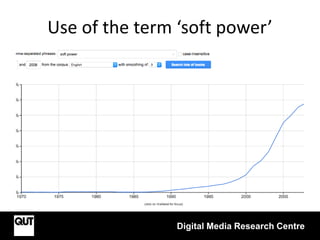
Use of the term ‘soft power’
Digital Media Research Centre
Institute for Government ‘soft power
index’ (2010)
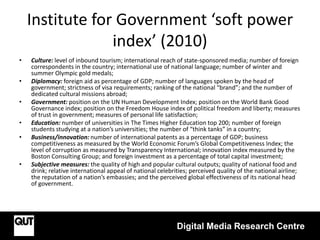
• Culture: level of inbound tourism; international reach of state-sponsored media; number of foreign
correspondents in the country; international use of national language; number of winter and
summer Olympic gold medals;
• Diplomacy: foreign aid as percentage of GDP; number of languages spoken by the head of
government; strictness of visa requirements; ranking of the national “brand”; and the number of
dedicated cultural missions abroad;
• Government: position on the UN Human Development Index; position on the World Bank Good
Governance index; position on the Freedom House index of political freedom and liberty; measures
of trust in government; measures of personal life satisfaction;
• Education: number of universities in The Times Higher Education top 200; number of foreign
students studying at a nation’s universities; the number of “think tanks” in a country;
• Business/innovation: number of international patents as a percentage of GDP; business
competitiveness as measured by the World Economic Forum’s Global Competitiveness Index; the
level of corruption as measured by Transparency International; innovation index measured by the
Boston Consulting Group; and foreign investment as a percentage of total capital investment;
• Subjective measures: the quality of high and popular cultural outputs; quality of national food and
drink; relative international appeal of national celebrities; perceived quality of the national airline;
the reputation of a nation’s embassies; and the perceived global effectiveness of its national head
of government.
Digital Media Research Centre
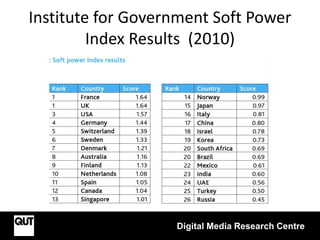
Institute for Government Soft Power
Index Results (2010)
Digital Media Research Centre
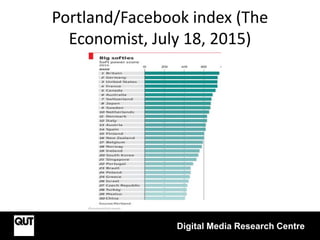
Portland/Facebook index (The
Economist, July 18, 2015)
Digital Media Research Centre
Soft power debates in China
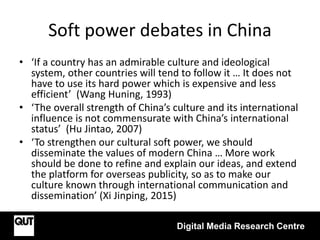
• ‘If a country has an admirable culture and ideological
system, other countries will tend to follow it … It does not
have to use its hard power which is expensive and less
efficient’ (Wang Huning, 1993)
• ‘The overall strength of China’s culture and its international
influence is not commensurate with China’s international
status’ (Hu Jintao, 2007)
• ‘To strengthen our cultural soft power, we should
disseminate the values of modern China … More work
should be done to refine and explain our ideas, and extend
the platform for overseas publicity, so as to make our
culture known through international communication and
dissemination’ (Xi Jinping, 2015)
Digital Media Research Centre
Dimensions of public diplomacy
Digital Media Research Centre
1. Listening: collecting information on international opinions,
whether by legal or covert means i.e. spying and intelligence
gathering;
2. Advocacy: promoting particular policies, ideas or interests to
foreign publics, typically through one’s own embassies in other
countries;
3. Cultural diplomacy: promoting a nation’s cultural resources
overseas and/or facilitating cultural transmission abroad (tourism,
art shows, Confucius Institutes, British Council etc.);
4. Exchange diplomacy: promoting reciprocal exchanges of people
with other nations e.g. as students and researchers (US Fulbright
Scholarships, China Scholarships Council);
5. International broadcasting: the use of news bureaus, radio and
television broadcasting, and Internet communication to engage
with foreign publics (BBC World, CCTV International, France 24,
Xinhua News Agency, China Radio Service, Russia Today).
China’s Soft Power Initiatives
• Hosting global events (Beijing Olympics 2008,
Shanghai World Expo 2010)
• Promoting scholarly exchanges (China
Scholarships Council)
• Confucius Institutes
• CCTV International, international expansion of
Xinhua News Agency and China Radio
International
• Co-production arrangements in films, TV
programs and online games
Digital Media Research Centre
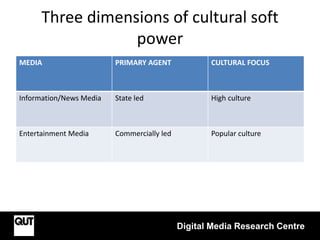
Three dimensions of cultural soft
power
Digital Media Research Centre
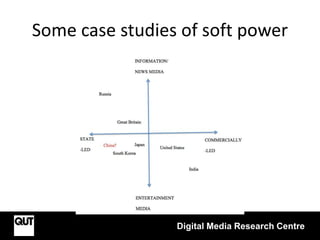
MEDIA PRIMARY AGENT CULTURAL FOCUS
Information/News Media State led High culture
Entertainment Media Commercially led Popular culture
Cultural Diplomacy
Digital Media Research Centre
• ‘An actor’s attempt to manage the international environment
through making its cultural resources and achievements known
overseas and/or facilitating cultural transmission abroad.
Historically, cultural diplomacy has meant a country’s policy to
facilitate the export of examples of its culture’ (Cull, 2008)
• ‘’The goal underlying the use of this concept is for a country,
particularly one with global influence, to convince the world of the
correctness of its principles and ideas and to have these principles
and ideas accepted. In this vein, culture is seen as a means of
public relations and a method of strengthening a country’s
influence. Cultural industries play a major role in this process.
Propelled by commerce, they are powerful carriers and distributors
of values and beliefs; disseminating cultural products and images to
accommodate a wide range of malleable audiences’ (Otmazgin,
2008)
Strategies behind cultural diplomacy
Digital Media Research Centre
• Increasing familiarity – making people think about your
country and updating their image of it;
• Increasing appreciation – creating positive perceptions of
your country and getting others to see issues from your
perspective;
• Engaging people – encouraging people to see your country
as an attractive destination for tourism and study and
encouraging them to buy its products and subscribe to its
values;
• Influencing people’s behaviour – getting companies to
invest, encouraging public support for your country’s
positions and convincing politicians to turn to it as an ally.
John Holden, Culture and Soft Power in the 21st Century,
Report for British Council, 2013.
Issues with ‘soft power’ theories
Digital Media Research Centre
• Tendency to conflate cultural diplomacy
(intentionally-driven governmental practice)
with cultural relations (primarily driven by
non-state actors)
• What is ‘cultural’ in this concept?
– ‘high culture’ or mass media?
– Information or entertainment?
– Commercial culture or state-supported culture?
– Culture as things or processes?
Issues with ‘soft power’ from a
communications/cultural studies
perspective
Digital Media Research Centre
• Transmission model of culture – distributional bias
• Culture as things/artefacts rather than as connected to
human processes
• Behavioral conception of power
• Where does media/cultural power reside? – producers,
distributors, audiences?
• ‘there is no guarantee that the audience for international
programming will decode the meaning of messages in a
way the source would prefer, since interpretation occurs
according to the prevailing cultural, social and political
beliefs, attitudes and norms among individual audience
members’. (Rawnsley, 2015, p. 280)
Actors in cultural diplomacy
Digital Media Research Centre
• There are four categories of actor who can be
regarded as making meaning with cultural
products in this context, and who can therefore
be described both as cultural producers and
cultural consumers: namely, policy-makers
themselves; institutions and individuals charged
with implementing cultural diplomacy policy …;
cultural practitioners; and, finally, individuals
engaging with cultural products which are
produced for or used in cultural diplomacy
(Clarke, 2014, p. 8).
‘Active audience’ debate in
communication and cultural studies
Digital Media Research Centre
• ‘The field of Cultural Studies has perpetually
oscillated between an emphasis on ‘power’ in
terms of the imposition of ideology through
culture, on the one hand, and ‘agency’ in
terms of the relatively freedom of the
consumer, on the other’ (Gibson, 2007, p.
167).
‘Soft power’ and ‘cultural imperialism”
Digital Media Research Centre
• Cultural imperialism as ‘the sum of the processes by
which a society is brought into the modern world
system and how its dominating stratum is attracted,
pressured, forced and sometimes bribed into shaping
social institutions to correspond to, or even promote,
the values and structures of the dominating centre of
the system’ (Schiller, 1976, p. 9).
• Nye and Schiller both see:
– American culture as globally pervasive
– Media having direct behavioral effects
– Culture as defined around its distribution
Cultural power
• Culture as resource
• Culture as governmental
• Nation branding
• Links to cultural trade and creative economy strategies
• As soft power ultimately derives from a
communications framework, we need to take
questions of transnational communication flows and
cross-cultural reception more seriously, and better
apprehend the limits of cultural power as it is exercised
through cultural diplomacy strategies involving global
media.
Digital Media Research Centre
US and UK as problematic exemplars
for China
• US = entertainment/commercial = Global
Hollywood?
• UK = information/state-led = BBC World?
• Governments connected to both ostensibly
“independent” entities
Digital Media Research Centre
Case Studies: United States
Digital Media Research Centre
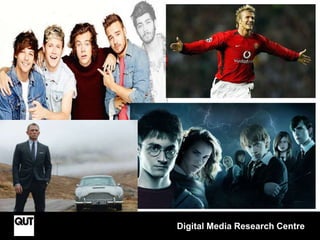
• Soft power appears to be in commercial
entertainment media
• US information/news media remains very globally
significant, but has faced crises of credibility in
recent years (Iraq War WMD)
• Commercial entertainment media not too far
away from government influence (US State
Department; international trade agreements)
• Move towards networked ICT media (“No-Cal”) in
competition with entertainment media (“So-Cal”)
Digital Media Research Centre
Case Studies: Russia
Digital Media Research Centre
• Insignificant in entertainment media
• Russia Today (RT) established in 2005: state-
funded news channel in English, Arabic and
Spanish
• Major international news service trying to
‘break the Anglo-Saxon monopoly on the
global information streams’ (Vladimir Putin,
June 2013)
Case Studies: India
Digital Media Research Centre
• Insignificant in news media: Doordorshan
largely unavailable outside of India
• Major global player in entertainment media
(“Bollywood”)
• Films appeal to family/community values –
also to religious sentiments – very popular
throughout South-S-E Asia and Middle East
Case Studies: Japan
Digital Media Research Centre
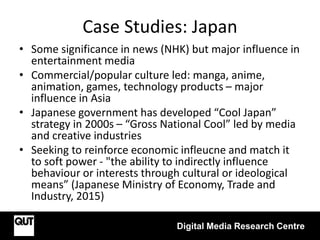
• Some significance in news (NHK) but major influence in
entertainment media
• Commercial/popular culture led: manga, anime,
animation, games, technology products – major
influence in Asia
• Japanese government has developed “Cool Japan”
strategy in 2000s – “Gross National Cool” led by media
and creative industries
• Seeking to reinforce economic infleucne and match it
to soft power - "the ability to indirectly influence
behaviour or interests through cultural or ideological
means” (Japanese Ministry of Economy, Trade and
Industry, 2015)
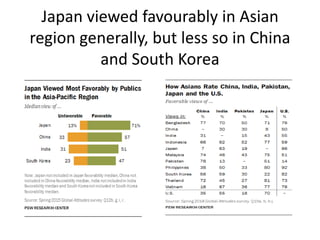
Japan viewed favourably in Asian
region generally, but less so in China
and South Korea
Case Studies: South Korea
Digital Media Research Centre
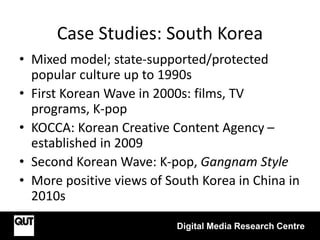
• Mixed model; state-supported/protected
popular culture up to 1990s
• First Korean Wave in 2000s: films, TV
programs, K-pop
• KOCCA: Korean Creative Content Agency –
established in 2009
• Second Korean Wave: K-pop, Gangnam Style
• More positive views of South Korea in China in
2010s
Some case studies of soft power
Digital Media Research Centre
The case of China
Digital Media Research Centre
• The Chinese culture belongs not only to the
Chinese, but to the whole world.
(Hu Jintao, address to the Australian Federal
Parliament, October 2003).
• ‘Going-out’ strategy:
– News/information: CCTV International, CRS,
Xinhua
– Entertainment: films, animation, games
– Other cultural: art exhibitions, Confucius Institutes
Communication and cultural
understanding
Digital Media Research Centre
• ‘The Chinese have an abiding faith in the ability of
international broadcasting to shape the global
conversation about China, and an unshakeable
belief that the Chinese must explain themselves
and their behavior to an international audience
that allegedly misunderstands them. Hence
public diplomacy activities are designed around
the principle ‘To know us is to love us’ … the
intangibles of public diplomacy can be converted
via communication and international
broadcasting into tangible foreign policy benefits’
(Rawnsley, 2015: 274-75).
China’s Opportunities
Digital Media Research Centre
• Large capacity for capital investment in new
cultural products
• Large domestic market (domestic market has
been key to US media industries)
• Chinese diaspora
• Partnerships/co-productions: opportunities for
knowledge transfer and acquisition of “soft skills”
• Tech-savvy national population with high
aspirations
• Growing global power of Chinese tech firms
China’s Challenges
Digital Media Research Centre
• Strong separation of news and entertainment in terms
of state policy
• State censorship and “Great Firewall”: “walled garden”
social media e.g. Twitter used by CCTV International
but unavailable within China
• Different domestic/international audience
entertainment expectations e.g. popular Chinese films
are “foreign” films in the US
• Ambivalent relationship to the US e.g. TPP excludes
China
• Who is the target? - easiest audiences (e.g. expatriate
Chinese) will not be generators of significant soft
power
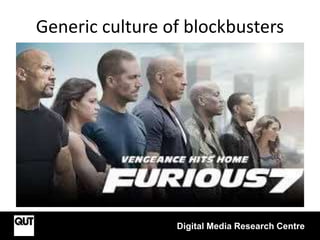
Blockbusters
Digital Media Research Centre
• The Hollywood blockbuster has had great cultural
influence in China
• Appeal of Chinese blockbusters has declined over
time – mid-budget films more popular with local
audiences (e.g. Lost in … series)
• Chinese interest in co-productions
– Outlet for investment capital
– Access to knowledge and soft skills
• US interest in co-productions
– Access to Chinese finance
– Access to Chinese domestic market
Generic culture of blockbusters
Digital Media Research Centre
Vernacular power: If You Are The One
Digital Media Research Centre
• If You Are The One (Fei Cheng Wu Rao (非诚
勿扰) – dating show on Jiangsu TV –
commenced in 2010 – est. audience 36m.
• Based on unsuccessful Australian TV format
(Taken Out) – now very popular in Australia on
SBS 2
• Contentious program – SARFT warned in 2011
against conspicuous displays of wealth and
“wrong values” – “I’d rather cry in a BMW”
Cultural power and post-globalization
• Political, economic and cultural power –
interconnected (critical political economy) or
divergent (globalisation theories)
• How does cultural power intersect – or not – with
political and economic power?
• How active are audiences in the shaping of
cultural meaning?
• What implications do new media have – “new
public diplomacy” debates
• Continuing power of nation-states in global
context – post-globalization
Digital Media Research Centre

Usc presentation 19 jan 16

  • 1.
    ENTERTAINMENT MEDIA, CULTURAL POWERAND POST-GLOBALIZATION: CHALLENGES AND OPPORTUNITIES FOR CHINA’S MEDIA AND CREATIVE INDUSTRIES Terry Flew, Digital Media Research Centre, Queensland University of Technology Presentation to US-China Institute, USC Annenberg School of Communication and Journalism, Los Angeles, CA, 19 January 2016 Digital Media Research Centre
  • 2.
    Joseph Nye’s Conceptof soft power • ‘Ability to shape the preferences of others’ based on: – Culture (in places where it is attractive to others) – Political values (when it lives up to them at home and abroad) – Foreign policies (when others see them as legitimate and having moral authority) Digital Media Research Centre
  • 3.
    Nye on softpower and partners • ‘Whether potential soft power resources translate into the behaviour of attraction that can influence others toward favourable outcomes … With soft power, what the target thinks is particularly important, and the targets matter as much as the agents. Attraction and persuasion are socially constructed. Soft power is a dance that requires partners’ (Nye, 2011, p. 84). Digital Media Research Centre
  • 4.
    Use of theterm ‘soft power’ Digital Media Research Centre
  • 5.
    Institute for Government‘soft power index’ (2010) • Culture: level of inbound tourism; international reach of state-sponsored media; number of foreign correspondents in the country; international use of national language; number of winter and summer Olympic gold medals; • Diplomacy: foreign aid as percentage of GDP; number of languages spoken by the head of government; strictness of visa requirements; ranking of the national “brand”; and the number of dedicated cultural missions abroad; • Government: position on the UN Human Development Index; position on the World Bank Good Governance index; position on the Freedom House index of political freedom and liberty; measures of trust in government; measures of personal life satisfaction; • Education: number of universities in The Times Higher Education top 200; number of foreign students studying at a nation’s universities; the number of “think tanks” in a country; • Business/innovation: number of international patents as a percentage of GDP; business competitiveness as measured by the World Economic Forum’s Global Competitiveness Index; the level of corruption as measured by Transparency International; innovation index measured by the Boston Consulting Group; and foreign investment as a percentage of total capital investment; • Subjective measures: the quality of high and popular cultural outputs; quality of national food and drink; relative international appeal of national celebrities; perceived quality of the national airline; the reputation of a nation’s embassies; and the perceived global effectiveness of its national head of government. Digital Media Research Centre
  • 6.
    Institute for GovernmentSoft Power Index Results (2010) Digital Media Research Centre
  • 7.
    Portland/Facebook index (The Economist,July 18, 2015) Digital Media Research Centre
  • 8.
    Soft power debatesin China • ‘If a country has an admirable culture and ideological system, other countries will tend to follow it … It does not have to use its hard power which is expensive and less efficient’ (Wang Huning, 1993) • ‘The overall strength of China’s culture and its international influence is not commensurate with China’s international status’ (Hu Jintao, 2007) • ‘To strengthen our cultural soft power, we should disseminate the values of modern China … More work should be done to refine and explain our ideas, and extend the platform for overseas publicity, so as to make our culture known through international communication and dissemination’ (Xi Jinping, 2015) Digital Media Research Centre
  • 9.
    Dimensions of publicdiplomacy Digital Media Research Centre 1. Listening: collecting information on international opinions, whether by legal or covert means i.e. spying and intelligence gathering; 2. Advocacy: promoting particular policies, ideas or interests to foreign publics, typically through one’s own embassies in other countries; 3. Cultural diplomacy: promoting a nation’s cultural resources overseas and/or facilitating cultural transmission abroad (tourism, art shows, Confucius Institutes, British Council etc.); 4. Exchange diplomacy: promoting reciprocal exchanges of people with other nations e.g. as students and researchers (US Fulbright Scholarships, China Scholarships Council); 5. International broadcasting: the use of news bureaus, radio and television broadcasting, and Internet communication to engage with foreign publics (BBC World, CCTV International, France 24, Xinhua News Agency, China Radio Service, Russia Today).
  • 10.
    China’s Soft PowerInitiatives • Hosting global events (Beijing Olympics 2008, Shanghai World Expo 2010) • Promoting scholarly exchanges (China Scholarships Council) • Confucius Institutes • CCTV International, international expansion of Xinhua News Agency and China Radio International • Co-production arrangements in films, TV programs and online games Digital Media Research Centre
  • 11.
    Three dimensions ofcultural soft power Digital Media Research Centre MEDIA PRIMARY AGENT CULTURAL FOCUS Information/News Media State led High culture Entertainment Media Commercially led Popular culture
  • 12.
    Cultural Diplomacy Digital MediaResearch Centre • ‘An actor’s attempt to manage the international environment through making its cultural resources and achievements known overseas and/or facilitating cultural transmission abroad. Historically, cultural diplomacy has meant a country’s policy to facilitate the export of examples of its culture’ (Cull, 2008) • ‘’The goal underlying the use of this concept is for a country, particularly one with global influence, to convince the world of the correctness of its principles and ideas and to have these principles and ideas accepted. In this vein, culture is seen as a means of public relations and a method of strengthening a country’s influence. Cultural industries play a major role in this process. Propelled by commerce, they are powerful carriers and distributors of values and beliefs; disseminating cultural products and images to accommodate a wide range of malleable audiences’ (Otmazgin, 2008)
  • 13.
    Strategies behind culturaldiplomacy Digital Media Research Centre • Increasing familiarity – making people think about your country and updating their image of it; • Increasing appreciation – creating positive perceptions of your country and getting others to see issues from your perspective; • Engaging people – encouraging people to see your country as an attractive destination for tourism and study and encouraging them to buy its products and subscribe to its values; • Influencing people’s behaviour – getting companies to invest, encouraging public support for your country’s positions and convincing politicians to turn to it as an ally. John Holden, Culture and Soft Power in the 21st Century, Report for British Council, 2013.
  • 14.
    Issues with ‘softpower’ theories Digital Media Research Centre • Tendency to conflate cultural diplomacy (intentionally-driven governmental practice) with cultural relations (primarily driven by non-state actors) • What is ‘cultural’ in this concept? – ‘high culture’ or mass media? – Information or entertainment? – Commercial culture or state-supported culture? – Culture as things or processes?
  • 15.
    Issues with ‘softpower’ from a communications/cultural studies perspective Digital Media Research Centre • Transmission model of culture – distributional bias • Culture as things/artefacts rather than as connected to human processes • Behavioral conception of power • Where does media/cultural power reside? – producers, distributors, audiences? • ‘there is no guarantee that the audience for international programming will decode the meaning of messages in a way the source would prefer, since interpretation occurs according to the prevailing cultural, social and political beliefs, attitudes and norms among individual audience members’. (Rawnsley, 2015, p. 280)
  • 16.
    Actors in culturaldiplomacy Digital Media Research Centre • There are four categories of actor who can be regarded as making meaning with cultural products in this context, and who can therefore be described both as cultural producers and cultural consumers: namely, policy-makers themselves; institutions and individuals charged with implementing cultural diplomacy policy …; cultural practitioners; and, finally, individuals engaging with cultural products which are produced for or used in cultural diplomacy (Clarke, 2014, p. 8).
  • 17.
    ‘Active audience’ debatein communication and cultural studies Digital Media Research Centre • ‘The field of Cultural Studies has perpetually oscillated between an emphasis on ‘power’ in terms of the imposition of ideology through culture, on the one hand, and ‘agency’ in terms of the relatively freedom of the consumer, on the other’ (Gibson, 2007, p. 167).
  • 18.
    ‘Soft power’ and‘cultural imperialism” Digital Media Research Centre • Cultural imperialism as ‘the sum of the processes by which a society is brought into the modern world system and how its dominating stratum is attracted, pressured, forced and sometimes bribed into shaping social institutions to correspond to, or even promote, the values and structures of the dominating centre of the system’ (Schiller, 1976, p. 9). • Nye and Schiller both see: – American culture as globally pervasive – Media having direct behavioral effects – Culture as defined around its distribution
  • 19.
    Cultural power • Cultureas resource • Culture as governmental • Nation branding • Links to cultural trade and creative economy strategies • As soft power ultimately derives from a communications framework, we need to take questions of transnational communication flows and cross-cultural reception more seriously, and better apprehend the limits of cultural power as it is exercised through cultural diplomacy strategies involving global media. Digital Media Research Centre
  • 20.
    US and UKas problematic exemplars for China • US = entertainment/commercial = Global Hollywood? • UK = information/state-led = BBC World? • Governments connected to both ostensibly “independent” entities Digital Media Research Centre
  • 21.
    Case Studies: UnitedStates Digital Media Research Centre • Soft power appears to be in commercial entertainment media • US information/news media remains very globally significant, but has faced crises of credibility in recent years (Iraq War WMD) • Commercial entertainment media not too far away from government influence (US State Department; international trade agreements) • Move towards networked ICT media (“No-Cal”) in competition with entertainment media (“So-Cal”)
  • 22.
  • 23.
    Case Studies: Russia DigitalMedia Research Centre • Insignificant in entertainment media • Russia Today (RT) established in 2005: state- funded news channel in English, Arabic and Spanish • Major international news service trying to ‘break the Anglo-Saxon monopoly on the global information streams’ (Vladimir Putin, June 2013)
  • 24.
    Case Studies: India DigitalMedia Research Centre • Insignificant in news media: Doordorshan largely unavailable outside of India • Major global player in entertainment media (“Bollywood”) • Films appeal to family/community values – also to religious sentiments – very popular throughout South-S-E Asia and Middle East
  • 25.
    Case Studies: Japan DigitalMedia Research Centre • Some significance in news (NHK) but major influence in entertainment media • Commercial/popular culture led: manga, anime, animation, games, technology products – major influence in Asia • Japanese government has developed “Cool Japan” strategy in 2000s – “Gross National Cool” led by media and creative industries • Seeking to reinforce economic infleucne and match it to soft power - "the ability to indirectly influence behaviour or interests through cultural or ideological means” (Japanese Ministry of Economy, Trade and Industry, 2015)
  • 26.
    Japan viewed favourablyin Asian region generally, but less so in China and South Korea
  • 27.
    Case Studies: SouthKorea Digital Media Research Centre • Mixed model; state-supported/protected popular culture up to 1990s • First Korean Wave in 2000s: films, TV programs, K-pop • KOCCA: Korean Creative Content Agency – established in 2009 • Second Korean Wave: K-pop, Gangnam Style • More positive views of South Korea in China in 2010s
  • 28.
    Some case studiesof soft power Digital Media Research Centre
  • 29.
    The case ofChina Digital Media Research Centre • The Chinese culture belongs not only to the Chinese, but to the whole world. (Hu Jintao, address to the Australian Federal Parliament, October 2003). • ‘Going-out’ strategy: – News/information: CCTV International, CRS, Xinhua – Entertainment: films, animation, games – Other cultural: art exhibitions, Confucius Institutes
  • 30.
    Communication and cultural understanding DigitalMedia Research Centre • ‘The Chinese have an abiding faith in the ability of international broadcasting to shape the global conversation about China, and an unshakeable belief that the Chinese must explain themselves and their behavior to an international audience that allegedly misunderstands them. Hence public diplomacy activities are designed around the principle ‘To know us is to love us’ … the intangibles of public diplomacy can be converted via communication and international broadcasting into tangible foreign policy benefits’ (Rawnsley, 2015: 274-75).
  • 31.
    China’s Opportunities Digital MediaResearch Centre • Large capacity for capital investment in new cultural products • Large domestic market (domestic market has been key to US media industries) • Chinese diaspora • Partnerships/co-productions: opportunities for knowledge transfer and acquisition of “soft skills” • Tech-savvy national population with high aspirations • Growing global power of Chinese tech firms
  • 32.
    China’s Challenges Digital MediaResearch Centre • Strong separation of news and entertainment in terms of state policy • State censorship and “Great Firewall”: “walled garden” social media e.g. Twitter used by CCTV International but unavailable within China • Different domestic/international audience entertainment expectations e.g. popular Chinese films are “foreign” films in the US • Ambivalent relationship to the US e.g. TPP excludes China • Who is the target? - easiest audiences (e.g. expatriate Chinese) will not be generators of significant soft power
  • 33.
    Blockbusters Digital Media ResearchCentre • The Hollywood blockbuster has had great cultural influence in China • Appeal of Chinese blockbusters has declined over time – mid-budget films more popular with local audiences (e.g. Lost in … series) • Chinese interest in co-productions – Outlet for investment capital – Access to knowledge and soft skills • US interest in co-productions – Access to Chinese finance – Access to Chinese domestic market
  • 34.
    Generic culture ofblockbusters Digital Media Research Centre
  • 35.
    Vernacular power: IfYou Are The One Digital Media Research Centre • If You Are The One (Fei Cheng Wu Rao (非诚 勿扰) – dating show on Jiangsu TV – commenced in 2010 – est. audience 36m. • Based on unsuccessful Australian TV format (Taken Out) – now very popular in Australia on SBS 2 • Contentious program – SARFT warned in 2011 against conspicuous displays of wealth and “wrong values” – “I’d rather cry in a BMW”
  • 36.
    Cultural power andpost-globalization • Political, economic and cultural power – interconnected (critical political economy) or divergent (globalisation theories) • How does cultural power intersect – or not – with political and economic power? • How active are audiences in the shaping of cultural meaning? • What implications do new media have – “new public diplomacy” debates • Continuing power of nation-states in global context – post-globalization Digital Media Research Centre