Universal Grammar
Discuss UG in SLA
INTRODUCTION
 Developed by Noam Chomsky and
numerous other followers in the last
few decades.
 UG is a “property theory,” it attempts
to characterize the underlying
linguistic knowledge in second-
language learners’ minds.
WHY A UNIVERSAL
GRAMMAR? p.1
 The UG approach claims that all human
beings inherit a universal set of principles
and parameters that control the shape
human languages can take, and which are
what make human languages similar to one
another.
 Government and Binding theory, Chomsky
(1981): core of human language must
comprise of those two components.
 Minimalist Program, Chomsky (1995): the
core of human language is the lexicon (the
word store) primarily within functional
categories.
WHY A UNIVERSAL
GRAMMAR? p.2
 Children have the help of an innate
language faculty to guide them.
 If there is a UG this would make the task
facing children much easier by providing
a genetic blueprint which determines in
advance the shape which language will
take.
 Second language grammars are
constrained by UG.1
 UG does not constrain second language
grammars or UG is impaired.2
WHY A UNIVERSAL
GRAMMAR? p.3
 Brief list of characteristics of first language
acquisition:
1. Children go through developmental stages.
2. Stages are similar across children for a
given language, although rate is variable.
3. Stages are similar across languages.
4. Child language is rule-governed and
systematic, rules do not correspond to adult
ones.
5. Children are resistant to correction.
6. Child language does not seem linked to
intelligence.1
WHAT DOES UG CONSIST OF?
 Principle of structure dependency- language is
organized in such a way that it crucially depends
on the structural relationship between elements in
a sentence.
 Move principle- whenever elements of a sentence
are moved to form passives or questions, the
movement takes account of the structural
relationships of the sentence rather than the linear
order of words.
 A over A condition- a principle which limits the
application of rules to a small sub-set of the logical
possibilities.
WHAT DOES UG CONSIST OF?
p2
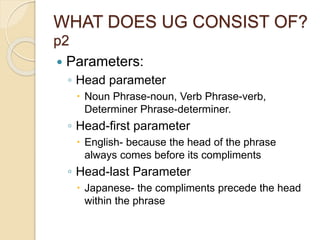
 Parameters:
◦ Head parameter
 Noun Phrase-noun, Verb Phrase-verb,
Determiner Phrase-determiner.
◦ Head-first parameter
 English- because the head of the phrase
always comes before its compliments
◦ Head-last Parameter
 Japanese- the compliments precede the head
within the phrase
UG AND SECONG LANGUAGE
ACQUISTION
 Factors to consider when applying UG
to L2:
◦ Second language learners are cognitively
mature
◦ Second Language learners already know
at least one other language
◦ Second language learners have different
motivations for learning a second
language
UG AND SECONG
LANGUAGE
ACQUISTION
 Possibilities concerning SLL:
◦ Second languages are not Universal Grammar
constrained- Second languages are not
constrained by UG principles and parameters, and
they do not behave like natural languages.
◦ Second languages are UG constrained-
 Full access: the wholes UG is available to SLL, in the
same way as it is to first language learners.
 Partial Access: some parts of UG are not available any
longer.
 No Access: there is critical period for children acquire the
first language and that adults have to resort to other
mechanisms to learning a second language.
Conclusion
 UG can be seen form the angle of
being applied to language, language
acquisition, and language learner.
 UG also is used differently from first
language acquisition to second
language acquisition.
 There are many that argue for and
against the use of this theory for
second language acquisition.

Universal Grammar IN Second Language ACQUISITION

  • 1.
  • 2.
    INTRODUCTION  Developed byNoam Chomsky and numerous other followers in the last few decades.  UG is a “property theory,” it attempts to characterize the underlying linguistic knowledge in second- language learners’ minds.
  • 3.
    WHY A UNIVERSAL GRAMMAR?p.1  The UG approach claims that all human beings inherit a universal set of principles and parameters that control the shape human languages can take, and which are what make human languages similar to one another.  Government and Binding theory, Chomsky (1981): core of human language must comprise of those two components.  Minimalist Program, Chomsky (1995): the core of human language is the lexicon (the word store) primarily within functional categories.
  • 4.
    WHY A UNIVERSAL GRAMMAR?p.2  Children have the help of an innate language faculty to guide them.  If there is a UG this would make the task facing children much easier by providing a genetic blueprint which determines in advance the shape which language will take.  Second language grammars are constrained by UG.1  UG does not constrain second language grammars or UG is impaired.2
  • 5.
    WHY A UNIVERSAL GRAMMAR?p.3  Brief list of characteristics of first language acquisition: 1. Children go through developmental stages. 2. Stages are similar across children for a given language, although rate is variable. 3. Stages are similar across languages. 4. Child language is rule-governed and systematic, rules do not correspond to adult ones. 5. Children are resistant to correction. 6. Child language does not seem linked to intelligence.1
  • 6.
    WHAT DOES UGCONSIST OF?  Principle of structure dependency- language is organized in such a way that it crucially depends on the structural relationship between elements in a sentence.  Move principle- whenever elements of a sentence are moved to form passives or questions, the movement takes account of the structural relationships of the sentence rather than the linear order of words.  A over A condition- a principle which limits the application of rules to a small sub-set of the logical possibilities.
  • 7.
    WHAT DOES UGCONSIST OF? p2  Parameters: ◦ Head parameter  Noun Phrase-noun, Verb Phrase-verb, Determiner Phrase-determiner. ◦ Head-first parameter  English- because the head of the phrase always comes before its compliments ◦ Head-last Parameter  Japanese- the compliments precede the head within the phrase
  • 8.
    UG AND SECONGLANGUAGE ACQUISTION  Factors to consider when applying UG to L2: ◦ Second language learners are cognitively mature ◦ Second Language learners already know at least one other language ◦ Second language learners have different motivations for learning a second language
  • 9.
    UG AND SECONG LANGUAGE ACQUISTION Possibilities concerning SLL: ◦ Second languages are not Universal Grammar constrained- Second languages are not constrained by UG principles and parameters, and they do not behave like natural languages. ◦ Second languages are UG constrained-  Full access: the wholes UG is available to SLL, in the same way as it is to first language learners.  Partial Access: some parts of UG are not available any longer.  No Access: there is critical period for children acquire the first language and that adults have to resort to other mechanisms to learning a second language.
  • 10.
    Conclusion  UG canbe seen form the angle of being applied to language, language acquisition, and language learner.  UG also is used differently from first language acquisition to second language acquisition.  There are many that argue for and against the use of this theory for second language acquisition.

Editor's Notes

  • #4 Principles: are unvarying and apply to all natural languages Parameters: possess a limited number of open values which characterize differences between languages (parametric variation) Lexicon: lexical (content words) and functional (grammatical words) categories
  • #5 1:the second language is one example of a natural language. This approach believes that the second language grammar can (but does not necessarily) become native-like. 2:Some researchers believe that second language grammars are fundamentally different from first language grammars. Second language grammar cannot become the same as that of first language speakers of the same language.
  • #6 1: Smith and Tsimpli (1995): study Christopher who combined relatively low performance IQ with an average or above average verbal IQ SLI: specific language impairment, FOXP2, Broca’s area (above left ear): Broca’s aphasia. Specific areas of the brain deal with specific aspects of language, and that suffering from a language deficit does not necessarily mean having lost language completely, but usually means having problems with one or more aspects of language. This evidence has been used to posit that there must be some kind of innate language faculty that is biologically triggered in order to explain why language in children just seems to ‘grow’, in the same way as teeth develop and children start walking. There is a language-specific module in the brain.