The views expressed in this presentation are the views of the author/s and do not necessarily reflect the views or policies of the Asian
Development Bank, or its Board of Governors, or the governments they represent. ADB does not guarantee the accuracy of the data included
in this presentation and accepts no responsibility for any consequence of their use. The countries listed in this presentation do not imply any
view on ADB's part as to sovereignty or independent status or necessarily conform to ADB's terminology.
Using Plain English
Olivier Serrat
2013
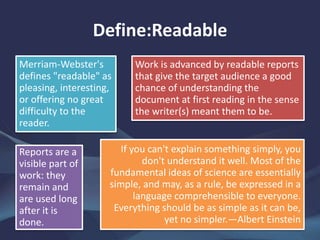
Define:Readable
Merriam-Webster's
defines "readable" as
pleasing, interesting,
or offering no great
difficulty to the
reader.
Work is advanced by readable reports
that give the target audience a good
chance of understanding the
document at first reading in the sense
the writer(s) meant them to be.
Reports are a
visible part of
work: they
remain and
are used long
after it is
done.
If you can't explain something simply, you
don't understand it well. Most of the
fundamental ideas of science are essentially
simple, and may, as a rule, be expressed in a
language comprehensible to everyone.
Everything should be as simple as it can be,
yet no simpler.—Albert Einstein
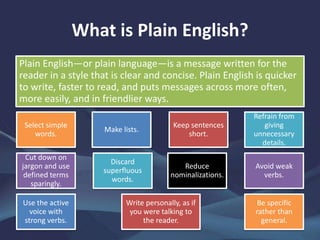
What is Plain English?
Plain English—or plain language—is a message written for the
reader in a style that is clear and concise. Plain English is quicker
to write, faster to read, and puts messages across more often,
more easily, and in friendlier ways.
Select simple
words.
Make lists.
Keep sentences
short.
Refrain from
giving
unnecessary
details.
Cut down on
jargon and use
defined terms
sparingly.
Discard
superfluous
words.
Reduce
nominalizations.
Avoid weak
verbs.
Use the active
voice with
strong verbs.
Be specific
rather than
general.
Write personally, as if
you were talking to
the reader.
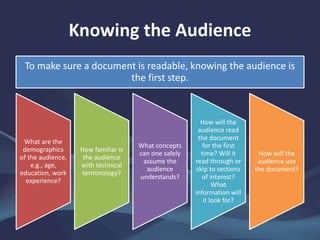
Knowing the Audience
What are the
demographics
of the audience,
e.g., age,
education, work
experience?
How familiar is
the audience
with technical
terminology?
What concepts
can one safely
assume the
audience
understands?
How will the
audience read
the document
for the first
time? Will it
read through or
skip to sections
of interest?
What
information will
it look for?
How will the
audience use
the document?
To make sure a document is readable, knowing the audience is
the first step.
Applying the Rule of 15
A useful principle of
plain English is the "rule
of 15":
• Not more than 15% of
sentences should be
longer than 15 words.
• Not more than 15% of
sentences should be
written in the passive
voice.
• Not more than 15% of
words should be longer
than three syllables.
The great enemy
of clear language
is insincerity.
When there is a
gap between one's
real and one's
declared aims,
one turns as it
were instinctively
to long words and
exhausted idioms,
like a cuttlefish
spurting out ink.—
George Orwell
A man who
uses a great
many words to
express his
meaning is like
a bad
marksman who,
instead of
aiming a single
stone at an
object, takes up
a handful and
throws in hopes
he may hit.—
Samuel Johnson
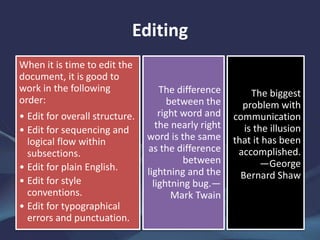
Editing
When it is time to edit the
document, it is good to
work in the following
order:
• Edit for overall structure.
• Edit for sequencing and
logical flow within
subsections.
• Edit for plain English.
• Edit for style
conventions.
• Edit for typographical
errors and punctuation.
The difference
between the
right word and
the nearly right
word is the same
as the difference
between
lightning and the
lightning bug.—
Mark Twain
The biggest
problem with
communication
is the illusion
that it has been
accomplished.
—George
Bernard Shaw
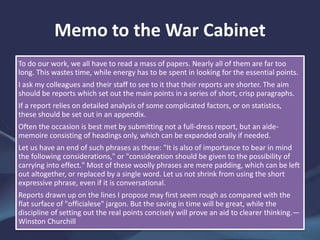
Memo to the War Cabinet
To do our work, we all have to read a mass of papers. Nearly all of them are far too
long. This wastes time, while energy has to be spent in looking for the essential points.
I ask my colleagues and their staff to see to it that their reports are shorter. The aim
should be reports which set out the main points in a series of short, crisp paragraphs.
If a report relies on detailed analysis of some complicated factors, or on statistics,
these should be set out in an appendix.
Often the occasion is best met by submitting not a full-dress report, but an aide-
memoire consisting of headings only, which can be expanded orally if needed.
Let us have an end of such phrases as these: "It is also of importance to bear in mind
the following considerations," or "consideration should be given to the possibility of
carrying into effect." Most of these woolly phrases are mere padding, which can be left
out altogether, or replaced by a single word. Let us not shrink from using the short
expressive phrase, even if it is conversational.
Reports drawn up on the lines I propose may first seem rough as compared with the
flat surface of "officialese" jargon. But the saving in time will be great, while the
discipline of setting out the real points concisely will prove an aid to clearer thinking.—
Winston Churchill
Further Reading
• ADB. 2008. Using Plain English. Manila.
www.adb.org/publications/using-plain-english
• ——. 2011. Handbook of Style and Usage. Manila.
www.adb.org/documents/handbook-style-and-usage
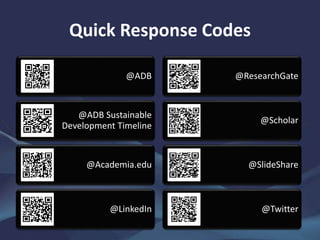
Quick Response Codes
@ADB
@ADB Sustainable
Development Timeline
@Academia.edu
@LinkedIn
@ResearchGate
@Scholar
@SlideShare
@Twitter

usingplainenglish-130919040634-phpapp02.pdf

  • 1.
    The views expressedin this presentation are the views of the author/s and do not necessarily reflect the views or policies of the Asian Development Bank, or its Board of Governors, or the governments they represent. ADB does not guarantee the accuracy of the data included in this presentation and accepts no responsibility for any consequence of their use. The countries listed in this presentation do not imply any view on ADB's part as to sovereignty or independent status or necessarily conform to ADB's terminology. Using Plain English Olivier Serrat 2013
  • 2.
    Define:Readable Merriam-Webster's defines "readable" as pleasing,interesting, or offering no great difficulty to the reader. Work is advanced by readable reports that give the target audience a good chance of understanding the document at first reading in the sense the writer(s) meant them to be. Reports are a visible part of work: they remain and are used long after it is done. If you can't explain something simply, you don't understand it well. Most of the fundamental ideas of science are essentially simple, and may, as a rule, be expressed in a language comprehensible to everyone. Everything should be as simple as it can be, yet no simpler.—Albert Einstein
  • 3.
    What is PlainEnglish? Plain English—or plain language—is a message written for the reader in a style that is clear and concise. Plain English is quicker to write, faster to read, and puts messages across more often, more easily, and in friendlier ways. Select simple words. Make lists. Keep sentences short. Refrain from giving unnecessary details. Cut down on jargon and use defined terms sparingly. Discard superfluous words. Reduce nominalizations. Avoid weak verbs. Use the active voice with strong verbs. Be specific rather than general. Write personally, as if you were talking to the reader.
  • 4.
    Knowing the Audience Whatare the demographics of the audience, e.g., age, education, work experience? How familiar is the audience with technical terminology? What concepts can one safely assume the audience understands? How will the audience read the document for the first time? Will it read through or skip to sections of interest? What information will it look for? How will the audience use the document? To make sure a document is readable, knowing the audience is the first step.
  • 5.
    Applying the Ruleof 15 A useful principle of plain English is the "rule of 15": • Not more than 15% of sentences should be longer than 15 words. • Not more than 15% of sentences should be written in the passive voice. • Not more than 15% of words should be longer than three syllables. The great enemy of clear language is insincerity. When there is a gap between one's real and one's declared aims, one turns as it were instinctively to long words and exhausted idioms, like a cuttlefish spurting out ink.— George Orwell A man who uses a great many words to express his meaning is like a bad marksman who, instead of aiming a single stone at an object, takes up a handful and throws in hopes he may hit.— Samuel Johnson
  • 6.
    Editing When it istime to edit the document, it is good to work in the following order: • Edit for overall structure. • Edit for sequencing and logical flow within subsections. • Edit for plain English. • Edit for style conventions. • Edit for typographical errors and punctuation. The difference between the right word and the nearly right word is the same as the difference between lightning and the lightning bug.— Mark Twain The biggest problem with communication is the illusion that it has been accomplished. —George Bernard Shaw
  • 7.
    Memo to theWar Cabinet To do our work, we all have to read a mass of papers. Nearly all of them are far too long. This wastes time, while energy has to be spent in looking for the essential points. I ask my colleagues and their staff to see to it that their reports are shorter. The aim should be reports which set out the main points in a series of short, crisp paragraphs. If a report relies on detailed analysis of some complicated factors, or on statistics, these should be set out in an appendix. Often the occasion is best met by submitting not a full-dress report, but an aide- memoire consisting of headings only, which can be expanded orally if needed. Let us have an end of such phrases as these: "It is also of importance to bear in mind the following considerations," or "consideration should be given to the possibility of carrying into effect." Most of these woolly phrases are mere padding, which can be left out altogether, or replaced by a single word. Let us not shrink from using the short expressive phrase, even if it is conversational. Reports drawn up on the lines I propose may first seem rough as compared with the flat surface of "officialese" jargon. But the saving in time will be great, while the discipline of setting out the real points concisely will prove an aid to clearer thinking.— Winston Churchill
  • 8.
    Further Reading • ADB.2008. Using Plain English. Manila. www.adb.org/publications/using-plain-english • ——. 2011. Handbook of Style and Usage. Manila. www.adb.org/documents/handbook-style-and-usage
  • 9.
    Quick Response Codes @ADB @ADBSustainable Development Timeline @Academia.edu @LinkedIn @ResearchGate @Scholar @SlideShare @Twitter