DEPARTMENT OF CHEMISTRY
WELCOMES YOUALL
22CYT28-Chemistry for Information
Technology
2022R
Prepared By
Krishnaveni K
Assistant Professor
Department of Chemistry
Kongu Engineering
College, Perundurai,
Erode
Introduction – cells – types - representation of galvanic cell - electrode
potential - Nernst equation (derivation of cell EMF) - calculation of cell EMF from
single electrode potential - reference electrode: construction, working and
applications of standard hydrogen electrode, standard calomel electrode - glass
electrode – EMF series and its applications - potentiometric titrations (redox) -
conductometric titrations - mixture of weak and strong acid vs strong base.
UNIT-II
ELECTROCHEMISTRY
ELECTROCHEMISTRY
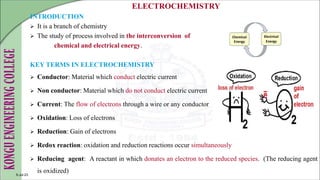
INTRODUCTION
 It is a branch of chemistry
 The study of process involved in the interconversion of
chemical and electrical energy.
KEY TERMS IN ELECTROCHEMISTRY
 Conductor: Material which conduct electric current
 Non conductor: Material which do not conduct electric current
 Current: The flow of electrons through a wire or any conductor
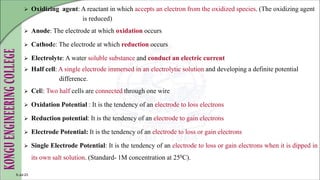
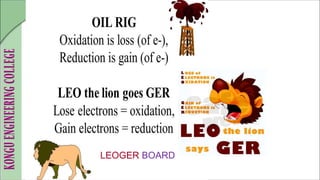
 Oxidation: Loss of electrons
 Reduction: Gain of electrons
 Redox reaction: oxidation and reduction reactions occur simultaneously
 Reducing agent: A reactant in which donates an electron to the reduced species. (The reducing agent
is oxidized)
5-Jul-23
 Oxidizing agent: A reactant in which accepts an electron from the oxidized species. (The oxidizing agent
is reduced)
 Anode: The electrode at which oxidation occurs
 Cathode: The electrode at which reduction occurs
 Electrolyte: A water soluble substance and conduct an electric current
 Half cell: A single electrode immersed in an electrolytic solution and developing a definite potential
difference.
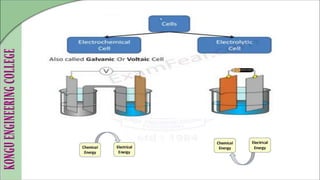
 Cell: Two half cells are connected through one wire
 Oxidation Potential : It is the tendency of an electrode to loss electrons
 Reduction potential: It is the tendency of an electrode to gain electrons
 Electrode Potential: It is the tendency of an electrode to loss or gain electrons
 Single Electrode Potential: It is the tendency of an electrode to loss or gain electrons when it is dipped in
its own salt solution. (Standard- 1M concentration at 250C).
5-Jul-23
5-Jul-23
LEOGER BOARD
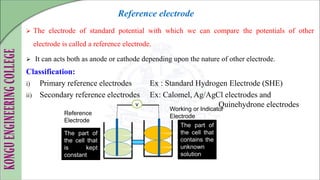
Reference electrode
 The electrode of standard potential with which we can compare the potentials of other
electrode is called a reference electrode.
 It can acts both as anode or cathode depending upon the nature of other electrode.
Classification:
i) Primary reference electrodes Ex : Standard Hydrogen Electrode (SHE)
ii) Secondary reference electrodes Ex: Calomel, Ag/AgCl electrodes and
Quinehydrone electrodes
v
Reference
Electrode
Working or Indicator
Electrode
The part of
the cell that
is kept
constant
The part of
the cell that
contains the
unknown
solution
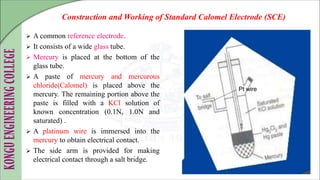
Construction and Working of Standard Calomel Electrode (SCE)
 A common reference electrode.
 It consists of a wide glass tube.
 Mercury is placed at the bottom of the
glass tube.
 A paste of mercury and mercurous
chloride(Calomel) is placed above the
mercury. The remaining portion above the
paste is filled with a KCl solution of
known concentration (0.1N, 1.0N and
saturated) .
 A platinum wire is immersed into the
mercury to obtain electrical contact.
 The side arm is provided for making
electrical contact through a salt bridge.
Pt wire
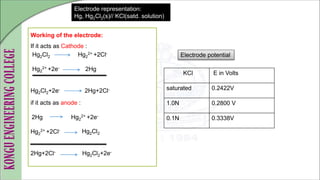
Electrode representation:
Hg, Hg2Cl2(s)// KCl(satd. solution)
Working of the electrode:
If it acts as Cathode :
Hg2Cl2 Hg2
2+ +2Cl-
Hg2
2+ +2e- 2Hg
Hg2Cl2+2e- 2Hg+2Cl-
if it acts as anode :
2Hg Hg2
2+ +2e-
Hg2
2+ +2Cl-
2Hg+2Cl- Hg2Cl2+2e-
Hg2Cl2
KCl E in Volts
saturated 0.2422V
1.0N 0.2800 V
0.1N 0.3338V
Electrode potential
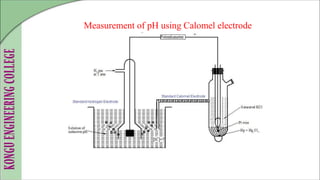
Measurement of pH using Calomel electrode
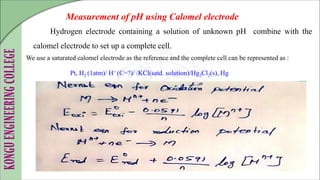
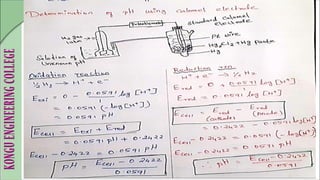
Hydrogen electrode containing a solution of unknown pH combine with the
calomel electrode to set up a complete cell.
We use a saturated calomel electrode as the reference and the complete cell can be represented as :
Pt, H2 (1atm)/ H+ (C=?)/ /KCl(satd. solution)/Hg2Cl2(s), Hg
Merits
 It is easy to construct and easy to transport.
 It provides almost a constant potential value with varying temperature and finds
application in laboratories for measuring potential of an electrode.
 It is used in corrosion studies.
REFERENCES:
 1.Palanisamy P.N., Manikandan P., Geetha A.& Manjula Rani K, “Applied
Chemistry”, 6th Edition, Tata McGraw Hill Education Private Limited, New
Delhi, 2019.
 2 .Paya Payal B.Joshi, Shashank Deep., “Engineering Chemistry”, Oxford
University Press, New Delhi, 2019.
 3.Palanna O., “Engineering Chemistry”, McGraw Hill Education, New
Delhi, 2017.
5-Jul-23
5-Jul-23
THANK
YOU
THANKYOU

Unit_I_Electrochemistry.ppt

  • 1.
    DEPARTMENT OF CHEMISTRY WELCOMESYOUALL 22CYT28-Chemistry for Information Technology 2022R Prepared By Krishnaveni K Assistant Professor Department of Chemistry Kongu Engineering College, Perundurai, Erode
  • 2.
    Introduction – cells– types - representation of galvanic cell - electrode potential - Nernst equation (derivation of cell EMF) - calculation of cell EMF from single electrode potential - reference electrode: construction, working and applications of standard hydrogen electrode, standard calomel electrode - glass electrode – EMF series and its applications - potentiometric titrations (redox) - conductometric titrations - mixture of weak and strong acid vs strong base. UNIT-II ELECTROCHEMISTRY
  • 3.
    ELECTROCHEMISTRY INTRODUCTION  It isa branch of chemistry  The study of process involved in the interconversion of chemical and electrical energy. KEY TERMS IN ELECTROCHEMISTRY  Conductor: Material which conduct electric current  Non conductor: Material which do not conduct electric current  Current: The flow of electrons through a wire or any conductor  Oxidation: Loss of electrons  Reduction: Gain of electrons  Redox reaction: oxidation and reduction reactions occur simultaneously  Reducing agent: A reactant in which donates an electron to the reduced species. (The reducing agent is oxidized) 5-Jul-23
  • 4.
     Oxidizing agent:A reactant in which accepts an electron from the oxidized species. (The oxidizing agent is reduced)  Anode: The electrode at which oxidation occurs  Cathode: The electrode at which reduction occurs  Electrolyte: A water soluble substance and conduct an electric current  Half cell: A single electrode immersed in an electrolytic solution and developing a definite potential difference.  Cell: Two half cells are connected through one wire  Oxidation Potential : It is the tendency of an electrode to loss electrons  Reduction potential: It is the tendency of an electrode to gain electrons  Electrode Potential: It is the tendency of an electrode to loss or gain electrons  Single Electrode Potential: It is the tendency of an electrode to loss or gain electrons when it is dipped in its own salt solution. (Standard- 1M concentration at 250C). 5-Jul-23
  • 5.
  • 7.
    Reference electrode  Theelectrode of standard potential with which we can compare the potentials of other electrode is called a reference electrode.  It can acts both as anode or cathode depending upon the nature of other electrode. Classification: i) Primary reference electrodes Ex : Standard Hydrogen Electrode (SHE) ii) Secondary reference electrodes Ex: Calomel, Ag/AgCl electrodes and Quinehydrone electrodes v Reference Electrode Working or Indicator Electrode The part of the cell that is kept constant The part of the cell that contains the unknown solution
  • 8.
    Construction and Workingof Standard Calomel Electrode (SCE)  A common reference electrode.  It consists of a wide glass tube.  Mercury is placed at the bottom of the glass tube.  A paste of mercury and mercurous chloride(Calomel) is placed above the mercury. The remaining portion above the paste is filled with a KCl solution of known concentration (0.1N, 1.0N and saturated) .  A platinum wire is immersed into the mercury to obtain electrical contact.  The side arm is provided for making electrical contact through a salt bridge. Pt wire
  • 9.
    Electrode representation: Hg, Hg2Cl2(s)//KCl(satd. solution) Working of the electrode: If it acts as Cathode : Hg2Cl2 Hg2 2+ +2Cl- Hg2 2+ +2e- 2Hg Hg2Cl2+2e- 2Hg+2Cl- if it acts as anode : 2Hg Hg2 2+ +2e- Hg2 2+ +2Cl- 2Hg+2Cl- Hg2Cl2+2e- Hg2Cl2 KCl E in Volts saturated 0.2422V 1.0N 0.2800 V 0.1N 0.3338V Electrode potential
  • 10.
    Measurement of pHusing Calomel electrode
  • 11.
    Measurement of pHusing Calomel electrode Hydrogen electrode containing a solution of unknown pH combine with the calomel electrode to set up a complete cell. We use a saturated calomel electrode as the reference and the complete cell can be represented as : Pt, H2 (1atm)/ H+ (C=?)/ /KCl(satd. solution)/Hg2Cl2(s), Hg
  • 13.
    Merits  It iseasy to construct and easy to transport.  It provides almost a constant potential value with varying temperature and finds application in laboratories for measuring potential of an electrode.  It is used in corrosion studies.
  • 14.
    REFERENCES:  1.Palanisamy P.N.,Manikandan P., Geetha A.& Manjula Rani K, “Applied Chemistry”, 6th Edition, Tata McGraw Hill Education Private Limited, New Delhi, 2019.  2 .Paya Payal B.Joshi, Shashank Deep., “Engineering Chemistry”, Oxford University Press, New Delhi, 2019.  3.Palanna O., “Engineering Chemistry”, McGraw Hill Education, New Delhi, 2017. 5-Jul-23
  • 15.