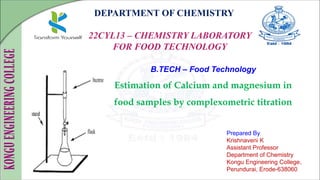
DEPARTMENT OF CHEMISTRY
22CYL13 – CHEMISTRY LABORATORY
FOR FOOD TECHNOLOGY
Prepared By
Krishnaveni K
Assistant Professor
Department of Chemistry
Kongu Engineering College,
Perundurai, Erode-638060
B.TECH – Food Technology
Estimation of Calcium and magnesium in
food samples by complexometric titration
Estimation of Calcium and magnesium in food samples by
complexometric titration
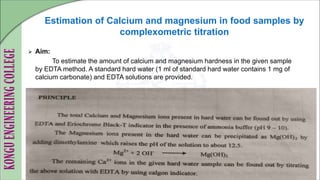
 Aim:
To estimate the amount of calcium and magnesium hardness in the given sample
by EDTA method. A standard hard water (1 ml of standard hard water contains 1 mg of
calcium carbonate) and EDTA solutions are provided.
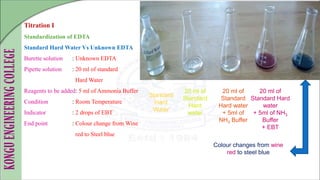
Standard
Hard
Water
20 ml of
Standard
Hard
water
20 ml of
Standard
Hard water
+ 5ml of
NH3 Buffer
20 ml of
Standard Hard
water
+ 5ml of NH3
Buffer
+ EBT
Colour changes from wine
red to steel blue
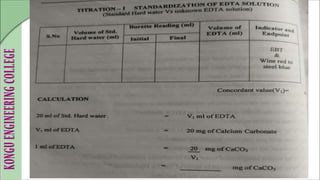
Titration I
Standardization of EDTA
Standard Hard Water Vs Unknown EDTA
Burette solution : Unknown EDTA
Pipette solution : 20 ml of standard
Hard Water
Reagents to be added: 5 ml of Ammonia Buffer
Condition : Room Temperature
Indicator : 2 drops of EBT
End point : Colour change from Wine
red to Steel blue
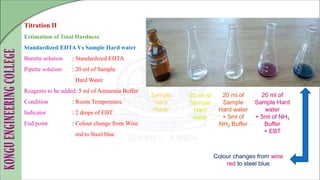
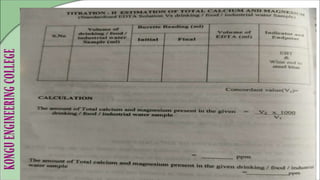
Titration II
Estimation of Total Hardness
Standardized EDTA Vs Sample Hard water
Burette solution : Standardized EDTA
Pipette solution : 20 ml of Sample
Hard Water
Reagents to be added: 5 ml of Ammonia Buffer
Condition : Room Temperature
Indicator : 2 drops of EBT
End point : Colour change from Wine
red to Steel blue
Sample
Hard
Water
20 ml of
Sample
Hard
water
20 ml of
Sample
Hard water
+ 5ml of
NH3 Buffer
20 ml of
Sample Hard
water
+ 5ml of NH3
Buffer
+ EBT
Colour changes from wine
red to steel blue
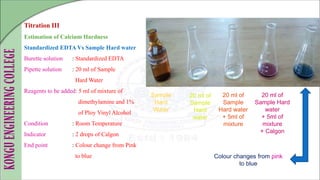
Sample
Hard
Water
20 ml of
Sample
Hard
water
20 ml of
Sample
Hard water
+ 5ml of
mixture
20 ml of
Sample Hard
water
+ 5ml of
mixture
+ Calgon
Colour changes from pink
to blue
Titration III
Estimation of Calcium Hardness
Standardized EDTA Vs Sample Hard water
Burette solution : Standardized EDTA
Pipette solution : 20 ml of Sample
Hard Water
Reagents to be added: 5 ml of mixture of
dimethylamine and 1%
of Ploy Vinyl Alcohol
Condition : Room Temperature
Indicator : 2 drops of Calgon
End point : Colour change from Pink
to blue
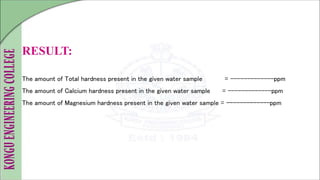
RESULT:
The amount of Total hardness present in the given water sample = -------------ppm
The amount of Calcium hardness present in the given water sample = -------------ppm
The amount of Magnesium hardness present in the given water sample = -------------ppm
VIVA - VOCE QUESTIONS
1. How can we prepare standard hard water?
2. Abbreviate EDTA & EBT.
3. Write the types of hardness.
4. List the reagents used in the estimation of calcium hardness.
5. Name the indicators used in this experiment.
6. What is NH3 buffer? Why is it needed for our experiment?
7. What is complexometric titration?
8. List the units of hardness.
9. Why hardness is expressed in terms of CaCO3 equivalent hardness?
10. Write the principle of our experiment.
11. Identify the colour of stable and unstable complex formed during the titration.
REFERENCES:
 1.Palanisamy P.N., Manikandan P., Geetha A.& Manjula Rani K,
“Chemistry lab Manual”, 2023.
26-Aug-23
26-Aug-23
THANK
YOU
THANKYOU

22CYL13 & Chemistry Laboratory for FT (FT-Ca & Mg).ppt

  • 1.
    DEPARTMENT OF CHEMISTRY 22CYL13– CHEMISTRY LABORATORY FOR FOOD TECHNOLOGY Prepared By Krishnaveni K Assistant Professor Department of Chemistry Kongu Engineering College, Perundurai, Erode-638060 B.TECH – Food Technology Estimation of Calcium and magnesium in food samples by complexometric titration
  • 2.
    Estimation of Calciumand magnesium in food samples by complexometric titration  Aim: To estimate the amount of calcium and magnesium hardness in the given sample by EDTA method. A standard hard water (1 ml of standard hard water contains 1 mg of calcium carbonate) and EDTA solutions are provided.
  • 3.
    Standard Hard Water 20 ml of Standard Hard water 20ml of Standard Hard water + 5ml of NH3 Buffer 20 ml of Standard Hard water + 5ml of NH3 Buffer + EBT Colour changes from wine red to steel blue Titration I Standardization of EDTA Standard Hard Water Vs Unknown EDTA Burette solution : Unknown EDTA Pipette solution : 20 ml of standard Hard Water Reagents to be added: 5 ml of Ammonia Buffer Condition : Room Temperature Indicator : 2 drops of EBT End point : Colour change from Wine red to Steel blue
  • 5.
    Titration II Estimation ofTotal Hardness Standardized EDTA Vs Sample Hard water Burette solution : Standardized EDTA Pipette solution : 20 ml of Sample Hard Water Reagents to be added: 5 ml of Ammonia Buffer Condition : Room Temperature Indicator : 2 drops of EBT End point : Colour change from Wine red to Steel blue Sample Hard Water 20 ml of Sample Hard water 20 ml of Sample Hard water + 5ml of NH3 Buffer 20 ml of Sample Hard water + 5ml of NH3 Buffer + EBT Colour changes from wine red to steel blue
  • 7.
    Sample Hard Water 20 ml of Sample Hard water 20ml of Sample Hard water + 5ml of mixture 20 ml of Sample Hard water + 5ml of mixture + Calgon Colour changes from pink to blue Titration III Estimation of Calcium Hardness Standardized EDTA Vs Sample Hard water Burette solution : Standardized EDTA Pipette solution : 20 ml of Sample Hard Water Reagents to be added: 5 ml of mixture of dimethylamine and 1% of Ploy Vinyl Alcohol Condition : Room Temperature Indicator : 2 drops of Calgon End point : Colour change from Pink to blue
  • 9.
    RESULT: The amount ofTotal hardness present in the given water sample = -------------ppm The amount of Calcium hardness present in the given water sample = -------------ppm The amount of Magnesium hardness present in the given water sample = -------------ppm
  • 10.
    VIVA - VOCEQUESTIONS 1. How can we prepare standard hard water? 2. Abbreviate EDTA & EBT. 3. Write the types of hardness. 4. List the reagents used in the estimation of calcium hardness. 5. Name the indicators used in this experiment. 6. What is NH3 buffer? Why is it needed for our experiment? 7. What is complexometric titration? 8. List the units of hardness. 9. Why hardness is expressed in terms of CaCO3 equivalent hardness? 10. Write the principle of our experiment. 11. Identify the colour of stable and unstable complex formed during the titration.
  • 11.
    REFERENCES:  1.Palanisamy P.N.,Manikandan P., Geetha A.& Manjula Rani K, “Chemistry lab Manual”, 2023. 26-Aug-23
  • 12.