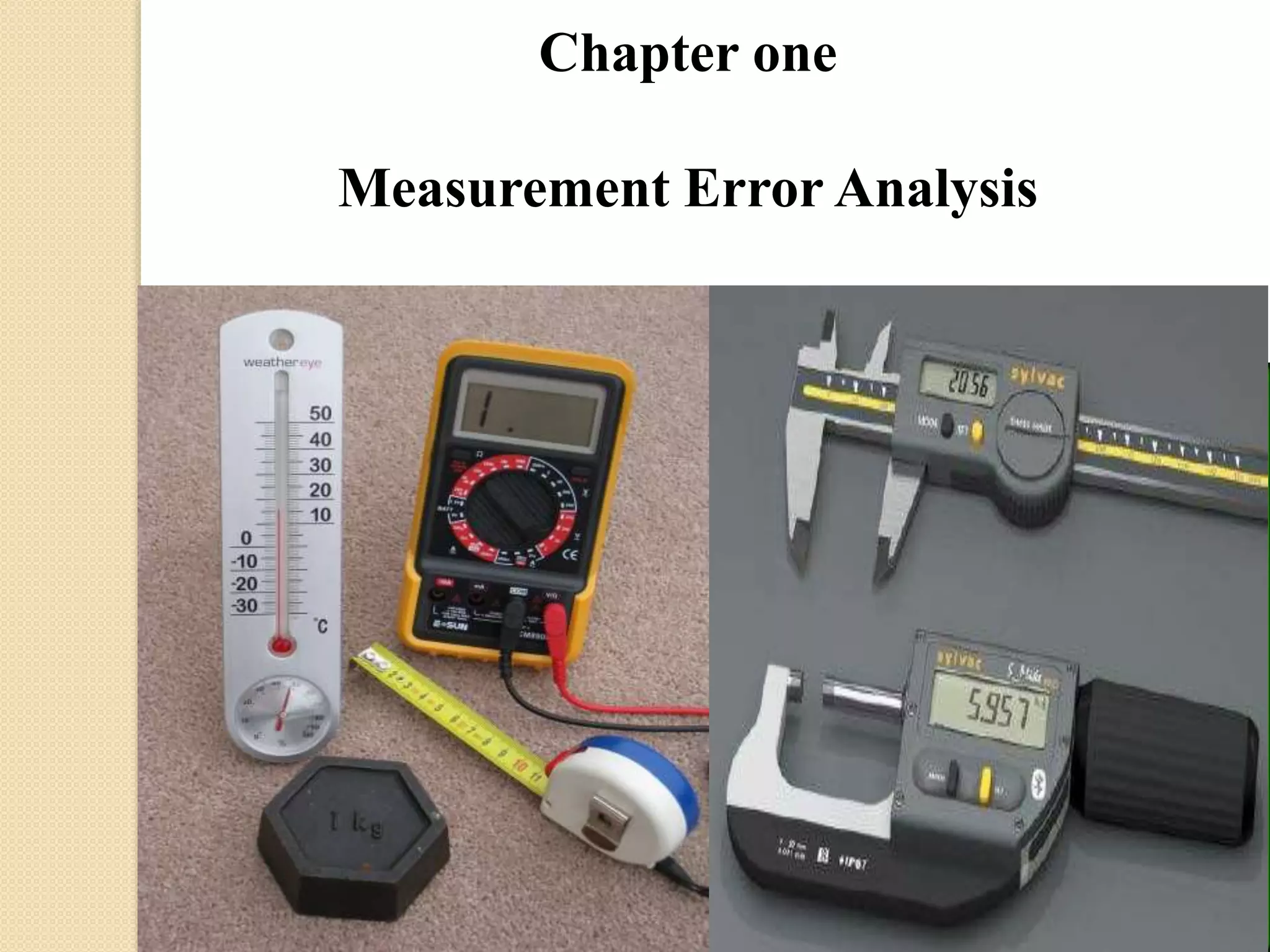
Chapter one
Measurement Error Analysis
Measurement systems are set up for the following functions
1. Monitoring of processes and operations – simply indicates the
value or condition of parameter under study and do not serve any
control function.
2. Control of process and operations –The thermostat in a
refrigeration or geyser determines the temperature of the relevant
environment and accordingly switches off or on the cooling or
heating mechanism to keep the temperature constant, i.e to control
the temperature.
3. Analysis – measurements are also made to
- test the validity of predictions from theories
- formulate the empirical models, i.e. relationships between
parameters and quantities assciated with a problem and
- characterize materials, devices and components
Notes. Any measurements are made with the help of instruments
Instruments
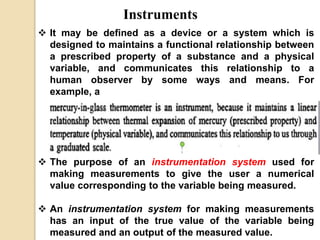
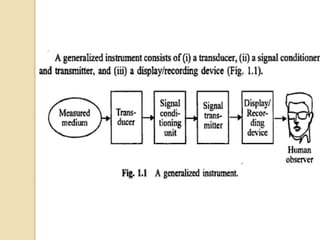
 It may be defined as a device or a system which is
designed to maintains a functional relationship between
a prescribed property of a substance and a physical
variable, and communicates this relationship to a
human observer by some ways and means. For
example, a
 The purpose of an instrumentation system used for
making measurements to give the user a numerical
value corresponding to the variable being measured.
 An instrumentation system for making measurements
has an input of the true value of the variable being
measured and an output of the measured value.
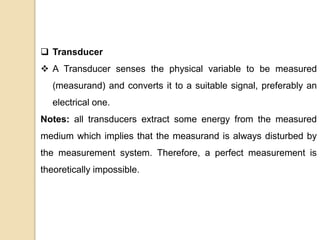
 Transducer
 A Transducer senses the physical variable to be measured
(measurand) and converts it to a suitable signal, preferably an
electrical one.
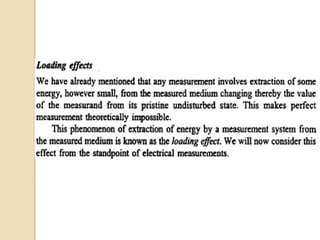
Notes: all transducers extract some energy from the measured
medium which implies that the measurand is always disturbed by
the measurement system. Therefore, a perfect measurement is
theoretically impossible.
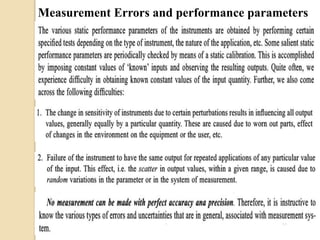
Measurement Errors and performance parameters
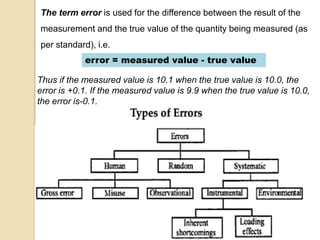
error = measured value - true value
The term error is used for the difference between the result of the
measurement and the true value of the quantity being measured (as
per standard), i.e.
Thus if the measured value is 10.1 when the true value is 10.0, the
error is +0.1. If the measured value is 9.9 when the true value is 10.0,
the error is-0.1.
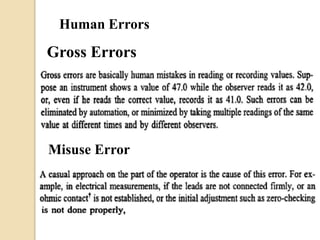
Gross Errors
Misuse Error
Human Errors
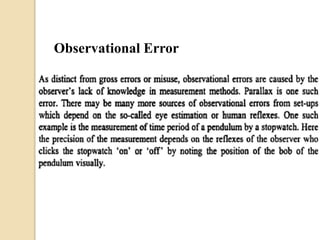
Observational Error
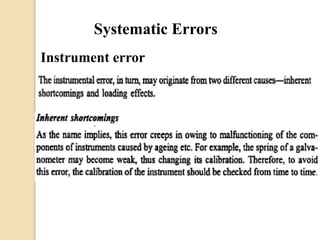
Instrument error
Systematic Errors
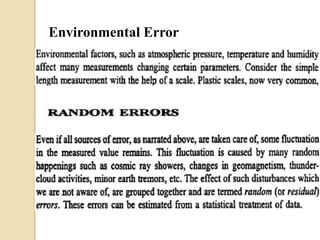
Environmental Error
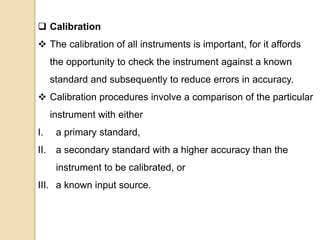
 Calibration
 The calibration of all instruments is important, for it affords
the opportunity to check the instrument against a known
standard and subsequently to reduce errors in accuracy.
 Calibration procedures involve a comparison of the particular
instrument with either
I. a primary standard,
II. a secondary standard with a higher accuracy than the
instrument to be calibrated, or
III. a known input source.
.
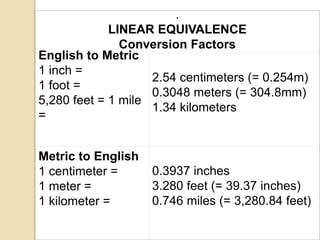
LINEAR EQUIVALENCE
Conversion Factors
English to Metric
1 inch =
1 foot =
5,280 feet = 1 mile
=
2.54 centimeters (= 0.254m)
0.3048 meters (= 304.8mm)
1.34 kilometers
Metric to English
1 centimeter =
1 meter =
1 kilometer =
0.3937 inches
3.280 feet (= 39.37 inches)
0.746 miles (= 3,280.84 feet)
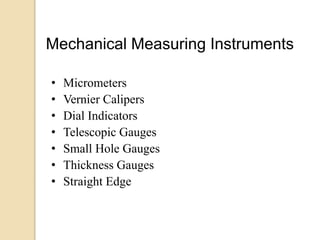
• Micrometers
• Vernier Calipers
• Dial Indicators
• Telescopic Gauges
• Small Hole Gauges
• Thickness Gauges
• Straight Edge
Mechanical Measuring Instruments
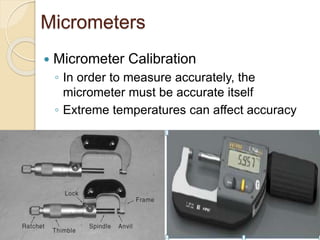
Micrometers
 Micrometer Calibration
◦ In order to measure accurately, the
micrometer must be accurate itself
◦ Extreme temperatures can affect accuracy
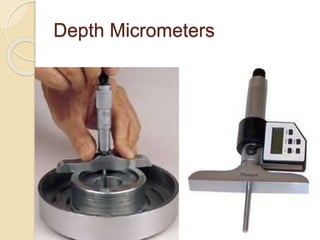
Depth Micrometers
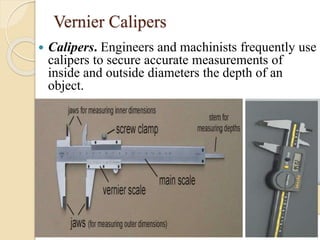
Vernier Calipers
 Calipers. Engineers and machinists frequently use
calipers to secure accurate measurements of
inside and outside diameters the depth of an
object.
Why a Vernier Caliper?
 Durable
 Accurate measuring instrument
 Multiple reading use
 Easy to store and maintain
Readings that can be taken
 Outside Diameter
 Inside Diameter
 Thickness
 Depth
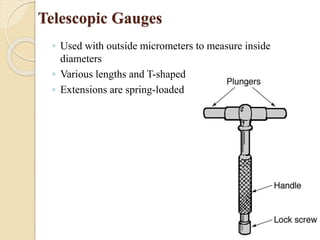
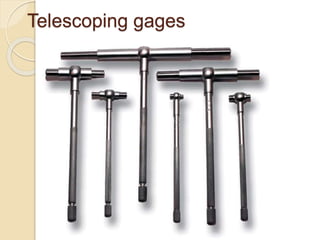
Telescopic Gauges
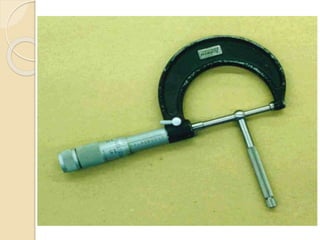
◦ Used with outside micrometers to measure inside
diameters
◦ Various lengths and T-shaped
◦ Extensions are spring-loaded
Telescoping gages
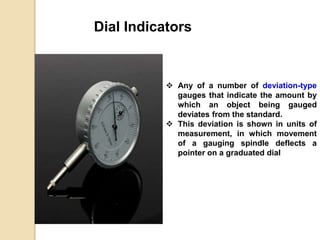
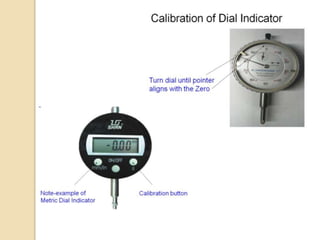
Dial Indicators
 Any of a number of deviation-type
gauges that indicate the amount by
which an object being gauged
deviates from the standard.
 This deviation is shown in units of
measurement, in which movement
of a gauging spindle deflects a
pointer on a graduated dial
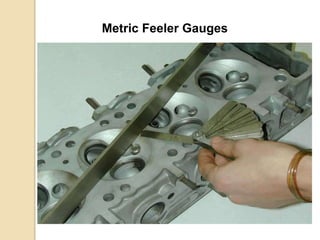
Metric Feeler Gauges
The end!!

Unit-1 instrumentation

  • 1.
  • 2.
    Measurement systems areset up for the following functions 1. Monitoring of processes and operations – simply indicates the value or condition of parameter under study and do not serve any control function. 2. Control of process and operations –The thermostat in a refrigeration or geyser determines the temperature of the relevant environment and accordingly switches off or on the cooling or heating mechanism to keep the temperature constant, i.e to control the temperature. 3. Analysis – measurements are also made to - test the validity of predictions from theories - formulate the empirical models, i.e. relationships between parameters and quantities assciated with a problem and - characterize materials, devices and components Notes. Any measurements are made with the help of instruments
  • 3.
    Instruments  It maybe defined as a device or a system which is designed to maintains a functional relationship between a prescribed property of a substance and a physical variable, and communicates this relationship to a human observer by some ways and means. For example, a  The purpose of an instrumentation system used for making measurements to give the user a numerical value corresponding to the variable being measured.  An instrumentation system for making measurements has an input of the true value of the variable being measured and an output of the measured value.
  • 5.
     Transducer  ATransducer senses the physical variable to be measured (measurand) and converts it to a suitable signal, preferably an electrical one. Notes: all transducers extract some energy from the measured medium which implies that the measurand is always disturbed by the measurement system. Therefore, a perfect measurement is theoretically impossible.
  • 7.
    Measurement Errors andperformance parameters
  • 8.
    error = measuredvalue - true value The term error is used for the difference between the result of the measurement and the true value of the quantity being measured (as per standard), i.e. Thus if the measured value is 10.1 when the true value is 10.0, the error is +0.1. If the measured value is 9.9 when the true value is 10.0, the error is-0.1.
  • 9.
  • 10.
  • 11.
  • 13.
  • 15.
     Calibration  Thecalibration of all instruments is important, for it affords the opportunity to check the instrument against a known standard and subsequently to reduce errors in accuracy.  Calibration procedures involve a comparison of the particular instrument with either I. a primary standard, II. a secondary standard with a higher accuracy than the instrument to be calibrated, or III. a known input source.
  • 16.
    . LINEAR EQUIVALENCE Conversion Factors Englishto Metric 1 inch = 1 foot = 5,280 feet = 1 mile = 2.54 centimeters (= 0.254m) 0.3048 meters (= 304.8mm) 1.34 kilometers Metric to English 1 centimeter = 1 meter = 1 kilometer = 0.3937 inches 3.280 feet (= 39.37 inches) 0.746 miles (= 3,280.84 feet)
  • 17.
    • Micrometers • VernierCalipers • Dial Indicators • Telescopic Gauges • Small Hole Gauges • Thickness Gauges • Straight Edge Mechanical Measuring Instruments
  • 18.
    Micrometers  Micrometer Calibration ◦In order to measure accurately, the micrometer must be accurate itself ◦ Extreme temperatures can affect accuracy
  • 19.
  • 20.
    Vernier Calipers  Calipers.Engineers and machinists frequently use calipers to secure accurate measurements of inside and outside diameters the depth of an object.
  • 21.
    Why a VernierCaliper?  Durable  Accurate measuring instrument  Multiple reading use  Easy to store and maintain Readings that can be taken  Outside Diameter  Inside Diameter  Thickness  Depth
  • 24.
    Telescopic Gauges ◦ Usedwith outside micrometers to measure inside diameters ◦ Various lengths and T-shaped ◦ Extensions are spring-loaded
  • 25.
  • 27.
    Dial Indicators  Anyof a number of deviation-type gauges that indicate the amount by which an object being gauged deviates from the standard.  This deviation is shown in units of measurement, in which movement of a gauging spindle deflects a pointer on a graduated dial
  • 29.
  • 31.