Mechanical Measurements
& Instrumentation
1st Lecture
Nada Rikabi
nadarikabi@yahoo.com
22 April 2014
Good to know…
• One class per week – 2 hours
• Time: Tuesday 2:00-4:00 PM
• Location:
• E-Mail: nadarikabi@yahoo.com
22 April 2014 Mechanical Measurement - 3rd year 2
Course Grade Distribution (100 Points)
1. Term Work [40 Points]
1. Small quizzes : 20 Points
2. Mid-term exam () : 20 Points
2. Final Exam (): 60 Points
Note: A student less than 75% attendance will not be
allowed to sit for the final examination.
22 April 2014 Mechanical Measurement - 3rd year 3
Course Material
Lecture Slides
Reference:
Mechanical Measurements
Sirohi, R. S., Radha Krishna.
22 April 2014 Mechanical Measurement - 3rd year 4
Course Outlines
 Basic Concept of Measurements
 Inaccuracy of Measurement and its Analysis
 Pressure Measurements
 Flow Measurements
 Velocity Measurements
 Temperature Measurements
 Force Measurements
 Strain and deflection measurements
 Strain and Stress measurements
22 April 2014 Mechanical Measurement - 3rd year 5
Today’s Lecture
Basic Concept of Measurements:
 What is measurement ?
 Why measurement?
 Systems of Measurements.
 Types of Measurements
 Calibration
 Inaccuracy of Measurements
 Errors in Measurements
 Accuracy & Precision
 Standards organizations
22 April 2014 Mechanical Measurement - 3rd year 6
What is measurement ?
• A measurement tells us about a property of
something. It might tell us how heavy an object is, or
how hot, or how long it is. A measurement gives a
number to that property.
• Measurements are always made using by an
instrument (tool) of some kind. Rulers, stopwatches,
weighing scales, and thermometers are all measuring
instruments.
• The result of a measurement is normally in two parts:
a number and a unit of measurement, e.g. ‘How long
is it? ... 2 metres.’
22 April 2014 Mechanical Measurement - 3rd year 7
What is measurement ? ..Contd.
Act of measurement — the quantitative
comparison between a predefined standard
and a measurand to produce a measured result
Measurand : physical parameter or variable to
be measured.
Standard: basis for comparison of quantitative
value to measurand.
22 April 2014 Mechanical Measurement - 3rd year 8
Examples of Measurements
What kinds of measurements did you make
today?
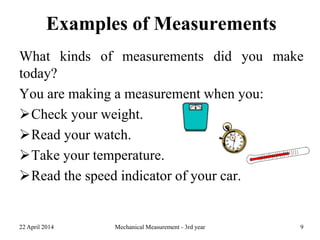
You are making a measurement when you:
Check your weight.
Read your watch.
Take your temperature.
Read the speed indicator of your car.
22 April 2014 Mechanical Measurement - 3rd year 9
Why measurement?
 We all make measurements, every day of our lives.
 We are surrounded by the outputs of measurement
devices , from the wind speeds on weather forecasts to
the figures on electricity bills.
 In the case of process industries and industrial
manufacturing…
– To improve the quality of the product.
– To improve the efficiency of production.
– To maintain the proper operation.
22 April 2014 Mechanical Measurement - 3rd year 10
Systems of Measurements
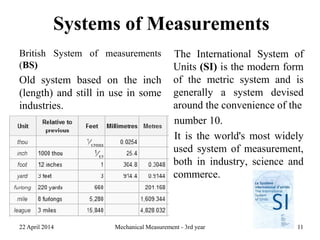
British System of measurements
(BS)
Old system based on the inch
(length) and still in use in some
industries.
The International System of
Units (SI) is the modern form
of the metric system and is
generally a system devised
around the convenience of the
number 10.
It is the world's most widely
used system of measurement,
both in industry, science and
commerce.
22 April 2014 Mechanical Measurement - 3rd year 11
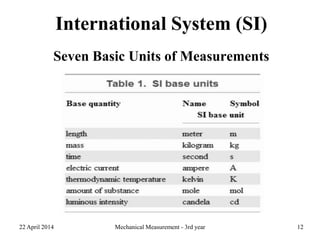
International System (SI)
Seven Basic Units of Measurements
22 April 2014 Mechanical Measurement - 3rd year 12
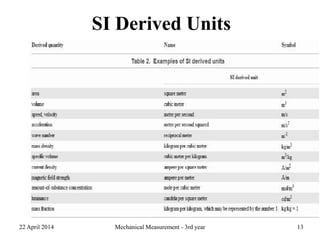
SI Derived Units
22 April 2014 Mechanical Measurement - 3rd year 13
Types of Measurements
• Direct comparison
– Easy to do but… less accurate
• e.g. to measure a steel bar
• Indirect comparison
– Calibrated system; consists of several devices to
convert, process (amplification or filtering) and
display the output ( ‫عرض‬‫الناتج‬ ).
• e.g. to measure force from strain gages(‫)معايير‬ located in
a structure.
22 April 2014 Mechanical Measurement - 3rd year 14
Calibration
• Calibration consists of comparing the output of the
instrument or sensor under test against the output of an
instrument of known accuracy (higher accuracy) when the
same input (the measured quantity is applied to both
instrument).
• The procedure is carried out for a range of inputs covering
the whole measurement range of the instrument or sensor.
• Ensures that the measuring accuracy of all instruments and
sensors used in a measurement system is known over the
whole measurement range, provided that the calibrated
instruments and sensors are used in environmental
conditions that are the same as those under which they
were calibrated.
22 April 2014 Mechanical Measurement - 3rd year 15
Calibration ..Contd.
Calibration involve a comparison of an
instrument with either:
1. A primary standard
2. A secondary standard
3. A known input
Short definition:
Comparison of an instrument against a reference
or standard, to find any errors in the values
indicated by the instrument.
22 April 2014 Mechanical Measurement - 3rd year 16
Inaccuracy of Measurements
 The purpose of any measurement is to describe some
physical property of an object or a system
quantitatively, exp. length, temperature, pressure,…
 All measured values are inaccurate to some degree.
 In fact, it is impossible to find the true value of a
physical quantity.
 The experimenters (we) aim is to find the most
probable value and assign an uncertainty to it.
22 April 2014 Mechanical Measurement - 3rd year 17
Errors in Measurements
Error may be defined as the difference
between the measured value and the true value.
No measurement can be made without errors at
all times i.e. 100% accurate measurements
cannot be made at all times.
22 April 2014 Mechanical Measurement - 3rd year 18
Error Classification
Error classified as following:
Systematic error
 Random errors
 Illegitimate errors
22 April 2014 Mechanical Measurement - 3rd year 19
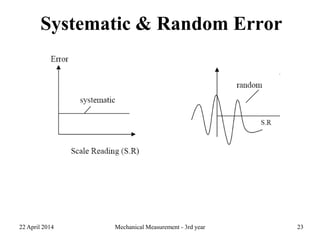
Systematic Errors
 Generally they will be constant / similar form
recur consistently every time measurement is
measured.
 May result from improper condition or
procedures employed.
 This kind of error can be eliminated(‫)ازالة‬ by
calibration.
22 April 2014 Mechanical Measurement - 3rd year 20
Random Errors
Random errors are distinguishable(‫)متميز‬ by
their lack of consistency. ‫عدم‬‫تناسق‬) ).
The variations in temperature, vibrations(‫)اهتزاز‬
of external medium, etc. cause errors in the
instrument.
Errors of this type are normally of limited
duration( ‫مدة‬‫محدودة‬ ) & are inherent to specific
environment.( ‫اساسي‬‫في‬‫بيئة‬‫معينة‬ ).
22April2014
Mechanical Measurement - 3rd year 21
Illegitimate errors
Happens due to many reasons such as:
1. Mistakes
2. Computational errors( ‫اخطاء‬‫حسابية‬ ).
Illegitimate errors may be eliminated by careful exercise
& repetition of measurement.) ‫ممارسة‬‫حذرة‬‫وتكرار‬ ).
Note: If a measuring instrument is not calibrated
periodically it will lead to errors in measurement .
22 April 2014 Mechanical Measurement - 3rd year 22
Systematic & Random Error
22 April 2014 Mechanical Measurement - 3rd year 23
Sources of Error
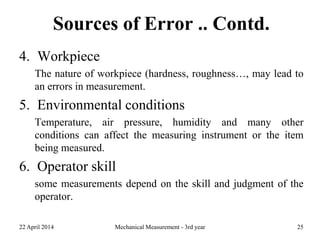
1. Instrument calibration
Due to frequent use of a measuring instrument and also of
aging, the instrument may go out of calibration. Which leads
to systematic error. Therefore the instrument should be sent
for calibration at frequent intervals.
2. Instrument reproducibility
Even if the instrument has been calibrated under a set of
conditions, there may still be error in measurement due to the
difference in the calibration conditions.
3. Measuring arrangement
22 April 2014 Mechanical Measurement - 3rd year 24
Sources of Error .. Contd.
4. Workpiece
The nature of workpiece (hardness, roughness…, may lead to
an errors in measurement.
5. Environmental conditions
Temperature, air pressure, humidity and many other
conditions can affect the measuring instrument or the item
being measured.
6. Operator skill
some measurements depend on the skill and judgment of the
operator.
22 April 2014 Mechanical Measurement - 3rd year 25
Accuracy & Precision
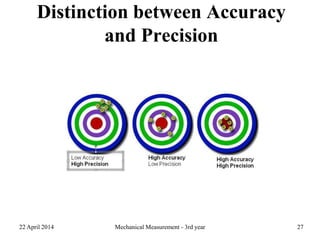
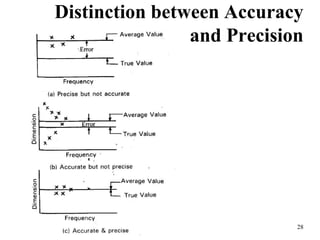
 The terms precision and accuracy are used in
connection with the performance of the instrument.
 Precision is the repeatability of the measuring
process.
 Accuracy is the degree to which the measured value
of the quantity agrees with the true value.
 Error= true value – measured value [explained before]
 Less the error more accurate is the measurement.
22 April 2014 Mechanical Measurement - 3rd year 26
Distinction between Accuracy
and Precision
22 April 2014 Mechanical Measurement - 3rd year 27
Distinction between Accuracy
and Precision
28
Standards organizations
• ISO - International Organization for
Standardization
• SASO - Saudi Arabian Standards organization
• Others—ASME, NFPA, ASTM, etc.
22 April 2014 Mechanical Measurement - 3rd year 29
Question
• If you make several measurements and find
that they also agree closely with each other,
then they are precise. If they agree closely with
the actual value, then they are accurate.
22 April 2014 Mechanical Measurement - 3rd year 30
precise
accurate
Question
State the tool (s) and the Units you would use to
measure the following:
A. Temperature ____________________
B. Volume ____________________
C. Length ____________________
D. Time ____________________
E. Weight ____________________
F. Pressure ____________________
22 April 2014 Mechanical Measurement - 3rd year 31

Measure 1st lec m7md abashar

  • 1.
    Mechanical Measurements & Instrumentation 1stLecture Nada Rikabi nadarikabi@yahoo.com 22 April 2014
  • 2.
    Good to know… •One class per week – 2 hours • Time: Tuesday 2:00-4:00 PM • Location: • E-Mail: nadarikabi@yahoo.com 22 April 2014 Mechanical Measurement - 3rd year 2
  • 3.
    Course Grade Distribution(100 Points) 1. Term Work [40 Points] 1. Small quizzes : 20 Points 2. Mid-term exam () : 20 Points 2. Final Exam (): 60 Points Note: A student less than 75% attendance will not be allowed to sit for the final examination. 22 April 2014 Mechanical Measurement - 3rd year 3
  • 4.
    Course Material Lecture Slides Reference: MechanicalMeasurements Sirohi, R. S., Radha Krishna. 22 April 2014 Mechanical Measurement - 3rd year 4
  • 5.
    Course Outlines  BasicConcept of Measurements  Inaccuracy of Measurement and its Analysis  Pressure Measurements  Flow Measurements  Velocity Measurements  Temperature Measurements  Force Measurements  Strain and deflection measurements  Strain and Stress measurements 22 April 2014 Mechanical Measurement - 3rd year 5
  • 6.
    Today’s Lecture Basic Conceptof Measurements:  What is measurement ?  Why measurement?  Systems of Measurements.  Types of Measurements  Calibration  Inaccuracy of Measurements  Errors in Measurements  Accuracy & Precision  Standards organizations 22 April 2014 Mechanical Measurement - 3rd year 6
  • 7.
    What is measurement? • A measurement tells us about a property of something. It might tell us how heavy an object is, or how hot, or how long it is. A measurement gives a number to that property. • Measurements are always made using by an instrument (tool) of some kind. Rulers, stopwatches, weighing scales, and thermometers are all measuring instruments. • The result of a measurement is normally in two parts: a number and a unit of measurement, e.g. ‘How long is it? ... 2 metres.’ 22 April 2014 Mechanical Measurement - 3rd year 7
  • 8.
    What is measurement? ..Contd. Act of measurement — the quantitative comparison between a predefined standard and a measurand to produce a measured result Measurand : physical parameter or variable to be measured. Standard: basis for comparison of quantitative value to measurand. 22 April 2014 Mechanical Measurement - 3rd year 8
  • 9.
    Examples of Measurements Whatkinds of measurements did you make today? You are making a measurement when you: Check your weight. Read your watch. Take your temperature. Read the speed indicator of your car. 22 April 2014 Mechanical Measurement - 3rd year 9
  • 10.
    Why measurement?  Weall make measurements, every day of our lives.  We are surrounded by the outputs of measurement devices , from the wind speeds on weather forecasts to the figures on electricity bills.  In the case of process industries and industrial manufacturing… – To improve the quality of the product. – To improve the efficiency of production. – To maintain the proper operation. 22 April 2014 Mechanical Measurement - 3rd year 10
  • 11.
    Systems of Measurements BritishSystem of measurements (BS) Old system based on the inch (length) and still in use in some industries. The International System of Units (SI) is the modern form of the metric system and is generally a system devised around the convenience of the number 10. It is the world's most widely used system of measurement, both in industry, science and commerce. 22 April 2014 Mechanical Measurement - 3rd year 11
  • 12.
    International System (SI) SevenBasic Units of Measurements 22 April 2014 Mechanical Measurement - 3rd year 12
  • 13.
    SI Derived Units 22April 2014 Mechanical Measurement - 3rd year 13
  • 14.
    Types of Measurements •Direct comparison – Easy to do but… less accurate • e.g. to measure a steel bar • Indirect comparison – Calibrated system; consists of several devices to convert, process (amplification or filtering) and display the output ( ‫عرض‬‫الناتج‬ ). • e.g. to measure force from strain gages(‫)معايير‬ located in a structure. 22 April 2014 Mechanical Measurement - 3rd year 14
  • 15.
    Calibration • Calibration consistsof comparing the output of the instrument or sensor under test against the output of an instrument of known accuracy (higher accuracy) when the same input (the measured quantity is applied to both instrument). • The procedure is carried out for a range of inputs covering the whole measurement range of the instrument or sensor. • Ensures that the measuring accuracy of all instruments and sensors used in a measurement system is known over the whole measurement range, provided that the calibrated instruments and sensors are used in environmental conditions that are the same as those under which they were calibrated. 22 April 2014 Mechanical Measurement - 3rd year 15
  • 16.
    Calibration ..Contd. Calibration involvea comparison of an instrument with either: 1. A primary standard 2. A secondary standard 3. A known input Short definition: Comparison of an instrument against a reference or standard, to find any errors in the values indicated by the instrument. 22 April 2014 Mechanical Measurement - 3rd year 16
  • 17.
    Inaccuracy of Measurements The purpose of any measurement is to describe some physical property of an object or a system quantitatively, exp. length, temperature, pressure,…  All measured values are inaccurate to some degree.  In fact, it is impossible to find the true value of a physical quantity.  The experimenters (we) aim is to find the most probable value and assign an uncertainty to it. 22 April 2014 Mechanical Measurement - 3rd year 17
  • 18.
    Errors in Measurements Errormay be defined as the difference between the measured value and the true value. No measurement can be made without errors at all times i.e. 100% accurate measurements cannot be made at all times. 22 April 2014 Mechanical Measurement - 3rd year 18
  • 19.
    Error Classification Error classifiedas following: Systematic error  Random errors  Illegitimate errors 22 April 2014 Mechanical Measurement - 3rd year 19
  • 20.
    Systematic Errors  Generallythey will be constant / similar form recur consistently every time measurement is measured.  May result from improper condition or procedures employed.  This kind of error can be eliminated(‫)ازالة‬ by calibration. 22 April 2014 Mechanical Measurement - 3rd year 20
  • 21.
    Random Errors Random errorsare distinguishable(‫)متميز‬ by their lack of consistency. ‫عدم‬‫تناسق‬) ). The variations in temperature, vibrations(‫)اهتزاز‬ of external medium, etc. cause errors in the instrument. Errors of this type are normally of limited duration( ‫مدة‬‫محدودة‬ ) & are inherent to specific environment.( ‫اساسي‬‫في‬‫بيئة‬‫معينة‬ ). 22April2014 Mechanical Measurement - 3rd year 21
  • 22.
    Illegitimate errors Happens dueto many reasons such as: 1. Mistakes 2. Computational errors( ‫اخطاء‬‫حسابية‬ ). Illegitimate errors may be eliminated by careful exercise & repetition of measurement.) ‫ممارسة‬‫حذرة‬‫وتكرار‬ ). Note: If a measuring instrument is not calibrated periodically it will lead to errors in measurement . 22 April 2014 Mechanical Measurement - 3rd year 22
  • 23.
    Systematic & RandomError 22 April 2014 Mechanical Measurement - 3rd year 23
  • 24.
    Sources of Error 1.Instrument calibration Due to frequent use of a measuring instrument and also of aging, the instrument may go out of calibration. Which leads to systematic error. Therefore the instrument should be sent for calibration at frequent intervals. 2. Instrument reproducibility Even if the instrument has been calibrated under a set of conditions, there may still be error in measurement due to the difference in the calibration conditions. 3. Measuring arrangement 22 April 2014 Mechanical Measurement - 3rd year 24
  • 25.
    Sources of Error.. Contd. 4. Workpiece The nature of workpiece (hardness, roughness…, may lead to an errors in measurement. 5. Environmental conditions Temperature, air pressure, humidity and many other conditions can affect the measuring instrument or the item being measured. 6. Operator skill some measurements depend on the skill and judgment of the operator. 22 April 2014 Mechanical Measurement - 3rd year 25
  • 26.
    Accuracy & Precision The terms precision and accuracy are used in connection with the performance of the instrument.  Precision is the repeatability of the measuring process.  Accuracy is the degree to which the measured value of the quantity agrees with the true value.  Error= true value – measured value [explained before]  Less the error more accurate is the measurement. 22 April 2014 Mechanical Measurement - 3rd year 26
  • 27.
    Distinction between Accuracy andPrecision 22 April 2014 Mechanical Measurement - 3rd year 27
  • 28.
  • 29.
    Standards organizations • ISO- International Organization for Standardization • SASO - Saudi Arabian Standards organization • Others—ASME, NFPA, ASTM, etc. 22 April 2014 Mechanical Measurement - 3rd year 29
  • 30.
    Question • If youmake several measurements and find that they also agree closely with each other, then they are precise. If they agree closely with the actual value, then they are accurate. 22 April 2014 Mechanical Measurement - 3rd year 30 precise accurate
  • 31.
    Question State the tool(s) and the Units you would use to measure the following: A. Temperature ____________________ B. Volume ____________________ C. Length ____________________ D. Time ____________________ E. Weight ____________________ F. Pressure ____________________ 22 April 2014 Mechanical Measurement - 3rd year 31