SCALAR
              QUANTITIES


  Physical quantities that have magnitude
                     only.
                   Example:
length, time, temperature, mass, speed, ar
           ea, volume and density.
VECTOR
              QUANTITIES


 Physical quantities that have magnitude
              and direction
                 Example:
displacement, momentum, acceleration, vel
             ocity and force.
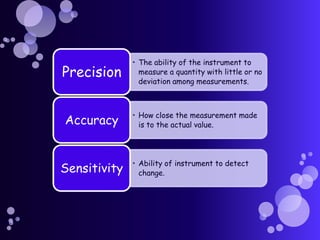
• The ability of the instrument to
Precision       measure a quantity with little or no
                deviation among measurements.


              • How close the measurement made
Accuracy        is to the actual value.


              • Ability of instrument to detect
Sensitivity     change.
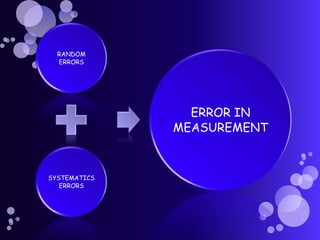
RANDOM
  ERRORS


                ERROR IN
              MEASUREMENT


SYSTEMATICS
   ERRORS
• Due to the calibration of
               instrument.
SYSTEMATIC   • Zero error- due to non-zero
               reading when actual reading should
   ERROR       be zero.


             • Due to mistakes made when
               making measurement either
               through incorrect positioning of

 RANDOM        eye or instrument.
             • May also occur when there is a
  ERROR        sudden change of environmental
               factors like temperature , air
               circulation or lighting.
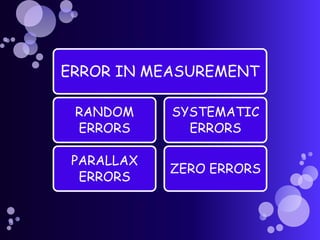
ERROR IN MEASUREMENT

 RANDOM     SYSTEMATIC
 ERRORS       ERRORS

 PARALLAX
            ZERO ERRORS
  ERRORS
Error
Error is the difference between the actual value of a quantity and the
value obtained in measurement.

There are 2 main types of error
- Systematic Error
- Random Error

Systematic Error
Systematic errors are errors which tend to shift all measurements in a
systematic way so their mean value is displaced. Systematic errors can
be compensated if the errors are known.

Examples of systematic errors are
zero error, which cause by an incorrect position of the zero point,
an incorrect calibration of the measuring instrument.
 consistently improper use of equipment.

Systematic error can be reduced by
 Conducting the experiment with care.
 Repeating the experiment by using different instruments.
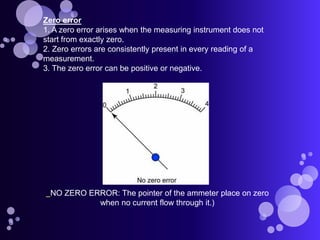
Zero error
1. A zero error arises when the measuring instrument does not
start from exactly zero.
2. Zero errors are consistently present in every reading of a
measurement.
3. The zero error can be positive or negative.


 NO ZERO ERROR: The pointer of the ammeter place on zero
           when no current flow through it.)
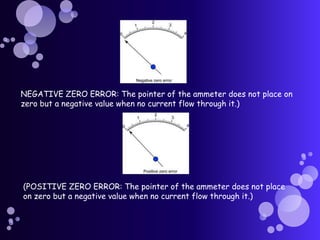
NEGATIVE ZERO ERROR: The pointer of the ammeter does not place on
zero but a negative value when no current flow through it.)


(POSITIVE ZERO ERROR: The pointer of the ammeter does not place
on zero but a negative value when no current flow through it.)
Random errors
1. Random errors arise from unknown and unpredictable variations
in condition.
2. It fluctuates from one measurement to the next.
3. Random errors are caused by factors that are beyond the
control of the observers.
4. Random error can cause by personal errors such as
     human limitations of sight and touch.
    lack of sensitivity of the instrument: the instrument fail to
    respond to the small change.
    natural errors such as changes in temperature or wind, while
    the experiment is in progress.
    wrong technique of measurement.
5. One example of random error is the parallax error.

Random error can be reduced by
- taking repeat readings
- find the average value of the reading.
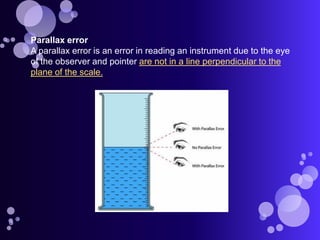
Parallax error
A parallax error is an error in reading an instrument due to the eye
of the observer and pointer are not in a line perpendicular to the
plane of the scale.
Precision
1. Precision is the ability of an instrument in
measuring a quantity in a consistent manner with
only a small relative deviation between readings.
2. The precision of a reading can be indicated by its
relative deviation.
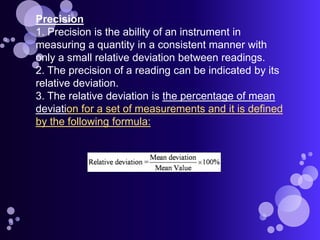
3. The relative deviation is the percentage of mean
deviation for a set of measurements and it is defined
by the following formula:
Accuracy
1. The accuracy of a measurement is the
approximation of the measurement to the actual
value for a certain quantity of Physics.
2. The measurement is more accurate if its number
of significant figures increases.
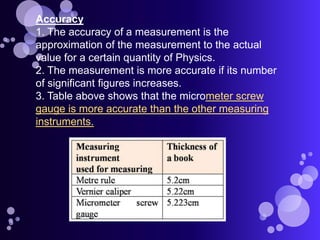
3. Table above shows that the micrometer screw
gauge is more accurate than the other measuring
instruments.
4. The accuracy of a measurement can be increased by
•taking a number of repeat readings to calculate the mean value of
the reading.
•avoiding the end errors or zero errors.
•taking into account the zero and parallax errors.
•using more sensitive equipment such as a vernier caliper to replace
a ruler.
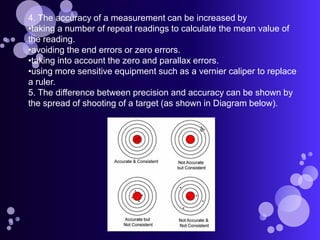
5. The difference between precision and accuracy can be shown by
the spread of shooting of a target (as shown in Diagram below).
Sensitivity
1. The sensitivity of an instrument is its ability to detect small
changes in the quantity that is being measured.
2. Thus, a sensitive instrument can quickly detect a small
change in measurement.
3. Measuring instruments that have smaller scale parts are
more sensitive.
4. Sensitive instruments need not necessarily be accurate.

Introduction to physics

  • 2.
    SCALAR QUANTITIES Physical quantities that have magnitude only. Example: length, time, temperature, mass, speed, ar ea, volume and density.
  • 3.
    VECTOR QUANTITIES Physical quantities that have magnitude and direction Example: displacement, momentum, acceleration, vel ocity and force.
  • 5.
    • The abilityof the instrument to Precision measure a quantity with little or no deviation among measurements. • How close the measurement made Accuracy is to the actual value. • Ability of instrument to detect Sensitivity change.
  • 6.
    RANDOM ERRORS ERROR IN MEASUREMENT SYSTEMATICS ERRORS
  • 7.
    • Due tothe calibration of instrument. SYSTEMATIC • Zero error- due to non-zero reading when actual reading should ERROR be zero. • Due to mistakes made when making measurement either through incorrect positioning of RANDOM eye or instrument. • May also occur when there is a ERROR sudden change of environmental factors like temperature , air circulation or lighting.
  • 8.
    ERROR IN MEASUREMENT RANDOM SYSTEMATIC ERRORS ERRORS PARALLAX ZERO ERRORS ERRORS
  • 9.
    Error Error is thedifference between the actual value of a quantity and the value obtained in measurement. There are 2 main types of error - Systematic Error - Random Error Systematic Error Systematic errors are errors which tend to shift all measurements in a systematic way so their mean value is displaced. Systematic errors can be compensated if the errors are known. Examples of systematic errors are zero error, which cause by an incorrect position of the zero point, an incorrect calibration of the measuring instrument.  consistently improper use of equipment. Systematic error can be reduced by  Conducting the experiment with care.  Repeating the experiment by using different instruments.
  • 10.
    Zero error 1. Azero error arises when the measuring instrument does not start from exactly zero. 2. Zero errors are consistently present in every reading of a measurement. 3. The zero error can be positive or negative. NO ZERO ERROR: The pointer of the ammeter place on zero when no current flow through it.)
  • 11.
    NEGATIVE ZERO ERROR:The pointer of the ammeter does not place on zero but a negative value when no current flow through it.) (POSITIVE ZERO ERROR: The pointer of the ammeter does not place on zero but a negative value when no current flow through it.)
  • 12.
    Random errors 1. Randomerrors arise from unknown and unpredictable variations in condition. 2. It fluctuates from one measurement to the next. 3. Random errors are caused by factors that are beyond the control of the observers. 4. Random error can cause by personal errors such as  human limitations of sight and touch. lack of sensitivity of the instrument: the instrument fail to respond to the small change. natural errors such as changes in temperature or wind, while the experiment is in progress. wrong technique of measurement. 5. One example of random error is the parallax error. Random error can be reduced by - taking repeat readings - find the average value of the reading.
  • 13.
    Parallax error A parallaxerror is an error in reading an instrument due to the eye of the observer and pointer are not in a line perpendicular to the plane of the scale.
  • 14.
    Precision 1. Precision isthe ability of an instrument in measuring a quantity in a consistent manner with only a small relative deviation between readings. 2. The precision of a reading can be indicated by its relative deviation. 3. The relative deviation is the percentage of mean deviation for a set of measurements and it is defined by the following formula:
  • 15.
    Accuracy 1. The accuracyof a measurement is the approximation of the measurement to the actual value for a certain quantity of Physics. 2. The measurement is more accurate if its number of significant figures increases. 3. Table above shows that the micrometer screw gauge is more accurate than the other measuring instruments.
  • 16.
    4. The accuracyof a measurement can be increased by •taking a number of repeat readings to calculate the mean value of the reading. •avoiding the end errors or zero errors. •taking into account the zero and parallax errors. •using more sensitive equipment such as a vernier caliper to replace a ruler. 5. The difference between precision and accuracy can be shown by the spread of shooting of a target (as shown in Diagram below).
  • 17.
    Sensitivity 1. The sensitivityof an instrument is its ability to detect small changes in the quantity that is being measured. 2. Thus, a sensitive instrument can quickly detect a small change in measurement. 3. Measuring instruments that have smaller scale parts are more sensitive. 4. Sensitive instruments need not necessarily be accurate.