CONDITIONAL
SENTENCES
If you should learn these, you would be
wise. 
What it is…
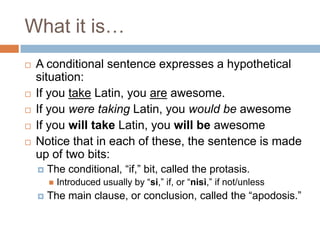
   A conditional sentence expresses a hypothetical
    situation:
   If you take Latin, you are awesome.
   If you were taking Latin, you would be awesome
   If you will take Latin, you will be awesome
   Notice that in each of these, the sentence is made
    up of two bits:
       The conditional, “if,” bit, called the protasis.
           Introduced usually by “si,” if, or “nisi,” if not/unless
       The main clause, or conclusion, called the “apodosis.”
But not all situations are equally
hypothetical…
 If you are taking notes (and you very likely
  are), you are one of Mrs. J’s favorite students.
 This type of conditional is called the SIMPLE

  FACT PRESENT.
 The fact that this is likely makes it less
  hypothetical, so the Romans used the
  INDICATIVE (normal) mood.
 Si Latinam discis, mirabilis es. Verb in main clause
 Condition type    Verb in conditional
                       clause (protasis)    (apodosis)
 Simple fact—present   Present indicative   Present indicative
Another type of simple conditional
sentence
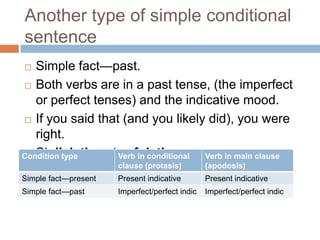
  Simple fact—past.
 Both verbs are in a past tense, (the imperfect

   or perfect tenses) and the indicative mood.
 If you said that (and you likely did), you were

   right.
 Si dixisti, rectus fuisti.
Condition type    Verb in conditional Verb in main clause
                      clause (protasis)         (apodosis)
Simple fact—present   Present indicative        Present indicative
Simple fact—past      Imperfect/perfect indic   Imperfect/perfect indic
One last simple type
    Simple fact—future (or the “future more vivid”)
      If
        you study [will study] (and many of you likely
       will), you will be prepared for the exam.

Condition type        Verb in conditional   Verb in main clause
                      clause (protasis)     (apodosis)
Simple fact—present   Present indicative    Present indicative
Simple fact—past      Imperf/perfect        Imperf/perfect indicative
                      indicative
Simple fact—future    Present/future        Future indicative
                      indicative
But what’s the point of living without
  the subjunctive? Hypothetical
  conditions
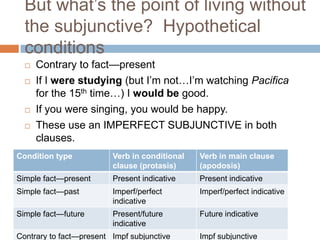
   Contrary to fact—present
  If I were studying (but I’m not…I’m watching Pacifica

    for the 15th time…) I would be good.
  If you were singing, you would be happy.

  These use an IMPERFECT SUBJUNCTIVE in both

    clauses.
Condition type Impf subjunctive = infinitive form + personal
      NOTE:         Verb in conditional  Verb in main clause
        endings      clause (protasis)    (apodosis)
Simple fact—present      Present indicative   Present indicative
Simple fact—past         Imperf/perfect       Imperf/perfect indicative
                         indicative
Simple fact—future       Present/future       Future indicative
                         indicative
Contrary to fact—present Impf subjunctive     Impf subjunctive
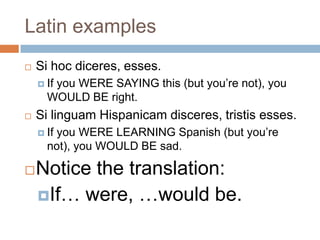
Latin examples
   Si hoc diceres, esses.
     If
       you WERE SAYING this (but you’re not), you
      WOULD BE right.
   Si linguam Hispanicam disceres, tristis esses.
     If
       you WERE LEARNING Spanish (but you’re
      not), you WOULD BE sad.

   Notice the translation:
    If… were, …would be.
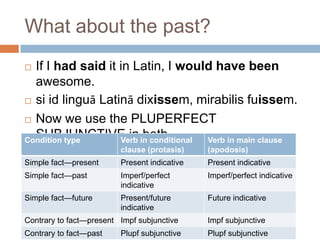
What about the past?
 If I had said it in Latin, I would have been
  awesome.
 si id linguā Latinā dixissem, mirabilis fuissem.

 Now we use the PLUPERFECT

  SUBJUNCTIVE in in conditional Verb in main clause
Condition type     Verb
                        both.
                         clause (protasis)    (apodosis)
Simple fact—present      Present indicative   Present indicative
Simple fact—past         Imperf/perfect       Imperf/perfect indicative
                         indicative
Simple fact—future       Present/future       Future indicative
                         indicative
Contrary to fact—present Impf subjunctive     Impf subjunctive
Contrary to fact—past    Plupf subjunctive    Plupf subjunctive
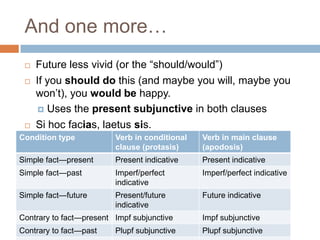
And one more…
    Future less vivid (or the “should/would”)
    If you should do this (and maybe you will, maybe you
     won’t), you would be happy.
       Uses the present subjunctive in both clauses

    Si hoc facias, laetus sis.
Condition type           Verb in conditional   Verb in main clause
                         clause (protasis)     (apodosis)
Simple fact—present      Present indicative    Present indicative
Simple fact—past         Imperf/perfect        Imperf/perfect indicative
                         indicative
Simple fact—future       Present/future        Future indicative
                         indicative
Contrary to fact—present Impf subjunctive      Impf subjunctive
Contrary to fact—past    Plupf subjunctive     Plupf subjunctive
Strategies to help you
remember…
   Recognize the patterns for subjunctives:
     Present     subjunctive =
       We     beat fat friars
     Imperfect     subjunctive =
       Infinitive   form + personal endings
     Pluperfect     subjunctive =
       3rd   part + isse + personal ending
     Itseems odd that the Contrary to Fact—Present
      uses imperfect? Think about how we say it in
      English:
       If   I were on vacation right now (but I’m not, I’m here
           teaching Latin), I would be swimming and getting a
           tan.

Conditional sentences

  • 1.
    CONDITIONAL SENTENCES If you shouldlearn these, you would be wise. 
  • 2.
    What it is…  A conditional sentence expresses a hypothetical situation:  If you take Latin, you are awesome.  If you were taking Latin, you would be awesome  If you will take Latin, you will be awesome  Notice that in each of these, the sentence is made up of two bits:  The conditional, “if,” bit, called the protasis.  Introduced usually by “si,” if, or “nisi,” if not/unless  The main clause, or conclusion, called the “apodosis.”
  • 3.
    But not allsituations are equally hypothetical…  If you are taking notes (and you very likely are), you are one of Mrs. J’s favorite students.  This type of conditional is called the SIMPLE FACT PRESENT.  The fact that this is likely makes it less hypothetical, so the Romans used the INDICATIVE (normal) mood.  Si Latinam discis, mirabilis es. Verb in main clause Condition type Verb in conditional clause (protasis) (apodosis) Simple fact—present Present indicative Present indicative
  • 4.
    Another type ofsimple conditional sentence  Simple fact—past.  Both verbs are in a past tense, (the imperfect or perfect tenses) and the indicative mood.  If you said that (and you likely did), you were right.  Si dixisti, rectus fuisti. Condition type Verb in conditional Verb in main clause clause (protasis) (apodosis) Simple fact—present Present indicative Present indicative Simple fact—past Imperfect/perfect indic Imperfect/perfect indic
  • 5.
    One last simpletype  Simple fact—future (or the “future more vivid”)  If you study [will study] (and many of you likely will), you will be prepared for the exam. Condition type Verb in conditional Verb in main clause clause (protasis) (apodosis) Simple fact—present Present indicative Present indicative Simple fact—past Imperf/perfect Imperf/perfect indicative indicative Simple fact—future Present/future Future indicative indicative
  • 6.
    But what’s thepoint of living without the subjunctive? Hypothetical conditions  Contrary to fact—present  If I were studying (but I’m not…I’m watching Pacifica for the 15th time…) I would be good.  If you were singing, you would be happy.  These use an IMPERFECT SUBJUNCTIVE in both clauses. Condition type Impf subjunctive = infinitive form + personal  NOTE: Verb in conditional Verb in main clause endings clause (protasis) (apodosis) Simple fact—present Present indicative Present indicative Simple fact—past Imperf/perfect Imperf/perfect indicative indicative Simple fact—future Present/future Future indicative indicative Contrary to fact—present Impf subjunctive Impf subjunctive
  • 7.
    Latin examples  Si hoc diceres, esses.  If you WERE SAYING this (but you’re not), you WOULD BE right.  Si linguam Hispanicam disceres, tristis esses.  If you WERE LEARNING Spanish (but you’re not), you WOULD BE sad.  Notice the translation: If… were, …would be.
  • 8.
    What about thepast?  If I had said it in Latin, I would have been awesome.  si id linguā Latinā dixissem, mirabilis fuissem.  Now we use the PLUPERFECT SUBJUNCTIVE in in conditional Verb in main clause Condition type Verb both. clause (protasis) (apodosis) Simple fact—present Present indicative Present indicative Simple fact—past Imperf/perfect Imperf/perfect indicative indicative Simple fact—future Present/future Future indicative indicative Contrary to fact—present Impf subjunctive Impf subjunctive Contrary to fact—past Plupf subjunctive Plupf subjunctive
  • 9.
    And one more…  Future less vivid (or the “should/would”)  If you should do this (and maybe you will, maybe you won’t), you would be happy.  Uses the present subjunctive in both clauses  Si hoc facias, laetus sis. Condition type Verb in conditional Verb in main clause clause (protasis) (apodosis) Simple fact—present Present indicative Present indicative Simple fact—past Imperf/perfect Imperf/perfect indicative indicative Simple fact—future Present/future Future indicative indicative Contrary to fact—present Impf subjunctive Impf subjunctive Contrary to fact—past Plupf subjunctive Plupf subjunctive
  • 10.
    Strategies to helpyou remember…  Recognize the patterns for subjunctives:  Present subjunctive =  We beat fat friars  Imperfect subjunctive =  Infinitive form + personal endings  Pluperfect subjunctive =  3rd part + isse + personal ending  Itseems odd that the Contrary to Fact—Present uses imperfect? Think about how we say it in English:  If I were on vacation right now (but I’m not, I’m here teaching Latin), I would be swimming and getting a tan.