Seminar 5 Data Collection, Preparation and Analysis Using SPSS By Dr. Muhammad Ramzan [email_address] ,  03004487844 Edited by Ahsan Khan Eco [email_address] 03008046243
Data Collection-Methods Data collection method is impacted by the method of research you choose. It is usually done through: Data collection by the individual researcher Collection through hired researchers Collection through firms
Data Collection-Formats Format of data is influenced by the method of research, as it could be Printed questionnaires Interview sheets (in-person or telephonic) Focus group notes Observation notes Email or web responses Content analysis notes, pictures, documentaries Printed, e-records, scanned data Literature review
Data Preparation Preparation of data file It is important to convert raw data into a usable data for analysis The analysis and results will surely depend on the quality of data There are possibilities of errors in handling instruments, raw data, transcribing, data entry, assigning codes, values, value labels Data need to be cleaned to fulfill the analysis conations
Data Analysis Analysis of data is influenced by a number of factors. They are but not limited to: The purpose of research The type research questions and hypothesis The method of research and format of data Use of software for management, manipulation and analysis of data Researchers skills and capabilities Techniques used for data The quality of the data
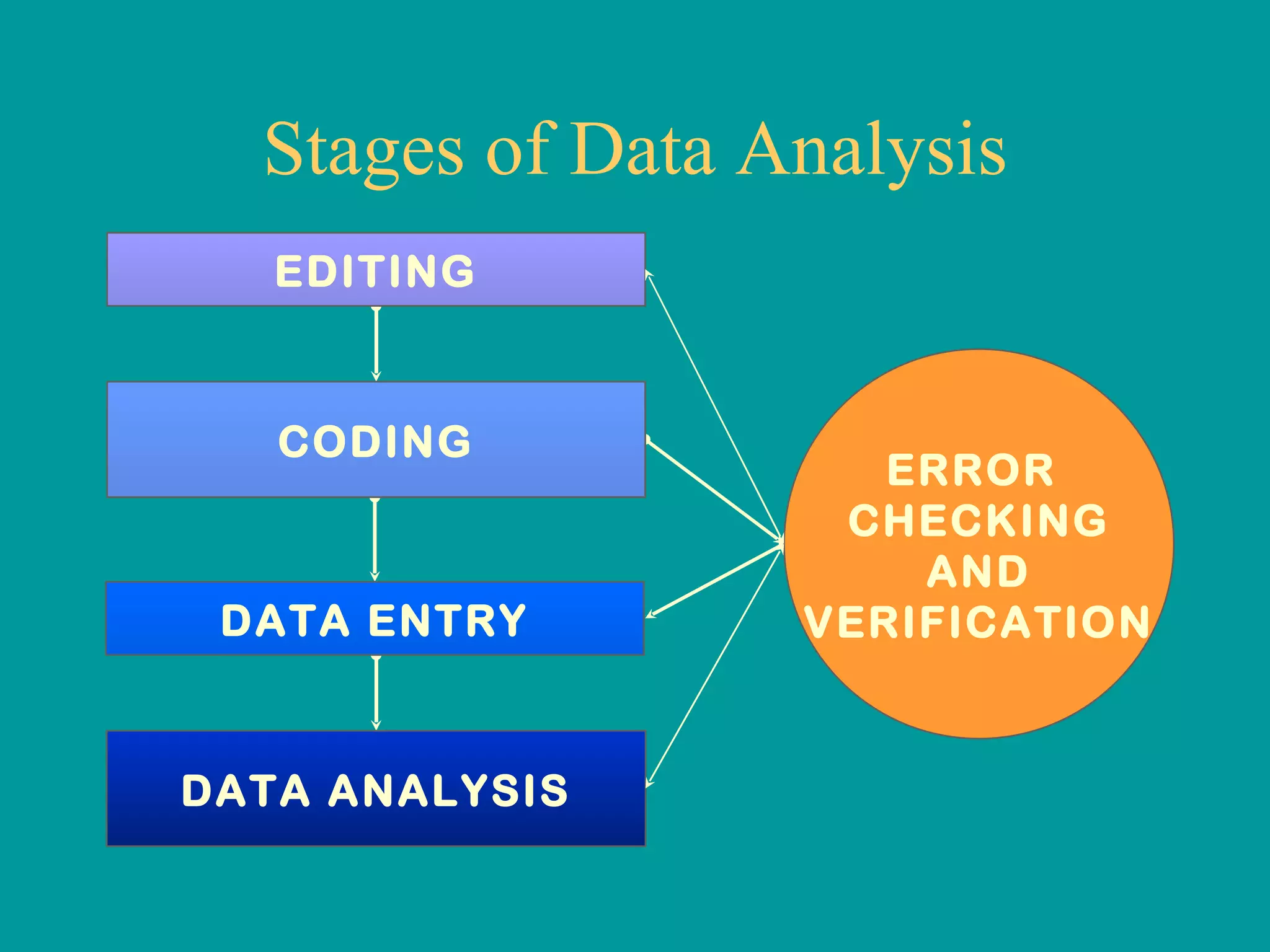
Stages of Data Analysis ERROR  CHECKING AND VERIFICATION EDITING DATA ANALYSIS DATA ENTRY CODING
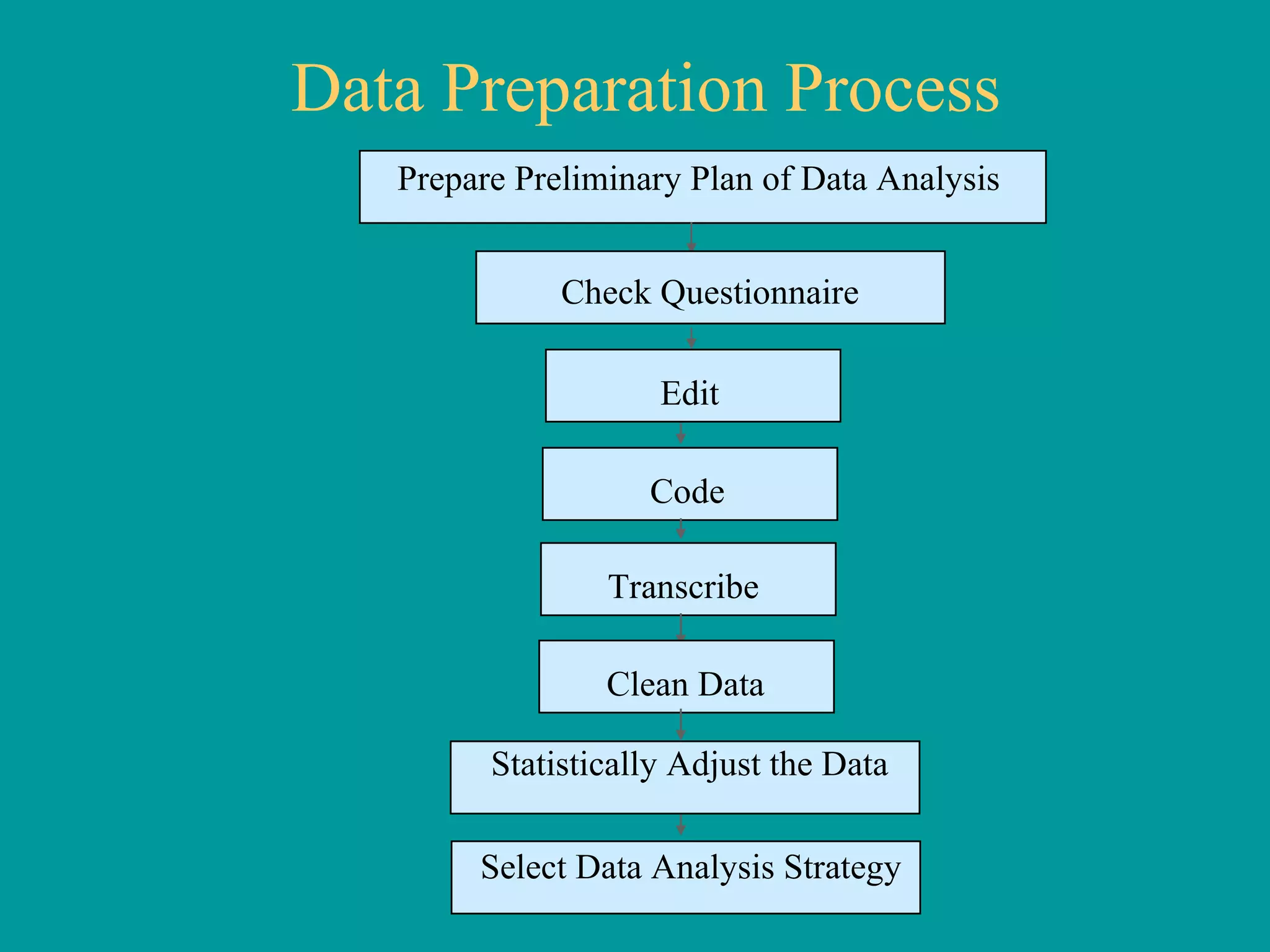
Data Preparation Process Select Data Analysis Strategy Prepare Preliminary Plan of Data Analysis Check Questionnaire Edit Code Transcribe Clean Data Statistically Adjust the Data
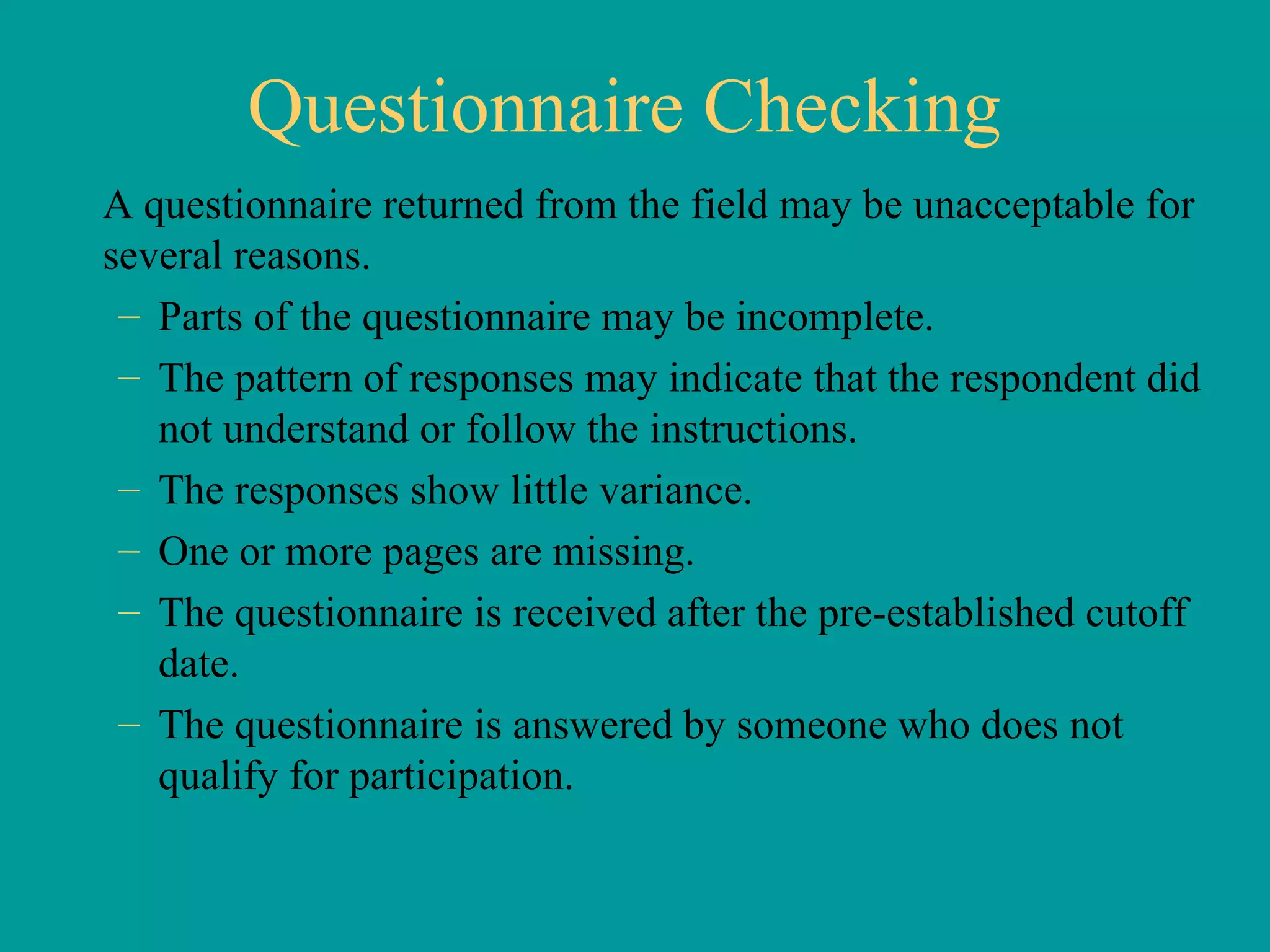
Questionnaire Checking A questionnaire returned from the field may be unacceptable for several reasons. Parts of the questionnaire may be incomplete. The pattern of responses may indicate that the respondent did not understand or follow the instructions. The responses show little variance.  One or more pages are missing. The questionnaire is received after the pre-established cutoff date. The questionnaire is answered by someone who does not qualify for participation.
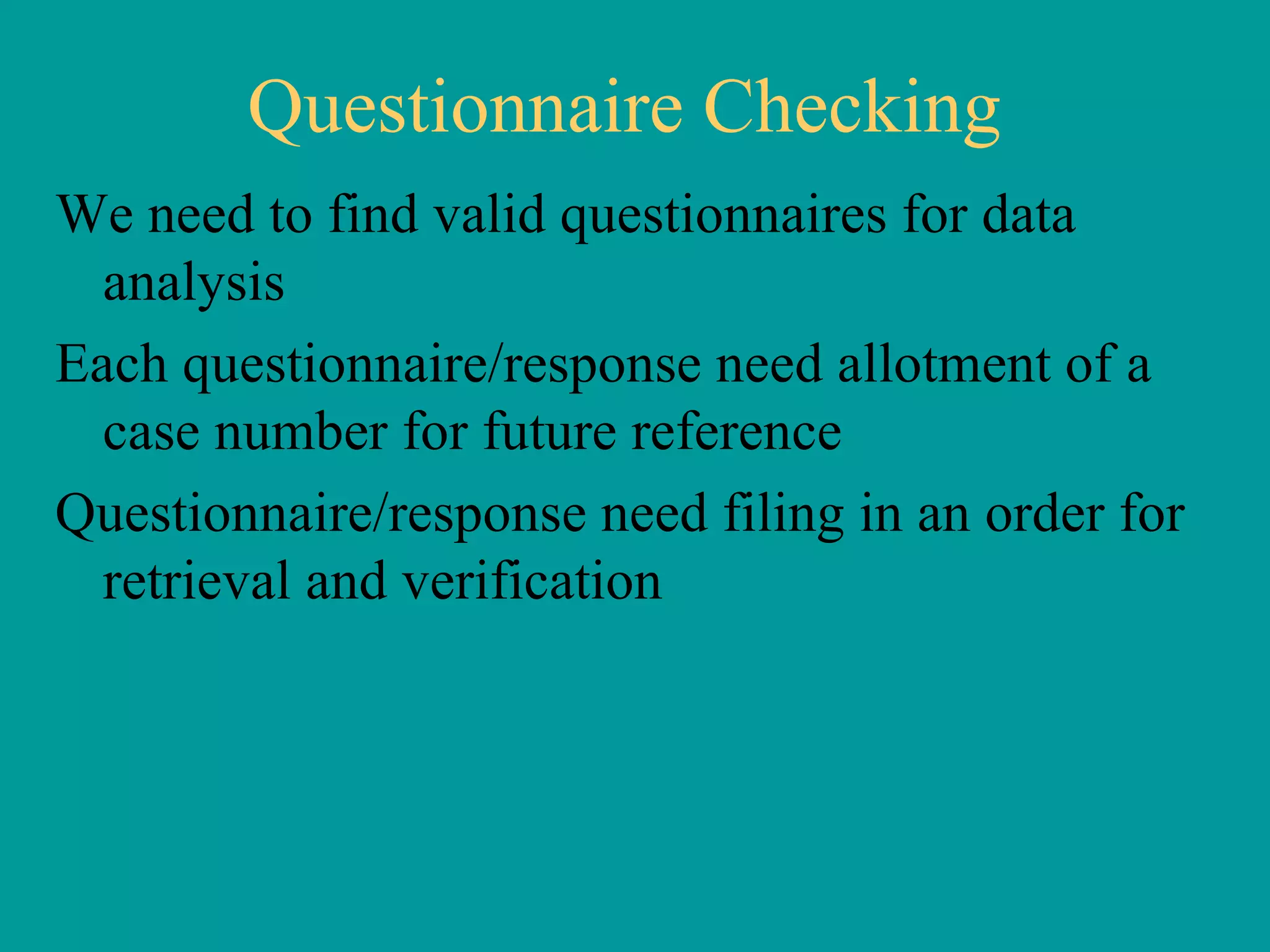
Questionnaire Checking We need to find valid questionnaires for data analysis Each questionnaire/response need allotment of a case number for future reference Questionnaire/response need filing in an order for retrieval and verification
Editing of Responses Treatment of Unsatisfactory Results Returning to the Field –  The questionnaires with unsatisfactory responses may be returned to the field, where the interviewers re-contact the respondents.  Assigning Missing Values –  If returning the questionnaires to the field is not feasible, the editor may assign missing values to unsatisfactory responses.  Discarding Unsatisfactory Respondents –  In this approach, the respondents with unsatisfactory responses are simply discarded.
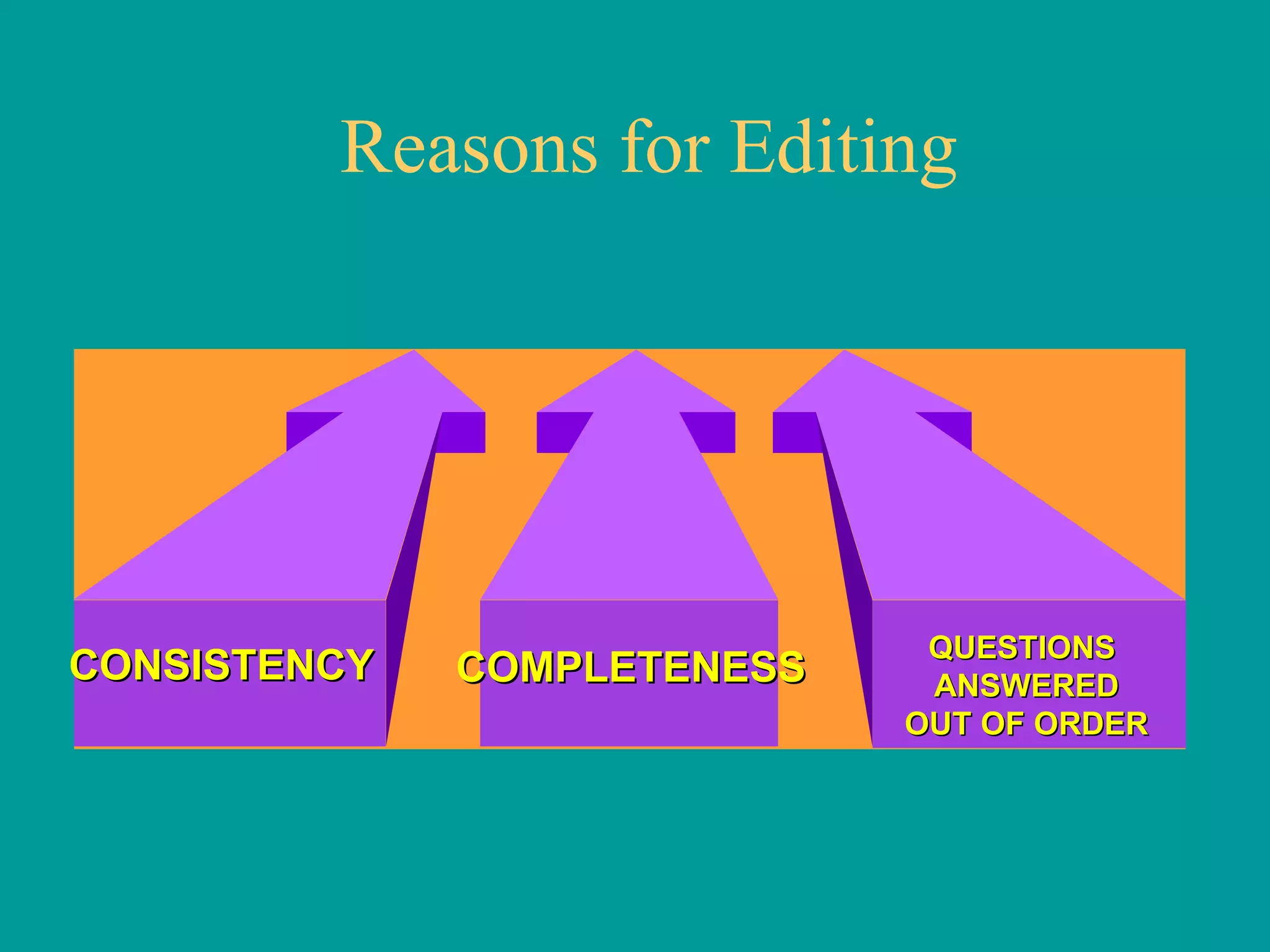
CONSISTENCY COMPLETENESS QUESTIONS  ANSWERED OUT OF ORDER Reasons for Editing
Editing The process of checking and adjusting the data for omissions for legibility for consistency And readying them for coding and storage
Codes The rules for interpreting, classifying, and recording data in the coding process The actual numerical or other character symbols
Coding Coding  means assigning a code, usually a number, to each possible response to each question.  The code includes an indication of the column position (field) and data record it will occupy.  Coding Questions Fixed field codes , which mean that the number of records for each respondent is the same and the same data appear in the same column(s) for all respondents, are highly desirable.  If possible, standard codes should be used for missing data.  Coding of structured questions is relatively simple, since the response options are predetermined.  In questions that permit a large number of responses, each possible response option should be assigned a separate column.
Coding Guidelines for coding unstructured questions : Category codes should be mutually exclusive and collectively exhaustive.  Only a few (10% or less) of the responses should fall into the “other” category.  Category codes should be assigned for critical issues even if no one has mentioned them.  Data should be coded to retain as much detail as possible .
Codebook A  codebook  contains coding instructions and the necessary information about variables in the data set.  A codebook generally contains the following information: column number record number variable number variable name question number instructions for coding
Coding Questionnaires The respondent code and the record number appear on each record in the data.  The first record contains the additional codes: project code, interviewer code, date and time codes, and validation code.  It is a good practice to insert blanks between parts Here are examples of coding
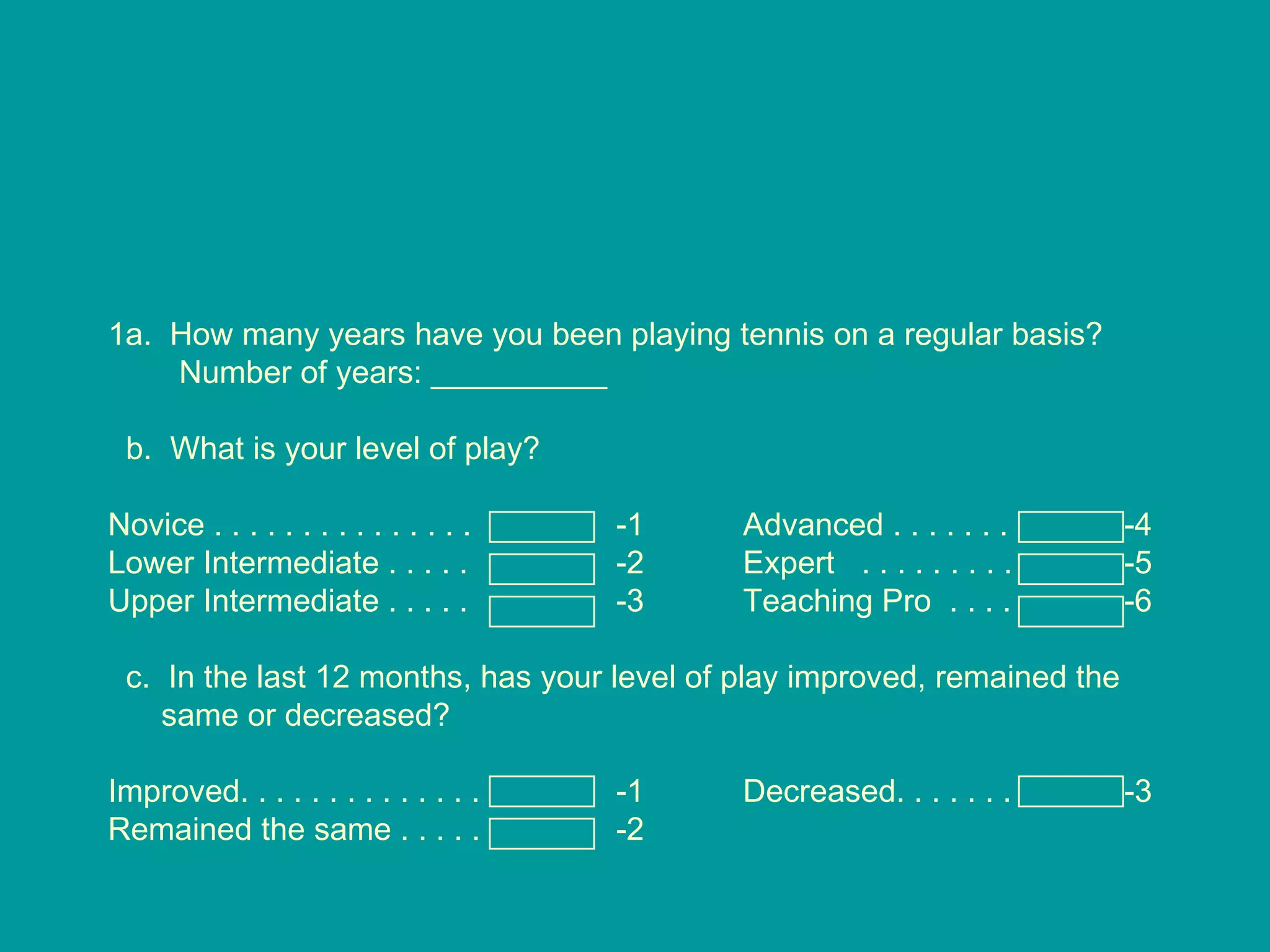
1a.  How many years have you been playing tennis on a regular basis?  Number of years: __________ b.  What is your level of play? Novice . . . . . . . . . . . . . . .  -1 Advanced . . . . . . . -4 Lower Intermediate . . . . . -2 Expert  . . . . . . . . . -5 Upper Intermediate . . . . .  -3 Teaching Pro  . . . .  -6 c.  In the last 12 months, has your level of play improved, remained the same or decreased? Improved. . . . . . . . . . . . . . -1 Decreased. . . . . . .  -3 Remained the same . . . . . -2
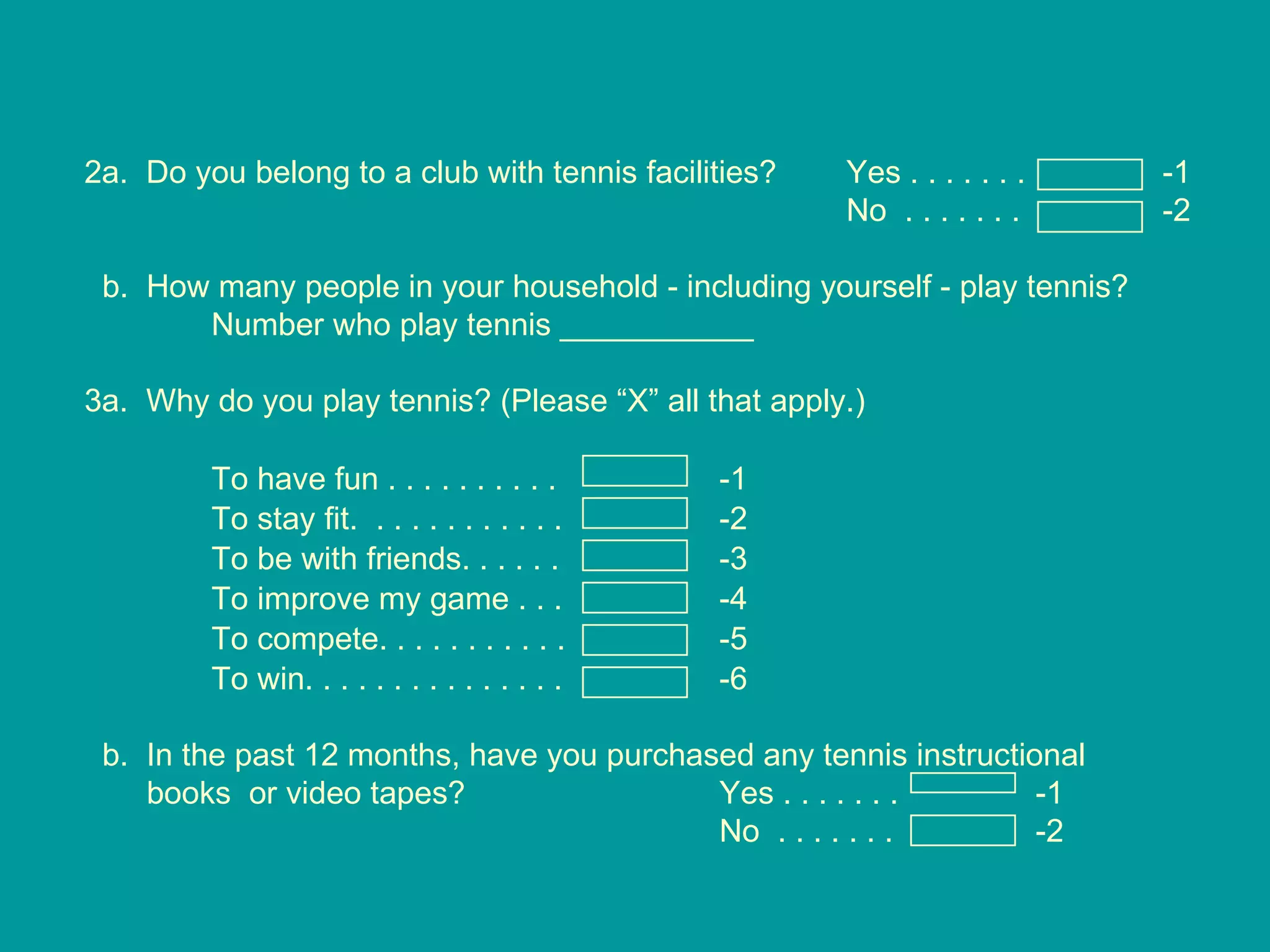
2a.  Do you belong to a club with tennis facilities? Yes . . . . . . .   -1 No  . . . . . . .   -2 b.  How many people in your household - including yourself - play tennis? Number who play tennis ___________  3a.  Why do you play tennis? (Please “X” all that apply.) To have fun . . . . . . . . . .  -1 To stay fit.  . . . . . . . . . . .  -2 To be with friends. . . . . .  -3 To improve my game . . . -4 To compete. . . . . . . . . . . -5 To win. . . . . . . . . . . . . . . -6 b.  In the past 12 months, have you purchased any tennis instructional  books  or video tapes? Yes . . . . . . .   -1 No  . . . . . . .   -2
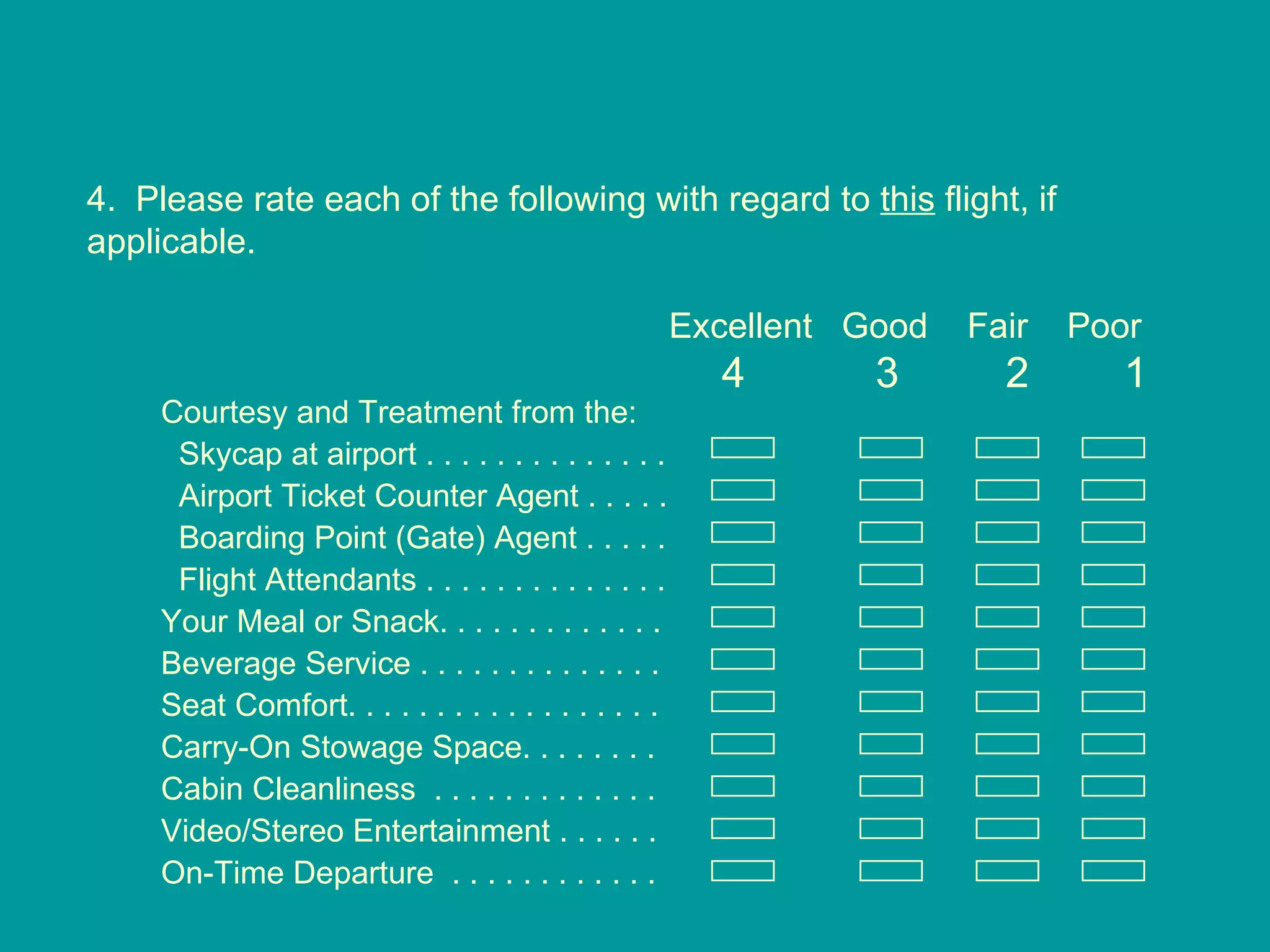
4.  Please rate each of the following with regard to  this  flight, if applicable. Excellent  Good  Fair  Poor 4  3  2  1 Courtesy and Treatment from the: Skycap at airport . . . . . . . . . . . . . .  Airport Ticket Counter Agent . . . . .  Boarding Point (Gate) Agent . . . . . Flight Attendants . . . . . . . . . . . . . . Your Meal or Snack. . . . . . . . . . . . . Beverage Service . . . . . . . . . . . . . . Seat Comfort. . . . . . . . . . . . . . . . . .  Carry-On Stowage Space. . . . . . . . Cabin Cleanliness  . . . . . . . . . . . . .  Video/Stereo Entertainment . . . . . . On-Time Departure  . . . . . . . . . . . .
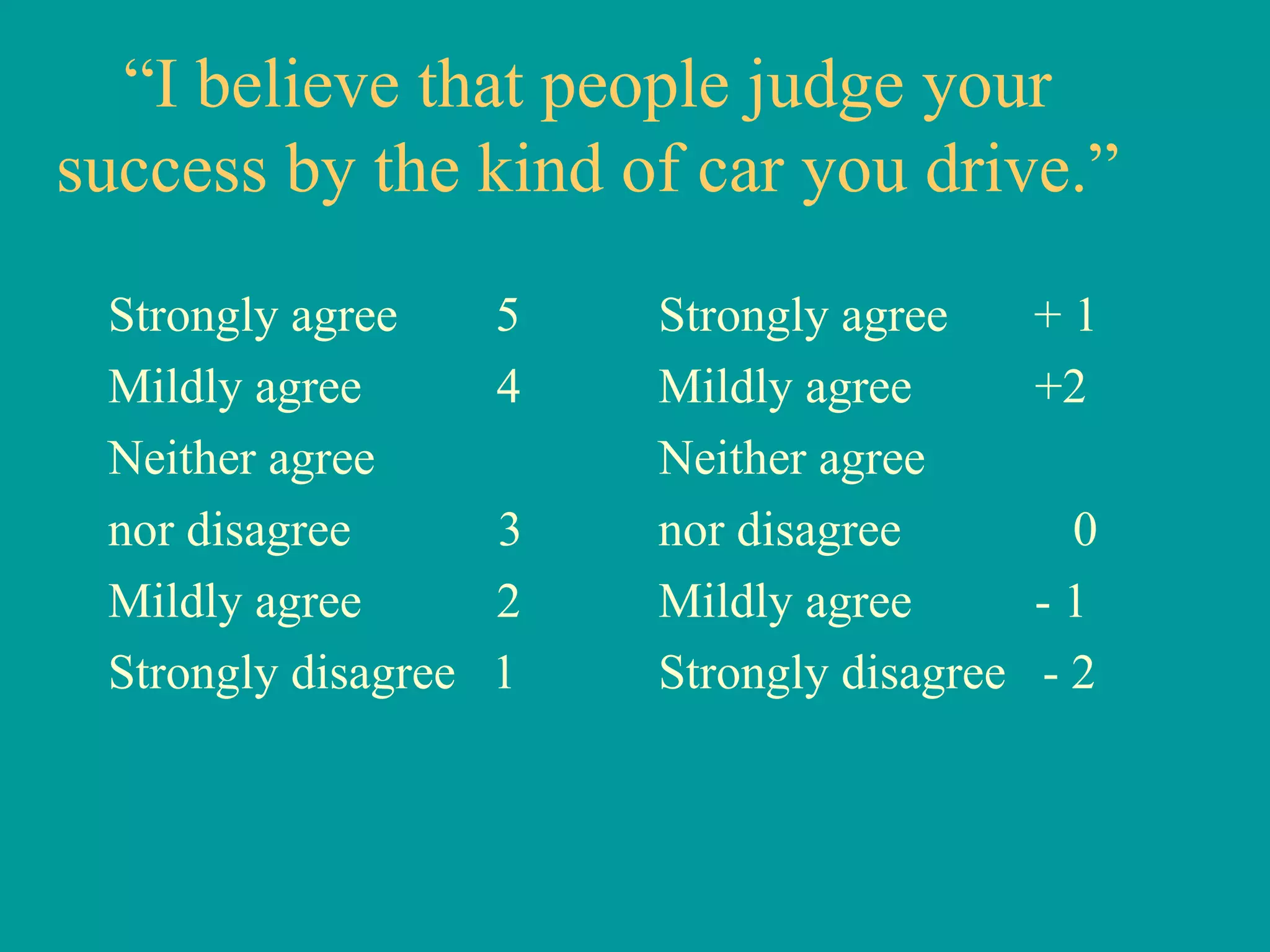
“ I believe that people judge your success by the kind of car you drive.” Strongly agree  5 Mildly agree  4 Neither agree nor disagree  3 Mildly agree  2 Strongly disagree  1 Strongly agree  + 1 Mildly agree  +2 Neither agree nor disagree  0 Mildly agree  - 1 Strongly disagree  - 2
Data Transcription Transcribe raw data into testable form Determine variables Convert raw data into meaningful for further processing and answering the research questions and testing hypothesis Assign values, weights, value labels Scanning, data entry
Data Entry The process of transforming data from the research project to computers Transferring data files from excel to SPSS Optical scanning systems Marked-sensed questionnaires In SPSS open the data view And enter the data Practical session
Data Cleaning: Consistency Checks Consistency checks  identify data that are out of range, logically inconsistent, or have extreme values.  Computer packages like SPSS, SAS, EXCEL and MINITAB can be programmed to identify out-of-range values for each variable and print out the respondent code, variable code, variable name, record number, column number, and out-of-range value. Extreme values should be closely examined .
Data Cleaning Through SPSS Click analyze in main menu of SPSS data, then click on descriptive analysis, then frequencies Select variable that you want to check Click on statistics and tick minimum and maximum values Click on continue Summary of results will provide each of variable you selected and then breakdown of responses Check if there are inconsistencies Go to data file and remove if there is any You can clean your data using SPSS descriptive analysis features
Data Cleaning: Treatment of Missing Responses Substitute a Neutral Value  – A neutral value, typically the mean response to the variable, is substituted for the missing responses.  Substitute an Imputed Response  – The respondents' pattern of responses to other questions are used to impute or calculate a suitable response to the missing questions.  In  casewise deletion , cases, or respondents, with any missing responses are discarded from the analysis.  In  pairwise deletion , instead of discarding all cases with any missing values, the researcher uses only the cases or respondents with complete responses for each calculation.
Statistically Adjusting the Data: Weighting In  weighting , each case or respondent in the database is assigned a weight to reflect its importance relative to other cases or respondents. Weighting is most widely used to make the sample data more representative of a target population on specific characteristics.  Yet another use of weighting is to adjust the sample so that greater importance is attached to respondents with certain characteristics Example
Variable Re-specification Variable respecification  involves the transformation of data to create new variables or modify existing variables.  E.G., the researcher may create new variables that are composites of several other variables.  Dummy variables are used for respecifying categorical variables.  The general rule is that to respecify a categorical variable with  K  categories,  K -1 dummy variables are needed .
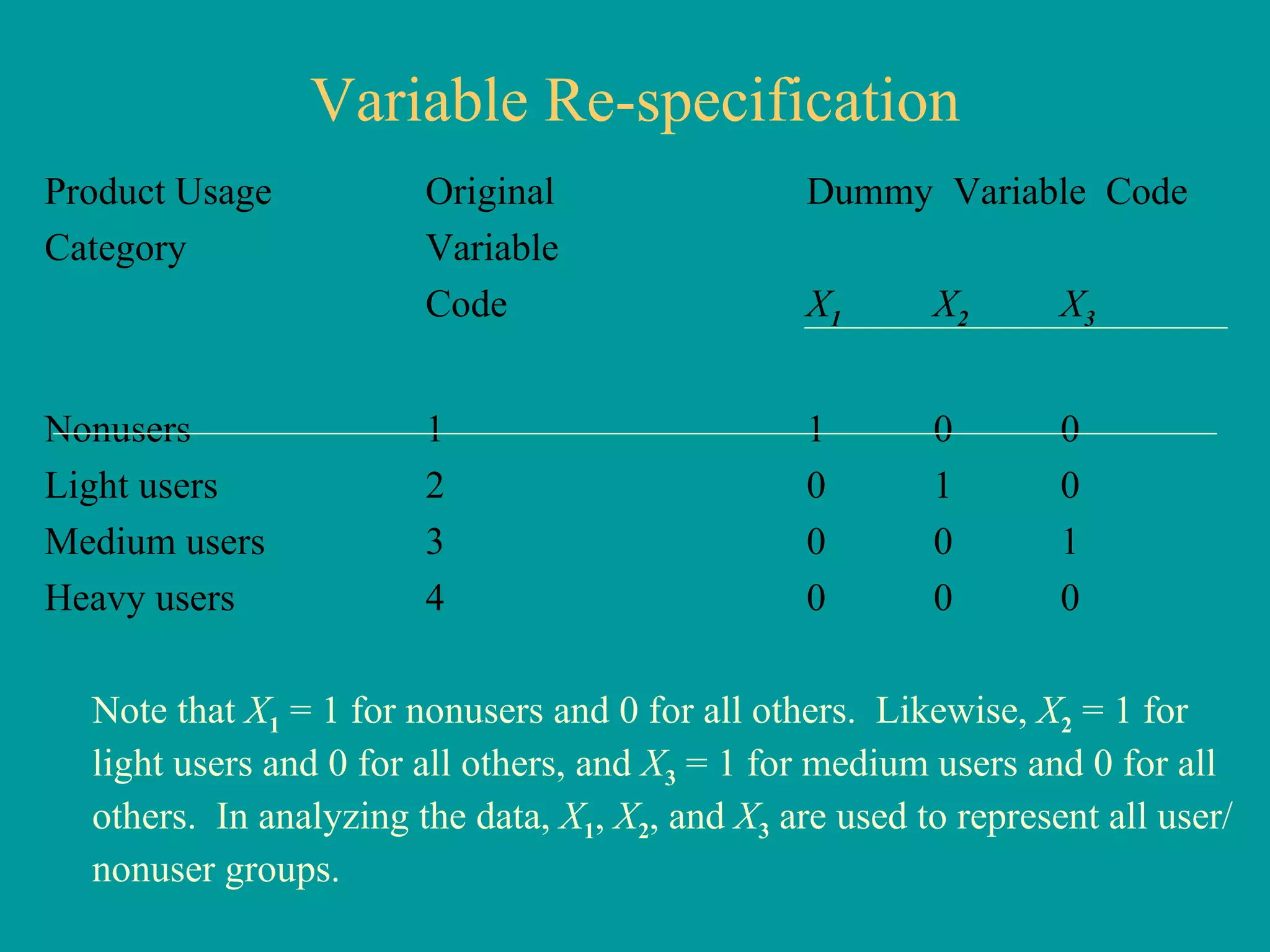
Variable Re-specification Product Usage Original Dummy  Variable  Code Category Variable Code X 1 X 2 X 3 Nonusers 1 1 0 0 Light users 2 0 1 0 Medium users 3 0 0 1 Heavy users 4 0 0 0   Note that  X 1  = 1 for nonusers and 0 for all others.  Likewise,  X 2  = 1 for light users and 0 for all others, and  X 3  = 1 for medium users and 0 for all others.  In analyzing the data,  X 1 ,  X 2 , and  X 3  are used to represent all user/nonuser groups.
Data Transformation Data conversion Changing the original form of the data to a new format More appropriate data analysis New variables
New Variables Collapsing 5-point scale into 3-point scale Collective, average data of respondents and variables Reversal of negative statements Example
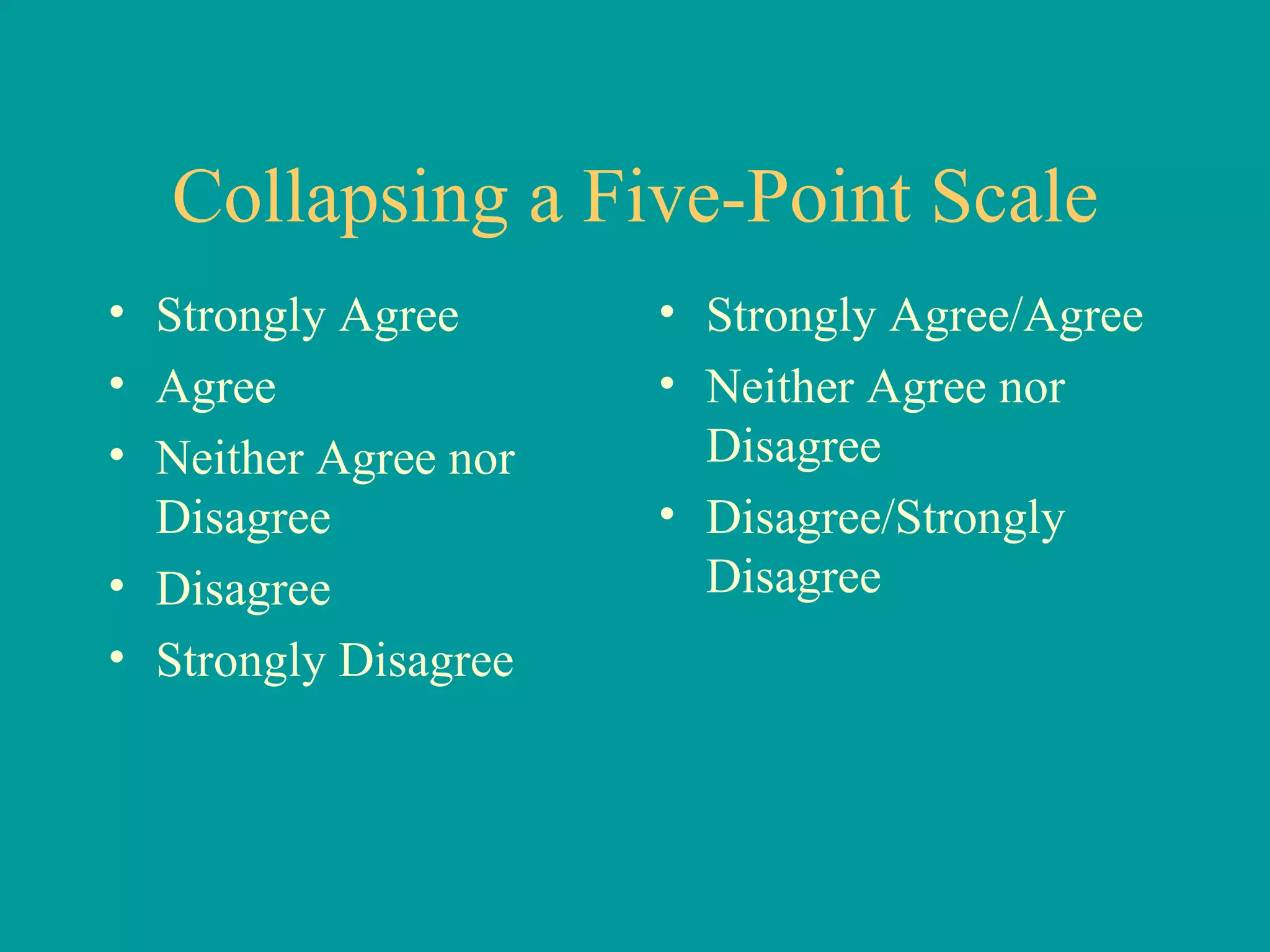
Collapsing a Five-Point Scale Strongly Agree Agree Neither Agree nor Disagree Disagree Strongly Disagree Strongly Agree/Agree Neither Agree nor Disagree Disagree/Strongly Disagree
Descriptive Analysis The transformation of raw data into a form that will make them easy to understand and interpret; rearranging, ordering, and manipulating data to generate descriptive information
Tabulation Tabulation - Orderly arrangement of data in a table or other summary format Frequency table Percentages
Frequency Table The arrangement of statistical data in a row-and-column format that exhibits the count of responses or observations for each category assigned to a variable
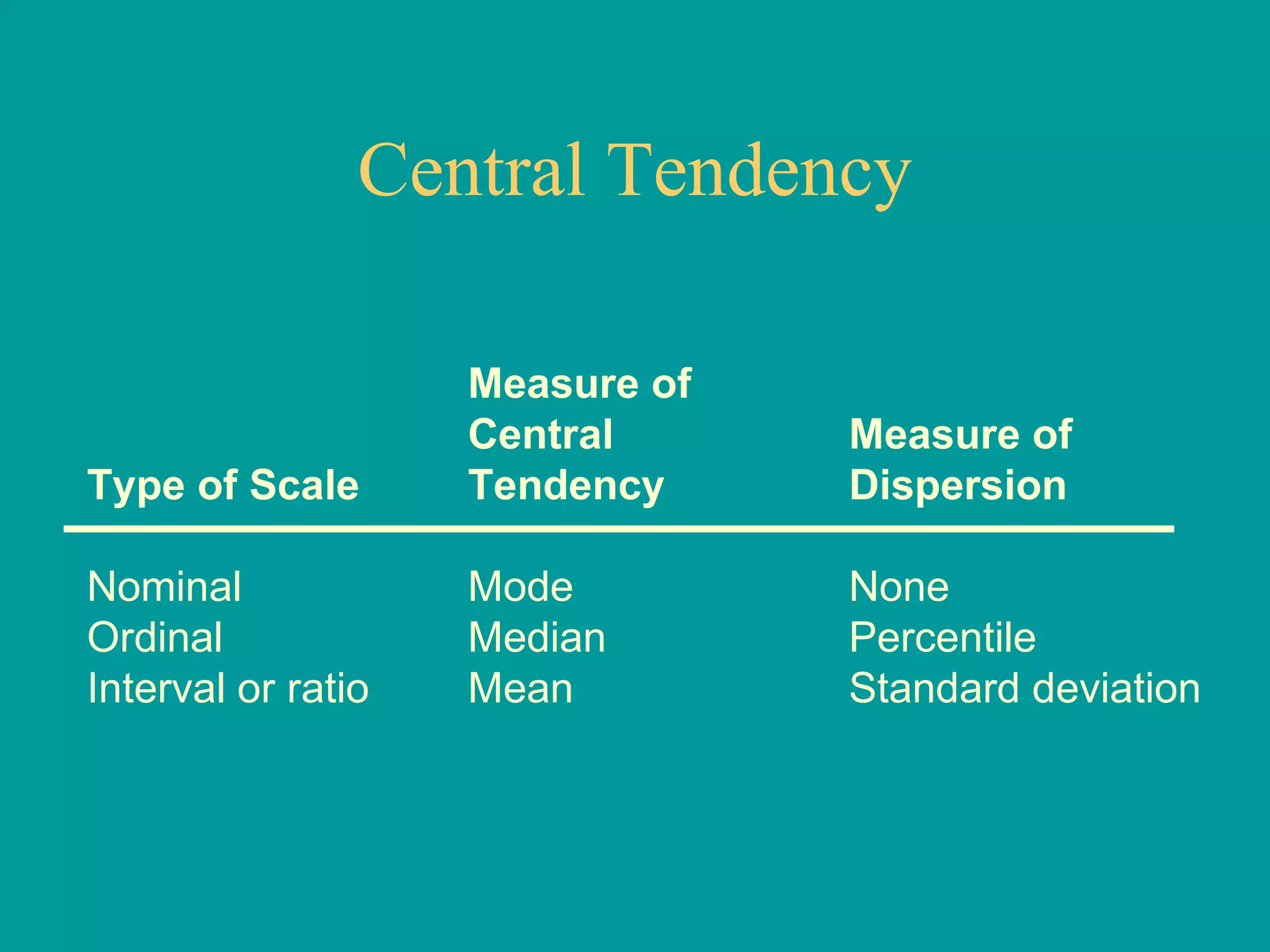
Central Tendency Measure of Central Measure of Type of Scale Tendency Dispersion Nominal Mode None Ordinal Median Percentile Interval or ratio Mean Standard deviation
Cross-Tabulation A technique for organizing data by groups, categories, or classes, thus facilitating comparisons; a joint frequency distribution of observations on two or more sets of variables Contingency table- The results of a cross-tabulation of two variables, such as survey questions
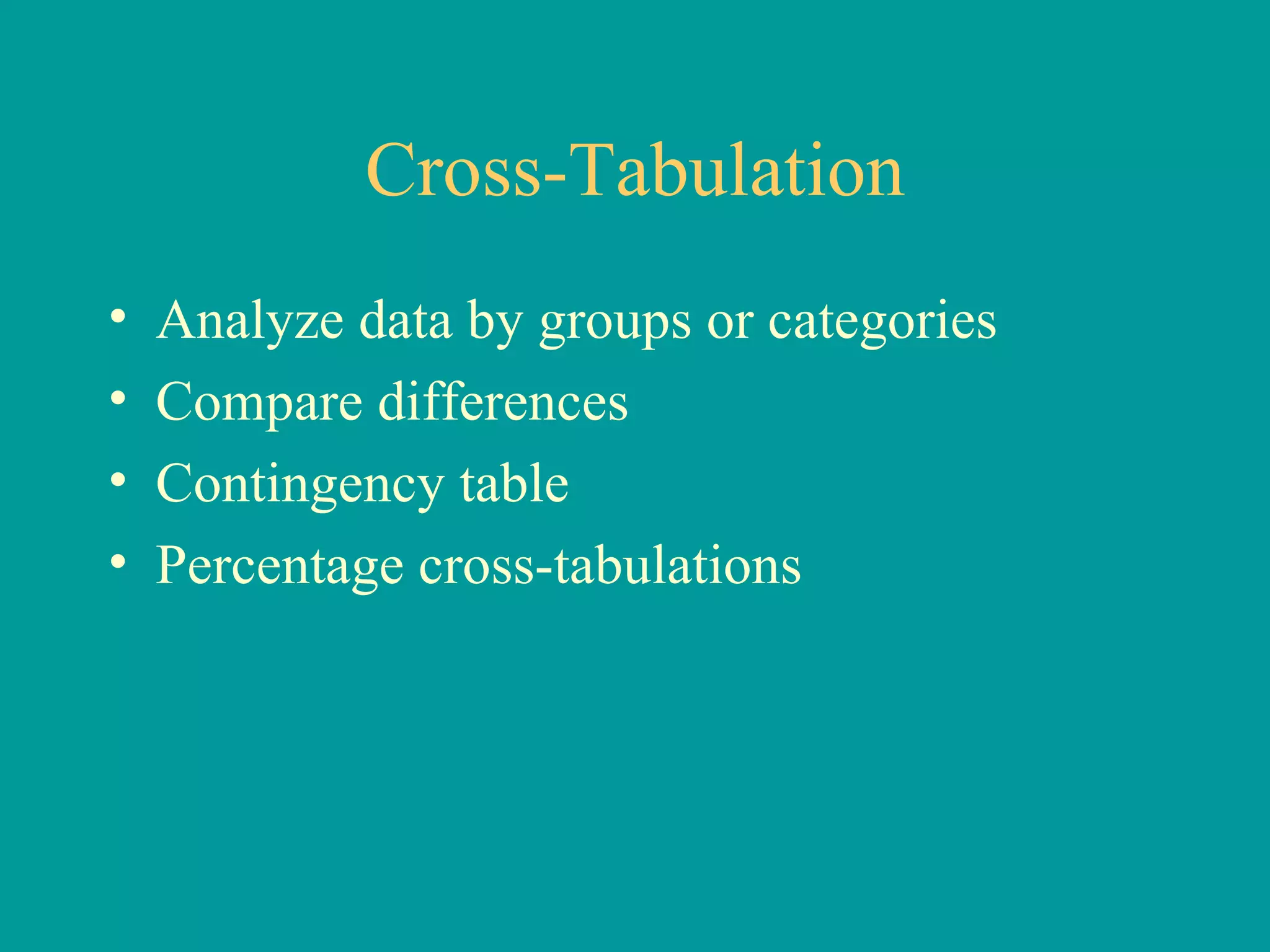
Cross-Tabulation Analyze data by groups or categories Compare differences Contingency table Percentage cross-tabulations
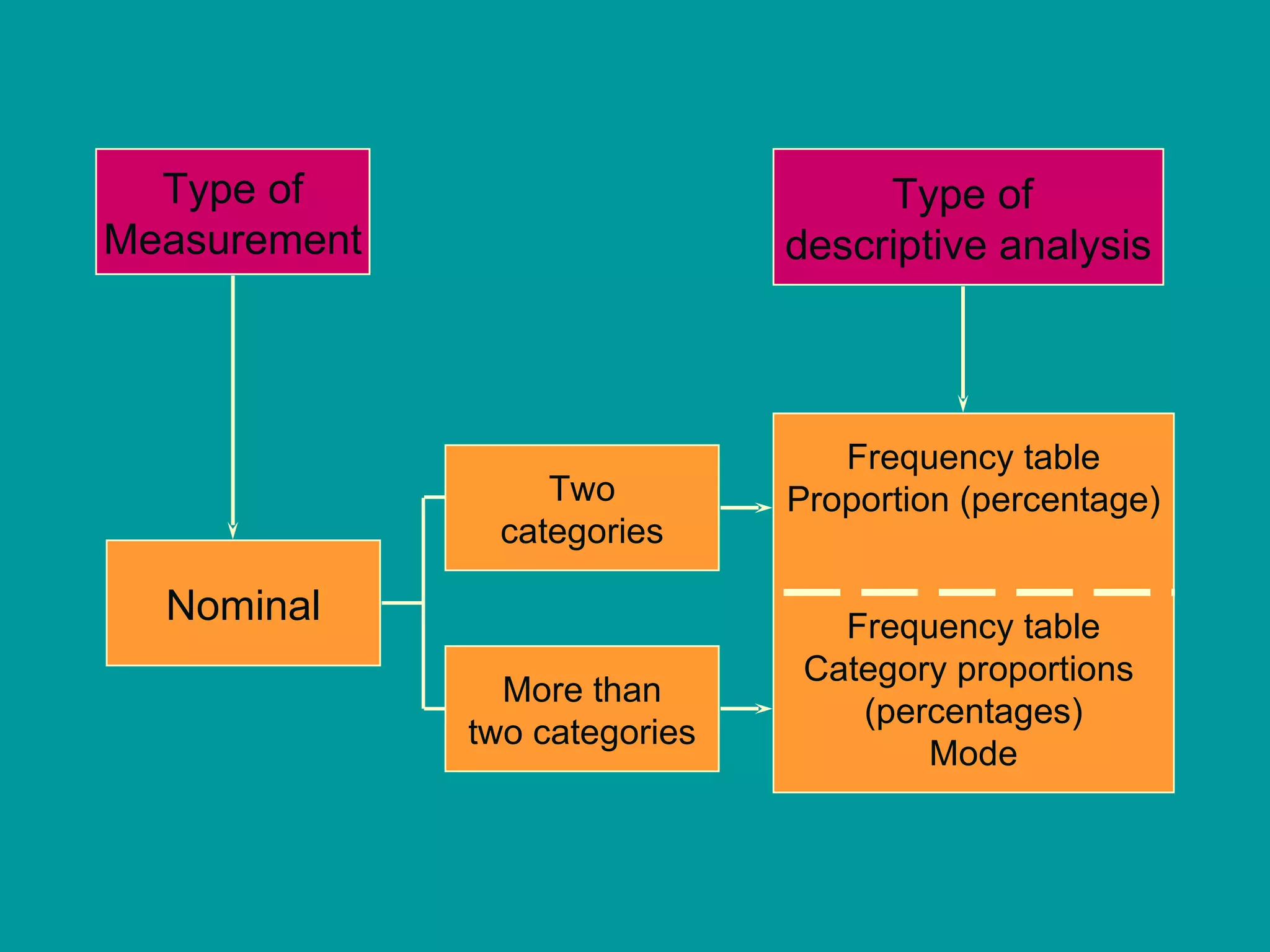
Type of Measurement Nominal Two categories More than two categories Frequency table Proportion (percentage) Frequency table Category proportions  (percentages) Mode Type of  descriptive analysis
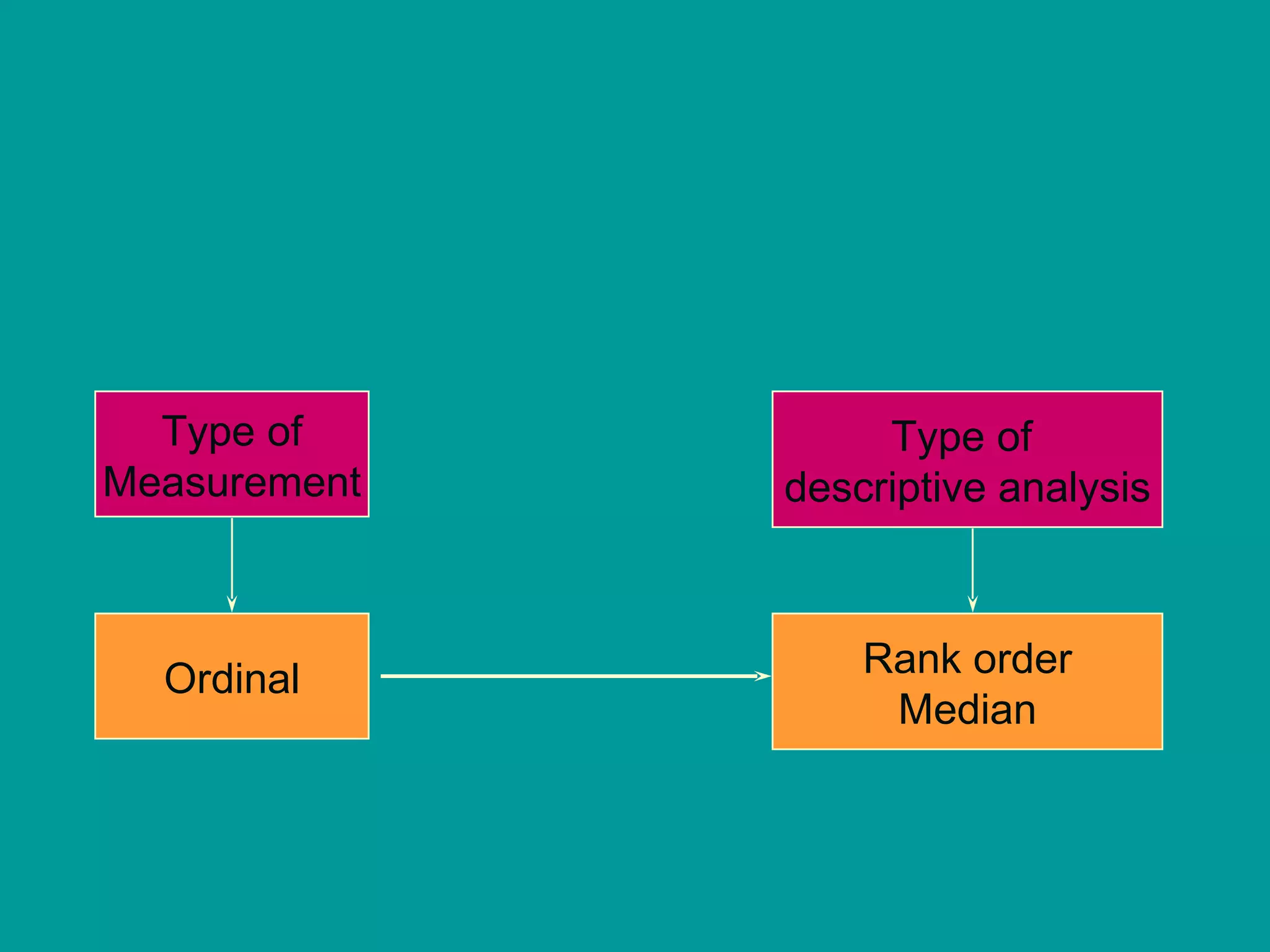
Type of Measurement Type of  descriptive analysis Ordinal Rank order Median
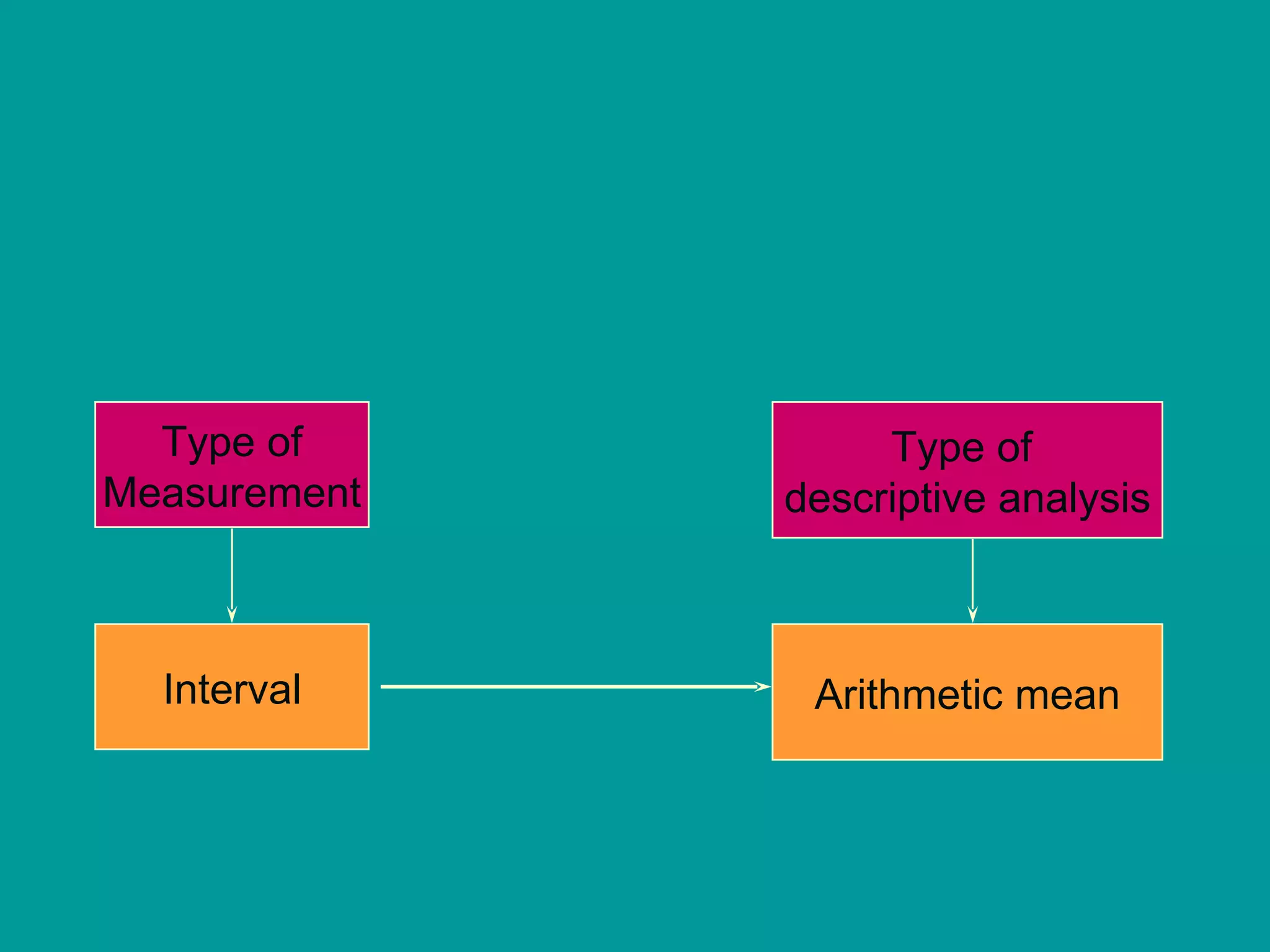
Type of Measurement Type of  descriptive analysis Interval Arithmetic mean
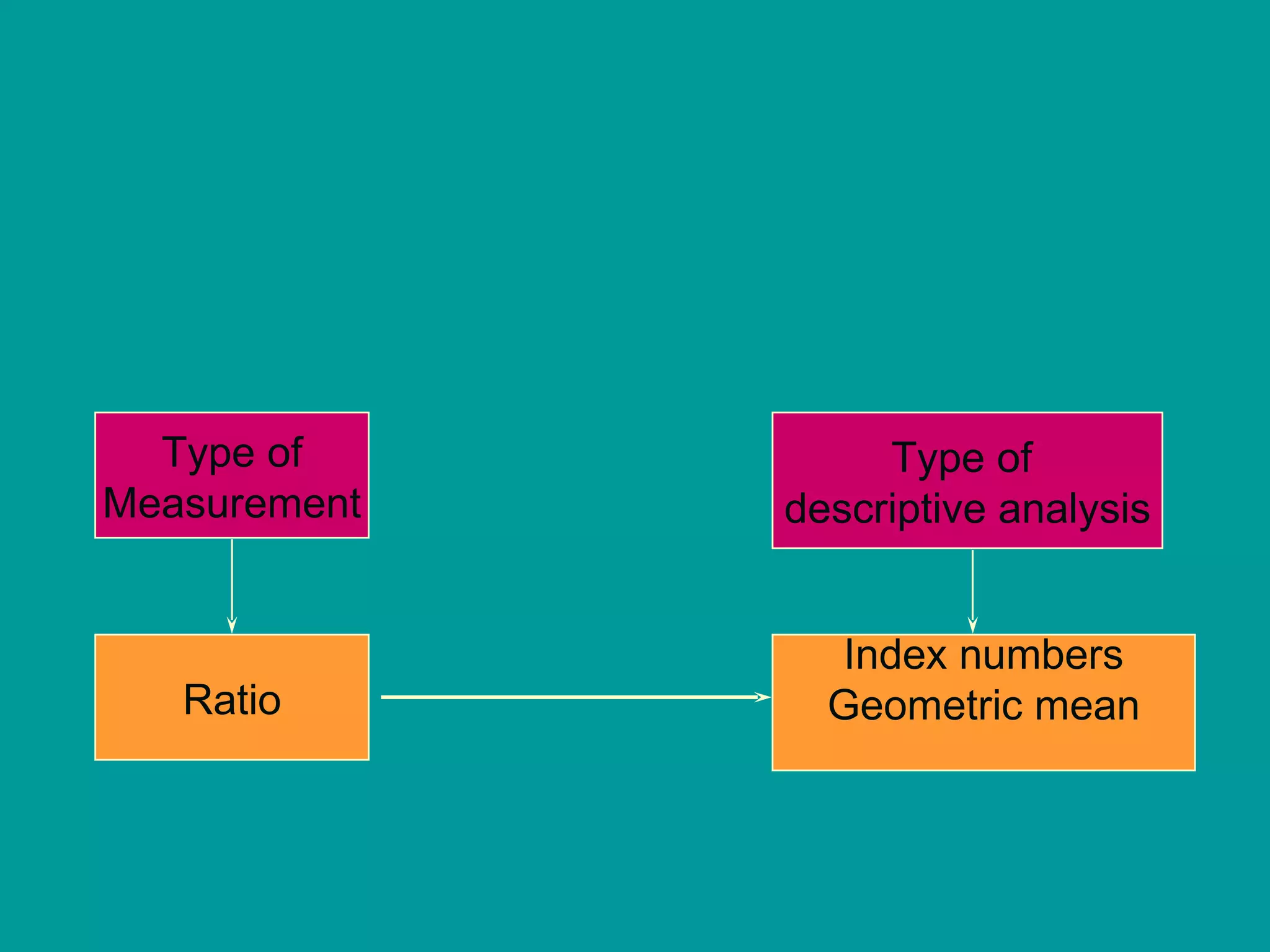
Type of Measurement Type of  descriptive analysis Ratio Index numbers Geometric mean
You are good students-NOW PRACTICE By Dr. Muhammad Ramzan [email_address] ,  03004487844 Edited by Ahsan Khan Eco [email_address] 03008046243

Business Research Methods. data collection preparation and analysis

  • 1.
    Seminar 5 DataCollection, Preparation and Analysis Using SPSS By Dr. Muhammad Ramzan [email_address] , 03004487844 Edited by Ahsan Khan Eco [email_address] 03008046243
  • 2.
    Data Collection-Methods Datacollection method is impacted by the method of research you choose. It is usually done through: Data collection by the individual researcher Collection through hired researchers Collection through firms
  • 3.
    Data Collection-Formats Formatof data is influenced by the method of research, as it could be Printed questionnaires Interview sheets (in-person or telephonic) Focus group notes Observation notes Email or web responses Content analysis notes, pictures, documentaries Printed, e-records, scanned data Literature review
  • 4.
    Data Preparation Preparationof data file It is important to convert raw data into a usable data for analysis The analysis and results will surely depend on the quality of data There are possibilities of errors in handling instruments, raw data, transcribing, data entry, assigning codes, values, value labels Data need to be cleaned to fulfill the analysis conations
  • 5.
    Data Analysis Analysisof data is influenced by a number of factors. They are but not limited to: The purpose of research The type research questions and hypothesis The method of research and format of data Use of software for management, manipulation and analysis of data Researchers skills and capabilities Techniques used for data The quality of the data
  • 6.
    Stages of DataAnalysis ERROR CHECKING AND VERIFICATION EDITING DATA ANALYSIS DATA ENTRY CODING
  • 7.
    Data Preparation ProcessSelect Data Analysis Strategy Prepare Preliminary Plan of Data Analysis Check Questionnaire Edit Code Transcribe Clean Data Statistically Adjust the Data
  • 8.
    Questionnaire Checking Aquestionnaire returned from the field may be unacceptable for several reasons. Parts of the questionnaire may be incomplete. The pattern of responses may indicate that the respondent did not understand or follow the instructions. The responses show little variance. One or more pages are missing. The questionnaire is received after the pre-established cutoff date. The questionnaire is answered by someone who does not qualify for participation.
  • 9.
    Questionnaire Checking Weneed to find valid questionnaires for data analysis Each questionnaire/response need allotment of a case number for future reference Questionnaire/response need filing in an order for retrieval and verification
  • 10.
    Editing of ResponsesTreatment of Unsatisfactory Results Returning to the Field – The questionnaires with unsatisfactory responses may be returned to the field, where the interviewers re-contact the respondents. Assigning Missing Values – If returning the questionnaires to the field is not feasible, the editor may assign missing values to unsatisfactory responses. Discarding Unsatisfactory Respondents – In this approach, the respondents with unsatisfactory responses are simply discarded.
  • 11.
    CONSISTENCY COMPLETENESS QUESTIONS ANSWERED OUT OF ORDER Reasons for Editing
  • 12.
    Editing The processof checking and adjusting the data for omissions for legibility for consistency And readying them for coding and storage
  • 13.
    Codes The rulesfor interpreting, classifying, and recording data in the coding process The actual numerical or other character symbols
  • 14.
    Coding Coding means assigning a code, usually a number, to each possible response to each question. The code includes an indication of the column position (field) and data record it will occupy. Coding Questions Fixed field codes , which mean that the number of records for each respondent is the same and the same data appear in the same column(s) for all respondents, are highly desirable. If possible, standard codes should be used for missing data. Coding of structured questions is relatively simple, since the response options are predetermined. In questions that permit a large number of responses, each possible response option should be assigned a separate column.
  • 15.
    Coding Guidelines forcoding unstructured questions : Category codes should be mutually exclusive and collectively exhaustive. Only a few (10% or less) of the responses should fall into the “other” category. Category codes should be assigned for critical issues even if no one has mentioned them. Data should be coded to retain as much detail as possible .
  • 16.
    Codebook A codebook contains coding instructions and the necessary information about variables in the data set. A codebook generally contains the following information: column number record number variable number variable name question number instructions for coding
  • 17.
    Coding Questionnaires Therespondent code and the record number appear on each record in the data. The first record contains the additional codes: project code, interviewer code, date and time codes, and validation code. It is a good practice to insert blanks between parts Here are examples of coding
  • 18.
    1a. Howmany years have you been playing tennis on a regular basis? Number of years: __________ b. What is your level of play? Novice . . . . . . . . . . . . . . . -1 Advanced . . . . . . . -4 Lower Intermediate . . . . . -2 Expert . . . . . . . . . -5 Upper Intermediate . . . . . -3 Teaching Pro . . . . -6 c. In the last 12 months, has your level of play improved, remained the same or decreased? Improved. . . . . . . . . . . . . . -1 Decreased. . . . . . . -3 Remained the same . . . . . -2
  • 19.
    2a. Doyou belong to a club with tennis facilities? Yes . . . . . . . -1 No . . . . . . . -2 b. How many people in your household - including yourself - play tennis? Number who play tennis ___________ 3a. Why do you play tennis? (Please “X” all that apply.) To have fun . . . . . . . . . . -1 To stay fit. . . . . . . . . . . . -2 To be with friends. . . . . . -3 To improve my game . . . -4 To compete. . . . . . . . . . . -5 To win. . . . . . . . . . . . . . . -6 b. In the past 12 months, have you purchased any tennis instructional books or video tapes? Yes . . . . . . . -1 No . . . . . . . -2
  • 20.
    4. Pleaserate each of the following with regard to this flight, if applicable. Excellent Good Fair Poor 4 3 2 1 Courtesy and Treatment from the: Skycap at airport . . . . . . . . . . . . . . Airport Ticket Counter Agent . . . . . Boarding Point (Gate) Agent . . . . . Flight Attendants . . . . . . . . . . . . . . Your Meal or Snack. . . . . . . . . . . . . Beverage Service . . . . . . . . . . . . . . Seat Comfort. . . . . . . . . . . . . . . . . . Carry-On Stowage Space. . . . . . . . Cabin Cleanliness . . . . . . . . . . . . . Video/Stereo Entertainment . . . . . . On-Time Departure . . . . . . . . . . . .
  • 21.
    “ I believethat people judge your success by the kind of car you drive.” Strongly agree 5 Mildly agree 4 Neither agree nor disagree 3 Mildly agree 2 Strongly disagree 1 Strongly agree + 1 Mildly agree +2 Neither agree nor disagree 0 Mildly agree - 1 Strongly disagree - 2
  • 22.
    Data Transcription Transcriberaw data into testable form Determine variables Convert raw data into meaningful for further processing and answering the research questions and testing hypothesis Assign values, weights, value labels Scanning, data entry
  • 23.
    Data Entry Theprocess of transforming data from the research project to computers Transferring data files from excel to SPSS Optical scanning systems Marked-sensed questionnaires In SPSS open the data view And enter the data Practical session
  • 24.
    Data Cleaning: ConsistencyChecks Consistency checks identify data that are out of range, logically inconsistent, or have extreme values. Computer packages like SPSS, SAS, EXCEL and MINITAB can be programmed to identify out-of-range values for each variable and print out the respondent code, variable code, variable name, record number, column number, and out-of-range value. Extreme values should be closely examined .
  • 25.
    Data Cleaning ThroughSPSS Click analyze in main menu of SPSS data, then click on descriptive analysis, then frequencies Select variable that you want to check Click on statistics and tick minimum and maximum values Click on continue Summary of results will provide each of variable you selected and then breakdown of responses Check if there are inconsistencies Go to data file and remove if there is any You can clean your data using SPSS descriptive analysis features
  • 26.
    Data Cleaning: Treatmentof Missing Responses Substitute a Neutral Value – A neutral value, typically the mean response to the variable, is substituted for the missing responses. Substitute an Imputed Response – The respondents' pattern of responses to other questions are used to impute or calculate a suitable response to the missing questions. In casewise deletion , cases, or respondents, with any missing responses are discarded from the analysis. In pairwise deletion , instead of discarding all cases with any missing values, the researcher uses only the cases or respondents with complete responses for each calculation.
  • 27.
    Statistically Adjusting theData: Weighting In weighting , each case or respondent in the database is assigned a weight to reflect its importance relative to other cases or respondents. Weighting is most widely used to make the sample data more representative of a target population on specific characteristics. Yet another use of weighting is to adjust the sample so that greater importance is attached to respondents with certain characteristics Example
  • 28.
    Variable Re-specification Variablerespecification involves the transformation of data to create new variables or modify existing variables. E.G., the researcher may create new variables that are composites of several other variables. Dummy variables are used for respecifying categorical variables. The general rule is that to respecify a categorical variable with K categories, K -1 dummy variables are needed .
  • 29.
    Variable Re-specification ProductUsage Original Dummy Variable Code Category Variable Code X 1 X 2 X 3 Nonusers 1 1 0 0 Light users 2 0 1 0 Medium users 3 0 0 1 Heavy users 4 0 0 0   Note that X 1 = 1 for nonusers and 0 for all others. Likewise, X 2 = 1 for light users and 0 for all others, and X 3 = 1 for medium users and 0 for all others. In analyzing the data, X 1 , X 2 , and X 3 are used to represent all user/nonuser groups.
  • 30.
    Data Transformation Dataconversion Changing the original form of the data to a new format More appropriate data analysis New variables
  • 31.
    New Variables Collapsing5-point scale into 3-point scale Collective, average data of respondents and variables Reversal of negative statements Example
  • 32.
    Collapsing a Five-PointScale Strongly Agree Agree Neither Agree nor Disagree Disagree Strongly Disagree Strongly Agree/Agree Neither Agree nor Disagree Disagree/Strongly Disagree
  • 33.
    Descriptive Analysis Thetransformation of raw data into a form that will make them easy to understand and interpret; rearranging, ordering, and manipulating data to generate descriptive information
  • 34.
    Tabulation Tabulation -Orderly arrangement of data in a table or other summary format Frequency table Percentages
  • 35.
    Frequency Table Thearrangement of statistical data in a row-and-column format that exhibits the count of responses or observations for each category assigned to a variable
  • 36.
    Central Tendency Measureof Central Measure of Type of Scale Tendency Dispersion Nominal Mode None Ordinal Median Percentile Interval or ratio Mean Standard deviation
  • 37.
    Cross-Tabulation A techniquefor organizing data by groups, categories, or classes, thus facilitating comparisons; a joint frequency distribution of observations on two or more sets of variables Contingency table- The results of a cross-tabulation of two variables, such as survey questions
  • 38.
    Cross-Tabulation Analyze databy groups or categories Compare differences Contingency table Percentage cross-tabulations
  • 39.
    Type of MeasurementNominal Two categories More than two categories Frequency table Proportion (percentage) Frequency table Category proportions (percentages) Mode Type of descriptive analysis
  • 40.
    Type of MeasurementType of descriptive analysis Ordinal Rank order Median
  • 41.
    Type of MeasurementType of descriptive analysis Interval Arithmetic mean
  • 42.
    Type of MeasurementType of descriptive analysis Ratio Index numbers Geometric mean
  • 43.
    You are goodstudents-NOW PRACTICE By Dr. Muhammad Ramzan [email_address] , 03004487844 Edited by Ahsan Khan Eco [email_address] 03008046243