By…
Prof. Sonali R. Pawar
Assistant Professor, Pharmaceutical Chemistry Department,
JSPM’s Charak College of Pharmacy and Research, Wagholi , Pune 412207
FACE TO FACE COMMUNICATION
ELEMENTS OF COMMUNICATION
More than half of message interpretation is from facial
expression and body language. (Forbes)
Even as technology increases the methods we have to
communicate with one another, nothing can replace the value
of a face-to-face conversation.
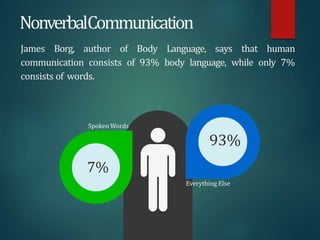
James Borg, author of Body Language, says that human
communication consists of 93% body language, while only 7%
consists of words.
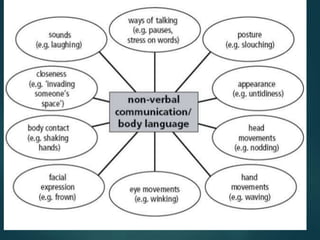
NonverbalCommunication
7%
93%
Spoken Words
Everything Else
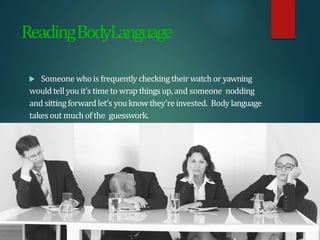
ReadingBodyLanguage
 Someone whois frequently checkingtheir watchor yawning
wouldtell youit’s timeto wrapthingsup,and someone nodding
and sittingforwardlet’s youknowthey’reinvested. Body language
takesout much of the guesswork.
You can also use non-verbal communication to your
advantage.Here’s a tip:
"Writing"BodyLanguage
Waitingin the lobby to join an important meeting? Put the mobile
device awayand read a newspaper–doing so will encourage a
“power pose” and project confidence. (Forbes)
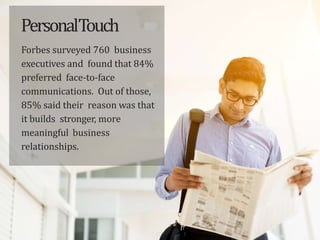
PersonalTouch
Forbes surveyed 760 business
executives and found that 84%
preferred face-to-face
communications. Out of those,
85% said their reason was that
it builds stronger, more
meaningful business
relationships.
BuildingRelationships
Making eye contact is crucial to show
sincerity and establish a firm
connection. The result is especially
valuable when trying to create a
lasting business relationship.
MeetingEffectiveness:
ThingsGetDone
When an issue arises that needs a decision, face-to-face enables you
to reach a consensus more quickly.One simple, 5- minute
conversation can eliminate 15 back and forth emails.
Oftentimes there’s a momentum that results from group face- to-face
collaboration. People are more willing to engage, build off of each
other’s creative energy–and don’t sit back on mute and read emails.
MeetingEffectiveness:
LessMisunderstanding
“Great, this is just what Ineed.”
Sarcasm can be difficult to detect in written,non-verbal,and
sometimes even verbal communication.On the other hand, when
speakingface-to-face there is less chance of perceivinga statement
to be rude or sarcastic when that wasn’t the intention.
The result? Meetingface-to-face helps to eliminate
misunderstandings,and therefore conditions trust.
IncreasedTime:ValueRatio
Meetingface-to-face by video conferencing offers the benefits of
meeting in-person, withoutthe significant travel expenses.
TONE OF VOICE
THEIMPORTANCEOF
THETONEOF VOICE
• According to Albert Mehrabian, the rule to determine a successful
communication is mainly made of three parts: one is the words that being used,
the tone of voice, and one’s body language.
• It must also be taken into consideration that while speaking on telephone,
mobile, or through computer, the other person is unable to see what your body
language is and therefore, this makes the tone of your voice a major contributor
while communicating.
• The tone of voice expresses what you are thinking, how you are feeling, and
what values you have within, so it is not something to be taken lightly.
• Having a wrong tone of voice while speaking to your partner can
instigate hurt feeling.
• Similarly, with a wrong tone of voice you may be putting off some
potential customers. Voice modulation course in Mumbai can be very
helpful to improve and manage your tone of voice.
• With vocal training Mumbai, reap the many benefits of having a better
tone of voice.
It lets your customers know who you are:
• With the right tone of voice, one will be able to advertise the best
side of themselves.
• If your target customers are women and businessmen, then you
would need to have a tone that is more professional and
authoritative.
• On the other hand, if your target customers are teenagers, then
your tone need to be more quirky and light-hearted.
• Having a consistency with your tone of voice over time, will
give you a personal brand and make it all the more likeable.
• Just keep in mind that don’t try to be something you are not. If
you are not really a fun brand, then don’t try hard to be.
• There are various tones of voice to choose from, just choose the
one that will reflect what your genuine values are.
It’s what that will make you different:
• The way you communicate and the tone of voice you use will define the way that
other people will be interpreting you.
• It’s the tone of voice that differentiates one person from another, the way they
speak, the pitch they use, and how softly or loudly one speaks.
• Without tone of voice, every other person would have the same dull
voice.
• It is your tone of voice that distinguishes your innovative, amazing, and
unique self.
• With voice coaching for singers, you can unleash your better self.
One’s tone of voice can help you demonstrate your expertise, warmth,
sense of humor, and other attributes that you desire to display.
It helps you build trust:
• When your customers or people you interact with are able to identify
your tone of voice, they are able to identify your personality as well.
• listeners start to form a mental image of a person based on his/her
tone.
• While this happens, customers start feeling a sense familiarity
and trust for the particular brand associated with the voice.
• Developing a tone of voice that is consistent will help build a
brand that seems more genuine and the customers will feel at
ease as well with this brand.
BODY LANGUAGE
Bodylanguage– “Theprocess of communicating, what you are
feeling or thinking by the way you place and move your body
rather thanby words.”
[ for example ]:The salesman / saleswomen reads the customer's
body languagefor
· understanding what they are thinking.OR
It is the unconscious ad conscious transmission and explanation of
feelings,
attitudes, and moods, through:
 body posture, movement, physical state, position and
relationship to other bodies, objects and surroundings,
 facial expression and eyemovement,
(andthis transmission and interpretation can be quite different to the
spoken words).
ORAL COMMUNICATION: Spoken by words
Categories: Discussion, Debate, Dialogue
Merits: It is economical, immediate feedback, it given the chance for
clarification, it has personal touch, communication with larger public, it is
flexible.
Demerits: Less reliable, not suitable for lengthy messages
WRITTEN COMMUNICATION:
Merits: permanent record, accurate and precise, legal document, assign
responsibility, composing in advance, lengthy massages
Demerits: Time consuming, expensive in term of time, money and energy
 NON VERBAL COMMUNICATION:
Kinetics: Facial expression
Proxemics: Distance use to communicate
Chronemics: Reply by business letter, phone etc
Paralingual: speed, volume
WHY IS BODY LANGUAGE
IMPORTANT ?
Body language can be used to improve your negotiation
skills, your presentation ability and in different social
interactions,includingajob interview.
Reading body language is a valuable key at a job
interview. To succeed over other confronts, you must
be attentive to what silent body gestures, you are
giving off, you also need to be aware of the interview’s
body language.
Body language is usually grouped as :
i. Partsofthe body - From head to toe, here are the groups when
grouped for body parts:
• TheHead- Movement and placement of the head, back to front, left
to right, side to side, including the shaking ofhair.
• FacialExpressions- The face has many muscles (anywhere between 54 and 98,
depending on who you ask) that move several areas of the face. Each combination
of movements of the following face elements communicates a state ofmind:
 Eyebrows - Up, down,frowning.
 Eyes- Left, right, up, down, blinking, eyedialiation.
 Nose- Wrinkle (at the top), flaring of the nostrils.
 Lips- Smiling, snarling, puckered, kissing, opened,closed, tight.
Types of Body Language
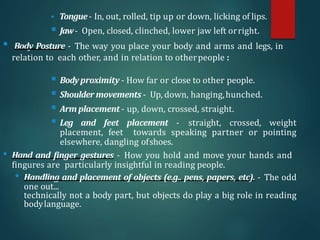
 Tongue- In, out, rolled, tip up or down, licking of lips.
 Jaw- Open, closed, clinched, lower jaw left orright.
• Body Posture - The way you place your body and arms and legs, in
relation to each other, and in relation to otherpeople :
 Bodyproximity - How far or close to other people.
 Shoulder movements - Up, down, hanging,hunched.
 Arm placement - up, down, crossed, straight.
 Leg and feet placement - straight, crossed, weight
placement, feet towards speaking partner or pointing
elsewhere, dangling ofshoes.
• Hand and finger gestures - How you hold and move your hands and
fingures are particularly insightful in reading people.
• Handling and placement of objects (e.g.. pens, papers, etc). - The odd
one out...
technically not a body part, but objects do play a big role in reading
bodylanguage.
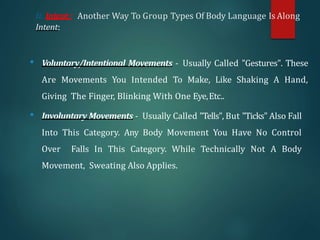
Ii. Intent : Another Way To Group Types Of Body Language Is Along
Intent:
• Voluntary/Intentional Movements - Usually Called "Gestures". These
Are Movements You Intended To Make, Like Shaking A Hand,
Giving The Finger, Blinking With One Eye,Etc..
• Involuntary Movements - Usually Called "Tells", But "Ticks" Also Fall
Into This Category. Any Body Movement You Have No Control
Over Falls In This Category. While Technically Not A Body
Movement, Sweating Also Applies.
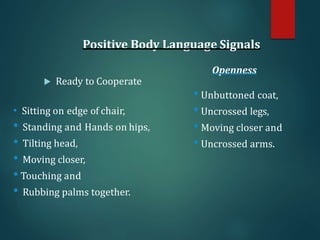
Positive Body Language Signals
 Ready to Cooperate
• Sitting on edge of chair,
• Standing and Hands on hips,
• Tilting head,
• Moving closer,
• Touching and
• Rubbing palms together.
Openness
• Unbuttoned coat,
• Uncrossed legs,
• Moving closer and
• Uncrossed arms.
Evaluation
• Sitting on edge of chair,
• Body leaning forward,
• Slightly tilted ahead,
• Hands on cheek,
• Stroking chin,
• Slightly squinting,
• Slow cleaning of glasses,
• Relaxed mouth, chin
forward and
• Extended eye contact.
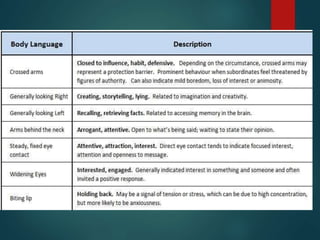
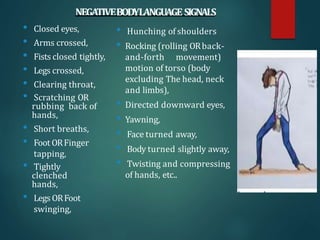
NEGATIVEBODYLANGUAGESIGNALS
• Closed eyes,
• Arms crossed,
• Fists closed tightly,
• Legs crossed,
• Clearing throat,
• Scratching OR
rubbing back of
hands,
• Short breaths,
• Foot ORFinger
tapping,
• Tightly
clenched
hands,
• Legs ORFoot
swinging,
• Hunching of shoulders
• Rocking (rolling ORback-
and-forth movement)
motion of torso (body
excluding The head, neck
and limbs),
• Directed downward eyes,
• Yawning,
• Face turned away,
• Body turned slightly away,
• Twisting and compressing
of hands, etc..
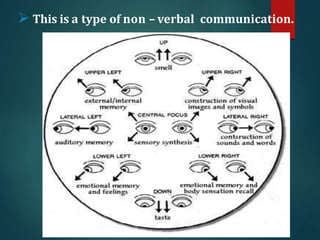
 This is a type of non – verbal communication.
WHAT IS BODY LANGUAGE?
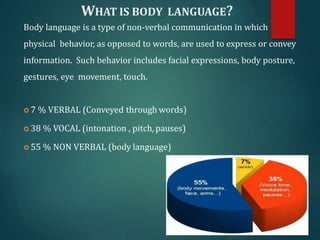
Body language is a type of non-verbal communication in which
physical behavior, as opposed to words, are used to express or convey
information. Such behavior includes facial expressions, body posture,
gestures, eye movement, touch.
 7 % VERBAL (Conveyed through words)
 38 % VOCAL (intonation , pitch,pauses)
 55 % NON VERBAL (body language)
TYPES OF BODY LANGUAGE
There are four types of body language:
Eye contact
Facial expression
Gestures
Posture and stance
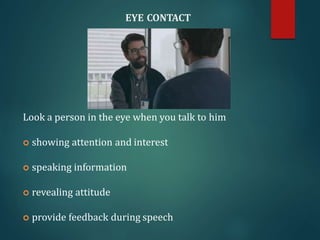
EYE CONTACT
Look a person in the eye when you talk to him
 showing attention and interest
 speaking information
 revealing attitude
 provide feedback during speech
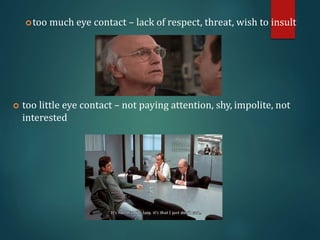
too much eye contact – lack of respect, threat, wish to insult
 too little eye contact – not paying attention, shy, impolite, not
interested
FACIAL EXPRESSION
Can face speak ?
Happiness
Sadness
Anger
Fear
Interest
Displeasure
Gesture And Posture
A Gesture Is A Form Of Non-verbal Communication Or Non-vocal
Communication In Which Visible Bodily Actions Communicate
Particular Messages, Either In Place Of, Or In Conjunction With,
Speech. Gestures Include Movement Of The Hands, Face, Or Other
Parts Of The Body.
Some Common Gestures
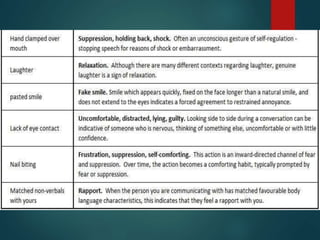
EYE RUB – Avoiding Eye Contact, Lying
CHIN STROKING – Making A Decision
STEEPLING HAND – Request, Frustrated
HAND CLENCHED TOGTHER – Confident
SHOULDER SHRUG – I Don’t Know
FINGER CROSSING - Protection
POSTURE AND STANCE
The position in which someone holds their body when standing or
sitting.
Some common Posture
 Arm folded across chest – unconfident
 Sagging – depression
 Forward lean – positive attitude
 Backward lean – negative attitude
 Sideway lean – relaxation , friends
PHYSICAL COMMUNICATION
Communication by using: Symbol, sign, gesture
 Improve by:
 stress management
 Control anxiety
 Eye contact
 Ask for meaning
 practice

UNIT II Elements of communication

  • 1.
    By… Prof. Sonali R.Pawar Assistant Professor, Pharmaceutical Chemistry Department, JSPM’s Charak College of Pharmacy and Research, Wagholi , Pune 412207 FACE TO FACE COMMUNICATION ELEMENTS OF COMMUNICATION
  • 2.
    More than halfof message interpretation is from facial expression and body language. (Forbes) Even as technology increases the methods we have to communicate with one another, nothing can replace the value of a face-to-face conversation.
  • 3.
    James Borg, authorof Body Language, says that human communication consists of 93% body language, while only 7% consists of words. NonverbalCommunication 7% 93% Spoken Words Everything Else
  • 4.
    ReadingBodyLanguage  Someone whoisfrequently checkingtheir watchor yawning wouldtell youit’s timeto wrapthingsup,and someone nodding and sittingforwardlet’s youknowthey’reinvested. Body language takesout much of the guesswork.
  • 5.
    You can alsouse non-verbal communication to your advantage.Here’s a tip: "Writing"BodyLanguage Waitingin the lobby to join an important meeting? Put the mobile device awayand read a newspaper–doing so will encourage a “power pose” and project confidence. (Forbes)
  • 6.
    PersonalTouch Forbes surveyed 760business executives and found that 84% preferred face-to-face communications. Out of those, 85% said their reason was that it builds stronger, more meaningful business relationships.
  • 7.
    BuildingRelationships Making eye contactis crucial to show sincerity and establish a firm connection. The result is especially valuable when trying to create a lasting business relationship.
  • 8.
    MeetingEffectiveness: ThingsGetDone When an issuearises that needs a decision, face-to-face enables you to reach a consensus more quickly.One simple, 5- minute conversation can eliminate 15 back and forth emails. Oftentimes there’s a momentum that results from group face- to-face collaboration. People are more willing to engage, build off of each other’s creative energy–and don’t sit back on mute and read emails.
  • 9.
    MeetingEffectiveness: LessMisunderstanding “Great, this isjust what Ineed.” Sarcasm can be difficult to detect in written,non-verbal,and sometimes even verbal communication.On the other hand, when speakingface-to-face there is less chance of perceivinga statement to be rude or sarcastic when that wasn’t the intention. The result? Meetingface-to-face helps to eliminate misunderstandings,and therefore conditions trust.
  • 10.
    IncreasedTime:ValueRatio Meetingface-to-face by videoconferencing offers the benefits of meeting in-person, withoutthe significant travel expenses.
  • 11.
  • 12.
    • According toAlbert Mehrabian, the rule to determine a successful communication is mainly made of three parts: one is the words that being used, the tone of voice, and one’s body language. • It must also be taken into consideration that while speaking on telephone, mobile, or through computer, the other person is unable to see what your body language is and therefore, this makes the tone of your voice a major contributor while communicating. • The tone of voice expresses what you are thinking, how you are feeling, and what values you have within, so it is not something to be taken lightly.
  • 13.
    • Having awrong tone of voice while speaking to your partner can instigate hurt feeling. • Similarly, with a wrong tone of voice you may be putting off some potential customers. Voice modulation course in Mumbai can be very helpful to improve and manage your tone of voice. • With vocal training Mumbai, reap the many benefits of having a better tone of voice.
  • 14.
    It lets yourcustomers know who you are: • With the right tone of voice, one will be able to advertise the best side of themselves. • If your target customers are women and businessmen, then you would need to have a tone that is more professional and authoritative. • On the other hand, if your target customers are teenagers, then your tone need to be more quirky and light-hearted.
  • 15.
    • Having aconsistency with your tone of voice over time, will give you a personal brand and make it all the more likeable. • Just keep in mind that don’t try to be something you are not. If you are not really a fun brand, then don’t try hard to be. • There are various tones of voice to choose from, just choose the one that will reflect what your genuine values are.
  • 16.
    It’s what thatwill make you different: • The way you communicate and the tone of voice you use will define the way that other people will be interpreting you. • It’s the tone of voice that differentiates one person from another, the way they speak, the pitch they use, and how softly or loudly one speaks. • Without tone of voice, every other person would have the same dull voice. • It is your tone of voice that distinguishes your innovative, amazing, and unique self.
  • 17.
    • With voicecoaching for singers, you can unleash your better self. One’s tone of voice can help you demonstrate your expertise, warmth, sense of humor, and other attributes that you desire to display. It helps you build trust: • When your customers or people you interact with are able to identify your tone of voice, they are able to identify your personality as well. • listeners start to form a mental image of a person based on his/her tone.
  • 18.
    • While thishappens, customers start feeling a sense familiarity and trust for the particular brand associated with the voice. • Developing a tone of voice that is consistent will help build a brand that seems more genuine and the customers will feel at ease as well with this brand.
  • 19.
    BODY LANGUAGE Bodylanguage– “Theprocessof communicating, what you are feeling or thinking by the way you place and move your body rather thanby words.” [ for example ]:The salesman / saleswomen reads the customer's body languagefor · understanding what they are thinking.OR
  • 20.
    It is theunconscious ad conscious transmission and explanation of feelings, attitudes, and moods, through:  body posture, movement, physical state, position and relationship to other bodies, objects and surroundings,  facial expression and eyemovement, (andthis transmission and interpretation can be quite different to the spoken words).
  • 22.
    ORAL COMMUNICATION: Spokenby words Categories: Discussion, Debate, Dialogue Merits: It is economical, immediate feedback, it given the chance for clarification, it has personal touch, communication with larger public, it is flexible. Demerits: Less reliable, not suitable for lengthy messages WRITTEN COMMUNICATION: Merits: permanent record, accurate and precise, legal document, assign responsibility, composing in advance, lengthy massages Demerits: Time consuming, expensive in term of time, money and energy
  • 23.
     NON VERBALCOMMUNICATION: Kinetics: Facial expression Proxemics: Distance use to communicate Chronemics: Reply by business letter, phone etc Paralingual: speed, volume
  • 24.
    WHY IS BODYLANGUAGE IMPORTANT ?
  • 25.
    Body language canbe used to improve your negotiation skills, your presentation ability and in different social interactions,includingajob interview. Reading body language is a valuable key at a job interview. To succeed over other confronts, you must be attentive to what silent body gestures, you are giving off, you also need to be aware of the interview’s body language.
  • 26.
    Body language isusually grouped as : i. Partsofthe body - From head to toe, here are the groups when grouped for body parts: • TheHead- Movement and placement of the head, back to front, left to right, side to side, including the shaking ofhair. • FacialExpressions- The face has many muscles (anywhere between 54 and 98, depending on who you ask) that move several areas of the face. Each combination of movements of the following face elements communicates a state ofmind:  Eyebrows - Up, down,frowning.  Eyes- Left, right, up, down, blinking, eyedialiation.  Nose- Wrinkle (at the top), flaring of the nostrils.  Lips- Smiling, snarling, puckered, kissing, opened,closed, tight. Types of Body Language
  • 27.
     Tongue- In,out, rolled, tip up or down, licking of lips.  Jaw- Open, closed, clinched, lower jaw left orright. • Body Posture - The way you place your body and arms and legs, in relation to each other, and in relation to otherpeople :  Bodyproximity - How far or close to other people.  Shoulder movements - Up, down, hanging,hunched.  Arm placement - up, down, crossed, straight.  Leg and feet placement - straight, crossed, weight placement, feet towards speaking partner or pointing elsewhere, dangling ofshoes. • Hand and finger gestures - How you hold and move your hands and fingures are particularly insightful in reading people. • Handling and placement of objects (e.g.. pens, papers, etc). - The odd one out... technically not a body part, but objects do play a big role in reading bodylanguage.
  • 28.
    Ii. Intent :Another Way To Group Types Of Body Language Is Along Intent: • Voluntary/Intentional Movements - Usually Called "Gestures". These Are Movements You Intended To Make, Like Shaking A Hand, Giving The Finger, Blinking With One Eye,Etc.. • Involuntary Movements - Usually Called "Tells", But "Ticks" Also Fall Into This Category. Any Body Movement You Have No Control Over Falls In This Category. While Technically Not A Body Movement, Sweating Also Applies.
  • 31.
    Positive Body LanguageSignals  Ready to Cooperate • Sitting on edge of chair, • Standing and Hands on hips, • Tilting head, • Moving closer, • Touching and • Rubbing palms together. Openness • Unbuttoned coat, • Uncrossed legs, • Moving closer and • Uncrossed arms.
  • 32.
    Evaluation • Sitting onedge of chair, • Body leaning forward, • Slightly tilted ahead, • Hands on cheek, • Stroking chin, • Slightly squinting, • Slow cleaning of glasses, • Relaxed mouth, chin forward and • Extended eye contact.
  • 33.
    NEGATIVEBODYLANGUAGESIGNALS • Closed eyes, •Arms crossed, • Fists closed tightly, • Legs crossed, • Clearing throat, • Scratching OR rubbing back of hands, • Short breaths, • Foot ORFinger tapping, • Tightly clenched hands, • Legs ORFoot swinging, • Hunching of shoulders • Rocking (rolling ORback- and-forth movement) motion of torso (body excluding The head, neck and limbs), • Directed downward eyes, • Yawning, • Face turned away, • Body turned slightly away, • Twisting and compressing of hands, etc..
  • 35.
     This isa type of non – verbal communication.
  • 36.
    WHAT IS BODYLANGUAGE? Body language is a type of non-verbal communication in which physical behavior, as opposed to words, are used to express or convey information. Such behavior includes facial expressions, body posture, gestures, eye movement, touch.  7 % VERBAL (Conveyed through words)  38 % VOCAL (intonation , pitch,pauses)  55 % NON VERBAL (body language)
  • 37.
    TYPES OF BODYLANGUAGE There are four types of body language: Eye contact Facial expression Gestures Posture and stance
  • 38.
    EYE CONTACT Look aperson in the eye when you talk to him  showing attention and interest  speaking information  revealing attitude  provide feedback during speech
  • 39.
    too much eyecontact – lack of respect, threat, wish to insult  too little eye contact – not paying attention, shy, impolite, not interested
  • 40.
    FACIAL EXPRESSION Can facespeak ? Happiness Sadness Anger Fear Interest Displeasure
  • 41.
    Gesture And Posture AGesture Is A Form Of Non-verbal Communication Or Non-vocal Communication In Which Visible Bodily Actions Communicate Particular Messages, Either In Place Of, Or In Conjunction With, Speech. Gestures Include Movement Of The Hands, Face, Or Other Parts Of The Body. Some Common Gestures EYE RUB – Avoiding Eye Contact, Lying CHIN STROKING – Making A Decision STEEPLING HAND – Request, Frustrated HAND CLENCHED TOGTHER – Confident SHOULDER SHRUG – I Don’t Know FINGER CROSSING - Protection
  • 42.
    POSTURE AND STANCE Theposition in which someone holds their body when standing or sitting. Some common Posture  Arm folded across chest – unconfident  Sagging – depression  Forward lean – positive attitude  Backward lean – negative attitude  Sideway lean – relaxation , friends PHYSICAL COMMUNICATION Communication by using: Symbol, sign, gesture  Improve by:  stress management  Control anxiety  Eye contact  Ask for meaning  practice