
1
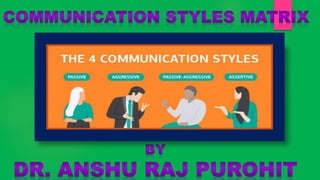
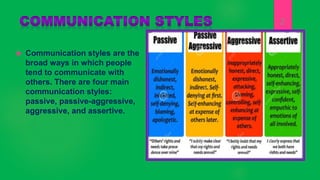
 Communication styles are the
broad ways in which people
tend to communicate with
others. There are four main
communication styles:
passive, passive-aggressive,
aggressive, and assertive.
2
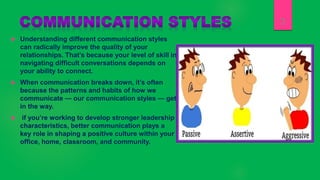
 Understanding different communication styles
can radically improve the quality of your
relationships. That’s because your level of skill in
navigating difficult conversations depends on
your ability to connect.
 When communication breaks down, it’s often
because the patterns and habits of how we
communicate — our communication styles — get
in the way.
 if you’re working to develop stronger leadership
characteristics, better communication plays a
key role in shaping a positive culture within your
office, home, classroom, and community.
3
 Our communication styles have the power to build meaningful
connections, a crucial aspect of success in any area of life. Here are
just a few reasons why we need to connect:
4
 Interpersonal connections have a positive
impact on physical and mental health, while
poor social connection has ill effects on
well-being.
 Those who feel connected to others
have lower rates of depression and anxiety.
 People with meaningful connections live
longer.
 Good communication skills and the ability
to connect with others directly correlates
with career success and job performance.
 Effective communication style builds a
strong, healthy family environment.
5
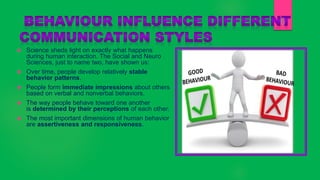
 Science sheds light on exactly what happens
during human interaction. The Social and Neuro
Sciences, just to name two, have shown us:
 Over time, people develop relatively stable
behavior patterns.
 People form immediate impressions about others
based on verbal and nonverbal behaviors.
 The way people behave toward one another
is determined by their perceptions of each other.
 The most important dimensions of human behavior
are assertiveness and responsiveness.
6
 Our communication habits often
don’t reflect our dynamic
thoughts and emotions, giving
others the wrong impression of
what we want to communicate.
These habits affect the way
others perceive and respond to
us during interactions.
7
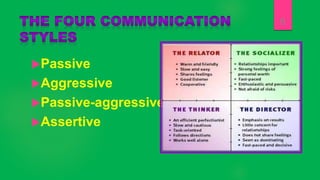
Passive
Aggressive
Passive-aggressive
Assertive
8
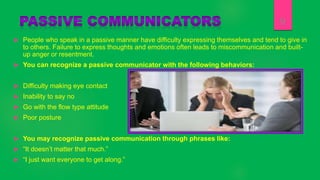
 People who speak in a passive manner have difficulty expressing themselves and tend to give in
to others. Failure to express thoughts and emotions often leads to miscommunication and built-
up anger or resentment.
 You can recognize a passive communicator with the following behaviors:
 Difficulty making eye contact
 Inability to say no
 Go with the flow type attitude
 Poor posture
 You may recognize passive communication through phrases like:
 “It doesn’t matter that much.”
 “I just want everyone to get along.”
9
 Aggressive communication takes things to the other side of the spectrum. People who rely on this
communication style in the workplace, at home, or among friends tend to dominate the conversation.
They issue commands and ask questions rudely while failing to listen to others.
 It’s always “me, me, me.”In positions of authority, they may be more of a boss vs a leader.
 You can recognize an aggressive communicator with the following behaviors:
 Talks over other people
 Poor listening, interrupts frequently
 Controlling or demanding
 Points fingers
 Stares and glares intensely
 Frowns
 Criticizes, intimidates, or threatens others
 You may recognize aggressive communication through phrases like:
 “It’s my way or the highway.”
 “I’m right, and you’re wrong.”
 “Because I said so.”
 “I’m entitled.”
10
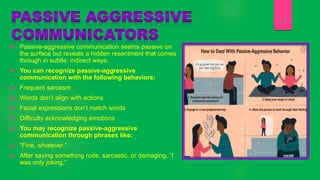
 Passive-aggressive communication seems passive on
the surface but reveals a hidden resentment that comes
through in subtle, indirect ways.
 You can recognize passive-aggressive
communication with the following behaviors:
 Frequent sarcasm
 Words don’t align with actions
 Facial expressions don’t match words
 Difficulty acknowledging emotions
 You may recognize passive-aggressive
communication through phrases like:
 “Fine, whatever.”
 After saying something rude, sarcastic, or damaging, “I
was only joking.”
11
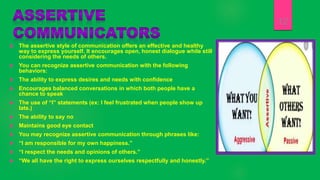
 The assertive style of communication offers an effective and healthy
way to express yourself. It encourages open, honest dialogue while still
considering the needs of others.
 You can recognize assertive communication with the following
behaviors:
 The ability to express desires and needs with confidence
 Encourages balanced conversations in which both people have a
chance to speak
 The use of “I” statements (ex: I feel frustrated when people show up
late.)
 The ability to say no
 Maintains good eye contact
 You may recognize assertive communication through phrases like:
 “I am responsible for my own happiness.”
 “I respect the needs and opinions of others.”
 “We all have the right to express ourselves respectfully and honestly.”
12
 When you find yourself falling into aggressive,
passive, or passive-aggressive patterns, it’s time
to learn a new communication style to create
healthier interactions. You can learn to recognize
your communication tendencies and adjust your
patterns.
 Assertive communication fosters an environment
that allows both the speaker and listener to
express themselves openly and respectfully. It
requires being open, honest, and direct — but not
aggressive.
13
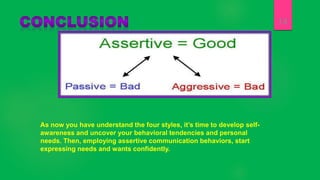
As now you have understand the four styles, it’s time to develop self-
awareness and uncover your behavioral tendencies and personal
needs. Then, employing assertive communication behaviors, start
expressing needs and wants confidently.
14
15

Communication styles matrix

  • 1.
  • 2.
     Communication stylesare the broad ways in which people tend to communicate with others. There are four main communication styles: passive, passive-aggressive, aggressive, and assertive. 2
  • 3.
     Understanding differentcommunication styles can radically improve the quality of your relationships. That’s because your level of skill in navigating difficult conversations depends on your ability to connect.  When communication breaks down, it’s often because the patterns and habits of how we communicate — our communication styles — get in the way.  if you’re working to develop stronger leadership characteristics, better communication plays a key role in shaping a positive culture within your office, home, classroom, and community. 3
  • 4.
     Our communicationstyles have the power to build meaningful connections, a crucial aspect of success in any area of life. Here are just a few reasons why we need to connect: 4
  • 5.
     Interpersonal connectionshave a positive impact on physical and mental health, while poor social connection has ill effects on well-being.  Those who feel connected to others have lower rates of depression and anxiety.  People with meaningful connections live longer.  Good communication skills and the ability to connect with others directly correlates with career success and job performance.  Effective communication style builds a strong, healthy family environment. 5
  • 6.
     Science shedslight on exactly what happens during human interaction. The Social and Neuro Sciences, just to name two, have shown us:  Over time, people develop relatively stable behavior patterns.  People form immediate impressions about others based on verbal and nonverbal behaviors.  The way people behave toward one another is determined by their perceptions of each other.  The most important dimensions of human behavior are assertiveness and responsiveness. 6
  • 7.
     Our communicationhabits often don’t reflect our dynamic thoughts and emotions, giving others the wrong impression of what we want to communicate. These habits affect the way others perceive and respond to us during interactions. 7
  • 8.
  • 9.
     People whospeak in a passive manner have difficulty expressing themselves and tend to give in to others. Failure to express thoughts and emotions often leads to miscommunication and built- up anger or resentment.  You can recognize a passive communicator with the following behaviors:  Difficulty making eye contact  Inability to say no  Go with the flow type attitude  Poor posture  You may recognize passive communication through phrases like:  “It doesn’t matter that much.”  “I just want everyone to get along.” 9
  • 10.
     Aggressive communicationtakes things to the other side of the spectrum. People who rely on this communication style in the workplace, at home, or among friends tend to dominate the conversation. They issue commands and ask questions rudely while failing to listen to others.  It’s always “me, me, me.”In positions of authority, they may be more of a boss vs a leader.  You can recognize an aggressive communicator with the following behaviors:  Talks over other people  Poor listening, interrupts frequently  Controlling or demanding  Points fingers  Stares and glares intensely  Frowns  Criticizes, intimidates, or threatens others  You may recognize aggressive communication through phrases like:  “It’s my way or the highway.”  “I’m right, and you’re wrong.”  “Because I said so.”  “I’m entitled.” 10
  • 11.
     Passive-aggressive communicationseems passive on the surface but reveals a hidden resentment that comes through in subtle, indirect ways.  You can recognize passive-aggressive communication with the following behaviors:  Frequent sarcasm  Words don’t align with actions  Facial expressions don’t match words  Difficulty acknowledging emotions  You may recognize passive-aggressive communication through phrases like:  “Fine, whatever.”  After saying something rude, sarcastic, or damaging, “I was only joking.” 11
  • 12.
     The assertivestyle of communication offers an effective and healthy way to express yourself. It encourages open, honest dialogue while still considering the needs of others.  You can recognize assertive communication with the following behaviors:  The ability to express desires and needs with confidence  Encourages balanced conversations in which both people have a chance to speak  The use of “I” statements (ex: I feel frustrated when people show up late.)  The ability to say no  Maintains good eye contact  You may recognize assertive communication through phrases like:  “I am responsible for my own happiness.”  “I respect the needs and opinions of others.”  “We all have the right to express ourselves respectfully and honestly.” 12
  • 13.
     When youfind yourself falling into aggressive, passive, or passive-aggressive patterns, it’s time to learn a new communication style to create healthier interactions. You can learn to recognize your communication tendencies and adjust your patterns.  Assertive communication fosters an environment that allows both the speaker and listener to express themselves openly and respectfully. It requires being open, honest, and direct — but not aggressive. 13
  • 14.
    As now youhave understand the four styles, it’s time to develop self- awareness and uncover your behavioral tendencies and personal needs. Then, employing assertive communication behaviors, start expressing needs and wants confidently. 14
  • 15.