COMMUNICATION SKILLS
BY
Dr. NUKALA APARNA
PHARM.D
COURSE OBJECTIVES
Upon completion of the course the student shall be able to:
1. Understand the behavioral needs for a pharmacist to function effectively
in areas of pharmaceutical operation.
2. Communicate effectively (Verbal and Non Verbal)
3. Effectively manage the team as team player.
4. Develop interview skills.
5. Develop leadership qualities and essentials.
ABOUT
1. Totally we have 5 units.
2. Mainly we are going to study about the skills involved in speaking,
listening, reading and writing.
UNIT-I
In this mainly we are going to study about the introduction, definition,
importance, barriers and perspectives involved in communication.
UNIT-1(a)
COMMUNICATION SKILS
INTRODUCTION:
 Communication is both an art and a science.
 It often involves acts of speaking and listening, reading and writing, but it also goes
beyond these and incorporates the transmission of non-verbal language/sign
language, codes transmitted electronically (e.g., Morse code), and physically (touch,
hormones, muscles, tendons, nerves), and messages communicated through music,
and by other means.
 The act of communicating verbally serves to convey how we feel and how we think to
others. It is also the basis of how we relate with others, using language as its
medium.
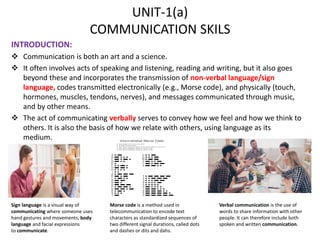
Sign language is a visual way of
communicating where someone uses
hand gestures and movements, body
language and facial expressions
to communicate.
Morse code is a method used in
telecommunication to encode text
characters as standardized sequences of
two different signal durations, called dots
and dashes or dits and dahs.
Verbal communication is the use of
words to share information with other
people. It can therefore include both
spoken and written communication.
DEFINITION
 Communication is giving, receiving or exchanging ideas, data, information,
signals or messages through appropriate media, enabling individuals or
groups to persuade, to seek information, to give information or to express
emotions.
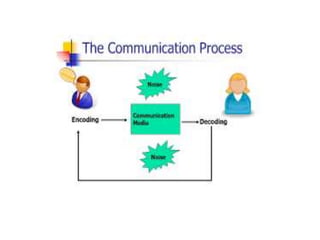
 Communication is usually a two-way process.
IMPORTANCE
 The communication brings people together, closer to each other.
 The communication is an important management function closely
associated with all other managerial functions.
 It bridges the gap between individuals and groups through flow of
information and understanding between them.
 Communication is a continuous process which mainly involves three
elements viz. sender, message and receiver.
CONTEXT
 Context refers to the setting in which communication takes place.
The context helps to establish meaning and can influence what is said and
how it is said.
 There are at least four aspects in regards to this idea: physical, cultural,
social-psychological, and temporal
Communication skills; B.PHARMACY 1 SEMESTER

Communication skills; B.PHARMACY 1 SEMESTER

  • 1.
  • 2.
    COURSE OBJECTIVES Upon completionof the course the student shall be able to: 1. Understand the behavioral needs for a pharmacist to function effectively in areas of pharmaceutical operation. 2. Communicate effectively (Verbal and Non Verbal) 3. Effectively manage the team as team player. 4. Develop interview skills. 5. Develop leadership qualities and essentials.
  • 3.
    ABOUT 1. Totally wehave 5 units. 2. Mainly we are going to study about the skills involved in speaking, listening, reading and writing.
  • 4.
    UNIT-I In this mainlywe are going to study about the introduction, definition, importance, barriers and perspectives involved in communication.
  • 5.
    UNIT-1(a) COMMUNICATION SKILS INTRODUCTION:  Communicationis both an art and a science.  It often involves acts of speaking and listening, reading and writing, but it also goes beyond these and incorporates the transmission of non-verbal language/sign language, codes transmitted electronically (e.g., Morse code), and physically (touch, hormones, muscles, tendons, nerves), and messages communicated through music, and by other means.  The act of communicating verbally serves to convey how we feel and how we think to others. It is also the basis of how we relate with others, using language as its medium. Sign language is a visual way of communicating where someone uses hand gestures and movements, body language and facial expressions to communicate. Morse code is a method used in telecommunication to encode text characters as standardized sequences of two different signal durations, called dots and dashes or dits and dahs. Verbal communication is the use of words to share information with other people. It can therefore include both spoken and written communication.
  • 6.
    DEFINITION  Communication isgiving, receiving or exchanging ideas, data, information, signals or messages through appropriate media, enabling individuals or groups to persuade, to seek information, to give information or to express emotions.  Communication is usually a two-way process.
  • 7.
    IMPORTANCE  The communicationbrings people together, closer to each other.  The communication is an important management function closely associated with all other managerial functions.  It bridges the gap between individuals and groups through flow of information and understanding between them.  Communication is a continuous process which mainly involves three elements viz. sender, message and receiver.
  • 19.
    CONTEXT  Context refersto the setting in which communication takes place. The context helps to establish meaning and can influence what is said and how it is said.  There are at least four aspects in regards to this idea: physical, cultural, social-psychological, and temporal