PERSPECTIVE IN COMMUNICATION
By…
Prof. Sonali R. Pawar
Assistant Professor, Pharmaceutical Chemistry Department,
JSPM’s Charak College of Pharmacy and Research, Wagholi , Pune
412207
CONTENTS
 INTRODUCTION
 VISUAL PERCEPTION
 LANGUAGE
 OTHER FACTOR AFFECTING OUR PRESPECTIVE
 Past experiences
 Prejudices
 Feelings
 Environment
INTRODUCTION
Weall see the world with our ownthinking which is known
as our individualperceptions.
Our individual perceptions are in actual the filters through
which we see, understand theworld.
 It is our view through which we handle a situation or a
topic. All persons has differentopinion/thinking.
Perspectives can be visual, due to different language due to
feelings or it depends upon the environment in which work.
Today, all the people in the world have their own
thinking which is known as individual perceptions.
Individual perception are in actual Filters through which
we see the world and understand the world.
It is our view through which we can handle any
situation.
Perspective can be visual due to different language ,
different Feelings or depend upon the Environment in
which we work.
VISUAL PERCEPTION
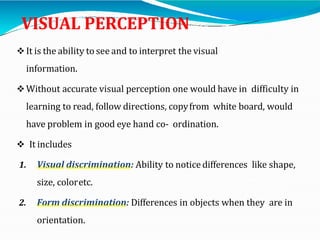
It is the ability to see and to interpret the visual
information.
Without accurate visual perception one would have in difficulty in
learning to read, follow directions, copyfrom white board, would
have problem in good eye hand co- ordination.
 It includes
1. Visual discrimination: Ability to noticedifferences like shape,
size, coloretc.
2. Form discrimination: Differences in objects when they are in
orientation.
Visual Perception
Visual
Perception
Visual
Memory
Visual
Discrimination
BACKGROUND
DIFFERENTIA
TION
 It is the ability to see and interpret the visual
information .
FORM
DISCRIMINATION
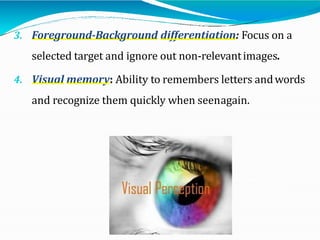
3. Foreground-Background differentiation: Focus on a
selected target and ignore out non-relevantimages.
4. Visual memory: Ability to remembers letters andwords
and recognize them quickly when seenagain.
LANGUAGE
 Language notonly help in communication but it shape our
perception.
Various emotion or feeling and experience can be influ-enced by
the pattern of the language a person speaks.
The same words can have different meaning depending
how interpret them. For example- A women without her
man is nothing.
Now read this phrase by addingpunctuation.
A woman, without her man is nothing.
OTHER FACTORS AFFECTING OUR
PERSPECTIVE
 PAST EXPERIENCE
 PREJUDICE
 FEELINGS
 ENVIRONMENT
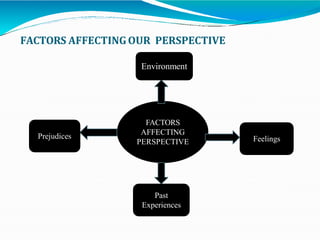
FACTORS AFFECTINGOUR PERSPECTIVE
FACTORS
AFFECTING
PERSPECTIVE
Past
Experiences
Feelings
Prejudices
Environment
1. Past experiences:
 Our past experience greatly affects ourway of thinking.
 Itacts as a filter through which wesee a particular situation.
 Our past experience can be positiveor negative and affects our
perception.
 Past Experiences:-
 It act as a Filter which we see a particular situation .
 It helps in decision making .
 Positive experiences followed again and again but
negative experiences alters our communication.
 Sometimes our past experiences influence our future
communication.
2. Prejudices:
 It is usually unfavorable feelings toward people or a person because of
their gender, values, age, religion, occupation, language or any personal
characteristics.
 It greatly limit the chances of communication being successful or
producing thedesired result.
 We should treat each person as a separate individual and must respect his
ideas.
 Prejudices:-
 It is usually unfavorable feeling toward people because of their gender,
values ,age , language ,religion or other personal characteristics.
 It involves positive and negative characteristics.
 The main problem occurs when prejudices start affecting how or whom we
communicate.
 It occurs when we take a single experience with one type of people.
 We must avoid prejudices during communication and should treat each
person as a separate individual and must respect his ideas.
3. Feeling:
 Feelings is known as a state of consciousness such as that result
from emotions, sentiment ordesires.
 A perso0n’s current mood affects the way hejudges other.
 When we feel happy we communicate better but if we feel ill, we
will not communicateeffectively.
 Feelings:-
 It is a major factor which affect perspective.
 When we feel happy we communicate better ,but if we feel ill we
even don’t
want to listen others ideas .
 Feelings are also known as state of consciousness that result from
emotions and desire.
4. Environment:
 All of us communicate differently in different
environment. This skill will help us in effective
communication.
 Wespeaks to ourcolleagues and friends in a different way.
 It will make the person more comfortable and to attain level of
formality which is important in a particular situation.
 Environment:-
 It has a great influence on communication e.g. when we
speak to our
friends and colleagues we talk in a different way.
 The skills help in effective communication and make the person
more
comfortable .
 It helps to attain level of formality which is important in
particular situation.

UNIT I: 2 Perpectives in communication

  • 1.
    PERSPECTIVE IN COMMUNICATION By… Prof.Sonali R. Pawar Assistant Professor, Pharmaceutical Chemistry Department, JSPM’s Charak College of Pharmacy and Research, Wagholi , Pune 412207
  • 2.
    CONTENTS  INTRODUCTION  VISUALPERCEPTION  LANGUAGE  OTHER FACTOR AFFECTING OUR PRESPECTIVE  Past experiences  Prejudices  Feelings  Environment
  • 3.
    INTRODUCTION Weall see theworld with our ownthinking which is known as our individualperceptions. Our individual perceptions are in actual the filters through which we see, understand theworld.  It is our view through which we handle a situation or a topic. All persons has differentopinion/thinking. Perspectives can be visual, due to different language due to feelings or it depends upon the environment in which work.
  • 4.
    Today, all thepeople in the world have their own thinking which is known as individual perceptions. Individual perception are in actual Filters through which we see the world and understand the world. It is our view through which we can handle any situation. Perspective can be visual due to different language , different Feelings or depend upon the Environment in which we work.
  • 5.
    VISUAL PERCEPTION It isthe ability to see and to interpret the visual information. Without accurate visual perception one would have in difficulty in learning to read, follow directions, copyfrom white board, would have problem in good eye hand co- ordination.  It includes 1. Visual discrimination: Ability to noticedifferences like shape, size, coloretc. 2. Form discrimination: Differences in objects when they are in orientation.
  • 6.
    Visual Perception Visual Perception Visual Memory Visual Discrimination BACKGROUND DIFFERENTIA TION  Itis the ability to see and interpret the visual information . FORM DISCRIMINATION
  • 7.
    3. Foreground-Background differentiation:Focus on a selected target and ignore out non-relevantimages. 4. Visual memory: Ability to remembers letters andwords and recognize them quickly when seenagain.
  • 8.
    LANGUAGE  Language notonlyhelp in communication but it shape our perception. Various emotion or feeling and experience can be influ-enced by the pattern of the language a person speaks. The same words can have different meaning depending how interpret them. For example- A women without her man is nothing. Now read this phrase by addingpunctuation. A woman, without her man is nothing.
  • 9.
    OTHER FACTORS AFFECTINGOUR PERSPECTIVE  PAST EXPERIENCE  PREJUDICE  FEELINGS  ENVIRONMENT
  • 10.
  • 11.
    1. Past experiences: Our past experience greatly affects ourway of thinking.  Itacts as a filter through which wesee a particular situation.  Our past experience can be positiveor negative and affects our perception.  Past Experiences:-  It act as a Filter which we see a particular situation .  It helps in decision making .  Positive experiences followed again and again but negative experiences alters our communication.  Sometimes our past experiences influence our future communication.
  • 12.
    2. Prejudices:  Itis usually unfavorable feelings toward people or a person because of their gender, values, age, religion, occupation, language or any personal characteristics.  It greatly limit the chances of communication being successful or producing thedesired result.  We should treat each person as a separate individual and must respect his ideas.  Prejudices:-  It is usually unfavorable feeling toward people because of their gender, values ,age , language ,religion or other personal characteristics.  It involves positive and negative characteristics.  The main problem occurs when prejudices start affecting how or whom we communicate.  It occurs when we take a single experience with one type of people.  We must avoid prejudices during communication and should treat each person as a separate individual and must respect his ideas.
  • 13.
    3. Feeling:  Feelingsis known as a state of consciousness such as that result from emotions, sentiment ordesires.  A perso0n’s current mood affects the way hejudges other.  When we feel happy we communicate better but if we feel ill, we will not communicateeffectively.  Feelings:-  It is a major factor which affect perspective.  When we feel happy we communicate better ,but if we feel ill we even don’t want to listen others ideas .  Feelings are also known as state of consciousness that result from emotions and desire.
  • 14.
    4. Environment:  Allof us communicate differently in different environment. This skill will help us in effective communication.  Wespeaks to ourcolleagues and friends in a different way.  It will make the person more comfortable and to attain level of formality which is important in a particular situation.  Environment:-  It has a great influence on communication e.g. when we speak to our friends and colleagues we talk in a different way.  The skills help in effective communication and make the person more comfortable .  It helps to attain level of formality which is important in particular situation.