DC MACHINES
Power developed by the armature=CoD²Ln kW
Output coefficient = π²Bav ac *10^-2
Maximum flux density Bg = Bav/Kf+Bav/ψ
Kf = field form factor
Ψ = Ratio of pole arc to pole pitch
Pa = P/η
P= Rated power output
η = Efficiency of the machine
CHOICE OF Bаv
 Flux density in the tooth
 Frequency
 Size of the machine
 Bav = 0.4 to 0.8 Wb / m²
Bg = .55 to 1.15 Wb/m²
CHOICE OF AMPERE CONDUCTOR
PER METER
 Temperature rise
 Speed of the machine
 Voltage
 Size of the machine
 Armature reaction
Commutation
 ac = 5000 to 50,000
CARTER’S COEFFICIENT
The Carter’s gap co-efficient ( Kcs) depends on the ratio of slot width to gap
length.
SELECTION OF NUMBER OF POLES
Frequency
 Weight of iron parts
 Weight of copper
 Length of commutator
 Labour charges
 Distortion of field form
GUIDANCE FACTOR FOR CHOICE OF
NUMBER OF POLES
 Frequency of flux reversals
f = pn/2
frequency should not exceed 30 Hz
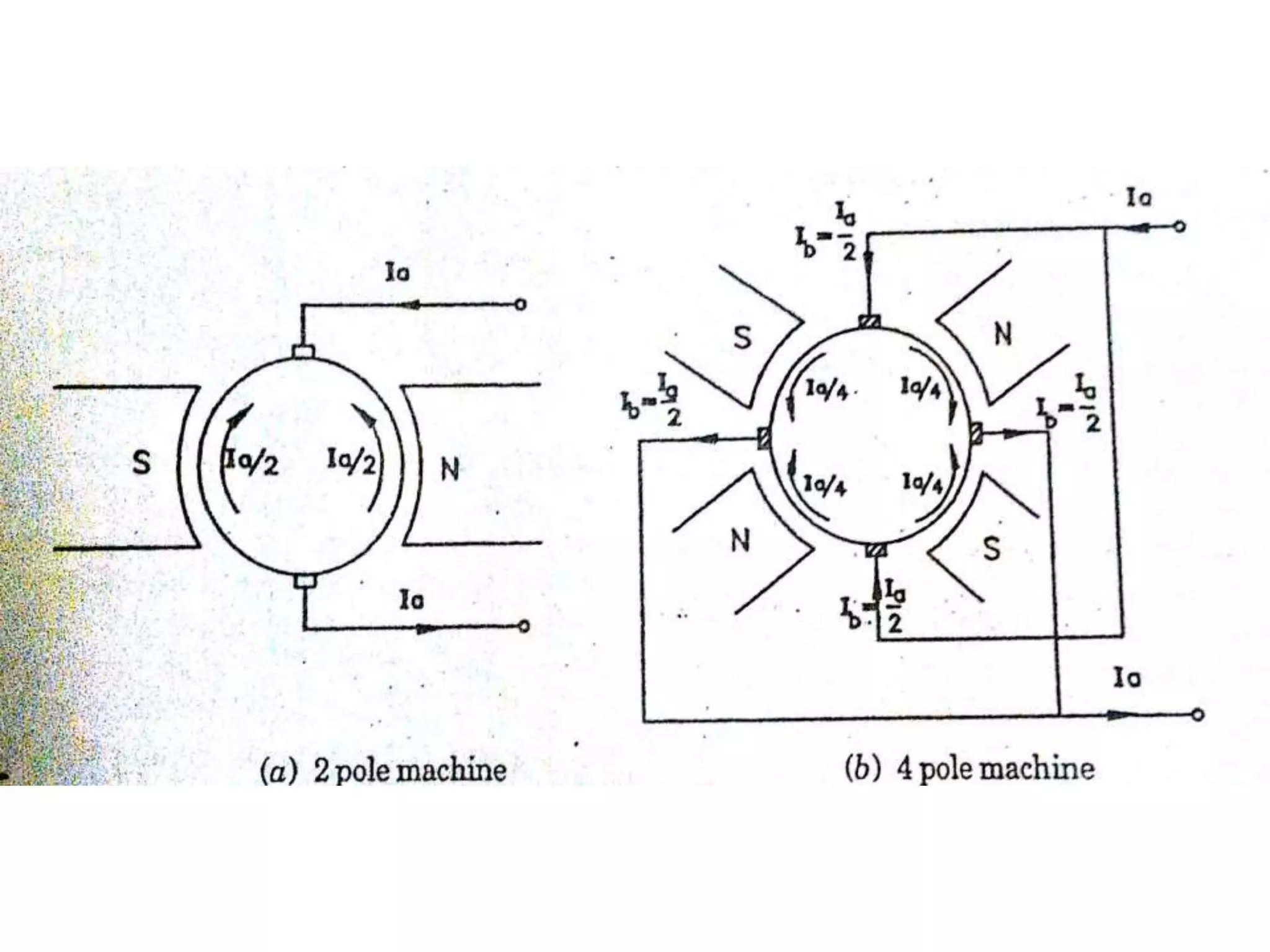
Current per brush arm
Ib = 2Ia/p
Ib should not be equal to or greater than
400 ampere
 Armature mmf per pole Ata = acζ / 2
ζ = ΠD / p
ac should not be greater than 1000 amperes
 Air gap mmf ATg = 50% to 60% of Ata
=8,00,000 Kg Bg Lg
Armature Core Design
3511/12/2019
Number of Armature Slots
3611/12/2019
Guiding Factors for No. of Slots
3711/12/2019
Slot Dimensions
3811/12/2019
Contd..
3911/12/2019
Depth of Armature Core
4011/12/2019
Contd..
4111/12/2019
Armature Winding Design
4211/12/2019
Armature Winding- Types
4311/12/2019
Contd..
4411/12/2019
Lap and Wave Winding - Comparison
4511/12/2019
Contd..
4611/12/2019
Terms & Definitions
4711/12/2019
Contd..
4811/12/2019
Contd..
4911/12/2019
Simplex Lap Winding
5011/12/2019
Contd..
5111/12/2019
Winding Pitches for lap winding
5211/12/2019
Designing of Lap Winding- Procedure
5311/12/2019
Contd..
5411/12/2019
Simplex Lap Winding Diagram- Procedure
5511/12/2019
Contd..
5611/12/2019
Contd..
5711/12/2019
Contd..
5811/12/2019
Contd..
5911/12/2019
Contd..
6011/12/2019
11/12/2019 61
Problem
6211/12/2019
6311/12/2019
6411/12/2019
6511/12/2019
6611/12/2019
6711/12/2019
6811/12/2019
6911/12/2019
7011/12/2019
Simplex Wave Winding
11/12/2019 71
Contd..
11/12/2019 72
Wave Winding Design - Procedure
11/12/2019 73
Contd..
11/12/2019 74
Guidelines- Drawing Wave Winding
11/12/2019 75
Contd..
11/12/2019 76
Contd..
11/12/2019 77
Contd..
11/12/2019 78
Contd..
11/12/2019 79
11/12/2019 80
11/12/2019 81
11/12/2019 82
11/12/2019 83
11/12/2019 84
11/12/2019 85
Brush Materials
11/12/2019 97
Design of Commutator & Brushes
11/12/2019 98
Contd..
11/12/2019 99
11/12/2019 100
11/12/2019 101
11/12/2019 102
ARMATURE DESIGN
 Find Z and conductor per slot Zs
E = PΦzn/a
Bw = pΦ/πDL
Choose current density
δ =1.25 to 2.5 A / mm²
 Find conductor area
area of the conductor = Iz/ δ
LIMITING VALUES OF L AND B
Factor of consideration when selecting L
ventilation
cost
 L = ez / (Bav*Va*Ta*Na)
 Bav = .7 Wb/m²
ez=conductor emf at no load 7.5
Va = 30 m /sec
Tc = turns per coil
Nc = Number of coil
Tc=Nc=1
 L=7.5/(.7*30*1*1) = .36 m
CORE DIAMETER
Factor of consideration
Peripheral speed
Pole pitch
Limiting values
Output P = EIa *10^-3 kW
P = (ez Z/a)Ia *10^-3
=ez*π*D*ac*10^-3
D = P*10^-3/ π*ac*ez
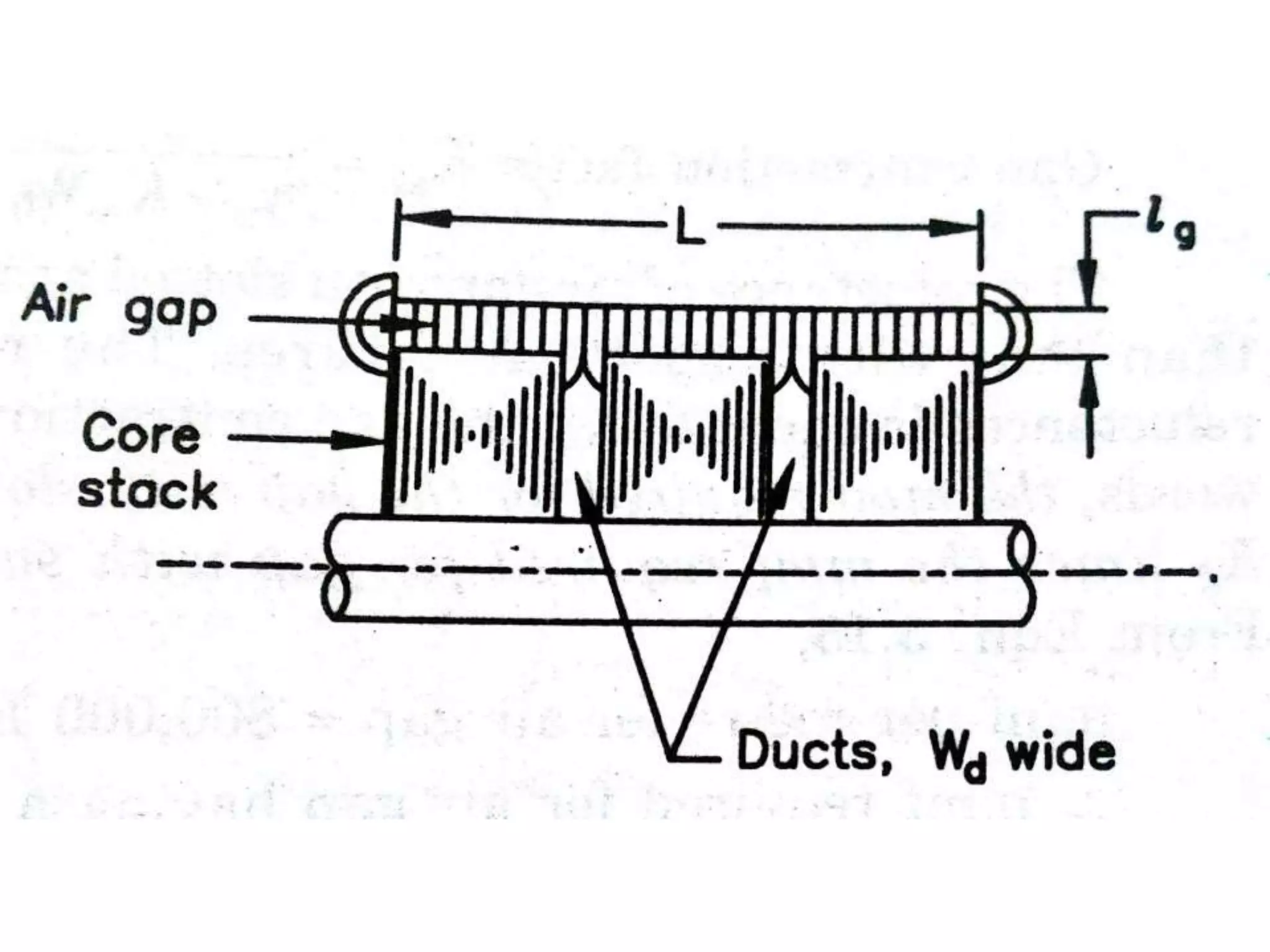
LENGTH OF AIR GAP(lg)
Cooling
Noise
Pulsation loss
•Cooling α lg
•Noise, pulsation loss α (1/lg)
•When air gap is less Pulsation of flux produces noise.So to reduce noise air
gap is increased, circulating current increases and so loss is more
SELECTION OF SLOTS
Slot pitch (Yss) = πD/S
S = Number of slots
Iz Zs should not be greater than or equal to 1500 ampere
Conductor per slot (Zs) = Z/S
Iz = current through each conductor
Slots per pole = 8 to 16
Slots per pole pair = odd pair
SLOT DIMENSION
Slot area = Ws* Ds
Ds/Ws = 2 to 4
 Insulation area = 10% to 20% of slot area
Area of core = Dc*Li
= Φc/Bc
Bc=1.2 to 1.5 tesla
POLE DESIGN
 height of pole= hf + hs + height of insulation
height of insulation is 15% to 20% hf
hs = 20% to 40% of hf
hp = hf + insulation height
DESIGN OF FIELD SYSTEM
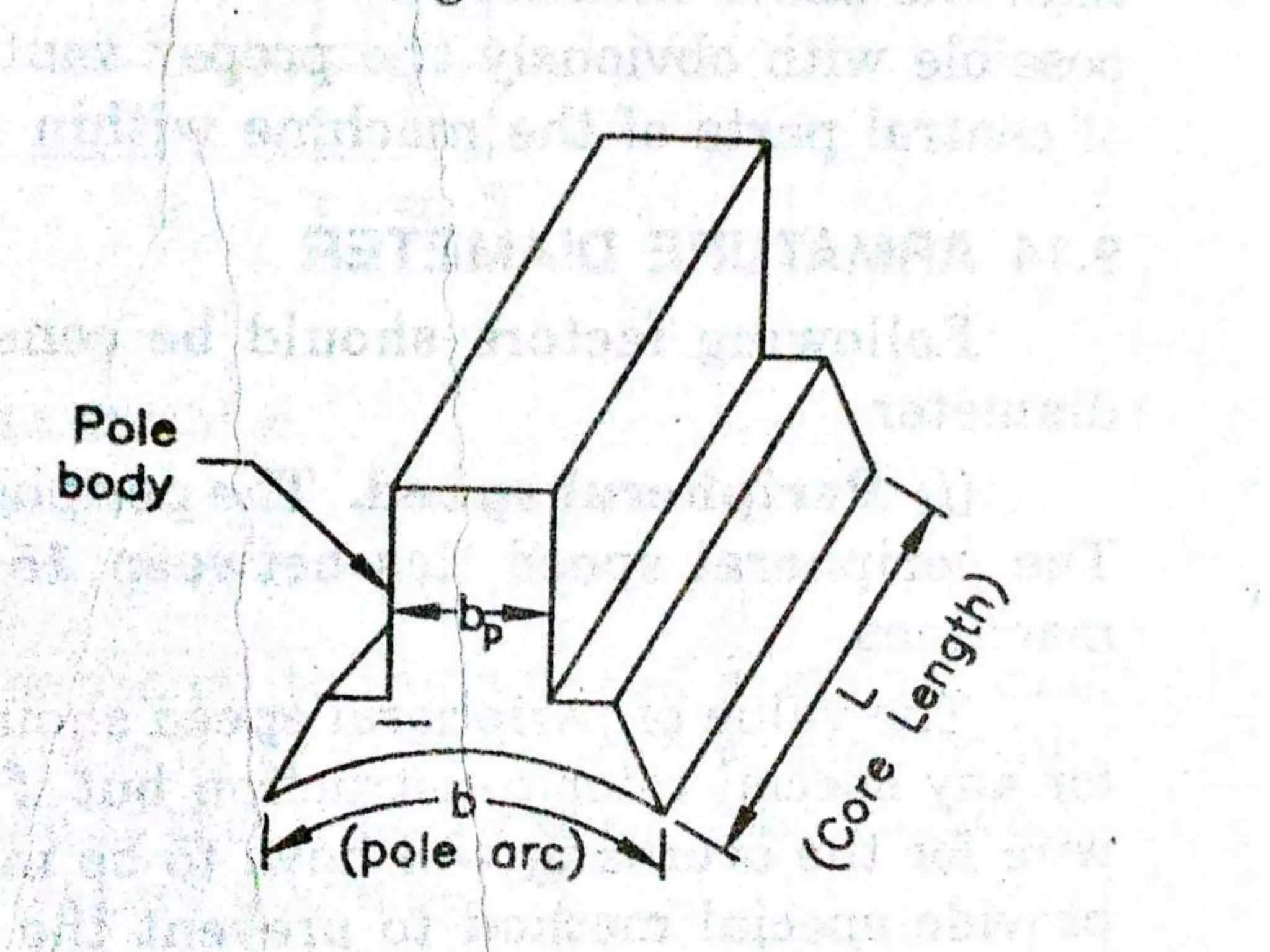
Area of the pole Ap = Lpi *Bp
Lpi = lp*0.9
=0.9*(L-(.001 to .015))
Ap = Φp/Bp Bp = 1.2 to 1.7 tesla
Φp = Φ*Cl
Cl = leakage coefficient =1.12 to 1.7 telsa
NOTATION
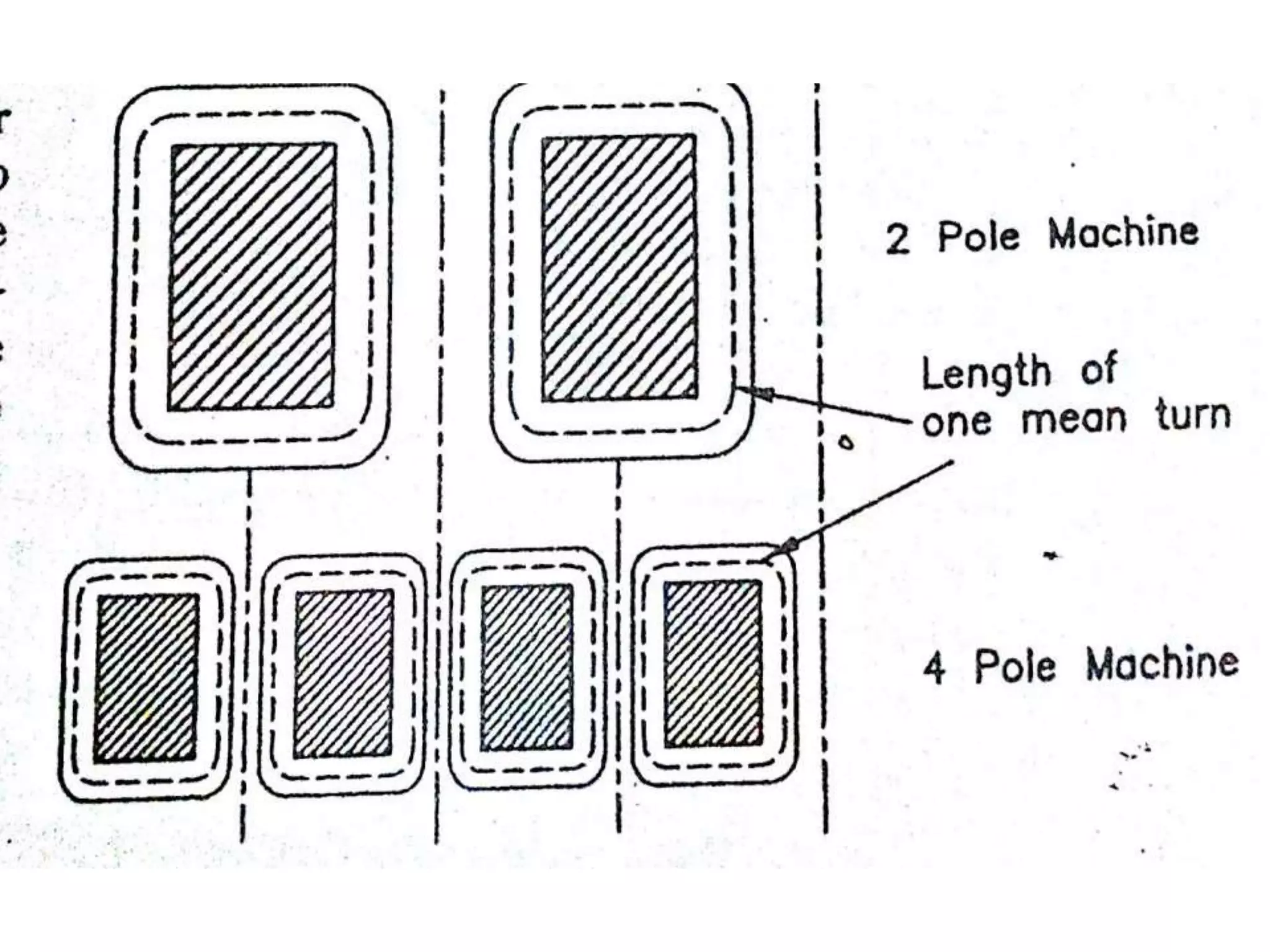
S → cooling surface available for dissipation of heat
S=2Lmt*hf(excluding top and bottom)
S=2Lmt(hf+df)(including top and bottom)
Tf → Number of turns
 af → conductor area
Lmt → mean length
Rf → resistance of coil
If → current across each coil
Ef → voltage across each coil
Qf → Total copper loss
qf → specific copper loss
 df → depth of field coil
hf →height of field coil
Sf → space factor
Sf = 0.4 to 0.75
ρ → resistivity of material used
Copper = 2*10^8 Ωm
Area of copper in field coil =Tf*af=hf*df*Sf
Qf = qf*S=If ²* Rf
Qf = δf ²*af ² *ρ* Lmt *Tf / af
qf *S = δf ²*af *ρ* Lmt *Tf
qf(2Lmt*hf) = δf ²*af *ρ* Lmt *Tf
δf = √((qf*2*hf)/(af* ρ*Tf))
Ρ = 2.8*10^8 Ωm
δf =10^4 √((qf*hf)/(af*Tf))
δf =10^4 √((qf*hf)/(df*hf *Sf))
δf =10^4 √((qf)/(df *Sf))
ATfl/hf=If*Tf/hf
= δf (af*Tf)/hf
= δf (Sf*hf*df)/hf
= δf (Sf*df)
=10^4√((qf(Sf*df)/(Sf*df))
=10^4√(qf*Sf*df)
hf = ATfl*10^-4/√(qf*Sf*df)
qf should not be greater than 700 Wb/m²
df = 40 to 50 mm
Sf=0.8(d/d1) ²
DESIGN OF FIELD COIL
SHUNT FIELD
Assume df
Find Ef = (0.8 to 0.85)rated voltage/P
Rf = Ef/If
=ρ Lmt Tf/af
af = ρ Lmt Tf If/Ef
=ATfl ρ Lmt /Ef
Tf = Sf hf df /af
Qf = If ²*Rf
If = Ef / Rf
Cooling coefficient c= .14 to .16/(1+.1Va)
Temperature rise θ =Qf * c/S
θ should be within temperature limit
If θ exceeds the limit then change the value of df and proceed
SERIES FIELD
ATse = (.1 to .2)Ata=Ise*Tse
Ise = Ia
δseries = δarmature = Ise/ase
DESIGN OF FIELD SYSTEM
Total mmf required at no load ATf = ATg+ATt+ATo+ATy+ATp
Mmf required for air gap
ATg = 800000 Kg Bg Lg = Φg*Lg/µoAg
Mmf required for teeth
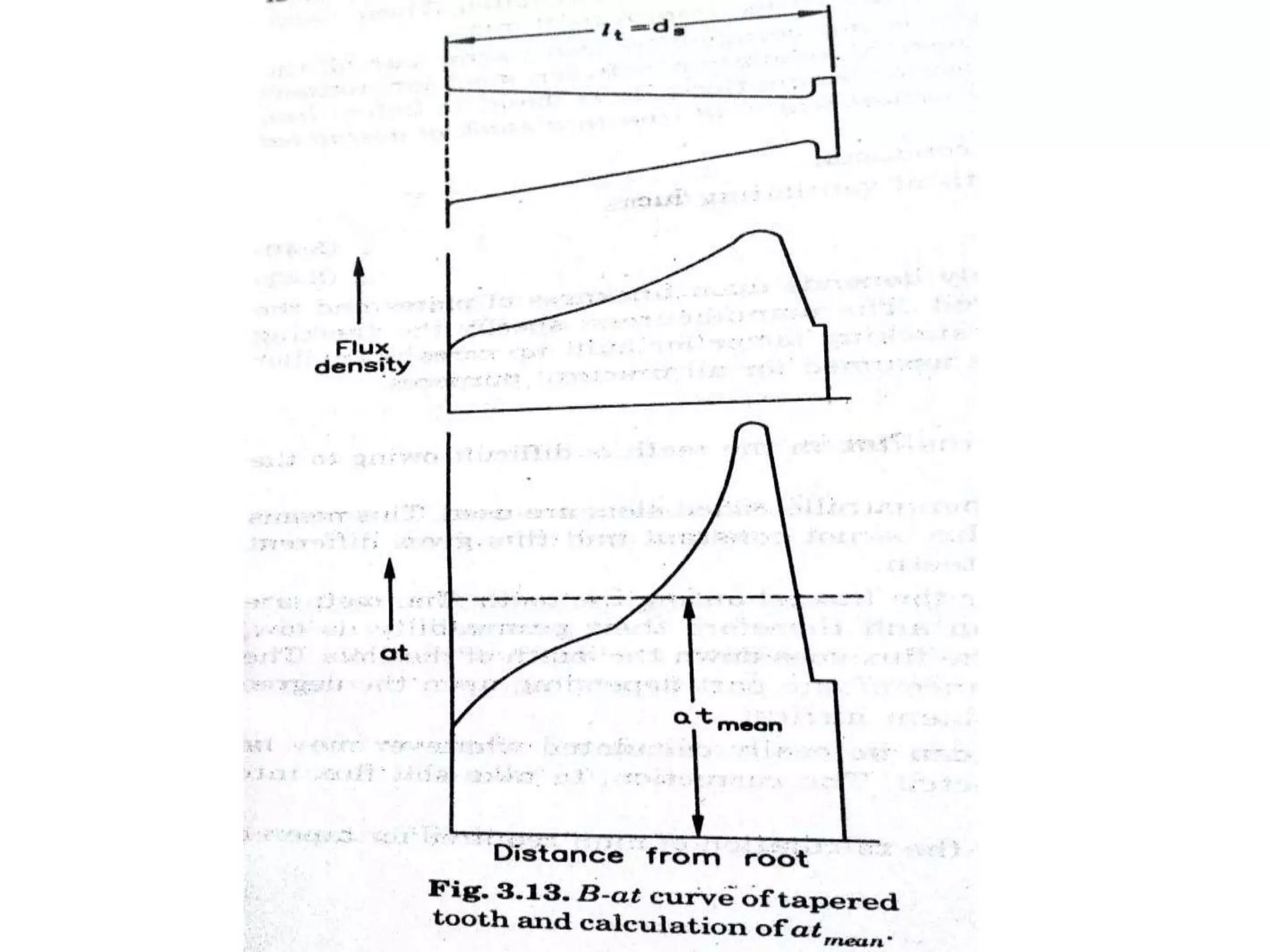
ATt = att *ds = Φt*lt/(µoµr*Ws*L*Ki)
Φt =Φ /((S/P)*ψ)
ds = depth of slot
Mmf required for core
ATc = atc*lc = Φc*lc/(µoµrAc)
Φc = Φ/2
lc = π(D-2S)/P
contd.…
Mmf required for yoke
ATy = aty *ly = Φy*ly/(µoµrAy)
Φy = Φ/2
ly = π(D+2lg+2hp)/2P
P number of poles
µo = 4 π*10^-7
µr = permeability of the material
ARMATURE WINDING
 Lap winding
Yb = back pitch = 2c/p + 1
Yf = front pitch = 2c/p -1
Y = winding pitch = Yb – Yf
Yc = +1  progressive winding
Yc = -1  retrocressive winding
coil pitch =slots/poles
Wave winding
Yb , Yf must be an odd
Y = odd integer
Y = Yb +Yf = winding pitch
• Progressive
Yc = Y/2 = (c+1) /(P/2)
Yb = (2c/P)+k
Y = (2c+2) /(P/2)
• Retrogressive
Yc = Y/2 = (c-1)/(P/2)
Yb = (2c/P)-k
Y = (2c -2)/(P/2)

Unit II Design of Electrical Machines