PRONOUNS
The Pronoun
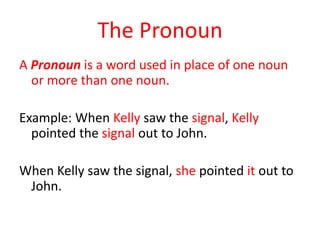
A Pronoun is a word used in place of one noun
or more than one noun.
Example: When Kelly saw the signal, Kelly
pointed the signal out to John.
When Kelly saw the signal, she pointed it out to
John.
The Pronoun
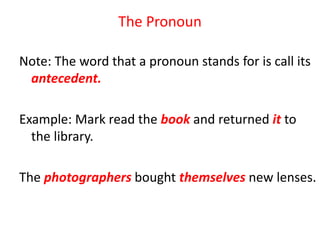
Note: The word that a pronoun stands for is call its
antecedent.
Example: Mark read the book and returned it to
the library.
The photographers bought themselves new lenses.
Personal Pronoun
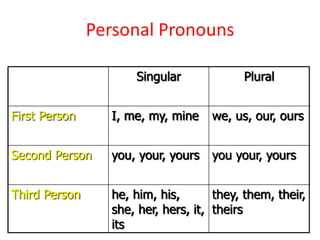
A personal pronoun refers to the one speaking
(first person), the one spoken to (second
person), or the one spoken about (third
person).
View the following examples:
Personal Pronouns
Singular Plural
First Person I, me, my, mine we, us, our, ours
Second Person you, your, yours you your, yours
Third Person he, him, his,
she, her, hers, it,
its
they, them, their,
theirs
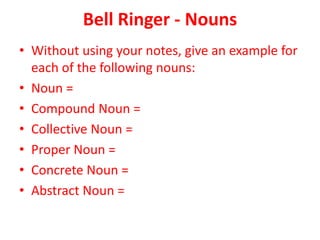
Bell Ringer - Nouns
• Without using your notes, give an example for
each of the following nouns:
• Noun =
• Compound Noun =
• Collective Noun =
• Proper Noun =
• Concrete Noun =
• Abstract Noun =
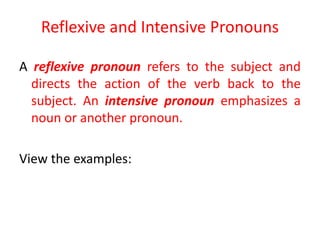
Reflexive and Intensive Pronouns
A reflexive pronoun refers to the subject and
directs the action of the verb back to the
subject. An intensive pronoun emphasizes a
noun or another pronoun.
View the examples:
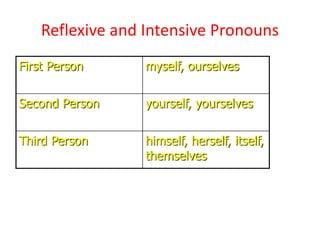
Reflexive and Intensive Pronouns
First Person myself, ourselves
Second Person yourself, yourselves
Third Person himself, herself, itself,
themselves
Reflexive and Intensive Pronouns
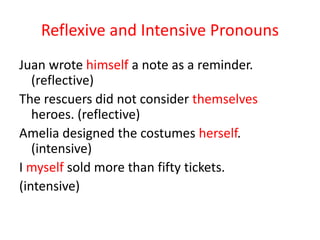
Juan wrote himself a note as a reminder.
(reflective)
The rescuers did not consider themselves
heroes. (reflective)
Amelia designed the costumes herself.
(intensive)
I myself sold more than fifty tickets.
(intensive)
Demonstrative Pronouns
A demonstrative pronoun points out a specific
person, a place, a thing, or an idea.
View the examples:
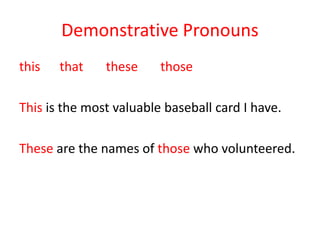
Demonstrative Pronouns
this that these those
This is the most valuable baseball card I have.
These are the names of those who volunteered.
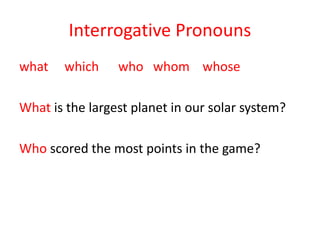
Interrogative Pronouns
An interrogative pronoun introduces a question.
View the following examples:
Interrogative Pronouns
what which who whom whose
What is the largest planet in our solar system?
Who scored the most points in the game?
Relative Pronouns
A relative pronoun introduces a subordinate
clause.
View the following examples:
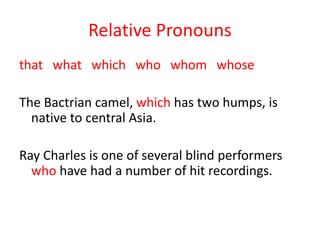
Relative Pronouns
that what which who whom whose
The Bactrian camel, which has two humps, is
native to central Asia.
Ray Charles is one of several blind performers
who have had a number of hit recordings.
Indefinite Pronouns
An indefinite pronoun refers to a person, a
place, or a thing that is not specifically named.
View the examples:
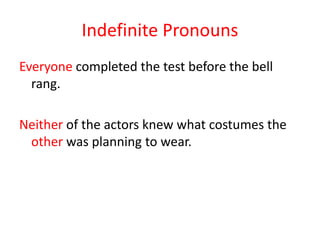
Indefinite Pronouns
Everyone completed the test before the bell
rang.
Neither of the actors knew what costumes the
other was planning to wear.
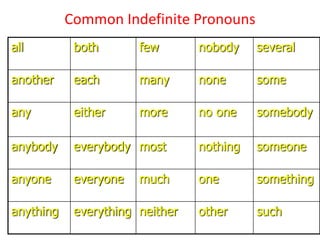
Common Indefinite Pronouns
all both few nobody several
another each many none some
any either more no one somebody
anybody everybody most nothing someone
anyone everyone much one something
anything everything neither other such

Pronouns (grade 4)

  • 1.
  • 2.
    The Pronoun A Pronounis a word used in place of one noun or more than one noun. Example: When Kelly saw the signal, Kelly pointed the signal out to John. When Kelly saw the signal, she pointed it out to John.
  • 3.
    The Pronoun Note: Theword that a pronoun stands for is call its antecedent. Example: Mark read the book and returned it to the library. The photographers bought themselves new lenses.
  • 4.
    Personal Pronoun A personalpronoun refers to the one speaking (first person), the one spoken to (second person), or the one spoken about (third person). View the following examples:
  • 5.
    Personal Pronouns Singular Plural FirstPerson I, me, my, mine we, us, our, ours Second Person you, your, yours you your, yours Third Person he, him, his, she, her, hers, it, its they, them, their, theirs
  • 6.
    Bell Ringer -Nouns • Without using your notes, give an example for each of the following nouns: • Noun = • Compound Noun = • Collective Noun = • Proper Noun = • Concrete Noun = • Abstract Noun =
  • 7.
    Reflexive and IntensivePronouns A reflexive pronoun refers to the subject and directs the action of the verb back to the subject. An intensive pronoun emphasizes a noun or another pronoun. View the examples:
  • 8.
    Reflexive and IntensivePronouns First Person myself, ourselves Second Person yourself, yourselves Third Person himself, herself, itself, themselves
  • 9.
    Reflexive and IntensivePronouns Juan wrote himself a note as a reminder. (reflective) The rescuers did not consider themselves heroes. (reflective) Amelia designed the costumes herself. (intensive) I myself sold more than fifty tickets. (intensive)
  • 10.
    Demonstrative Pronouns A demonstrativepronoun points out a specific person, a place, a thing, or an idea. View the examples:
  • 11.
    Demonstrative Pronouns this thatthese those This is the most valuable baseball card I have. These are the names of those who volunteered.
  • 12.
    Interrogative Pronouns An interrogativepronoun introduces a question. View the following examples:
  • 13.
    Interrogative Pronouns what whichwho whom whose What is the largest planet in our solar system? Who scored the most points in the game?
  • 14.
    Relative Pronouns A relativepronoun introduces a subordinate clause. View the following examples:
  • 15.
    Relative Pronouns that whatwhich who whom whose The Bactrian camel, which has two humps, is native to central Asia. Ray Charles is one of several blind performers who have had a number of hit recordings.
  • 16.
    Indefinite Pronouns An indefinitepronoun refers to a person, a place, or a thing that is not specifically named. View the examples:
  • 17.
    Indefinite Pronouns Everyone completedthe test before the bell rang. Neither of the actors knew what costumes the other was planning to wear.
  • 18.
    Common Indefinite Pronouns allboth few nobody several another each many none some any either more no one somebody anybody everybody most nothing someone anyone everyone much one something anything everything neither other such