PREFIXES
With the Meaning NOT
Prefixes (un-, im-, in-, il-, ir-, and dis-) are often
used to give adjectives (and some verbs and
nouns) a negative meaning. Here are common
examples:
happy
unhappy
polite
impolite
correct
incorrect
like
dislike
legal
illegal
regular
irregular
Next

• Un- is used with many different words, e.g.,
unfriendly, unable, unemployed (without job),
unreasonable, unknown, unavailable,
unacceptable, unattractive, uncertain.
• Im- is used before some words beginning with
m, p, or b e.g., impure, impolite, impatient,
impossible, imbalance, immeasurable,
imperfect, impersonal.
• Il- is used before some words beginning with l,
e.g., illogical, illegal, illegitimate, illegible
(cannot be read because the writing or the
copy is very bad)
Next
• Ir- is used only before words beginning with r,
e.g., irrational, irrelevant, irreconcilable,
irresponsible, irregular, irreplaceable.
• Dis- is used before some adjectives, e.g.,
disadvantaged, dishonest, dissatisfied,
displeased, and few verbs, e.g., dislike,
disagree, disapprove, disallow, disbelieve.
• In- is used before a limited number of words,
e.g., invisible, inadequate, inappropriate,
inanimate, inaudible, inaccurate, incorrect.
Verb prefixes: un- and dis• These prefixes have two meanings: They can
have a negative meaning, but they can also
mean “the opposite of an action” or “to
reverse an action.”
a. I locked the door when I left, but then I lost
the key, so I couldn’t unlocked it.
b. The plane appeared in the sky, then
suddenly disappeared behind a cloud.
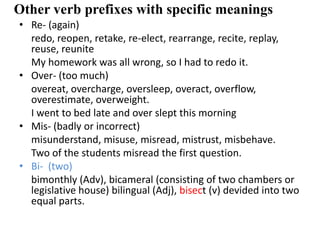
Other verb prefixes with specific meanings
• Re- (again)
redo, reopen, retake, re-elect, rearrange, recite, replay,
reuse, reunite
My homework was all wrong, so I had to redo it.
• Over- (too much)
overeat, overcharge, oversleep, overact, overflow,
overestimate, overweight.
I went to bed late and over slept this morning
• Mis- (badly or incorrect)
misunderstand, misuse, misread, mistrust, misbehave.
Two of the students misread the first question.
• Bi- (two)
bimonthly (Adv), bicameral (consisting of two chambers or
legislative house) bilingual (Adj), bisect (v) devided into two
equal parts.
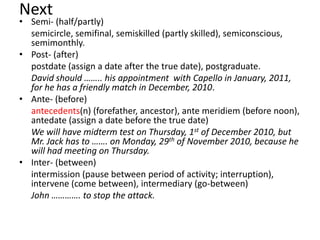
Next

• Semi- (half/partly)
semicircle, semifinal, semiskilled (partly skilled), semiconscious,
semimonthly.
• Post- (after)
postdate (assign a date after the true date), postgraduate.
David should …….. his appointment with Capello in January, 2011,
for he has a friendly match in December, 2010.
• Ante- (before)
antecedents(n) (forefather, ancestor), ante meridiem (before noon),
antedate (assign a date before the true date)
We will have midterm test on Thursday, 1st of December 2010, but
Mr. Jack has to ……. on Monday, 29th of November 2010, because he
will had meeting on Thursday.
• Inter- (between)
intermission (pause between period of activity; interruption),
intervene (come between), intermediary (go-between)
John …………. to stop the attack.
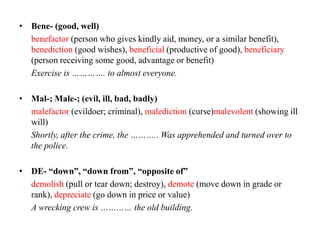
• Bene- (good, well)
benefactor (person who gives kindly aid, money, or a similar benefit),
benediction (good wishes), beneficial (productive of good), beneficiary
(person receiving some good, advantage or benefit)
Exercise is …………. to almost everyone.
• Mal-; Male-; (evil, ill, bad, badly)
malefactor (evildoer; criminal), malediction (curse)malevolent (showing ill
will)
Shortly, after the crime, the ……….. Was apprehended and turned over to
the police.
• DE- “down”, “down from”, “opposite of”
demolish (pull or tear down; destroy), demote (move down in grade or
rank), depreciate (go down in price or value)
A wrecking crew is ………… the old building.
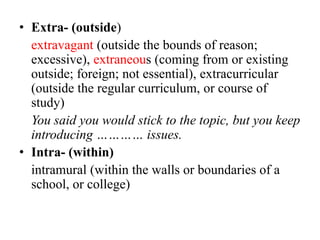
• Extra- (outside)
extravagant (outside the bounds of reason;
excessive), extraneous (coming from or existing
outside; foreign; not essential), extracurricular
(outside the regular curriculum, or course of
study)
You said you would stick to the topic, but you keep
introducing ………… issues.
• Intra- (within)
intramural (within the walls or boundaries of a
school, or college)

Prefixes

  • 1.
  • 2.
    With the MeaningNOT Prefixes (un-, im-, in-, il-, ir-, and dis-) are often used to give adjectives (and some verbs and nouns) a negative meaning. Here are common examples: happy unhappy polite impolite correct incorrect like dislike legal illegal regular irregular
  • 3.
    Next • Un- isused with many different words, e.g., unfriendly, unable, unemployed (without job), unreasonable, unknown, unavailable, unacceptable, unattractive, uncertain. • Im- is used before some words beginning with m, p, or b e.g., impure, impolite, impatient, impossible, imbalance, immeasurable, imperfect, impersonal. • Il- is used before some words beginning with l, e.g., illogical, illegal, illegitimate, illegible (cannot be read because the writing or the copy is very bad)
  • 4.
    Next • Ir- isused only before words beginning with r, e.g., irrational, irrelevant, irreconcilable, irresponsible, irregular, irreplaceable. • Dis- is used before some adjectives, e.g., disadvantaged, dishonest, dissatisfied, displeased, and few verbs, e.g., dislike, disagree, disapprove, disallow, disbelieve. • In- is used before a limited number of words, e.g., invisible, inadequate, inappropriate, inanimate, inaudible, inaccurate, incorrect.
  • 5.
    Verb prefixes: un-and dis• These prefixes have two meanings: They can have a negative meaning, but they can also mean “the opposite of an action” or “to reverse an action.” a. I locked the door when I left, but then I lost the key, so I couldn’t unlocked it. b. The plane appeared in the sky, then suddenly disappeared behind a cloud.
  • 6.
    Other verb prefixeswith specific meanings • Re- (again) redo, reopen, retake, re-elect, rearrange, recite, replay, reuse, reunite My homework was all wrong, so I had to redo it. • Over- (too much) overeat, overcharge, oversleep, overact, overflow, overestimate, overweight. I went to bed late and over slept this morning • Mis- (badly or incorrect) misunderstand, misuse, misread, mistrust, misbehave. Two of the students misread the first question. • Bi- (two) bimonthly (Adv), bicameral (consisting of two chambers or legislative house) bilingual (Adj), bisect (v) devided into two equal parts.
  • 7.
    Next • Semi- (half/partly) semicircle,semifinal, semiskilled (partly skilled), semiconscious, semimonthly. • Post- (after) postdate (assign a date after the true date), postgraduate. David should …….. his appointment with Capello in January, 2011, for he has a friendly match in December, 2010. • Ante- (before) antecedents(n) (forefather, ancestor), ante meridiem (before noon), antedate (assign a date before the true date) We will have midterm test on Thursday, 1st of December 2010, but Mr. Jack has to ……. on Monday, 29th of November 2010, because he will had meeting on Thursday. • Inter- (between) intermission (pause between period of activity; interruption), intervene (come between), intermediary (go-between) John …………. to stop the attack.
  • 8.
    • Bene- (good,well) benefactor (person who gives kindly aid, money, or a similar benefit), benediction (good wishes), beneficial (productive of good), beneficiary (person receiving some good, advantage or benefit) Exercise is …………. to almost everyone. • Mal-; Male-; (evil, ill, bad, badly) malefactor (evildoer; criminal), malediction (curse)malevolent (showing ill will) Shortly, after the crime, the ……….. Was apprehended and turned over to the police. • DE- “down”, “down from”, “opposite of” demolish (pull or tear down; destroy), demote (move down in grade or rank), depreciate (go down in price or value) A wrecking crew is ………… the old building.
  • 9.
    • Extra- (outside) extravagant(outside the bounds of reason; excessive), extraneous (coming from or existing outside; foreign; not essential), extracurricular (outside the regular curriculum, or course of study) You said you would stick to the topic, but you keep introducing ………… issues. • Intra- (within) intramural (within the walls or boundaries of a school, or college)