1
ENGINEERING
MECHANICS
GED 1201
Dr. S. Rasool Mohideen
Professor
Mechanical Engineering
Lecture 6: Friction
Dr. S. Rasool Mohideen
Professor
Mechanical Engineering
UNIT V FRICTION
• Introduction to friction
• Types of friction
• Laws of Coulomb friction
• Frictional force
• simple contact friction
• Block friction
• Rolling resistance
• ladder friction and
• wedge friction
2
Dr. S. Rasool Mohideen
Professor
Mechanical Engineering
Introduction
• Friction is defined as a force of resistance
acting on a body which prevents or retards
slipping of the body relative to another body.
• Friction is caused by the “microscopic”
interactions between the two surfaces
• Friction results in a force in the
direction opposite to the direction of motion!
• Hence It opposes motion!
Friction! Is it a BOON or BAN?
Dr. S. Rasool Mohideen
Professor
Mechanical Engineering
Introduction (Contd.)
Application
BOON BAN
Dr. S. Rasool Mohideen
Professor
Mechanical Engineering
Introduction (Contd.)
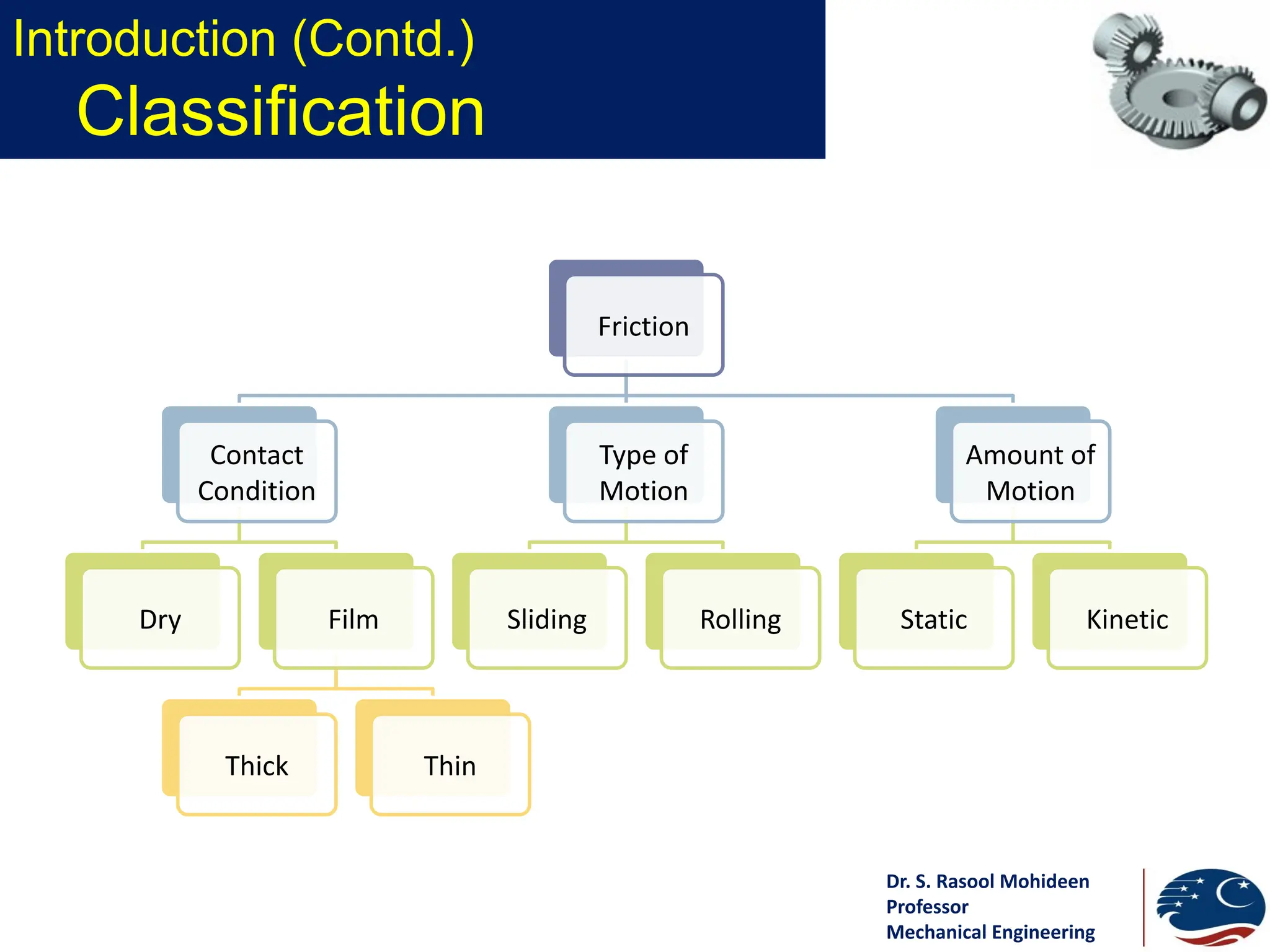
Classification
Friction
Contact
Condition
Dry Film
Thick Thin
Type of
Motion
Sliding Rolling
Amount of
Motion
Static Kinetic
Dr. S. Rasool Mohideen
Professor
Mechanical Engineering
Dry Friction
Dr. S. Rasool Mohideen
Professor
Mechanical Engineering
Dry Friction (Contd.)
Coefficients of Friction
7
Approximate Values of
Coefficient of Static
Friction for Dry Surfaces
▪ The coefficients of friction μs
and μk
do not depend upon the
area of the surfaces in contact.
▪ Both coefficients, however, depend strongly on the nature of
the surfaces in contact.
The coefficient of static friction
between a package and the inclined
conveyer belt must be sufficiently
large to enable the package to be
transported without slipping.
Dr. S. Rasool Mohideen
Professor
Mechanical Engineering
Dry Friction (Contd.)
Dr. S. Rasool Mohideen
Professor
Mechanical Engineering
Friction (Contd.)
Types of Problems
Dr. S. Rasool Mohideen
Professor
Mechanical Engineering
Angles of Friction
• It is sometimes convenient to replace the normal force
N and the friction force F by their resultant R.
• Let us consider again a block of weight W resting on a
horizontal plane surface.
• If no horizontal force is applied to the block, the
resultant R reduces to the normal force N (Fig.a).
• However, if the applied force P has a horizontal
component Px
which tends to move the block, the force
R will have a horizontal component F and, thus, will
form an angle φ with the normal to the surface (Fig. b).
• If Px
is increased until motion becomes impending, the
angle between R and the vertical grows and reaches a
maximum value so that φ = φs
.
• This value is called the angle of static friction and is
denoted by φs
.
10
Dr. S. Rasool Mohideen
Professor
Mechanical Engineering
Angles of Repose
• Consider a block resting on a board and subjected
to no other force than its weight W and the
reaction R of the board.
• The board can be given any desired inclination.
• If the board is horizontal, the force R exerted by
the board on the block is perpendicular to the
board and balances the weight W (Fig. a).
• If the board is given a small angle of inclination θ,
the force R will deviate from the perpendicular to
the board by the angle θ and will keep balancing
W (Fig. b)
• It will then have a normal component N of
magnitude N = W cos θ and a tangential
component F of magnitude F = W sin θ.
11
Dr. S. Rasool Mohideen
Professor
Mechanical Engineering
Angles of Repose (Contd.)
• If we keep increasing the angle of inclination,
motion will soon become impending.
• At that time, the angle between R and the
normal will have reached its maximum value φs
(Fig. c).
• The value of the angle of inclination
corresponding to impending motion is called the
angle of repose.
• Clearly, the angle of repose is equal to the angle
of static friction φs
.
• If the angle of inclination u is further increased,
motion starts and the angle between R and the
normal drops to the lower value φk
(Fig. d).
• The reaction R is not vertical any more, and the
forces acting on the block are unbalanced.
12
Dr. S. Rasool Mohideen
Professor
Mechanical Engineering
Problem 1
• Find the static coefficient friction of between
the block shown in the figure having a mass of
75 kg and the surface.
13
30°
P=300 N
75 kg
Dr. S. Rasool Mohideen
Professor
Mechanical Engineering
Solution to Problem 1
• System of forces on the block are shown
• Resolving the forces horizontally
• Resolving the forces vertically
• Hence to find the static friction
14
Dr. S. Rasool Mohideen
Professor
Mechanical Engineering
Problem 2
A 450 N force acts as shown on a
1350 N block placed on an inclined
plane. The coefficients of friction
between the block and plane are
μs
=0.25 and μk
= 0.20. Determine whether
the block is in equilibrium and find the
value of the friction force.
Dr. S. Rasool Mohideen
Professor
Mechanical Engineering
Solution to Problem 2
(Contd.)
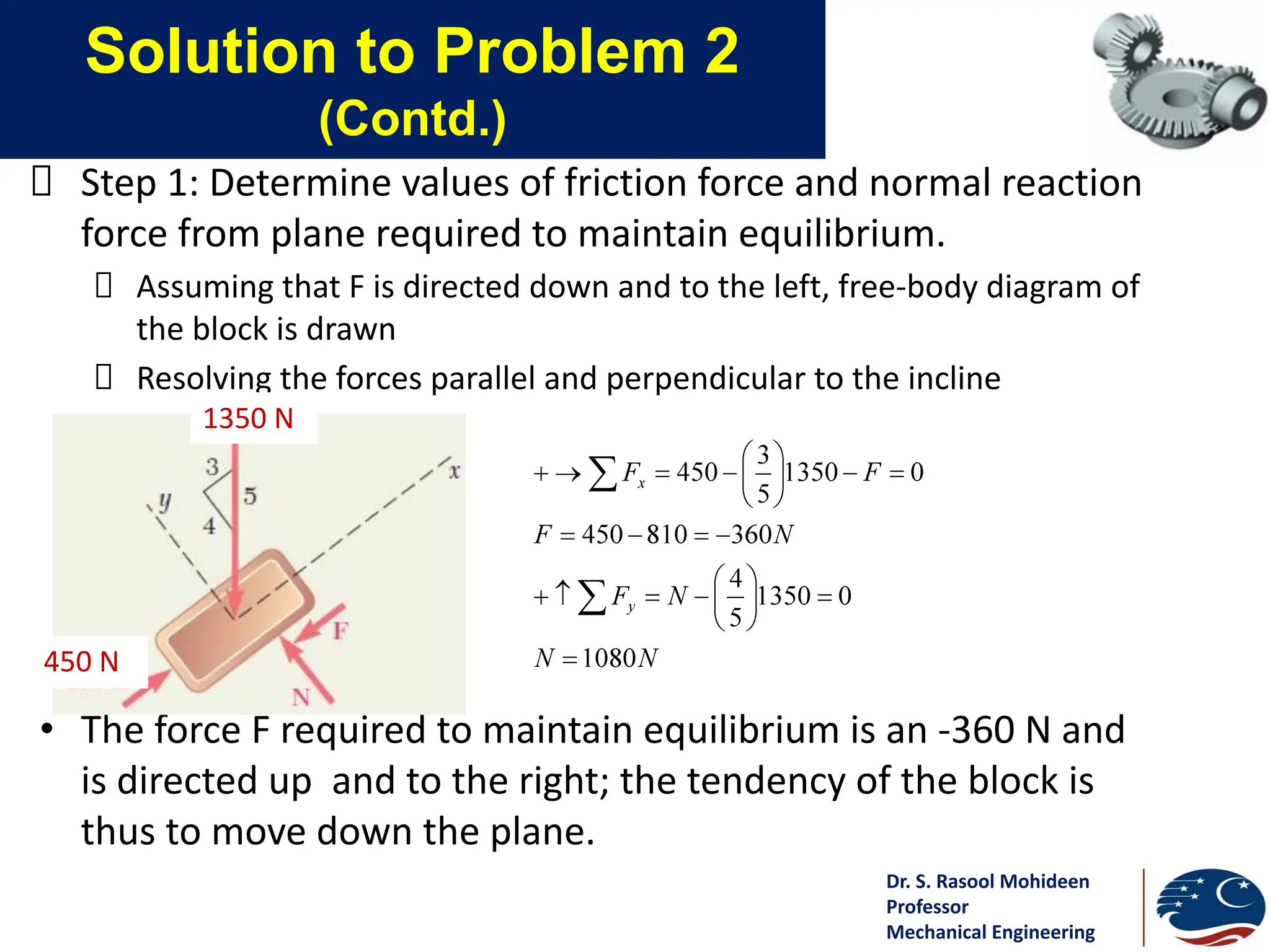
Step 1: Determine values of friction force and normal reaction
force from plane required to maintain equilibrium.
Assuming that F is directed down and to the left, free-body diagram of
the block is drawn
Resolving the forces parallel and perpendicular to the incline
• The force F required to maintain equilibrium is an -360 N and
is directed up and to the right; the tendency of the block is
thus to move down the plane.
1350 N
450 N
Dr. S. Rasool Mohideen
Professor
Mechanical Engineering
Solution to Problem 2
(Contd.)
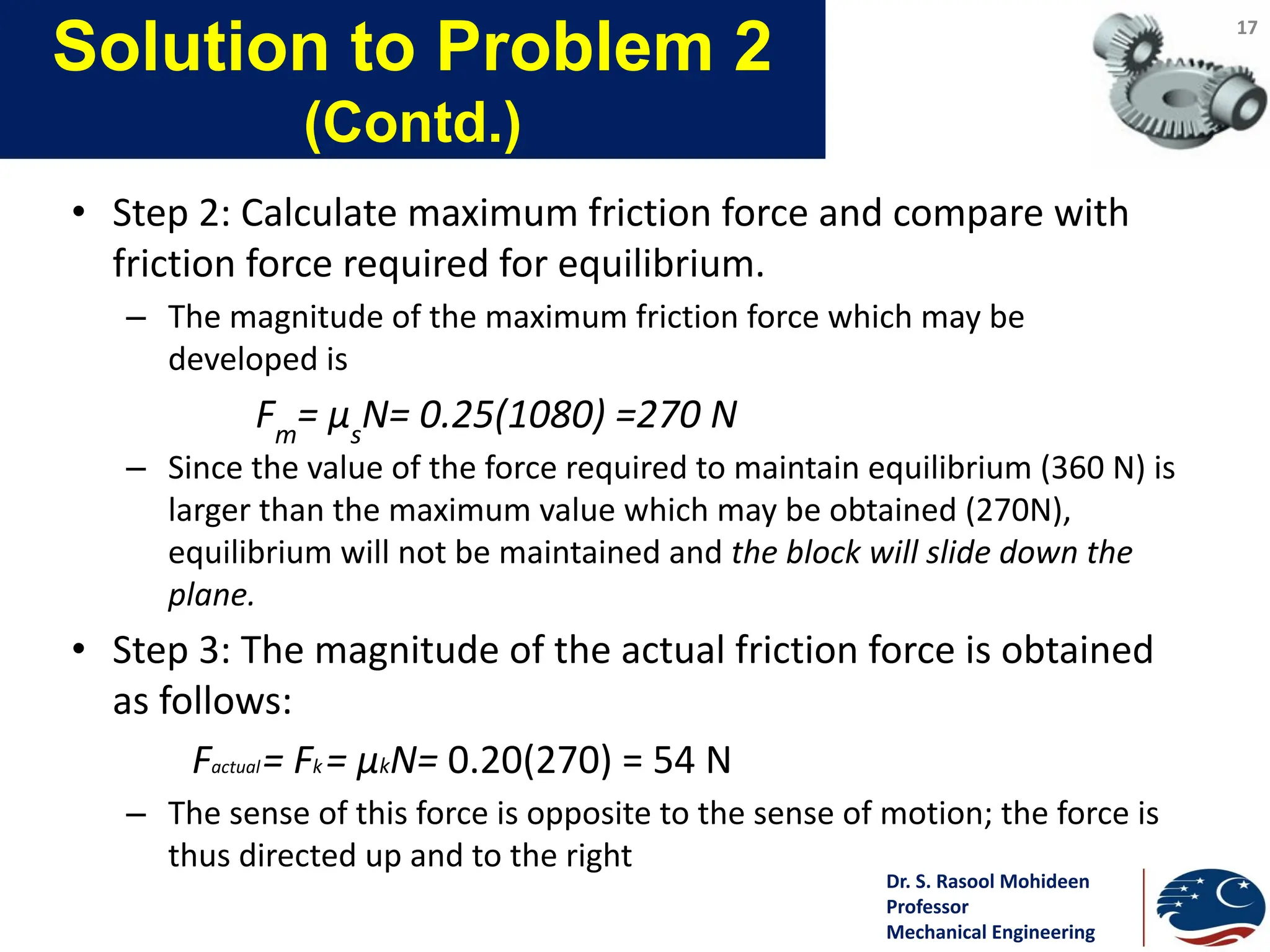
• Step 2: Calculate maximum friction force and compare with
friction force required for equilibrium.
– The magnitude of the maximum friction force which may be
developed is
Fm
= μs
N= 0.25(1080) =270 N
– Since the value of the force required to maintain equilibrium (360 N) is
larger than the maximum value which may be obtained (270N),
equilibrium will not be maintained and the block will slide down the
plane.
• Step 3: The magnitude of the actual friction force is obtained
as follows:
Factual= Fk = μkN= 0.20(270) = 54 N
– The sense of this force is opposite to the sense of motion; the force is
thus directed up and to the right
17
Dr. S. Rasool Mohideen
Professor
Mechanical Engineering
Problem 4
18
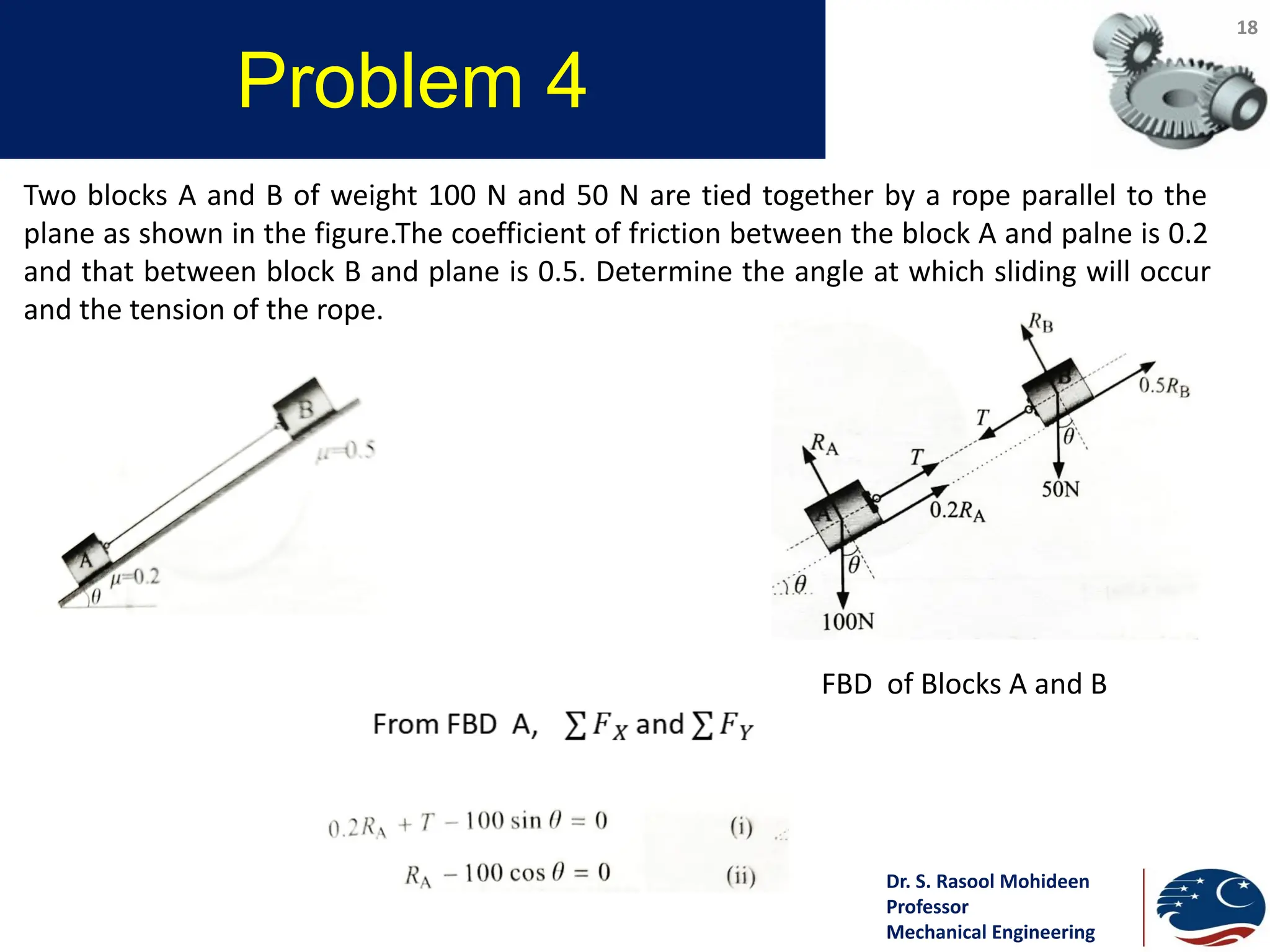
Two blocks A and B of weight 100 N and 50 N are tied together by a rope parallel to the
plane as shown in the figure.The coefficient of friction between the block A and palne is 0.2
and that between block B and plane is 0.5. Determine the angle at which sliding will occur
and the tension of the rope.
FBD of Blocks A and B
Dr. S. Rasool Mohideen
Professor
Mechanical Engineering
Problem 4 (Contd.)
19
From FBD B,
Dr. S. Rasool Mohideen
Professor
Mechanical Engineering
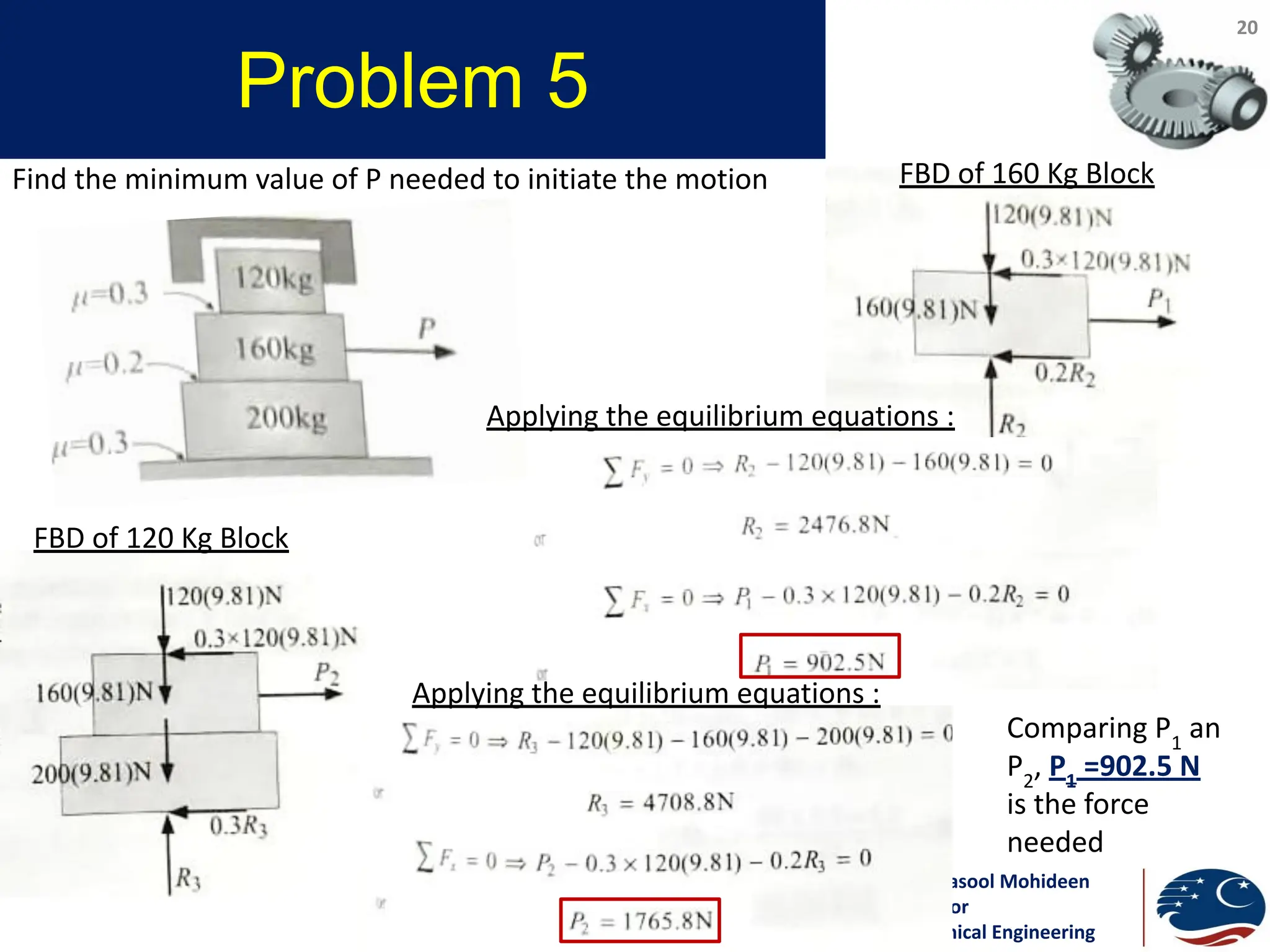
Problem 5
20
Find the minimum value of P needed to initiate the motion FBD of 160 Kg Block
Applying the equilibrium equations :
FBD of 120 Kg Block
Applying the equilibrium equations :
Comparing P1
an
P2
, P1
=902.5 N
is the force
needed
Dr. S. Rasool Mohideen
Professor
Mechanical Engineering
Problem 6
21
Find the value of P when the coeffecient of friction between the contact surfaces is 0.2
Dr. S. Rasool Mohideen
Professor
Mechanical Engineering
Problem 6 (Contd.)
22
Dr. S. Rasool Mohideen
Professor
Mechanical Engineering
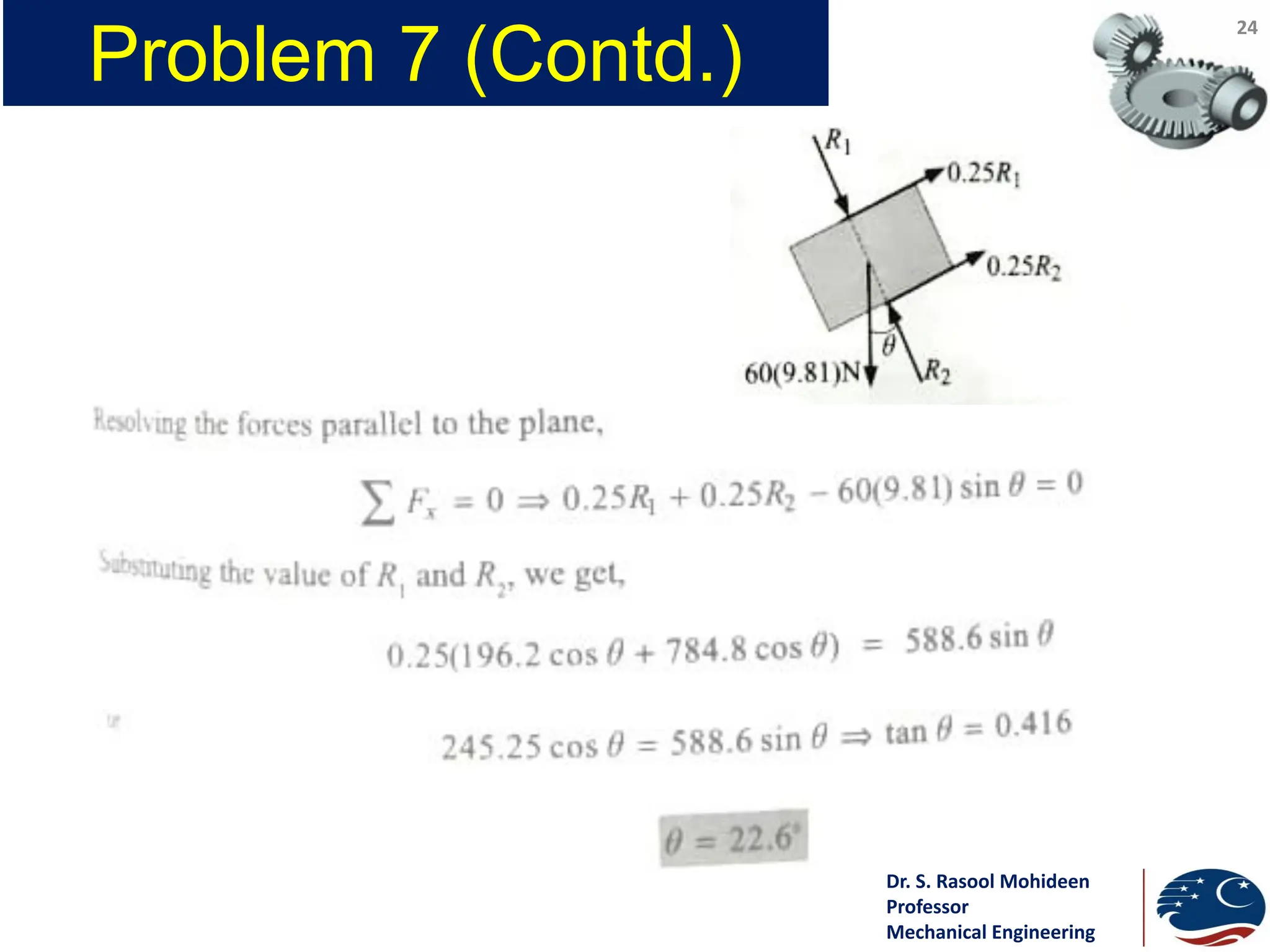
Problem 7
23
Find the angle θ, when μ=0.25 for all contact surfaces
From FBD of 20 kg block
From FBD of 60 kg block
Dr. S. Rasool Mohideen
Professor
Mechanical Engineering
Problem 7 (Contd.)
24
Dr. S. Rasool Mohideen
Professor
Mechanical Engineering
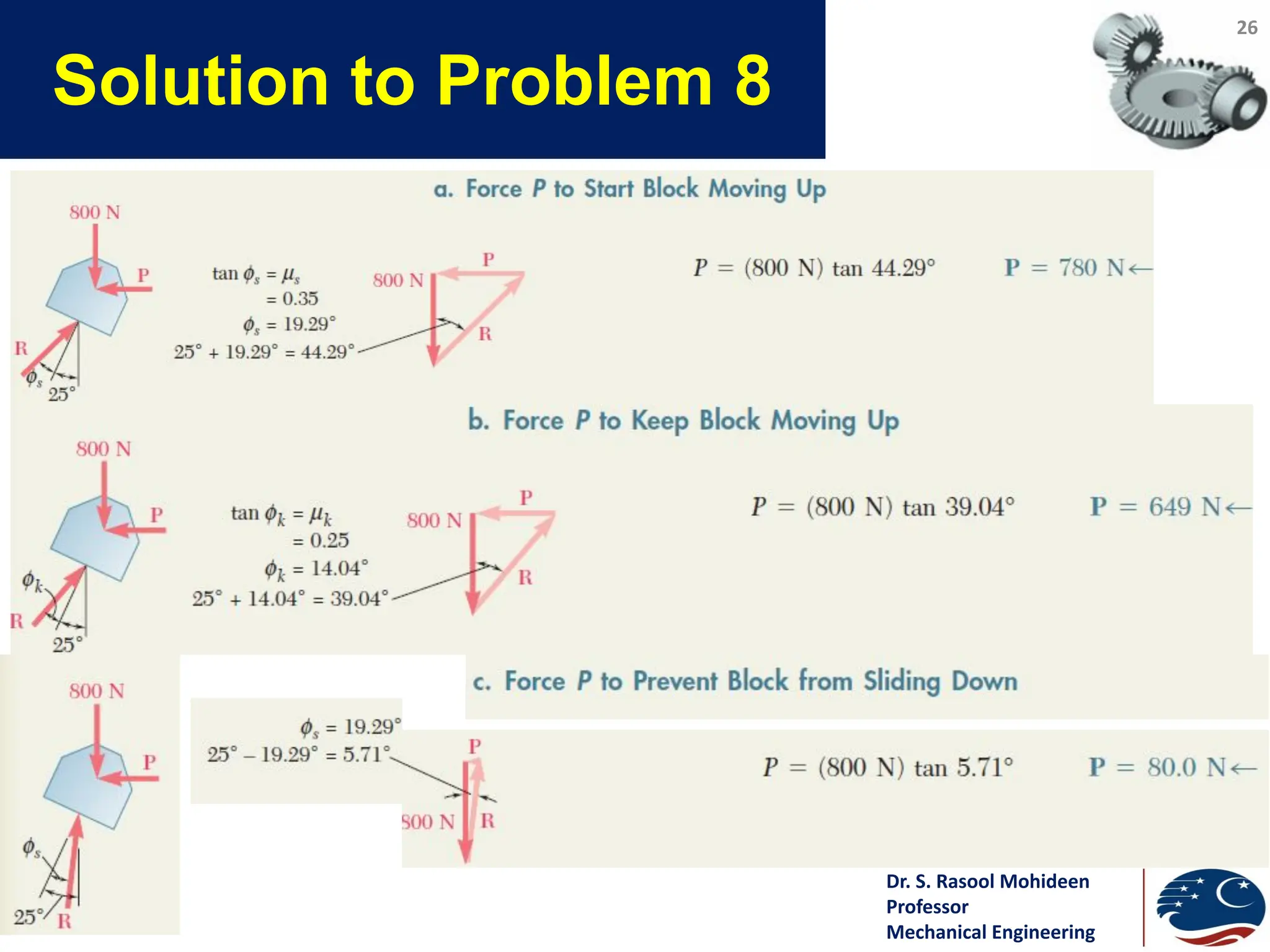
Problem 8
• A support block is acted upon by two forces as
shown. Knowing that the coefficients of
friction between the block and the incline are
μs
= 0.35 and μk
= 0.25, determine the force P
required
– (a) to start the block moving up the incline,
– (b) to keep it moving up,
– (c) to prevent it from sliding down.
25
Dr. S. Rasool Mohideen
Professor
Mechanical Engineering
Solution to Problem 8
26
Dr. S. Rasool Mohideen
Professor
Mechanical Engineering
Problem 9
• A uniform ladder of 4m in length and 10 kg
mass is resting against a smooth wall at end B.
End A rests on rough ground with μ=0.3.
Determine the angle of inclination of the
ladder and the normal reaction at B if the
ladder is in the verge of slipping.
27
A
B
θ=?
RB
=?
Dr. S. Rasool Mohideen
Professor
Mechanical Engineering
Solution to Problem 9
• Given
▪ ladder length =4m,
▪ mass =10 kg and
▪ μ=0.3
• Step 1: FBD of Ladder:
• Step 2: Apply Eqbm equations:
28
A
B
θ
RB
W= 10 x 9.81
RA
FA
4 Cosθ
4m
4 sir θ
2 Cosθ
Dr. S. Rasool Mohideen
Professor
Mechanical Engineering
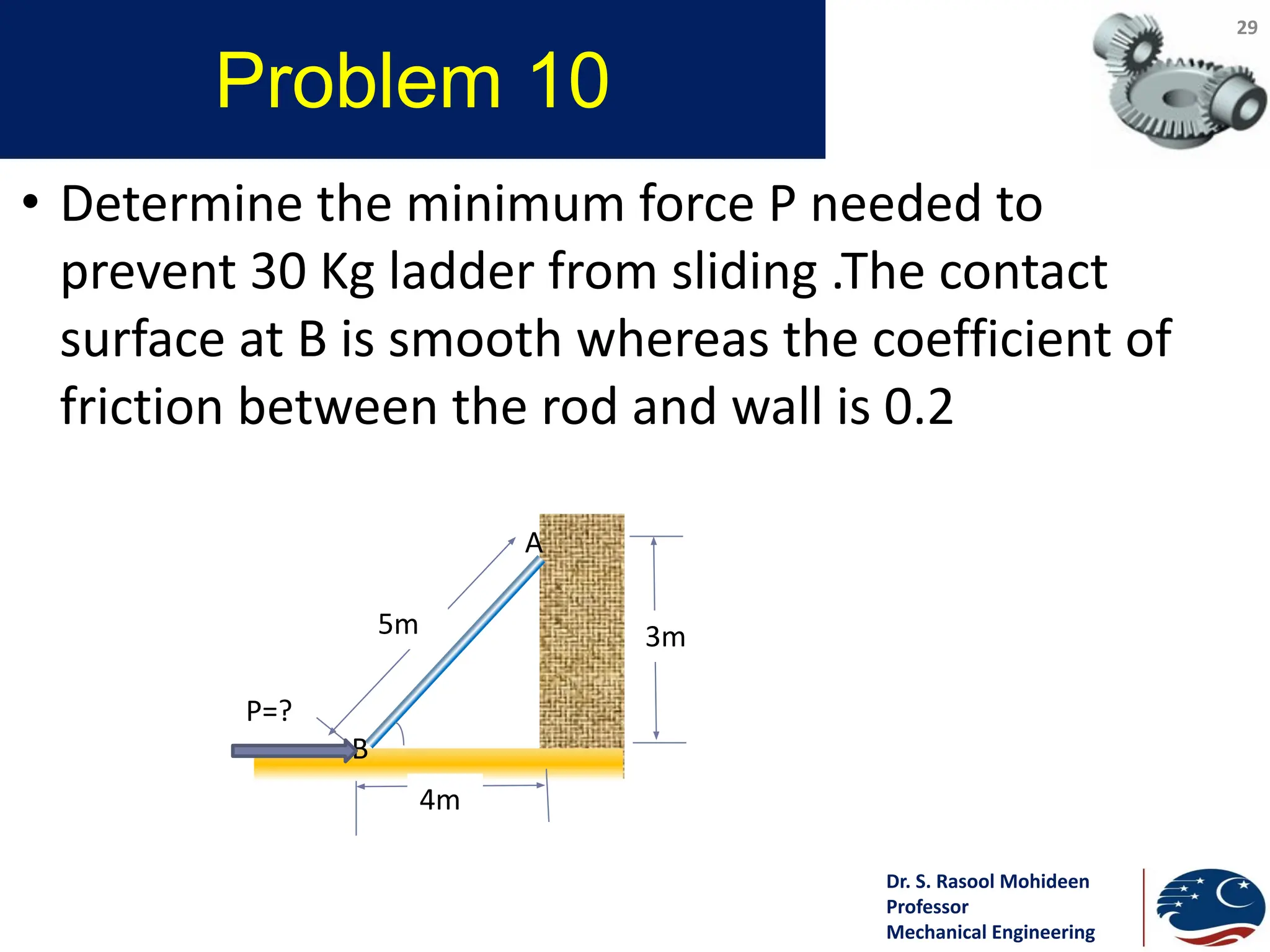
Problem 10
• Determine the minimum force P needed to
prevent 30 Kg ladder from sliding .The contact
surface at B is smooth whereas the coefficient of
friction between the rod and wall is 0.2
29
B
A
3m
4m
5m
P=?
Dr. S. Rasool Mohideen
Professor
Mechanical Engineering
Solution to Problem 10 30
3m
4m
5
m
θ
B
A
RB
W
RA
FB
FA
P=?
3m
4m
X=2.5 cos 36.86
36.86
B
A
W
RA
θ=tan-1
(3/4)
=36.86°
5
m
Dr. S. Rasool Mohideen
Professor
Mechanical Engineering
Problem 11
A uniform ladder of 3m length, and weighing 200 N is
resting on a wall making a angle of 60° with floor.
The coeffecient of friciton between the wall and
ladder is 0.25 and that between floor and ladder is
0.5. The ladder in addition to its own weight supports
a man of weight 1 kN at its top. Calculate the
horizantal force applied to the ladder at the floor to
prevent it from slipping
31
B
A
3 m
P=? 60°
200N
1000N
Dr. S. Rasool Mohideen
Professor
Mechanical Engineering
Solution to Problem 11
32
A
B
60
RB
W=200N
RA
P
3 Cos60
3m
3 sin 60
1.5 Cos60
1000 N
FA
FB

FRICTION and surface,............................

  • 1.
    1 ENGINEERING MECHANICS GED 1201 Dr. S.Rasool Mohideen Professor Mechanical Engineering Lecture 6: Friction
  • 2.
    Dr. S. RasoolMohideen Professor Mechanical Engineering UNIT V FRICTION • Introduction to friction • Types of friction • Laws of Coulomb friction • Frictional force • simple contact friction • Block friction • Rolling resistance • ladder friction and • wedge friction 2
  • 3.
    Dr. S. RasoolMohideen Professor Mechanical Engineering Introduction • Friction is defined as a force of resistance acting on a body which prevents or retards slipping of the body relative to another body. • Friction is caused by the “microscopic” interactions between the two surfaces • Friction results in a force in the direction opposite to the direction of motion! • Hence It opposes motion! Friction! Is it a BOON or BAN?
  • 4.
    Dr. S. RasoolMohideen Professor Mechanical Engineering Introduction (Contd.) Application BOON BAN
  • 5.
    Dr. S. RasoolMohideen Professor Mechanical Engineering Introduction (Contd.) Classification Friction Contact Condition Dry Film Thick Thin Type of Motion Sliding Rolling Amount of Motion Static Kinetic
  • 6.
    Dr. S. RasoolMohideen Professor Mechanical Engineering Dry Friction
  • 7.
    Dr. S. RasoolMohideen Professor Mechanical Engineering Dry Friction (Contd.) Coefficients of Friction 7 Approximate Values of Coefficient of Static Friction for Dry Surfaces ▪ The coefficients of friction μs and μk do not depend upon the area of the surfaces in contact. ▪ Both coefficients, however, depend strongly on the nature of the surfaces in contact. The coefficient of static friction between a package and the inclined conveyer belt must be sufficiently large to enable the package to be transported without slipping.
  • 8.
    Dr. S. RasoolMohideen Professor Mechanical Engineering Dry Friction (Contd.)
  • 9.
    Dr. S. RasoolMohideen Professor Mechanical Engineering Friction (Contd.) Types of Problems
  • 10.
    Dr. S. RasoolMohideen Professor Mechanical Engineering Angles of Friction • It is sometimes convenient to replace the normal force N and the friction force F by their resultant R. • Let us consider again a block of weight W resting on a horizontal plane surface. • If no horizontal force is applied to the block, the resultant R reduces to the normal force N (Fig.a). • However, if the applied force P has a horizontal component Px which tends to move the block, the force R will have a horizontal component F and, thus, will form an angle φ with the normal to the surface (Fig. b). • If Px is increased until motion becomes impending, the angle between R and the vertical grows and reaches a maximum value so that φ = φs . • This value is called the angle of static friction and is denoted by φs . 10
  • 11.
    Dr. S. RasoolMohideen Professor Mechanical Engineering Angles of Repose • Consider a block resting on a board and subjected to no other force than its weight W and the reaction R of the board. • The board can be given any desired inclination. • If the board is horizontal, the force R exerted by the board on the block is perpendicular to the board and balances the weight W (Fig. a). • If the board is given a small angle of inclination θ, the force R will deviate from the perpendicular to the board by the angle θ and will keep balancing W (Fig. b) • It will then have a normal component N of magnitude N = W cos θ and a tangential component F of magnitude F = W sin θ. 11
  • 12.
    Dr. S. RasoolMohideen Professor Mechanical Engineering Angles of Repose (Contd.) • If we keep increasing the angle of inclination, motion will soon become impending. • At that time, the angle between R and the normal will have reached its maximum value φs (Fig. c). • The value of the angle of inclination corresponding to impending motion is called the angle of repose. • Clearly, the angle of repose is equal to the angle of static friction φs . • If the angle of inclination u is further increased, motion starts and the angle between R and the normal drops to the lower value φk (Fig. d). • The reaction R is not vertical any more, and the forces acting on the block are unbalanced. 12
  • 13.
    Dr. S. RasoolMohideen Professor Mechanical Engineering Problem 1 • Find the static coefficient friction of between the block shown in the figure having a mass of 75 kg and the surface. 13 30° P=300 N 75 kg
  • 14.
    Dr. S. RasoolMohideen Professor Mechanical Engineering Solution to Problem 1 • System of forces on the block are shown • Resolving the forces horizontally • Resolving the forces vertically • Hence to find the static friction 14
  • 15.
    Dr. S. RasoolMohideen Professor Mechanical Engineering Problem 2 A 450 N force acts as shown on a 1350 N block placed on an inclined plane. The coefficients of friction between the block and plane are μs =0.25 and μk = 0.20. Determine whether the block is in equilibrium and find the value of the friction force.
  • 16.
    Dr. S. RasoolMohideen Professor Mechanical Engineering Solution to Problem 2 (Contd.) Step 1: Determine values of friction force and normal reaction force from plane required to maintain equilibrium. Assuming that F is directed down and to the left, free-body diagram of the block is drawn Resolving the forces parallel and perpendicular to the incline • The force F required to maintain equilibrium is an -360 N and is directed up and to the right; the tendency of the block is thus to move down the plane. 1350 N 450 N
  • 17.
    Dr. S. RasoolMohideen Professor Mechanical Engineering Solution to Problem 2 (Contd.) • Step 2: Calculate maximum friction force and compare with friction force required for equilibrium. – The magnitude of the maximum friction force which may be developed is Fm = μs N= 0.25(1080) =270 N – Since the value of the force required to maintain equilibrium (360 N) is larger than the maximum value which may be obtained (270N), equilibrium will not be maintained and the block will slide down the plane. • Step 3: The magnitude of the actual friction force is obtained as follows: Factual= Fk = μkN= 0.20(270) = 54 N – The sense of this force is opposite to the sense of motion; the force is thus directed up and to the right 17
  • 18.
    Dr. S. RasoolMohideen Professor Mechanical Engineering Problem 4 18 Two blocks A and B of weight 100 N and 50 N are tied together by a rope parallel to the plane as shown in the figure.The coefficient of friction between the block A and palne is 0.2 and that between block B and plane is 0.5. Determine the angle at which sliding will occur and the tension of the rope. FBD of Blocks A and B
  • 19.
    Dr. S. RasoolMohideen Professor Mechanical Engineering Problem 4 (Contd.) 19 From FBD B,
  • 20.
    Dr. S. RasoolMohideen Professor Mechanical Engineering Problem 5 20 Find the minimum value of P needed to initiate the motion FBD of 160 Kg Block Applying the equilibrium equations : FBD of 120 Kg Block Applying the equilibrium equations : Comparing P1 an P2 , P1 =902.5 N is the force needed
  • 21.
    Dr. S. RasoolMohideen Professor Mechanical Engineering Problem 6 21 Find the value of P when the coeffecient of friction between the contact surfaces is 0.2
  • 22.
    Dr. S. RasoolMohideen Professor Mechanical Engineering Problem 6 (Contd.) 22
  • 23.
    Dr. S. RasoolMohideen Professor Mechanical Engineering Problem 7 23 Find the angle θ, when μ=0.25 for all contact surfaces From FBD of 20 kg block From FBD of 60 kg block
  • 24.
    Dr. S. RasoolMohideen Professor Mechanical Engineering Problem 7 (Contd.) 24
  • 25.
    Dr. S. RasoolMohideen Professor Mechanical Engineering Problem 8 • A support block is acted upon by two forces as shown. Knowing that the coefficients of friction between the block and the incline are μs = 0.35 and μk = 0.25, determine the force P required – (a) to start the block moving up the incline, – (b) to keep it moving up, – (c) to prevent it from sliding down. 25
  • 26.
    Dr. S. RasoolMohideen Professor Mechanical Engineering Solution to Problem 8 26
  • 27.
    Dr. S. RasoolMohideen Professor Mechanical Engineering Problem 9 • A uniform ladder of 4m in length and 10 kg mass is resting against a smooth wall at end B. End A rests on rough ground with μ=0.3. Determine the angle of inclination of the ladder and the normal reaction at B if the ladder is in the verge of slipping. 27 A B θ=? RB =?
  • 28.
    Dr. S. RasoolMohideen Professor Mechanical Engineering Solution to Problem 9 • Given ▪ ladder length =4m, ▪ mass =10 kg and ▪ μ=0.3 • Step 1: FBD of Ladder: • Step 2: Apply Eqbm equations: 28 A B θ RB W= 10 x 9.81 RA FA 4 Cosθ 4m 4 sir θ 2 Cosθ
  • 29.
    Dr. S. RasoolMohideen Professor Mechanical Engineering Problem 10 • Determine the minimum force P needed to prevent 30 Kg ladder from sliding .The contact surface at B is smooth whereas the coefficient of friction between the rod and wall is 0.2 29 B A 3m 4m 5m P=?
  • 30.
    Dr. S. RasoolMohideen Professor Mechanical Engineering Solution to Problem 10 30 3m 4m 5 m θ B A RB W RA FB FA P=? 3m 4m X=2.5 cos 36.86 36.86 B A W RA θ=tan-1 (3/4) =36.86° 5 m
  • 31.
    Dr. S. RasoolMohideen Professor Mechanical Engineering Problem 11 A uniform ladder of 3m length, and weighing 200 N is resting on a wall making a angle of 60° with floor. The coeffecient of friciton between the wall and ladder is 0.25 and that between floor and ladder is 0.5. The ladder in addition to its own weight supports a man of weight 1 kN at its top. Calculate the horizantal force applied to the ladder at the floor to prevent it from slipping 31 B A 3 m P=? 60° 200N 1000N
  • 32.
    Dr. S. RasoolMohideen Professor Mechanical Engineering Solution to Problem 11 32 A B 60 RB W=200N RA P 3 Cos60 3m 3 sin 60 1.5 Cos60 1000 N FA FB