GCE Business
Year 13


Evidence A - Disney Takeover of Marvel

Disney's takeover of Marvel is a perfect fit, given the popularity
of superhero movies

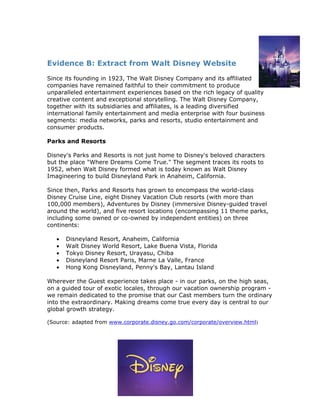
Even superheroes crumble when faced
with the might of Mickey Mouse.
Disney has bought Marvel Comics for
$4 billion, and the news has sent
shivers down the spine of teenage
comic-book fans all over the world.
Marvel is, after all, the home of heroes
who are outsiders and misfits. Spider-
Man suffers from teenage angst, the
Hulk has an anger management
problem, Wolverine hates nearly everybody and the Silver Surfer takes the
problems of the universe on his shoulders. How are they going to fit in to a
corporation that became a byword for sugar coated mass entertainment?

Marvel has been quick to reassure its fans. “Everybody take a deep breath,
all your favourite comics remain unchanged,” writes Joe Quesada, Marvel’s
editor-in-chief, on Twitter. “Disney merging with Marvel is a VERY GOOD
thing for us,” adds CB Cebulski, a Marvel writer and editor.

The acquisition makes perfect business sense. The biggest growth area in
Hollywood in the past 10 years has been superhero movies, ever since
Terminator 2 made it clear that CGI technology could cope with anything a
writer’s imagination could throw at it. And Marvel has been a huge
beneficiary, with Spider-Man, X-Men, Fantastic Four and Iron Man being big
hits.

Disney today is a very different organisation from the one that turned AA
Milne’s Winnie-the-Pooh into animation in 1966. And the proof is the
relationship between Disney and Pixar. When Disney bought Pixar in 2006,
there were anxieties that a giant company was swallowing up a smaller but
more successful rival and that Pixar’s distinctive style would not survive. But
Disney had the great good sense not to kill the goose that laid the golden
eggs, and the result has been classic Pixar animations such as Wall-E, Bolt
and the forthcoming Up. John Lasseter, the creator of Pixar, is overall head
of Disney animation.

Disney is unlikely to forget that with great power comes great responsibility.
And lots of money.

(Source: adapted from www.independent.co.uk by Paul Gent 2 Sept. 2009)
Evidence B: Extract from Walt Disney Website
Since its founding in 1923, The Walt Disney Company and its affiliated
companies have remained faithful to their commitment to produce
unparalleled entertainment experiences based on the rich legacy of quality
creative content and exceptional storytelling. The Walt Disney Company,
together with its subsidiaries and affiliates, is a leading diversified
international family entertainment and media enterprise with four business
segments: media networks, parks and resorts, studio entertainment and
consumer products.

Parks and Resorts

Disney's Parks and Resorts is not just home to Disney's beloved characters
but the place "Where Dreams Come True." The segment traces its roots to
1952, when Walt Disney formed what is today known as Walt Disney
Imagineering to build Disneyland Park in Anaheim, California.

Since then, Parks and Resorts has grown to encompass the world-class
Disney Cruise Line, eight Disney Vacation Club resorts (with more than
100,000 members), Adventures by Disney (immersive Disney-guided travel
around the world), and five resort locations (encompassing 11 theme parks,
including some owned or co-owned by independent entities) on three
continents:

   •   Disneyland Resort, Anaheim, California
   •   Walt Disney World Resort, Lake Buena Vista, Florida
   •   Tokyo Disney Resort, Urayasu, Chiba
   •   Disneyland Resort Paris, Marne La Valle, France
   •   Hong Kong Disneyland, Penny's Bay, Lantau Island

Wherever the Guest experience takes place - in our parks, on the high seas,
on a guided tour of exotic locales, through our vacation ownership program -
we remain dedicated to the promise that our Cast members turn the ordinary
into the extraordinary. Making dreams come true every day is central to our
global growth strategy.

(Source: adapted from www.corporate.disney.go.com/corporate/overview.html)
Evidence C

Walt Disney International (WDI) is at the center of Disney’s new business
development and growth activities in markets around the world. WDI’s
responsibilities range from providing administrative support and coordination
for Disney’s global offices to increasing the globalization of the Disney brand
to ensure that it is locally relevant to consumers around the world.

From Russia and India to China and Latin America, WDI has invested to grow
its businesses, capitalizing in many of those markets by the creation of
localized versions of Disney family entertainment. October 2008 saw the
release of Disney’s first animated film created especially for the India
market, Roadside Romeo, as well as the exciting debut of the stage
production in Moscow of Beauty and the Beast, which will embark on a six-
city tour of Russia. Minnie Mouse made a splash on the pages of Russian
Vogue magazine, wearing fancy attire designed by top Russian fashion
designers. The first film created specifically for the Russian market, The
Book of Masters, will arrive in movie theaters next year. After the
successful release of The Magic Gourd, the first Disney film made locally in
China, a second film, Touch of a Panda, will premiere in early 2009.

In Latin America this year, two localized versions of High School Musical –
one in Argentina and the other in Mexico – danced their way to box office
success. Localized versions of Desperate Housewives are proving to be an
international hit on small screens throughout the region.

WDI has also consolidated an integrated organizational structure in Japan,
assuring that all Disney content has a clear vision and is consistent with
other Company-wide priorities. An all-new Japanese animated TV series,
Stitch, has been a ratings success and is another successful example of what
happens when content is created specifically for a given market.

This year, WDI formed the European Management Board (EMB). The EMB
assumes responsibility for identifying and exploiting growth opportunities in
Europe, the Middle East and Africa, including acquisitions, as well as agreeing
on cross-business strategic priorities and initiatives to support them. The
EMB constantly evaluates ways in which WDI can maximize efficiencies
across operations, both front and back of house; develops brand marketing
plans; and drives synergy support for key Company priorities. It
communicates a clear strategy for TWDC (The Walt Disney Corporation)
senior management and will work to ensure that similar objectives are
achieved on an individual country or territory basis.

Together with the impact of assertive strategies in developed markets, the
creation of the EMB and an eye to overall growth, WDI will continue to use
localized content and staff to establish and reconfirm the Disney brand
globally

Source: The Walt Disney Annual Report 2008
Evidence D


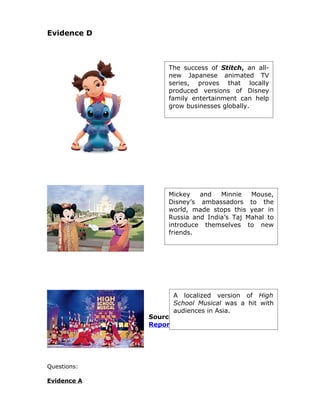
                  The success of Stitch, an all-
                  new Japanese animated TV
                  series, proves that locally
                  produced versions of Disney
                  family entertainment can help
                  grow businesses globally.


                  Mickey   and   Minnie   Mouse,
                  Disney’s ambassadors to the
                  world, made stops this year in
                  Russia and India’s Taj Mahal to
                  introduce themselves to new
                  friends.


                   A localized version of High
                   School Musical was a hit with
                   audiences in Asia.
             Source: The Walt Disney Annual
             Report 2008


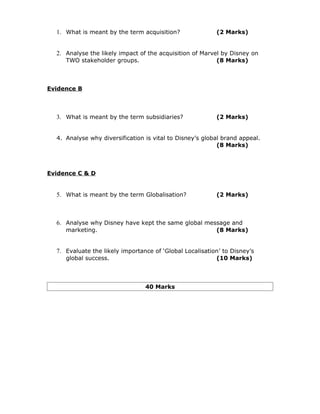
Questions:

Evidence A
1. What is meant by the term acquisition?               (2 Marks)


  2. Analyse the likely impact of the acquisition of Marvel by Disney on
     TWO stakeholder groups.                              (8 Marks)


Evidence B


  3. What is meant by the term subsidiaries?              (2 Marks)


  4. Analyse why diversification is vital to Disney’s global brand appeal.
                                                           (8 Marks)


Evidence C & D


  5. What is meant by the term Globalisation?             (2 Marks)


  6. Analyse why Disney have kept the same global message and
     marketing.                                           (8 Marks)


  7. Evaluate the likely importance of ‘Global Localisation’ to Disney’s
     global success.                                      (10 Marks)


                                 40 Marks

Unit 3 Revision test globalisation

  • 1.
    GCE Business Year 13 EvidenceA - Disney Takeover of Marvel Disney's takeover of Marvel is a perfect fit, given the popularity of superhero movies Even superheroes crumble when faced with the might of Mickey Mouse. Disney has bought Marvel Comics for $4 billion, and the news has sent shivers down the spine of teenage comic-book fans all over the world. Marvel is, after all, the home of heroes who are outsiders and misfits. Spider- Man suffers from teenage angst, the Hulk has an anger management problem, Wolverine hates nearly everybody and the Silver Surfer takes the problems of the universe on his shoulders. How are they going to fit in to a corporation that became a byword for sugar coated mass entertainment? Marvel has been quick to reassure its fans. “Everybody take a deep breath, all your favourite comics remain unchanged,” writes Joe Quesada, Marvel’s editor-in-chief, on Twitter. “Disney merging with Marvel is a VERY GOOD thing for us,” adds CB Cebulski, a Marvel writer and editor. The acquisition makes perfect business sense. The biggest growth area in Hollywood in the past 10 years has been superhero movies, ever since Terminator 2 made it clear that CGI technology could cope with anything a writer’s imagination could throw at it. And Marvel has been a huge beneficiary, with Spider-Man, X-Men, Fantastic Four and Iron Man being big hits. Disney today is a very different organisation from the one that turned AA Milne’s Winnie-the-Pooh into animation in 1966. And the proof is the relationship between Disney and Pixar. When Disney bought Pixar in 2006, there were anxieties that a giant company was swallowing up a smaller but more successful rival and that Pixar’s distinctive style would not survive. But Disney had the great good sense not to kill the goose that laid the golden eggs, and the result has been classic Pixar animations such as Wall-E, Bolt and the forthcoming Up. John Lasseter, the creator of Pixar, is overall head of Disney animation. Disney is unlikely to forget that with great power comes great responsibility. And lots of money. (Source: adapted from www.independent.co.uk by Paul Gent 2 Sept. 2009)
  • 2.
    Evidence B: Extractfrom Walt Disney Website Since its founding in 1923, The Walt Disney Company and its affiliated companies have remained faithful to their commitment to produce unparalleled entertainment experiences based on the rich legacy of quality creative content and exceptional storytelling. The Walt Disney Company, together with its subsidiaries and affiliates, is a leading diversified international family entertainment and media enterprise with four business segments: media networks, parks and resorts, studio entertainment and consumer products. Parks and Resorts Disney's Parks and Resorts is not just home to Disney's beloved characters but the place "Where Dreams Come True." The segment traces its roots to 1952, when Walt Disney formed what is today known as Walt Disney Imagineering to build Disneyland Park in Anaheim, California. Since then, Parks and Resorts has grown to encompass the world-class Disney Cruise Line, eight Disney Vacation Club resorts (with more than 100,000 members), Adventures by Disney (immersive Disney-guided travel around the world), and five resort locations (encompassing 11 theme parks, including some owned or co-owned by independent entities) on three continents: • Disneyland Resort, Anaheim, California • Walt Disney World Resort, Lake Buena Vista, Florida • Tokyo Disney Resort, Urayasu, Chiba • Disneyland Resort Paris, Marne La Valle, France • Hong Kong Disneyland, Penny's Bay, Lantau Island Wherever the Guest experience takes place - in our parks, on the high seas, on a guided tour of exotic locales, through our vacation ownership program - we remain dedicated to the promise that our Cast members turn the ordinary into the extraordinary. Making dreams come true every day is central to our global growth strategy. (Source: adapted from www.corporate.disney.go.com/corporate/overview.html)
  • 3.
    Evidence C Walt DisneyInternational (WDI) is at the center of Disney’s new business development and growth activities in markets around the world. WDI’s responsibilities range from providing administrative support and coordination for Disney’s global offices to increasing the globalization of the Disney brand to ensure that it is locally relevant to consumers around the world. From Russia and India to China and Latin America, WDI has invested to grow its businesses, capitalizing in many of those markets by the creation of localized versions of Disney family entertainment. October 2008 saw the release of Disney’s first animated film created especially for the India market, Roadside Romeo, as well as the exciting debut of the stage production in Moscow of Beauty and the Beast, which will embark on a six- city tour of Russia. Minnie Mouse made a splash on the pages of Russian Vogue magazine, wearing fancy attire designed by top Russian fashion designers. The first film created specifically for the Russian market, The Book of Masters, will arrive in movie theaters next year. After the successful release of The Magic Gourd, the first Disney film made locally in China, a second film, Touch of a Panda, will premiere in early 2009. In Latin America this year, two localized versions of High School Musical – one in Argentina and the other in Mexico – danced their way to box office success. Localized versions of Desperate Housewives are proving to be an international hit on small screens throughout the region. WDI has also consolidated an integrated organizational structure in Japan, assuring that all Disney content has a clear vision and is consistent with other Company-wide priorities. An all-new Japanese animated TV series, Stitch, has been a ratings success and is another successful example of what happens when content is created specifically for a given market. This year, WDI formed the European Management Board (EMB). The EMB assumes responsibility for identifying and exploiting growth opportunities in Europe, the Middle East and Africa, including acquisitions, as well as agreeing on cross-business strategic priorities and initiatives to support them. The EMB constantly evaluates ways in which WDI can maximize efficiencies across operations, both front and back of house; develops brand marketing plans; and drives synergy support for key Company priorities. It communicates a clear strategy for TWDC (The Walt Disney Corporation) senior management and will work to ensure that similar objectives are achieved on an individual country or territory basis. Together with the impact of assertive strategies in developed markets, the creation of the EMB and an eye to overall growth, WDI will continue to use localized content and staff to establish and reconfirm the Disney brand globally Source: The Walt Disney Annual Report 2008
  • 4.
    Evidence D The success of Stitch, an all- new Japanese animated TV series, proves that locally produced versions of Disney family entertainment can help grow businesses globally. Mickey and Minnie Mouse, Disney’s ambassadors to the world, made stops this year in Russia and India’s Taj Mahal to introduce themselves to new friends. A localized version of High School Musical was a hit with audiences in Asia. Source: The Walt Disney Annual Report 2008 Questions: Evidence A
  • 5.
    1. What ismeant by the term acquisition? (2 Marks) 2. Analyse the likely impact of the acquisition of Marvel by Disney on TWO stakeholder groups. (8 Marks) Evidence B 3. What is meant by the term subsidiaries? (2 Marks) 4. Analyse why diversification is vital to Disney’s global brand appeal. (8 Marks) Evidence C & D 5. What is meant by the term Globalisation? (2 Marks) 6. Analyse why Disney have kept the same global message and marketing. (8 Marks) 7. Evaluate the likely importance of ‘Global Localisation’ to Disney’s global success. (10 Marks) 40 Marks