A Case Study on
 
Agenda About Disney Divisions of Disney A bit of History About the CASE SWOT Analysis Its Current Executive Management Recommended Organizational structures Model 1 Model 2 Model 3
About Disney The Walt Disney Company  (most commonly known as  Disney ) ( NYSE :  DIS ) is one of the largest media and entertainment corporations in the world. Founded on  October 16 ,  1923  by brothers  Walt  and  Roy Disney  as a small animation studio Today it is one of the largest  Hollywood  studios and also owns eleven  theme parks , two  water parks  and several television networks, including the  American Broadcasting Company  (ABC). Disney's corporate headquarters and primary production facilities are located at the  Walt Disney Studios  in  Burbank ,  California ,  USA .  The company is a component of the  Dow Jones Industrial Average . It had revenues of  $31.9 billion  in 2005
Continued….. On June 12, 2006 Disney Mobile phone service is launche d On  January 23 , Disney announces a deal to purchase  Pixar Animation Studios  in an all-stock transaction worth $7.4bn   In July 2006, the Disney film  Pirates of the Caribbean 2  is the highest grossing movie in opening weekend history at $135,000,000  USD   Employees :  133,000 (2006)
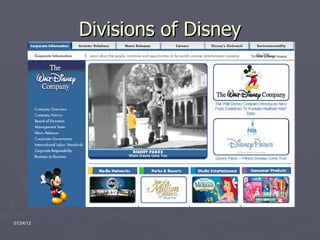
Divisions of Disney
Divisions of Disney Media and Entertainment   American Broadcasting Company Buena Vista Distribution Buena Vista Motion Pictures Group Walt Disney Studio Entertainment Walt Disney Parks and Resorts Disney Consumer Products
A bit of History For more than eight decades, the name Walt Disney has been preeminent in the field of family entertainment. From humble beginnings as a cartoon studio in the 1920s to today's global corporation, The Walt Disney Company continues to proudly provide quality entertainment for every member of the family, across America and around the world Disney Legends   The Disney Legends program was established in 1987 to acknowledge and honor the many individuals whose imagination, talents, and dreams have created the Disney magic. Since its inception, the program has honored many gifted animators, Imagineers, song writers, actors and business leaders as having made a significant impact on the Disney legacy The Walt Disney Family Museum   The Disney Family Museum Web site is produced and maintained by the Walt Disney Family Foundation, a nonprofit organization. Founded in 1995, the Foundation strives to promote education, writing, and scholarship about Walt Disney To read more on history of Disney you can visit:  http://corporate.disney.go.com/corporate/complete_history.html
About the CASE The Walt Disney Company Is heralded as the world’s largest entertainment company Earned the reputation by tight control Although control pervades the company, it is not too strong a grip
Strict control but independent Employees are aware of their prime objectives Have freedom to think beyond limit and come up with new innovative ideas Company have adopted the phrase “Dream as a team” The concept of independency tempered the control over each department Managers here do the great job of encouraging  the imagineers and employees Imagineers have a brainstorming session called  “Blue sky” Disney president Frank Wells believes that “If a good idea is there. You know it, you feel it, you do it, no matter where it comes from”
SWOT Analysis
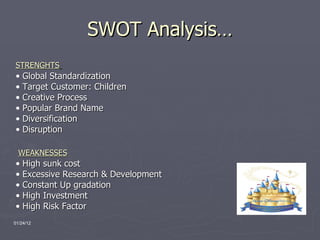
SWOT Analysis… STRENGHTS   Global Standardization Target Customer: Children Creative Process Popular Brand Name Diversification Disruption WEAKNESSES High sunk cost Excessive Research & Development Constant Up gradation High Investment High Risk Factor
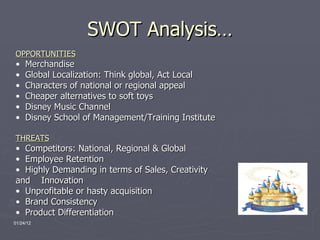
SWOT Analysis… OPPORTUNITIES Merchandise Global Localization: Think global, Act Local Characters of national or regional appeal Cheaper alternatives to soft toys Disney Music Channel Disney School of Management/Training Institute  THREATS Competitors: National, Regional & Global Employee Retention Highly Demanding in terms of Sales, Creativity and  Innovation Unprofitable or hasty acquisition Brand Consistency Product Differentiation
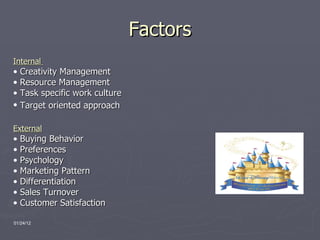
Factors Internal  Creativity Management Resource Management Task specific work culture Target oriented approach   External Buying Behavior Preferences Psychology Marketing Pattern Differentiation Sales Turnover Customer Satisfaction
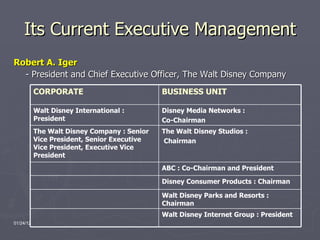
Its Current Executive Management Robert A. Iger - President and Chief Executive Officer, The Walt Disney Company Walt Disney Internet Group : President Walt Disney Parks and Resorts : Chairman Disney Consumer Products : Chairman ABC : Co-Chairman and President  The Walt Disney Studios : Chairman The Walt Disney Company : Senior Vice President, Senior Executive Vice President, Executive Vice President Disney Media Networks :  Co-Chairman Walt Disney International : President BUSINESS UNIT  CORPORATE
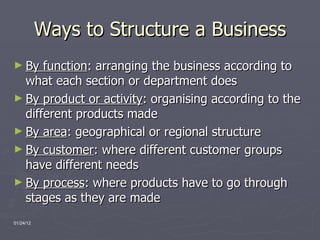
Ways to Structure a Business By function : arranging the business according to what each section or department does By product or activity : organising according to the different products made By area : geographical or regional structure By customer : where different customer groups have different needs By process : where products have to go through stages as they are made
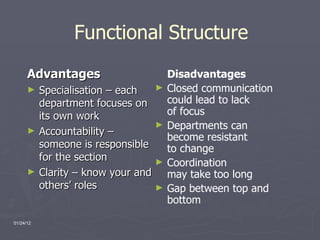
Advantages Specialisation – each department focuses on its own work Accountability – someone is responsible for the section Clarity – know your and others’ roles Functional Structure Disadvantages Closed communication  could lead to lack  of focus Departments can become resistant  to change Coordination  may take too long Gap between top and bottom
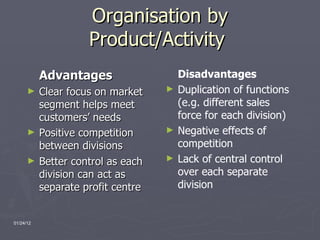
Organisation by Product/Activity  Advantages Clear focus on market segment helps meet customers’ needs Positive competition between divisions Better control as each division can act as separate profit centre Disadvantages Duplication of functions (e.g. different sales force for each division) Negative effects of competition Lack of central control over each separate division
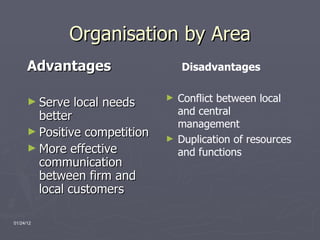
Organisation by Area Advantages Serve local needs better  Positive competition More effective communication between firm and local customers   Disadvantages Conflict between local and central management Duplication of resources and functions
Recommended Organizational structures
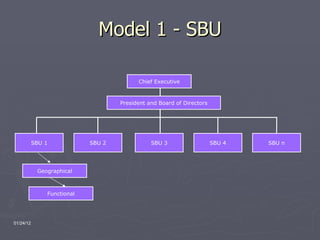
Model 1 - SBU SBU 1 SBU 2 SBU 3 SBU 4 SBU n President and Board of Directors Chief Executive Geographical Functional
Model 2 – Matrix structure
Model 3 – Cross Functional
Questions???
Thank You!!!

Case study disney

  • 1.
  • 2.
  • 3.
    Agenda About DisneyDivisions of Disney A bit of History About the CASE SWOT Analysis Its Current Executive Management Recommended Organizational structures Model 1 Model 2 Model 3
  • 4.
    About Disney TheWalt Disney Company (most commonly known as Disney ) ( NYSE : DIS ) is one of the largest media and entertainment corporations in the world. Founded on October 16 , 1923 by brothers Walt and Roy Disney as a small animation studio Today it is one of the largest Hollywood studios and also owns eleven theme parks , two water parks and several television networks, including the American Broadcasting Company (ABC). Disney's corporate headquarters and primary production facilities are located at the Walt Disney Studios in Burbank , California , USA . The company is a component of the Dow Jones Industrial Average . It had revenues of $31.9 billion in 2005
  • 5.
    Continued….. On June12, 2006 Disney Mobile phone service is launche d On January 23 , Disney announces a deal to purchase Pixar Animation Studios in an all-stock transaction worth $7.4bn In July 2006, the Disney film Pirates of the Caribbean 2 is the highest grossing movie in opening weekend history at $135,000,000 USD Employees : 133,000 (2006)
  • 6.
  • 7.
    Divisions of DisneyMedia and Entertainment American Broadcasting Company Buena Vista Distribution Buena Vista Motion Pictures Group Walt Disney Studio Entertainment Walt Disney Parks and Resorts Disney Consumer Products
  • 8.
    A bit ofHistory For more than eight decades, the name Walt Disney has been preeminent in the field of family entertainment. From humble beginnings as a cartoon studio in the 1920s to today's global corporation, The Walt Disney Company continues to proudly provide quality entertainment for every member of the family, across America and around the world Disney Legends The Disney Legends program was established in 1987 to acknowledge and honor the many individuals whose imagination, talents, and dreams have created the Disney magic. Since its inception, the program has honored many gifted animators, Imagineers, song writers, actors and business leaders as having made a significant impact on the Disney legacy The Walt Disney Family Museum The Disney Family Museum Web site is produced and maintained by the Walt Disney Family Foundation, a nonprofit organization. Founded in 1995, the Foundation strives to promote education, writing, and scholarship about Walt Disney To read more on history of Disney you can visit: http://corporate.disney.go.com/corporate/complete_history.html
  • 9.
    About the CASEThe Walt Disney Company Is heralded as the world’s largest entertainment company Earned the reputation by tight control Although control pervades the company, it is not too strong a grip
  • 10.
    Strict control butindependent Employees are aware of their prime objectives Have freedom to think beyond limit and come up with new innovative ideas Company have adopted the phrase “Dream as a team” The concept of independency tempered the control over each department Managers here do the great job of encouraging the imagineers and employees Imagineers have a brainstorming session called “Blue sky” Disney president Frank Wells believes that “If a good idea is there. You know it, you feel it, you do it, no matter where it comes from”
  • 11.
  • 12.
    SWOT Analysis… STRENGHTS Global Standardization Target Customer: Children Creative Process Popular Brand Name Diversification Disruption WEAKNESSES High sunk cost Excessive Research & Development Constant Up gradation High Investment High Risk Factor
  • 13.
    SWOT Analysis… OPPORTUNITIESMerchandise Global Localization: Think global, Act Local Characters of national or regional appeal Cheaper alternatives to soft toys Disney Music Channel Disney School of Management/Training Institute THREATS Competitors: National, Regional & Global Employee Retention Highly Demanding in terms of Sales, Creativity and Innovation Unprofitable or hasty acquisition Brand Consistency Product Differentiation
  • 14.
    Factors Internal Creativity Management Resource Management Task specific work culture Target oriented approach External Buying Behavior Preferences Psychology Marketing Pattern Differentiation Sales Turnover Customer Satisfaction
  • 15.
    Its Current ExecutiveManagement Robert A. Iger - President and Chief Executive Officer, The Walt Disney Company Walt Disney Internet Group : President Walt Disney Parks and Resorts : Chairman Disney Consumer Products : Chairman ABC : Co-Chairman and President The Walt Disney Studios : Chairman The Walt Disney Company : Senior Vice President, Senior Executive Vice President, Executive Vice President Disney Media Networks : Co-Chairman Walt Disney International : President BUSINESS UNIT CORPORATE
  • 16.
    Ways to Structurea Business By function : arranging the business according to what each section or department does By product or activity : organising according to the different products made By area : geographical or regional structure By customer : where different customer groups have different needs By process : where products have to go through stages as they are made
  • 17.
    Advantages Specialisation –each department focuses on its own work Accountability – someone is responsible for the section Clarity – know your and others’ roles Functional Structure Disadvantages Closed communication could lead to lack of focus Departments can become resistant to change Coordination may take too long Gap between top and bottom
  • 18.
    Organisation by Product/Activity Advantages Clear focus on market segment helps meet customers’ needs Positive competition between divisions Better control as each division can act as separate profit centre Disadvantages Duplication of functions (e.g. different sales force for each division) Negative effects of competition Lack of central control over each separate division
  • 19.
    Organisation by AreaAdvantages Serve local needs better Positive competition More effective communication between firm and local customers Disadvantages Conflict between local and central management Duplication of resources and functions
  • 20.
  • 21.
    Model 1 -SBU SBU 1 SBU 2 SBU 3 SBU 4 SBU n President and Board of Directors Chief Executive Geographical Functional
  • 22.
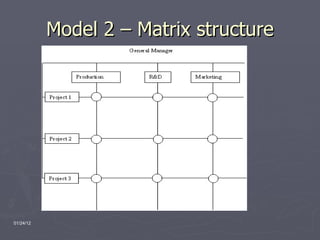
    Model 2 –Matrix structure
  • 23.
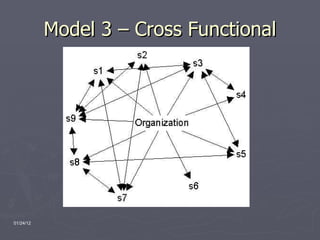
    Model 3 –Cross Functional
  • 24.
  • 25.

Editor's Notes

  • #2 Dale Carnegie Training® can help you manage the sweeping changes that continue to reshape the workplace. Organizations today need managers who are knowledgeable business partners skilled at managing change. As change agents, managers can play a vital role in helping their organizations remain competitive. Rely on the following process, and you will be more effective in managing organizational change. Be sure you have earned the right to deliver this program, are excited about the topic, and are eager to share with your audience. Speak from your own experiences. Set a good example. Help others benefit from what you have learned about managing organizational change.
  • #3 Dale Carnegie Training® can help you manage the sweeping changes that continue to reshape the workplace. Organizations today need managers who are knowledgeable business partners skilled at managing change. As change agents, managers can play a vital role in helping their organizations remain competitive. Rely on the following process, and you will be more effective in managing organizational change. Be sure you have earned the right to deliver this program, are excited about the topic, and are eager to share with your audience. Speak from your own experiences. Set a good example. Help others benefit from what you have learned about managing organizational change.
  • #4 Start by articulating a clear vision of what your organization should be. Present the vision clearly, and explain why it is important for your organization to achieve this vision. Include a picture of the leadership skills this vision will require. For example, global thinking, strategic partnering, etc.
  • #5 Start by articulating a clear vision of what your organization should be. Present the vision clearly, and explain why it is important for your organization to achieve this vision. Include a picture of the leadership skills this vision will require. For example, global thinking, strategic partnering, etc.
  • #6 Start by articulating a clear vision of what your organization should be. Present the vision clearly, and explain why it is important for your organization to achieve this vision. Include a picture of the leadership skills this vision will require. For example, global thinking, strategic partnering, etc.
  • #7 Start by articulating a clear vision of what your organization should be. Present the vision clearly, and explain why it is important for your organization to achieve this vision. Include a picture of the leadership skills this vision will require. For example, global thinking, strategic partnering, etc.
  • #8 Start by articulating a clear vision of what your organization should be. Present the vision clearly, and explain why it is important for your organization to achieve this vision. Include a picture of the leadership skills this vision will require. For example, global thinking, strategic partnering, etc.
  • #9 Start by articulating a clear vision of what your organization should be. Present the vision clearly, and explain why it is important for your organization to achieve this vision. Include a picture of the leadership skills this vision will require. For example, global thinking, strategic partnering, etc.
  • #10 Start by articulating a clear vision of what your organization should be. Present the vision clearly, and explain why it is important for your organization to achieve this vision. Include a picture of the leadership skills this vision will require. For example, global thinking, strategic partnering, etc.
  • #11 Start by articulating a clear vision of what your organization should be. Present the vision clearly, and explain why it is important for your organization to achieve this vision. Include a picture of the leadership skills this vision will require. For example, global thinking, strategic partnering, etc.
  • #12 Start by articulating a clear vision of what your organization should be. Present the vision clearly, and explain why it is important for your organization to achieve this vision. Include a picture of the leadership skills this vision will require. For example, global thinking, strategic partnering, etc.
  • #16 Start by articulating a clear vision of what your organization should be. Present the vision clearly, and explain why it is important for your organization to achieve this vision. Include a picture of the leadership skills this vision will require. For example, global thinking, strategic partnering, etc.
  • #17 Start by articulating a clear vision of what your organization should be. Present the vision clearly, and explain why it is important for your organization to achieve this vision. Include a picture of the leadership skills this vision will require. For example, global thinking, strategic partnering, etc.
  • #18 Start by articulating a clear vision of what your organization should be. Present the vision clearly, and explain why it is important for your organization to achieve this vision. Include a picture of the leadership skills this vision will require. For example, global thinking, strategic partnering, etc.
  • #19 Start by articulating a clear vision of what your organization should be. Present the vision clearly, and explain why it is important for your organization to achieve this vision. Include a picture of the leadership skills this vision will require. For example, global thinking, strategic partnering, etc.
  • #20 Start by articulating a clear vision of what your organization should be. Present the vision clearly, and explain why it is important for your organization to achieve this vision. Include a picture of the leadership skills this vision will require. For example, global thinking, strategic partnering, etc.
  • #21 Start by articulating a clear vision of what your organization should be. Present the vision clearly, and explain why it is important for your organization to achieve this vision. Include a picture of the leadership skills this vision will require. For example, global thinking, strategic partnering, etc.
  • #22 Start by articulating a clear vision of what your organization should be. Present the vision clearly, and explain why it is important for your organization to achieve this vision. Include a picture of the leadership skills this vision will require. For example, global thinking, strategic partnering, etc.
  • #23 Start by articulating a clear vision of what your organization should be. Present the vision clearly, and explain why it is important for your organization to achieve this vision. Include a picture of the leadership skills this vision will require. For example, global thinking, strategic partnering, etc.
  • #24 Start by articulating a clear vision of what your organization should be. Present the vision clearly, and explain why it is important for your organization to achieve this vision. Include a picture of the leadership skills this vision will require. For example, global thinking, strategic partnering, etc.
  • #25 Start by articulating a clear vision of what your organization should be. Present the vision clearly, and explain why it is important for your organization to achieve this vision. Include a picture of the leadership skills this vision will require. For example, global thinking, strategic partnering, etc.
  • #26 Start by articulating a clear vision of what your organization should be. Present the vision clearly, and explain why it is important for your organization to achieve this vision. Include a picture of the leadership skills this vision will require. For example, global thinking, strategic partnering, etc.