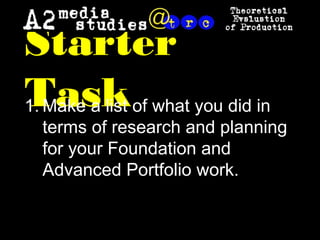
Starter
Task1. Make a list of what you did in
terms of research and planning
for your Foundation and
Advanced Portfolio work.
Unit G325:
Theoretical
Evaluation
Of Production
Research and
Planning
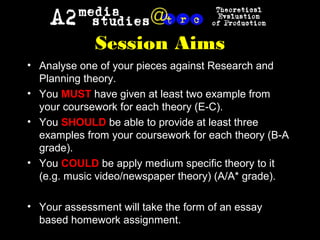
• Analyse one of your pieces against Research and
Planning theory.
• You MUST have given at least two example from
your coursework for each theory (E-C).
• You SHOULD be able to provide at least three
examples from your coursework for each theory (B-A
grade).
• You COULD be apply medium specific theory to it
(e.g. music video/newspaper theory) (A/A* grade).
• Your assessment will take the form of an essay
based homework assignment.
Session Aims
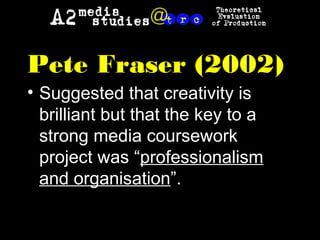
Pete Fraser (2002)
• Suggested that creativity is
brilliant but that the key to a
strong media coursework
project was “professionalism
and organisation”.
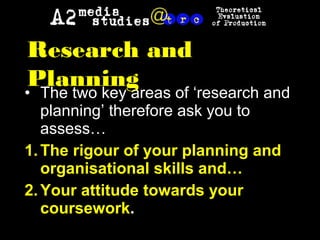
• The two key areas of ‘research and
planning’ therefore ask you to
assess…
1.The rigour of your planning and
organisational skills and…
2.Your attitude towards your
coursework.
Research and
Planning
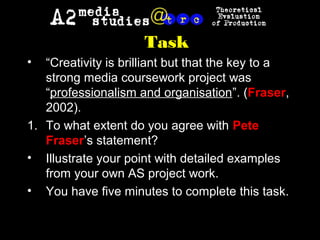
Task
• “Creativity is brilliant but that the key to a
strong media coursework project was
“professionalism and organisation”. (Fraser,
2002).
1. To what extent do you agree with Pete
Fraser’s statement?
• Illustrate your point with detailed examples
from your own AS project work.
• You have five minutes to complete this task.
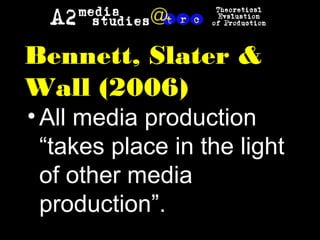
Bennett, Slater &
Wall (2006)
•All media production
“takes place in the light
of other media
production”.
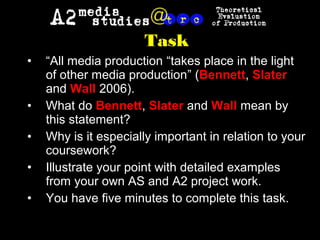
Task
• “All media production “takes place in the light
of other media production” (Bennett, Slater
and Wall 2006).
• What do Bennett, Slater and Wall mean by
this statement?
• Why is it especially important in relation to your
coursework?
• Illustrate your point with detailed examples
from your own AS and A2 project work.
• You have five minutes to complete this task.
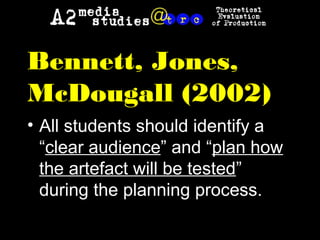
Bennett, Jones,
McDougall (2002)
• All students should identify a
“clear audience” and “plan how
the artefact will be tested”
during the planning process.
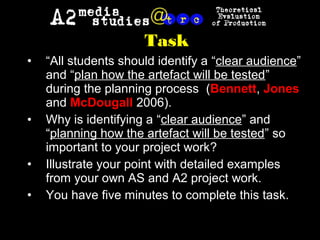
Task
• “All students should identify a “clear audience”
and “plan how the artefact will be tested”
during the planning process (Bennett, Jones
and McDougall 2006).
• Why is identifying a “clear audience” and
“planning how the artefact will be tested” so
important to your project work?
• Illustrate your point with detailed examples
from your own AS and A2 project work.
• You have five minutes to complete this task.
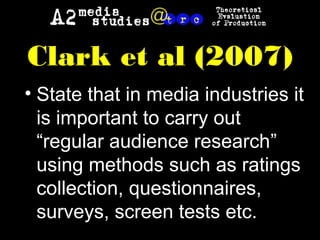
Clark et al (2007)
• State that in media industries it
is important to carry out
“regular audience research”
using methods such as ratings
collection, questionnaires,
surveys, screen tests etc.
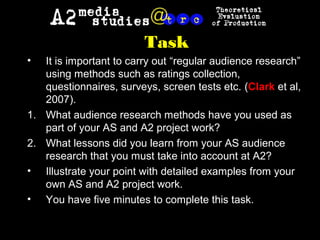
Task
• It is important to carry out “regular audience research”
using methods such as ratings collection,
questionnaires, surveys, screen tests etc. (Clark et al,
2007).
1. What audience research methods have you used as
part of your AS and A2 project work?
2. What lessons did you learn from your AS audience
research that you must take into account at A2?
• Illustrate your point with detailed examples from your
own AS and A2 project work.
• You have five minutes to complete this task.
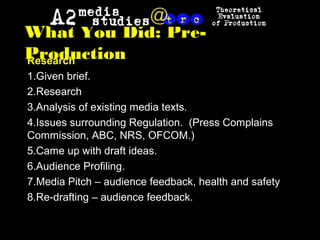
What You Did: Pre-
ProductionResearch
1.Given brief.
2.Research
3.Analysis of existing media texts.
4.Issues surrounding Regulation. (Press Complains
Commission, ABC, NRS, OFCOM.)
5.Came up with draft ideas.
6.Audience Profiling.
7.Media Pitch – audience feedback, health and safety
8.Re-drafting – audience feedback.
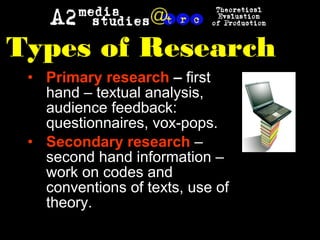
• Primary research – first
hand – textual analysis,
audience feedback:
questionnaires, vox-pops.
• Secondary research –
second hand information –
work on codes and
conventions of texts, use of
theory.
Types of Research
1. What primary research sources
have you used during your
Foundation and Advanced Portfolio
projects?
2. Do you think your ability to use
primary research sources has
improved from AS to A2? Illustrate
your answer with detailed
examples.
Primary Research
Primary Research
Sources
–Internet – covers, contents pages,
double pages spreads, shot types etc.
–Magazines – what magazines did you
textually analyse?
–Posters.
–DigiPaks.
–Websites.
–Radio Trailers.
–Listings Magazine DPSs.
1. What secondary research sources
have you used during your
Foundation and Advanced Portfolio
projects?
2. Do you think your ability to use
secondary research sources has
improved from AS to A2? Illustrate
your answer with detailed
examples.
Secondary Research
Secondary
Research
• www.trcmediastudies.co.uk,
• Subject blogs,
• Google,
• Wikipedia,
• Class handouts,
• Text books,
• Newspapers,
• Journals/magazines,
• Industry websites – viewing figures, ABC
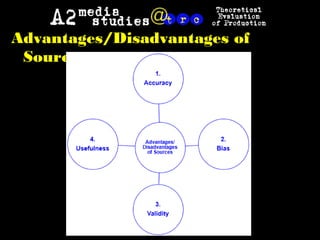
Advantages/Disadvantages of
Sources
Accuracy
•Were the facts and figures correct?
•Did your audience feedback results
provide a fair sample of overall
opinions?
Bias
•Textual analysis can be biased as it
is subjective.
•Did you complete enough research
to overcome this?
•Were any secondary sources
biased?
•Think about documentary and
mediation?
Validity
•Was there a link between the
particular research and final product?
•Was there a strong indication that
this research effected the outcome of
your work?
Usefulness
•How relevant was this to your
project (see validity).
•OR did any of your research
methods prove to be completely
useless and why?
•Could you have used BOOLEAN
searches on the internet for
example?
S. Sonderling
(in P.J. Fourie (2004))
• Suggests that “to make any media
product equipment and people are
needed”.
• For video – a clear location and
organisation of correct personnel are
vital.
What You Did: Pre-
Production
Planning
•Treatment.
•Storyboards and final flat-plans.
•Organisation of personnel in group.
•Production schedules .
•Call Sheets.
• In this essay you will be required to evaluate as part
of the specified write up the outcomes of the
research and planning process.
• E.g. (P) The planning of my storyboard enabled me to
think about the order of my shots. (D) For example there
was a sequence in my music video which required cross
cut of insert shots to gig and back again. (Q) As this
sequence did appear in my final product, although with
some SPFX enhancement at post production, I clearly
felt the benefit of storyboarding, more so than flat-
planning at AS where I hadn’t drawn with colours so I
feel my skills did indeed improve in this area across the
two years.
Planning – Pre-Production
• Adequate research – link this to DIGITAL
TECHNOLOGY – where did you find the research? Link to use of
real media conventions. Was it VALID? USEFUL? RELIABLE?
• Drafting – flat plans for magazines and storyboards/ancillary
drafts for A2 - link to DIGITAL TECHNOLOGY and CREATIVITY –
how did you construct these?
• Audience Feedback – Again link to DIGITAL
TECHNOLOGY and USE OR REAL MEDIA CONVENTIONS if
possible. How did you make sure you collated this? How did you
ensure that you collated this? What was the development between
AS and A2?
• Remember the key words: Qualitative, Quantitative, Validity.
Scheduling
• Did your knowledge of call
sheets/production schedules grow across
AS and A2?
• Working as a team and organising
equipment?
• What did you learn about planning roles –
who was designer, journalist, director?
• Was booking equipment done smoothly?
Time and
Resources
• Did you meet deadlines?
• What are the pros and cons of organising personnel?
• What have you learned about communication between
personnel?
• Did your knowledge of call sheets/production schedules
grow?
• What could you have done better?
• What are your strengths and weaknesses?
• Did you utilise digital technology to aid your organisation
(call sheets and production schedules on blog)?
Individual/Group
Work
• What did you learn about working
individually or in groups?
• What are the pro and cons of
individual/team work?
• What main things have you learned about
group work at AS and A2 in terms of
planning your product?
Presentation•How did you present your primary and secondary
research on your blogs? We are talking about
enhancing CREATIVITY and USE OF DIGITAL
TECHNOLOGY
•Did your presentation of audience feedback for
example become more creative through your increased
use of digital technology available for embedding on the
blogs (onlinecharttool, bubl.us, WMM etc.)?
•Again, did your knowledge of referencing grow? Did
this allow you to become more knowledgeable of
presentation skills? i.e. did your present research
findings in slideshow format?
• How did you organise your research and planning
materials? (Link to digital technology).
• Did you utilise the blog more at A2 than at AS
level?
• How did you follow your flat plans/storyboards?
• What did you understand about the changes that
were made?
• Did all group members have copies of production
schedules, call sheets, storyboards etc.?
Organisation
• Consider your pre-production processes for AS
Foundation Portfolio and A2 Advanced Portfolio.
In what ways have they differed? In what ways are
they the same?
• What lessons did you learn from your AS audience
research that you must take into account at A2?
• Illustrate your point with detailed examples from
your own AS and A2 project work.
• You have five minutes to complete this task.
Organisation
Homework Assignment
• Describe the ways in which your production work
was informed by research into real media texts
and how your ability to use such research for
production developed over time.
• Refer to specific and detailed examples from your
products.
• Use as much media theory and terminology as
possible.
• Hand written.
• 30 minute time limit.
Essay Structure
Introduction
• Define what is meant by research and planning
(using an appropriate quote – remember to relate the
quote to the question).
• Briefly describe what products you created at AS and
A2. Who were your audience?
• Briefly answer the question. Explain how close
textual analysis of real media texts enabled you to
pastiche the generic conventions of real texts.
• Do you think your research into real media texts
developed from AS to A2? Explain why you think this.
Essay Structure
You Must
• Discuss how close textual analysis of real
media texts enabled you to pastiche the generic
conventions of real texts – relate this to
Bennett, Slater and Wall (2006).
• Use specific and detailed examples from your
AS and A2 coursework to assess how your
research and textual analysis skills developed
over time in relation to Bennett, Slater and
Wall (2006).
Essay Structure
You Could
• Discuss how important it is to target your product at a specific
audience (Bennett, Jones and McDougall (2002)).
• Explain how you identified this target audience at the stage of
pre-production and how you ensured that your products
effectively appealed to this audience (relate this to Clark et al.
(2007)).
• How did your ability to do this develop from AS to A2?
• At A2, was your research into real media texts conducted
individually or as a group? Did different group members
conduct different research? If so then relate this to S.
Sonderling (2004).
Essay Structure
Conclusion
• Conclude your answer by restating whether, in your
opinion, your research into real media texts during
your AS Foundation Portfolio and A2 Advanced
Portfolio was affective or not.
• Sum up whether your ability to use such research for
production developed over time. What lessons have
you learned from this process?
• If you were to conduct a similar project in the future,
what would you do differently?
Next Lesson
• Creativity.

Research and planning theory

  • 1.
    Starter Task1. Make alist of what you did in terms of research and planning for your Foundation and Advanced Portfolio work.
  • 2.
  • 3.
    • Analyse oneof your pieces against Research and Planning theory. • You MUST have given at least two example from your coursework for each theory (E-C). • You SHOULD be able to provide at least three examples from your coursework for each theory (B-A grade). • You COULD be apply medium specific theory to it (e.g. music video/newspaper theory) (A/A* grade). • Your assessment will take the form of an essay based homework assignment. Session Aims
  • 4.
    Pete Fraser (2002) •Suggested that creativity is brilliant but that the key to a strong media coursework project was “professionalism and organisation”.
  • 5.
    • The twokey areas of ‘research and planning’ therefore ask you to assess… 1.The rigour of your planning and organisational skills and… 2.Your attitude towards your coursework. Research and Planning
  • 6.
    Task • “Creativity isbrilliant but that the key to a strong media coursework project was “professionalism and organisation”. (Fraser, 2002). 1. To what extent do you agree with Pete Fraser’s statement? • Illustrate your point with detailed examples from your own AS project work. • You have five minutes to complete this task.
  • 7.
    Bennett, Slater & Wall(2006) •All media production “takes place in the light of other media production”.
  • 8.
    Task • “All mediaproduction “takes place in the light of other media production” (Bennett, Slater and Wall 2006). • What do Bennett, Slater and Wall mean by this statement? • Why is it especially important in relation to your coursework? • Illustrate your point with detailed examples from your own AS and A2 project work. • You have five minutes to complete this task.
  • 9.
    Bennett, Jones, McDougall (2002) •All students should identify a “clear audience” and “plan how the artefact will be tested” during the planning process.
  • 10.
    Task • “All studentsshould identify a “clear audience” and “plan how the artefact will be tested” during the planning process (Bennett, Jones and McDougall 2006). • Why is identifying a “clear audience” and “planning how the artefact will be tested” so important to your project work? • Illustrate your point with detailed examples from your own AS and A2 project work. • You have five minutes to complete this task.
  • 11.
    Clark et al(2007) • State that in media industries it is important to carry out “regular audience research” using methods such as ratings collection, questionnaires, surveys, screen tests etc.
  • 12.
    Task • It isimportant to carry out “regular audience research” using methods such as ratings collection, questionnaires, surveys, screen tests etc. (Clark et al, 2007). 1. What audience research methods have you used as part of your AS and A2 project work? 2. What lessons did you learn from your AS audience research that you must take into account at A2? • Illustrate your point with detailed examples from your own AS and A2 project work. • You have five minutes to complete this task.
  • 13.
    What You Did:Pre- ProductionResearch 1.Given brief. 2.Research 3.Analysis of existing media texts. 4.Issues surrounding Regulation. (Press Complains Commission, ABC, NRS, OFCOM.) 5.Came up with draft ideas. 6.Audience Profiling. 7.Media Pitch – audience feedback, health and safety 8.Re-drafting – audience feedback.
  • 14.
    • Primary research– first hand – textual analysis, audience feedback: questionnaires, vox-pops. • Secondary research – second hand information – work on codes and conventions of texts, use of theory. Types of Research
  • 15.
    1. What primaryresearch sources have you used during your Foundation and Advanced Portfolio projects? 2. Do you think your ability to use primary research sources has improved from AS to A2? Illustrate your answer with detailed examples. Primary Research
  • 16.
    Primary Research Sources –Internet –covers, contents pages, double pages spreads, shot types etc. –Magazines – what magazines did you textually analyse? –Posters. –DigiPaks. –Websites. –Radio Trailers. –Listings Magazine DPSs.
  • 17.
    1. What secondaryresearch sources have you used during your Foundation and Advanced Portfolio projects? 2. Do you think your ability to use secondary research sources has improved from AS to A2? Illustrate your answer with detailed examples. Secondary Research
  • 18.
    Secondary Research • www.trcmediastudies.co.uk, • Subjectblogs, • Google, • Wikipedia, • Class handouts, • Text books, • Newspapers, • Journals/magazines, • Industry websites – viewing figures, ABC
  • 19.
  • 20.
    Accuracy •Were the factsand figures correct? •Did your audience feedback results provide a fair sample of overall opinions?
  • 21.
    Bias •Textual analysis canbe biased as it is subjective. •Did you complete enough research to overcome this? •Were any secondary sources biased? •Think about documentary and mediation?
  • 22.
    Validity •Was there alink between the particular research and final product? •Was there a strong indication that this research effected the outcome of your work?
  • 23.
    Usefulness •How relevant wasthis to your project (see validity). •OR did any of your research methods prove to be completely useless and why? •Could you have used BOOLEAN searches on the internet for example?
  • 24.
    S. Sonderling (in P.J.Fourie (2004)) • Suggests that “to make any media product equipment and people are needed”. • For video – a clear location and organisation of correct personnel are vital.
  • 25.
    What You Did:Pre- Production Planning •Treatment. •Storyboards and final flat-plans. •Organisation of personnel in group. •Production schedules . •Call Sheets.
  • 26.
    • In thisessay you will be required to evaluate as part of the specified write up the outcomes of the research and planning process. • E.g. (P) The planning of my storyboard enabled me to think about the order of my shots. (D) For example there was a sequence in my music video which required cross cut of insert shots to gig and back again. (Q) As this sequence did appear in my final product, although with some SPFX enhancement at post production, I clearly felt the benefit of storyboarding, more so than flat- planning at AS where I hadn’t drawn with colours so I feel my skills did indeed improve in this area across the two years.
  • 27.
    Planning – Pre-Production •Adequate research – link this to DIGITAL TECHNOLOGY – where did you find the research? Link to use of real media conventions. Was it VALID? USEFUL? RELIABLE? • Drafting – flat plans for magazines and storyboards/ancillary drafts for A2 - link to DIGITAL TECHNOLOGY and CREATIVITY – how did you construct these? • Audience Feedback – Again link to DIGITAL TECHNOLOGY and USE OR REAL MEDIA CONVENTIONS if possible. How did you make sure you collated this? How did you ensure that you collated this? What was the development between AS and A2? • Remember the key words: Qualitative, Quantitative, Validity.
  • 28.
    Scheduling • Did yourknowledge of call sheets/production schedules grow across AS and A2? • Working as a team and organising equipment? • What did you learn about planning roles – who was designer, journalist, director? • Was booking equipment done smoothly?
  • 29.
    Time and Resources • Didyou meet deadlines? • What are the pros and cons of organising personnel? • What have you learned about communication between personnel? • Did your knowledge of call sheets/production schedules grow? • What could you have done better? • What are your strengths and weaknesses? • Did you utilise digital technology to aid your organisation (call sheets and production schedules on blog)?
  • 30.
    Individual/Group Work • What didyou learn about working individually or in groups? • What are the pro and cons of individual/team work? • What main things have you learned about group work at AS and A2 in terms of planning your product?
  • 31.
    Presentation•How did youpresent your primary and secondary research on your blogs? We are talking about enhancing CREATIVITY and USE OF DIGITAL TECHNOLOGY •Did your presentation of audience feedback for example become more creative through your increased use of digital technology available for embedding on the blogs (onlinecharttool, bubl.us, WMM etc.)? •Again, did your knowledge of referencing grow? Did this allow you to become more knowledgeable of presentation skills? i.e. did your present research findings in slideshow format?
  • 32.
    • How didyou organise your research and planning materials? (Link to digital technology). • Did you utilise the blog more at A2 than at AS level? • How did you follow your flat plans/storyboards? • What did you understand about the changes that were made? • Did all group members have copies of production schedules, call sheets, storyboards etc.? Organisation
  • 33.
    • Consider yourpre-production processes for AS Foundation Portfolio and A2 Advanced Portfolio. In what ways have they differed? In what ways are they the same? • What lessons did you learn from your AS audience research that you must take into account at A2? • Illustrate your point with detailed examples from your own AS and A2 project work. • You have five minutes to complete this task. Organisation
  • 34.
    Homework Assignment • Describethe ways in which your production work was informed by research into real media texts and how your ability to use such research for production developed over time. • Refer to specific and detailed examples from your products. • Use as much media theory and terminology as possible. • Hand written. • 30 minute time limit.
  • 35.
    Essay Structure Introduction • Definewhat is meant by research and planning (using an appropriate quote – remember to relate the quote to the question). • Briefly describe what products you created at AS and A2. Who were your audience? • Briefly answer the question. Explain how close textual analysis of real media texts enabled you to pastiche the generic conventions of real texts. • Do you think your research into real media texts developed from AS to A2? Explain why you think this.
  • 36.
    Essay Structure You Must •Discuss how close textual analysis of real media texts enabled you to pastiche the generic conventions of real texts – relate this to Bennett, Slater and Wall (2006). • Use specific and detailed examples from your AS and A2 coursework to assess how your research and textual analysis skills developed over time in relation to Bennett, Slater and Wall (2006).
  • 37.
    Essay Structure You Could •Discuss how important it is to target your product at a specific audience (Bennett, Jones and McDougall (2002)). • Explain how you identified this target audience at the stage of pre-production and how you ensured that your products effectively appealed to this audience (relate this to Clark et al. (2007)). • How did your ability to do this develop from AS to A2? • At A2, was your research into real media texts conducted individually or as a group? Did different group members conduct different research? If so then relate this to S. Sonderling (2004).
  • 38.
    Essay Structure Conclusion • Concludeyour answer by restating whether, in your opinion, your research into real media texts during your AS Foundation Portfolio and A2 Advanced Portfolio was affective or not. • Sum up whether your ability to use such research for production developed over time. What lessons have you learned from this process? • If you were to conduct a similar project in the future, what would you do differently?
  • 39.