CHAPTER 5
Trees
Dr. R. Khanchana
Assistant Professor
Department of Computer Science
Sri Ramakrishna College of Arts and Science for Women
http://icodeguru.com/vc/10book/books/book1/chap05.htm
Tree
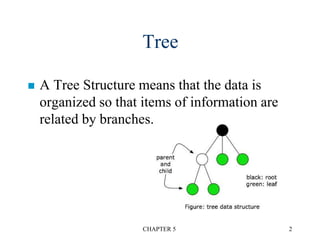
 A Tree Structure means that the data is
organized so that items of information are
related by branches.
CHAPTER 5 2
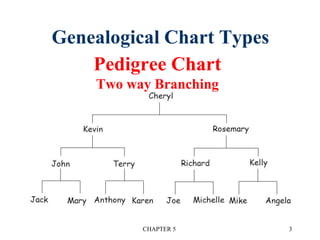
Genealogical Chart Types
CHAPTER 5 3
Pedigree Chart
Two way Branching
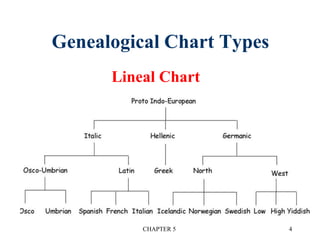
Genealogical Chart Types
CHAPTER 5 4
Lineal Chart
CHAPTER 5 5
Definition of Tree
 A tree is a finite set of one or more nodes
such that:
 There is a specially designated node called
the root.
 The remaining nodes are partitioned into n>=0
disjoint sets T1, ..., Tn, where each of these sets
is a tree.
 We call T1, ..., Tn the subtrees of the root.
CHAPTER 5 6
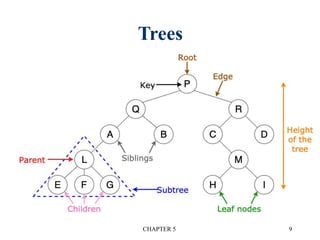
Terminology
 Node stands for the item of information plus the branches
to other items.
 The degree of a node is the number of subtrees of the
node.
– The degree of A is 3; the degree of C is 1.
 The node with degree 0 is a leaf or terminal node. Other
nodes are nonterminal nodes.
 A node that has subtrees is the parent of the roots of the
subtrees.
 The roots of these subtrees are the children of the node.
 Children of the same parent are siblings.
Terminology
 The ancestors of a node are all the nodes along the
path from the root to the node.
 The degree of a tree is the maximum degree of the
nodes in the tree.
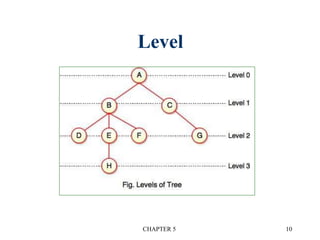
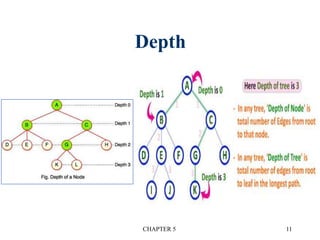
 The height or depth of a tree is defined to be the
maximum level of any node in the tree.
 The level of a node is defined by initially letting the
root be at level one.
 If a node is at level l then its children are at level l + 1
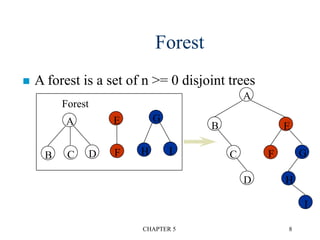
 A forest is a set of n>=0 disjoint trees. If we remove
the root of a tree we get a forest.
CHAPTER 5 7
CHAPTER 5 8
Forest
 A forest is a set of n >= 0 disjoint trees
A E G
B C D F H I G
H
I
A
B
C
D
F
E
Forest
CHAPTER 5 9
Trees
Level
CHAPTER 5 10
Depth
CHAPTER 5 11
Representation of Trees
CHAPTER 5 12
CHAPTER 5 13
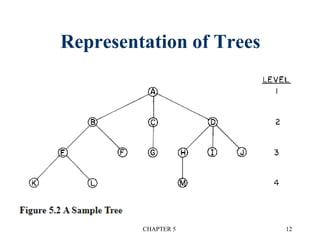
Representation of Trees
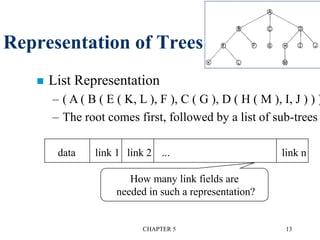
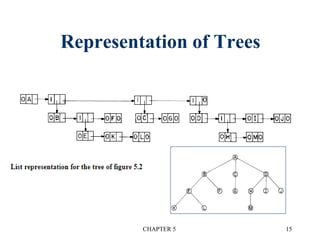
 List Representation
– ( A ( B ( E ( K, L ), F ), C ( G ), D ( H ( M ), I, J ) ) )
– The root comes first, followed by a list of sub-trees
data link 1 link 2 ... link n
How many link fields are
needed in such a representation?
CHAPTER 5 14
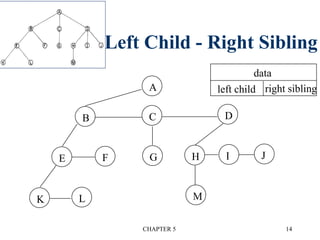
Left Child - Right Sibling
A
B C D
E F G H I J
K L M
data
left child right sibling
Representation of Trees
CHAPTER 5 15
Quiz
CHAPTER 5 16
https://quizizz.com/admin/quiz/5f4390b3d43729001baf44e1
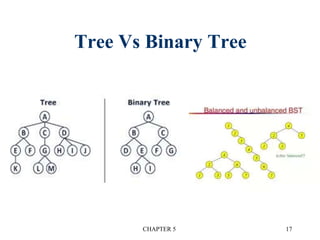
Tree Vs Binary Tree
CHAPTER 5 17
CHAPTER 5 18
Binary Trees
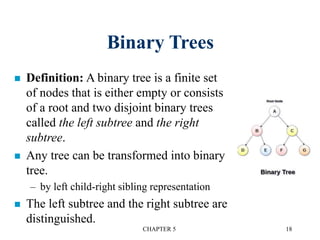
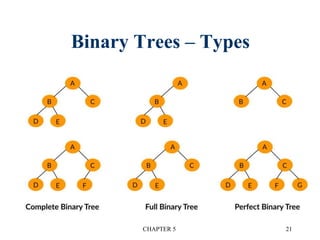
 Definition: A binary tree is a finite set
of nodes that is either empty or consists
of a root and two disjoint binary trees
called the left subtree and the right
subtree.
 Any tree can be transformed into binary
tree.
– by left child-right sibling representation
 The left subtree and the right subtree are
distinguished.
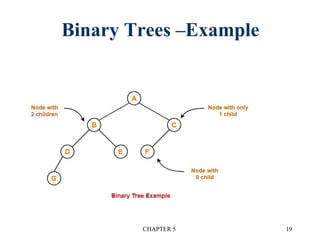
Binary Trees –Example
CHAPTER 5 19
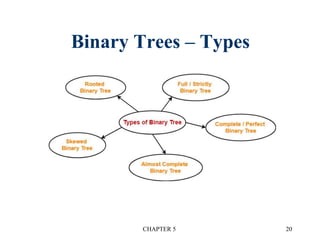
Binary Trees – Types
CHAPTER 5 20
Binary Trees – Types
CHAPTER 5 21
CHAPTER 5 22
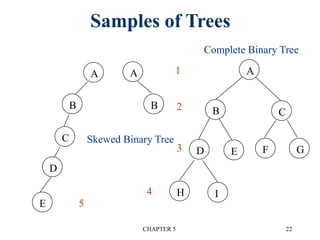
Samples of Trees
A
B
A
B
A
B C
GE
I
D
H
F
Complete Binary Tree
Skewed Binary Tree
E
C
D
1
2
3
4
5
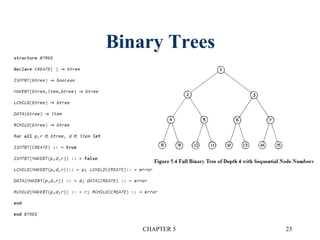
Binary Trees
CHAPTER 5 23
CHAPTER 5 24
Maximum Number of Nodes in BT
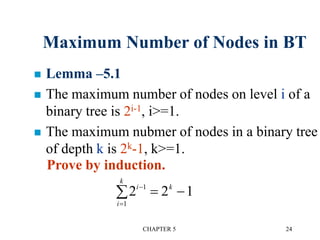
 Lemma –5.1
 The maximum number of nodes on level i of a
binary tree is 2i-1, i>=1.
 The maximum nubmer of nodes in a binary tree
of depth k is 2k-1, k>=1.
Prove by induction.
2 2 11
1
i
i
k
k

  
CHAPTER 5 25
Relations between Number of
Leaf Nodes and Nodes of Degree 2
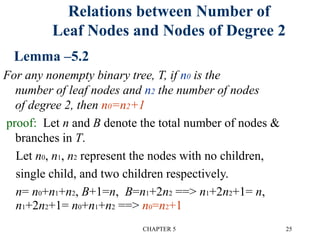
Lemma –5.2
For any nonempty binary tree, T, if n0 is the
number of leaf nodes and n2 the number of nodes
of degree 2, then n0=n2+1
proof: Let n and B denote the total number of nodes &
branches in T.
Let n0, n1, n2 represent the nodes with no children,
single child, and two children respectively.
n= n0+n1+n2, B+1=n, B=n1+2n2 ==> n1+2n2+1= n,
n1+2n2+1= n0+n1+n2 ==> n0=n2+1
CHAPTER 5 26
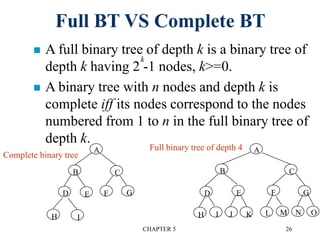
Full BT VS Complete BT
 A full binary tree of depth k is a binary tree of
depth k having 2 -1 nodes, k>=0.
 A binary tree with n nodes and depth k is
complete iff its nodes correspond to the nodes
numbered from 1 to n in the full binary tree of
depth k.
k
A
B C
GE
I
D
H
F
A
B C
GE
K
D
J
F
IH ONML
Full binary tree of depth 4
Complete binary tree
Quiz
 https://quizizz.com/admin/quiz/5f449b8b68
3fb6001b5efd76
CHAPTER 5 27
 A full binary tree of depth k is a binary tree
of depth k having 2k - 1 nodes.
 A binary tree with n nodes and of
depth k is complete iff its nodes correspond
to the nodes which are numbered one to n in
the full binary tree of depth k
CHAPTER 5 28
Binary Tree Representations
CHAPTER 5 29
Binary Tree Representations
Lemma 5.3: If a complete binary tree with n nodes (i.e.,
depth= [log2n] + 1) is represented sequentially as above
then for any node with index i, 1 i n we have:
(i) PARENT(i) is at [i/2] if i 1. When i = 1, i is the root
and has no parent.
(ii) LCHILD(i) is at 2i if 2i n. If 2i > n, then i has no
left child.
(iii) RCHILD(i) is at 2i + 1 if 2i + 1 n. If 2i + 1 > n,
then i has no right child.
CHAPTER 5 30
Sequential Representation
A
B
--
C
--
--
--
D
--
.
E
[1]
[2]
[3]
[4]
[5]
[6]
[7]
[8]
[9]
.
[16]
[1]
[2]
[3]
[4]
[5]
[6]
[7]
[8]
[9]
A
B
C
D
E
F
G
H
I
A
B
E
C
D
A
B C
GE
I
D
H
F
(1) waste space
(2) insertion/deletion
problem
CHAPTER 5 31
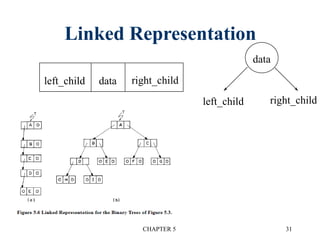
Linked Representation
dataleft_child right_child
data
left_child right_child
CHAPTER 5 32
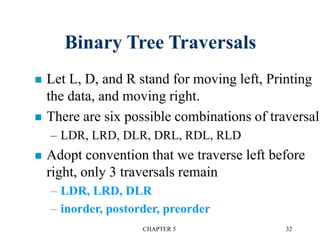
Binary Tree Traversals
 Let L, D, and R stand for moving left, Printing
the data, and moving right.
 There are six possible combinations of traversal
– LDR, LRD, DLR, DRL, RDL, RLD
 Adopt convention that we traverse left before
right, only 3 traversals remain
– LDR, LRD, DLR
– inorder, postorder, preorder
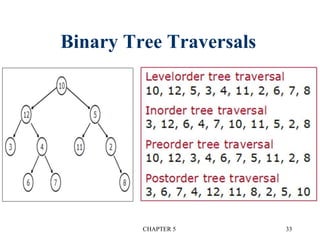
Binary Tree Traversals
CHAPTER 5 33
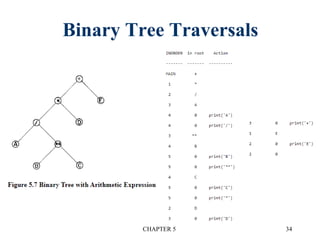
Binary Tree Traversals
CHAPTER 5 34
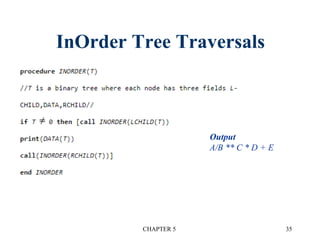
InOrder Tree Traversals
CHAPTER 5 35
Output
A/B ** C * D + E
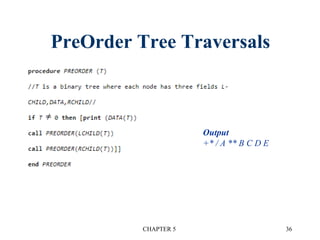
PreOrder Tree Traversals
CHAPTER 5 36
Output
+* / A ** B C D E
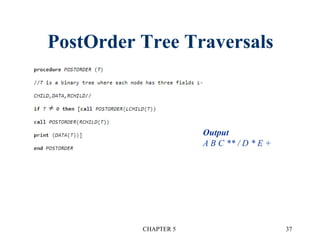
PostOrder Tree Traversals
CHAPTER 5 37
Output
A B C ** / D * E +
CHAPTER 5 38
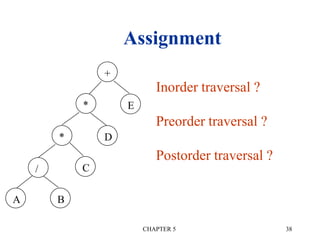
Assignment
+
*
A
*
/
E
D
C
B
Inorder traversal ?
Preorder traversal ?
Postorder traversal ?
Quiz
CHAPTER 5 39
https://quizizz.com/admin/quiz/5f53582fac018d001b325a30
CHAPTER 5 40
Assignment Results
+
*
A
*
/
E
D
C
B
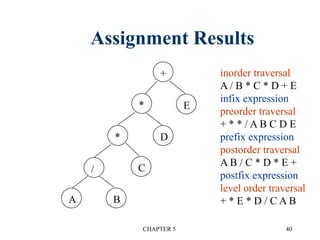
inorder traversal
A / B * C * D + E
infix expression
preorder traversal
+ * * / A B C D E
prefix expression
postorder traversal
A B / C * D * E +
postfix expression
level order traversal
+ * E * D / C A B
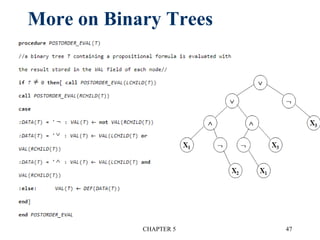
More on Binary Trees
CHAPTER 5 41
More on Binary Trees
CHAPTER 5 42
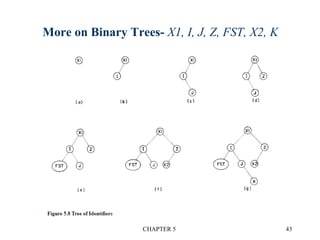
More on Binary Trees- X1, I, J, Z, FST, X2, K
CHAPTER 5 43
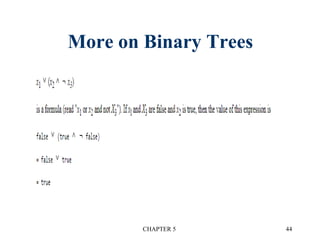
More on Binary Trees
CHAPTER 5 44



X3X1
X2 X1
 X3
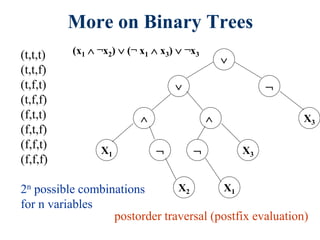
(x1  ¬x2)  (¬ x1  x3)  ¬x3(t,t,t)
(t,t,f)
(t,f,t)
(t,f,f)
(f,t,t)
(f,t,f)
(f,f,t)
(f,f,f)
2n possible combinations
for n variables
postorder traversal (postfix evaluation)
More on Binary Trees
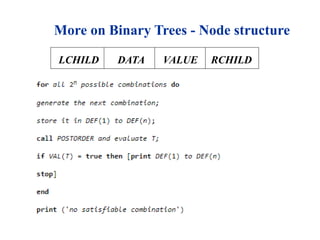
LCHILD DATA VALUE RCHILD
More on Binary Trees - Node structure
More on Binary Trees
CHAPTER 5 47
CHAPTER 5 48
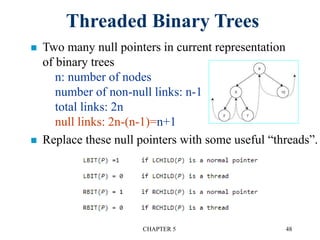
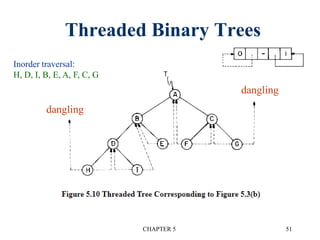
Threaded Binary Trees
 Two many null pointers in current representation
of binary trees
n: number of nodes
number of non-null links: n-1
total links: 2n
null links: 2n-(n-1)=n+1
 Replace these null pointers with some useful “threads”.
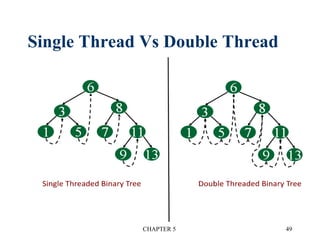
Single Thread Vs Double Thread
CHAPTER 5 49
Advantages of Threaded BST
 Thread is pointer to other nodes in the tree to
replace null links.
CHAPTER 5 50
Threaded Binary Trees
CHAPTER 5 51
Inorder traversal:
H, D, I, B, E, A, F, C, G
dangling
dangling
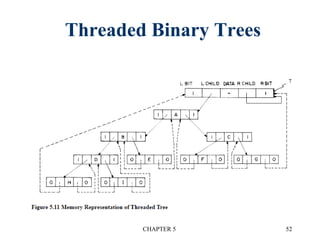
Threaded Binary Trees
CHAPTER 5 52
CHAPTER 5 53
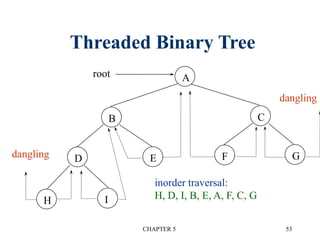
Threaded Binary Tree
A
B C
GE
I
D
H
F
root
dangling
dangling
inorder traversal:
H, D, I, B, E, A, F, C, G
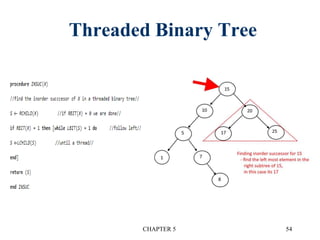
Threaded Binary Tree
CHAPTER 5 54
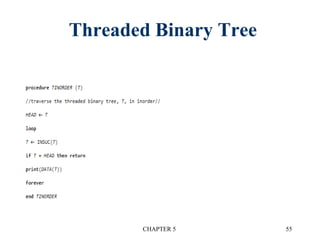
Threaded Binary Tree
CHAPTER 5 55
CHAPTER 5 56
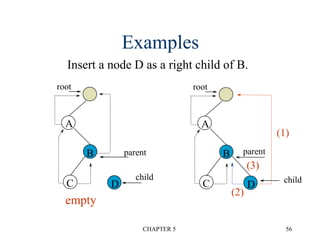
Examples
root
parent
A
B
C D
child
root
parent
A
B
C D child
empty
Insert a node D as a right child of B.
(1)
(2)
(3)
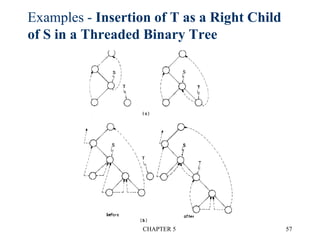
Examples - Insertion of T as a Right Child
of S in a Threaded Binary Tree
CHAPTER 5 57
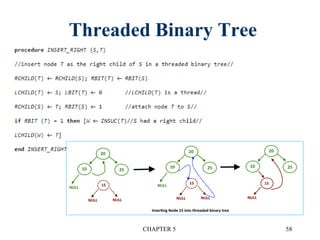
Threaded Binary Tree
CHAPTER 5 58
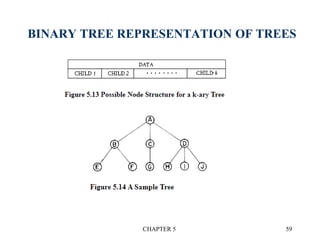
BINARY TREE REPRESENTATION OF TREES
CHAPTER 5 59
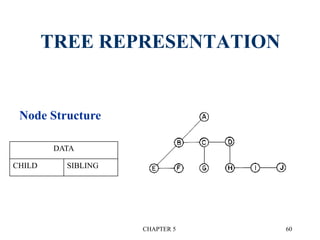
TREE REPRESENTATION
CHAPTER 5 60
DATA
CHILD SIBLING
Node Structure
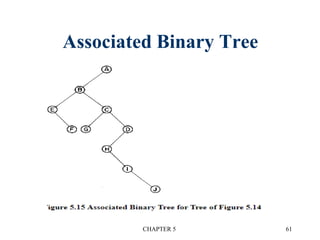
Associated Binary Tree
CHAPTER 5 61
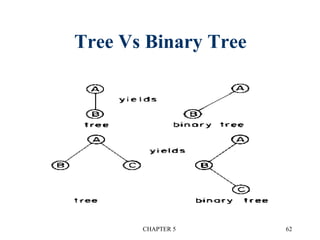
Tree Vs Binary Tree
CHAPTER 5 62
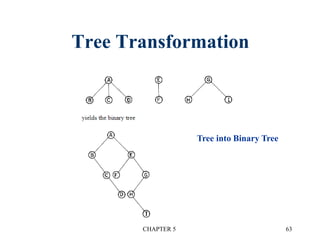
Tree Transformation
CHAPTER 5 63
Tree into Binary Tree
Tree Transformation
CHAPTER 5 64
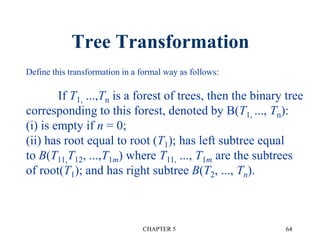
Define this transformation in a formal way as follows:
If T1, ...,Tn is a forest of trees, then the binary tree
corresponding to this forest, denoted by B(T1, ..., Tn):
(i) is empty if n = 0;
(ii) has root equal to root (T1); has left subtree equal
to B(T11,T12, ...,T1m) where T11, ..., T1m are the subtrees
of root(T1); and has right subtree B(T2, ..., Tn).
Tree Transformation
CHAPTER 5 65
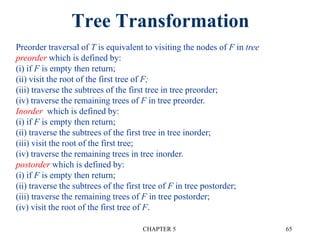
Preorder traversal of T is equivalent to visiting the nodes of F in tree
preorder which is defined by:
(i) if F is empty then return;
(ii) visit the root of the first tree of F;
(iii) traverse the subtrees of the first tree in tree preorder;
(iv) traverse the remaining trees of F in tree preorder.
Inorder which is defined by:
(i) if F is empty then return;
(ii) traverse the subtrees of the first tree in tree inorder;
(iii) visit the root of the first tree;
(iv) traverse the remaining trees in tree inorder.
postorder which is defined by:
(i) if F is empty then return;
(ii) traverse the subtrees of the first tree of F in tree postorder;
(iii) traverse the remaining trees of F in tree postorder;
(iv) visit the root of the first tree of F.
Quiz
CHAPTER 5 66
https://quizizz.com/admin/quiz/5f53574a41c5a0001b1467dd
Counting Binary Trees
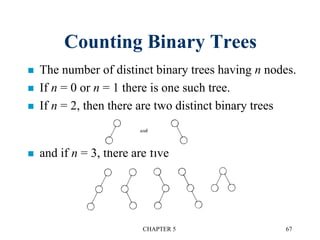
 The number of distinct binary trees having n nodes.
 If n = 0 or n = 1 there is one such tree.
 If n = 2, then there are two distinct binary trees
 and if n = 3, there are five
CHAPTER 5 67
Counting Binary Trees
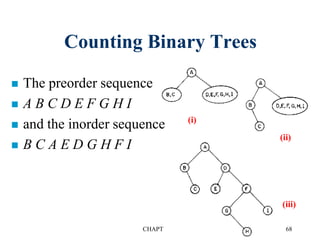
 The preorder sequence
 A B C D E F G H I
 and the inorder sequence
 B C A E D G H F I
CHAPTER 5 68
(i)
(ii)
(iii)
Tree Permutations
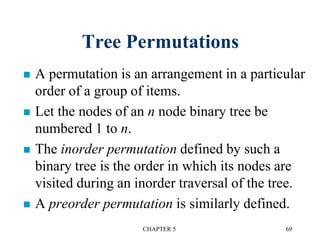
 A permutation is an arrangement in a particular
order of a group of items.
 Let the nodes of an n node binary tree be
numbered 1 to n.
 The inorder permutation defined by such a
binary tree is the order in which its nodes are
visited during an inorder traversal of the tree.
 A preorder permutation is similarly defined.
CHAPTER 5 69
Tree Permutations
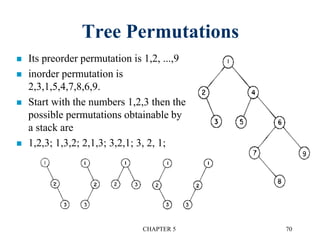
 Its preorder permutation is 1,2, ...,9
 inorder permutation is
2,3,1,5,4,7,8,6,9.
 Start with the numbers 1,2,3 then the
possible permutations obtainable by
a stack are
 1,2,3; 1,3,2; 2,1,3; 3,2,1; 3, 2, 1;
CHAPTER 5 70
Matrix Multiplication
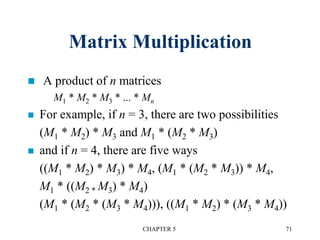
 A product of n matrices
M1 * M2 * M3 * ... * Mn
 For example, if n = 3, there are two possibilities
(M1 * M2) * M3 and M1 * (M2 * M3)
 and if n = 4, there are five ways
((M1 * M2) * M3) * M4, (M1 * (M2 * M3)) * M4,
M1 * ((M2 * M3) * M4)
(M1 * (M2 * (M3 * M4))), ((M1 * M2) * (M3 * M4))
CHAPTER 5 71
Matrix Multiplication
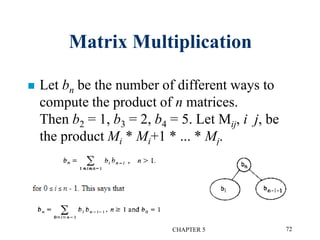
 Let bn be the number of different ways to
compute the product of n matrices.
Then b2 = 1, b3 = 2, b4 = 5. Let Mij, i j, be
the product Mi * Mi+1 * ... * Mj.
CHAPTER 5 72
CHAPTER 5 73

Unit 3 Tree chapter 5

  • 1.
    CHAPTER 5 Trees Dr. R.Khanchana Assistant Professor Department of Computer Science Sri Ramakrishna College of Arts and Science for Women http://icodeguru.com/vc/10book/books/book1/chap05.htm
  • 2.
    Tree  A TreeStructure means that the data is organized so that items of information are related by branches. CHAPTER 5 2
  • 3.
    Genealogical Chart Types CHAPTER5 3 Pedigree Chart Two way Branching
  • 4.
  • 5.
    CHAPTER 5 5 Definitionof Tree  A tree is a finite set of one or more nodes such that:  There is a specially designated node called the root.  The remaining nodes are partitioned into n>=0 disjoint sets T1, ..., Tn, where each of these sets is a tree.  We call T1, ..., Tn the subtrees of the root.
  • 6.
    CHAPTER 5 6 Terminology Node stands for the item of information plus the branches to other items.  The degree of a node is the number of subtrees of the node. – The degree of A is 3; the degree of C is 1.  The node with degree 0 is a leaf or terminal node. Other nodes are nonterminal nodes.  A node that has subtrees is the parent of the roots of the subtrees.  The roots of these subtrees are the children of the node.  Children of the same parent are siblings.
  • 7.
    Terminology  The ancestorsof a node are all the nodes along the path from the root to the node.  The degree of a tree is the maximum degree of the nodes in the tree.  The height or depth of a tree is defined to be the maximum level of any node in the tree.  The level of a node is defined by initially letting the root be at level one.  If a node is at level l then its children are at level l + 1  A forest is a set of n>=0 disjoint trees. If we remove the root of a tree we get a forest. CHAPTER 5 7
  • 8.
    CHAPTER 5 8 Forest A forest is a set of n >= 0 disjoint trees A E G B C D F H I G H I A B C D F E Forest
  • 9.
  • 10.
  • 11.
  • 12.
  • 13.
    CHAPTER 5 13 Representationof Trees  List Representation – ( A ( B ( E ( K, L ), F ), C ( G ), D ( H ( M ), I, J ) ) ) – The root comes first, followed by a list of sub-trees data link 1 link 2 ... link n How many link fields are needed in such a representation?
  • 14.
    CHAPTER 5 14 LeftChild - Right Sibling A B C D E F G H I J K L M data left child right sibling
  • 15.
  • 16.
  • 17.
    Tree Vs BinaryTree CHAPTER 5 17
  • 18.
    CHAPTER 5 18 BinaryTrees  Definition: A binary tree is a finite set of nodes that is either empty or consists of a root and two disjoint binary trees called the left subtree and the right subtree.  Any tree can be transformed into binary tree. – by left child-right sibling representation  The left subtree and the right subtree are distinguished.
  • 19.
  • 20.
    Binary Trees –Types CHAPTER 5 20
  • 21.
    Binary Trees –Types CHAPTER 5 21
  • 22.
    CHAPTER 5 22 Samplesof Trees A B A B A B C GE I D H F Complete Binary Tree Skewed Binary Tree E C D 1 2 3 4 5
  • 23.
  • 24.
    CHAPTER 5 24 MaximumNumber of Nodes in BT  Lemma –5.1  The maximum number of nodes on level i of a binary tree is 2i-1, i>=1.  The maximum nubmer of nodes in a binary tree of depth k is 2k-1, k>=1. Prove by induction. 2 2 11 1 i i k k    
  • 25.
    CHAPTER 5 25 Relationsbetween Number of Leaf Nodes and Nodes of Degree 2 Lemma –5.2 For any nonempty binary tree, T, if n0 is the number of leaf nodes and n2 the number of nodes of degree 2, then n0=n2+1 proof: Let n and B denote the total number of nodes & branches in T. Let n0, n1, n2 represent the nodes with no children, single child, and two children respectively. n= n0+n1+n2, B+1=n, B=n1+2n2 ==> n1+2n2+1= n, n1+2n2+1= n0+n1+n2 ==> n0=n2+1
  • 26.
    CHAPTER 5 26 FullBT VS Complete BT  A full binary tree of depth k is a binary tree of depth k having 2 -1 nodes, k>=0.  A binary tree with n nodes and depth k is complete iff its nodes correspond to the nodes numbered from 1 to n in the full binary tree of depth k. k A B C GE I D H F A B C GE K D J F IH ONML Full binary tree of depth 4 Complete binary tree
  • 27.
  • 28.
     A fullbinary tree of depth k is a binary tree of depth k having 2k - 1 nodes.  A binary tree with n nodes and of depth k is complete iff its nodes correspond to the nodes which are numbered one to n in the full binary tree of depth k CHAPTER 5 28 Binary Tree Representations
  • 29.
    CHAPTER 5 29 BinaryTree Representations Lemma 5.3: If a complete binary tree with n nodes (i.e., depth= [log2n] + 1) is represented sequentially as above then for any node with index i, 1 i n we have: (i) PARENT(i) is at [i/2] if i 1. When i = 1, i is the root and has no parent. (ii) LCHILD(i) is at 2i if 2i n. If 2i > n, then i has no left child. (iii) RCHILD(i) is at 2i + 1 if 2i + 1 n. If 2i + 1 > n, then i has no right child.
  • 30.
    CHAPTER 5 30 SequentialRepresentation A B -- C -- -- -- D -- . E [1] [2] [3] [4] [5] [6] [7] [8] [9] . [16] [1] [2] [3] [4] [5] [6] [7] [8] [9] A B C D E F G H I A B E C D A B C GE I D H F (1) waste space (2) insertion/deletion problem
  • 31.
    CHAPTER 5 31 LinkedRepresentation dataleft_child right_child data left_child right_child
  • 32.
    CHAPTER 5 32 BinaryTree Traversals  Let L, D, and R stand for moving left, Printing the data, and moving right.  There are six possible combinations of traversal – LDR, LRD, DLR, DRL, RDL, RLD  Adopt convention that we traverse left before right, only 3 traversals remain – LDR, LRD, DLR – inorder, postorder, preorder
  • 33.
  • 34.
  • 35.
    InOrder Tree Traversals CHAPTER5 35 Output A/B ** C * D + E
  • 36.
    PreOrder Tree Traversals CHAPTER5 36 Output +* / A ** B C D E
  • 37.
    PostOrder Tree Traversals CHAPTER5 37 Output A B C ** / D * E +
  • 38.
    CHAPTER 5 38 Assignment + * A * / E D C B Inordertraversal ? Preorder traversal ? Postorder traversal ?
  • 39.
  • 40.
    CHAPTER 5 40 AssignmentResults + * A * / E D C B inorder traversal A / B * C * D + E infix expression preorder traversal + * * / A B C D E prefix expression postorder traversal A B / C * D * E + postfix expression level order traversal + * E * D / C A B
  • 41.
    More on BinaryTrees CHAPTER 5 41
  • 42.
    More on BinaryTrees CHAPTER 5 42
  • 43.
    More on BinaryTrees- X1, I, J, Z, FST, X2, K CHAPTER 5 43
  • 44.
    More on BinaryTrees CHAPTER 5 44
  • 45.
       X3X1 X2 X1  X3 (x1 ¬x2)  (¬ x1  x3)  ¬x3(t,t,t) (t,t,f) (t,f,t) (t,f,f) (f,t,t) (f,t,f) (f,f,t) (f,f,f) 2n possible combinations for n variables postorder traversal (postfix evaluation) More on Binary Trees
  • 46.
    LCHILD DATA VALUERCHILD More on Binary Trees - Node structure
  • 47.
    More on BinaryTrees CHAPTER 5 47
  • 48.
    CHAPTER 5 48 ThreadedBinary Trees  Two many null pointers in current representation of binary trees n: number of nodes number of non-null links: n-1 total links: 2n null links: 2n-(n-1)=n+1  Replace these null pointers with some useful “threads”.
  • 49.
    Single Thread VsDouble Thread CHAPTER 5 49
  • 50.
    Advantages of ThreadedBST  Thread is pointer to other nodes in the tree to replace null links. CHAPTER 5 50
  • 51.
    Threaded Binary Trees CHAPTER5 51 Inorder traversal: H, D, I, B, E, A, F, C, G dangling dangling
  • 52.
  • 53.
    CHAPTER 5 53 ThreadedBinary Tree A B C GE I D H F root dangling dangling inorder traversal: H, D, I, B, E, A, F, C, G
  • 54.
  • 55.
  • 56.
    CHAPTER 5 56 Examples root parent A B CD child root parent A B C D child empty Insert a node D as a right child of B. (1) (2) (3)
  • 57.
    Examples - Insertionof T as a Right Child of S in a Threaded Binary Tree CHAPTER 5 57
  • 58.
  • 59.
    BINARY TREE REPRESENTATIONOF TREES CHAPTER 5 59
  • 60.
    TREE REPRESENTATION CHAPTER 560 DATA CHILD SIBLING Node Structure
  • 61.
  • 62.
    Tree Vs BinaryTree CHAPTER 5 62
  • 63.
    Tree Transformation CHAPTER 563 Tree into Binary Tree
  • 64.
    Tree Transformation CHAPTER 564 Define this transformation in a formal way as follows: If T1, ...,Tn is a forest of trees, then the binary tree corresponding to this forest, denoted by B(T1, ..., Tn): (i) is empty if n = 0; (ii) has root equal to root (T1); has left subtree equal to B(T11,T12, ...,T1m) where T11, ..., T1m are the subtrees of root(T1); and has right subtree B(T2, ..., Tn).
  • 65.
    Tree Transformation CHAPTER 565 Preorder traversal of T is equivalent to visiting the nodes of F in tree preorder which is defined by: (i) if F is empty then return; (ii) visit the root of the first tree of F; (iii) traverse the subtrees of the first tree in tree preorder; (iv) traverse the remaining trees of F in tree preorder. Inorder which is defined by: (i) if F is empty then return; (ii) traverse the subtrees of the first tree in tree inorder; (iii) visit the root of the first tree; (iv) traverse the remaining trees in tree inorder. postorder which is defined by: (i) if F is empty then return; (ii) traverse the subtrees of the first tree of F in tree postorder; (iii) traverse the remaining trees of F in tree postorder; (iv) visit the root of the first tree of F.
  • 66.
  • 67.
    Counting Binary Trees The number of distinct binary trees having n nodes.  If n = 0 or n = 1 there is one such tree.  If n = 2, then there are two distinct binary trees  and if n = 3, there are five CHAPTER 5 67
  • 68.
    Counting Binary Trees The preorder sequence  A B C D E F G H I  and the inorder sequence  B C A E D G H F I CHAPTER 5 68 (i) (ii) (iii)
  • 69.
    Tree Permutations  Apermutation is an arrangement in a particular order of a group of items.  Let the nodes of an n node binary tree be numbered 1 to n.  The inorder permutation defined by such a binary tree is the order in which its nodes are visited during an inorder traversal of the tree.  A preorder permutation is similarly defined. CHAPTER 5 69
  • 70.
    Tree Permutations  Itspreorder permutation is 1,2, ...,9  inorder permutation is 2,3,1,5,4,7,8,6,9.  Start with the numbers 1,2,3 then the possible permutations obtainable by a stack are  1,2,3; 1,3,2; 2,1,3; 3,2,1; 3, 2, 1; CHAPTER 5 70
  • 71.
    Matrix Multiplication  Aproduct of n matrices M1 * M2 * M3 * ... * Mn  For example, if n = 3, there are two possibilities (M1 * M2) * M3 and M1 * (M2 * M3)  and if n = 4, there are five ways ((M1 * M2) * M3) * M4, (M1 * (M2 * M3)) * M4, M1 * ((M2 * M3) * M4) (M1 * (M2 * (M3 * M4))), ((M1 * M2) * (M3 * M4)) CHAPTER 5 71
  • 72.
    Matrix Multiplication  Letbn be the number of different ways to compute the product of n matrices. Then b2 = 1, b3 = 2, b4 = 5. Let Mij, i j, be the product Mi * Mi+1 * ... * Mj. CHAPTER 5 72
  • 73.