GRAPHS
CSE, POSTECH
Chapter 16 covers the following topics
 Graph terminology: vertex, edge, adjacent, incident,
degree, cycle, path, connected component, spanning tree
 Types of graphs: undirected, directed, weighted
 Graph representations: adjacency matrix, array adjacency
lists, linked adjacency lists
 Graph search methods: breath-first, depth-first search
 Algorithms:
– to find a path in a graph
– to find the connected components of an undirected graph
– to find a spanning tree of a connected undirected graph
Graphs
 G = (V,E)
 V is the vertex set.
 Vertices are also called nodes and points.
 E is the edge set.
 Each edge connects two vertices.
 Edges are also called arcs and lines.
 Vertices i and j are adjacent vertices iff (i, j) is an edge in
the graph
 The edge (i, j) is incident on the vertices i and j
Graphs
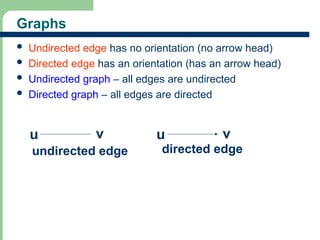
 Undirected edge has no orientation (no arrow head)
 Directed edge has an orientation (has an arrow head)
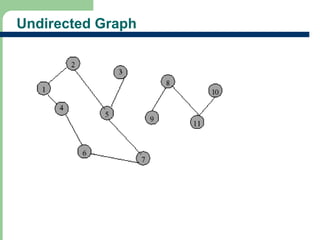
 Undirected graph – all edges are undirected
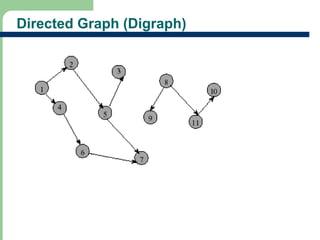
 Directed graph – all edges are directed
u v
directed edge
u v
undirected edge
Undirected Graph
Directed Graph (Digraph)
Directed Graph
 It is useful to have a slightly refined notion of adjacency
and incidence
 Directed edge (i, j) is incident to vertex j and incident from
vertex i
 Vertex i is adjacent to vertex j, and vertex j is adjacent from
vertex i
 In Figure 16.1, which graphs are undirected and which
graphs are directed?
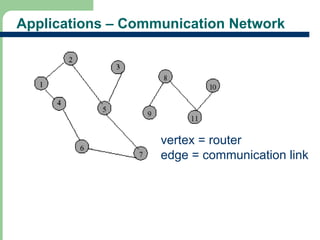
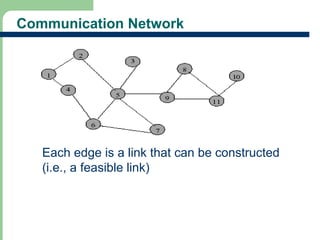
Applications – Communication Network
vertex = router
edge = communication link
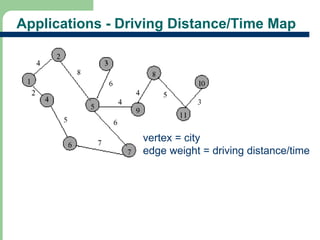
Applications - Driving Distance/Time Map
vertex = city
edge weight = driving distance/time
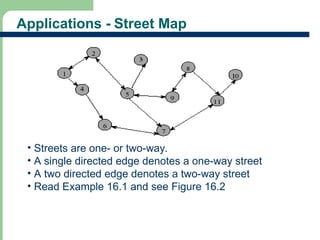
Applications - Street Map
• Streets are one- or two-way.
• A single directed edge denotes a one-way street
• A two directed edge denotes a two-way street
• Read Example 16.1 and see Figure 16.2
Path
 A sequence of vertices P = i1, i2, …, ik is an i1 to ik
path in the graph G=(V, E) iff the edge (ij, ij+1) is in
E for every j, 1≤ j < k
 What are possible paths in Figure 16.2(b)?
Simple Path
 A simple path is a path in which all vertices,
except possibly in the first and last, are different
 What are possible simple paths in Figure 16.2(b)?
 Do Exercise 16.1 and explain why or why not
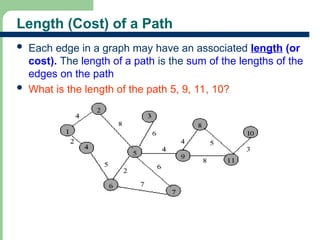
Length (Cost) of a Path
 Each edge in a graph may have an associated length (or
cost). The length of a path is the sum of the lengths of the
edges on the path
 What is the length of the path 5, 9, 11, 10?
Subgraph & Cycle
 Let G = (V, E) be an undirected graph
 A graph H is a subgraph of graph G iff its vertex and edge
sets are subsets of those of G
 A cycle is a simple path with the same start and end vertex
 List all cycles of the graph of Figure 16.1(a)?
– 1, 2, 3, 1
– 1, 4, 3, 1
– 1, 2, 3, 4, 1
 Do Exercise 16.5
Spanning Tree
 Let G = (V, E) be an undirected graph
 A connected undirected graph that contains no cycles is a
tree
 A subgraph of G that contains all the vertices of G and is a
tree is a spanning tree
 A spanning tree has n vertices and n-1 edges
 What are possible spanning trees in Figure 16.1(a)?
 See spanning trees of Figure 16.1(a) in Figure 16.3
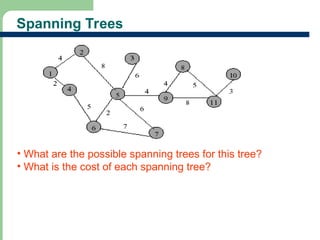
Spanning Trees
• What are the possible spanning trees for this tree?
• What is the cost of each spanning tree?
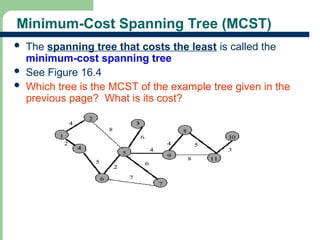
Minimum-Cost Spanning Tree (MCST)
 The spanning tree that costs the least is called the
minimum-cost spanning tree
 See Figure 16.4
 Which tree is the MCST of the example tree given in the
previous page? What is its cost?
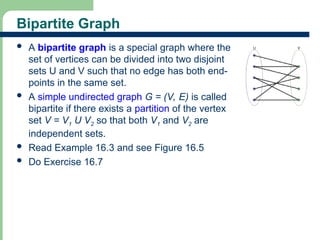
Bipartite Graph
 A bipartite graph is a special graph where the
set of vertices can be divided into two disjoint
sets U and V such that no edge has both end-
points in the same set.
 A simple undirected graph G = (V, E) is called
bipartite if there exists a partition of the vertex
set V = V1 U V2 so that both V1 and V2 are
independent sets.
 Read Example 16.3 and see Figure 16.5
 Do Exercise 16.7
Graph Properties
Number of Edges – Undirected Graph
 Each edge is of the form (u,v), u != v.
 The no. of possible pairs in an n vertex graph is n*(n-1)
 Since edge (u,v) is the same as edge (v,u), the number of
edges in an undirected graph is n*(n-1)/2
 Thus, the number of edges in an undirected graph
is  n*(n-1)/2
Number of Edges - Directed Graph
 Each edge is of the form (u,v), u != v.
 The no. of possible pairs in an n vertex graph is n*(n-1)
 Since edge (u,v) is not the same as edge (v,u), the
number of edges in a directed graph is n*(n-1)
 Thus, the number of edges in a directed graph is  n*(n-
1)
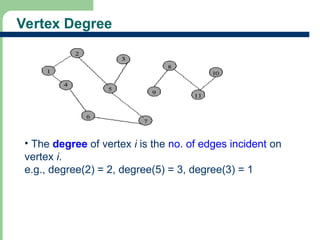
Vertex Degree
• The degree of vertex i is the no. of edges incident on
vertex i.
e.g., degree(2) = 2, degree(5) = 3, degree(3) = 1
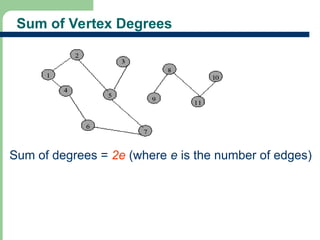
Sum of Vertex Degrees
Sum of degrees = 2e (where e is the number of edges)
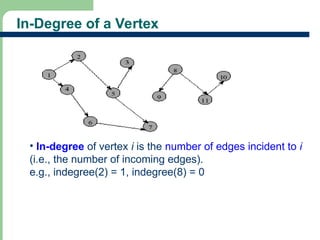
In-Degree of a Vertex
• In-degree of vertex i is the number of edges incident to i
(i.e., the number of incoming edges).
e.g., indegree(2) = 1, indegree(8) = 0
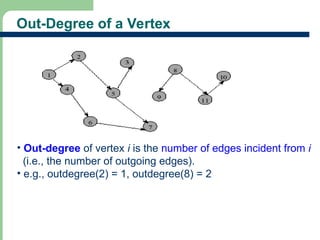
Out-Degree of a Vertex
• Out-degree of vertex i is the number of edges incident from i
(i.e., the number of outgoing edges).
• e.g., outdegree(2) = 1, outdegree(8) = 2
Sum of In- and Out-Degrees
 Each edge contributes
1 to the in-degree of some vertex and
1 to the out-degree of some other vertex.
 Sum of in-degrees = sum of out-degrees = e,
where e is the number of edges in the digraph.
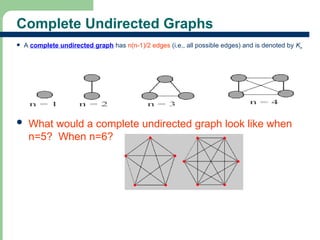
Complete Undirected Graphs
 A complete undirected graph has n(n-1)/2 edges (i.e., all possible edges) and is denoted by Kn
 What would a complete undirected graph look like when
n=5? When n=6?
Complete Directed Graphs
 A complete directed graph (also denoted by Kn) on n
vertices contains exactly n(n-1) edges
 See Figure 16.7 for complete digraphs for n = 1, 2, 3 and
4
 What would a complete directed graph look like when
n=5? When n=6?
 Do Exercise 16.9
ADT graph
 See ADT 16.1 for the abstract data type
specification of a graph
 See Program 16.1 for the abstract class definition
of graph
Sample Graph Problems
 Path Finding Problems
 Connectedness Problems
 Spanning Tree Problems
Path Finding
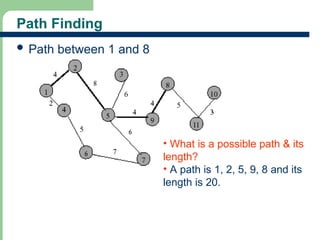
 Path between 1 and 8
• What is a possible path & its
length?
• A path is 1, 2, 5, 9, 8 and its
length is 20.
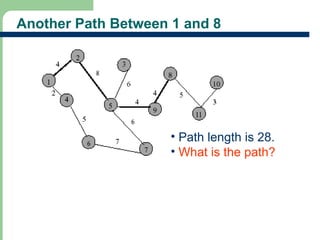
Another Path Between 1 and 8
• Path length is 28.
• What is the path?
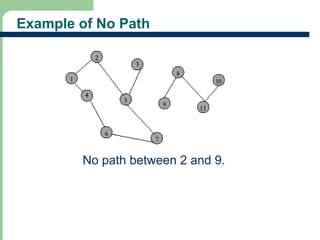
Example of No Path
No path between 2 and 9.
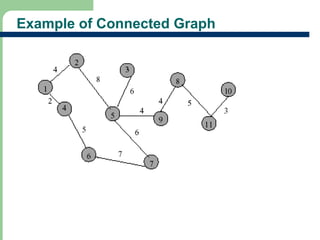
Connected Graph
 Let G = (V, E) be an undirected graph
 G is connected iff there is a path between every
pair of vertices in G
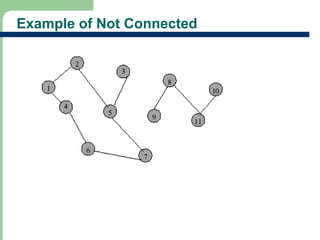
Example of Not Connected
Example of Connected Graph
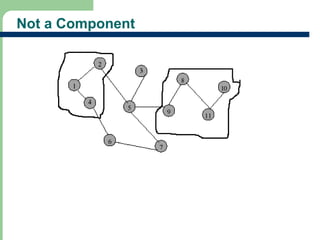
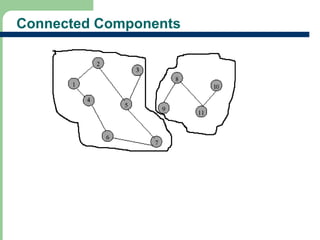
Connected Component
 A connected component is a maximal subgraph
that is connected.
 A connected graph has exactly 1 component.
Connected Components
Not a Component
Communication Network
Each edge is a link that can be constructed
(i.e., a feasible link)
Communication Network Problems
 Is the network connected?
– Can we communicate between every pair of cities?
 Find the components.
 Want to construct the smallest number of
feasible links so that resulting network is
connected.
Cycles and Connectedness
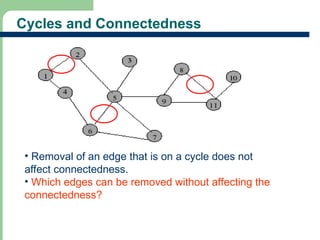
• Removal of an edge that is on a cycle does not
affect connectedness.
• Which edges can be removed without affecting the
connectedness?
Cycles and Connectedness
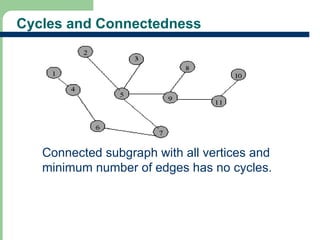
Connected subgraph with all vertices and
minimum number of edges has no cycles.
Representation of Unweighted Graphs
 The most frequently used representations for
unweighted graphs are
– Adjacency Matrix
– Linked adjacency lists
– Array adjacency lists
Adjacency Matrix
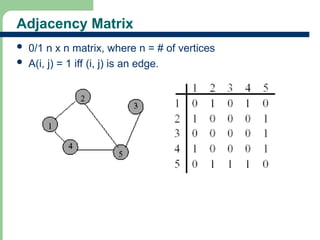
 0/1 n x n matrix, where n = # of vertices
 A(i, j) = 1 iff (i, j) is an edge.
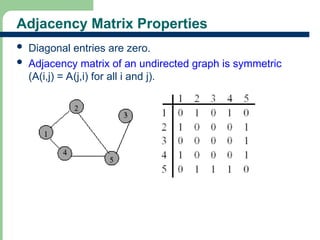
Adjacency Matrix Properties
 Diagonal entries are zero.
 Adjacency matrix of an undirected graph is symmetric
(A(i,j) = A(j,i) for all i and j).
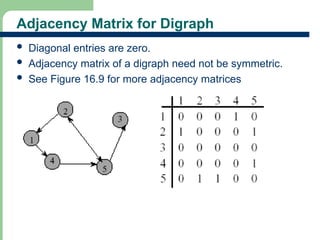
Adjacency Matrix for Digraph
 Diagonal entries are zero.
 Adjacency matrix of a digraph need not be symmetric.
 See Figure 16.9 for more adjacency matrices
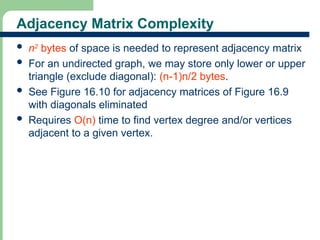
Adjacency Matrix Complexity
 n2
bytes of space is needed to represent adjacency matrix
 For an undirected graph, we may store only lower or upper
triangle (exclude diagonal): (n-1)n/2 bytes.
 See Figure 16.10 for adjacency matrices of Figure 16.9
with diagonals eliminated
 Requires O(n) time to find vertex degree and/or vertices
adjacent to a given vertex.
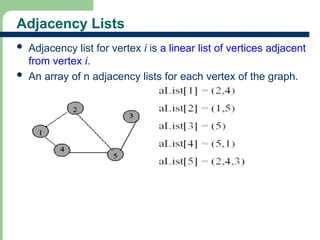
Adjacency Lists
 Adjacency list for vertex i is a linear list of vertices adjacent
from vertex i.
 An array of n adjacency lists for each vertex of the graph.
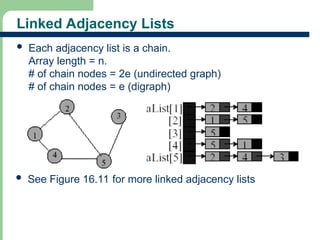
Linked Adjacency Lists
 Each adjacency list is a chain.
Array length = n.
# of chain nodes = 2e (undirected graph)
# of chain nodes = e (digraph)
 See Figure 16.11 for more linked adjacency lists
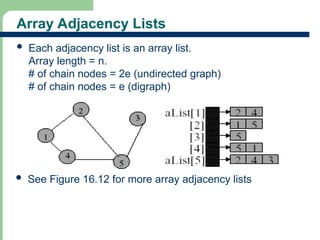
Array Adjacency Lists
 Each adjacency list is an array list.
Array length = n.
# of chain nodes = 2e (undirected graph)
# of chain nodes = e (digraph)
 See Figure 16.12 for more array adjacency lists
Representation of Weighted Graphs
 Weighted graphs are represented with simple extensions
of those used for unweighted graphs
 The cost-adjacency-matrix representation uses a matrix
C just like the adjacency-matrix representation does
 Cost-adjacency matrix: C(i, j) = cost of edge (i, j)
 Adjacency lists: each list element is a pair
(adjacent vertex, edge weight)
 See Figure 16.13 for cost-adjacency matrices
 See Figure 16.14 for linked adjacency lists for weighted
graph
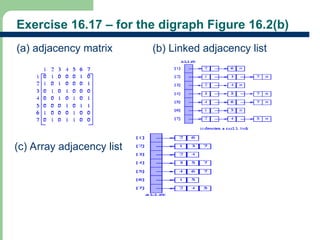
Exercise 16.17 – for the digraph Figure 16.2(b)
(a) adjacency matrix (b) Linked adjacency list
(c) Array adjacency list
READING
 READ Sections 16.1 - 16.7

GraphGraph data structureGraph data structure.ppt

  • 1.
  • 2.
    Chapter 16 coversthe following topics  Graph terminology: vertex, edge, adjacent, incident, degree, cycle, path, connected component, spanning tree  Types of graphs: undirected, directed, weighted  Graph representations: adjacency matrix, array adjacency lists, linked adjacency lists  Graph search methods: breath-first, depth-first search  Algorithms: – to find a path in a graph – to find the connected components of an undirected graph – to find a spanning tree of a connected undirected graph
  • 3.
    Graphs  G =(V,E)  V is the vertex set.  Vertices are also called nodes and points.  E is the edge set.  Each edge connects two vertices.  Edges are also called arcs and lines.  Vertices i and j are adjacent vertices iff (i, j) is an edge in the graph  The edge (i, j) is incident on the vertices i and j
  • 4.
    Graphs  Undirected edgehas no orientation (no arrow head)  Directed edge has an orientation (has an arrow head)  Undirected graph – all edges are undirected  Directed graph – all edges are directed u v directed edge u v undirected edge
  • 5.
  • 6.
  • 7.
    Directed Graph  Itis useful to have a slightly refined notion of adjacency and incidence  Directed edge (i, j) is incident to vertex j and incident from vertex i  Vertex i is adjacent to vertex j, and vertex j is adjacent from vertex i  In Figure 16.1, which graphs are undirected and which graphs are directed?
  • 8.
    Applications – CommunicationNetwork vertex = router edge = communication link
  • 9.
    Applications - DrivingDistance/Time Map vertex = city edge weight = driving distance/time
  • 10.
    Applications - StreetMap • Streets are one- or two-way. • A single directed edge denotes a one-way street • A two directed edge denotes a two-way street • Read Example 16.1 and see Figure 16.2
  • 11.
    Path  A sequenceof vertices P = i1, i2, …, ik is an i1 to ik path in the graph G=(V, E) iff the edge (ij, ij+1) is in E for every j, 1≤ j < k  What are possible paths in Figure 16.2(b)?
  • 12.
    Simple Path  Asimple path is a path in which all vertices, except possibly in the first and last, are different  What are possible simple paths in Figure 16.2(b)?  Do Exercise 16.1 and explain why or why not
  • 13.
    Length (Cost) ofa Path  Each edge in a graph may have an associated length (or cost). The length of a path is the sum of the lengths of the edges on the path  What is the length of the path 5, 9, 11, 10?
  • 14.
    Subgraph & Cycle Let G = (V, E) be an undirected graph  A graph H is a subgraph of graph G iff its vertex and edge sets are subsets of those of G  A cycle is a simple path with the same start and end vertex  List all cycles of the graph of Figure 16.1(a)? – 1, 2, 3, 1 – 1, 4, 3, 1 – 1, 2, 3, 4, 1  Do Exercise 16.5
  • 15.
    Spanning Tree  LetG = (V, E) be an undirected graph  A connected undirected graph that contains no cycles is a tree  A subgraph of G that contains all the vertices of G and is a tree is a spanning tree  A spanning tree has n vertices and n-1 edges  What are possible spanning trees in Figure 16.1(a)?  See spanning trees of Figure 16.1(a) in Figure 16.3
  • 16.
    Spanning Trees • Whatare the possible spanning trees for this tree? • What is the cost of each spanning tree?
  • 17.
    Minimum-Cost Spanning Tree(MCST)  The spanning tree that costs the least is called the minimum-cost spanning tree  See Figure 16.4  Which tree is the MCST of the example tree given in the previous page? What is its cost?
  • 18.
    Bipartite Graph  Abipartite graph is a special graph where the set of vertices can be divided into two disjoint sets U and V such that no edge has both end- points in the same set.  A simple undirected graph G = (V, E) is called bipartite if there exists a partition of the vertex set V = V1 U V2 so that both V1 and V2 are independent sets.  Read Example 16.3 and see Figure 16.5  Do Exercise 16.7
  • 19.
  • 20.
    Number of Edges– Undirected Graph  Each edge is of the form (u,v), u != v.  The no. of possible pairs in an n vertex graph is n*(n-1)  Since edge (u,v) is the same as edge (v,u), the number of edges in an undirected graph is n*(n-1)/2  Thus, the number of edges in an undirected graph is  n*(n-1)/2
  • 21.
    Number of Edges- Directed Graph  Each edge is of the form (u,v), u != v.  The no. of possible pairs in an n vertex graph is n*(n-1)  Since edge (u,v) is not the same as edge (v,u), the number of edges in a directed graph is n*(n-1)  Thus, the number of edges in a directed graph is  n*(n- 1)
  • 22.
    Vertex Degree • Thedegree of vertex i is the no. of edges incident on vertex i. e.g., degree(2) = 2, degree(5) = 3, degree(3) = 1
  • 23.
    Sum of VertexDegrees Sum of degrees = 2e (where e is the number of edges)
  • 24.
    In-Degree of aVertex • In-degree of vertex i is the number of edges incident to i (i.e., the number of incoming edges). e.g., indegree(2) = 1, indegree(8) = 0
  • 25.
    Out-Degree of aVertex • Out-degree of vertex i is the number of edges incident from i (i.e., the number of outgoing edges). • e.g., outdegree(2) = 1, outdegree(8) = 2
  • 26.
    Sum of In-and Out-Degrees  Each edge contributes 1 to the in-degree of some vertex and 1 to the out-degree of some other vertex.  Sum of in-degrees = sum of out-degrees = e, where e is the number of edges in the digraph.
  • 27.
    Complete Undirected Graphs A complete undirected graph has n(n-1)/2 edges (i.e., all possible edges) and is denoted by Kn  What would a complete undirected graph look like when n=5? When n=6?
  • 28.
    Complete Directed Graphs A complete directed graph (also denoted by Kn) on n vertices contains exactly n(n-1) edges  See Figure 16.7 for complete digraphs for n = 1, 2, 3 and 4  What would a complete directed graph look like when n=5? When n=6?  Do Exercise 16.9
  • 29.
    ADT graph  SeeADT 16.1 for the abstract data type specification of a graph  See Program 16.1 for the abstract class definition of graph
  • 30.
    Sample Graph Problems Path Finding Problems  Connectedness Problems  Spanning Tree Problems
  • 31.
    Path Finding  Pathbetween 1 and 8 • What is a possible path & its length? • A path is 1, 2, 5, 9, 8 and its length is 20.
  • 32.
    Another Path Between1 and 8 • Path length is 28. • What is the path?
  • 33.
    Example of NoPath No path between 2 and 9.
  • 34.
    Connected Graph  LetG = (V, E) be an undirected graph  G is connected iff there is a path between every pair of vertices in G
  • 35.
    Example of NotConnected
  • 36.
  • 37.
    Connected Component  Aconnected component is a maximal subgraph that is connected.  A connected graph has exactly 1 component.
  • 38.
  • 39.
  • 40.
    Communication Network Each edgeis a link that can be constructed (i.e., a feasible link)
  • 41.
    Communication Network Problems Is the network connected? – Can we communicate between every pair of cities?  Find the components.  Want to construct the smallest number of feasible links so that resulting network is connected.
  • 42.
    Cycles and Connectedness •Removal of an edge that is on a cycle does not affect connectedness. • Which edges can be removed without affecting the connectedness?
  • 43.
    Cycles and Connectedness Connectedsubgraph with all vertices and minimum number of edges has no cycles.
  • 44.
    Representation of UnweightedGraphs  The most frequently used representations for unweighted graphs are – Adjacency Matrix – Linked adjacency lists – Array adjacency lists
  • 45.
    Adjacency Matrix  0/1n x n matrix, where n = # of vertices  A(i, j) = 1 iff (i, j) is an edge.
  • 46.
    Adjacency Matrix Properties Diagonal entries are zero.  Adjacency matrix of an undirected graph is symmetric (A(i,j) = A(j,i) for all i and j).
  • 47.
    Adjacency Matrix forDigraph  Diagonal entries are zero.  Adjacency matrix of a digraph need not be symmetric.  See Figure 16.9 for more adjacency matrices
  • 48.
    Adjacency Matrix Complexity n2 bytes of space is needed to represent adjacency matrix  For an undirected graph, we may store only lower or upper triangle (exclude diagonal): (n-1)n/2 bytes.  See Figure 16.10 for adjacency matrices of Figure 16.9 with diagonals eliminated  Requires O(n) time to find vertex degree and/or vertices adjacent to a given vertex.
  • 49.
    Adjacency Lists  Adjacencylist for vertex i is a linear list of vertices adjacent from vertex i.  An array of n adjacency lists for each vertex of the graph.
  • 50.
    Linked Adjacency Lists Each adjacency list is a chain. Array length = n. # of chain nodes = 2e (undirected graph) # of chain nodes = e (digraph)  See Figure 16.11 for more linked adjacency lists
  • 51.
    Array Adjacency Lists Each adjacency list is an array list. Array length = n. # of chain nodes = 2e (undirected graph) # of chain nodes = e (digraph)  See Figure 16.12 for more array adjacency lists
  • 52.
    Representation of WeightedGraphs  Weighted graphs are represented with simple extensions of those used for unweighted graphs  The cost-adjacency-matrix representation uses a matrix C just like the adjacency-matrix representation does  Cost-adjacency matrix: C(i, j) = cost of edge (i, j)  Adjacency lists: each list element is a pair (adjacent vertex, edge weight)  See Figure 16.13 for cost-adjacency matrices  See Figure 16.14 for linked adjacency lists for weighted graph
  • 53.
    Exercise 16.17 –for the digraph Figure 16.2(b) (a) adjacency matrix (b) Linked adjacency list (c) Array adjacency list
  • 54.