GRAPHS notes presentation of non linear data structure
1.
CHAPTER 6 1
CHAPTER6
GRAPHS
All the programs in this file are selected from
Ellis Horowitz, Sartaj Sahni, and Susan Anderson-Freed
“Fundamentals of Data Structures in C”,
Computer Science Press, 1992.
2.
Introduction
First Recordedevidence – 1736 – Leonhard
Euler – solve classical – Konigsberg bridge
problem.
4 Land areas (A to D) – isolated by river.
Interconnected by 7 bridges ( a to g).
Problem: start at one land location – is it
possible to walk across all bridges exactly
once and reach the starting land area?
2
Intro…..
Leonhard’s solution:
Start from Land area B
Walk across bridge a to island A
Take bridge e to area D
Take bridge g to C
Take bridge b to B
Take bridge f to D
Wrong !!! – Euler answered in negative – Not
possible
4
5.
Intro….
Euler –represented – land area – vertex – bridges –
edges.
Degree of a vertex – number of edges incident on it.
A walk starting at vertex – going through each
edge exactly once – terminating at starting
vertex – possible – iff – the degrees of each
vertex is even.
A walk that does this is called as Eulerian.
No Eulerian walk – Konigsberg Bridge problem
5
6.
Applications…….
Analysis ofelectric circuits.
Finding shortest routes.
Project planning.
Identification of chemical compounds.
Statistical Mechanics.
Genetics
Cybernetics
Linguistics
Social Sciences
6
7.
7
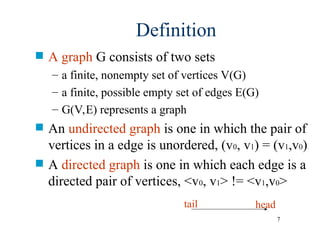
Definition
A graphG consists of two sets
– a finite, nonempty set of vertices V(G)
– a finite, possible empty set of edges E(G)
– G(V,E) represents a graph
An undirected graph is one in which the pair of
vertices in a edge is unordered, (v0, v1) = (v1,v0)
A directed graph is one in which each edge is a
directed pair of vertices, <v0, v1> != <v1,v0>
tail head
9
Complete Graph
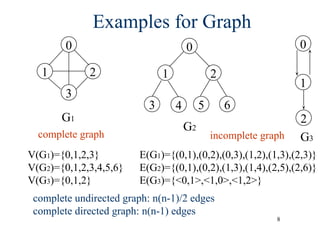
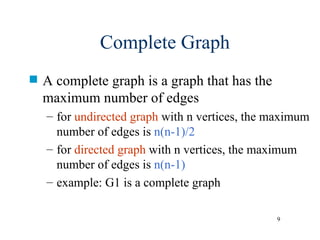
Acomplete graph is a graph that has the
maximum number of edges
– for undirected graph with n vertices, the maximum
number of edges is n(n-1)/2
– for directed graph with n vertices, the maximum
number of edges is n(n-1)
– example: G1 is a complete graph
10.
10
Adjacent and Incident
If (v0, v1) is an edge in an undirected graph,
– v0 and v1 are adjacent
– The edge (v0, v1) is incident on vertices v0 and v1
If <v0, v1> is an edge in a directed graph
– v0 is adjacent to v1, and v1 is adjacent from v0
– The edge <v0, v1> is incident on v0 and v1
11.
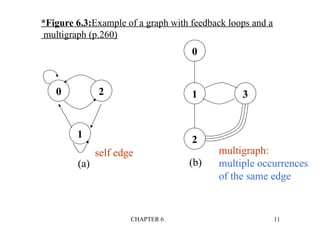
CHAPTER 6 11
02
1
(a)
2
1
0
3
(b)
*Figure 6.3:Example of a graph with feedback loops and a
multigraph (p.260)
self edge multigraph:
multiple occurrences
of the same edge
Figure 6.3
12.
12
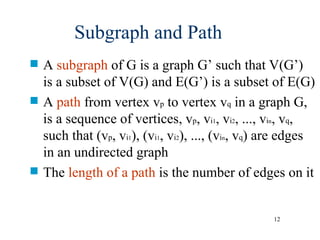
A subgraphof G is a graph G’ such that V(G’)
is a subset of V(G) and E(G’) is a subset of E(G)
A path from vertex vp to vertex vq in a graph G,
is a sequence of vertices, vp, vi1, vi2, ..., vin, vq,
such that (vp, vi1), (vi1, vi2), ..., (vin, vq) are edges
in an undirected graph
The length of a path is the number of edges on it
Subgraph and Path
13.
13
0 0
1 23
1 2 0
1 2
3
(i) (ii) (iii) (iv)
(a) Some of the subgraph of G1
0 0
1
0
1
2
0
1
2
(i) (ii) (iii) (iv)
(b) Some of the subgraph of G3
0
1 2
3
G1
0
1
2
G3
Figure 6.4: subgraphs of G1 and G3 (p.261)
14.
14
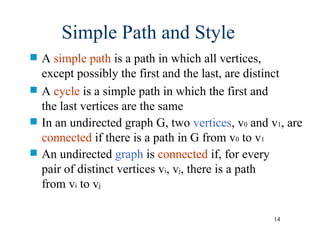
A simplepath is a path in which all vertices,
except possibly the first and the last, are distinct
A cycle is a simple path in which the first and
the last vertices are the same
In an undirected graph G, two vertices, v0 and v1, are
connected if there is a path in G from v0 to v1
An undirected graph is connected if, for every
pair of distinct vertices vi, vj, there is a path
from vi to vj
Simple Path and Style
16
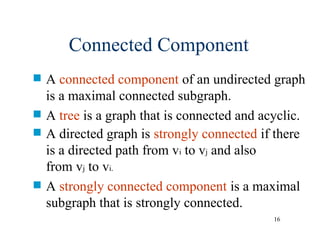
A connectedcomponent of an undirected graph
is a maximal connected subgraph.
A tree is a graph that is connected and acyclic.
A directed graph is strongly connected if there
is a directed path from vi to vj and also
from vj to vi.
A strongly connected component is a maximal
subgraph that is strongly connected.
Connected Component
CHAPTER 6 19
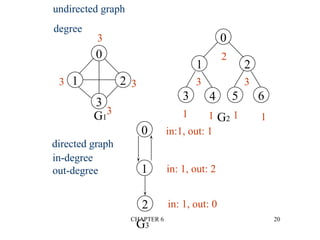
Degree
The degree of a vertex is the number of edges
incident to that vertex
For directed graph,
– the in-degree of a vertex v is the number of edges
that have v as the head
– the out-degree of a vertex v is the number of edges
that have v as the tail
– if di is the degree of a vertex i in a graph G with n
vertices and e edges, the number of edges is
e di
n
( ) /
0
1
2
CHAPTER 6 21
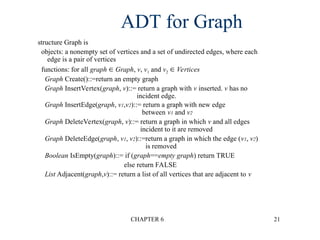
ADTfor Graph
structure Graph is
objects: a nonempty set of vertices and a set of undirected edges, where each
edge is a pair of vertices
functions: for all graph Graph, v, v1 and v2 Vertices
Graph Create()::=return an empty graph
Graph InsertVertex(graph, v)::= return a graph with v inserted. v has no
incident edge.
Graph InsertEdge(graph, v1,v2)::= return a graph with new edge
between v1 and v2
Graph DeleteVertex(graph, v)::= return a graph in which v and all edges
incident to it are removed
Graph DeleteEdge(graph, v1, v2)::=return a graph in which the edge (v1, v2)
is removed
Boolean IsEmpty(graph)::= if (graph==empty graph) return TRUE
else return FALSE
List Adjacent(graph,v)::= return a list of all vertices that are adjacent to v
CHAPTER 6 23
AdjacencyMatrix
Let G=(V,E) be a graph with n vertices.
The adjacency matrix of G is a two-dimensional
n by n array, say adj_mat
If the edge (vi, vj) is in E(G), adj_mat[i][j]=1
If there is no such edge in E(G), adj_mat[i][j]=0
The adjacency matrix for an undirected graph is
symmetric; the adjacency matrix for a digraph
need not be symmetric
CHAPTER 6 25
Meritsof Adjacency Matrix
From the adjacency matrix, to determine the
connection of vertices is easy
The degree of a vertex is
For a digraph, the row sum is the out_degree,
while the column sum is the in_degree
adj mat i j
j
n
_ [ ][ ]
0
1
ind vi A j i
j
n
( ) [ , ]
0
1
outd vi A i j
j
n
( ) [ , ]
0
1
26.
CHAPTER 6 26
DataStructures for Adjacency Lists
#define MAX_VERTICES 50
typedef struct node *node_pointer;
typedef struct node {
int vertex;
struct node *link;
};
node_pointer graph[MAX_VERTICES];
int n=0; /* vertices currently in use *
Each row in adjacency matrix is represented as an adjacency list.
27.
CHAPTER 6 27
0
1
2
3
0
1
2
0
1
2
3
4
5
6
7
12 3
0 2 3
0 1 3
0 1 2
G1
1
0 2
G3
1 2
0 3
0 3
1 2
5
4 6
5 7
6
G4
0
1 2
3
0
1
2
1
0
2
3
4
5
6
7
An undirected graph with n vertices and e edges ==> n head nodes and 2e list nodes
28.
CHAPTER 6 28
3 2 NULL
1
0
2 3 NULL
0
1
3 1 NULL
0
2
2 0 NULL
1
3
headnodes vertax link
Order is of no significance.
0
1 2
3
Figure 6.13:Alternate order adjacency list for G1 (p.268)
29.
CHAPTER 6 29
InterestingOperations
degree of a vertex in an undirected graph
–# of nodes in adjacency list
# of edges in a graph
–determined in O(n+e)
out-degree of a vertex in a directed graph
–# of nodes in its adjacency list
in-degree of a vertex in a directed graph
–traverse the whole data structure
CHAPTER 6 31
0
1
2
1NULL
0 NULL
1 NULL
0
1
2
Determine in-degree of a vertex in a fast way.
Figure 6.10: Inverse adjacency list for G3
32.
CHAPTER 6 32
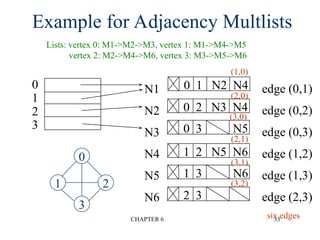
AdjacencyMultilists
marked vertex1 vertex2 path1 path2
An edge in an undirected graph is
represented by two nodes in adjacency list
representation.
Adjacency Multilists
–lists in which nodes may be shared among
several lists.
(an edge is shared by two different paths)
CHAPTER 6 34
typedefstruct edge *edge_pointer;
typedef struct edge {
short int marked;
int vertex1, vertex2;
edge_pointer path1, path2;
};
edge_pointer graph[MAX_VERTICES];
marked vertex1 vertex2 path1 path2
Adjacency Multilists
35.
CHAPTER 6 35
SomeGraph Operations
Traversal
Given G=(V,E) and vertex v, find all wV,
such that w connects v.
– Depth First Search (DFS)
preorder tree traversal
– Breadth First Search (BFS)
level order tree traversal
Connected Components
Spanning Trees
36.
CHAPTER 6 36
*Figure6.19:Graph G and its adjacency lists (p.274)
depth first search: v0, v1, v3, v7, v4, v5, v2, v6
breadth first search: v0, v1, v2, v3, v4, v5, v6, v7
Vertex Visit
0 0
1 0
2 0
3 0
4 0
5 0
6 0
7 0
37.
CHAPTER 6 37
DepthFirst Search
void dfs(int v)
{
node_pointer w;
visited[v]= TRUE;
printf(“%5d”, v);
for (w=graph[v]; w; w=w->link)
if (!visited[w->vertex])
dfs(w->vertex);
}
#define FALSE 0
#define TRUE 1
short int visited[MAX_VERTICES];
Data structure
adjacency list: O(e)
adjacency matrix: O(n2
)
CHAPTER 6 42
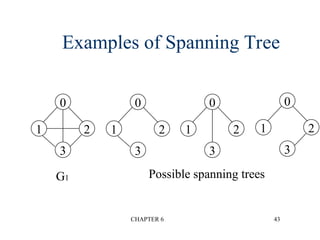
SpanningTrees
When graph G is connected, a depth first or
breadth first search starting at any vertex will
visit all vertices in G
A spanning tree is any tree that consists solely
of edges in G and that includes all the vertices
E(G): T (tree edges) + N (nontree edges)
where T: set of edges used during search
N: set of remaining edges
43.
CHAPTER 6 43
Examplesof Spanning Tree
0
1 2
3
0
1 2
3
0
1 2
3
0
1 2
3
G1 Possible spanning trees
44.
CHAPTER 6 44
SpanningTrees
Either dfs or bfs can be used to create a
spanning tree
– When dfs is used, the resulting spanning tree is
known as a depth first spanning tree
– When bfs is used, the resulting spanning tree is
known as a breadth first spanning tree
While adding a nontree edge into any spanning
tree, this will create a cycle
CHAPTER 6 46
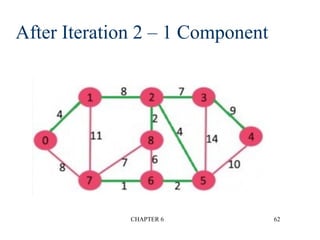
MinimumCost Spanning Tree
The cost of a spanning tree of a weighted
undirected graph is the sum of the costs of the
edges in the spanning tree
A minimum cost spanning tree is a spanning
tree of least cost
Three different algorithms can be used
– Kruskal
– Prim
– Sollin
Select n-1 edges from a weighted graph
of n vertices with minimum cost.
47.
CHAPTER 6 47
GreedyStrategy
An optimal solution is constructed in stages
At each stage, the best decision is made at this
time
Since this decision cannot be changed later,
we make sure that the decision will result in a feasib
solution
Typically, the selection of an item at each
stage is based on a least cost or a highest profit crite
48.
CHAPTER 6 48
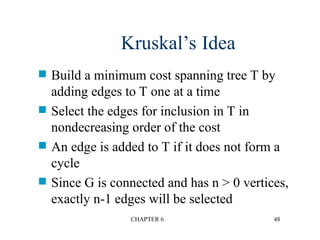
Kruskal’sIdea
Build a minimum cost spanning tree T by
adding edges to T one at a time
Select the edges for inclusion in T in
nondecreasing order of the cost
An edge is added to T if it does not form a
cycle
Since G is connected and has n > 0 vertices,
exactly n-1 edges will be selected
CHAPTER 6 52
Kruskal’sAlgorithm
T= {};
while (T contains less than n-1 edges
&& E is not empty) {
choose a least cost edge (v,w) from E;
delete (v,w) from E;
if ((v,w) does not create a cycle in T)
add (v,w) to T
else discard (v,w);
}
if (T contains fewer than n-1 edges)
printf(“No spanning treen”);
O(e log e)
53.
CHAPTER 6 53
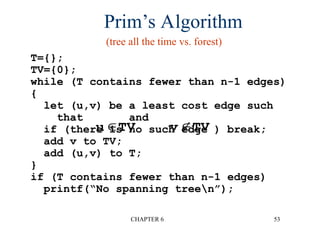
Prim’sAlgorithm
T={};
TV={0};
while (T contains fewer than n-1 edges)
{
let (u,v) be a least cost edge such
that and
if (there is no such edge ) break;
add v to TV;
add (u,v) to T;
}
if (T contains fewer than n-1 edges)
printf(“No spanning treen”);
u TV
v TV
(tree all the time vs. forest)
CHAPTER 6 68
DataStructure for SSAD
#define MAX_VERTICES 6
int cost[][MAX_VERTICES]=
{{ 0, 50, 10, 1000, 45, 1000},
{1000, 0, 15, 1000, 10, 1000},
{ 20, 1000, 0, 15, 1000, 1000},
{1000, 20, 1000, 0, 35, 1000},
{1000, 1000, 30, 1000, 0, 1000},
{1000, 1000, 1000, 3, 1000, 0}};
int distance[MAX_VERTICES];
short int found{MAX_VERTICES];
int n = MAX_VERTICES;
adjacency matrix
69.
CHAPTER 6 69
SingleSource All Destinations
void shortestpath(int v, int cost[][MAX_ERXTICES
int distance[], int n, short int found[])
{
int i, u, w;
for (i=0; i<n; i++) {
found[i] = FALSE;
distance[i] = cost[v][i];
}
found[v] = TRUE;
distance[v] = 0;
O(n)
70.
CHAPTER 6 70
for(i=0; i<n-2; i++) {determine n-1 paths from v
u = choose(distance, n, found);
found[u] = TRUE;
for (w=0; w<n; w++)
if (!found[w])
if (distance[u]+cost[u][w]<distance[w])
distance[w] = distance[u]+cost[u][w];
}
}
O(n2
)
與 u 相連的端點 w
71.
CHAPTER 6 71
AllPairs Shortest Paths
Find the shortest paths between all pairs of
vertices.
Solution 1
–Apply shortest path n times with each vertex as
source.
O(n3
)
Solution 2
–Represent the graph G by its cost adjacency matrix
with cost[i][j]
–If the edge <i,j> is not in G, the cost[i][j] is set to
some sufficiently large number
–A[i][j] is the cost of the shortest path form i to j,
using only those intermediate vertices with an index
<= k
72.
CHAPTER 6 72
AllPairs Shortest Paths (Continued)
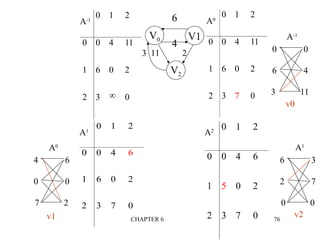
The cost of the shortest path from i to j is A [i][j],
as no vertex in G has an index greater than n-1
A [i][j]=cost[i][j]
Calculate the A, A, A, ..., A from A iteratively
A [i][j]=min{A [i][j], A [i][k]+A [k][j]}, k>=0
n-1
-1
0 1 2 n-1 -1
k k-1 k-1 k-1
73.
CHAPTER 6 73
Graphwith negative cycle
0 1 2
-2
1 1
(a) Directed graph (b) A-1
0
1
0
2
1
0
The length of the shortest path from vertex 0 to vertex 2 is -.
0, 1, 0, 1,0, 1, …, 0, 1, 2
74.
CHAPTER 6 74
Algorithmfor All Pairs Shortest Paths
void allcosts(int cost[][MAX_VERTICES],
int distance[][MAX_VERTICES], int n)
{
int i, j, k;
for (i=0; i<n; i++)
for (j=0; j<n; j++)
distance[i][j] = cost[i][j];
for (k=0; k<n; k++)
for (i=0; i<n; i++)
for (j=0; j<n; j++)
if (distance[i][k]+distance[k][j]
< distance[i][j])
distance[i][j]=
distance[i][k]+distance[k][j];
}
75.
CHAPTER 6 75
*Figure 6.33: Directed graph and its cost matrix (p.299)
V0
V2
V1
6
4
3 11 2
(a)Digraph G (b)Cost adjacency matrix for G
0 1 2
0 0 4 11
1 6 0 2
2 3 0
CHAPTER 6 77
01 4
3
2
0
0
1
0
0
1
0
0
0
0
0
1
0
0
0
0
0
1
0
0
0
0
0
1
0
1
1
1
0
0
1
1
1
0
0
1
1
1
0
0
1
1
1
0
0
1
1
1
1
0
0
1
2
3
4
0
1
2
3
4
1
1
1
0
0
1
1
1
0
0
1
1
1
0
0
1
1
1
1
0
1
1
1
1
1
0
1
2
3
4
(a) Digraph G (b) Adjacency matrix A for G
(c) transitive closure matrix A+
(d) reflexive transitive closure matrix A*
cycle
reflexiv
e
Transitive Closure
Goal: given a graph with unweighted edges, determine if there is a path
from i to j for all i and j.
(1) Require positive path (> 0) lengths.
(2) Require nonnegative path (0) lengths.
There is a path of length > 0 There is a path of length 0
transitive closure matrix
reflexive transitive closure matrix
78.
CHAPTER 6 78
Activityon Vertex (AOV) Network
definition
A directed graph in which the vertices represent
tasks or activities and the edges represent
precedence relations between tasks.
predecessor (successor)
vertex i is a predecessor of vertex j iff there is a
directed path from i to j. j is a successor of i.
partial order
a precedence relation which is both transitive (i, j,
k, ij & jk => ik ) and irreflexive (x xx).
acylic graph
a directed graph with no directed cycles
79.
CHAPTER 6 79
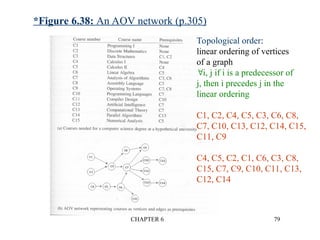
*Figure6.38: An AOV network (p.305)
Topological order:
linear ordering of vertices
of a graph
i, j if i is a predecessor of
j, then i precedes j in the
linear ordering
C1, C2, C4, C5, C3, C6, C8,
C7, C10, C13, C12, C14, C15,
C11, C9
C4, C5, C2, C1, C6, C3, C8,
C15, C7, C9, C10, C11, C13,
C12, C14
80.
CHAPTER 6 80
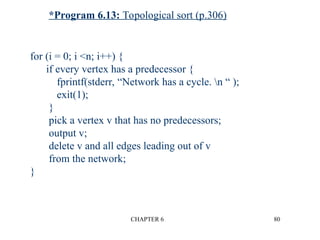
*Program6.13: Topological sort (p.306)
for (i = 0; i <n; i++) {
if every vertex has a predecessor {
fprintf(stderr, “Network has a cycle. n “ );
exit(1);
}
pick a vertex v that has no predecessors;
output v;
delete v and all edges leading out of v
from the network;
}
81.
CHAPTER 6 81
*Figure6.39:Simulation of Program 6.13 on an AOV
network (p.306)
v0 no predecessor
delete v0->v1, v0->v2, v0->v3
v1, v2, v3 no predecessor
select v3
delete v3->v4, v3->v5
select v2
delete v2->v4, v2->v5
select v5 select v1
delete v1->v4
82.
CHAPTER 6 82
Issuesin Data Structure
Consideration
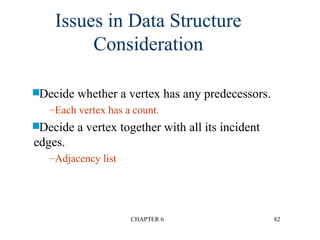
Decide whether a vertex has any predecessors.
–Each vertex has a count.
Decide a vertex together with all its incident
edges.
–Adjacency list
CHAPTER 6 85
*Program6.14: Topological sort (p.308)
O(n)
void topsort (hdnodes graph [] , int n)
{
int i, j, k, top;
node_pointer ptr;
/* create a stack of vertices with no predecessors */
top = -1;
for (i = 0; i < n; i++)
if (!graph[i].count) {no predecessors, stack is linked through
graph[i].count = top; count field
top = i;
}
for (i = 0; i < n; i++)
if (top == -1) {
fprintf(stderr, “n Network has a cycle. Sort terminated. n”);
exit(1);
}
86.
CHAPTER 6 86
O(e)
O(e+n)
Continued
}
else{
j = top; /* unstack a vertex */
top = graph[top].count;
printf(“v%d, “, j);
for (ptr = graph [j]. link; ptr ;ptr = ptr ->link ){
/* decrease the count of the successor vertices of j */
k = ptr ->vertex;
graph[k].count --;
if (!graph[k].count) {
/* add vertex k to the stack*/
graph[k].count = top;
top = k;
}
}
}
}
87.
CHAPTER 6 87
Activityon Edge (AOE)
Networks
directed edge
–tasks or activities to be performed
vertex
–events which signal the completion of certain activities
number
–time required to perform the activity
CHAPTER 6 89
Applicationof AOE Network
Evaluate performance
–minimum amount of time
–activity whose duration time should be shortened
–…
Critical path
–a path that has the longest length
–minimum time required to complete the project
–v0, v1, v4, v7, v8 or v0, v1, v4, v6, v8 (18)
90.
CHAPTER 6 90
otherfactors
Earliest time that vi can occur
–the length of the longest path from v0 to vi
–the earliest start time for all activities leaving vi
–early(6) = early(7) = 7
Latest time of activity
–the latest time the activity may start without increasing
the project duration
–late(5)=8, late(7)=7
Critical activity
–an activity for which early(i)=late(i)
–early(7)=late(7)
late(i)-early(i)
–measure of how critical an activity is
–late(5)-early(5)=8-5=3
CHAPTER 6 92
DetermineCritical Paths
Delete all noncritical activities
Generate all the paths from the start to
finish vertex.
93.
CHAPTER 6 93
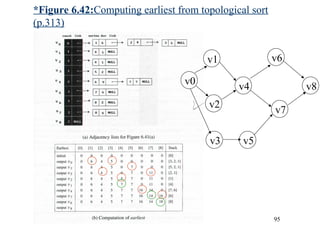
Calculationof Earliest Times
vk vl
ai
early(i)=earliest(k)
late(i)=latest(l)-duration of ai
earliest[0]=0
earliest[j]=max{earliest[i]+duration of <i,j>}
i p(j)
earliest[j]
–the earliest event occurrence time
latest[j]
–the latest event occurrence time








![CHAPTER 6 23
Adjacency Matrix
Let G=(V,E) be a graph with n vertices.
The adjacency matrix of G is a two-dimensional
n by n array, say adj_mat
If the edge (vi, vj) is in E(G), adj_mat[i][j]=1
If there is no such edge in E(G), adj_mat[i][j]=0
The adjacency matrix for an undirected graph is
symmetric; the adjacency matrix for a digraph
need not be symmetric](https://image.slidesharecdn.com/graphs-250510100250-b5291199/85/GRAPHS-notes-presentation-of-non-linear-data-structure-23-320.jpg)

![CHAPTER 6 25
Merits of Adjacency Matrix
From the adjacency matrix, to determine the
connection of vertices is easy
The degree of a vertex is
For a digraph, the row sum is the out_degree,
while the column sum is the in_degree
adj mat i j
j
n
_ [ ][ ]
0
1
ind vi A j i
j
n
( ) [ , ]
0
1
outd vi A i j
j
n
( ) [ , ]
0
1](https://image.slidesharecdn.com/graphs-250510100250-b5291199/85/GRAPHS-notes-presentation-of-non-linear-data-structure-25-320.jpg)
![CHAPTER 6 26
Data Structures for Adjacency Lists
#define MAX_VERTICES 50
typedef struct node *node_pointer;
typedef struct node {
int vertex;
struct node *link;
};
node_pointer graph[MAX_VERTICES];
int n=0; /* vertices currently in use *
Each row in adjacency matrix is represented as an adjacency list.](https://image.slidesharecdn.com/graphs-250510100250-b5291199/85/GRAPHS-notes-presentation-of-non-linear-data-structure-26-320.jpg)


![CHAPTER 6 30
[0] 9 [8] 23 [16] 2
[1] 11 [9] 1 [17] 5
[2] 13 [10] 2 [18] 4
[3] 15 [11] 0 [19] 6
[4] 17 [12] 3 [20] 5
[5] 18 [13] 0 [21] 7
[6] 20 [14] 3 [22] 6
[7] 22 [15] 1
1
0
2
3
4
5
6
7
0
1
2
3
4
5
6
7
node[0] … node[n-1]: starting point for vertices
node[n]: n+2e+1
node[n+1] … node[n+2e]: head node of edge
Compact Representation](https://image.slidesharecdn.com/graphs-250510100250-b5291199/85/GRAPHS-notes-presentation-of-non-linear-data-structure-30-320.jpg)


![CHAPTER 6 34
typedef struct edge *edge_pointer;
typedef struct edge {
short int marked;
int vertex1, vertex2;
edge_pointer path1, path2;
};
edge_pointer graph[MAX_VERTICES];
marked vertex1 vertex2 path1 path2
Adjacency Multilists](https://image.slidesharecdn.com/graphs-250510100250-b5291199/85/GRAPHS-notes-presentation-of-non-linear-data-structure-34-320.jpg)


![CHAPTER 6 37
Depth First Search
void dfs(int v)
{
node_pointer w;
visited[v]= TRUE;
printf(“%5d”, v);
for (w=graph[v]; w; w=w->link)
if (!visited[w->vertex])
dfs(w->vertex);
}
#define FALSE 0
#define TRUE 1
short int visited[MAX_VERTICES];
Data structure
adjacency list: O(e)
adjacency matrix: O(n2
)](https://image.slidesharecdn.com/graphs-250510100250-b5291199/85/GRAPHS-notes-presentation-of-non-linear-data-structure-37-320.jpg)

![CHAPTER 6 39
Breadth First Search (Continued)
void bfs(int v)
{
node_pointer w;
queue_pointer front, rear;
front = rear = NULL;
printf(“%5d”, v);
visited[v] = TRUE;
addq(&front, &rear, v);
adjacency list: O(e)
adjacency matrix: O(n2
)](https://image.slidesharecdn.com/graphs-250510100250-b5291199/85/GRAPHS-notes-presentation-of-non-linear-data-structure-39-320.jpg)
![CHAPTER 6 40
while (front) {
v= deleteq(&front);
for (w=graph[v]; w; w=w->link)
if (!visited[w->vertex]) {
printf(“%5d”, w->vertex);
addq(&front, &rear, w->vertex);
visited[w->vertex] = TRUE;
}
}
}](https://image.slidesharecdn.com/graphs-250510100250-b5291199/85/GRAPHS-notes-presentation-of-non-linear-data-structure-40-320.jpg)
![CHAPTER 6 41
Connected Components
void connected(void)
{
for (i=0; i<n; i++) {
if (!visited[i]) {
dfs(i);
printf(“n”);
}
}
}
adjacency list: O(n+e)
adjacency matrix: O(n2
)](https://image.slidesharecdn.com/graphs-250510100250-b5291199/85/GRAPHS-notes-presentation-of-non-linear-data-structure-41-320.jpg)










![CHAPTER 6 67
Example for the Shortest Path
(Continued)
Iteration S Vertex
Selected
LA
[0]
SF
[1]
DEN
[2]
CHI
[3]
BO
[4]
NY
[5]
MIA
[6]
NO
Initial -- ---- + + + 1500 0 250 + +
1 {4} 5 + + + 1250 0 250 1150 1650
2 {4,5} 6 + + + 1250 0 250 1150 1650
3 {4,5,6} 3 + + 2450 1250 0 250 1150 1650
4 {4,5,6,3} 7 3350 + 2450 1250 0 250 1150 1650
5 {4,5,6,3,7} 2 3350 3250 2450 1250 0 250 1150 1650
6 {4,5,6,3,7,2} 1 3350 3250 2450 1250 0 250 1150 1650
7 {4,5,6,3,7,2,1}
(a)
(b) (c) (d)
(e)
(f)
(g)
(h)
(i)
(j)](https://image.slidesharecdn.com/graphs-250510100250-b5291199/85/GRAPHS-notes-presentation-of-non-linear-data-structure-67-320.jpg)
![CHAPTER 6 68
Data Structure for SSAD
#define MAX_VERTICES 6
int cost[][MAX_VERTICES]=
{{ 0, 50, 10, 1000, 45, 1000},
{1000, 0, 15, 1000, 10, 1000},
{ 20, 1000, 0, 15, 1000, 1000},
{1000, 20, 1000, 0, 35, 1000},
{1000, 1000, 30, 1000, 0, 1000},
{1000, 1000, 1000, 3, 1000, 0}};
int distance[MAX_VERTICES];
short int found{MAX_VERTICES];
int n = MAX_VERTICES;
adjacency matrix](https://image.slidesharecdn.com/graphs-250510100250-b5291199/85/GRAPHS-notes-presentation-of-non-linear-data-structure-68-320.jpg)
![CHAPTER 6 69
Single Source All Destinations
void shortestpath(int v, int cost[][MAX_ERXTICES
int distance[], int n, short int found[])
{
int i, u, w;
for (i=0; i<n; i++) {
found[i] = FALSE;
distance[i] = cost[v][i];
}
found[v] = TRUE;
distance[v] = 0;
O(n)](https://image.slidesharecdn.com/graphs-250510100250-b5291199/85/GRAPHS-notes-presentation-of-non-linear-data-structure-69-320.jpg)
![CHAPTER 6 70
for (i=0; i<n-2; i++) {determine n-1 paths from v
u = choose(distance, n, found);
found[u] = TRUE;
for (w=0; w<n; w++)
if (!found[w])
if (distance[u]+cost[u][w]<distance[w])
distance[w] = distance[u]+cost[u][w];
}
}
O(n2
)
與 u 相連的端點 w](https://image.slidesharecdn.com/graphs-250510100250-b5291199/85/GRAPHS-notes-presentation-of-non-linear-data-structure-70-320.jpg)
![CHAPTER 6 71
All Pairs Shortest Paths
Find the shortest paths between all pairs of
vertices.
Solution 1
–Apply shortest path n times with each vertex as
source.
O(n3
)
Solution 2
–Represent the graph G by its cost adjacency matrix
with cost[i][j]
–If the edge <i,j> is not in G, the cost[i][j] is set to
some sufficiently large number
–A[i][j] is the cost of the shortest path form i to j,
using only those intermediate vertices with an index
<= k](https://image.slidesharecdn.com/graphs-250510100250-b5291199/85/GRAPHS-notes-presentation-of-non-linear-data-structure-71-320.jpg)
![CHAPTER 6 72
All Pairs Shortest Paths (Continued)
The cost of the shortest path from i to j is A [i][j],
as no vertex in G has an index greater than n-1
A [i][j]=cost[i][j]
Calculate the A, A, A, ..., A from A iteratively
A [i][j]=min{A [i][j], A [i][k]+A [k][j]}, k>=0
n-1
-1
0 1 2 n-1 -1
k k-1 k-1 k-1](https://image.slidesharecdn.com/graphs-250510100250-b5291199/85/GRAPHS-notes-presentation-of-non-linear-data-structure-72-320.jpg)

![CHAPTER 6 74
Algorithm for All Pairs Shortest Paths
void allcosts(int cost[][MAX_VERTICES],
int distance[][MAX_VERTICES], int n)
{
int i, j, k;
for (i=0; i<n; i++)
for (j=0; j<n; j++)
distance[i][j] = cost[i][j];
for (k=0; k<n; k++)
for (i=0; i<n; i++)
for (j=0; j<n; j++)
if (distance[i][k]+distance[k][j]
< distance[i][j])
distance[i][j]=
distance[i][k]+distance[k][j];
}](https://image.slidesharecdn.com/graphs-250510100250-b5291199/85/GRAPHS-notes-presentation-of-non-linear-data-structure-74-320.jpg)




![CHAPTER 6 84
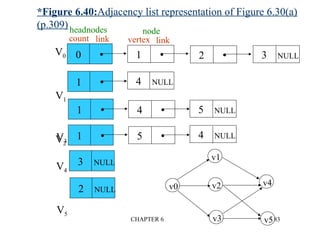
*(p.307)
typedef struct node *node_pointer;
typedef struct node {
int vertex;
node_pointer link;
};
typedef struct {
int count;
node_pointer link;
} hdnodes;
hdnodes graph[MAX_VERTICES];](https://image.slidesharecdn.com/graphs-250510100250-b5291199/85/GRAPHS-notes-presentation-of-non-linear-data-structure-84-320.jpg)
![CHAPTER 6 85
*Program 6.14: Topological sort (p.308)
O(n)
void topsort (hdnodes graph [] , int n)
{
int i, j, k, top;
node_pointer ptr;
/* create a stack of vertices with no predecessors */
top = -1;
for (i = 0; i < n; i++)
if (!graph[i].count) {no predecessors, stack is linked through
graph[i].count = top; count field
top = i;
}
for (i = 0; i < n; i++)
if (top == -1) {
fprintf(stderr, “n Network has a cycle. Sort terminated. n”);
exit(1);
}](https://image.slidesharecdn.com/graphs-250510100250-b5291199/85/GRAPHS-notes-presentation-of-non-linear-data-structure-85-320.jpg)
![CHAPTER 6 86
O(e)
O(e+n)
Continued
}
else {
j = top; /* unstack a vertex */
top = graph[top].count;
printf(“v%d, “, j);
for (ptr = graph [j]. link; ptr ;ptr = ptr ->link ){
/* decrease the count of the successor vertices of j */
k = ptr ->vertex;
graph[k].count --;
if (!graph[k].count) {
/* add vertex k to the stack*/
graph[k].count = top;
top = k;
}
}
}
}](https://image.slidesharecdn.com/graphs-250510100250-b5291199/85/GRAPHS-notes-presentation-of-non-linear-data-structure-86-320.jpg)


![CHAPTER 6 93
Calculation of Earliest Times
vk vl
ai
early(i)=earliest(k)
late(i)=latest(l)-duration of ai
earliest[0]=0
earliest[j]=max{earliest[i]+duration of <i,j>}
i p(j)
earliest[j]
–the earliest event occurrence time
latest[j]
–the latest event occurrence time](https://image.slidesharecdn.com/graphs-250510100250-b5291199/85/GRAPHS-notes-presentation-of-non-linear-data-structure-93-320.jpg)
![CHAPTER 6 94
vi1
vi2
vin
.
.
.
vj
forward stage
if (earliest[k] < earliest[j]+ptr->duration)
earliest[k]=earliest[j]+ptr->duration](https://image.slidesharecdn.com/graphs-250510100250-b5291199/85/GRAPHS-notes-presentation-of-non-linear-data-structure-94-320.jpg)
![CHAPTER 6 96
Calculation of Latest Times
latest[j]
– the latest event occurrence time
latest[n-1]=earliest[n-1]
latest[j]=min{latest[i]-duration of <j,i>}
i s(j)
vi1
vi2
vin
.
.
.
vj backward stage
if (latest[k] > latest[j]-ptr->duration)
latest[k]=latest[j]-ptr->duration](https://image.slidesharecdn.com/graphs-250510100250-b5291199/85/GRAPHS-notes-presentation-of-non-linear-data-structure-96-320.jpg)

![CHAPTER 6 98
*Figure 6.43(continued):Computing latest of AOE network of Figure 6.41(a)
(p.315)
latest[8]=earliest[8]=18
latest[6]=min{earliest[8] - 2}=16
latest[7]=min{earliest[8] - 4}=14
latest[4]=min{earliest[6] - 9;earliest[7] -7}= 7
latest[1]=min{earliest[4] - 1}=6
latest[2]=min{earliest[4] - 1}=6
latest[5]=min{earliest[7] - 4}=10
latest[3]=min{earliest[5] - 2}=8
latest[0]=min{earliest[1] - 6;earliest[2]- 4; earliest[3] -
5}=0
(c)Computation of latest from Equation (6.4) using a reverse topological
order](https://image.slidesharecdn.com/graphs-250510100250-b5291199/85/GRAPHS-notes-presentation-of-non-linear-data-structure-98-320.jpg)


![CHAPTER 6 101
*Figure 6.46: AOE network with unreachable activities (p.317)
V0
V3
V1
V5
V2
V4
a0
a1
a2
a3
a5
a6
a4
earliest[i]=0](https://image.slidesharecdn.com/graphs-250510100250-b5291199/85/GRAPHS-notes-presentation-of-non-linear-data-structure-101-320.jpg)


![Attack surfaces and attack tress[inform]](https://cdn.slidesharecdn.com/ss_thumbnails/lecture03-260108015941-a4dee53b-thumbnail.jpg?width=640&height=640&fit=bounds)
