Corporate level strategy
Presented by- prashant pandey
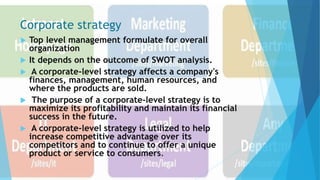
Corporate strategy
 Top level management formulate for overall
organization
 It depends on the outcome of SWOT analysis.
 A corporate-level strategy affects a company's
finances, management, human resources, and
where the products are sold.
 The purpose of a corporate-level strategy is to
maximize its profitability and maintain its financial
success in the future.
 A corporate-level strategy is utilized to help
increase competitive advantage over its
competitors and to continue to offer a unique
product or service to consumers.
Stability strategy
 A stability strategy involves maintaining the status quo or
growing in a methodical, but slow, manner.
 It continues to serve the public in the same product or
service, market, and function sectors as defined in its
business definition.
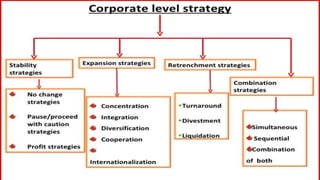
Types of stability strategy
 No change strategy
 Pause and proceed strategy
 Profit strategy
Types of stability strategy
No change strategies
 Taking no decision sometimes, is a
decision too!
 This strategy is relevant in predictable and
certain external environment and stable
organizational environment.
 Small and medium sized firms rely on this
strategy
Pause/proceed with caution strategies
 It is employed to test the ground before moving
ahead with a full-fledged corporate strategy
 The purpose is to let the system adapt to the
new strategies.
 It is deliberate and conscious attempt
Profit strategy
 It is assumed that the problem is short lived. Only
motive is sustaining profitability for a temporary
phase
 It works only if the problems are really short lived
Expansion Strategies
 These are pursued basically to accelerate the
pace of growth of an organisation.
 Most organisations chase expansion in order
to exploit market opportunities.
 Expansion helps a firm dominate the market
and gain control over competition.
Types of expansion strategy
 Expansion through concentration
 Expansion through integration
 Expansion through diversification
 Expansion through cooperation
 Expansion through internationalisation
Expansion through concentration
 Here growth happens by concentrating resources on few
things that the organisation can do better than rivals.
 Expansion through concentration can be undertaken
through three strategies, namely market penetration,
market development and product development.
Methods of cocentration
 Market Penetration:
It is the strategy of a firm that directs its resources to the
profitable growth of a single product, in a single market
with a single dominant technology.
 Increasing sales to current customers.
 Woo customers from competitors’ products
 Convert non-users into users
 Market Development
It consists of marketing existing products in new markets.
The firm tries to achieve growth by finding new uses for
the existing products and tap new customers on that basis
(within the country or outside the country).
The firm can add new channels of distribution to expand
the customer reach of the product.
 Product Development
This strategy tries to achieve growth through new
products in existing markets.
The new products in this case are not essentially new
products, but improved versions of an existing product.
usually carried through;
Quality improvement
Feature improvement
Style improvement
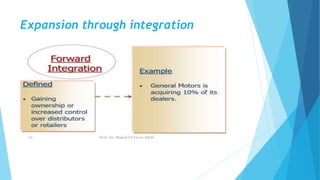
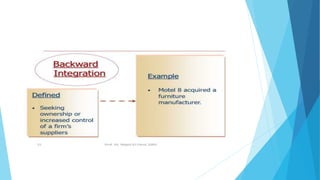
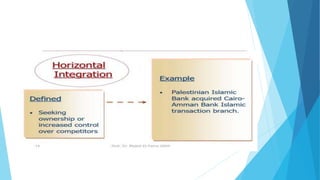
Expansion through integration
Expansion through diversification
 A firm can expand its operations by launching new
products or new lines of business.
 It can enter new markets as well.
 A diversified firm is armed with a portfolio of products or
businesses that help it to strengthen its position in more
than one industry or market.
Expansion through cooperation
 Expansion strategies through cooperation include joint
ventures, mergers and acquisitions strategic alliances and
consortia. These are also known as combination
strategies.
Joint venture.
Merger &Acquisition
Strategic alliances
Expansion through internationalisation
 To market their products and services internationally,
firms pursue this path. Keeping political, social, legal risks
in mind, firms need to step into this arena carefully.
International expansion is a different ball game
altogether.
International Strategy
Multi-Domestic Strategy
Global Strategy
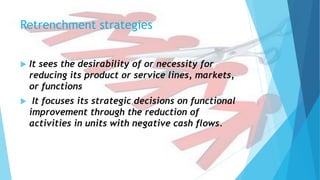
Retrenchment strategies
 It sees the desirability of or necessity for
reducing its product or service lines, markets,
or functions
 It focuses its strategic decisions on functional
improvement through the reduction of
activities in units with negative cash flows.
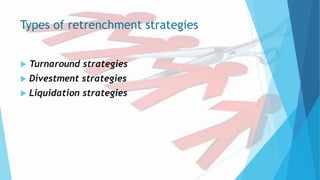
Types of retrenchment strategies
 Turnaround strategies
 Divestment strategies
 Liquidation strategies
Turnaround strategies
 A turnaround is designed to reverse a negative trend and
bring the organisation back to normal health and
profitability.
 It usually involves getting rid of unprofitable products,
trimming the workforce, pruning distribution outlets, and
finding other useful ways of making the organisation more
efficient.
Divestment strategy
 It involves the sale of those units or parts of a business
that no longer contribute to or fit the firm’s distinctive
competence. The firm simply gets out of certain
businesses and sells off units or divisions for various
reasons
Liquidation strategy
 This is a strategy to be followed as ‘last resort’. When
neither a turnaround nor a divestment seems feasible,
liquidation is used. Liquidation involves selling or
disposing of all or part of an organisation’s assets,
Liquidation is generally followed when-
(i) The future of a unit looks bleak in terms of sales,
profitability etc.
(ii) The unit has unmanageable accumulated losses;
(iii) Some other firm is willing to buy the unit, to avail tax
benefits.
(iv) It is not possible to revive the unit with the existing
resources.
Combination strategy
 Combination strategies are a mixture of expansion,
stability or retrenchment strategies.
 They are a hybrid variety and can be applied in a firm
either at the same time in different businesses or at
different times within the same business.
Corporate level strategy

Corporate level strategy

  • 1.
  • 2.
    Corporate strategy  Toplevel management formulate for overall organization  It depends on the outcome of SWOT analysis.  A corporate-level strategy affects a company's finances, management, human resources, and where the products are sold.  The purpose of a corporate-level strategy is to maximize its profitability and maintain its financial success in the future.  A corporate-level strategy is utilized to help increase competitive advantage over its competitors and to continue to offer a unique product or service to consumers.
  • 4.
    Stability strategy  Astability strategy involves maintaining the status quo or growing in a methodical, but slow, manner.  It continues to serve the public in the same product or service, market, and function sectors as defined in its business definition.
  • 5.
    Types of stabilitystrategy  No change strategy  Pause and proceed strategy  Profit strategy
  • 6.
    Types of stabilitystrategy No change strategies  Taking no decision sometimes, is a decision too!  This strategy is relevant in predictable and certain external environment and stable organizational environment.  Small and medium sized firms rely on this strategy
  • 7.
    Pause/proceed with cautionstrategies  It is employed to test the ground before moving ahead with a full-fledged corporate strategy  The purpose is to let the system adapt to the new strategies.  It is deliberate and conscious attempt
  • 8.
    Profit strategy  Itis assumed that the problem is short lived. Only motive is sustaining profitability for a temporary phase  It works only if the problems are really short lived
  • 9.
    Expansion Strategies  Theseare pursued basically to accelerate the pace of growth of an organisation.  Most organisations chase expansion in order to exploit market opportunities.  Expansion helps a firm dominate the market and gain control over competition.
  • 10.
    Types of expansionstrategy  Expansion through concentration  Expansion through integration  Expansion through diversification  Expansion through cooperation  Expansion through internationalisation
  • 11.
    Expansion through concentration Here growth happens by concentrating resources on few things that the organisation can do better than rivals.  Expansion through concentration can be undertaken through three strategies, namely market penetration, market development and product development.
  • 12.
    Methods of cocentration Market Penetration: It is the strategy of a firm that directs its resources to the profitable growth of a single product, in a single market with a single dominant technology.  Increasing sales to current customers.  Woo customers from competitors’ products  Convert non-users into users
  • 13.
     Market Development Itconsists of marketing existing products in new markets. The firm tries to achieve growth by finding new uses for the existing products and tap new customers on that basis (within the country or outside the country). The firm can add new channels of distribution to expand the customer reach of the product.
  • 14.
     Product Development Thisstrategy tries to achieve growth through new products in existing markets. The new products in this case are not essentially new products, but improved versions of an existing product. usually carried through; Quality improvement Feature improvement Style improvement
  • 15.
  • 18.
    Expansion through diversification A firm can expand its operations by launching new products or new lines of business.  It can enter new markets as well.  A diversified firm is armed with a portfolio of products or businesses that help it to strengthen its position in more than one industry or market.
  • 19.
    Expansion through cooperation Expansion strategies through cooperation include joint ventures, mergers and acquisitions strategic alliances and consortia. These are also known as combination strategies. Joint venture. Merger &Acquisition Strategic alliances
  • 20.
    Expansion through internationalisation To market their products and services internationally, firms pursue this path. Keeping political, social, legal risks in mind, firms need to step into this arena carefully. International expansion is a different ball game altogether. International Strategy Multi-Domestic Strategy Global Strategy
  • 21.
    Retrenchment strategies  Itsees the desirability of or necessity for reducing its product or service lines, markets, or functions  It focuses its strategic decisions on functional improvement through the reduction of activities in units with negative cash flows.
  • 22.
    Types of retrenchmentstrategies  Turnaround strategies  Divestment strategies  Liquidation strategies
  • 23.
    Turnaround strategies  Aturnaround is designed to reverse a negative trend and bring the organisation back to normal health and profitability.  It usually involves getting rid of unprofitable products, trimming the workforce, pruning distribution outlets, and finding other useful ways of making the organisation more efficient.
  • 24.
    Divestment strategy  Itinvolves the sale of those units or parts of a business that no longer contribute to or fit the firm’s distinctive competence. The firm simply gets out of certain businesses and sells off units or divisions for various reasons
  • 25.
    Liquidation strategy  Thisis a strategy to be followed as ‘last resort’. When neither a turnaround nor a divestment seems feasible, liquidation is used. Liquidation involves selling or disposing of all or part of an organisation’s assets, Liquidation is generally followed when- (i) The future of a unit looks bleak in terms of sales, profitability etc. (ii) The unit has unmanageable accumulated losses; (iii) Some other firm is willing to buy the unit, to avail tax benefits. (iv) It is not possible to revive the unit with the existing resources.
  • 26.
    Combination strategy  Combinationstrategies are a mixture of expansion, stability or retrenchment strategies.  They are a hybrid variety and can be applied in a firm either at the same time in different businesses or at different times within the same business.