UNIT 2 – PHYSICAL
GEOGRAPHY: RELIEF
1- What is the Earth made of?
2- What is the Earth’s relief?
3- Why do landscapes change?
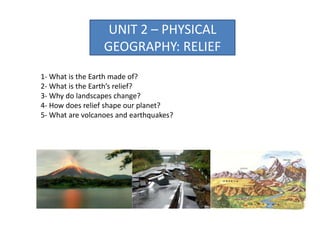
4- How does relief shape our planet?
5- What are volcanoes and earthquakes?
UNIT 2 – PHYSICAL
GEOGRAPHY: RELIEF
1- Identify the different parts of the interior of the planet
2- Understand the continental drift and the tectonic plates
Volcanoes and earthquakes
Objectives
4- Identify the main relief features
5- Locate relief features
3- Understand how the relief changes: how the mountains are
made and how the relief changes (erosion, transportation and
deposition)
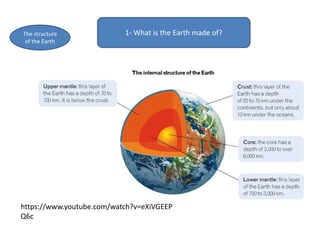
1- What is the Earth made of?The structure
of the Earth
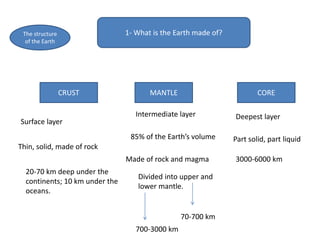
CRUST MANTLE CORE
Surface layer
Thin, solid, made of rock
Intermediate layer
85% of the Earth’s volume
Made of rock and magma
Deepest layer
Part solid, part liquid
20-70 km deep under the
continents; 10 km under the
oceans.
Divided into upper and
lower mantle.
70-700 km
700-3000 km
3000-6000 km
1- What is the Earth made of?The structure
of the Earth
https://www.youtube.com/watch?v=eXiVGEEP
Q6c
1- What is the Earth made of?
1- Name the three layers the Earth is divided into
2- Describe the crust
3- Describe the mantle
4- Describe the core
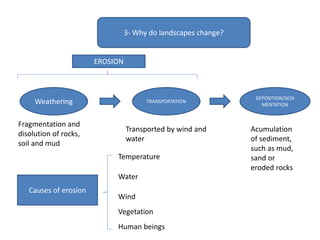
3- Why do landscapes change?
Weathering TRANSPORTATION
DEPOSITION/SEDI
MENTATION
Fragmentation and
disolution of rocks,
soil and mud
Transported by wind and
water
Acumulation
of sediment,
such as mud,
sand or
eroded rocks
Causes of erosion
Temperature
Water
Wind
Vegetation
Human beings
EROSION
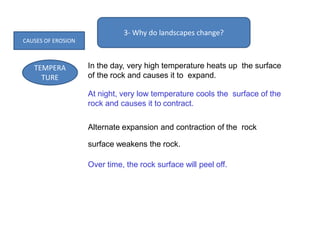
3- Why do landscapes change?
TEMPERA
TURE
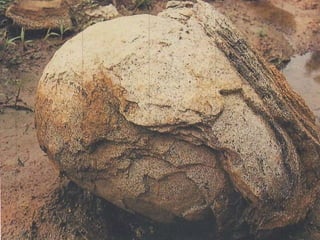
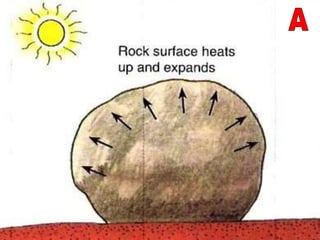
In the day, very high temperature heats up the surface
of the rock and causes it to expand.
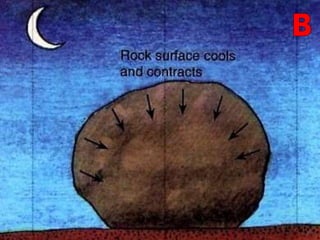
At night, very low temperature cools the surface of the
rock and causes it to contract.
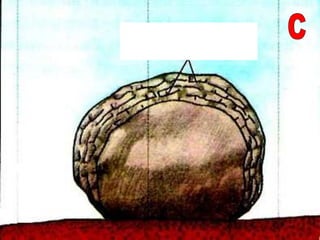
Alternate expansion and contraction of the rock
surface weakens the rock.
Over time, the rock surface will peel off.
CAUSES OF EROSION
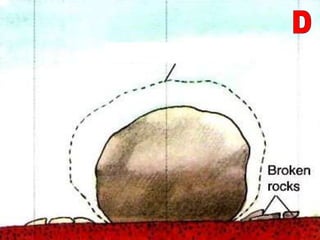
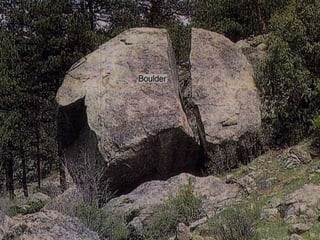
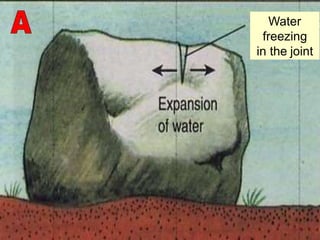
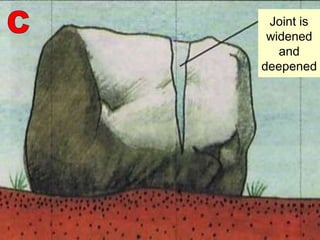
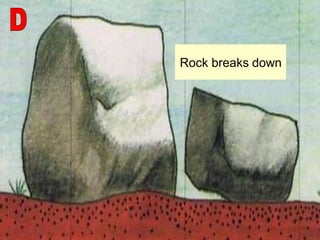
When temperature falls below freezing point,
water in the cracks of rock turns into ice.
The ice will expand, widening the cracks.
When temperature rises above freezing
point, the ice in the crack will melt.
Repeated freezing and melting will cause the
cracks to become wider and the rocks will
break apart.
Water
freezing
in the joint
Joint is
widened
and
deepened
Rock breaks down
3- Why do landscapes change?
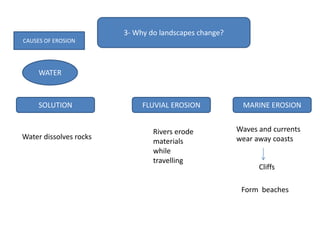
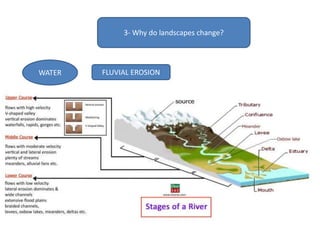
WATER
CAUSES OF EROSION
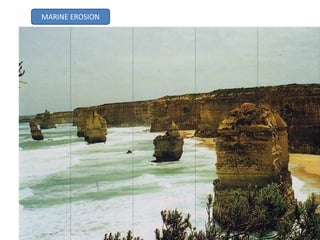
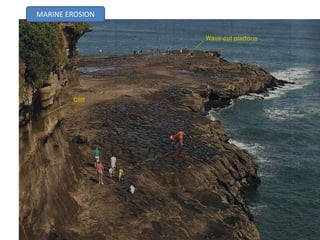
SOLUTION FLUVIAL EROSION MARINE EROSION
Water dissolves rocks
Rivers erode
materials
while
travelling
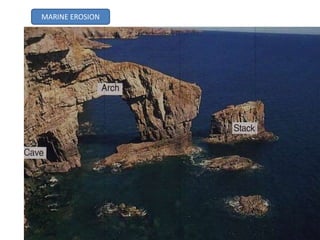
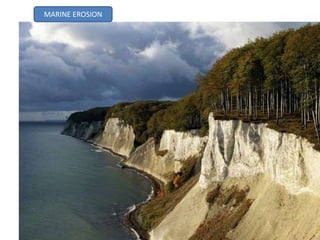
Waves and currents
wear away coasts
Cliffs
Form beaches
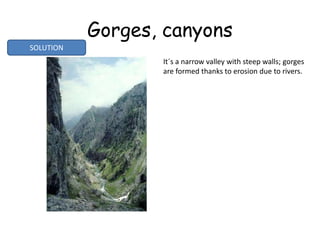
Gorges, canyons
It´s a narrow valley with steep walls; gorges
are formed thanks to erosion due to rivers.
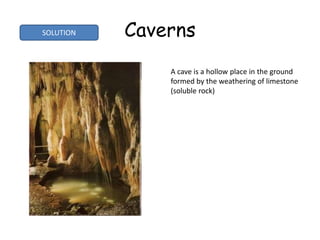
SOLUTION
Caverns
A cave is a hollow place in the ground
formed by the weathering of limestone
(soluble rock)
SOLUTION
3- Why do landscapes change?
WATER FLUVIAL EROSION
MARINE EROSION
MARINE EROSION
MARINE EROSION
MARINE EROSION
3- Why do landscapes change?
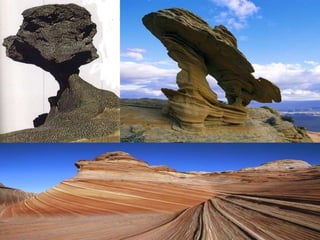
Wind
•Wind picks up sand in the deserts and hits
against the rock surface.
•As sand is heavy, it can only be carried by
wind to a certain height.
•Wind erosion can therefore take place near
the base of rocks.
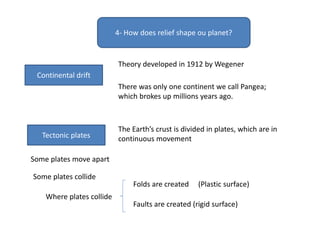
4- How does relief shape ou planet?
Continental drift
Tectonic plates
Theory developed in 1912 by Wegener
There was only one continent we call Pangea;
which brokes up millions years ago.
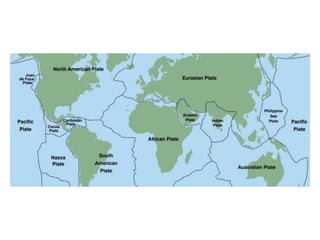
The Earth’s crust is divided in plates, which are in
continuous movement
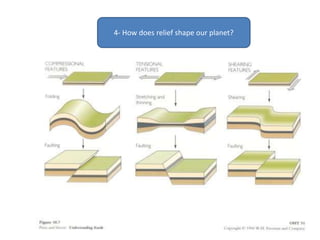
Where plates collide
Folds are created
Faults are created (rigid surface)
(Plastic surface)
Some plates move apart
Some plates collide
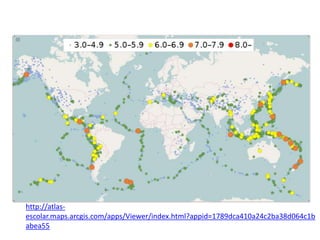
4- How does relief shape our planet?
http://atlas-
escolar.maps.arcgis.com/apps/Viewer/index.html?appid=1789dca410a24c2ba38d064c1b
abea55
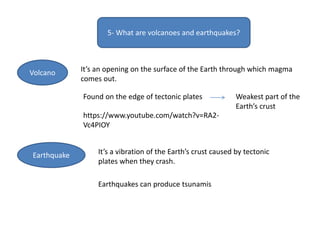
5- What are volcanoes and earthquakes?
Volcano
Earthquake
It’s an opening on the surface of the Earth through which magma
comes out.
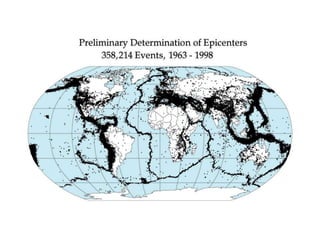
It’s a vibration of the Earth’s crust caused by tectonic
plates when they crash.
Earthquakes can produce tsunamis
https://www.youtube.com/watch?v=RA2-
Vc4PIOY
Found on the edge of tectonic plates Weakest part of the
Earth’s crust
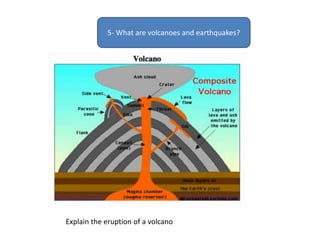
5- What are volcanoes and earthquakes?
Explain the eruption of a volcano

Unit 2 Physical Geography

  • 1.
    UNIT 2 –PHYSICAL GEOGRAPHY: RELIEF 1- What is the Earth made of? 2- What is the Earth’s relief? 3- Why do landscapes change? 4- How does relief shape our planet? 5- What are volcanoes and earthquakes?
  • 2.
    UNIT 2 –PHYSICAL GEOGRAPHY: RELIEF 1- Identify the different parts of the interior of the planet 2- Understand the continental drift and the tectonic plates Volcanoes and earthquakes Objectives 4- Identify the main relief features 5- Locate relief features 3- Understand how the relief changes: how the mountains are made and how the relief changes (erosion, transportation and deposition)
  • 3.
    1- What isthe Earth made of?The structure of the Earth CRUST MANTLE CORE Surface layer Thin, solid, made of rock Intermediate layer 85% of the Earth’s volume Made of rock and magma Deepest layer Part solid, part liquid 20-70 km deep under the continents; 10 km under the oceans. Divided into upper and lower mantle. 70-700 km 700-3000 km 3000-6000 km
  • 4.
    1- What isthe Earth made of?The structure of the Earth https://www.youtube.com/watch?v=eXiVGEEP Q6c
  • 6.
    1- What isthe Earth made of? 1- Name the three layers the Earth is divided into 2- Describe the crust 3- Describe the mantle 4- Describe the core
  • 7.
    3- Why dolandscapes change? Weathering TRANSPORTATION DEPOSITION/SEDI MENTATION Fragmentation and disolution of rocks, soil and mud Transported by wind and water Acumulation of sediment, such as mud, sand or eroded rocks Causes of erosion Temperature Water Wind Vegetation Human beings EROSION
  • 8.
    3- Why dolandscapes change? TEMPERA TURE In the day, very high temperature heats up the surface of the rock and causes it to expand. At night, very low temperature cools the surface of the rock and causes it to contract. Alternate expansion and contraction of the rock surface weakens the rock. Over time, the rock surface will peel off. CAUSES OF EROSION
  • 14.
    When temperature fallsbelow freezing point, water in the cracks of rock turns into ice. The ice will expand, widening the cracks. When temperature rises above freezing point, the ice in the crack will melt. Repeated freezing and melting will cause the cracks to become wider and the rocks will break apart.
  • 16.
  • 17.
  • 18.
  • 19.
    3- Why dolandscapes change? WATER CAUSES OF EROSION SOLUTION FLUVIAL EROSION MARINE EROSION Water dissolves rocks Rivers erode materials while travelling Waves and currents wear away coasts Cliffs Form beaches
  • 20.
    Gorges, canyons It´s anarrow valley with steep walls; gorges are formed thanks to erosion due to rivers. SOLUTION
  • 21.
    Caverns A cave isa hollow place in the ground formed by the weathering of limestone (soluble rock) SOLUTION
  • 22.
    3- Why dolandscapes change? WATER FLUVIAL EROSION
  • 23.
  • 24.
  • 25.
  • 26.
  • 27.
    3- Why dolandscapes change? Wind •Wind picks up sand in the deserts and hits against the rock surface. •As sand is heavy, it can only be carried by wind to a certain height. •Wind erosion can therefore take place near the base of rocks.
  • 29.
    4- How doesrelief shape ou planet? Continental drift Tectonic plates Theory developed in 1912 by Wegener There was only one continent we call Pangea; which brokes up millions years ago. The Earth’s crust is divided in plates, which are in continuous movement Where plates collide Folds are created Faults are created (rigid surface) (Plastic surface) Some plates move apart Some plates collide
  • 30.
    4- How doesrelief shape our planet?
  • 33.
  • 34.
    5- What arevolcanoes and earthquakes? Volcano Earthquake It’s an opening on the surface of the Earth through which magma comes out. It’s a vibration of the Earth’s crust caused by tectonic plates when they crash. Earthquakes can produce tsunamis https://www.youtube.com/watch?v=RA2- Vc4PIOY Found on the edge of tectonic plates Weakest part of the Earth’s crust
  • 35.
    5- What arevolcanoes and earthquakes? Explain the eruption of a volcano