Chapter 6:Earth changes
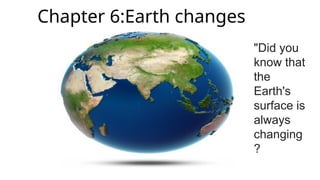
"Did you
know that
the
Earth's
surface is
always
changing
?
Learning outcome
• Understand the earth’s internal
structure
• What causes geological
phenomena like earth quakes
and volcanoes ?
• what is magma and it’s role?
• How the earth has evolved over
the time?
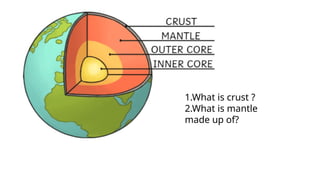
1.What is crust ?
2.What is mantle
made up of?
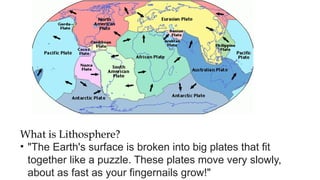
What is Lithosphere?
• "The Earth's surface is broken into big plates that fit
together like a puzzle. These plates move very slowly,
about as fast as your fingernails grow!"
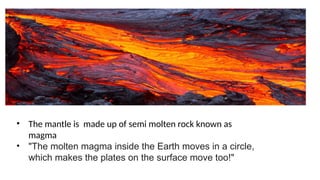
• The mantle is made up of semi molten rock known as
magma
• "The molten magma inside the Earth moves in a circle,
which makes the plates on the surface move too!"
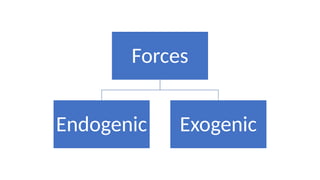
Forces
Endogenic Exogenic
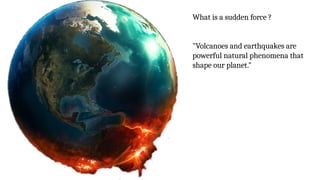
What is a sudden force ?
"Volcanoes and earthquakes are
powerful natural phenomena that
shape our planet."
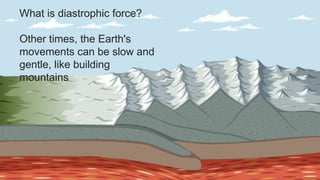
What is diastrophic force?
Other times, the Earth's
movements can be slow and
gentle, like building
mountains
Let’s do a quick summary!
• Lithospheric Plates:* - Broken into several plates
that move slowly (a few mm/year)
• Movement driven by molten magma beneath the
Earth's surface
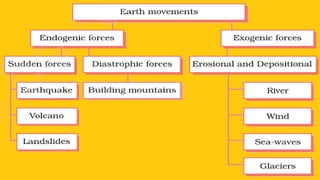
• Forces: -
1. Endogenic Forces:
Internal forces that act within the Earth
a)Sudden movements: earthquakes, volcanoes
b)Diastrophic movements ( mountain building)
2.Exogenic Forces:
a)External forces that act on the Earth's surface,
Erosion and deposition (rivers, wind, glaciers, sea-
waves)
"Volcanoes and Earthquakes"
"Understanding the Earth's
Power"
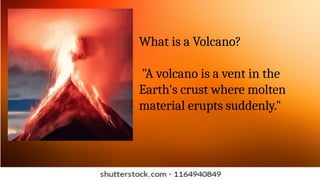
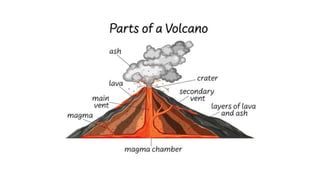
What is a Volcano?
"A volcano is a vent in the
Earth's crust where molten
material erupts suddenly."
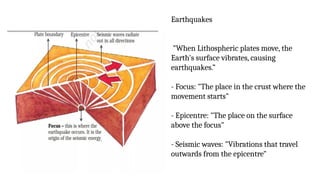
Earthquakes
"When Lithospheric plates move, the
Earth's surface vibrates, causing
earthquakes.”
- Focus: "The place in the crust where the
movement starts"
- Epicentre: "The place on the surface
above the focus"
- Seismic waves: "Vibrations that travel
outwards from the epicentre"
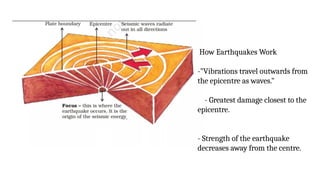
How Earthquakes Work
-"Vibrations travel outwards from
the epicentre as waves."
- Greatest damage closest to the
epicentre.
- Strength of the earthquake
decreases away from the centre.
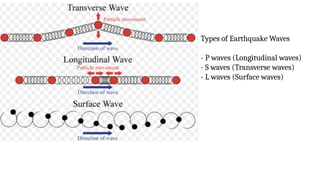
Types of Earthquake Waves
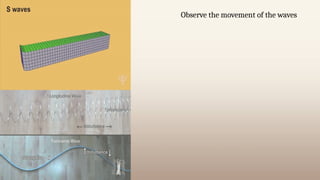
- P waves (Longitudinal waves)
- S waves (Transverse waves)
- L waves (Surface waves)
Observe the movement of the waves
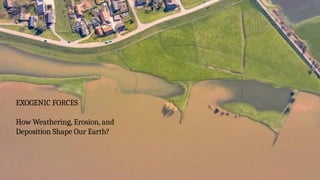
EXOGENIC FORCES
How Weathering, Erosion, and
Deposition Shape Our Earth?
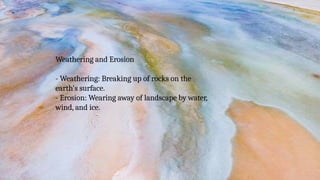
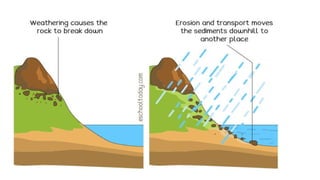
Weathering and Erosion
- Weathering: Breaking up of rocks on the
earth's surface.
- Erosion: Wearing away of landscape by water,
wind, and ice.
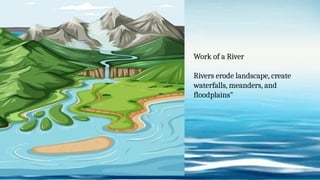
Work of a River
Rivers erode landscape, create
waterfalls, meanders, and
floodplains"
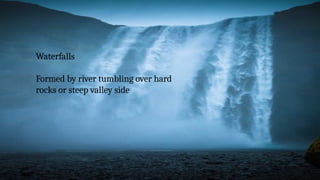
Waterfalls
Formed by river tumbling over hard
rocks or steep valley side
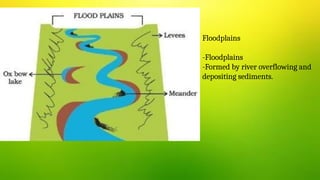
Floodplains
-Floodplains
-Formed by river overflowing and
depositing sediments.
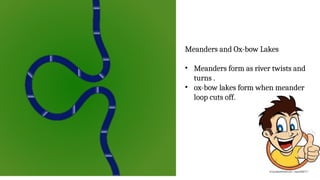
Meanders and Ox-bow Lakes
• Meanders form as river twists and
turns .
• ox-bow lakes form when meander
loop cuts off.
Meanders and Ox-bow Lakes
"Meanders form as river twists and turns, ox-
bow lakes form when meander loop cuts off"
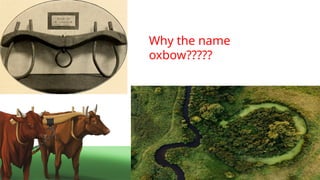
Why the name
oxbow?????
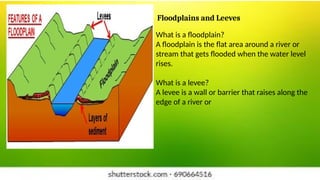
Floodplains and Leeves
What is a floodplain?
A floodplain is the flat area around a river or
stream that gets flooded when the water level
rises.
What is a levee?
A levee is a wall or barrier that raises along the
edge of a river or
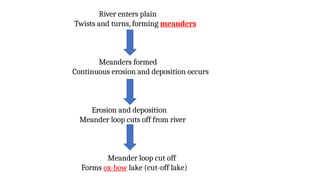
River enters plain
Twists and turns, forming meanders
Meanders formed
Continuous erosion and deposition occurs
Erosion and deposition
Meander loop cuts off from river
Meander loop cut off
Forms ox-bow lake (cut-off lake)
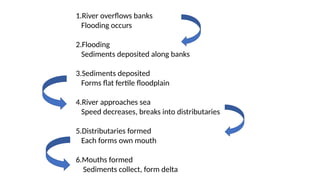
1.River overflows banks
Flooding occurs
2.Flooding
Sediments deposited along banks
3.Sediments deposited
Forms flat fertile floodplain
4.River approaches sea
Speed decreases, breaks into distributaries
5.Distributaries formed
Each forms own mouth
6.Mouths formed
Sediments collect, form delta
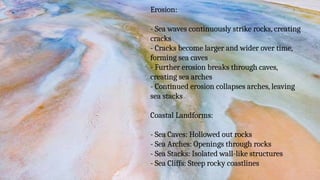
Erosion:
- Sea waves continuously strike rocks, creating
cracks
- Cracks become larger and wider over time,
forming sea caves
- Further erosion breaks through caves,
creating sea arches
- Continued erosion collapses arches, leaving
sea stacks
Coastal Landforms:
- Sea Caves: Hollowed out rocks
- Sea Arches: Openings through rocks
- Sea Stacks: Isolated wall-like structures
- Sea Cliffs: Steep rocky coastlines
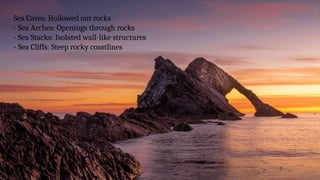
Sea Caves: Hollowed out rocks
- Sea Arches: Openings through rocks
- Sea Stacks: Isolated wall-like structures
- Sea Cliffs: Steep rocky coastlines
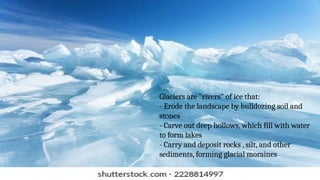
Glaciers are "rivers" of ice that:
- Erode the landscape by bulldozing soil and
stones
- Carve out deep hollows, which fill with water
to form lakes
- Carry and deposit rocks , silt, and other
sediments, forming glacial moraines
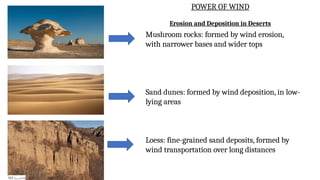
Mushroom rocks: formed by wind erosion,
with narrower bases and wider tops
Sand dunes: formed by wind deposition, in low-
lying areas
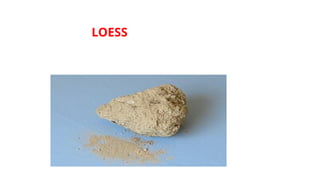
Loess: fine-grained sand deposits, formed by
wind transportation over long distances
POWER OF WIND
Erosion and Deposition in Deserts
LOESS
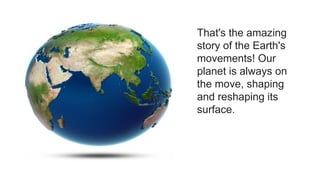
That's the amazing
story of the Earth's
movements! Our
planet is always on
the move, shaping
and reshaping its
surface.

earth changing changes /ncert /grade 7.pptx

  • 1.
    Chapter 6:Earth changes "Didyou know that the Earth's surface is always changing ?
  • 3.
    Learning outcome • Understandthe earth’s internal structure • What causes geological phenomena like earth quakes and volcanoes ? • what is magma and it’s role? • How the earth has evolved over the time?
  • 4.
    1.What is crust? 2.What is mantle made up of?
  • 5.
    What is Lithosphere? •"The Earth's surface is broken into big plates that fit together like a puzzle. These plates move very slowly, about as fast as your fingernails grow!"
  • 6.
    • The mantleis made up of semi molten rock known as magma • "The molten magma inside the Earth moves in a circle, which makes the plates on the surface move too!"
  • 7.
  • 9.
    What is asudden force ? "Volcanoes and earthquakes are powerful natural phenomena that shape our planet."
  • 10.
    What is diastrophicforce? Other times, the Earth's movements can be slow and gentle, like building mountains
  • 11.
    Let’s do aquick summary! • Lithospheric Plates:* - Broken into several plates that move slowly (a few mm/year) • Movement driven by molten magma beneath the Earth's surface • Forces: - 1. Endogenic Forces: Internal forces that act within the Earth a)Sudden movements: earthquakes, volcanoes b)Diastrophic movements ( mountain building) 2.Exogenic Forces: a)External forces that act on the Earth's surface, Erosion and deposition (rivers, wind, glaciers, sea- waves)
  • 12.
  • 13.
    What is aVolcano? "A volcano is a vent in the Earth's crust where molten material erupts suddenly."
  • 15.
    Earthquakes "When Lithospheric platesmove, the Earth's surface vibrates, causing earthquakes.” - Focus: "The place in the crust where the movement starts" - Epicentre: "The place on the surface above the focus" - Seismic waves: "Vibrations that travel outwards from the epicentre"
  • 16.
    How Earthquakes Work -"Vibrationstravel outwards from the epicentre as waves." - Greatest damage closest to the epicentre. - Strength of the earthquake decreases away from the centre.
  • 17.
    Types of EarthquakeWaves - P waves (Longitudinal waves) - S waves (Transverse waves) - L waves (Surface waves)
  • 18.
  • 19.
    EXOGENIC FORCES How Weathering,Erosion, and Deposition Shape Our Earth?
  • 20.
    Weathering and Erosion -Weathering: Breaking up of rocks on the earth's surface. - Erosion: Wearing away of landscape by water, wind, and ice.
  • 22.
    Work of aRiver Rivers erode landscape, create waterfalls, meanders, and floodplains"
  • 23.
    Waterfalls Formed by rivertumbling over hard rocks or steep valley side
  • 24.
    Floodplains -Floodplains -Formed by riveroverflowing and depositing sediments.
  • 25.
    Meanders and Ox-bowLakes • Meanders form as river twists and turns . • ox-bow lakes form when meander loop cuts off.
  • 26.
    Meanders and Ox-bowLakes "Meanders form as river twists and turns, ox- bow lakes form when meander loop cuts off"
  • 27.
  • 28.
    Floodplains and Leeves Whatis a floodplain? A floodplain is the flat area around a river or stream that gets flooded when the water level rises. What is a levee? A levee is a wall or barrier that raises along the edge of a river or
  • 29.
    River enters plain Twistsand turns, forming meanders Meanders formed Continuous erosion and deposition occurs Erosion and deposition Meander loop cuts off from river Meander loop cut off Forms ox-bow lake (cut-off lake)
  • 30.
    1.River overflows banks Floodingoccurs 2.Flooding Sediments deposited along banks 3.Sediments deposited Forms flat fertile floodplain 4.River approaches sea Speed decreases, breaks into distributaries 5.Distributaries formed Each forms own mouth 6.Mouths formed Sediments collect, form delta
  • 31.
    Erosion: - Sea wavescontinuously strike rocks, creating cracks - Cracks become larger and wider over time, forming sea caves - Further erosion breaks through caves, creating sea arches - Continued erosion collapses arches, leaving sea stacks Coastal Landforms: - Sea Caves: Hollowed out rocks - Sea Arches: Openings through rocks - Sea Stacks: Isolated wall-like structures - Sea Cliffs: Steep rocky coastlines
  • 32.
    Sea Caves: Hollowedout rocks - Sea Arches: Openings through rocks - Sea Stacks: Isolated wall-like structures - Sea Cliffs: Steep rocky coastlines
  • 33.
    Glaciers are "rivers"of ice that: - Erode the landscape by bulldozing soil and stones - Carve out deep hollows, which fill with water to form lakes - Carry and deposit rocks , silt, and other sediments, forming glacial moraines
  • 34.
    Mushroom rocks: formedby wind erosion, with narrower bases and wider tops Sand dunes: formed by wind deposition, in low- lying areas Loess: fine-grained sand deposits, formed by wind transportation over long distances POWER OF WIND Erosion and Deposition in Deserts
  • 35.
  • 36.
    That's the amazing storyof the Earth's movements! Our planet is always on the move, shaping and reshaping its surface.